Print ISSN: 2288-4637 / Online ISSN 2288-4645 doi:10.13106/jafeb.2021.vol8.no7.0509
Factors Affecting an Application of Environmental Management Accounting: A Case Study of the Automobile Industry in Vietnam
Ngoc Hung TRAN
1, Thi Thuy Hanh NGUYEN
2, Thi Phuong NGUYEN
3Received: March 30, 2021 Revised: June 07, 2021 Accepted: June 17, 2021
Abstract
This study aims to find out and measure the level of factors affecting the applicability of environmental management accounting (EMA) in Vietnamese automobile industry enterprises. Data was collected using both quantitative and qualitative methods. First, in general research, qualitative methodology was used to find out factors (variables) that can impact the possibility of implementing EMA in Vietnamese automobile enterprises. Second, in detailed research, all variables are measured using a quantitative method by collecting data through sampling and sending questionnaires. 500 questionnaires were sent to automobile enterprise managers and only 352 questionnaires met the criteria for the data analysis. The study used a mixed research design approach- a procedure for collecting, analyzing, and “mixing” both quantitative and qualitative research and methods in a single study to understand the research problem. Results show that 7 factors affect the possibility of implementing EMA in Vietnamese automobile industry enterprises. These factors are coercive pressure, normative pressure, mimetic pressure, business environmental uncertainty, environmental strategy, benefits when applying EMA, and task complexity. Based on the results of the study, promoting EMA in the automotive industry should depend mainly on the role of governmental departments.
Keywords: Environmental Management Accounting, Affecting Factors, Automobile Industry JEL Classification Code: M40, M41, M14
to lead the world to sustainable energy consumption, people are actively seeking a healthier alternative for transportation such as electric vehicles. Most of the activities related to the automobile industry, directly or indirectly, have a significant impact on the environment. For the automotive enterprises whose operations have a greater impact on the environment, applying EMA is especially critical since environmental impacts are much more apparent in this industry.
For the 2025–2035 Vietnamese Automobile Industry Development Strategy, the automotive industry in Vietnam must ensure the overall socio-economic efficiency as well as environmental requirements. This means that the Vietnamese automobile industry must also catch up with the trend of saving energy as well as meet domestic demand, and participate in the worldwide manufacturing chain. Therefore, there is a great need for an efficient and systematic economic system to provide accounting information for the management of the automobile manufacturing industry in Vietnam. To catch up with the trend of stable development by saving energy when participating in the worldwide manufacturing chain, there is a need for efficient and systematic management methods to provide accounting information related to environmental issues for making decisions in the automobile manufacturing
1
First Author and Corresponding Author. Lecturer, Faculty of Accounting and Auditing, Industrial University of Ho Chi Minh City, Vietnam [Postal Address: 12 Nguyen Van Bao St., Ward 4, Go Vap Dist., Ho Chi Minh City, 08408, Vietnam]
Email: [email protected]
2
Lecturer, Faculty of Accounting and Auditing, Industrial University of Ho Chi Minh City, Vietnam. Email: [email protected]
3
Faculty of Accounting and Auditing, Industrial University of Ho Chi Minh City, Vietnam. Email: [email protected]
© Copyright: The Author(s)
This is an Open Access article distributed under the terms of the Creative Commons Attribution Non-Commercial License (https://creativecommons.org/licenses/by-nc/4.0/) which permits unrestricted non-commercial use, distribution, and reproduction in any medium, provided the original work is properly cited.
1. Introduction
People in the world are becoming conscious about
energy use. They are aware of the dangers of climate change
and environmental pollution, now more than ever. Amazon
burning, COVID-19 pandemic, etc. have been originated
from noticeable environmental threats, and seriously
affecting the human future. Especially, the automotive
industry has been considered as the largest contributor to air
pollutant emissions (Sharma & Sharma, 2014). Therefore,
industry. So, this study has provided important insights into the factors that influence the acceptance and adoption of EMA in general, and specifically in the Vietnamese automobile industry. More importantly, this study has opened up possibilities for further research into EMA adoption in Vietnam and worldwide.
2. Literature Review and Hypotheses
EMA practices become important for enterprises because of internal and external implications. EMA addresses the management information needs of managers for corporate activities that affect the environment, as well as environment-related impacts on the corporation. EMA information disclosure can help to enhance a firm’s image.
EMA is the identification, collection, analysis, and use of two types of information for internal decision making. The first is physical information on the use, flows, and rates of energy, water, and materials (including wastes). The second is monetary information on environment-related costs, earnings, and savings (Jamil et al., 2015). Hence, EMA helps firms in identifying and estimating the costs of environment- related activities. Based on that, it helps decide better pricing strategies and also leads to effective performance evaluation.
In general, managers can use EMA tools to identify the impact of the organization’s activities on the environment. In addition, they can also use related environmental information for making decisions. However, in a developing economy such as Vietnam, implementing EMA practices are affected by both internal and external factors. Nguyen et al. (2020) investigated Environmental Accounting Information (EAI) as well as factors affecting the environmental accounting implementation by the construction firms listed on the Ho Chi Minh Stock Exchange (HOSE), Vietnam. After eliminating seven enterprises that lacked data, the authors selected a sample of 112 observations from 28 construction businesses listed on the Ho Chi Minh Stock Exchange in the period 2015-2018. This study used research data extracted from the companies’ annual reports. The results showed that construction companies listed on the Ho Chi Minh Stock Exchange have both internal and external factors affecting EIA implementation.
2.1. Coercive, Normative, and Mimetic Variables and EMA
Government could apply the environmental rules to create coercive pressures on enterprises to choose and implement EMA. Jamil et al. (2015) investigated factors and barriers, which influence the practice of EMA. This study focused on SMEs, specifically, Malaysian manufacturing SME firms.
The study argued that coercion is a dominant factor for practicing EMA and therefore, the Malaysian government and other authorities should resolve barriers to EMA
development. Their study was in line with institutional theory, which considers the processes by which structures, including schemes, rules, norms, and routines, become established as authoritative guidelines for social behavior. However, their results concluded that both normative and mimetic pressures do not contribute significantly to EMA practices. Nguyen et al. (2020) found that Vietnamese governmental regulations, as well as environmental management agencies’ legal documents have the strongest influence on environmental information disclosure of listed companies.
H1: Coercive pressure will have a positive impact on the possibility of implementing EMA in Vietnamese automobile enterprises.
H2: Normative pressure will have a positive impact on the possibility of implementing EMA in Vietnamese automobile enterprises.
H3: Mimetic processes will have a positive impact on the possibility of implementing EMA in Vietnamese automobile enterprises.
2.2. Environmental Variables and EMA
Al Kisher (2013) examined the factors that influenced EMA adoption. Specifically, it investigated the influence of the dominant factors in the organizational, environmental and technological contexts on firms’ intentions to adopt EMA.
The results revealed that age, education level, and tenure in position were among the influential factors on firms’ intention to adopt EMA. Furthermore, the results also revealed that organizational, environmental, and technological variables significantly influenced firms’ intention to adopt EMA. The results of this study complied with Qian et al. (2011)
H4: The business environmental uncertainty will have a positive impact on the possibility of implementing of EMA in Vietnamese automobile enterprises.
H5: The environmental strategy will have a positive impact on the possibility of implementing of EMA in Vietnamese automobile enterprises.
2.3. Benefit, Task Complexity Variables, and EMA
According to contingent theory, the application of EMA is
affected by internal and external factors. As a result, previous
research had concluded that task complexity had an impact
on EMA adoption (Qian et al., 2011). Task Complexity is
the rule of performing a given task under certain conditions
that the performer needs to take into account for completing
the task as required. Besides pressure and barriers to EMA
practices, there are some common benefits that could motivate
organizations to comply with environmental sustainability,
respond to stakeholder influences, and achieve competitive
advantage (Burritt et al., 2003; Doody, 2010). According to Gray and Bebbington (2001), motivation for implementing EMA is divided into legislative motivation and market-based motivation, which can lead to additional revenue streams and cost-saving opportunities for an organization (Bennett et al., 2003; Burritt et al., 2003; Doody, 2010; Lee, 2011;
Schaltegger et al., 2011).
H6: The benefit will have a positive impact on the possibility of implementing of EMA in Vietnamese automobile enterprises.
H7: The task complexity will have a positive impact on the possibility of implementing of EMA in Vietnamese automobile enterprises.
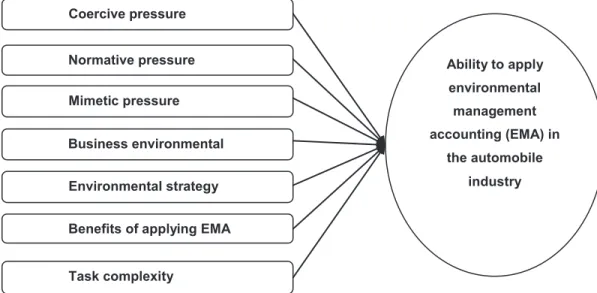
Based on the hypotheses above, the conceptual framework of this study is depicted in Figure 1.
3. Research Methods 3.1. Research Model
In general, based on previous research and some theories, the model is as below:
Y = β
1× COER + β
2× NORM + β
3× MIME + β
4× BUEU + β
5× ENVS + β
6× BEN + β
7× TASK + ε
where:
Y: possibility of implementing of EMA in Vietnamese automobile enterprises;
α: constant term;
β
i: coefficient of variables;
ε
i: Residual.
The variables COER
,NORM, MIME, BUEU, ENVS, BEN, and TASK represent coercive pressure, normative pressure, mimetic processes, business environmental uncertainty, environmental strategy, the benefit gained when implementing EMA, and task complexity in Vietnamese automobile enterprises.
3.2. Data Collection
During the research process, data was collected using both quantitative and qualitative methods. First, in general, research, the qualitative methodology is applied to find out factors (variables) that can impact the possibility of implementing EMA in Vietnamese automobile enterprises, and then the researchers adjust and add more factors from group discussion and interviews of experts. Second, in detailed research, all variables are measured using a quantitative method by collecting data through sampling and sending questionnaires. Using the software SPSS 26.0, the researchers check the research model, theoretical model, and hypotheses with the EFA. 500 questionnaires were sent to automobile enterprise managers and only 352 questionnaires met the criteria for data analysis. The study used a mixed research design approach- a procedure for collecting, analyzing, and “mixing” both quantitative and qualitative research and methods in a single study to understand the research problem. The response rate was 70.4% - higher than expected - since EMA is still new in Vietnam.
Coercive pressure
Normative pressure Mimetic pressure Business environmental
Task complexity
Benefits of applying EMA Environmental strategy
Ability to apply environmental
management accounting (EMA) in
the automobile industry
Figure 1: Research Model
4. Results
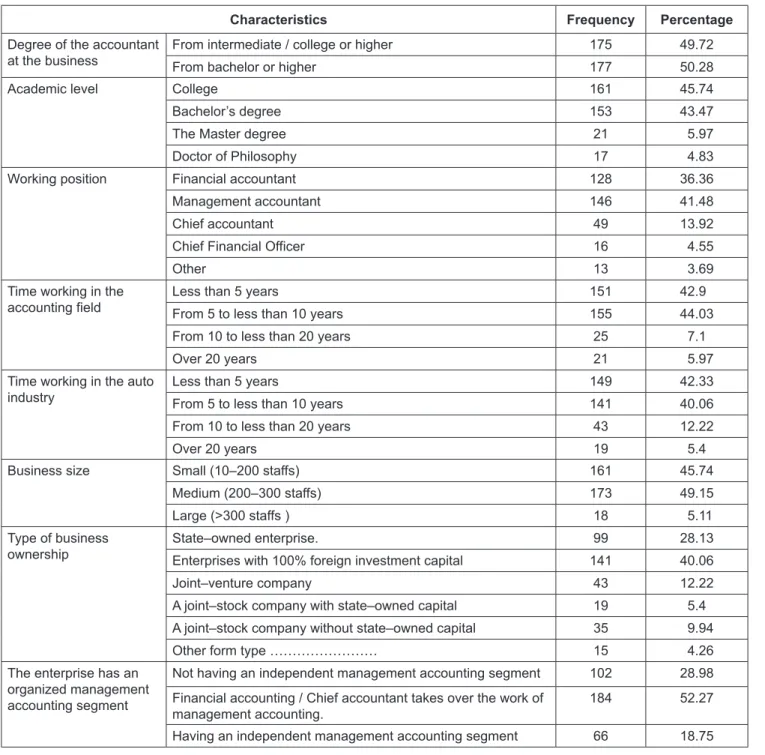
The finding shows that the majority of the respondents are from enterprises with 100% foreign investment capital (40.06%) and State-owned enterprise (28.13%);
respondents from other types constitute only a minority (see Table 1). The result also reveals that the majority of
the respondents are from small and medium enterprises (94.89%); it also shows the degree of the accountant has improved recently with 54.27% with a bachelor’s degree or higher. This result suggests “accounting human resources” in the automobile industry field are aware of EMA activities as well as how these activities are vital for global sustainability in the future.
Table 1: Profile of Respondents (N = 352)
Characteristics Frequency Percentage
Degree of the accountant
at the business From intermediate / college or higher 175 49.72
From bachelor or higher 177 50.28
Academic level College 161 45.74
Bachelor’s degree 153 43.47
The Master degree 21 5.97
Doctor of Philosophy 17 4.83
Working position Financial accountant 128 36.36
Management accountant 146 41.48
Chief accountant 49 13.92
Chief Financial Officer 16 4.55
Other 13 3.69
Time working in the
accounting field Less than 5 years 151 42.9
From 5 to less than 10 years 155 44.03
From 10 to less than 20 years 25 7.1
Over 20 years 21 5.97
Time working in the auto
industry Less than 5 years 149 42.33
From 5 to less than 10 years 141 40.06
From 10 to less than 20 years 43 12.22
Over 20 years 19 5.4
Business size Small (10–200 staffs) 161 45.74
Medium (200–300 staffs) 173 49.15
Large (>300 staffs ) 18 5.11
Type of business
ownership State–owned enterprise. 99 28.13
Enterprises with 100% foreign investment capital 141 40.06
Joint–venture company 43 12.22
A joint–stock company with state–owned capital 19 5.4
A joint–stock company without state–owned capital 35 9.94
Other form type ……… 15 4.26
The enterprise has an organized management accounting segment
Not having an independent management accounting segment 102 28.98 Financial accounting / Chief accountant takes over the work of
management accounting. 184 52.27
Having an independent management accounting segment 66 18.75
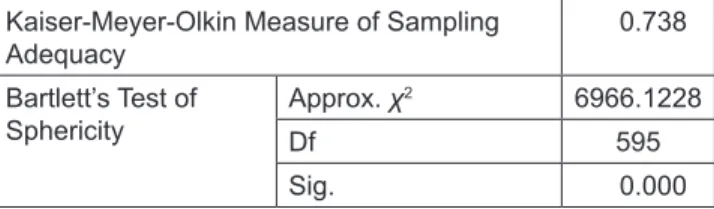
The test results in Table 2 show that KMO = 0.738 >
0.5, and Bartlett test is statistically significant with P-value <
0.05. Thus, it is appropriate to use the EFA model to evaluate the scale values of the independent variables.
The analytical results in Table 3 show that 59.299%
(> 50%) of change in the factors is explained by the observed variables. Hence, we can conclude that the factor analysis model (EFA) is suitable and the scale is accepted.
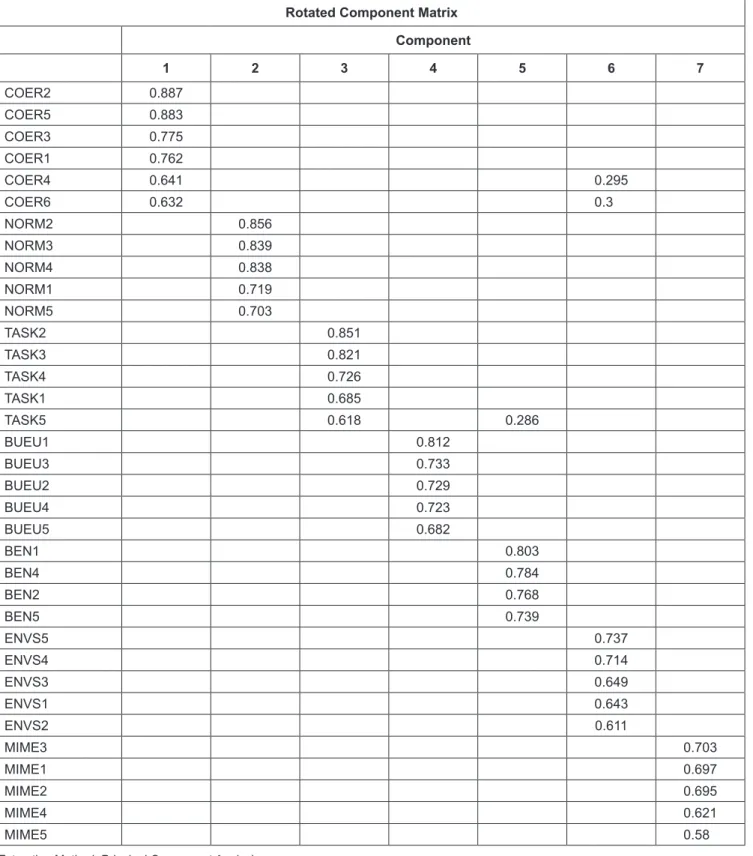
Using 35 observed variables, to achieve the reliability of the factors of 7 independent variables, the researchers perform a factor analysis test (EFA), and the results are shown in Table 4.
Factor analysis results (EFA) for independent variables of the rotation factor matrix (Table 4) show that all factor loading of the observed variables satisfy the condition (that is values are greater than 0.5) and the number of factors created in factor analysis is 7. This is consistent with the initial hypothesis of the corresponding measurement variables for each factor.
The results in Table 5 showed that adjusted R
2coefficient = 68.9% > 50%, at the same time, the F-test in the ANOVA
table (Table 6) showed that this value was statistically significant for Sig. < 0.05. From that conclusion, the model is appropriate and the independent variables (COER, NORM, MIME, TASK, ENVS, BEN, BUEU) explained 68.9% of the change in the dependent variable Y (ABIL). The balance 32.1% is explained by factors that are not considered in the model.
From the results in the regression weight table (Table 7), the regression equation is determined as follows:
Y = 0.407 × COER + 0.313 × NORM + 0.178
× MIME + 0.245 × TASK + 0.232 × EVNS + 0.250 × BEN + 0.239 × BUEU
5. Discussions and Conclusion
The above sections mention that the pressure from governmental departments has the most significant influence on the possibility of implementing EMA practices, followed by pressure from related parties such as environmental protection organizations, environmental interdisciplinary management agencies, customers’ interest, etc. More detailed circulars, decrees, guidance books from governmental offices and environmental agencies can push Vietnamese automobile enterprises to adopt EMA activities. In addition, managers are willing to implement EMA-related tools if they are confident that the enterprise will be financially benefited or be able to improve the product costs, increase competitive advantage, etc. Contrary to the benefit, coercive, or normative factors, task complexity has a negative impact on EMA implementation. In the automobile industry, it is not easy to Table 2: KMO and Bartlett Testing for the Scale of
Independent Variables
Kaiser-Meyer-Olkin Measure of Sampling
Adequacy 0.738
Bartlett’s Test of
Sphericity Approx. χ
26966.1228
Df 595
Sig. 0.000
Table 3: Table of Variance Extracted for the Scale of Independent Variables Total Variance Explained Component
Initial Eigenvalues Extraction Sums of
Squared Loadings Rotation Sums of Squared Loadings Total % of
Variance Cumulative
% Total % of
Variance Cumulative
% Total % of
Variance Cumulative
%
1 4.419 12.625 12.625 4.419 12.625 12.625 3.72 10.629 10.629
2 4.106 11.731 24.356 4.106 11.731 24.356 3.281 9.375 20.004
3 3.215 9.186 33.542 3.215 9.186 33.542 3.103 8.866 28.87
4 2.865 8.186 41.728 2.865 8.186 41.728 2.964 8.468 37.338
5 2.346 6.703 48.431 2.346 6.703 48.431 2.759 7.882 45.22
6 2.058 5.88 54.31 2.058 5.88 54.31 2.6 7.428 52.647
7 1.746 4.9859 59.299 1.746 4.989 59.299 2.328 6.652 59.299
...
Extraction Method: Principal Component Analysis.
Table 4: Matrix of Rotational Factors
Rotated Component Matrix Component
1 2 3 4 5 6 7
COER2 0.887
COER5 0.883
COER3 0.775
COER1 0.762
COER4 0.641 0.295
COER6 0.632 0.3
NORM2 0.856
NORM3 0.839
NORM4 0.838
NORM1 0.719
NORM5 0.703
TASK2 0.851
TASK3 0.821
TASK4 0.726
TASK1 0.685
TASK5 0.618 0.286
BUEU1 0.812
BUEU3 0.733
BUEU2 0.729
BUEU4 0.723
BUEU5 0.682
BEN1 0.803
BEN4 0.784
BEN2 0.768
BEN5 0.739
ENVS5 0.737
ENVS4 0.714
ENVS3 0.649
ENVS1 0.643
ENVS2 0.611
MIME3 0.703
MIME1 0.697
MIME2 0.695
MIME4 0.621
MIME5 0.58
Extraction Method: Principal Component Analysis.
Rotation Method: Varimax with Kaiser Normalization.
Rotation converged in 6 iterations.
Table 7: Regression Weighting Table
Model
Unstandardize
Coefficients Standardized Coefficients
t Sig.
Collinearity Statistics
B Std.
Error Beta Tolerance VIF
1 (Constant) 0.100 0.141 –0.712 0.477
COER 0.160 0.012 0.407 13.164 0.000 0.927 1.079
NORM 0.130 0.013 0.313 10.164 0.000 0.936 1.068
MIME 0.127 0.022 0.178 5.872 0.000 0.962 1.040
TASK 0.153 0.021 0.245 7.367 0.000 0.800 1.249
ENVS 0.180 0.024 0.232 7.630 0.000 0.963 1.038
BEN 0.155 0.021 0.250 7.554 0.000 0.811 1.233
BUEU 0.120 0.015 0.239 7.863 0.000 0.963 1.039
a
Dependent: ABIL.
Table 5: Summary of Regression Model
Model Summary
Model R R
Square Adjusted R Square
Std. Error of the Estimate
Change Statistics
Durbin- Watson R Square
Change F Change df1 df2 Sig. F Change
1 0.834a 0.695 0.689 0.21452 0.695 111.956 7 344 0 1.806
a
Predictors: (Constant), BUEU, BEN, COER, ENVS, MIME, NORM, TASK.
b
Dependent Variable: Y.
Table 6: ANOVA Table
Model Sum of
Squares df Mean Square F Sig.
1 Regression 36.066 7 5.152 111.956 0.000b
Residual 15.831 344 0.046
Total 51.898 351
a
Dependent Variable: Y.
b