Print ISSN: 2288-4637 / Online ISSN 2288-4645 doi:10.13106/jafeb.2021.vol8.no10.0177
The Influence of University Sustainability Practices on Student Loyalty: An Empirical Study from Vietnam
Thuy Thanh Thi DOAN1
Received: June 15, 2021 Revised: August 29, 2021 Accepted: September 06, 2021
Abstract
The purpose of this paper is to examine whether service quality, student satisfaction, and university image mediate the relationship between university sustainability practices and student loyalty of the students in Ho Chi Minh City, Vietnam. To analyze the data, this study used a structural equation model to explore the relationships existing between constructs. A structured questionnaire comprising of 22 questions was used with 5 constructs. A total of 465 students from Ho Chi Minh City universities filled in the newly developed questionnaires using five points Likert scales. Consistent with the existing result, the study reveals a valuable insight on university sustainability practices toward student loyalty of the university. According to the findings, university sustainability practices have a positive direct impact on service quality, student satisfaction, university image, and student loyalty. And also service quality has a positive strong impact on student loyalty.
Furthermore, service quality, student satisfaction, and university image play the mediating role in the relationship between university sustainability practices and student loyalty. Thus, the loyalty of students seems to reflect quite well from university sustainability practices, service quality, and university image. The findings indicate that universities should be more concerned about university sustainability practices, service quality, and university image in attracting student loyalty.
Keywords: University Sustainability Practices, Service Quality, Student Satisfaction, Student Loyalty, Vietnam JEL Classification Code: M31, M39, I20, I23, I24
is a contributing factor to improve student loyalty to the university (Latif et al., 2021). In addition, previous studies also confirmed the positive impact of university sustainability on student satisfaction (Osman & Saputra, 2019; Shurair
& Pokharel, 2019). Universities are increasingly interested in sustainable practices (Vazquez et al., 2015). However, Ozdemir et al. (2020) argued that there is still not much research on linking university sustainability activities with student loyalty. Latif et al. (2021) argued that previous studies have largely neglected to examine the role of university sustainability activities in influencing student loyalty.
Especially in an era where sustainability principles are being closely integrated with university policies and practices.
Therefore, this study attempts to bridge this gap in the literature. This study examines the mediating role of service quality, university satisfaction, and image in the relationship between sustainability activities and student loyalty.
Following this introduction, the remainder of this study is structured as follows. Section 2 presents a literature review and hypothesis development, resulting in the development of a research model and the proposal of hypotheses. Section 3 shows the research methodology and data. Empirical findings
1 First Author and Corresponding Author. Lecturer, Faculty of Business Administration, Ho Chi Minh City Open University, Vietnam [Postal Address: 97 Vo Van Tan Street, District 3, Ho Chi Minh City, 700000, Vietnam] Email: [email protected]
© Copyright: The Author(s)
This is an Open Access article distributed under the terms of the Creative Commons Attribution Non-Commercial License (https://creativecommons.org/licenses/by-nc/4.0/) which permits unrestricted non-commercial use, distribution, and reproduction in any medium, provided the original work is properly cited.
1. Introduction
According to Philip and Hazlett (1997), studies on service quality and customer loyalty have increased in the past four decades. In addition, studies are increasingly interested in university service quality, student satisfaction, and loyalty (Chandra et al., 2019). Annamdevula and Bellamkonda (2016) emphasized that it is important to assess issues related to service quality and measure it in the higher education environment.
Gallegos and Vasquez (2019) argued that student loyalty does not only depend on student satisfaction with the educational service received, but also on the student’s relationship with the university. Besides, social responsibility
and discussions are shown in Section 4, followed by the conclusions and policy implications in Section 5.
2. Literature Review and Hypothesis Development
2.1. University Sustainability Practices
Previous studies (Dam & Dam, 2021; Lubis et al., 2021;
Maignan et al., 1999) have asserted that sustainability practices have a significant effect on service quality, trust, and loyalty. Latif (2018) argued that corporate social responsibility in the field of higher education represents a university’s commitment to recognizing the benefits of society through the provision of quality educational services.
In addition, the university’s sustainable practice is defined as the university actively engaging with its community, to meet all stakeholder expectations. University sustainability practices can be measured based on the university’s focus on ethical responsibilities, serious implementation of research and development responsibilities, and commitment to philanthropy (Latif, 2018). In addition, students appreciate the university’s implementation of innovative education and environmental protection programs and their attitude towards employees and society (Dabija et al., 2017). Studies on the impact of social responsibility on the business performance of enterprises have been carried out in previous studies (Reverte et al., 2016; Mehralian et al., 2016). Besides, the impact of social responsibility on service quality, customer satisfaction, and loyalty has also been considered (Pivato et al., 2014).
However, previous studies have largely ignored the role of university sustainability practices in student satisfaction and loyalty. Vazquez et al. (2015) examined the factors affecting student satisfaction in the process of using educational services using the USR model. The study analyzed responses from 400 students from the University of Leon, Spain, asking them to assess the school’s educational, cognitive, organizational, and social impact on service quality, student engagement, and student satisfaction. They found that the general perception of the university’s sustainability practices was a determining factor in service quality and student satisfaction. Latif et al.
(2021) studied with a sample of 215 students at universities in Pakistan. The authors assert that university sustainability practices will be associated with student loyalty and this relationship will be mediated by service quality, student satisfaction, and trust. In particular, the authors argue that more research is needed to explore the impact of university sustainability practices on student trust and loyalty.
2.2. Service Quality
Ugboma et al. (2007) argued that businesses focus on the quality of service they provide to customers to develop
competitive advantages, retain existing customers and attract new customers. Jancey and Burns (2013) argued that the concept of higher education quality depends on people experiencing different services provided by higher education institutions. In which, students are the main stakeholders in the assessment of the university’s service quality. According to Tahar (2008), the university’s service quality is assessed by students based on five aspects, which are program issues, ability to create career opportunities, cost, material aspects, and location. Since then, the results of different studies (Sultan &Wong, 2013) have shown that aspects of higher education service quality vary widely. In addition, Hennig-Thurau et al. (2001) indicated that teaching quality has a positive effect on student loyalty. Besides, Long et al. (2021) and Annamdevula and Bellamkonda (2016) also showed that not caring about service quality has the potential to adversely affect student loyalty. Service quality (such as academic facilities, administrative services, quality of teaching) is a decisive factor in student satisfaction.
In addition, service quality has a direct influence on student satisfaction (Teeroovengadum et al., 2019).
2.3. Student Satisfaction
According to Ali and Amin (2014), the literature on customer satisfaction revolves around concepts such as expectations, experience, perceived value, and after-sales service evaluation. Annamdevula and Bellamkonda (2016) had shown that service quality has a positive influence on customer satisfaction. Besides, Elliot and Healy (2001) also said that student satisfaction is the assessment of students’
experience with the university’s services. Appuhamilage and Torii (2019) argued that student satisfaction is an indicator of the extent to which faculty and universities meet their expectations and goals. Student satisfaction depends on student characteristics and perceived performance about the educational services provided by universities (Wilkins
& Balakrishnan, 2013; Mukhtar et al., 2015). Previous studies (Rojas-Mendez et al., 2009; Fernandes et al., 2013;
Mulyono et al., 2020) have confirmed that higher service quality improves student satisfaction. In addition, Giner and Rillo (2016) had shown that student loyalty is significantly affected by student satisfaction. Besides, Appuhamilage and Torii (2019) emphasized that satisfied students contribute to the success of higher education institutions because they are more likely to be loyal. Moreover, Yildiz (2013) argued that when satisfaction is achieved, students recommend programs to other students and financially support their universities.
2.4. Student Loyalty
According to Tellis (1988), customer loyalty is the frequency of repeat purchases. Dick and Basu (1994) suggested
that loyalty consists of two interrelated components, namely relative attitude and repeat patronage. Firms are interested in developing, maintaining, and enhancing customer loyalty for the products or services of that organization. Besides, Oliver (1997) argued that loyalty consists of four stages: perception, opinion, influence, and action. In addition, Marzo-Navarro et al. (2005) pointed out that student loyalty also includes a fundamental component and a behavioral component. In addition, loyalty requires developing a solid relationship with students. At the same time, when it comes to student loyalty, universities will benefit from having not only current students but also former students. Annamdevula and Bellamkonda (2016) suggested that research on student loyalty in the higher education sector helps managers to establish appropriate programs to foster and maintain successful long-term relationships with both current and former students. A strong relationship between the university and students builds loyalty. Hence, universities will benefit from having loyal students.
2.5. Hypotheses Development
To address the research objectives, the following hypotheses were proposed (Figure 1):
H1: University sustainability practices positively affect service quality.
H2: University sustainability practices positively affect student satisfaction.
H3: University sustainability practices positively affect image.
H4: University sustainability practices positively affect student loyalty.
H5: Service quality positively affects student loyalty.
H6: Student satisfaction positively affects student loyalty.
H7: Image positively effects on student loyalty.
H8: Service quality mediates the relationship between university sustainability practices and student loyalty.
H9: Student satisfaction significantly mediates the relationship between university sustainability practices and student loyalty.
H10: Image significantly mediates the relationship between university sustainability practices and student loyalty.
3. Research Methods 3.1. Analytical Methods
Based on the literature review, this study proposed a conceptual model between university sustainability practices, service quality, student satisfaction, university image, and student loyalty. The research framework is shown in Figure 1. For this study, hypotheses are tested based on structural equation modeling by using Smart PLS Version 3.0 software (Ringle et al., 2015). In addition, partial least squares is a well-established technique for estimating path coefficients in structural models (Ali et al., 2016).
Besides, the bootstrapping technique was used to explore the significance levels of the loadings, weights, and path coefficients. Follow by Anderson and Gerbing (1988), the goodness and validity of fit for the measurement model were used before the structural relationships outlined in the structural model were examined.
Figure 1: Research Model Service quality
Image Student satisfaction
Student loyalty University
sustainability pratices
3.2. Data Collection
The target population for this study is limited to students studying in universities located in Ho Chi Minh City, Vietnam. Because of difficulties in accessing participants in universities during the COVID-19 epidemic, an online survey was conducted. The author utilized a convenience sample for the survey. After removing responses with missing data, 465 responses were deemed fit for further analyses. Of these valid responses, 62% were from males whereas 38% were from females. 60% were from those of 20 to 22 years of age, 27% from 21 to 30 years, and 13% from those older than 31 years.
3.3. Variables and Measures
This study has five variables, including university sustainability practices, service quality, student satisfaction, university image, and student loyalty. The indicators to compute those variables are adapted from previous studies.
Each item is calculated by 5-point Likert – type, a type of psychometric response scale in which responders specify their level of agreement to a statement typically in five points:
(1) Strongly disagree; (2) Disagree; (3) Neither agree nor disagree; (4) Agree; (5) Strongly agree.University sustainability practices were measured by using a four-item scale by Latif et al. (2021);. Example items include Sustainability university is creating partnerships with government, non-governmental organizations, and industries working toward sustainability, and sustainability university is engaging in community outreach programs that benefit the local environment.
Service quality was calculated by using a five-item scale by Chaudhary and Dey (2021) and Hennig-Thurau et al. (2001).
Example items include University staff are knowledgeable when answering my questions and I have access to the latest infrastructure at my university. Satisfaction was computed by using a six-item scale by Latif et al. (2021). Example items include I am satisfied with the quality of equipment and facilities and My course has met all of my expectations.
University image was measured by using a three-item scale by Appuhamilage and Torii (2019). Example items include This university was recommended to me by my friends and This university has a prestigious image. Student loyalty was assessed using a four-item scale by following Chaudhary and Dey, (2021) Hennig-Thurau et al. (2001). Example items include I’m very interested in keeping in touch with “my faculty” and I will recommend this university to my friends and family. The wording of the items from all five constructs has been translated into Vietnamese and slightly modified to fit the current research context.
The study explores the structural model to examine the hypothesized relationships between the variables (using SmartPLS 3.2.7) (Ringle et al., 2015; Hair et al., 2017).
4. Results
4.1. Measurement Model
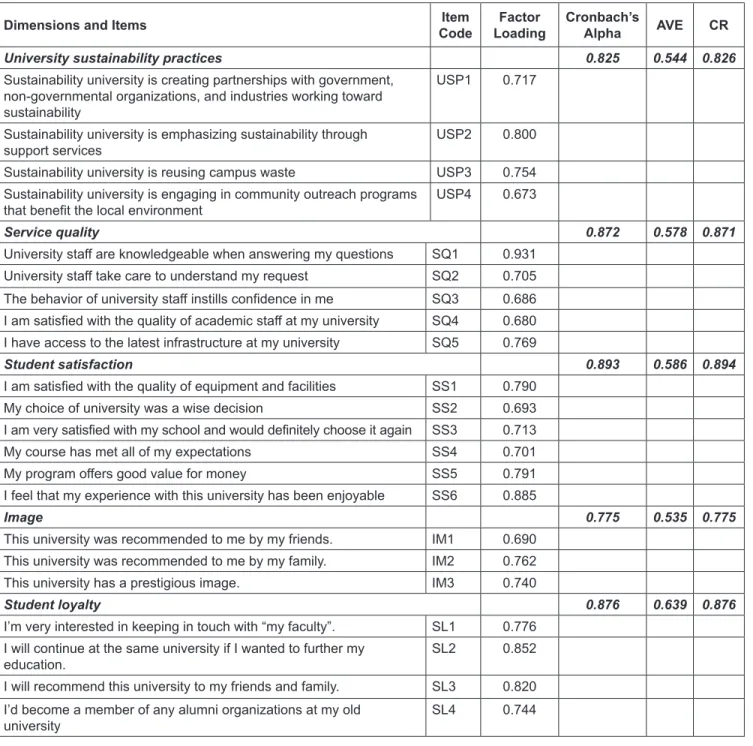
All the scales used in this study exceed the 0.70 benchmark, in line with Nunnally (1978) for reliability testing. In addition, the convergent validity of all constructs was assessed by using the average variance extracted (AVE), suggested by Fornell and Larcker (1981).
The operationalized constructs are shown in Table 1, including their factor loading, Cronbach’s alpha, AVE, and construct reliability values (CR).
In particular, all the loadings except USP4, SQ3, SQ4, SS2, and IM1 are higher than 0.7. The factor loadings of USP4, SQ3, SQ4, SS2, and IM1 are between 0.6 and 0.7, above the threshold value. Based on Hair et al. (2017), the results supported retaining all the items in the model.
Besides, CR values are higher than 0.7, hence, construct reliability was established. In addition, AVE values are also greater than the threshold value of 0.50.
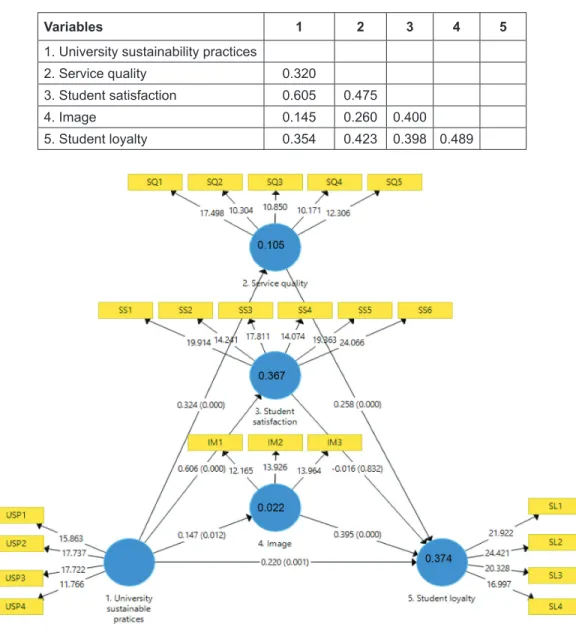
Moreover, the Heterotrait-Monotrait Ratio (HTMT) of correlation was also used as an estimate of discriminant validity. Table 2 shows that all values are under the prescribed limit of 0.70, in line with Henseler et al. (2015).
In the next step, the structural model estimation through the R2 adjusted value is employed to examine the predictive ability of the model. As shown in Figure 2, the R2 adjusted value of student loyalty in this study is 37.4%.
Meanwhile, Arya et al. (2019) stressed that R2 adjusted value greater than 30% is considered good enough in social research.
In the final step, bootstrapping function is conducted to assess the significance level of the direct and mediate effects of the constructs (Figure 2).
4.2. Testing of Hypotheses
Hypotheses H1, H2, H3, and H4 revealed that university sustainability practices have a positive impact on service quality, student satisfaction, and student loyalty. As illustrated in Table 3, the effects of these factors have values of 0.324 (p < 0.001), 0.606 (p < 0.001), 0.147 (p < 0.05) and 0.220 (p < 0.01), respectively. In addition, service quality and university image also positively impacts student loyalty, hence, H5 and H7 are supported. Meanwhile, student satisfaction has an insignificant relationship with student loyalty, hence H6 is rejected.
To evaluate the mediating effect of service quality, student satisfaction, and university image in the relationship between university sustainability practices and student loyalty, further analyses were conducted to confirm the indirect effects. Table 4 shows the analysis of the indirect and total effects. In addition, the significance of the indirect
Table 1: Constructs’ Factor Loadings, AVE, and Reliability Values
Dimensions and Items Item
Code Factor
Loading Cronbach’s
Alpha AVE CR
University sustainability practices 0.825 0.544 0.826
Sustainability university is creating partnerships with government, non-governmental organizations, and industries working toward sustainability
USP1 0.717
Sustainability university is emphasizing sustainability through
support services USP2 0.800
Sustainability university is reusing campus waste USP3 0.754
Sustainability university is engaging in community outreach programs
that benefit the local environment USP4 0.673
Service quality 0.872 0.578 0.871
University staff are knowledgeable when answering my questions SQ1 0.931 University staff take care to understand my request SQ2 0.705 The behavior of university staff instills confidence in me SQ3 0.686 I am satisfied with the quality of academic staff at my university SQ4 0.680 I have access to the latest infrastructure at my university SQ5 0.769
Student satisfaction 0.893 0.586 0.894
I am satisfied with the quality of equipment and facilities SS1 0.790
My choice of university was a wise decision SS2 0.693
I am very satisfied with my school and would definitely choose it again SS3 0.713
My course has met all of my expectations SS4 0.701
My program offers good value for money SS5 0.791
I feel that my experience with this university has been enjoyable SS6 0.885
Image 0.775 0.535 0.775
This university was recommended to me by my friends. IM1 0.690 This university was recommended to me by my family. IM2 0.762
This university has a prestigious image. IM3 0.740
Student loyalty 0.876 0.639 0.876
I’m very interested in keeping in touch with “my faculty”. SL1 0.776 I will continue at the same university if I wanted to further my
education. SL2 0.852
I will recommend this university to my friends and family. SL3 0.820 I’d become a member of any alumni organizations at my old
university SL4 0.744
effects is also explored by using the bootstrap confidence intervals method with 5000 iterations.
The results perform the indirect effects of university sustainability practices on student loyalty are positive with the values 0.084 for service quality, 0.058 for
university image. Meanwhile, the mediating role of student satisfaction in the relationship between university sustainability practices and student loyalty is insignificant.
Thus, all hypotheses H8 and H10 are supported, while H9 is rejected.
Table 2: Discriminant Validity using Heterotrait-Monotrait Ratio (HTMT)
Variables 1 2 3 4 5
1. University sustainability practices
2. Service quality 0.320
3. Student satisfaction 0.605 0.475
4. Image 0.145 0.260 0.400
5. Student loyalty 0.354 0.423 0.398 0.489
Table 3: Structural Model Results
Hypotheses Proposal Effect Beta P-value Results
H1: University sustainability practices → Service quality + 0.324 0.000 Supported H2: University sustainability practices → Student satisfaction + 0.606 0.000 Supported
H3: University sustainability practices → Image + 0.147 0.012 Supported
H4:University sustainability practices → Student loyalty + 0.220 0.001 Supported
H5: Service quality → Student loyalty + 0.258 0.000 Supported
H6:Student satisfaction → Student loyalty + -0.016 0.834 Rejected
H7:Image → Student loyalty + 0.395 0.000 Supported
Figure 2: Structural Model with Bootstrap Values
5. Discussion and Conclusion
The purpose of this research is to explore student loyalty beyond its customary relationship with university sustainability practices. In addition, three key mediators (service quality, student satisfaction, and university image) were added to increase the explanatory power of university sustainability practices on student loyalty.
The sequence of explanations begins with the university’s sustainability practices but continues with the evolution of service quality, student satisfaction, and the image of the university culminating in student loyalty. R2 is greater than 30%, indicating that the model is robust. As such, student loyalty does not depend solely on the sustainability activities of the university; it requires service quality, student satisfaction, and also the image of the university. These results confirm the explanatory chain that has been stated in previous studies (Latif et al., 2021; Chaudhary & Dey, 2021).
Our findings show that service quality and university image mediated the relation between university sustainability practices and student loyalty. These results state that the implementation of university sustainability practices indirectly increases student loyalty if it is embedded in the university in a way that improves service quality and university image.
Although there is a significant lack of literature on the role of university sustainability practices in tertiary education, Latif et al. (2021) revealed that service quality and student satisfaction both mediated the relationship between university sustainability practices and student loyalty. This study suggests that university managers should realize that investing in university sustainability practices can have a significant impact on the quality of services, university image, especially student loyalty. In addition, service quality must be enhanced to rely on students’ familiarity with the service as an active mediator in forming student loyalty. Universities must also consider their image as this is a trait that influences the long- term development of student loyalty.
This study has some fundamental limitations. First, the participants came from universities in Ho Chi Minh City,
Vietnam, there is no comparison of age, education level, or family background. Therefore, more studies are needed to determine the generalizability of the findings for different types of students. In addition, future studies may also assess the impact of university sustainability practices on other relevant variables such as the quality of relationships with students or student trust and determine the effects on student outcomes. Besides, future research could explore the differences between public and private universities, providing a more complete view of how university sustainability efforts affect student loyalty.
References
Ali, F., & Amin, M. (2014). The influence of physical environment on emotions, customer satisfaction, and behavioral intentions in the Chinese resort hotel industry. Journal for Global Business Advancement, 7(3), 249–266. https://doi.org/10.1504/
JGBA.2014.064109
Ali, F., Zhou, Y., Hussain, K., Nair, P. K., & Ragavan, N. A. (2016).
Does higher education service quality affect student satisfaction, image, and loyalty? Quality Assurance in Education, 24(1), 70–94. https://doi.org/10.1108/qae-02-2014-0008
Anderson, J., & Gerbing, D. (1988). Structural modeling in practice:
a review and recommended two-step approach. Psychological Bulletin, 103(3), 411–423. https://doi.org/10.1037/0033-2909.
103.3.411
Annamdevula, S., & Bellamkonda, R. S. (2016). The effects of service quality on student loyalty: the mediating role of student satisfaction. Journal of Modelling in Management, 11(2), 446–462. https://doi.org/10.1108/JM2-04-2014-0031
Appuhamilage, K. S. M., & Torii, H. (2019). The impact of loyalty on student satisfaction in higher education. Higher Education Evaluation and Development, 13(2), 82–96. https://doi.org/
10.1108/heed-01-2019-0003
Arya, V., Sethi, D., & Paul, J. (2019). Does digital footprint act as a digital asset? Enhancing brand experience through remarketing. International Journal of Information Management, 49, 142–156. https://doi.org/10.1016/j.ijinfomgt.2019.03.013 Table 4: Indirect and Total Effects Analysis
Indirect Effects
Path Beta P-value Confidence Intervals Bias Corrected
Lower
Confidence Level Upper Confidence Level
USP → SQ → SL 0.084 0.000 0.047 0.131
USP → SS → SL -0.010 0.835 -0.098 0.078
USP → IM → SL 0.058 0.021 0.005 0.108
Total effects USP → SL 0.132 0.010 0.034 0.218
Notes: USP = university sustainability practices; SQ = service quality; SS = student satisfaction; IM = image; SL = student loyalty.
Chandra, T., Hafni, L., Chandra, S., Purwati, A. A., & Chandra, J. (2019). The influence of service quality, university image on student satisfaction and student loyalty. Benchmarking:
An International Journal, 26(5), 1533–1549. https://doi.org/
10.1108/BIJ-07-2018-0212
Chaudhary, S., & Dey, A. K. (2021). Influence of student-perceived service quality on sustainability practices of university and student satisfaction. Quality Assurance in Education, 29(1), 29–40. https://doi.org/10.1108/QAE-10-2019-0107 Dabija, D., Postelnicu, C., Dinu, V., & Mihaila, A. (2017).
Stakeholders’ perception of sustainability orientation within a major Romanian university. International Journal of Sustainability in Higher Education, 18(4), 533–553. https://
doi.org/10.1108/IJSHE-10-2015-0169
Dam, S. M., & Dam, T. C. (2021). Relationships between service quality, brand image, customer satisfaction, and customer loyalty. The Journal of Asian Finance, Economics, and Business, 8(3), 585–593. https://doi.org/10.13106/jafeb.2021.
vol8.no3.0585
Dick, A. S., & Basu, K. (1994). Customer loyalty: toward an integrated conceptual framework. Journal of the Academy of Marketing Science, 22(2), 99–113. https://doi.org/
10.1177/0092070394222001
Elliot, K. M., & Healy, M. A. (2001). Key factors influencing student satisfaction related to recruitment retention. Journal of Marketing for Higher Education, 10(4), 1–11. https://doi.
org/10.1300/J050v10n04_01
Fernandes, C., Ross, K., & Meraj, M. (2013). Understanding student satisfaction and loyalty in the UAE HE sector. International Journal of Educational Management, 27(6), 613–630. https://
www.learntechlib.org/p/133278/
Fornell, C., & Larcker, D. F. (1981). Structural equation models with unobservable variables and measurement error: Algebra and statistics. Journal of Marketing Research, 18(3), 328–388.
https://doi.org/10.1177/002224378101800313
Gallegos, J. A., & Vasquez, A. (2019). Explaining university student loyalty: theory, method, and empirical research in Chile. Academia Revista Latinoamericana de Administración, 32(4), 525–540. https://doi.org/10.1108/ARLA-02-2019-0049 Giner, G. R., & Rillo, A. P. (2016). Structural equation modeling
of co-creation and its influence on the student’s satisfaction and loyalty towards university. Journal of Computational and Applied Mathematics, 291, 257–263. https://doi.org/10.1016/
j.cam.2015.02.044
Hair, J. F., Hult, G. T. M., Ringle, C. M., & Sarstedt, M. (2017).
A primer on partial least squares structural equation modeling (2nd ed.). Thousand Oaks, CA: Sage Publications.
Hennig-Thurau, T., Langer, M. F., & Hansen, U. (2001). Modeling and managing student loyalty: an approach based on the concept of relationship quality. Journal of Service Research, 3(4), 331–344. https://doi.org/10.1177/109467050134006 Henseler, J., Ringle, C. M., & Sarstedt, M. (2015). A new criterion
for assessing discriminant validity in variance-based structural
equation modeling. Journal of the Academy of Marketing Science, 43(1), 115–135. https://doi.org/10.1007/s11747-014- 0403-8
Jancey, J., & Burns, S., (2013). Institutional factors and the postgraduate student experience. Quality Assurance in Education, 21(3), 311–322. https://doi.org/10.1108/QAE- Nov-2011-0069
Latif, K. F. (2018). The development and validation of a stakeholder- based scale for measuring university social responsibility (USR). Social Indicators Research, 140(2), 511–547. https://
doi.org/10.1007%2Fs11205-017-1794-y
Latif, K. F., Bunce, L., & Ahmad, M. S. (2021). How can universities improve student loyalty? The roles of university social responsibility, service quality, and “customer” satisfaction and trust. International Journal of Educational Management, 35(4), 815–829. https://doi.org/10.1108/IJEM-11-2020-0524 Long, S., Duang-Ek-Anong, S., & Vongurai, R. (2021).
Determinants of business education on student satisfaction in higher education: A case study in Cambodia. The Journal of Asian Finance, Economics, and Business, 8(3), 1405–1416.
https://doi.org/10.13106/jafeb.2021.vol8.no3.1405
Lubis, A., Dalimunthe, R., Absah, Y., & Fawzeea, B. K. (2021).
The effect of corporate communication and service quality on customer loyalty and satisfaction in sharia banking. The Journal of Asian Finance, Economics, and Business, 8(3), 1267–1274.
https://doi.org/10.13106/jafeb.2021.vol8.no3.1267
Maignan, I., Ferrell, O. C., & Hult, G. T. M. (1999). Corporate citizenship: Cultural antecedents and business benefits. Journal of the Academy of Marketing Science, 27(4), 455–469. https://
doi.org/10.1177/0092070399274005
Marzo-Navarro, M., Pedraja-Iglesias, M., & Rivera-Torres, M. P.
(2005). Measuring customer satisfaction in summer courses.
Quality Assurance in Education, 13(1), 53–65.
Mehralian, G., Nazari, J. A., Zarei, L., & Rasekh, H. R. (2016).
The effects of corporate social responsibility on organizational performance in the Iranian pharmaceutical industry:
The mediating role of TQM. Journal of Cleaner Production, 135, 689–698. https://doi.org/10.1016/j.jclepro.2016.06.116 Mukhtar, U., Ahmed, U., Anwar, S., & Baloch, M. A. (2015).
Factors affecting the service quality of public and private sector universities comparatively: An empirical investigation. Journal of Arts Science and Commerce, 3(1), 132–142. http://www.
sciepub.com/reference/199918
Mulyono, H., Hadian, A., Purba, N., & Pramono, R. (2020). Effect of service quality toward student satisfaction and loyalty in higher education. The Journal of Asian Finance, Economics, and Business, 7(10), 929–938. https://doi.org/10.13106/
jafeb.2020.vol7.no10.929
Nunnally, J. C. (1978). An overview of psychological measurement.
In: B. B. Wolman (Ed.), Clinical diagnosis of mental disorders (pp. 97–146). New York, NY: Plenum Press.
Oliver, R. L. (1997). Satisfaction: A behavioral perspective on the consumer. New York: McGraw-Hill.
Osman, A. R., & Saputra, R. S. (2019). A pragmatic model of student satisfaction: A viewpoint of private higher education.
Quality Assurance in Education, 27(2), 142–165. https://
doi.org/10.1108/QAE-05-2017-0019
Ozdemir, Y., Kaya, S. K., & Turhan, E. (2020). A scale to measure sustainability campus services in higher education:
‘sustainability service quality. Journal of Cleaner Production, 245, 118839. https://doi.org/10.1016/j.jclepro.2019.118839 Philip, G., & Hazlett, S. A. (1997). The measurement of service
quality: A new PCP attributes model. International Journal of Quality and Reliability Management, 14(3), 260–286. https://
doi.org/10.1108/02656719710165482
Pivato, S., Misani, N., & Tencati, A. (2008). The impact of corporate social responsibility on consumer trust: the case of organic food. Business Ethics-A European Review, 17(1), 3–12.
https://doi.org/10.1111/j.1467-8608.2008.00515.x
Reverte, C., Gomez-Melero, E., & Cegarra-Navarro, J. G. (2016).
The influence of corporate social responsibility practices on organizational performance: evidence from Eco-Responsible Spanish firms. Journal of Cleaner Production, 112, 2870–2884.
https://doi.org/10.1016/j.jclepro.2015.09.128
Ringle, C. M., Wende, S., & Becker, J. M. (2015). SmartPLS 3.
Boenningstedt: SmartPLS GmbH.
Rojas-Mendez, J. I., Vasquez-Parraga, A. Z., Kara, A. L. I., &
Cerda-Urrutia, A. (2009). Determinants of student loyalty in higher education: a tested relationship approach in Latin America. Latin American Business Review, 10(1), 21–39.
https://doi.org/10.1080/10978520903022089
Sultan, P., & Wong, H. Y. (2013). Antecedents and consequences of service quality in a higher education context: A qualitative research approach. Quality Assurance in Education, 21(1), 70–95. https://
doi.org/10.1108/09684881311293070
Shurair, A. S. A., & Pokharel, S. (2019). Stakeholder’s perception of service quality: A case in Qatar. Quality Assurance in
Education, 27(4), 493–510. https://doi.org/10.1108/QAE-05- 2017-0023
Tahar, E. B. M. (2008). Expectation and perception of postgraduate students for service quality in UTM. [Doctoral Thesis, Universiti Teknologi Malaysia]. Universiti Teknologi Malaysia Institutional Repository. http://eprints.utm.my/id/eprint/9556/
Teeroovengadum, V., Nunkoo, R., Gronroos, C., Kamalanabhan, T., & Seebaluck, A. (2019). Higher education service quality, student satisfaction, and loyalty. Quality Assurance in Education, 27(4), 427–445. https://doi.org/10.1108/QAE-01- 2019-0003
Tellis, G. J. (1988). The price elasticity of selective demand:
a meta-analysis of econometric models of sales. Journal of Marketing Research, 25(4), 331–341. https://doi.org/
10.2307/3172944
Ugboma, C., Ogwude, I. C., Ugboma, O., & Nnadi, K. (2007).
Service quality and satisfaction measurements in Nigerian ports: an exploration. Maritime Policy and Management, 34(4), 331–346. https://doi.org/10.1080/03088830701539073 Vazquez, J. L., Aza, C. L., & Lanero, A. (2015). Students’ experiences
of university social responsibility and perceptions of satisfaction and quality of service. Ekonomski Vjesnik/Econviews: Review of Contemporary Business, Entrepreneurship and Economic Issues, 28(S), 25–39. https://hrcak.srce.hr/ojs/index.php/
ekonomski-vjesnik/article/view/3091
Wilkins, S., & Balakrishnan, S. M (2013). Assessing student satisfaction in transnational higher education. International Journal of Educational Management, 27(2), 143–156. https://
doi.org/10.1108/095135413112975680701539073
Yildiz, S. M. (2013). Service quality evaluation in the school of physical education and sports: An empirical investigation of students’ perceptions. Total Quality Management and Business Excellence, 25(1/2), 80–94. https://doi.org/10.1080/14783363.
2011.637804