Korean J. Mineral. Petrol. Vol. 33, No. 1, p. 53~64, 2020 https://doi.org/10.22807/ KJMP.2020.33.1.53
광물과 암석 단 보
삼광 금-은 광상의 엽리상 석영맥에서 산출되는 백색운모와 철백운석의 산상 및 화학조성
유봉철1,2*
1한국지질자원연구원 DMR융합연구단, 2과학기술연합대학원대학교 광물지하수자원학과
Occurrence and Chemical Composition of White Mica and Ankerite from Laminated Quartz Vein of Samgwang
Au-Ag Deposit, Republic of Korea
Bong Chul Yoo1,2*
1Convergence Research Center for Development of Mineral Resources, Korea Institute of Geoscience and Mineral Resources, Daejeon 34132, Korea
2Department of Mineral and Grroundwater Resources, University of Science and Technology, Daejeon 34113, Korea
요 약: 삼광 금-은 광상은 과거에 한국에서 가장 큰 금-은 광상들 중의 하나이다. 이 광상 주변지질은 선캠 브리아기의 변성퇴적암류와 이를 부정합으로 피복한 쥐라기 백운사층으로 구성된다. 이 광상은 선캠브리아기 의 변성퇴적암류내에 발달된 열극대를 충진한 8개조의 석영맥으로 구성된 조산형 금-은 광상이다. 이 광상에 는 일반적으로 엽리상 석영맥이 관찰되며 석영, 철백운석, 백색운모, 녹니석, 인회석, 금홍석, 유비철석, 섬아 연석, 황동석 및 방연석 등으로 구성된다. 엽리상 석영맥과 모암변질에서 산출되는 백색운모의 화학조성은 (K
1.02-0.82Na
0.02-0.00Ca
0.00)(Al
1.73-1.58Mg
0.26-0.16Fe
0.23-0.10Mn
0.00Ti
0.03-0.01Cr
0.01-0.00)(Si
3.35-3.22Al
0.79-0.65)O
10(OH)
2및 (K
0.75-0.67Na
0.01Ca
0.00) (Al
1.78-1.74Mg
0.16-0.15Fe
0.15-0.13Mn
0.00Ti
0.04-0.02Cr
0.01-0.00)(Si
3.33-3.26Al
0.74-0.67)O
10(OH)
2로써 엽리상 석영맥에서 산출되 는 백색운모에서 층간 양이온(K+Na+Ca)과 팔면체 자리에서의 Fe+Mg+Mn+Ti 함량이 높게 산출된다. 이 광 상의 엽리상 석영맥에서 산출되는 백색운모의 화학조성 변화는 팬자이틱 또는 Tschermark 치환((Al
3+)
VI+ (Al
3+)
IV<> (Fe
2+또는 Mg
2+)
VI+(Si
4+)
IV) 및 직접적인 (Fe
3+)
VI<> (Al
3+)
VI치환에 의해 일어났음을 알 수 있 다. 엽리상 석영맥에서 산출되는 철백운석은 결정방향에 따라 서로 다른 상들이 교호하며 산출되며 이들 상 들에서는 FeO 및 MgO 함량 변화가 관찰된다. 따라서 삼광 금-은 광상의 엽리상 석영맥 형성은 조산형 금- 은 광상의 형성 시 주 광화시기인 연성전단(ductile shear) 시기에 형성되었음을 알 수 있다.
핵심어: 삼광 금-은 광상, 백색운모, 철백운석, 산상, 화학조성
Abstract:
The Samgwang deposit has been one of the largest deposits in Korea. The deposit consists of series of host rocks including Precambrian metasedimentary rocks and Jurassic Baegunsa formation, which unconformably overlies the Precambrian metasedimentary rocks. The deposit consists of eight lens-shaped quartz veins which filled fractures along fault zones in Precambrian metasedimentary rock, which feature suggest that it is an orogenic-type deposit. Laminated quartz veins are common in the deposit which contain minerals including quartz, ankerite, white mica, chlorite, apatite, rutile, arsenopyrite, sphalerite, chalcopyrite and galena. The structural formulars of white micas from laminated quartz vein and wallrock alteration are determined to be (K1.02-0.82Na0.02-0.00Ca0.00)(Al1.73-1.58Mg0.26-0.16Fe0.23-0.10Mn0.00Ti0.03- 0.01Cr0.01-0.00) (Si3.35-3.22Al0.79-0.65)O10(OH)2 and (K0.75-0.67Na0.01Ca0.00)(Al1.78-1.74Mg0.16-0.15 Fe0.15–0.13Mn0.00Ti0.04-0.02Cr0.01-0.00)(Si3.33-3.26Al0.74-0.67)O10(OH)2, respectively. It suggest that white mica from laminated quartz vein has higher interlayer cation (K+Na+Ca) and Fe+Mg+Mn+Ti content in octahedral site compared to the white mica from the
*Corresponding author Tel: +82-42-868-3505 E-mail: [email protected]
Korean J. Mineral. Petrol.
wallrock alteration. Compositional variations in white mica from laminated quartz vein can be caused by phengitic or Tschermark substitution ((Al3+)VI+ (Al3+)IV <> (Fe2+ or Mg2+)VI+(Si4+)IV) and direct (Fe3+)VI <>
(Al3+)VI substitution. Ankerite from laminated quartz vein has compositional variations of FeO and MgO contents along crystal growth direction. The geochemical and textural features suggest that laminated quartz vein from the Samgwang gold-silver deposit was formed during ductile shear stage, which is an important main gold-silver ore–forming event in orogeinc deposit.
Keywords:
Samgwang Au-Ag deposit, White mica, Ankerite, Occurrence, Chemical composition서 언
금-은 광상들은 선캠브리아기로부터 현세까지 다양 한 지질환경에서 형성되었다. 이들 금-은 광상들은 지 체구조으로 해양호(oceanic arc)에서 배호확장대(back- arc extension)까지 다양한 광상형으로 산출된다 (Groves et al., 1998). 특히, Groves et al. (1998) 에 의하면 조산형 금 광상은 해양지각이 대륙지각 하 부로 섭입하는 어크리트 테레인(accreted terranes)에 서 형성되며 형성 깊이에 따라 심지성(hypozonal) 광 상, 중지성(mesozonal) 광상 및 근지성(epizonal) 광 상으로 분류하였다. 삼광 금-은 광상은 생성심도가 11.6km 정도에서 형성된 조산형 심지성(hypozonal) 광상에 해당된다(Yoo et al., 2010; Lee et al., 2019). 조산형 심지성(hypozonal) 금-은 광상은 엽리 상 석영맥이 일반적으로 관찰되는데 이 엽리상 석영 맥은 스러스트와 관련된 전단응력(shear stress)에 의 해 형성되며 그 규모는 전단응력의 규모에 의해 좌우 된다(Craw and MacKenzie, 2016). 조산형 금 광상 에서 관찰되는 엽리상 석영맥의 형성 시 맥석광물로 는 석영, 백색운모, 녹니석, 방해석, 흑연 및 능철석 등이 산출되는 것으로 보고되어 있다(Craw and MacKenzie, 2016).
특히, 최근들어 백색운모는 다양한 유형의 광상들 에서 모암변질 광물 또는 초생 광물로써 산출되며 이 백색운모를 대상으로 광체 탐사 지시자 및 백색운모 내 각 사이트(site)별 치환 원소들의 종류 및 함량에 따라 생성환경 인자로 활용하는 연구들이 많이 보고 되고 있다(Christie and Brathwaite, 2003; Ayati et al., 2008; Cohen, 2011; Jimenez, 2011; Pearce et al., 2015; Craw and MacKenzie, 2016; Wallace, 2016; Wang et al., 2017; Gaillard et al., 2018;
Uribe-Mogollon and Maher, 2018; Dehnavi et al., 2019; Yoo, 2019). 일반적으로 광상에서 모암변질 광 물 또는 초생 광물로 산출되는 백색운모는 true
micas에 해당된다. 백색운모의 일반적인 화학식은 XY2Z4O10(OH,F)2이며 여기에서 X에는 K+, Na+, Ca2+, Ba2+, Rb+, Cs+, Sr2+ 등 원소들, Y에는 Al3+, Mg2+, Fe2+, Fe3+, Mn2+, Cr3+, Ti4+, Li+, V3+, Ni2+
등 원소들이 Z에는 Si4+, Al3+ 원소들로 구성된다 (Rieder et al., 1999; Deer et al., 2003). 더불어 탄산염 광물들은 조산형 금 광상에서 광상의 생성환 경에 따라 산출광물의 종류 및 화학조성을 달리하며 산출된다(Christie and Brathwaite, 2003; Dugdale et al., 2006; Yoo et al., 2014; Craw and MacKenzie, 2016; Kalliomäki et al., 2019).
과거 삼광 금-은 광상에 대한 연구로는 생성환경, 모암변질 및 원소분산에 대한 연구가 수행되었으나 (Yoo et al., 2002; 2009; 2010) 엽리상 석영맥내에 산출되는 광물들에 대한 산상 및 화학조성은 연구되 지 않았다. 따라서 이 연구에서는 엽리상 석영맥내에 산출되는 백색운모와 철백운석의 산출상태 및 화학조 성을 토대로 기 연구된 삼광 금-은 광상 및 조산형 금 광상에서 산출되는 백색운모 및 철백운석의 화학 조성을 비교함으로써 그 특징을 고찰해 보고자 한다.
주변지질 및 광상개요
삼광 금-은 광상은 충청남도 청양군 운곡면 신대리 에 위치한다(Fig. 1). 이 광상의 주변지질 및 광상개 요는 기존연구(Yoo et al., 2002; 2009; 2010)에서 보고되어 있어 여기에서는 간략하게 기술하고자 한다.
이 광상의 주변지질은 선캠브리아기의 변성퇴적암류 와 이를 부정합으로 피복한 쥐라기 백운사층이 분포 된다(Fig. 1). 더불어 상기의 암류들을 후기에 관입한 백악기의 맥암류가 소규모 분포된다(Yoo et al., 2009)(Fig. 1). 선캠브리아기의 변성퇴적암류는 광상일 대에 넓게 분포하고 있으며 편리구조가 관찰되는 호 상편마암, 안구상편마암 및 선구조가 관찰되지 않는 화강편마암으로 분류되나 상호 점이적이다(Yoo et al.,
삼광 금-은 광상의 엽리상 석영맥에서 산출되는 백색운모와 철백운석의 산상 및 화학조성 55
2009). 일반적으로 편리의 주향과 경사는 각각 N50~
80oE, 45~70oSE이며 구성광물은 석영, 장석류, 흑운 모, 백운모, 백색운모, 녹니석 및 소량의 각섬석 등으 로 각섬암상 정도의 광역변성을 받았다(Lee et al., 1998; Yoo et al., 2002; 2009). 백운사층은 광상의 서측에 남북방향으로 분포되며 탄층을 포함한 대동계 퇴적암류이다(Yoo et al., 2002; 2009). 이 층은 선 캠브리아기의 변성퇴적암류와 경계부분에서 편마암을 역으로 포함하는 역암, 사암 및 흑색셰일로 구성되며 주향과 경사는 각각 N30~50oE, 27~30oNW, 34~48oSE
를 갖는 배사구조가 관찰된다(Yoo et al., 2002;
2009). 맥암류는 석영맥, 염기성암맥 및 산성암맥 등 으로 구성되며 광상일대의 여러 곳에서 산출된다(Yoo et al., 2002; 2009).
삼광 금-은 광상은 선캠브리아기의 변성퇴적암류내 에 발달된 열극대를 충진한 조산형 금-은 석영맥 광 상이다(Yoo et al., 2009)(Fig. 1). 이 광상은 1928년 에 광업권이 등록되었고 1933년부터 일본 미쯔비시 공업(주)에서 개발되어 오다가 1943년도 조선광업진 흥(주)로 이전되었다(Yoo et al., 2009). 그 후 1977
Fig. 1. Generalized geological map of the Samgwang Au-Ag deposit, showing the orientation of the principal quartz
veins ( 1 = Guksa vein, 2 = Bongamri vein, 3 = Sinri vein, 4 = Daeheung 1 vein, 5 = Daeheung 2 vein ( Yoo
et al., 2009).
Korean J. Mineral. Petrol.
년에는 조규호에 의해 인수되었으며 1980년부터는 일 신산업(주)에서 개발하였다. 1994년도에는 영화기업사 에서 하청받아 1996년도 2월 휴광신고를 내기까지 상 반맥을 중심으로 총 7,900 m 정고가 연맥 굴진되었다 (Yoo et al., 2009). 휴광이후 현재까지 광업권을 살 아 있으며 일부 개인 및 회사들이 간헐적으로 광산 폐석에서 규사를 채취하기 위한 소규모 작업을 진행 하거나 광상 개발을 위한 붕괴된 대절갱 갱내 일부를 보수하기도 하였다. 삼광 금-은 광상은 총 8개의 평 행한 석영맥들로 구성되며 석영맥의 평균폭은 0.5~1.5 m이며 부분적으로 2~12 m에 달하는 곳도 있 으나 석영맥의 연장성은 불량하며 대체로 렌즈상을 이룬다(Yoo et al., 2009). 이 석영맥들의 방향에 따 라 국사맥, 상반맥, 국성맥, 대흥맥, 봉가리맥 및 신리 맥으로 분류되며 과거 주로 국사맥, 상반맥 및 국성 맥을 주 채굴대상으로 하였다(Yoo et al., 2009)(Fig.
1). 국사맥은 대절갱 입구로부터 동측으로 약 2 km 이상 연장되는 구조대내에 단속적으로 배태된 렌즈상 광체로써 N60~80oE의 주향과 40~75oSE의 경사를 갖 는다. 국사맥은 부광대의 위치에 따라 통동광체, 본항 광체 및 국사봉광체로 구분하여 과거 개발하였다(Yoo et al., 2009). 상반맥은 국사맥에서 역단층에 의해 분 지된 것으로 EW의 주향과 30~40oS의 경사를 갖는다 (Yoo et al., 2009). 국성맥은 N30oW의 주향과 6 5~
70oSW의 경사를 갖으며 수갱 2편까지 확인되나 그 하부에서는 구조대가 미약하고 석영맥이 분산되거나 발견되지 않는다. 또한 지표에서는 과거 채굴된 흔적 만 남아있다(Yoo et al., 2002; 2009).
연구 방법
삼광 금-은 광상의 엽리상 석영맥에서 산출되는 광 물의 산상을 알아보기 위하여 지질광상조사와 더불어 시료채취를 수행하였다. 채취된 시료들에 대해선 암 석절단기를 이용하여 우선 암편(rock slab)을 제작하 여 조직 및 산출광물의 종류, 산상 등을 관찰하였다.
이것을 토대로 연마박편을 제작하여 편투과/반사현미 경 관찰을 통하여 광물의 종류, 산상 및 공생관계를 관찰하였다. 백색운모와 철백운석의 화학조성은 전북 테크노파크 연구개발지원센터에서 보유하고 있는 Shimazu사의 EPMA-1610(5채널 및 EDX가 부착)을 이용하여 수행하였다. 분석조건은 가속전압 15 keV, 시료 전류 2.0×10⁻⁸A, 전자선의 크기 5~10 μm이며
표준시료는 Si, Na: 알바이트(albite), Ti: titanium monoxide, Al, K: 정장석, Fe: 황철석, Mn: 장미휘 석, Mg: MgO, Ca: 규회석, Cr: metal Cr, Hf:
metal Hf, W: metal W, V: metal V, Nb: metal Nb, Ta: metal Ta를 사용하였다. 특성 X-선과 분광 결정은 PET: SiK, CaK, KK, HfM, WM, TaM, NbL, LiF: TiK, FeK, MnK, CrK, VKb, RAP: AlK, MgK, NaK를 사용하였다.
결론 및 토의
백색운모와 철백운석의 산상 및 산출광물
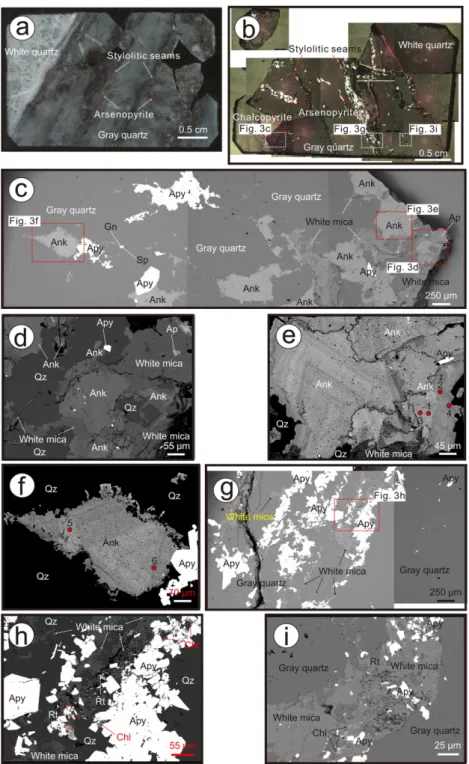
삼광 금-은 광상의 지질광상조사 시 현장에서 엽리 상 석영맥에 대한 산상과 더불어 실내실험을 위해 채 취한 엽리상 석영맥 시료들에 대한 암편들을 제작하 여 조직, 산출광물 및 산출광물의 공생관계를 관찰하 였다(Fig. 2). 이 엽리상 석영맥은 삼광 금-은 광상의 모든 맥들에서 관찰되며 스타일롤라이틱심(stylolitic seams)의 폭과 연장성은 맥들마다 다르게 산출된다.
엽리상 석영맥은 육안상 유색대와 무색대로 호상구조 를 갖으며 그 대간 두께는 수 mm에서 수 cm 정도 이며 특히 유색대의 산출빈도와 산출량은 모암으로 감에 따라 증가한다(Fig. 2). 엽리상 석영맥의 무색대 는 주로 석영으로 구성되며 일부 산점상으로 철백운 석이 산출된다(Fig. 2b). 엽리상 석영맥의 유색대는 변질광물과 유비철석이 주로 구성되어 있는 부분과 간혹 철백운석으로만 구성되어 있는 부분이 있는 것 으로 관찰된다(Fig. 2). 더불어 엽리상 석영맥 및 백 색 석영맥이 관찰되는 곳에서 모암으로 감에 따라 유 색대만 산출되는 시료들도 다수 관찰된다(Fig. 2c).
엽리상 석영맥내 유색대에서 산출되는 변질광물은 휴 대용 PIMA분석, 편투과/반사현미경 및 전자현미분석 을 통해 광물을 동정하여 보면 주로 백색운모이며 소 량 녹니석이 산출되며 석영, 철백운석, 녹니석, 인회 석, 금홍석, 유비철석, 섬아연석, 황동석 및 방연석이 유색대에서 산출된다(Figs. 2 and 3). 현미경 및 전자 현미분석에서 백색운모는 유색대에서 주로 회색석영, 유비철석, 철백운석, 녹니석 및 금홍석과 함께 세립질 내지 중립질 입단(aggregate)으로써 산출된다(Fig. 3c- e, g-i). 철백운석은 엽리상 석영맥내 무색대에서 백색 석영과 함께 산점상으로 관찰되거나 유색대내 단독의 광물 또는 회색석영, 백색운모 및 유비철석과 함께 반자형 또는 자형으로 산출된다(Figs. 2 and 3). 더불
삼광 금-은 광상의 엽리상 석영맥에서 산출되는 백색운모와 철백운석의 산상 및 화학조성 57
어 철백운석에 대한 전자현미분석의 BSE에 대해 관 찰을 해보면 결정방향에 따라서 서로 다른 상들(밝은 부분과 어두운 부분)로 구성되어 있는 것을 관찰할 수 있다(Fig. 3e-f).
백색운모와 철백운석의 화학조성
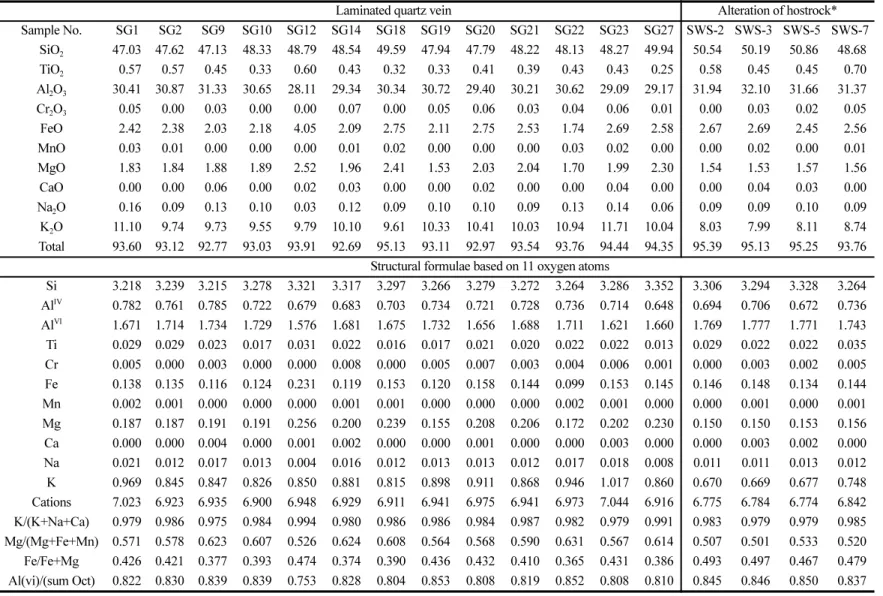
삼광 금-은 광상의 엽리상 석영맥에서 산출되는 백 색운모에 대한 EPMA 정량분석 결과는 Table 1과 같으며 구조식 계산은 산소원자 11로 계산하였다.
Table 1에는 모암변질내 백색운모의 화학조성도 포함 되어 있다(Yoo et al., 2009). Table 1에서 보는 것 과 같이, 엽리상 석영맥과 모암변질에서 산출되는 백 색운모의 화학조성은 각각 (K1.02-0.82Na0.02-0.00Ca0.00) (Al1.73-1.58Mg0.26-0.16Fe0.23-0.10Mn0.00Ti0.03-0.01Cr0.01-0.00)(Si3.35 -3.22Al0.79-0.65)O10(OH)2 및 (K0.75-0.67Na0.01Ca0.00)(Al1.78-1.74 Mg0.16-0.15Fe0.15-0.13Mn0.00Ti0.04-0.02Cr0.01-0.00)(Si3.33-3.26Al0.74-0.67)
O10(OH)2 로써 이론적인 이중팔면체형 운모류 값보다 Si가 높고 K, Na는 낮다. 엽리상 석영맥과 모암변질 에서 산출되는 백색운모의 층간 양이온(K+Na+Ca)은 각각 0.82~1.04 apfu, 0.68~0.78 apfu로서 엽리상 석 영맥에서 산출되는 백색운모에서 층간 양이온이 높게 산출된다(Table 1). 또한 팔면체 자리에서의 Fe+Mg +Mn+Ti 함량은 각각 0.29~0.52 apfu, 0.31~0.34 apfu 로서 엽리상 석영맥에서 산출되는 백색운모에서 다소 높게 산출된다(Table 1). 더불어 엽리상 석영맥에서 산출되는 백색운모내 MgO 함량이 모암변질내 산출 되는 백색운모보다 높게 산출된다(Table 1).
삼광 금-은 광상에서 산출되는 백색운모에 대한 층 간 양이온의 K 함량, 팔면체 및 사면체 자리에서의 Si 및 Al 함량을 기초로 Macraes 조산형 금 광상과 Reefton goldfield의 조산형 금 광상에서 산출되는 백 색운모들과 비교하여 보았다(Fig. 4). 뉴질랜드의
Fig. 2. Photographs of laminated quartz vein samples from the Samgwang Au-Ag deposit. (a)-(c) Stylolitic seams and
ankerite in different laminated quartz vein, (d) closed-up laminated quartz vein and extension quartz vein of
Samgwang deposit.
유봉철
Kor ea n J. Min eral . Petr ol.
Table 1. Chemical composition of white mica from the Samgwang Au-Ag deposit
Laminated quartz vein Alteration of hostrock*
Sample No. SG1 SG2 SG9SG10 SG12 SG14 SG18 SG19SG20 SG21 SG22 SG23 SG27 SWS-2 SWS-3 SWS-5 SWS-7 SiO
247.03 47.62 47.13 48.33 48.79 48.54 49.59 47.94 47.79 48.22 48.13 48.27 49.94 50.54 50.19 50.86 48.68 TiO
20.57 0.57 0.45 0.33 0.60 0.43 0.32 0.33 0.41 0.390.43 0.43 0.25 0.58 0.45 0.45 0.70 Al
2O
330.41 30.87 31.33 30.65 28.11 29.34 30.34 30.72 29.40 30.21 30.62 29.09 29.17 31.94 32.10 31.66 31.37 Cr
2O
30.05 0.00 0.03 0.00 0.00 0.07 0.00 0.05 0.06 0.03 0.04 0.06 0.01 0.00 0.03 0.02 0.05 FeO 2.42 2.38 2.03 2.18 4.05 2.092.75 2.11 2.75 2.53 1.74 2.692.58 2.67 2.69 2.45 2.56 MnO 0.03 0.01 0.00 0.00 0.00 0.01 0.02 0.00 0.00 0.00 0.03 0.02 0.00 0.00 0.02 0.00 0.01 MgO 1.83 1.84 1.88 1.89 2.52 1.96 2.41 1.53 2.03 2.04 1.70 1.99 2.30 1.54 1.53 1.57 1.56 CaO 0.00 0.00 0.06 0.00 0.02 0.03 0.00 0.00 0.02 0.00 0.00 0.04 0.00 0.00 0.04 0.03 0.00 Na
2O 0.16 0.090.13 0.10 0.03 0.12 0.090.10 0.10 0.090.13 0.14 0.06 0.09 0.09 0.10 0.09
K
2O 11.10 9.74 9.73 9.55 9.79 10.10 9.61 10.33 10.41 10.03 10.94 11.71 10.04 8.03 7.99 8.11 8.74 Total 93.60 93.12 92.77 93.03 93.91 92.69 95.13 93.11 92.97 93.54 93.76 94.44 94.35 95.39 95.13 95.25 93.76
Structural formulae based on 11 oxygen atoms
Si 3.218 3.239 3.215 3.278 3.321 3.317 3.297 3.266 3.279 3.272 3.264 3.286 3.352 3.306 3.294 3.328 3.264 Al
IV0.782 0.761 0.785 0.722 0.6790.683 0.703 0.734 0.721 0.728 0.736 0.714 0.648 0.69 4 0.706 0.672 0.736 Al
VI1.671 1.714 1.734 1.7291.576 1.681 1.675 1.732 1.656 1.688 1.711 1.621 1.660 1.769 1.777 1.771 1.743 Ti 0.0290.0290.023 0.017 0.031 0.022 0.016 0.017 0.021 0.020 0.022 0.022 0.013 0.029 0.022 0.022 0.035 Cr 0.005 0.000 0.003 0.000 0.000 0.008 0.000 0.005 0.007 0.003 0.004 0.006 0.001 0.000 0.003 0.002 0.005 Fe 0.138 0.135 0.116 0.124 0.231 0.1190.153 0.120 0.158 0.144 0.09 90.153 0.145 0.146 0.148 0.134 0.144 Mn 0.002 0.001 0.000 0.000 0.000 0.001 0.001 0.000 0.000 0.000 0.002 0.001 0.000 0.000 0.001 0.000 0.001 Mg 0.187 0.187 0.191 0.191 0.256 0.200 0.239 0.155 0.208 0.206 0.172 0.202 0.230 0.150 0.150 0.153 0.156 Ca 0.000 0.000 0.004 0.000 0.001 0.002 0.000 0.000 0.001 0.000 0.000 0.003 0.000 0.000 0.003 0.002 0.000 Na 0.021 0.012 0.017 0.013 0.004 0.016 0.012 0.013 0.013 0.012 0.017 0.018 0.008 0.011 0.011 0.013 0.012 K 0.969 0.845 0.847 0.826 0.850 0.881 0.815 0.898 0.911 0.868 0.946 1.017 0.860 0.670 0.669 0.677 0.748 Cations 7.023 6.923 6.935 6.900 6.948 6.929 6.911 6.941 6.975 6.941 6.973 7.044 6.916 6.775 6.784 6.774 6.842 K/(K+Na+Ca) 0.979 0.986 0.975 0.984 0.994 0.980 0.986 0.986 0.984 0.987 0.982 0.979 0.991 0.983 0.979 0.979 0.985 Mg/(Mg+Fe+Mn) 0.571 0.578 0.623 0.607 0.526 0.624 0.608 0.564 0.568 0.590 0.631 0.567 0.614 0.507 0.501 0.533 0.520 Fe/Fe+Mg 0.426 0.421 0.377 0.393 0.474 0.374 0.390 0.436 0.432 0.410 0.365 0.431 0.386 0.493 0.497 0.467 0.479 Al(vi)/(sum Oct) 0.822 0.830 0.8390.8390.753 0.828 0.804 0.853 0.808 0.8190.852 0.808 0.810 0.845 0.846 0.850 0.837
*Source by Yoo et al. (2009)
삼광 금-은 광상의 엽리상 석영맥에서 산출되는 백색운모와 철백운석의 산상 및 화학조성 59
Fig. 3. Photograph, microphotograph and BSEs of minerals representative for laminated quartz veins from the
Samgwang Au-Ag deposit. (a) photograph of polishing thin section for laminated quartz vein, (b) microphoto-
graph of laminated quartz vein, (c) white mica, ankerite, arsenopyrite, sphalerite, galena and grey quartz in
laminated quartz vein, (d) closed-up white mica, ankerite, arsenopyrite, apatite and grey quartz, (e)-(f) closed-
up different phases of ankerite, (g)-(i) white mica, chlorite, arsenopyrite, rutile and grey quartz. Abbrevia-
tions; Ank = ankerite, Ap = apatite, Apy = arsenopyrite, Chl = chlorite, Gn = galena, Qz = quartz, Rt = rutile, Sp =
sphalerite. Red circles indicate quantitative analysis points.
Korean J. Mineral. Petrol.
Macraes 조산형 금 광상과 호주의 Reefton goldfield 의 조산형 금 광상는 전세계적으로 잘 알려진 조산형 금 광상이며 또한 백색운모에 대한 체계적인 연구가 된 광상들이다. Fig. 4a에서 보는 것과 같이, 삼광 금 -은 광상의 엽리상 석영맥에서 산출되는 백색운모의 Al 함량은 Reefton goldfield의 조산형 금 광상에서 산출되는 백색운모의 Al 함량에 낮은 함량을 갖으나 Macraes 조산형 금 광상의 mineralised schist (광화 작용의 ductile shear 시기)에서 산출되는 백색운모의 Al 함량과 거의 일치하거나 약간 높은 함량을 갖는 다. 또한 삼광 금-은 광상의 모암변질에서 산출되는 백색운모의 Al 함량은 Macraes 조산형 금 광상의 late microshears (광화작용의 brittle shear 시기)에서 산출되는 백색운모의 Al 함량과 거의 일치하거나 약 간 높은 함량을 갖는다(Fig. 4a). 더불어 Fig. 4에서 보는 것과 같이, 이들 광상에서 산출되는 백색운모의 Si 및 K 함량은 각 정출시기에 따라 함량이 다르며 특히 삼광 금-은 광상의 엽리상 백색운모의 화학조성 은 Macraes 조산형 금 광상의 mineralised schist (광 화작용의 ductile shear 시기)에서 산출되는 백색운모 의 화학조성과 매우 유사함을 알 수 있다. 또한 팔면 체 자리에서의 Fe+Mg 함량과 사면체 자리에서의 Si 함량을 기초로 삼광 금-은 광상의 백색운모와 Reefton goldfield의 조산형 금 광상에서 산출되는 백색운모와 비교해 본 결과, 삼광 금-은 광상의 엽리상 석영맥에 서 산출되는 백색운모는 Reefton goldfield의 조산형 금 광상에서 산출되는 백색운모보다 Fe+Mg 및 Si 함량이 다소 높은 값을 갖는다(Fig. 5).
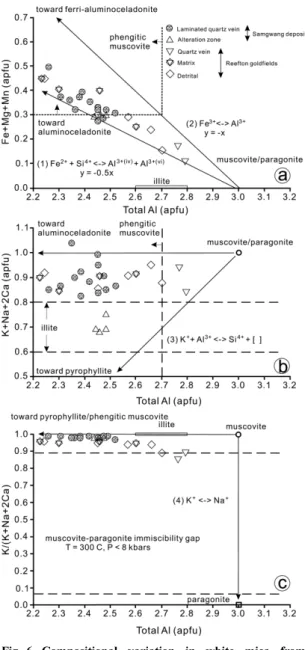
백색운모에 대한 구성 성분 변화는 일반적으로 4가 지의 치환 메카니즘에 의해 기술될 수 있다(Cohen, 2011). 첫 번째 치환은 팬자이틱 또는 Tschermark 치 환((Al3+)VI+(Al3+)IV <> (Fe2+ 또는 Mg2+)VI+(Si4+)IV), 두 번째 치환은 직접적인 (Fe3+)VI <> (Al3+)VI 치환, 세 번째 치환은 illitic 치환((K+)interlayer cation site+(Al3+)IV
<> (Si4+)IV+( )interlayer cation site) 및 네 번째 치환은 층 간 양이온 자리에서 Na+ <> K+ 치환이다(Cohen, 2011). 삼광 금-은 광상과 Reefton goldfield의 조산 형 금 광상에서 산출되는 백색운모에 대한 치환 유형 을 알아보기 위해 우선 팬자이틱 또는 Tschermark 치 환((Al3+)VI+(Al3+)IV <> (Fe2+ 또는 Mg2+)VI+(Si4+)IV) 과 직접적인 (Fe3+)VI <> (Al3+)VI 치환간의 관계를 알아보았다. 이 치환 관계에 대해 total Al 대 Fe+
Mg+Mn 상관 관계도에 도시하여 보면, 삼광 금-은
광상과 Reefton goldfield의 조산형 금 광상에서 산출 되는 백색운모 모두가 팬자이틱 치환선((Al3+)VI+ (Al3+)IV <> (Fe2+ 또는 Mg2+)VI+(Si4+)IV)(lower line in Fig. 6a)과 (Fe3+)VI <> (Al3+)VI 치환선(upper line in Fig. 6a) 사이에 도시된다(Fig. 6a). 이것은 삼광
Fig. 4. Compositional variations of white micas from
the Samgwang Au-Ag deposit (Modified after
Craw and MacKenzie, 2016). Also are shown
the Reefton goldfields (Christie and Brathwaite,
2003) and Macraes deposit (Craw and MacKen-
zie, 2016).
삼광 금-은 광상의 엽리상 석영맥에서 산출되는 백색운모와 철백운석의 산상 및 화학조성 61
금-은 광상과 Reefton goldfield의 조산형 금 광상에 서 산출되는 모든 백색운모의 Fe가 Fe2+와 Fe3+가 존 재함을 의미한다. Cohen (2011)는 Fe+Mg+Mn에 대 해 0.2 apfu 이상의 값을 갖는 것을 팬자이틱 백운모 (phengitic muscovite)라 명명하였다. 삼광 금-은 광상 에서 산출되는 백색운모는 팬자이틱 백운모에 해당되 나 Reefton goldfield의 조산형 금 광상에서 산출되는 백색운모는 백운모에 해당된다(Fig. 6a).
또한 팬자이틱 또는 Tschermark 치환((Al3+)VI+ (Al3+)IV <> (Fe2+ 또는 Mg2+)VI+(Si4+)IV)과 illitic 치환 ((K+)interlayer cation site+(Al3+)IV <> (Si4+)IV+( )interlayer cation site) 간의 관계를 알아보기 위하여 total Al 대 K+ Na+
2Ca 관계도에 도시하여 보았다(Fig. 6b). 그림 6b에서 보는 것과 같이, 삼광 금-은 광상과 Reefton goldfield 의 조산형 금 광상에서 산출되는 백색운모들은 illitic 치환이 관찰되지 않는다. 더불어 팬자이틱 또는 Tschermark 치환((Al3+)VI+(Al3+)IV <> (Fe2+ 또는 Mg2+)VI+(Si4+)IV)과 층간 양이온 자리에서 Na+ <>
K+ 치환간의 관계를 알아보기 위하여 total Al 대 K/
(K+Na+2Ca) 관계도에 도시하여 보았다(Fig. 6c). 그림 6c에서 보는 것과 같이, 삼광 금-은 광상과 Reefton goldfield의 조산형 금 광상에서 산출되는 백색운모들 은 층간 양이온 자리에서 Na+ <> K+ 치환이 관찰 되지 않는다. 따라서 삼광 금-은 광상의 엽리상 석영 맥과 모암변질에서 산출되는 백색운모의 화학조성 변 화는 팬자이틱 또는 Tschermark 치환((Al3+)VI+(Al3+)IV
<> (Fe2+ 또는 Mg2+)VI+(Si4+)IV) 및 직접적인 (Fe3+)VI
<> (Al3+)VI 치환으로 일어났음을 알 수 있다.
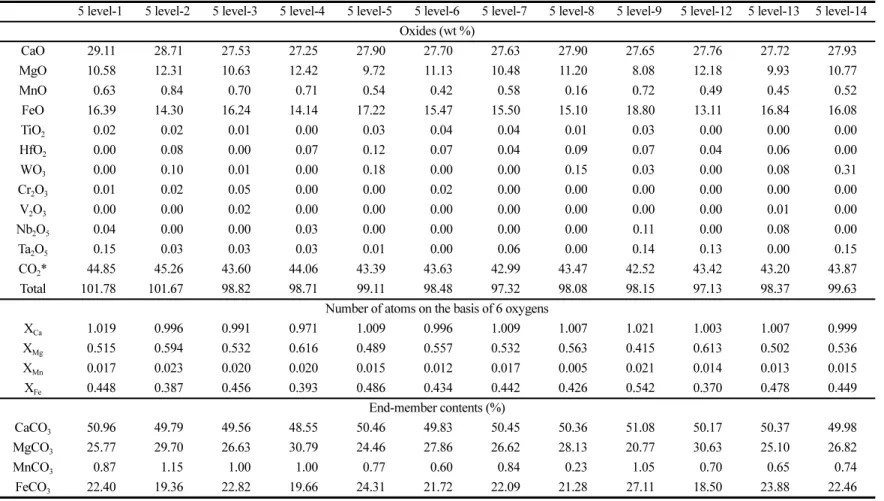
삼광 금-은 광상의 엽리상 석영맥에서 산출되는 철 백운석에 대한 EPMA 정량분석 결과는 Table 2와 같다. 이 도표에서 보는 것과 같이, MgO 함량은 8.08~12.42 wt.%, FeO 함량은 13.11~18.80 wt.%,
Fig. 5. Compositional variation in white mica in terms
of total Si (apfu) vs. Fe+Mg (apfu) (Modified after Christie and Brathwaite, 2003).
Fig. 6. Compositional variation in white mica from Samgwang Au-Ag deposit. (a) total Al (apfu) vs.
Fe+Mg+Mn (apfu), (b) total Al (apfu) vs. K+Na +2Ca (apfu), (c) total Al (apfu) vs. K/(K+Na +2Ca) (apfu) (Modified after Cohen, 2011).
Arrows represent compositional vectors for
main substitution mechanisms and black open
symbols represent end-member compositions.
유봉철
Kor ea n J. Min eral . Petr ol.
Table 2. Chemical composition of ankerite from the Samgwang Au-Ag deposit
5 level-1 5 level-2 5 level-3 5 level-4 5 level-5 5 level-6 5 level-7 5 level-8 5 level-9 5 level-12 5 level-13 5 level-14 Oxides (wt %)
CaO 29.11 28.71 27.53 27.25 27.90 27.70 27.63 27.90 27.65 27.76 27.72 27.93
MgO 10.58 12.31 10.63 12.42 9.72 11.13 10.48 11.20 8.08 12.18 9.93 10.77
MnO 0.63 0.84 0.70 0.71 0.54 0.42 0.58 0.16 0.72 0.49 0.45 0.52
FeO 16.39 14.30 16.24 14.14 17.22 15.47 15.50 15.10 18.80 13.11 16.84 16.08
TiO
20.02 0.02 0.01 0.00 0.03 0.04 0.04 0.01 0.03 0.00 0.00 0.00
HfO
20.00 0.08 0.00 0.07 0.12 0.07 0.04 0.09 0.07 0.04 0.06 0.00
WO
30.00 0.10 0.01 0.00 0.18 0.00 0.00 0.15 0.03 0.00 0.08 0.31
Cr
2O
30.01 0.02 0.05 0.00 0.00 0.02 0.00 0.00 0.00 0.00 0.00 0.00
V
2O
30.00 0.00 0.02 0.00 0.00 0.00 0.00 0.00 0.00 0.00 0.01 0.00
Nb
2O
50.04 0.00 0.00 0.03 0.00 0.00 0.00 0.00 0.11 0.00 0.08 0.00
Ta
2O
50.15 0.03 0.03 0.03 0.01 0.00 0.06 0.00 0.14 0.13 0.00 0.15
CO
2* 44.85 45.26 43.60 44.06 43.39 43.63 42.99 43.47 42.52 43.42 43.20 43.87
Total 101.78 101.67 98.82 98.71 99.11 98.48 97.32 98.08 98.15 97.13 98.37 99.63
Number of atoms on the basis of 6 oxygens
X
Ca1.019 0.996 0.991 0.971 1.009 0.996 1.009 1.007 1.021 1.003 1.007 0.999
X
Mg0.515 0.594 0.532 0.616 0.489 0.557 0.532 0.563 0.415 0.613 0.502 0.536
X
Mn0.017 0.023 0.020 0.020 0.015 0.012 0.017 0.005 0.021 0.014 0.013 0.015
X
Fe0.448 0.387 0.456 0.393 0.486 0.434 0.442 0.426 0.542 0.370 0.478 0.449
End-member contents (%)
CaCO
350.96 49.79 49.56 48.55 50.46 49.83 50.45 50.36 51.08 50.17 50.37 49.98
MgCO
325.77 29.70 26.63 30.79 24.46 27.86 26.62 28.13 20.77 30.63 25.10 26.82
MnCO
30.87 1.15 1.00 1.00 0.77 0.60 0.84 0.23 1.05 0.70 0.65 0.74
FeCO
322.40 19.36 22.82 19.66 24.31 21.72 22.09 21.28 27.11 18.50 23.88 22.46
* = calculated based on stoichiometry
삼광 금-은 광상의 엽리상 석영맥에서 산출되는 백색운모와 철백운석의 산상 및 화학조성 63
MnO 함량은 0.16~0.84 wt.% 값을 갖으며 소량 HfO2, WO3, TiO2, Cr2O3, Nb2O5 및 Ta2O5 원소들 을 갖는 Mg 철백운석으로 산출된다. 이들 원소들의 치환관계를 살펴보면, MgO 원소는 FeO 원소, MnO 원소는 CaO 원소, HfO2, WO3, TiO2, Cr2O3, Nb2O5
및 Ta2O5 원소들은 MgO 및 FeO 원소를 치환하고 있음을 알 수 있다. Fig. 3e-f에서 보는 것과 같이, 철백운석의 결정방향에 따라서 서로 다른 상들(밝은 부분과 어두운 부분)이 교호하며 산출된다. 이들 서 로 다른 상들에 대한 화학조성 변화를 살펴보면, 밝 은 부분과 어두운 부분의 상들에 대한 MgO 함량은 각각 8.08~10.77 wt.%, 11.13~12.42 wt.%, FeO 함량은 각각 15.50~18.80 wt.%, 13.11~15.47 wt.% 및 MnO 함량은 각각 0.45~0.72 wt.%, 0.16~0.84 wt.% 값으로 밝은 부분이 어두운 부분보다 FeO 함량이 높고 MgO 함량은 낮게 산출된다(Table 2). 철백운석의 화 학조성을 기초로 CaCO3-MgCO3-FeCO3 삼각 다이어 그램에 도시하면 뉴질랜드 Reefton goldfield 조산형 금 광상, 호주의 벤디고 gold field 조산형 금광상 및 몽꼴의 Olon Ovoot 조산형 금 광상에서 산출되는 철백운석 조성과 유사하다(Li et al., 1998; Bargar and Keith, 1999; Christie and Brathwaite, 2003;
Yoo et al., 2009)(Fig. 7). 또한 Craw et al. (2009) 에 의하면 뉴질랜드 조산형 금 광상들에서 철백운석
은 철백운석 변질시기(광화작용의 ductile shear 시기
= mineralised schist)에 형성된다고 하였다. 따라서 삼광 금-은 광상에서 산출되는 엽리상 석영맥 산상과 그 엽리상 석영맥에서 산출되는 백색운모 및 철백운 석을 포함한 광물들은 연성전단(ductile shear) 시기에 형성되었음을 의미한다.
사 사
이 연구는 한국지질자원연구원 융합사업인 “북한 광물자원 탐사기술 실증 및 잠재성 평가(18-8901, 19-8901)” 과제로 수행되었으며 이에 사의를 표한다.
바쁘신 와중에도 이 논문의 미비점을 지적, 수정하여 주신 심사위원님들께 깊이 감사드립니다.
REFERENCES