269
Research Article Weed & Turfgrass Science
Weed & Turfgrass Science was renamed from both formerly Korean Journal of Weed Science from Volume 32(3), 2012, and formerly Korean Journal of Turfgrass Science from Volume 25(1), 2011 and Asian Journal of Turfgrass Science from Volume 26(2), 2012 which were launched by The Korean Society of Weed Science and The Turfgrass Society of Korea found in 1981 and 1987, respectively.
마밭에 출현하는 잡초와 식생유형의 특성
김덕환1·박재만1·강상모1·이석민1·이인용2·이인중1*
1경북대학교 농업생명과학대학, 2국립농업과학원 작물보호과
Distribution Characteristics of Weeds and Vegetation Types in Dioscorea oppostifolia Thunb. Field
Duk-Hwan Kim1, Jae-Man Park1, Sang-Mo Kang1, Seok-Min Lee1, In-Yong Lee2, and In-jung Lee1*
1College of Agricultural Kyungpook National University, Daegu 702-701, Korea
2Crop Protection Division, National Academy of Agricultural Science, RDA, Jeonju 560-500, Korea
서 론
마(Dioscorea oppostifolia Thunb.)는 마과에 속하는 덩굴성 다년초로 우리나라 전역에 자생하고 있으며, 전 세계적으 로 약 650여종이 분포되어 있고, 이 가운데 약 10여종이 식 용으로 이용되고 있다(Onwueme, 1978). 마는 21세기의 중 요한 식량자원과 에너지원으로 이용될 수 있는 대표적인 전분작물로서 전세계적으로 볼 때 감자, 카사바, 고구마, 구 약감자, 야콘 다음으로 많이 재배되고 작물이다. 마는 고온 성 작물로 생육적온은 25-30oC이며 우리나라 어느 곳에서 나 재배가 가능하다(Chang et al., 2005). 마는 예로부터 한 방에서 산약이라 불리며 보양제로 알려져 자양, 강정, 지사 등에 유효하고 당뇨병을 비롯한 각종 성인병에 효과가 있 는 것으로 알려져 있다. 또한, 알카리성 식품으로 여러 소
화효소가 함유되어 있어 생식으로도 소화가 잘 되는 작물 로 잘 알려져 있다(Choi, 2012; Shin et al., 2014).
마는 지하부인 괴경의 길고 짧음에 따라 장마와 단마로 구분하고 있으며, 원형형태의 마를 둥근마라고 부르고 있다 (Chang et al, 2005). 우리 나라에서 재배되는 마는 장마, 단 마 및 둥근마로서 충북 충주시와 경북 안동권, 그리고 경남 진주권을 중심으로 재배되고 있다. 둥근마는 괴경이 형성 되는 심도가 낮아 장마와 단마에 비해 수확이 용이하고, mucin이라는 점액질이 장마와 단마에 비해 많고, 분말처럼 가공할 수 있는 특성이 우수하여(Chang et al., 2005), 국내 에는 경남 진주시 지수면, 산청군 생초면, 함양군 유림면, 충북 충주시 일대에서 재배가 되고 있다.
앞서 언급한 바, 건강식품으로서 마의 국내·외 소비가 ABSTRACT. A survey was conducted to identify the occurrence of problematic weed species on the Dioscorea oppostifolia fields in South Korea. Total 43 sites of the 8 different regions in S. Korea were investigated from May to October, 2014. In yam fields, the identified weeds were distributed in 11 families and 44 species. The exotic plants were identified as 3 families, 10 genera, 10 species. The vegetation of Dioscorea oppostifolia fields was classified into communities of 7 groups by methods of the Zurich- Montpellier school of phytosociology (Xanthium canadense Community, Bidens frondosa Community, Echinochloa oryzoides Community, Eclipta prostrata Community, Portulaca oleracea Community, Centipeda minima Community, Rorippa islandica Community). The weeds occurred in Dioscorea oppostifolia fields were divided into three groups in principal component plot anal- ysis (PCA). Without weed control, yields loss in yam production was reached up to 82% as compared to weed controlled fields.
Key words: Dioscorea oppostifolia Thunb., vegetation, PCA analysis
Received on October 16, 2014; Revised on November 12, 2014; Accepted on December 5, 2014
*Corresponding author: Phone) +82-53-950-5708, Fax) +82-53-958-6880; E-mail) [email protected]
© 2014 The Korean Society of Weed Science and The Turfgrass Society of Korea
This is an Open-Access article distributed under the terms of the Creative Commons Attribution Non-Commercial License & #160;
(http://creativecommons.org/licenses/by-nc/3.0) which permits unrestricted noncommercial use, distribution, & #160; and reproduc- tion in any medium, provided the original work is properly cited.
늘어남에 따라, 1990년 이후 그 재배면적과 생산량이 점차 증가하는 추세에 있다. 마의 재배면적은 1990년 104 ha, 1996년 404 ha, 2001년 414 ha, 2006년 563 ha, 2011년 719 ha 인 것으로 집계되고 있다. 90년 이후 재배면적이 급격히 증 가한 이유는 1987년 한방의료보험이 실시되면서 생약수요 가 증가된 것이 주요 원인으로 작용하였으며, 2000년 이후 최근까지 생약용 이외에 건강식품(생즙, 분말)으로도 소비 가 지속적으로 늘어 2008년에는 재배면적이 850 ha까지 증 가하기도 하였으나 2012년 현재 621 ha를 유지하고 있다.
마는 주로 지하영양기관인 괴경을 절단하여 번식시키거 나 괴경상단에 붙어 있는 노두를 이용하여 번식시키거나, 장마와 단마는 잎 기부에서 발생하는 영양체인 영여자(零 余子)를 이용하기도 하는데(Kim et al., 2010), 이러한 마 재 배 특성으로 인하여 발생되는 잡초의 방제에 큰 어려움을 겪고 있다. 마 정식 이후 두둑에 발생되는 잡초는 손제초 에 의존하고 있으며, 마 덩굴이 다발생되기 이전에는 헛골 을 중심으로 마에 등록되지 않은 비선택성 제초제를 처리 하는 것이 전부이다. 일부 농가에서 헛골에 부직포나 멀칭 비닐로 피복을 하고는 있으나, 대부분의 농가에서 잡초가 대발생되는 7-8월에는 손제초 이외의 방제 방법은 없는 실 정이다. 보다 현실적인 수준에서 마밭에서 발생되는 잡초 를 파악하고 주요 초종을 대상으로 방제 가능한 약제 선발 이 시급하다.
2014년 현재, 마에 관한 연구는 마를 가공한 후 특정식품 에 첨가하여 식품의 특성변화를 추적하는 연구, 마(산약) 생 산량 증대를 위한 시비법 개선연구(Shin et al., 2014), 재배 년수에 따른 둥근마 영여자 생산성에 미치는 영향(Kim et al., 2011), 둥근마 종근 종류에 따른 생육과 수량 비교(Kim et al., 2010) 등과 같이 식품가공 및 재배생리와 관련된 연 구가 대부분이며, 마밭에 출현하는 잡초 분류나 식생에 대 한 연구는 전무한 실정이다.
마밭이라는 유사한 입지환경에서 특정한 잡초들이 반복 출현하며 형성되는 식물군락을 통하여 식생유형을 분석하 고, 동시에 이들 주요 잡초들로 인한 마밭의 피해정도를 파 악하여 효과적인 잡초방제 기초자료로 활용하고자 본 시 험을 수행하였다.
재료 및 방법
발생초종 및 식생조사 방법
마밭에 출현하는 초종과 식생군락을 분석하여 마밭 잡초 방제 기초자료로 활용하기 위하여 2014년 5월부터 10월까 지 총 7회에 걸쳐 조사를 실시하였다. 조사지역은 경북 4
지역(안동시, 영주시, 군위군, 청송군), 경남 4지역(진주시, 산청군, 함양군, 창녕군) 총 8개 지역의 43개 지점으로 이 들 지역에서 방형구 설치 후 발생초종을 기록하여 식생자 료(Relevè)를 수집하였다. 잡초는 국가표준식물목록(KNA, 2007)에 의거하여 목록을 작성하였고, 외래잡초는 한국귀 화식물 원색도감에 의해 표기하였다(Park, 2009). 발생한 초 종들은 현장에서 동정을 하였으며, 미확인된 잡초는 샘플 링 후 연구실에서 대한식물도감을 이용하여 동정을 하였 다(Lee, 2006). 일년생잡초와 다년생잡초를 구분하는 생활 사(life cycle)와 잡초의 생육특성을 나타내는 생활형(Life form)은 Raunkiaer (1934)의 분류체계를 따랐다. 조사방형 구는 출현하는 잡초의 특성이 잘 나타난 식생조사구를 중 심으로 발생된 초종을 취합하였으며, 그렇지 않은 조사방 형구는 식생자료로 취합하지 않았다. 잡초군락 분류는 여 러 가지가 있으나, 식물종조성에 중점을 둔 Z.-M.학파(Zürich- Montpellier school)의 식물사회학적 방법(Braun-Blanquet, 1964)을 이용하였다. 분류된 식생단위에 대한 비교 검토는 기여도(NCD: Net Contribution Degree)와 이를 이용하여 정량적 상대값을 나타내는 백분율 상대기여도(rNCD: relative Net Contribution Degree)로 이루어졌다(Lee et al., 2007). 또 한 군락분류와 식생의 공간적 분포 특성 이해는 수리분석 을 통한 통합분류방법(Hybrid Sorting Method : Becking, 1957)으로 정밀도를 높였다(Lee et al., 2007).
ΣCi : 식생단위(군락/군집) 내의 i종의 피도 적산값 N : 전체 조사구 수
ni : i종이 출현한 조사구 수
NCDi : 대상 식생단위에 대한 i종의 기여도 NCDmax : 대상 식생단위 내의 기여도 최대값
통계 및 수량분석
잡초군락의 지역적 식생차이를 분석하기 위하여 각각 PCA (Principal Component Analysis)의 공변량(Covariance) 분석을 실시하였으며, 공변량 분석의 자료 분석은 Community analysis package 4.0 (Seaby and Henderson, 2007)을 이용하 였다. 잡초 무방제구와 방제구에서의 마 수량분석은 경북 군위군 효령면에 위치한 경북대학교 농업생명과학대학 부 속실험실습장에서 실시하였다.
NCDi ΣCi--- N ∋
--- CN( min≤NCD C≤ max)
⋅
=
τNCDi NCDi NCDmax --- 100×
=
결 과
마밭에 발생한 잡초는 총 11과 44종으로 월년생을 포함 한 일년생잡초가 33종, 다년생잡초가 11종으로 조사되었다 (Table 1). 일년생잡초가 전체 잡초의 75%를 차지하였으며, 국화과 잡초들이 13종으로 가장 많았다. 조사지역과 지점 에 비해 발생된 잡초가 현저하게 낮은 이유는 대부분의 농 가에서 헛골을 중심으로 Glufosinate-ammonium, Glyphosate 와 같은 비선택성 제초제를 관행적으로 처리하여 조사된 Table 1. Occurrence of weed species in Dioscorea oppostifolia Thunb. fields.
Scientific names Life form1) Life cycle Class Dicotyledoneae
Order Salicales Family Salicaceae
Salix koreensis Anderss M Perennial
Class Angiospermae Order Urticales Family Urticaceae
Boehmeria nivea (L.) Gaudich. Ch Perennial Order Polygonales
Family Polygonaceae
Persicaria hydropiper (L.) Spach Th Annual Order Centrospermales
Family Chenopodiaceae Chenopodium album var.
centrorubrum Makino Th Annual
Family Amaranthaceae
Amaranthus mangostanus L. Th Annual
Family Amaranthaceae
Portulaca oleracea L. Th Annual
Family Caryophyllaceae
Stellaria aquatica Scop. H Perennial
Family Cruciferae
Capsella bursa-pastoris (L.) Medicus Th Annual Rorippa islandica (Oed.) Borb. H Annual Family Leguminosae
Aeschynomene indica L. Th Annual
Order Geraniales Family Oxalidaceae
Oxalis corniculata L. G Perennial
Family Euphorbiaceae
Acalypha australis L. Th Annual
Euphorbia supina Rafin. H Annual
Scientific names Life form1) Life cycle Order Myrtales
Family Lythraceae
Lythrum anceps (Koehne) Makino H Perennial Family Onagraceae
Ludwigia prostrata Roxb. H Annual
Order Myrtales Family Lythraceae
Lythrum anceps (Koehne) Makino H Perennial Family Onagraceae
Ludwigia prostrata Roxb. H Annual
Order Tubiflorales Family Convolvulaceae
Calystegia hederacea Wall. H Perennial
Calystegia japonica (Thunb.) Chois. H Perennial Calystegia sepium var. americana
Matsuda H Perennial
Family Scrophulariaceae
Lindernia attenuata Muhl. Th Annual
Lindernia procumbens Borbas Th Annual
Mazus pumilus (Burm. F.) Van Steenis Th Annual
Veronica undulata Wall. H Annual
Order Campanulales Family Compositae
Artemisia princeps var.orientalis
(Pampan.) Hara H Perennial
Bidens frondosa L. Th Annual
Eclipta prostrata L. Th Annual
Erigeron annuus (L.) Pers. Th Annual
Erigeron canadensis L. Th Annual
Galinsoga ciliata (Raf.) Blake Th Annual
Hemistepta lyrata Bunge Th Annual
Ixeris dentata (Thunb.) Nakai H Perennial
Senecio vulgaris L. Th Annual
Taraxacum officinale Weber H Perennial
Sonchus oleraceus L. Th Annual
Centipeda minima (L.) A. Br. et Aschers. Th Annual
Xanthium canadense Mill. Th Annual
Order Graminales Family Gramineae
Digitaria sanguinalis (L.) Scop. Th Annual Echinochloa crus-galli (L.) Beauv. Th Annual Echinochloa oryzoides (Ard.) Fritsch Th Annual
Eleusine indica (L.) Gaertn Th Annual
지점에 비해 출현한 잡초의 수는 많지가 않아 종다양성이 높지는 않은 것으로 확인되었다. 또한 대부분 논 경작지에 마를 심은 경우가 많아 주요 우점잡초는 논 경작지 식생이 발달된 것을 확인하였다. 조사지역 내 확인된 귀화식물은 3과 10종으로 분류되었으며, 국화과 8종, 현삼과 1종, 대극 과 1종으로 분류되었다(Table 2). 귀화식물 가운데 마밭에 서 잡초군락의 형태를 보이는 초종으로는 미국가막사리와 큰도꼬마리가 확인되었다. 마 재배농가에서 주기적으로 실 시하는 손제초와 비선택성 제초제 처리가 행해지지 않았다 면 발생되는 귀화식물은 이보다 훨씬 많았을 것으로 판단된다.
경남 진주시 지수면(남강), 경남 창녕군 부곡면(낙동강), 경남 산청군 생초면(경호강), 경북 안동시 북후면(송야천
지류) 일원의 마밭은 대부분 하천을 인접하고 있어 하천식 생에 가까운 종조성을 보일 것으로 판단되었으나, 이들 지 역으로는 우리나라 하천의 높은 토지 이용압으로 인해 발 생되는 하천의 구조적 변화(밭이나 논)로 소리쟁이류, 명 아주류 및 비름류, 기타 귀화식물종 등의 진개(塵芥)식생 의 잡초들이 높은 빈도와 피도로 나타났다(Kim and Lee;
2006). 경남 창녕군 부곡면 일대로는 4대강 농경지 리모델 링으로 준설토를 덮는 객토사업이 이루어져 다른 지역과 는 달리 귀화식물인 큰도꼬마리와 미국가막사리가 우점하 는 독특한 식생양상을 보였다. 이들 지역으로는 향후 잡초 의 변화양상 및 논 경작지 식생천이와 관련하여 지속적인 모니터링이 필요할 것으로 판단된다.
조사방형구를 통해 얻어진 식생자료를 분석한 결과, 마 밭에 우점하는 잡초군락은 같은 지역 내 조사지점간의 차 이보다는 지역적으로 발생하는 잡초군락에 의한 군락분류 가 발생하는 것으로 확인되었다(Table 3). 논피가 우점하여 군집을 형성하는 경남 창녕군 부곡면과 안동시 북후면은 각각 1개의 군락으로 세분화되었다(Table 4). 먼저 경남 창 녕군 부곡면에서 경작되고 있는 마밭에서는 큰도꼬마리-미 국가막사리 군락이 나타났는데, 유일하게 귀화식물이 군락 으로 형성되었다. 큰도꼬마리의 경우, 종자의 구조상 발아 의 차이를 두게 되는데 그로인해 이들 지역은 지속적으로 큰도꼬마리가 잠재적으로 우점할 것으로 예측된다. 미국가 막사리 또한 논에서 지속적으로 발생되는 귀화식물로서 습 한 지역을 선호하는 습성을 지니고 있고, 종자의 생산량 또 한 자생잡초인 가막사리보다 많아 농경지에서 그 피해가 심각할 것으로 보인다. 창녕군 부곡면에서는 이외에도 한 련초, 방동사니, 미국외풀, 돌피 등 논잡초류 발생율이 높 은 것으로 확인되었다. 창녕군 부곡면 일대로 4대강 농경 Table 1. Occurrence of weed species in Dioscorea oppostifolia
Thunb. fields (continued).
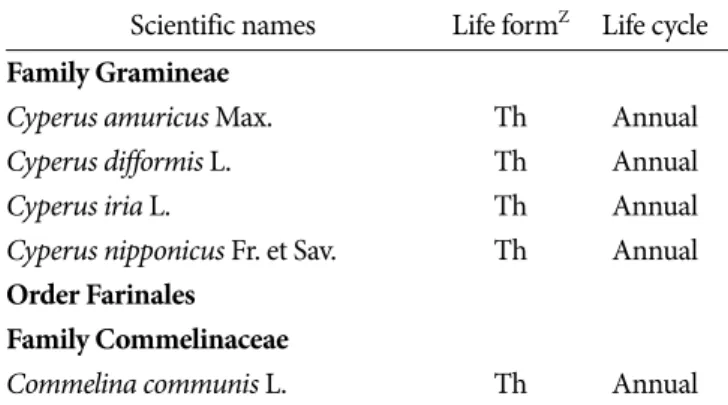
Scientific names Life formZ Life cycle Family Gramineae
Cyperus amuricus Max. Th Annual
Cyperus difformis L. Th Annual
Cyperus iria L. Th Annual
Cyperus nipponicus Fr. et Sav. Th Annual Order Farinales
Family Commelinaceae
Commelina communis L. Th Annual
ZRanukiaer's life form spectra.
M: Megaphanerophytes, Mesophanerophytes, Microphanerophytes; N:
Nanophanerophytes; E: Epiphytes; CH: Chamaephytes; H:
Hemicryptophytes; G: Geophytes; HH: Hydrophytes; Th: Therophytes.
Table 2. List of the exotic plants in Dioscorea oppostifolia Thunb.
field of cultivated area.
No. Family Weeds Community
1
Compositae
Bidens frondosa L. 미국가막사리 ○
2 Sochus oleraceus L. 방가지똥 -
3 Erigeron annuus (L.) Pers. 개망초 -
4 Galinsoga ciliata (Raf.) S.F.Blake
털별꽃아재비 -
5 Conyza canadensis (L.) Cronquist 망초 -
6 Taraxacum officinale Weber
서양민들레 -
7 Senecio vulgaris L. 개쑥갓 -
8 Xanthium canadense Mill.
큰도꼬마리 ○
9 ScrophulariaceaeLindernia dubia (L.) Pennell
미국외풀 -
10 Euphorbiaceae Euphorbia supina Raf.
애기땅빈대 -
Table 3. Synthesized vegetation table using rNCD value
Vegetation GroupZ A
B C
XB PR
Total Species 15 24 29 13
Releve 28 14 35 29
Differential species of plant communities Echinochloa oryzoides (Ard.)
Fritsch 90.0 94.4
Xanthium canadense Mill. 100 Bidens frondosa L. 85.7 13.1
Portulaca oleracea L. 0.2 100 42.1 6.9 Rorippa islandica (Oed.) Borb. 76.2 20.9 8.6 Centipeda minima (L.) A. Br. et
Aschers. 0.8 100 6.4
Eclipta prostrata L. 31.1 1.6 1.6 100
지 리모델링 사업으로 객토를 하면서 외부에서 유입된 큰 도꼬마리가 농경지에 혼입되면서 독특한 잡초군락을 형성 한 것으로 보인다.
경북 안동시 북후면 일대의 마밭에서는 쇠비름-속속이풀 군락이 형성되어 있었다. 전국적으로 광범위하게 발생되는 잡초이며, 수반되는 또 다른 잡초로는 명아주, 바랭이, 방
동사니, 메꽃 등으로 전형적인 밭잡초 출현이 높은 지역으 로 분석되었다.
경남 산청군 생초면의 경우, 경호강과 인접한 하천변 농 경지에서 마 재배를 하는 입지 조건을 보이고 있었다. 이곳 은 논경작지라기 보다는 하천식생으로 유수역과 정수역의 가장자리에서 띠 형태 도는 소규모 면적으로 발달된 식생 형으로 밭잡초의 출현율이 높았으며(Kim and Lee, 2006), 쇠비름, 속속이풀, 나도방동사니, 괭이밥, 방가지똥 등의 잡 초들이 수반되어 출현하였다.
경남 진주시 지수면 지역의 마 경작지에서는 한련초가 절대적으로 우점하는 경향을 보였으며, 이외에 쇠비름, 속 속이풀, 중대가리풀, 방동사니가 수반되었다. 지수면 남강 일대는 전국에서 가장 넓은 면적인 약 57.5 ha의 규모로 마 가 생산되는데, 영농조합에서 대단위로 경작을 하고 있었 다. 주기적으로 인력을 동원하여 손제초를 실시하는 이유 로 경작지 내 잡초의 다양성은 높지 않았다.
통계 및 수량분석 결과
PCA (Principal component analysis) 분석은 군집생태에 서 군락을 구성하는 방형구의 초종간의 분석이 우수하여 생태학에서 주로 이용되고 있다(JanžekoviË and Novak, 2012;
Lee et al., 2014). PCA-Covariance 분석을 실시하여 마밭에 출현한 초종들의 분석을 실시한 결과, 큰도꼬마리 군락 Table 3. Synthesized vegetation table using rNCD value
(continued).
Companion
Chenopodium album var.
centrorubrum Makino 37.7 0.1
Digitaria sanguinalis (L.) Scop. 20.6
Cyperus amuricus Max. 4.8 20.6 3.5 5.0 Cyperus nipponicus Fr. et Sav. 29.2 1.6
Oxalis corniculata L. 1.2 26.4
Sonchus oleraceus L. 11.9
Lindernia procumbens Borbas 0.8 11.4 0.3 Lindernia attenuata Muhl. 9.1
Calystegia japonica (Thunb.)
Chois. 9.5
Persicaria hydropiper (L.) Spach 4.0
Cyperus iria L. 3.4
Calystegia sepium var. americana
Matsuda 3.6 2.9 0.1
Acalypha australis L. 0.6 2.4 0.1 1.0
Aeschynomene indica L. 3.2 1.9
Mazus pumilus (Burm. F.)
Van Steenis 2.0 9.0 0.3
Ludwigia prostrata Roxb. 1.4 9.0 1.9 Commelina communis L. 2.1 1.6
Amaranthus mangostanus L. 0.8 2.9 Erigeron annuus (L.) Pers. 1.6 1.8
Salix koreensis Anderss 1.6
Erigeron canadensis L. 1.2 0.1
Cyperus difformis L. 0.8 0.6
Taraxacum officinale Weber 0.8 0.1 Echinochloa crus-galli (L.)
Beauv. 0.4
Capsella bursa-pastoris (L.)
Medicus 0.8
Senecio vulgaris L. 0.1
The other species were omitted by author.
ZA: Echinochloa oryzoides community; B: Centipeda minima community; C: Eclipta prostrata community; XB: Xanthium canadense-Bidens frondosa community; PR: Portulaca oleracea- Rorippa islandica community
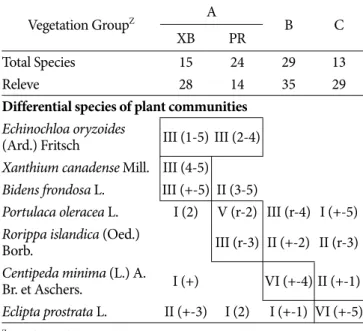
Table 4. Synthesized summary table in Dioscorea oppostifolia Thunb. Fields
Vegetation GroupZ A
B C
XB PR
Total Species 15 24 29 13
Releve 28 14 35 29
Differential species of plant communities Echinochloa oryzoides
(Ard.) Fritsch III (1-5) III (2-4) Xanthium canadense Mill. III (4-5)
Bidens frondosa L. III (+-5) II (3-5)
Portulaca oleracea L. I (2) V (r-2) III (r-4) I (+-5) Rorippa islandica (Oed.)
Borb. III (r-3) II (+-2) II (r-3) Centipeda minima (L.) A.
Br. et Aschers. I (+) VI (+-4) II (+-1) Eclipta prostrata L. II (+-3) I (2) I (+-1) VI (+-5)
ZA: Echinochloa oryzoides community; B: Centipeda minima community;
C: Eclipta prostrata community; XB: Xanthium canadense-Bidens frondosa community; PR: Portulaca oleracea-Rorippa islandica community.
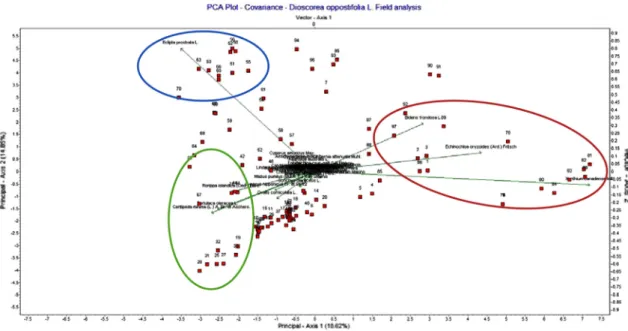
(Xanthium canadense Community), 미국가막사리 군락 (Bidens frondosa Community), 논피 군락(Echinochloa oryzoides Community), 한련초 군락(Eclipta prostrata Community), 쇠비름 군락(Portulaca oleracea Community), 중대가리풀 군락(Centipeda minima Community), 마지막으 로 속속이풀 군락(Rorippa islandica Community)으로 분석 되었다(Fig. 1). 이 결과는 앞서 군락분석을 실시한 식물사 회학적 군락분석 결과와 동일하게 나타났다. 큰도꼬마리와 미국가막사리, 논피가 같은 그룹에, 한련초가 단일 그룹으 로 유형화된 결과는 각각, 경남 창녕군 부곡면과 경남 진 주시 지수면의 마밭에 출현하는 잡초종이 명확히 구분되 는 식별종으로 군락을 구성하고 있다는 결과로 해석되며, 한련초, 중대가리풀, 속속이풀이 같은 그룹에 속한 결과는 경북 안동시 북후면과 경남 산청군 생초면의 마밭에서 우 점하는 종은 다르나 수반되어 출현하는 초종들이 유사한 패턴을 보인다는 것을 확인하였다.
마밭에 발생된 잡초에 의한 마 괴경 수량변화를 확인하 기 위해 잡초 무방제구와 방제구로 나누어 수량변화를 확 인하였다(Table 5). 실험이 진행된 2013년 12월까지 마밭의 헛골에 등록된 비선택성 제초제가 없어 잡초 방제구는 물 리적 잡초방제 방법인 중경제초를 20일마다 실시하여 헛 골 잡초를 방제하였다. 잡초 무방제구의 마 괴경 20주당 무 게는 211.8 g이며 잡초 방제구의 마 괴경 20주당 무게는 1,153.6 g으로 약 81.6%의 수량 감소율을 보였다. 무방제구 에 발생된 우점잡초로는 물피, 명아주, 미국가막사리, 바랭 이가 발생하여 마의 지상부 생육저하를 야기시키고, 이들
의 초장이 커지면서 형성된 canopy로 인해 마의 광합성에 도 악영향을 끼쳤을 것으로 예측된다. 단순한 무게 감소뿐 만 아니라, 실제 수확된 마의 괴경모양(상품성)을 고려하 면 그 피해가 더 큰 것으로 확인되었다.
본 조사 결과, 마(둥근마, 장마, 단마)는 생육 특성상 덩 굴이 우거지는 6월 이전에 초기 잡초방제가 이루어져야 한 다. 특히나 헛골을 중심으로 발생되는 잡초는 마가 생육하 는데 상당히 불리한 조건이 되므로 체계적인 관리가 필요 할 것으로 예측된다. 일부 농가에서는 두둑과 헛골 모두 비 닐멀칭을 실시하여 발생되는 초종을 사전에 억제시키기도 하지만, 폐비닐 발생과 무단 소각으로 인한 환경오염이 발 생된다. 마밭의 헛골에 적용가능한 비선택성 제초제를 개 발하고 체계적인 잡초관리가 이루어진다면 마의 안정적인 생산으로 이어질 것으로 판단된다.
요 약
마밭에 출현하는 초종과 식생군락을 분석하여 마밭 잡초 Fig. 1. Result of PCA plot covariance in Dioscorea oppostifolia Thunb. fields.
Table 5. Comparison of Dioscorea oppostifolia's root weight between weed control plot and weed untreated control plot.
Weed treated control plot
Weed untreated control plot.
Root weight (g) Root weight (g) Average of 20 plant roots 1,153.6 211.8 Rate of decrease (%) - 81.6
방제 기초자료로 활용하기 위하여 2014년 5월부터 10월까 지 총 7회에 걸쳐 조사를 실시하였다. 마밭에는 총 11과 44 종이 출현하였으며, 조사지역 내 출현한 귀화식물은 3과, 10속 10종으로 분류되었는데 주기적인 잡초방제로 인하여 잡초의 생물다양성이 높지는 않았다. Z-M학파의 식물사회 학적 식생분류 결과, 큰도꼬마리, 논피, 미국가막사리, 한련 초, 속속이풀, 중대가리풀, 쇠비름이 군락으로 분류되었으 며, PCA plot 분석결과도 식생분류 결과와 동일하게 유형 화되었다. 수량조사 결과, 잡초 방제구 대비 무처리에서 82%의 수량감소가 발생하였다.
주요어: 마밭, 식생군락, PCA 분석
Acknowledgment
This study was supported by joint research project of Rural Development Administration, Republic of Korea (Project number: PJ00919201).
References
Becking, R.W. 1957. The Zurich-montpellier school of phytosociology Bot. Rev. 23:411-488.
Braun-Blanquet, J. 1964. Pflanzensoziologie: grundzüge der vegetationskunde. Zweite, umgearbeitete und vermehrte Auflage. Springer-Verlag: Wien. p. 865.
Chang, K.J., Park, B.J., Park, J.H., Kim, S.L. and Park, C.H. 2005.
2005. Tuber enlargement and chemical components of yams (Dioscorea opposita Thunb.). Korean J. Plant Res. 18(1):161- 168.
Choi, W.S. 2012. Development of functional beverage using yam (Dioscorea opposita Thunb.). Food Industry Nutr. 17(2):20-22.
JanûekoviË, F. and Novak, T. 2012. PCAA powerful method for
analyze ecological niches. p. 127.
Kim, I.J., Nam, S.Y., Choi, S.Y., Song, I.G., Kim, D.S., et al. 2010.
Comparison of root growth and yield by tuber types of Dioscortea opposita Thunb. Korean J. Intl. Agri. 22(2):134-138.
Kim, I.J., Nam, S.Y., Choi, S.Y., Yun, C.K., Lee, J.S., et al. 2011.
Effects of years of cultivation on the growth and yied of epi- phyte bulbil in dioscorea opposita. Korean J. Intl. Agri.
23(3):292-296.
Kim, J.W. and Lee, Y.K. 2006. Classification and assessment of plant communities. Worldscience, Seoul, Korea. (In Korean) KNA (Korea National Arboretum). 2007. A synonymic list of
vascular plants in Korea. Korea National Arboretum. Pochen, Gyeonggi, Korea.
Lee, Y.K., Kwon, S.G. and Baek, H.M. 2007. The riparian vegetation characteristics in habitats of Cottus koreanus (Cottidae:
Osteichthyes). Kor. J. Env. Eco. 21(5):390-399.
Lee, Y. N. 2006. New flora of Korea. Gyohaksa, Seoul, Korea. (In Korean)
Lee, I.Y., Kim, C.S., Lee, J.R., Kim, J.H., Kim, K.H., et al. 2014. The occurrence of weed species in cultivated Ligularia fischeri Fields. Weed Turf. Sci. 3(2):95-101.
Onwueme, I.C. 1978. The tropical tuber crops; yams, cassava, sweet potato and coco yam. John Wiley Chichester, UK.
Park, S.H. 2009. New illustrations and photographs of naturalized plants of Korea. Ilchokak Inc., Seoul, Korea. (In Korean) Raunkiaer, C. 1934. The life forms of plants and statistical plant
geography. Oxford University Press, Oxford, UK.
Seaby, R.M.H. and Henderson, P.A. 2007. Community analysis package 4-Reference manual and user' guide to CAP for window program. Pisces, UK.
Shin, J.H., Kim, S.K., Kang, D.K. and Park, S.Z. 2014. Effect of fertilizer and organic matter level on marketable tuber production in Chinese yam (Dioscorea opposita). Korean J.
Crop Sci. 59(2):144-150.