저작자표시-비영리-변경금지 2.0 대한민국 이용자는 아래의 조건을 따르는 경우에 한하여 자유롭게 l 이 저작물을 복제, 배포, 전송, 전시, 공연 및 방송할 수 있습니다. 다음과 같은 조건을 따라야 합니다: l 귀하는, 이 저작물의 재이용이나 배포의 경우, 이 저작물에 적용된 이용허락조건 을 명확하게 나타내어야 합니다. l 저작권자로부터 별도의 허가를 받으면 이러한 조건들은 적용되지 않습니다. 저작권법에 따른 이용자의 권리는 위의 내용에 의하여 영향을 받지 않습니다. 이것은 이용허락규약(Legal Code)을 이해하기 쉽게 요약한 것입니다. Disclaimer 저작자표시. 귀하는 원저작자를 표시하여야 합니다. 비영리. 귀하는 이 저작물을 영리 목적으로 이용할 수 없습니다. 변경금지. 귀하는 이 저작물을 개작, 변형 또는 가공할 수 없습니다.
A Thesis for the Degree of Master of Science
Comparative approach to decipher the
molecular basis of pattern-triggered immunity
in Brassica rapa pekinensis
배추의 패턴 유발 면역체계의 기반과 기능에
대한 비교 연구
AUGUST 2019
YONGHUA TIAN
MAJOR IN HORTICULTURAL SCIENCE
AND BIOTECHNOLOGY
THE GRADUATE SCHOOL OF
SEOUL NATIONAL UNIVERSITY
Comparative approach to decipher the
molecular basis of pattern-triggered immunity
in Brassica rapa pekinensis
YONGHUA TIANDEPARTMENT OF PLANT SCIENCE
THE GRADUATE SCHOOL OF SEOUL NATIONAL UNIVERSITY
ABSTRACT
Chinese cabbage (Brassica rapa ssp. pekinensis) is an important horticultural crop which is particularly popular in Korea. Several bacterial and fungal diseases can significantly impair Chinese cabbage production. Plants rely on their innate immune system to defend themselves against pathogens. The surface-localized pattern-recognition receptors (PRRs) perceive pathogen-associated molecular patterns (PAMPs), such as flagellin, elongation factor Tu or fungal cell wall component chitin, and induce a series of defense responses called pattern-triggered immunity (PTI). PTI efficiently restricts pathogen growth and provide durable broad-spectrum disease resistance. PRRs and PTI signaling have been intensively investigated in the model species Arabidopsis thaliana, however, the comprehensive understanding is scarce in Chinese cabbage.
In order to decipher the molecular basis of PTI in Chinese cabbage, PAMP responsiveness was investigated by assessing typical defense responses.
significantly and rapidly induced by several PAMPs. ROS production was rapidly induced upon flg22, elf18 and chitin treatments in Chinese cabbage.
Comparative analysis revealed the presence of putative homologs of
Arabidopsis FLS2, EFR and CERK1 in B. rapa genome, and revealed the high
similarity between protein sequences of BraPRR and AtPRR. The putative
BraFLS2, BraEFR1, BraEFR2 and BraCERK1 were cloned using Golden Gate
cloning strategy.
Transient expression of BraFLS2, BraEFRs and BraCERK1 in Nicotiana
benthamiana showed all BraPRRs were plasma membrane-localized and
BraFLS2 mediated flg22-triggered endocytosis, BraEFR2 mediated elf18-triggered ROS burst and BraCERK1 led to chitin-independent cell death.
BraEFR1 expression could not induce ROS burst in N. benthamiana, suggesting
that BraEFR1 might not function.
Subsequently, BraFLS2, BraEFR1, BraEFR2 and BraCERK1 were further characterized by functional complementation in Arabidopsis fls2 single mutant or fls2 efr cerk1 triple mutant. The expression of BraFLS2, BraEFR2 and
BraCERK1 conferred gain of flg22, elf18 and chitin-responsiveness,
respectively, in transgenic lines. Expression of BraFLS2 and BraEFR2 led to flg22 and elf18-induced seedling growth inhibition, respectively, in transgenic
BraFLS2 or BraEFR2 expressing lines. Expression of BraFLS2, BraEFR2 and BraCERK1 induced ROS production upon flg22, elf18 and chitin elicitation in
transgenic BraPRR expressing lines, respectively. Kinase activity of BraPRRs was also assessed in this study via construction of BraPRR dead kinase versions.
All results indicated that BraFLS2, BraEFR2 and BraCERK1 most likely function as PRRs in Chinese cabbage in a partial kinase-dependent manner.
Key words: Chinese cabbage, Brassica rapa pekinensis, pattern-triggered
immunity (PTI), pattern-recognition receptor (PRR), pathogen-associated molecular pattern (PAMP).
CONTENTS
ABSTRACT ... I CONTENTS ... V LIST OF TABLES ... VIII
LIST OF FIGURES ... IX LIST OF ABBREVIATIONS ... X
INTRODUCTION ... 1
MATERIALS AND METHODS ... 8
Plant materials and growth conditions ... 8
PAMP solutions ... 9
RNA isolation and cDNA synthesis ... 9
Reverse transcription polymerase chain reaction (RT-PCR) ... 10
Quantitative Real-time PCR (qRT-PCR or qPCR) ... 10
Oxidative burst measurement ... 11
Cloning and Construction of PRR library ... 11
Agrobacterium-mediated transient expression in N. benthamiana ... 13
Subcellular localization analysis ... 13
Generation of transgenic PRR expressing lines ... 14
RESULTS ... 15 Pattern-triggered immune responses in Chinese cabbage ... 15 Multiple homologs of AtPRRs exist in Chinese cabbage genome. ... 15 PAMPs upregulated the expression of defense marker genes in Chinese
cabbage. ... 17 flg22, elf18 and chitin triggered ROS burst in Chinese cabbage. ... 22 Identification and characterization of BraFLS2, BraEFR and
BraCERK1 candidates ... 27
At least one B. rapa ortholog of AtFLS2, AtEFR and AtCERK1 express in Chinese cabbage. ... 27 BraPRRs share a high similarity with their orthologous AtPRRs in
protein sequences. ... 29 BraFLS2, BraEFR, and BraCERK1 were expressed in 1, 2, 4, 6-week-old
Chinese cabbage leaves. ... 38 Cloning and expression library of PRRs were created using Golden Gate
Assembly. ... 43 Functional analysis of BraFLS2, BraEFR1, BraEFR2 and BraCERK1
by transient expression in N. benthamiana ... 47 BraPRR-YFPs were localized at the plasma membrane of plant cells. .. 47 BraFLS2 endocytosis was induced upon flg22 perception. ... 52 BraEFR2 expression induced elf18-triggered ROS production. ... 53 BraCERK1 expression led to chitin-independent cell death. ... 56 Functional complementation in Arabidopsis transgenic
BraPRR-expressing lines ... 59 Screening of Arabidopsis transgenic PRR expressing lines ... 59
BraFLS2 and BraEFR2 expression complemented flg22 and
elf18-triggered seedling growth inhibition in fls2 and fec mutants. ... 61
Expression of BraPRRs led to PAMP responsive ROS production in fls2 or fec mutant. ... 65
Functional complementation in SGI assay and oxidative burst assay correlated with transgene expression. ... 69
DISCUSSION ... 76
The repertoire of PAMP-perception in Chinese cabbage ... 76
Divergence in the expression of two BraFLS2 candidates ... 77
Functionality between two BraEFR candidates ... 79
BraCERK1: the PTI dogma breaker ... 80
Kinase activity of BraFLS2, BraEFR2 and BraCERK1 for immune responses ... 81
Diverse degrees of immune responses from T2 transgenic plants ... 83
The conserved and sophisticated immune system of plant ... 83
REFERENCES ... 85
APPENDICES ... 96
LIST OF TABLES
Table 1 | Homologs of known PRRs in B. rapa genome ... 16
Table 2 | Expression of BraFLS2, BraEFR and BraCERK1 in B.rapa
organs ... 28
Table 3 | Identity of functional domains and protein sequences between
BraPRRs and AtPRRs ... 37
Appendix A | Primers list ... 96
Appendix B | Cloning and expression vector construction using Golden
Gate assembly ... 100
Appendix C | Generation of Arabidopsis transgenic PRR expressing
LIST OF FIGURES
Figure 1 | PAMP-responsive defense marker gene expression ... 21
Figure 2 | PAMP-induced ROS production in B.rapa and A.thaliana
Col-0... 26
Figure 3 | Alignments and annotations of BraPRRs protein sequences ... 36
Figure 4 | Expression of BraPRR candidates in Chinese cabbage leaf ... 42
Figure 5 | Cloning scheme for the construction of PRR-library by Golden
Gate Assembly ... 46
Figure 6 | Localization of BraPRRs and endocytosis upon flg22 perception
in N. benthamiana ... 51
Figure 7 | elf18-induced ROS production in N. benthamiana transiently
expressing BraEFR1 and BraEFR2 ... 55
Figure 8 | Cell death induced by BraCERK1 in N. benthamiana ... 58
Figure 9 | Seedling growth inhibition in transgenic FLS2 and EFR
expressing lines ... 64
Figure 10 | PAMP-induced ROS production in transgenic PRR
overexpressing lines ... 68
Figure 11 | Expression of transgenes in transgenic PRR expressing lines .. 72
Figure 12 | Defense responses triggered by BraPRRs in this study ... 75
LIST OF ABBREVIATIONS
A. thaliana Arabidopsis thaliana
A. tumefaciens Agrobacterium tumefaciens
AA Amino Acid residues
At Arabidopsis thaliana
B. rapa Brassica rapa pekinensis
BAK1 BRI1-ASSOCIATED RECEPTOR KINASE 1
BGAL1 β-galactosidase 1
BIK1 BOTRYTIS-INDUCED KINASE 1
BR brassinosteroids
Bra B. rapa
BRAD Brassica database
CAPS cleaved amplified polymorphic sequence
CDI1 CELL DEATH INDUCING 1
CDPK calcium-dependent protein kinase
CEBiP CHITIN ELICITOR BINDING PROTEIN
CERK1 CHITIN ELICITOR RECEPTOR KINASE 1
CSP cold shock protein
dpi day post infiltration
EFR EF-TU RECEPTOR
EF-Tu elongation factor Tu
ER the endoplasmic reticulum
ETI effector-triggered immunity
fec fls2 efr cerk1 triple mutant
FLS2 FLAGELLIN SENSITIVE 2
FPKM fragments per kilobase of exon per million fragments
mapped
gDNA genomic DNA
GFP Green fluorescent protein
HR hypersensitive response
LD condition long-day condition
LEC lectin motifs
LF less fractioned subgenome
LPS lipopolysaccharides
LRR domain leucine-rich repeat domain
MAPK mitogen-activated protein kinase
MF1 moderate fractioned subgenome
MF2 most fractioned subgenome
mod module
MS medium Murashige and Skoog medium
N. benthamiana Nicotiana benthamiana
Nb Nicotiana benthamiana
NB domain nucleotide-binding domain
Norang Norang Kimchi Baechu
Os Oryza sativa
PAMP pathogen-associated molecular pattern
PBL PBS1-LIKE KINASE
PGN peptidoglycans
PM plasma membrane
PRR pattern-recognition receptor
PTI pattern-triggered immunity
pUC19B vector pICH41021
qPCR Quantitative Real-time PCR
R protein resistance protein
R:S the ratios of resistant to susceptible individuals
RBOHD RESPIRATORY BURST OXIDASE HOMOLOG
PROTEIN D
Rc Rhynchosporium commune
RLCK receptor-like cytoplasmic kinase
RLK receptor-like kinase
RLP receptor-like protein
RLU relative light unit
ROS reactive oxygen species
RT reverse transcription
RT-PCR reverse transcription polymerase chain reaction
SD condition short-day condition
SGI seedling growth inhibition
SP signal peptide
TM domain transmembrane domain
WT wild-type
INTRODUCTION
Brassica rapa pekinensis (abbreviated B. rapa hereafter), also called Chinese
cabbage, is a common horticultural crop in East Asia. It is widely used in cuisine, and particularly important in Korea as the main ingredient of a traditional food “Kimchi”. Known as a highly nutritious and healthy vegetable, Chinese cabbage has also become popular worldwide. Through breeding and cultivation improvement, people can get a good yield of Chinese cabbage, however, pests, bacterial and fungal diseases such as black rot, soft rot or blackleg, seriously impair its production. Bacterial soft rot is deemed one of the most destructive diseases that threaten
Brassica species.
To defend themselves against pathogens, plants rely on their innate immune system where each individual cell can trigger local responses and produce systemic defense signals. Plant immunity is widely described as a multi-layered recognition system that involves transmembrane pattern recognition receptors (PRRs) and intracellular receptors (Dodds and Rathjen, 2010; Dangl et al., 2013). PRRs perceive conserved pathogen-associated molecular patterns (PAMPs) and usually mediate profound and tractable defense responses called pattern-triggered immunity (PTI). PTI efficiently restricts the growth of pathogens and contribute to basal and durable disease resistance of plants. Adapted pathogens secrete virulence factors, termed effectors to interfere with PTI (Dodds and Rathjen, 2010). However, those effectors can be perceived by intracellular receptors, which are also called resistance (R) proteins, containing nucleotide-binding (NB) and leucine-rich repeat (LRR) domains, and triggering a robust defense responses called effector-triggered
immunity (ETI). ETI is deemed commonly an accelerated and amplified responses of PTI, usually resulting in a hypersensitive response (HR) localized at the infection site (Jones and Dangl, 2006). However, continued studies indicated that plant immune system is continuous and integrated, so it could not be narrowly defined using a simple PTI-ETI dichotomy (Cook et al., 2015). PRRs are as dynamic as R proteins evolved via specific host-pathogen interaction. Both PRRs and PAMPs display dynamic variations even within a single species, suggesting a specific recognition rather than general perception (Cook et al., 2015).
Well-characterized bacterial PAMPs include flagellin and its immunogenic epitope flg22 and flgII-28 (Felix et al., 1999; Gómez-Gómez and Boller, 2000; Cai
et al., 2011), elongation factor Tu (EF-Tu) and its epitope elf18 and EFa50 (Kunze et al., 2004; Zipfel et al., 2006; Furukawa et al., 2014), cold shock proteins (CSP22) (Felix and Boller, 2003), lipopolysaccharides (LPS) (Erbs and Newman, 2012)
and a major component of bacterial cell walls, peptidoglycans (PGNs) (Gust et al.,
2007; Erbs et al., 2008). Likewise, the major component of fungal cell wall, chitin,
is also a well described PAMP (Shibuya and Minami, 2001). Little is known about the release of PAMPs that are usually embedded in the polymer structure. Recent study revealed that plant secreted β-galactosidase 1 (BGAL1) to release flagellin elicitor from glycosylated flagellin carrying a terminal modified viosamine, and plant-secreted proteases could process the deglycosylated flagellin to release the immunogenic peptide elicitors in the apoplast (Buscaill et al., 2019). Significant variation exists in sequences of the same PAMP across microbe species that leads to diverse degrees of immune responses in plant, although PAMP is usually defined conserved because of its crucial and necessary role in the life of microbes. Likewise, the significant variation also exists in PAMP responsiveness among plant species or even within one plant species, resulting from the variation of PRR repertoire across
species or families.
Several PAMP responsive receptors PRRs have been identified, such as FLAGELLIN SENSITIVE 2 (FLS2), EF-TU RECEPTOR (EFR) or CHITIN ELICITOR RECEPTOR KINASE 1 (CERK1) (Gómez-Gómez and Boller, 2000;
Zipfel et al., 2006; Miya et al., 2007). PRRs identified so far are plasma membrane
localized proteins in plant, and they are either receptor-like kinases (RLKs) or receptor-like proteins (RLPs). RLKs are composed of a ligand-binding ectodomain, a single pass transmembrane domain, and an intracellular kinase domain. RLPs share a similar structure with RLKs, but lack the kinase domain, suggesting that its full activation requires a cooperation with other kinase proteins. Relying on the ectodomains, PRRs could be also subdivided as leucine-rich repeats (LRR)-RLKs/RLPs that bind to proteins or peptides like flagellin and EF-Tu, lysine motifs (LysM)-RLKs/RLPs that bind to carbohydrate-based ligands like chitin and PGN, or lectin motifs (LEC)-RLKs/RLPs that bind to extracellular ATP or LPS (Zipfel, 2014;
Bohm et al., 2014). Neither RLKs nor RLPs could contribute PTI by themselves,
they emanate and transduce the defense signals from the ectodomain after PAMP perception to activate the intracellular PTI pathway, relying on forming a PRR complexes with co-receptor or signal enhancer at the plasma membrane (Monaghan
and Zipfel, 2012; Macho and Zipfel., 2014). One of well-known co-receptor is
BRI1-ASSOCIATED RECEPTOR KINASE 1 (BAK1), which is involved in flg22 or elf18 responsiveness through rapidly forming ligand-induced receptor complexes by heteromerization with FLS2 or EFR (Chinchilla et al., 2007). Likewise, activation of CERK1 relies on the generation of PRR complex but independent of BAK1 (Gimenez-Ibanez et al., 2009; Wan et al., 2008). The long chitin oligomers could lead Arabidopsis CERK1 (AtCERK1) to homodimerize into an active receptor complex (Liu et al., 2012), whereas in rice, chitin-binding leads to the generation of
a multimeric receptor complex formed by OsCERK1 and the rice CHITIN ELICITOR BINDING PROTEINs (OsCEBiPs) (Shimizu et al., 2010). To transmit defense signals and activate intracellular signaling cascades, receptor-like cytoplasmic kinases (RLCKs) play crucial roles as direct substrates of PRR complexes and positive regulators of PTI signaling (Macho and Zipfel, 2014). One of best-studied examples is BOTRYTIS-INDUCED KINASE 1 (BIK1). Upon flg22 elicitation, BIK1 is rapidly phosphorylated by FLS2/BAK1 complex and activates downstream signaling components (Zhang et al., 2010; Lu et al., 2010). Additionally, PBS1-LIKE KINASE (PBL) proteins, which belong to the same RLCK subfamily of BIK1 (Zhang et al., 2010), are also important substrates of PRR complexes. Both are involved in not only flg22-triggered immunity but also elf18 or chitin-triggered immunity (Zhang et al., 2010).
The downstream signaling of PRR complexes initiates a series of various PTI events, such as the expression of defense marker genes, reactive oxygen species (ROS) burst, ligand-induced endocytosis, etc.
Upon PAMP elicitation, selective transcriptional reprogramming is rapidly induced via the activation of mitogen-activated protein kinases (MAPKs) and calcium-dependent protein kinases (CDPKs) cascades by RLCKs (Tena et al., 2011), resulting in the expression of immune responsive genes, such as genes correlated to PRR complexes or PTI signaling components. Interestingly, transcriptional reprogramming triggered by diverse PAMPs largely overlapped but with distinct temporal dynamics (Li et al., 2016).
ROS burst is induced via the activation of NADPH oxidase by RLCK(s). For example, RESPIRATORY BURST OXIDASE HOMOLOG PROTEIN D (RBOHD) is directly phosphorylated by BIK1 and PBLs, resulting in ROS production in
Ligand-induced endocytosis of PRR complexes is transiently stimulated after PAMP elicitation, suggesting a subcellular trafficking of PRRs and degradation of activated PRRs and non-self-patterns. PRR-mediated endocytosis seems to be dependent on PRR phosphorylation (Robatzek et al., 2006). FLS2 internalization has been observed upon flg22 elicitation in Arabidopsis (Robatzek et al., 2006). LPS of the phytopathogenic bacterium Xanthomonas campestris pv. campestris (X.c.c) could be internalized into the non-host plant cells of Nicotiana tabacum
(Gross et al., 2005).
Prolonged PAMP exposure inhibits plant growth, due to the trade-offs between growth and immunity. BAK1 is involved both in brassinosteroids (BR) pathway and PTI (Li et al., 2002; Nam and Li, 2002; Chinchilla et al., 2007), most likely acting as a switch to balance these two pathways. However, BAK1 is not rate-limiting between BR and PTI pathways in native conditions, suggesting that the trade-offs between growth and defense is also in a BAK1-independent manner (Albrecht et
al., 2011). Seedling growth inhibition (SGI) of Arabidopsis Col-0 in response to
flg22 has been observed in a dose-dependent manner (Gómez-Gómez et al., 1999).
Although the mechanism leading to SGI is still unclear, SGI is often used as a read-out of PTI to examine PAMP perception in plants.
PTI is deemed as slow, tractable and durable defense responses. However, continued studies showed that PAMPs or PRRs could induce cell death. Flagellin from Pseudomonas avenae or Pseudomonas syringae pv. tabaci could induce HR in nonhost rice or tomato cells, respectively (Che et al., 2000; Marutani et al., 2005). And flagellin from Pseudomonas syringae pv. tomato could induce HR in tomato cells (Taguchi et al., 2003). Moreover, a novel fungal PAMP called CELL DEATH INDUCING 1 (RcCDI1) which is identified in the Rhynchosporium commune transcript, as well as its homologues from other fungal species, could induce cell
death in Nicotiana benthamiana (N. benthamiana) (Franco-Orozco et al., 2017). Intriguingly, overexpression of AtCERK1 in N. benthamiana could induce cell death without PAMP elicitation (Pietraszewska-Bogiel et al., 2013).
Although the intracellular signaling is largely conserved, the variation in PRR repertoire occurs across species and families. The best-studied PRRs, so far, are from the model plant Arabidopsis thaliana (A. thaliana). AtFLS2, which recognizes flg22
(Gómez-Gómez and Boller, 2000), contains 28 LRRs ectodomain with direct
flg22-binding sites (Chinchilla et al., 2006; Dunning et al., 2007). Its homologs have been often found to be functional across species, for example in N. benthamiana
(Hann and Rathjen, 2007), in tomato (Robatzek et al., 2007) or in rice (Takai et al., 2008), suggesting that flg22 is probably perceived by most higher plants. Unlike
AtFLS2, AtEFR and its functional orthologs, which recognize elf18 (Zipfel et al.,
2006), has been found so far confined to the Brassicaceae family (Kunze et al., 2004; Zipfel et al., 2006). Transient expression of AtEFR in N. benthamiana and
transgenic expression of AtEFR in tomato, which both belongs to Solanaceae family, confers elf18 responsiveness (Zipfel et al., 2006; Lacombe et al., 2010), indicating the expansion of PRR repertoire using interfamily transfer. In addition, PRR and its functional homolog(s) vary in structure across species. One of the best examples is CERK1 mentioned above. AtCERK1 contains three LysM domains and is able to directly bind to chitin oligomers (Miya et al., 2007; Petutschnig et al., 2010; Liu
et al., 2012), whereas its homolog OsCERK1 only has one single LysM domain and
does not bind chitin oligomers directly by itself (Shimizu et al., 2010).
B. rapa is closely related to A. thaliana. Both belong to Brassicaceae family
and their lineages diverged from a common ancestor. Whole genome triplication occurred in Brassica (Wang et al., 2011), resulting in the existence of duplicated or triplicated homologs of A. thaliana (Force et al., 1999; Rastogi and Liberles, 2005).
Although PRRs and PTI signaling have been intensively investigated in A.
thaliana, limited studies have been done to understand the defense system of Chinese
cabbage. In order to decipher the molecular basis of PTI in Chinese cabbage, the range of PAMP responsiveness in Chinese cabbage was firstly investigated via assessing PTI typical responses. Secondly, comparative analysis revealed the presence of BraPRRs, the putative homolog(s) of AtPRRs, in B. rapa genome. Finally, putative BraPRRs candidates were cloned and characterized comparable to
AtPRRs via transient expression in N. benthamiana and via functional
complementation in transgenic Arabidopsis prr mutant. This study provided reliable tools to assess PAMP perception in Chinese cabbage, gave new insights into PRR repertoire of Chinese cabbage, and identified functional B. rapa homologs of
AtPRRs, allowing to further test with new PAMPs, and helping to design strategies
to construct batter arsenal of plant against pathogens and finally to improve the production of Chinese cabbage.
MATERIALS AND METHODS
Plant materials and growth conditions
Chinese cabbage (Brassica rapa spp. pekinensis) seeds were provided from Hungnong company in Korea. The commercial name was Norang Kimchi Baechu. Chinese cabbage seeds were sown in the soil (BioGreen), then germinated and grown at 23 °C and 60% humidity in a 10 h light/14h dark cycle (short-day condition, SD condition) in an environment-controlled chamber.
Nicotiana benthamiana seeds were sown in the soil (BioGreen), transferred 2
weeks after sowing and grown at 24 °C and 60% humidity in a 16 h light/8h dark cycle (long-day condition, LD condition) in an environment-controlled room.
Arabidopsis thaliana seeds of wild-type (WT) Columbia (Col-0), fls2 single
mutant, and fls2 efr cerk1 (fec) triple mutant were provided from Plant immunity laboratory at Pohang University of Science and Technology (POSTECH). fls2 (SALK_093905, T-DNA insertion in the first exon) and fec mutants were generated from the Col-0 background, described in previous studies (Heese et al., 2007,
Gimenez-Ibanez et al., 2009). All A. thaliana seeds were vernalized at least for 4
days at 4 °C, and sown in the soil (BioGreen) or in Murashige and Skoog (MS) medium. Plants were germinated and grown at 23 °C and 60% humidity 1) in a 10 h light/14h dark cycle in an environment-controlled chamber for ROS burst measurement or 2) in a 16 h light/8h dark cycle in an environment-controlled room for SGI assay and for generation of PRR -transgenic lines.
PAMP solutions
Flg22 (flg22-Pto, QRLSTGSRINSAKDDAAGLQIA, Felix et al., 1999), elf18 (Ac-SKEKFERTKPHVNVGTIG, Kunze et al., 2004) and CSP22 (CSP22-Rsol, ATGTVKWFNETKGFGFITPDGG) peptides were synthesized by Peptron company. flgII-28 (flgII-28-Pto, ESTNILQRMRELAVQSRNDSNSSTDRDA) was synthesized by GL Biochem (Shanghai) Ltd. Four peptides were resuspended in sterile H2O at 10 mM and were divided into 10 µM then stored at -20 °C. Chitin
(GlcNac)7 from crab shells was provided from Sigma-Aldrich company. Chitin
products were resuspended in sterile H2O at 10 mg/mL and autoclaved before storing
at -20 °C. LPS and PGN products were provided by Kyeong- Ho Won, RDA, Naju. LPS were resuspended in sterile H2O at 5 mg/mL and PGN at 10 mg/mL then stored
at -20 °C.
RNA isolation and cDNA synthesis
To detect defense marker gene expression [Figure 1], 6 leaf discs (diameter = 5 mm) were collected with a cork borer and recovered on 1000 µL of sterile H2O overnight.
Then leaf discs were challenged with water or PAMP for 30 min, 60 min or 180 min, then rapidly frozen in liquid nitrogen. To measure BraPRR-expression level [Figure
4], leaf materials with a weight equal to 6 leaf discs (diameter = 5 mm) were collected
with a cork borer or scissor and rapidly frozen in liquid nitrogen. And to monitor transgene-expression [Figure 11], plant material of transgenic EFR expressing lines was collected from four seedlings, which were 14-day-old, germinated and grown on solid MS medium for 4 days and grown in liquid MS medium for additional 10 days. The material of transgenic FLS2 and CERK1 expressing lines was collected in
the way followed: 1 leaf disc (diameter = 5 mm) per plant was collected with a cork borer from eight different 5-week-old plants, total of 8 discs per line were rapidly frozen in liquid nitrogen.
Total RNA was isolated using TRIzol-Reagent (Ambion) and treated with DNase I (Sigma-Aldrich) for genomic DNA (gDNA) digestion.
1.5 µg isolated RNA was used for cDNA synthesis using Maxima cDNA synthesis kit (Thermo Fisher Scientific). Reverse Transcription (RT) protocol was programed as following: 25 °C 10 min, 50 °C 30 min, 85 °C 5 min. Cover temperature was 105 °C and total reactive volume was 20 µL.
Synthesized cDNA was diluted 5 times and 1 µL was used as template in Reverse transcription polymerase chain reaction (RT-PCR) and Quantitative Real-time PCR (qPCR or qRT-PCR) process.
Reverse transcription polymerase chain reaction (RT-PCR)
RT-PCR products were amplified using Prime taq (GeNetBio, Korea).The primers are listed in Appendix A. The RT-PCR reaction was performed in 20 µL and heated for 1 cycle of 5 min at 95 °C (Stage I), 20 to 35 cycles of 30 sec at 95 °C, 30 sec at 55 to 60 °C and 30 to 40 sec at 72 °C (Stage II), and 1 cycle of 7 min at 72 °C and 5 min at 25 °C (Stage III).
Quantitative Real-time PCR (qRT-PCR or qPCR)
qRT-PCR was performed with Roche LightCycler 480 using GoTaq qPCR master mix (Promega). The primers are listed in Appendix A. The qRT-PCR reaction was performed in 20 µL under the detection format of SyBR Green I/HRM Dye heated
for 1 cycle of 5 min at 95 °C (Stage I), 45 cycles of 10 sec at 95 °C, 10 sec at 58 to 60 °C, and 10 to 40 sec at 72 °C with signal detection (Stage II: Quantification), and was followed by a stage of melting curve analysis of 5 sec at 95 °C, 30 sec at 65 °C and continuous at 97 °C, and finally a dissociation stage of 30 sec at 40 °C.
Data was analyzed using program Conversion LC480 and LinRegPCR.
Oxidative burst measurement
Leaf discs (diameter = 5 mm) were collected with a cork borer and recovered on 150 µL of sterile H2O overnight. 16 h after collecting, the water was removed and leaf
discs were challenged with a solution of 100 µM luminol (Sigma-Aldrich) and 2 µg/µL horseradish peroxydase (Sigma-Aldrich) containing PAMPs. The amount of relative light unit (RLU) was measured over a period of 75 or 114 min using GloMax 96 Microplate Luminometer (Promega).
Cloning and Construction of PRR library
PRR genes were cloned using Golden Gate Assembly technology [Figure 5]. Gene
of interest was divided into three to four ~1 kb modules. Each module was amplified using Phusion High-Fidelity DNA polymerase (Thermo Fisher Scientific) by RT-PCR. The primers used for amplifying each module are listed in Appendix A. PCR products were resolved on 1% agarose. Band of interest was purified through gel extraction and ligated into the cloning vector pICH41021 (pUC19B) by SmaI/T4 ligase (Both from New England BioLabs). After sepharose-purification, the cloning constructs were transformed to E. coli strain DH5α using electroporation. After culture and selection on LB plate containing antibiotic ampicillin or carbenicillin and
X-gal/IPTG overnight, white single colonies were picked and cultured in liquid LB containing antibiotic ampicillin or carbenicillin overnight. Plasmid DNA of cultured cells was extracted by Miniprep then confirmed by BsaI-digestion and by sequencing method. The E. coli strain DH5α carrying confirmed cloning-construct of modules were stored at -80°C.
To assemble all modules into final construct and fuse with 6xHA or YFP tag, all plasmids carrying the module-construct, backbone vector pICH86988 and vector carrying 6xHA or YFP-tag were added to set up assembly reaction with BsaI/T4 DNA ligase (Both from New England BioLabs). The assembly reaction was heated for 25 cycles of 3 min at 37 °C and 4 min at 16 °C (Stage I), and 1 cycle of 5 min at 50 °C, 5 min at 80 °C and 5 min at 20 °C (Stage II).
The final constructions were confirmed by restriction digest and transformed into Agrobacterium tumefaciens (A. tumefaciens) strain AGL1 using electroporation. After culture and selection on LB plate containing antibiotic carbenicillin and kanamycin, one white single colony was picked to culture in liquid LB containing antibiotic carbenicillin and kanamycin overnight and stored at -80 °C as cell stock.
Point mutations of PRR kinase dead version were generated using site-directed mutagenesis by RT-PCR. The primers used in mutagenesis are listed in Appendix
A. The mutagenesis reaction was heated for 1 cycle of 1 min at 95 °C (Stage I), 15
cycles of 50 sec at 95 °C, 1 min at 55 °C and 4 min at 72 °C (Stage II), and 1 cycle of 10 min at 68 °C, and 5 min at 20 °C (Stage III).
PCR product of mutagenesis was digested by DpnI for 1 to 2 h and resolved on 1% agarose with PCR product without digestion as a control to confirm mutant strand synthesis. After sepharose-purification, the construct of mutagenesis was transformed to E. coli strain DH5α using electroporation. Plasmid DNA extracted using Miniprep was confirmed by restriction digest and by sequencing.
All the constructs in this study are listed in Appendix B.
Agrobacterium-mediated transient expression in N. benthamiana
A. tumefaciens strain AGL1 cells carrying the expression vector were grown in LB
medium containing antibiotic carbenicillin and kanamycin overnight. After spinning down, the cells were resuspended in buffer (10 mM MgCl2 and 10 mM MES-KOH,
pH=5.6) and adjusted the suspension to OD600=0.004 to 0.5. Adjusted bacterial
suspension was pressure infiltrated into 5 or 6-week-old N. benthamiana leaves with a needleless syringe.
Subcellular localization analysis
2 days after infiltration, leaf discs (diameter =8 mm) of N. benthamiana transformed by A. tumefaciens strain AGL1 cells carrying the expression vector were collected with a cork borer and rinsed in sterile water, 1 M NaCl or 100 nM flg22 before imaging. Imaging was performed using Confocal Laser Scanning Microscope (Leica SP8 X). Fluorescence analysis was done with a 20x or 40x water lens objective under White Light Laser (WLL, 470 – 670 nm, 1 nm tunable laser). YFP fluorescence was collected with 514 nm excitation wavelength and 527 nm emission wavelength. GFP fluorescence was collected with 489 nm excitation wavelength and 509 nm emission wavelength.
Generation of transgenic PRR expressing lines
To generate transgenic PRR expressing lines, Arabidopsis background plant was transformed with A. tumefaciens strain AGL1 carrying insert gene construct using floral dip method (Clough and Bent, 1998). The information of insert gene construct and Arabidopsis background plant is listed in Appendix B. Transformant-seeds generated from self-pollination of previous generation plants which were screened on MS medium containing antibiotic kanamycin. The amount of surviving T1 plants, the segregation ratio of T2 plant and selected T3 homozygous lines (100% resistance) are listed in Appendix C.
PAMP-triggered seedling growth inhibition
Seeds were stored at 4 °C. To sow on MS medium, seeds were sterilized with solution I (0.05% Triton X-100 and 70% ethanol) twice and solution II (95% ethanol) once. After drying on sterile paper, seeds were sown on solid MS medium and grown at 23 °C and 60% humidity in a 16 h light/8h dark cycle in an environment-controlled room. 4 days after sowing, seedlings were transferred to 24-well plates. Each well was filled with 990 µL of liquid MS medium and 10 µL of H2O or PAMP solutions.
2 seedlings were transferred per well. 24-well plates were kept in same condition. 2 weeks after sowing, fresh weight of seedling was measured using high precision digital balance.
RESULTS
Pattern-triggered immune responses in Chinese cabbage
Multiple homologs of AtPRRs exist in Chinese cabbage genome.
In order to predict PRR repertoire of Chinese cabbage, the putative PRRs were primarily sought in Chinese cabbage genome. Although it was difficult to find a database that describes the exact genetic data of B. rapa hybrid cultivar line “Norang kimchi baechu” which is used in this study, the Brassica database (BRAD) provides the complete Brassica ‘A’ genome sequence from B. rapa cultivar line “Chiifu-401” (Cheng et al., 2011).
Using BRAD, multiple homologs of known Arabidopsis PRRs (AtPRRs) were found in B. rapa genome. Two B. rapa genes were syntenic orthologs of A. thaliana
EFR, FLS2 and LYM1, respectively. One was syntenic ortholog of CERK1 and LYM3,
individually. Besides, one B. rapa gene was a non-syntenic ortholog of LORE. However, CORE, CSPR, FLS3, which are known so far only to be confined to the
Solanaceae family, no homolog of them could be found in Chinese cabbage genome.
Furthermore, at least 72.2 % amino acid residues were identical between the protein sequences of B. rapa homologs to their orthologs in A. thaliana [Table 1], suggesting highly structural similarity and high conservation between AtPRRs and their homologous PRRs in B. rapa (BraPRRs). Hence, Chinese cabbage seems to possess receptors to detect chitin, elf18, flg22, LPS and PGN but could not respond to CSP22 and flgII-28.
Table 1 | Homologs of known PRRs in B. rapa genome
a
From Brassica database (BRAD) http://brassicadb.org (s): syntenic gene
-: absence
LF: Less Fractioned subgenome
MF1: Moderate Fractioned subgenome MF2: Most Fractioned subgenome AA: Amino Acid residues
Gene Pattern (ligand) Gene ID Receptor Family Reference B.rapa homolog a Gene fractionation a A.A identity
CERK1 N-acetylglucosamine (chitin) AT3G21630 LysM-RLK Miya et al. (2007) Bra031293 (s) LF 83.5%
CORE Cold shock protein (CSP22) Solyc03g096190 LRR-RLK Wang et al. (2016)
-CSPR Cold shock protein (CSP22) Niben101Scf03240g00007 LRR-RLP Saur et al. (2016)
-EFR Elongation factor Tu (elf18) AT5G20480 LRR-RLK Zipfel et al. (2006) Bra002305 (s) LF 76.7%
Bra006560 (s) MF1 78.2%
FLS2 Flagellin (flg22) AT5G46330 LRR-RLK Gómez-Gómez et al. (2000) Bra017563 (s) MF2 73.7%
Bra022032 (s) MF1 72.2%
FLS3 Flagellin (flgII-28) Soly04g009640 LRR-RLK Hind et al. (2016)
-LORE Lipopolysaccharides (LPS) AT1G61380 LEC-RLK Ranf et al. (2015) Bra027088 75.0%
LYM1 Peptidoglycan (PGN) AT1G21880 LysM-RLP Willmann et al. (2011) Bra016402 (s) MF1 86.6%
Bra017956 (s) LF 87.1%
PAMPs upregulated the expression of defense marker genes in Chinese
cabbage.
PAMP perception leads to PTI events in plant. Early PTI events include selective transcriptional reprogramming and rapid ROS burst. To confirm the hypothesis above about PAMP-perception of Chinese cabbage and predict the function of BraPRRs, selective transcriptional reprogramming was assessed through detecting the regulation of PAMP-induced marker gene expression in Chinese cabbage.
First, it required to identify a reliable marker gene whose expression could significantly and rapidly induced by several PAMPs. Because of the conserved downstream of PRRs in plant cells, the homologs of Arabidopsis marker genes were often found implement as effective markers in other species. Although B. rapa and A. thaliana are genetically close, it was still required to validate the homologs of
Arabidopsis marker genes in Chinese cabbage. The B. rapa genes, which are
orthologous to Arabidopsis defense marker gene AtNHL10, AtCYP81F2, AtMPK4 and AtWRKY33, were selected as the candidates. And flg22, which is perceived by most higher plants, was chosen as an elicitor. Chinese cabbage discs were exposed to 100 nM flg22 for 1 h and 3 h. flg22 exposure resulted in the upregulation within 1 h and downregulation within 3 h of all marker gene candidates compared to the control with water (H2O) treatment. Among them, the expression level of BraNHL10
and BraCYP81F2 were significantly low upon water (H2O) treatment [Figure 1A],
therefore these two candidates were selected to identify whether they were reliable in response to several PAMPs. Either BraNHL10 or BraCYP81F2 was consistently upregulated following 1 h treatment with flg22, elf18, chitin, CSP22 and LPS in Chinese cabbage leaves [Figure 1B]. Two marker genes were strongly induced in response to chitin. Relatively, upon PGN-treatment, it was difficult to define the
change of BraNHL10 and BraCYP81F2 gene expression compared to water treatment [Figure 1B]. So far, BraNHL10 and BraCYP81F2 were both effective marker genes for PAMP-responsiveness. Here BraNHL10 was selected for following kinetic study.
To describe the kinetics of defense gene expression, Chinese cabbage discs were treated with water, 100 nM flg22, 100 nM elf18, 100 µg/mL chitin, 100 nM CSP22, 50 µg/mL LPS, 100 µg/mL PGN and 100 nM flgII-28 for 30 min, 1 h or 3 h. BraNHL10 expression was strongly upregulated within 30 min in response to flg22, elf18 and chitin and downregulated at 1 h, and finally returned to background level at 3 h time point [Figure 1C]. In response to CSP22 and LPS, BraNHL10 expression was slightly upregulated within 30 min. After 30 min, BraNHL10 expression was downregulated upon CSP22 elicitation, however, slightly and continuously upregulated in response to LPS. In addition, in response to PGN and flgII-28, BraNHL10 expression level was too low to be visible in agarose gel, comparable to water-treatment control [Figure 1C]. Therefore, flg22, elf18 and chitin apparently induced the expression of defense marker gene BraNHL10 in Chinese cabbage. And Chinese cabbage seemed to perceive CSP22 and LPS, but probably could not recognize PGN and flgII-28.
Consistent with the kinetic results observed by semi-quantitative PCR, quantitative analysis showed BraNHL10 expression was upregulated 43-fold in response to 100 nM flg22, 19-fold in response to 100 nM elf18, 47-fold in response to 100 µg/mL chitin and 2-fold in response to 100 nM CSP22 within 30 min and reduced between 30 min to 1 h then recovered to background level after 3 h compared to H2O treatment [Figure 1D]. Among four PAMPs, BraNHL10
expression was strongly induced in response to chitin (47-fold) and flg22 (43-fold) and the expression maintained at a considerable level, 42-fold upon chitin treatment
and 32-fold upon flg22 treatment, at 1 h. Conversely, BraNHL10 expression in response to elf18 was strongly downregulated to 2-fold at 1 h. With water-treatment, although a slight reduction of BraNHL10 expression was observed at 3 h, the change was insignificant to the expression level at 30 min or at 1 h, and it was significantly lower than other treatments [Figure 1D]. Here the existence of flg22, elf18 and chitin sensing PRRs in Chinese cabbage could be subsequently hypothesized. Flg22, elf18 and chitin were selected as the elicitors and their responsive receptors were focused to decipher in further study.
BraEF1α BraCYP81F2 BraNHL10 60’
B
A
528 nt_ 500 nt_ 500 nt_ 467 nt_ 550 nt_ BraEF1α BraNHL10 BraCYP81F2 BraMPK4 BraWRKY33D
0 10 20 30 40 50 60H2O flg22 elf18 chitin CSP22
R e la ti v e e x p re s s io n BraNHL10 30' 60' 180'
C
BraEF1α x23 cycles BraNHL10 x35 cycles BraNHL10 x26 cycles H2O flg22 elf18 chitin flgII-28 BraEF1α x23 cycles BraNHL10 x35 cycles BraNHL10 x26 cycles CSP22 LPS PGNFigure 1 | PAMP-responsive defense marker gene expression
5-week-old Chinese cabbage leaf discs were challenged with water (H2O) or
PAMPs for 30 minutes, one hour or three hours before RNA extraction. Concentrations of PAMPs were 100 nM flg22, 100 nM elf18, 100 μg/mL chitin, 100 nM CSP22, 50 μg/mL LPS, 100 μg/mL PGN and 100 nM flgII-28. (A),
(B) and (C) Housekeeping gene BraEF1α and Marker genes (BraNHL10, BraCYP81F2, BraMPK4 and BraWRKY33) were amplified by PCR.
RT-PCR products were resolved on 1.5% agarose. (D) PAMP-induced
BraNHL10 gene expression was monitored by qRT-PCR. Expression level
was normalized against BraEF1α gene expression. The expression level of
BraNHL10 in the sample with H2O-treatment for 30 minutes assigned the
value 1. Values are presented as mean of the relative BraNHL10 expression level in three technical replicates ± standard error. Representative data from one of three biological repeats are presented.
flg22, elf18 and chitin triggered ROS burst in Chinese cabbage.
ROS burst is one of the typical early immune responses mediated by NADPH oxidases localized at the plasma membrane in plant, and it is well-known as a subsequent event of PRR complexes-activation upon PAMP-perception. ROS are usually generated within a few minutes after PAMP treatment. Using a luminol-based assay, ROS burst could be detected in laboratory. To further examine flg22, elf18 and chitin responsiveness in Chinese cabbage, ROS burst was analyzed in Chinese cabbage and A. thaliana wild-type plant Col-0. Leaf discs were exposed in a series concentration gradient of flg22, elf18 (1 nM, 10 nM, 100 nM or 1000 nM) or chitin (10 µg/mL, 100 µg/mL or 1000 µg/mL). As shown in results, water treatment did not cause a significant change of ROS production. Increasing the dose of PAMPs, ROS was produced faster and with larger amplitudes within approximately 50 min, indicating that flg22, elf18 and chitin trigger ROS burst in kinetic and dose-dependent manner. And slight differences in the amplitude and saturation could be observed between the responses of B. rapa and A. thaliana
[Figure 2].
In response to flg22, Chinese cabbage produced ROS earliest and accumulated ROS earliest to the maximum peak after 1000 nM treatment [Figure 2A flg22]. Along with dose increase, ROS production was induced faster and reached the maximum peak earlier. Total ROS production was also significantly accumulated with concentration gradient increased from 1 nM to 100 nM and saturated with 100 nM [Figure 2B flg22]. However, the concentration gradient did not affect the period of recovery back to background level except with 1 nM [Figure 2A flg22]. With 1 nM treatment, ROS was induced within 10 min. The ROS induction was delayed compared to the induction within 3 min with other concentration. The ROS production finished within approximately 39 min earlier than 55 min with other
concentration. Compared to Chinese cabbage, ROS burst was rarely observed with 1 nM treatment in Col-0. And unlike the kinetic behaviors which were similar between 100 nM and 1000 nM in Chinese cabbage, ROS production upon 100 nM treatment in Col-0 increased and decreased more slowly than with 1000 nM [Figure
2A flg22], leading to a higher total ROS production with 100 nM than with 1000 nM
although the difference was insignificant [Figure 2B flg22]. Furthermore, ROS production with 1000 nM treatment in Col-0 reached the maximum peak approximately 3 min earlier than Chinese cabbage. All ROS production of Col-0 in this assay finished approximately 8 min earlier than Chinese cabbage [Figure 2A
flg22]. In addition, total ROS production of Chinese cabbage was approximately 2
to 5 times more than Col-0 compared to the same concentration between two species
[Figure 2B flg22].
In response to elf18, ROS production saturated with 10 nM treatment in Chinese cabbage, the kinetics behaved similar with 10 nM, 100 nM and 1000 nM although the maximum value was sequentially raised [Figure 2A&B elf18]. With 1 nM treatment, total production was significantly reduced compared to 10 nM [Figure
2B elf18]and the induction was also delayed 5 min, however, there was no delay for
the recovery [Figure 2A elf18]. Same as with other treatments, it recovered to background level within 33 min. Compared to the consistent behaviors in Chinese cabbage, the induction of ROS burst in Col-0 was apparently delayed with concentration gradient decreased. ROS burst with 1000 nM treatment in Col-0 was induced earliest but recovered to background level fastest [Figure 2A elf18]. This behavior led to reduce total ROS production less than with 100 nM, 10 nM and 1 nM [Figure 2B elf18]. ROS production reached the highest maximum peak and saturated with 10 nM [Figure 2A&B elf18]. Unlike in Chinese cabbage, ROS responded significantly strongly to 1 nM treatment in Col-0. ROS induced earlier
and the duration of response was longer in Col-0 than in Chinese cabbage [Figure
2A elf18]. Total ROS production in Col-0 was approximately 6 to 10 times more
than in Chinese cabbage compared to the same concentration between two species
[Figure 2B elf18].
In response to chitin, ROS burst in Chinese cabbage was induced early and simultaneously within approximately 1 min with 100 and 1000 µg/mL treatment
[Figure 2A chitin]. But ROS burst reached the maximum peak within approximately
7 min and saturated with 100 µg/mL [Figure 2A&B chitin]. With 1000 µg/mL, ROS burst reached the maximum peak within approximately 16 min with a little higher value than with 100 µg/mL [Figure 2A chitin]. ROS burst is slightly induced with 10 µg/mL but rarely shown in kinetic figure and the total production was insignificantly different to water control [Figure 2A&B chitin]. Compared to Chinese cabbage, Col-0 generated ROS within 3 min a little later than Chinese cabbage and the maximum value was decreased significantly along with concentration gradient decrease, leading to constant decreases of total production in a dose-dependent manner [Figure 2A&B chitin]. Total ROS production of Col-0 was higher than Chinese cabbage only with 1000 µg/mL condition. With 100 µg/mL, the total production in Col-0 was only half of Chinese cabbage [Figure 2B chitin]. However, Col-0 showed a long and durable ROS response upon chitin elicitation
[Figure 2A chitin].
Compared between flg22, elf18 and chitin, flg22 seems to be the most effective elicitor to ROS response in Chinese cabbage, and Chinese cabbage seems to be more sensitive than Col-0 in response to flg22. Hence, feasible molecular tools had been obtained to measure PTI signaling in Chinese cabbage, and all results indicated that Chinese cabbage can perceive major PAMPs and trigger defense responses.
0 2 4 6 8 10 12 14 16 B.rapa Col-0 To ta l R O S p ro d u c ti o n (R L U ) x 10 4 0 nM 1 nM 10 nM 100 nM 1000 nM 0 1 2 3 4 5 6 7 8 9 0 5 10 16 21 26 31 36 41 47 52 57 62 67 73 x 10 3 Time (min) Col-0 0 nM 1 nM 10 nM 100 nM 1000 nM 0 2 4 6 8 10 12 14 16 18 20 0 5 10 16 21 26 31 36 41 47 52 57 62 67 73 R O S p ro d u c ti o n (R L U ) x 10 3 Time (min) B. rapa 0 nM 1 nM 10 nM 100 nM 1000 nM 0 5 10 15 20 25 30 35 40 B.rapa Col-0 To ta l R O S p ro d u c ti o n (R L U ) x 10 3 0 nM 1 nM 10 nM 100 nM 1000 nM 0 5 10 15 20 25 30 35 40 0 5 10 16 21 26 31 36 41 47 52 57 62 67 73 x 10 2 Time (min) Col-0 0 nM 1 nM 10 nM 100 nM 1000 nM 0 1 2 3 4 5 6 7 8 0 5 10 16 21 26 31 36 41 47 52 57 62 67 73 R O S p ro d u c ti o n (R L U ) x 10 2 Time (min) B.rapa 0 nM 1 nM 10 nM 100 nM 1000 nM 0 2 4 6 8 10 12 14 B.rapa Col-0 To ta l R O S p ro d u c ti o n (R L U ) x 10 3 0 μg/mL 10 μg/mL 100 μg/mL 1000 μg/mL 0 2 4 6 8 10 12 0 5 10 16 21 26 31 36 41 47 52 57 62 67 73 x 10 2 Time (min) Col-0 0 μg/mL 10 μg/mL 100 μg/mL 1000 μg/mL 0 1 2 3 4 5 6 7 8 9 10 0 5 10162126313641475257626773 R O S p ro d u c ti o n (R L U ) x 10 2 Time (min) B. rapa 0 μg/mL 10 μg/mL 100 μg/mL 1000 μg/mL **** **** **** **** **** **** *** ** **** * * *** ** **** ****
flg22
chitin
elf18
A
B
Figure 2 | PAMP-induced ROS production in B.rapa and A.thaliana Col-0
6-week-old Chinese cabbage and Col-0 leaves were challenged with different concentrations of flg22, elf18 (1 nM, 10 nM, 100 nM and 1000 nM) or chitin (10 µg/mL, 100 µg/mL and 1000 µg/mL). For each condition, 16 to 24 leaf discs were collected. ROS production (Relative Light Unit) was measured by chemiluminescence of oxidized luminol. (A) Kinetic and (B) total ROS production was measured for 75 minutes in three biological replicates ± standard error. Asterisks indicate significant differences between each concentration compared by Student’s T-test. ****: p <0.0001 ***: 0.0001<p<0.001 **: 0.001<p<0.01 *: 0.01<p<0.05 ns: p≥ 0.05.
Identification and characterization of BraFLS2, BraEFR and
BraCERK1 candidates
At least one B. rapa ortholog of AtFLS2, AtEFR and AtCERK1 express in
Chinese cabbage.
According to flg22, elf18 and chitin-induced marker gene BraNHL10 expression and ROS burst, the existence of BraFLS2, BraEFR and BraCERK1 could be subsequently hypothesized. Ortholog of known PRR was often found functional in other species. The genes found in B. rapa accession Chiifu-402-42, which are orthologous to AtFLS2, AtEFR and AtCERK1 [Table 1], were considered as
BraPRR candidates. Firstly, the expression level of FLS2 candidates (BraFLS2), EFR candidates (BraEFR) and CERK1 candidate (BraCERK1) was extracted from
published analysis of Chinese cabbage tissue-specific transcriptome (Tong et al.,
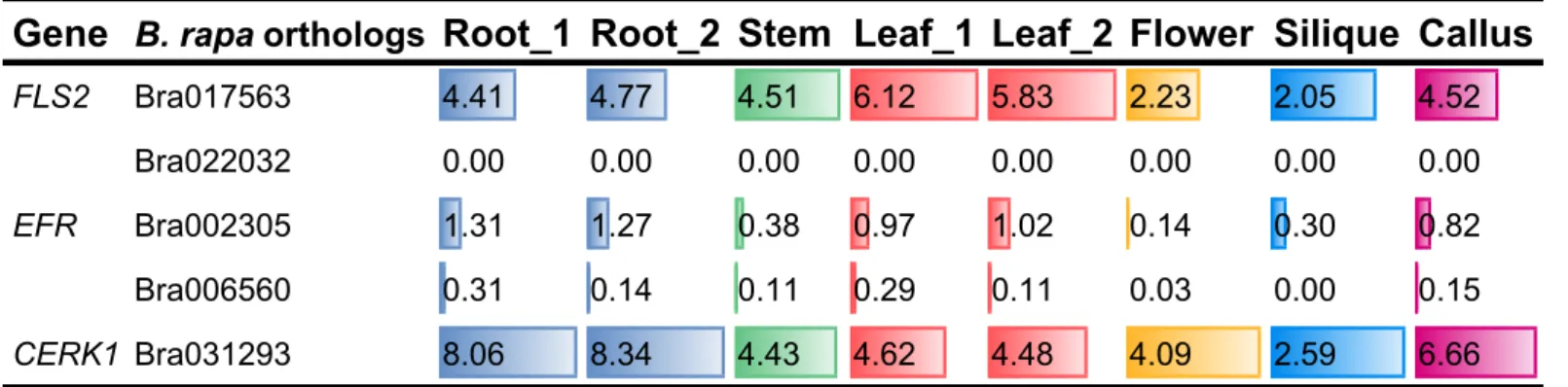
2013) [Table 2]. Among BraFLS2 candidates, only Bra017563 was expressed in B. rapa organs, and there were no reads mapped to Bra022032, indicating that
Bra022032 was most likely unexpressed. Two of EFR candidates, Bra002305 and Bra006560 were expressed in B. rapa organs but at a low level, especially Bra006560. CERK1 candidate Bra031293 is expressed at a relatively high level in B.
Table 2 | Expression of BraFLS2, BraEFR and BraCERK1 in B.rapa organs
Data extracted from Cheng et al., 2011 and Tong et al., 2013.
FPKM: Fragments per kilobase of exon per million fragments mapped
Gene
B. rapa orthologs
Root_1 Root_2 Stem Leaf_1 Leaf_2 Flower Silique Callus
FLS2 Bra017563 4.41 4.77 4.51 6.12 5.83 2.23 2.05 4.52
Bra022032 0.00 0.00 0.00 0.00 0.00 0.00 0.00 0.00
EFR Bra002305 1.31 1.27 0.38 0.97 1.02 0.14 0.30 0.82
Bra006560 0.31 0.14 0.11 0.29 0.11 0.03 0.00 0.15
BraPRRs share a high similarity with their orthologous AtPRRs in protein
sequences.
To decipher whether the slight difference of immune responses in the oxidative burst assay between Chinese cabbage and Col-0 could be relevant to the degree of similarity in protein sequences, the protein sequences of BraPRRs and their orthologous AtPRRs were aligned using Geneious 10.2.6 and manually annotated the functional domains referring to UniProt.
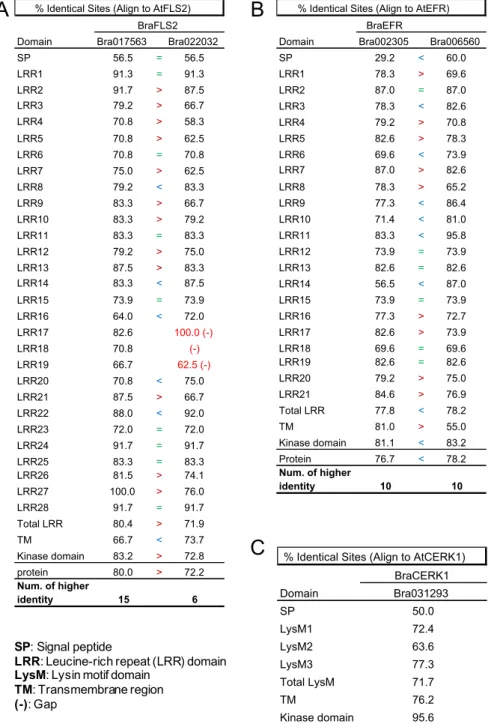
For expressed gene BraFLS2 (Bra017563), the gene sequence was shorter than the previous one sought in BRAD database. The new annotated protein sequence shared 80% A.A identity with AtFLS2 [Table 3A], higher than 73.7% with old annotations shown in Table 1. All functional domains in AtFLS2 could be found in Bra017563 [Figure 3A], whereas the other unexpressed BraFLS2 (Bra022032) were difficult to find LRR17, 18 and 19 domains by alignment. In addition, the first flg22-binding site which corresponds to tyrosine (Y148) in AtFLS2 was shown mutated in BraFLS2 (Bra022032). And the protein of Bra022032 missed 2 amino acids in the end of helical transmembrane region corresponsive to leucine (L826) and isoleucine (I827) in AtFLS2 [Figure 3B]. Furthermore, BraFLS2 (Bra017563) shared 80.4% identity in LRR domains and 83.2% in kinase domain with those domains of AtFLS2. BraFLS2 (Bra022032) shared 71.9% in LRR domains and 72.8% in kinase domain with those of AtFLS2 [Table 3A]. BraFLS2 (Bra017563) shared higher identity in LRR domains and in kinase domain with those domains of AtFLS2 than BraFLS2 (Bra022032), indicating that Bra017563 was probably the functional BraFLS2 gene. Compared two BraEFRs, the protein of lower expressed Bra006560 shared, however, a little higher A.A identity (78.2%) with AtEFR than the protein translated from Bra002305 (76.7%) [Table 3B]. And Bra006560 also shared a little higher
identity in LRR domains (78.2%) and in kinase domain (83.2%) with those in AtEFR, compared to Bra002305 [Table 3B]. All functional domains between two BraEFR proteins seemed to be similar except signal peptide (SP) domain and transmembrane (TM) domain. In SP domain, protein of Bra002305 shared only 29.2% identity with AtEFR, very low compared to 60% of Bra006560 protein. On the contrary, in TM domain, protein of Bra006560 shared only 55.0% identity with AtEFR whereas protein of Bra002305 shared 81.0% [Table 3B]. Neither Bra002305 nor Bra006560 lost functional domain examined by annotation [Figure 3C&3D] and the protein sequences of two BraEFRs were very similar, sharing 75.0% A.A identity (data not
shown). It was difficult to infer the reason of low expression level of Bra006560
upon protein sequence, and was difficult to confirm which candidate functions in Chinese cabbage, one or both.
At last, BraCERK1 (Bra031293) shared 83.5% of high A.A identity with AtCERK1, all functional domains were highly similar to AtCERK1 except SP domain with 50.0% of identity. Especially, the kinase domain of BraCERK1 showed be highly conserved in the evolution, sharing 95.6% of similarity with AtCERK1
[Table 3C]. Every functional domain could be found corresponsive to those in
AtCERK1 [Figure 3E], indicating Bra031293 most likely functions as BraCERK1 in Chinese cabbage.
A
Score = 4774.0, Identities = 941/1176 (80%), Positives = 1042/1176 (88%), Gaps = 5/1176 (0%)-1,174 -1,173
B
Score = 4036.0, Identities = 845/1179 (71%), Positives = 962/1179 (81%), Gaps = 78/1179 (6%)-1,107 -1,173
C
Score = 4052.0, Identities = 796/1042 (76%), Positives = 901/1042 (86%), Gaps = 22/1042 (2%)-1,031 -1,031
D
Score = 4107.0, Identities = 809/1038 (77%), Positives = 895/1038 (86%), Gaps = 13/1038 (1%)-1,032 -1,031
Score = 2618.0, Identities = 518/620 (83%), Positives = 555/620 (89%), Gaps = 7/620 (1%)
E
Black: Identical Gray: Similar White: Not similar Similarity:
Mean pairwise identity over all pairs in the column. Green: 100% identity
Greeny-brown: at least 30% and under 100% identity Red: below 30% identity
Identity: Signal peptide
Leucine-rich repeat (LRR) domain Lysin motif (LysM) domain Transmembrane region Protein kinase domain flg22-binding site Nucleotide-binding region ATP-binding site Proton-acceptor Chitin-binding region
Figure 3 | Alignments and annotations of BraPRRs protein sequences
Alignments of 2 sequences: (A) BraFLS2 (Bra017563) and AtFLS2 (AT5G46330), (B) BraFLS2 (Bra022032) and AtFLS2 (AT5G46330), (C) BraEFR (Bra002305) and AtEFR (AT5G20480), (D) BraEFR (Bra006560) and AtEFR (AT5G20480), or (E) BraCERK1 (Bra031293) and AtCERK1 (AT3G21630) were generated and analyzed using Geneious 10.2.6. BraPRRs were manually annotated upon their reference protein AtPRR whose annotations are provided from UniProt (www.uniprot.org). All figures are extracted from Geneious 10.2.6.
Table 3 | Identity of functional domains and protein sequences between BraPRRs and AtPRRs
Domain Bra017563 Bra022032
SP 56.5 = 56.5 LRR1 91.3 = 91.3 LRR2 91.7 > 87.5 LRR3 79.2 > 66.7 LRR4 70.8 > 58.3 LRR5 70.8 > 62.5 LRR6 70.8 = 70.8 LRR7 75.0 > 62.5 LRR8 79.2 < 83.3 LRR9 83.3 > 66.7 LRR10 83.3 > 79.2 LRR11 83.3 = 83.3 LRR12 79.2 > 75.0 LRR13 87.5 > 83.3 LRR14 83.3 < 87.5 LRR15 73.9 = 73.9 LRR16 64.0 < 72.0 LRR17 82.6 100.0 (-) LRR18 70.8 (-) LRR19 66.7 62.5 (-) LRR20 70.8 < 75.0 LRR21 87.5 > 66.7 LRR22 88.0 < 92.0 LRR23 72.0 = 72.0 LRR24 91.7 = 91.7 LRR25 83.3 = 83.3 LRR26 81.5 > 74.1 LRR27 100.0 > 76.0 LRR28 91.7 = 91.7 Total LRR 80.4 > 71.9 TM 66.7 < 73.7 Kinase domain 83.2 > 72.8 protein 80.0 > 72.2 Num. of higher identity 15 6
% Identical Sites (Align to AtFLS2)
BraFLS2 BraEFR
Domain Bra002305 Bra006560
SP 29.2 < 60.0 LRR1 78.3 > 69.6 LRR2 87.0 = 87.0 LRR3 78.3 < 82.6 LRR4 79.2 > 70.8 LRR5 82.6 > 78.3 LRR6 69.6 < 73.9 LRR7 87.0 > 82.6 LRR8 78.3 > 65.2 LRR9 77.3 < 86.4 LRR10 71.4 < 81.0 LRR11 83.3 < 95.8 LRR12 73.9 = 73.9 LRR13 82.6 = 82.6 LRR14 56.5 < 87.0 LRR15 73.9 = 73.9 LRR16 77.3 > 72.7 LRR17 82.6 > 73.9 LRR18 69.6 = 69.6 LRR19 82.6 = 82.6 LRR20 79.2 > 75.0 LRR21 84.6 > 76.9 Total LRR 77.8 < 78.2 TM 81.0 > 55.0 Kinase domain 81.1 < 83.2 Protein 76.7 < 78.2 Num. of higher identity 10 10
% Identical Sites (Align to AtEFR)
BraCERK1 Domain Bra031293 SP 50.0 LysM1 72.4 LysM2 63.6 LysM3 77.3 Total LysM 71.7 TM 76.2 Kinase domain 95.6 Protein 83.5
% Identical Sites (Align to AtCERK1)
SP: Signal peptide
LRR: Leucine-rich repeat (LRR) domain LysM: Lysin motif domain
TM: Transmembrane region (-): Gap
Data extracted from Geneious 10.2.6
A
B
BraFLS2, BraEFR, and BraCERK1 were expressed in 1, 2, 4, 6-week-old
Chinese cabbage leaves.
Followed by the comparative genomics between B. rapa cultivar line “Chiifu-401” and A. thaliana Col-0, the actual expression of BraPRRs in B. rapa hybrid cultivar line “Norang kimchi baechu” used for this study was required to examine. Furthermore, the data shown in Table 2 presented the expression level of BraPRRs in the 7-week-old plant (Tong et al., 2013), whereas the plant material in the first section of this study was collected in the 5 or 6-week-old Chinese cabbage. Hence, it was also necessary to investigate the expression level of BraPRRs in different stages of plants. Additionally, GUS accumulation driven by AtFLS2 promoter could be observed in the 2-day-old seedling (Beck et al., 2014), hypothesizing that
BraPRRs are expressed in a very early stage during plant development. To examine
the expression level change of BraPRRs during Chinese cabbage growth, the expression of BraFLS2 (Bra017563), two BraEFRs (Bra002305 and Bra006560) and
BraCERK1 (Bra031293) was monitored by qRT-PCR in the 1-week-old cotyledon,
and in the last elongated true leaves of 1, 2, 4 and 6-week-old plants.
As shown in the results [Figure 4A], BraFLS2 (Bra017563) and BraCERK1 (Bra031293) were expressed in the week-old cotyledon. In the true leaves of 1-week-old plant, BraFLS2 (Bra017563) was downregulated to 0.19-fold and
BraCERK1 (Bra031293) was downregulated to 0.34-fold, comparable to the
expression in the 1-week-old cotyledon. At 2 weeks, BraFLS2 (Bra017563) was continuously downregulated but on the contrary, BraCERK1 (Bra031293) was upregulated. In 4 weeks, both were upregulated. BraFLS2 (Bra017563) was slightly upregulated, but BraCERK1 (Bra031293) was strongly upregulated to 6.72-fold, comparable to the expression in the 1-week-old cotyledon. In 6 weeks, BraFLS2