Bifunctional Silane (TESPD) Effects on Silica Containing Elastomer Compound
Part I: Natural Rubber (NR)
Kwang-Jea Kim
Institute of Polymer Engineering, The University of Akron, OH 44325-0301, USA E-mail:[email protected]
(Received May 7, 2009, Revised & Accepted May 29, 2009)
양기능성실란(TESPD)이 실리카함유 복합소재에 미치는 영향
김 광 제
아크론대학교 고분자공학과
(2009년 5월 7일 접수, 2009년 5월 29일 수정 및 채택)
ABSTRACT:Organo bifunctional silane (TESPD) is added into silica containing NR and its effects are investigated with respect to the vulcanization properties, the processability, and the physical properties. The addition of the TESPD into silica filled NR compound increases the degree of crosslinking by formation of a strong 3-dimensional network structure with silica surface via coupling reaction, which results in an improved mechanical property. It also improves the processabilities compared to the Control compound.
요 약:양기능성실란(TESPD)이 실리카가 함유된 NR복합소재에 첨가되었을시 그에따른 가교특성, 가공정도, 물리적 특성들에 미치는 영향을 조사하였다. TESPD를 첨가한 NR복합소재는 TESPD가 실리카표면과 고무의표면을 화학 적으로 결합하여 3차원적인 구조를 형성함으로해서 가교도가 증가하였고, 이에따라 기계적강도가 증가하였다. 이 복합소재는 또한 TESPD를 첨가하지않은 소재와 비교했을시 가공성이 증가하는것을 보여주었다.
Keywords:NR, TESPD, silica, processability, mechanical property
Ⅰ. Introduction
General silane chemistry is widely used in various indu- stries. Silanes are used for automotives (e.g. engine mount, door sealing), military vehicles (e.g. air, ground (heavy duty tires, tank innerliner), and underwater), military goods (e.g.
gas masks, boots, protective gloves, hose, rubber gasket), aero- space vehicles (e.g. hose, wire products), tires (e.g. airplane, heavy-duty, high performance (racing etc.)), belts (e.g. auto- motives, conveyer), general rubber goods, construction (e.g.
building vibration absorption), medical (e.g. artificial teeth), recycling of end-of-life polymers, biodegradable fibers cou- pling with polymers (cf. bio-resin: poly(lactic acid), poly(tri- methylene terephthalate), etc.
Use of bifunctional silanes such as TESPT and TESPD with silica particle in natural rubber (NR) and styrene-co-butadiene rubber (SBR) or SBR/BR has been known to improve several tire properties such as gas mileage, 1 wet and snow traction due to improved rolling resistance 2 and degree of cross-linking via improved silica-silane coupling. 3-8 One end of silane chem- ically bond on silica surface via hydrolysis reaction 9-12 and
the other end of silane bond on rubber chain via sulfur cross-linking. 13-15
NRs have been used in the area of heavy-duty tires and building vibration absorption against earthquakes. 16 NR is non-polar and has more double bonds than SBR. Each rubber has different levels of double bonds and different types of residues. The unit cell of crystalline form NR has a density of 1.0 g/cm 3 and that of amorphous unfilled rubber is 0.9 g/cm 3 , respectively. 17 The NR is mainly based on isoprene and has many other ingredients such as sugars, fats and proteins, which influence the vulcanizate properties. The residue such as fatty acids, amino acids, and proteins will also react with the initial zinc oxide. These acids should present in the final vulcanizate as their zinc soaps. Wunderlich 18 theoretically de- scribed the nucleation rate based on absolute rate reaction theory. Avrami 19-21 describe rate relationships for crystals gro- wing uniformly in metals in one, two or three dimensions.
The state of equilibrium is a function of the rubber crosslink
density, 22 the temperature 23 and the strain. 24 Flory has made
use of thermodynamic arguments to derive theoretical ex-
pressions for relaxation of stress due to crystallization for the
Table 1. Materials Used in This Study
Usage Trade name Supplier Remark
Rubber SMR20 1 Goodyear NR
Filler Hi-Sil 243 PPG 150 (m 2 /g)
Peptizer A 86 Struktol
Activator ZOCO Zochem Zinc Oxide
Activator/processing aid Stearic acid Harwick Standard
Silica surface modifier/UV absorber TiO 2 Malvern Minerals Titanium dioxide
Antioxidant TMQ 2 R. T. Vanderbilt
Homogenizer 60NS Struktol
Antiozonant/inhibitor Sunolite 240 Sovereign Chemical Co. Blended wax
Plasticizer/softener Stanplas 2000 Harwick Naphthenic oil
Silane SCA985 Struktol S2
Accelerator TBBS 3
DPG 4
Flexsys America L.P.
Harwick
Vulcanizer Sulfur C. P. Hall
1 Natural rubber
2 1,2-dihydro-2,2,4-trimethylquinoline
3 N-t-butylbenzothiazole-2-sulfenamide
4 Diphenylguanidine
(a)
S S
Si
OCH 2 CH 3 OCH 2 CH 3 OCH 2 CH 3 CH 2
CH 2 CH 2
Si
OCH 2 CH 3 OCH 2 CH 3 OCH 2 CH 3 CH 2
CH 2 CH 2
(b)
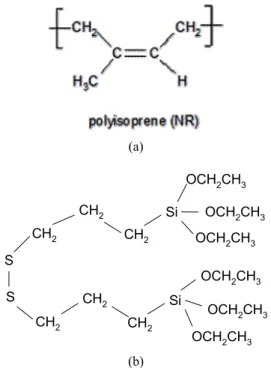
Scheme 1. Chemical Structure of (a) NR, (b) TESPD (Bis(trie- thoxysilylpropyl)disulfide).
equilibrium degree of crystallinity. After Flory's 24 proposed model 'fringed micelle', Andrews 25,26 discovered 'chain fold' structure in electron microscopy studies of strained ultra thin rubber films. More refined versions of chain fold have devel- oped by Keller 27 and later authors. 28-30 The crystallization is
accompanied by an increase in density (i.e. decrease in vol- ume) and volume changes. 31,32 Nucleation may occur sponta- neously and homogeneously throughout the amorphous phase at lower temperature or be 'seeded' by foreign surfaces or struc- ture discontinuities. The crystal growth 26 is influenced by the type and density of nucleation. Embryo nuclei grow to a crit- ical size and distribution before any macroscopic effect such as elastic modulus increase is observed.
The chemical structure of NR is shown in Scheme 1. There have been many researches on NR compounds; 8, 33-37 however, there have been few published researches on application of TESPD in silica containing NR 8 compound. Furthermore, there were very few published studies effects of the TESPD in prac- tical tire compound.
In this research, we investigate the effects of TESPD in a silica filled NR compound, which consists with many differ- ent ingredients used in practical tire industry, with respect to the processability and the mechanical properties.
Ⅱ. Experimental
1. Materials
The silane used in this study was TESPD (bis (triethoxysi-
lylpropyl) disulfide), which is a product of Struktol Co
America brand name of SCA985. The main chemical structure
of the TESPD is shown in Scheme 1. The silica used was
Hi-Sil 243, which is precipitated silica with BET area 150
(m 2 /g) and primary particle diameter 19 nm supplied by PPG.
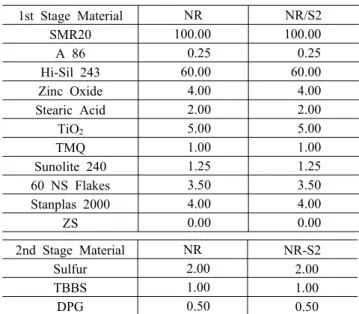
The elastomer used was natural rubber (polyisoprene rub- ber), which was a Goodyear product by the brand name of SMR-20. Various additives including activator (zinc oxide), processing aid/activator (stearic acid), peptizer (A 86), silica surface modifier/UV absorber (titanium dioxide), anti oxidants (TMQ), anti antiozonant/inhibitor (Sunolite 240), homogenizer (60NS Flakes), plasticizer (Stanplas 2000), curing agent (Sulphur), and accelerators (TBBS, DPG) were used. The in- formation on the materials used in this study was summarized in Table 1.
2. Mixing
Banbury internal mixer (BR 1600) was used for masterbatch mixings (MB1 and MB2) of rubber and additives (batch: the product of one mixing operation). The silane level in the NR
Table 2. Formulation and Mixing Procedure for NR Compound 2.1 Formulation
1st Stage Material NR NR/S2
SMR20 100.00 100.00
A 86 0.25 0.25
Hi-Sil 243 60.00 60.00
Zinc Oxide 4.00 4.00
Stearic Acid 2.00 2.00
TiO 2 5.00 5.00
TMQ 1.00 1.00
Sunolite 240 1.25 1.25
60 NS Flakes 3.50 3.50
Stanplas 2000 4.00 4.00
ZS 0.00 0.00
2nd Stage Material NR NR-S2
Sulfur 2.00 2.00
TBBS 1.00 1.00
DPG 0.50 0.50
2.2 Mixing Procedure (70 RPM, 30 PSI, Fill Factor 0.7, Starting Temp 65 o C)
1st stage (MB1)
a. Add rubber and A86.
b. Mix for 30 sec.
c. Add rest additives.
d. Mix for 1 min and sweep e. Mix for 2 min and sweep.
f. Mix for 5 min and dump.
2nd stage (MB2) (70 RPM, 30PSI) a. Add 1/2 MB1
b. Mix for 30 sec
c. Add curatives and 1/2 MB1.
d. Drop at 90 sec.
compounds was 3 phr. All the materials with the same in- gredients in each elastomer compounds were added in master- batch 1 (MB1) and discharged (dropped) at 300 sec mixing.
After drop out of MB1, real temperature of each compound was measured by probing. At second pass mixing (MB2), each compound was further mixed with curatives for 90 sec. The total mixing times of the compounds were the same for 6.5 min each. The fill factor, RAM pressure, and rotor speed was fixed at 70%, 30 PSI, and 70 RPM, respectively. The mixing formulations and procedures are included in Table 2.
3. Mooney viscosity measurement
Mooney viscosities were measured as a function of apparent shear rate at 2RPM and ML1+4 at 100 o C according to ASTM D1646. The rotor diameter of the shearing disc rheometer was 38.1 mm and the thickness of the rotor was 5.5 mm. The machine we used for measuring Mooney viscosity was brand name Mooney Viscometer 2000 (MV 2000) manufactured from Alpha Technology. The shear rate at the outer radius of the shearing disc could be expressed as follows: 38,39
H
R = R Ω
⋅ ( )
γ (1)
where R is the radius of rotating disc, Ω, the rotor rotation rate, H, the distance between the disc surface and the stationary housing.
4. Cure rheometer test
Oscillating disc cure rheometer (Model Rheotec) manufac- tured from Tech Pro Inc. was used for measuring vulcanization and reversion resistance property of the compounds in a pres- surized rotational rheometer with a biconical rotor following ASTM D 2084 at 160 o C. The oscillation frequency was 100 cycles/min (1.66 Hz) with amplitude of 3 o . Minimum torque (M L ), maximum torque (M H ), torque rise (M H -M L ), scorch (premature vulcanization of a rubber compound) time (Ts-2), cure time (Tc-90), and reversion (deterioration of vulcanizate properties that may occur when vulcanization time is extended beyond the optimum) resistance time (T-2) were measured.
5. Viscoelastic property (tanδ) measurement
Vulcanized specimens were characterized using Mechanical Energy Resolver (MER-1100B) manufactured by Instrumentors, Inc. This instrument measures the oscillatory input of axial compression and tension response of the cylindrical specimen.
Oscillatory signal response depending on material was meas-
ured and recorded as the elastic and the viscous property as
follows: 38,39
tanδ = G"/G' (2)
G'(ω) = G* cosδ (3)
G"(ω) = G* sinδ (4)
δ
ω ω ω
η " * sin
) (
' = G = G (5)
where ω represents oscillation frequency; G*, the complex modulus; δ, the phase angle; G'(ω), the storage modulus;
G"(ω), the loss modulus; and η'(ω), the dynamic viscosity.
Depending on each sample group condition (23 o C or 100 o C) the static servo position (signal accepter position) was adjusted.
6. Screw extrusion
Single Screw Lab Extruder (SSE) manufactured by C. W.
Brabender Instruments, Inc. (CWB) attached with roll feeder (Model 1513) was used and data were obtained from a PC attached to CWB at the time of extrusion of the compounds.
The drive type of the extruder for SSE was Plasti-Corder PL2100 manufactured by CWB. The length/diameter (L/D) ra- tio of the barrel was 15:1 (barrel diameter 19 mm) with com- pression ratio of three-to-one (3:1). The processing temper- ature and screw speed were set to 100 o C and 30 RPM, respectively. Garvey type ASTM Extrusion Die (see ASTM D 2230-88) was attached at the exit of the screw. The pressure buildup (PSI) of each compound at the exit of the die was measured.
7. Tensile test
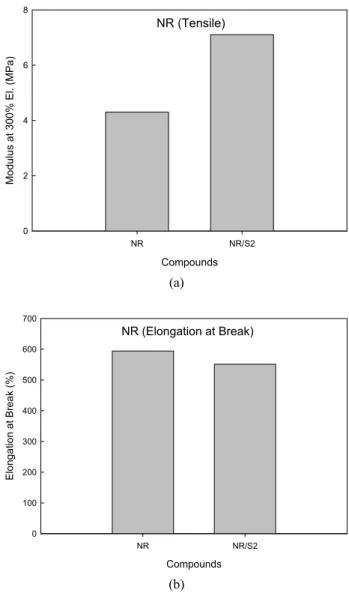
An Instron tensile tester (Model 4201) with data acquisition system was used to obtain tensile test data of dumbbell specimen. The average of three specimens was obtained fol- lowing the ASTM D 412-87 method. This instrument meets the ASTM E4 and measures mechanical properties of the mate- rials, which was a table mounted units consisting of loading frame and control console as separate assemblies. The modulus (Pa) of each compound was measured at 300% elongation.
The average thickness and width of the specimens were 2.2 mm and 6.3 mm, respectively.
Ⅲ . Results
1. MB1 mixing temperature changes
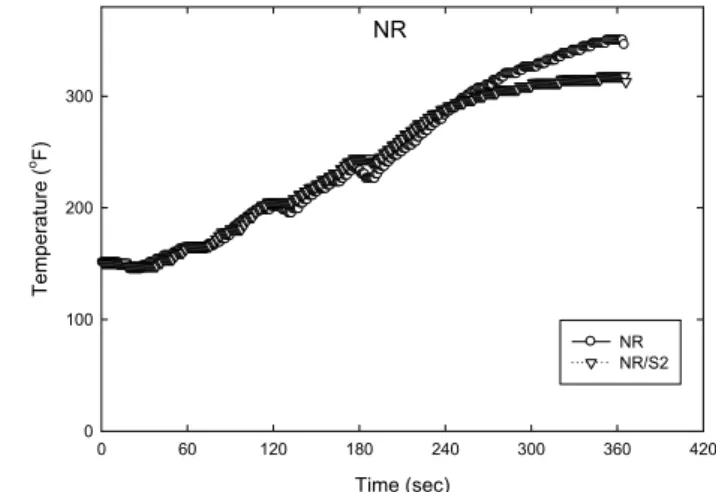
Figure 1 represents the mixing temperature changes (MB1) of NR compounds in a Banbury internal mixer. The addition of the S2 lowered the rate of mixing temperature rise than
NR
Time (sec)
0 60 120 180 240 300 360 420
Te mp er a tur e (
oF)
0 100 200 300
NR NR/S2
Figure 1. Mixing temperature changes (MB1) of NR com- pounds in a Banbury internal mixer.
NR (Probe Temperature)
Compounds
NR NR/S2
Temper at ure (
oF)
0 100 200 300 400 500
Figure 2. Probe temperatures of each compound measured from MB1.
the NR compound.
2. Drop temperature
Figure 2 shows the drop/probe temperatures of each com- pound measured from MB1. The NR/S2 compound showed a lower drop temperature than the NR one.
3. Vulcanization curve
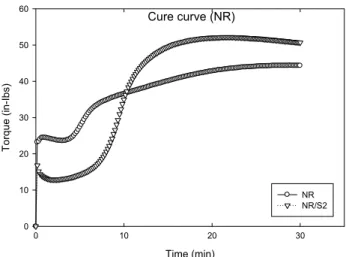
Figure 3 shows the vulcanization curve changes of the NR
compounds for 30 min at 160 o C. The S2 added compounds
showed a higher M H , lower M L , higher torque rise (M H -M L ),
and delayed scorch (Ts-2) time than the NR one. This is an
implication that addition of silane (S2) improves the process-
ability and the degree of cross-linking of the NR compound.
Cure curve (NR)
Time (min)
0 10 20 30
T orque (i n-Ibs)
0 10 20 30 40 50 60
NR NR/S2
Figure 3. Vulcanization curve changes of NR compounds for 30 min at 160 o C.
Torque Tise (M
H-M
L)
Compounds
NR NR/S2
Torque(i n -I bs)
0 10 20 30 40 50
Figure 4. The torque rise (MH-ML) of the NR compounds.
Torque (M
H, M
L)
Compounds
NR NR/S2
Torque (in -I b s)
0 10 20 30 40 50 60
M
HM
LFigure 5. The torque maximum (M H ) and the torque minimum (M L ) of the NR compounds.
Figure 4 shows the torque rise (M H -M L ) of each compound.
Silane added compound (NR/S2) showed a higher torque rise than the NR one.
Figure 5 shows the torque maximum (M H ) and the torque minimum (M L ) of each compound. Silane added compound (NR/S2) showed a higher torque maximum (M H ) and a lower torque minimum (M L ) than the NR one.
4. Viscoelastic property (tanδ)
Figure 6 shows the tanδ values of each compound. At room temperature, the tanδ of NR/S2 compound showed a lower value than that of the Control one.
5. Mooney viscosity
Figure 7 shows the Mooney viscosity of each compound.
The NR/S2 compound showed a lower Mooney viscosity than the NR one.
NR (tanδ)
Compounds
NR NR/S2
ta nδ
0.00 0.05 0.10 0.15 0.20 0.25
23C 100C
Figure 6. The tanδ values of the NR compounds.
NR (Mooney)
Compounds
NR NR/S2
M oone y (M U)
0 20 40 60 80 100
Figure 7. The mooney viscosity of the NR compounds.
NR (Extrusion Torque)
Compounds
NR NR/S2
T o rq ue(N m )
0 20 40 60 80 100
NR (Extrusion Pressure)
Compounds
NR NR/S2
Pres su re (PSI)
0 200 400 600 800 1000
Figure 8. The extrusion torque and the pressure build up of each compound processed through a single screw extruder.
6. Extrusion torque
Figure 8 shows the extrusion torque and the pressure build up of each compound processed through a single screw ex- truder. Silane added compound (NR/S2) showed a lower tor- que and pressure build up than the NR one.
7. Tensile test