Immediate Effects of Soft Tissue Massage on Posterior Shoulder Muscle Tightness: A Preliminary Study
Sil-ah Choi1, BHSc, PT, Ji-hyun Lee1, BHSc, PT, Tae-lim Yoon1, MA, PT, Heon-seock Cynn2, PhD, PT
1Dept. of Physical Therapy, The Graduate School, Yonsei University,
2Dept. of Physical Therapy, College of Health Science, Yonsei University,
Dept. of Ergonomic Therapy, The Graduate School of Health and Environment, Yonsei University
Abstract
1)Posterior shoulder muscle tightness is frequently observed in shoulder impingement syndrome because tightness in the posterior portion of the shoulder muscles can cause anterior and superior translation of the humeral head in relation to the glenoid fossa. The purpose of this study was to determine the immediate effects of soft tissue massage on acromiohumeral distance (AHD), anterior translation of the humeral head, and glenohumeral (GH) range of motion (ROM) in subjects with posterior shoulder muscle tightness. Twenty-seven subjects with greater than 10° difference in the range of GH horizontal adduction between right and left sides were recruited. The range of GH horizontal adduction and internal rotation were measured by a digital inclinometer. The AHD and anterior translation of the humeral head were measured using ultrasonography. A paired t-test was used to compare AHD, anterior translation of the humeral head, and the range of GH horizontal adduction and internal rotation before and after soft tissue massage. The results showed that AHD increased significantly (p<.05) and the anterior translation of humeral head decreased slightly, but not significantly (p=.40) after the soft tissue massage.
Furthermore, the ROM of horizontal adduction and internal rotation in the GH joint increased significantly after the soft tissue massage (p<.05). These findings indicate that soft tissue massage on posterior shoulder muscle tightness is an effective method to increase AHD and ROM in the horizontal adduction and internal rotation of the GH joint.
[Sil-ah Choi, Ji-hyun Lee, Tae-lim Yoon, Heon-soeck Cynn. Immediate Effects of Soft Tissue Massage on Posterior Shoulder Muscle Tightness: A Preliminary Study. Phys Ther Kor. 2012;19(4):8-15.]
Key Words: Acromiohumeral distance; Posterior shoulder muscle tightness; Soft tissue massage.
Introduction
Posterior shoulder muscle tightness, such as pos- terior deltoid and teres minor, is frequently observed in subjects with shoulder impingement syndrome be- cause the tight posterior portion of the shoulder muscles may cause anterior and superior translation of the humeral head in relation to the glenoid fossa (McClure et al, 2007; Tyler et al, 2000). Posterior shoulder tightness leads to approximation of the humeral head to the acromion causing compression
of tissues in the GH joint and limited shoulder flex- ion, internal rotation, and horizontal adduction (Warner et al, 1997). Several studies have revealed the importance of the release of posterior shoulder muscles in improving posterior shoulder flexibility for the treatment of shoulder disorders. (Myers et al, 2006; Warner et al, 1990). Moderate positive correla- tions were found between muscle stiffness and range of motion (ROM) deficit of the GH joint in three muscles (r=.57~.72 for the posterior deltoid, infra- spinatus, and teres minor p<.05) (Hung et al, 2010).
Corresponding author: Heon-seock Cynn [email protected]
Shoulder impingement syndrome is one of the most common musculoskeletal disorders and is re- lated to narrowing of the acromiohumeral distance (AHD). AHD is defined as the shortest distance be- tween the inferior surface of the acromion and supe- rior aspect of the humeral head (Kalra et al, 2010).
Reduced AHD may be associated with limited gleno- humeral (GH) horizontal adduction and internal rota- tion, while increased AHD may relieve symptoms of compressed structures of the subacromial space (Kalra et al, 2010; McClure et al, 2007).
Anterior translation of the humeral head is defined as the position of the humeral head center along with the anterior direction relative to the glenoid fossa when the humeral head center is at 0° abduc- tion (Massimini et al, 2012). Anterior translation of the humeral head accounts for about 95% of cases of chronic shoulder instability (Hawkins and Mohtadi, 1991). Matsen et al (1991) described glenohumeral instability as a clinical condition in which unwanted translation of the head on the glenoid disturbs the function of the shoulder. Similaryly, anterior trans- lation of humeral head over the glenoid fossa has been interpreted as a sign of instability (Bahk et al, 2006), and excessive anterior translation of humeral head caused by posterior shoulder muscle tightness may contribute to the instability or dislocation of the GH joint.
Soft tissue massage on posterior shoulder muscles has been used in physical therapy intervention or during rehabilitation programs to increase the ROM of the GH joint and restore posterior shoulder flexibility. Poser and Casonato (2008) suggested that soft tissue massage on infraspinatus and teres minor could be used for shoulder impingement syndrome without stressing the GH joint. Park et al (2010) al- so reported that by focusing on releasing the muscle, soft tissue massage on the posterior deltoid was ef- fective in reducing posterior shoulder muscle tightness. Soft tissue massage technique is a type of friction that involves pressing into the skin and moving it over the underlying tissues. The direction
of the massage pressure follows the direction of the muscle fibers. Although the majority of studies (Nordschow and Bierman, 1962; Wiktorsson-Moller et al, 1983) investigated the effects of massage on muscle and connective tissue were investigated by measuring the ROM, the effects of soft tissue mas- sage on AHD and anterior translation of humeral head related to specific muscle tightness has not been reported in the literature.
Thus the purpose of this study was to determine the immediate effects of soft tissue massage on AHD and anterior translation of the humeral head by using ultrasonography (US) and on ROM of the GH by joint using a digital inclinometer in subjects with posterior shoulder muscle tightness. We hypothesized that soft tissue massage on the posterior shoulder muscles, such as posterior deltoid and teres minor, would increase AHD, decrease anterior translation of humeral head, and increase the range of horizontal adduction and internal rotation in the GH joint.
Methods
Subjects
We recruited 27 subjects (14 male, 13 female) who had greater than 10° difference in the range of GH horizontal adduction between right and left sides for this study (Park et al, 2010). The power analysis was performed by G-power software. The data of a pilot study of 10 subjects was used to select, the necessary sample size of 13 subjects by calculating to achieve a power of .80 and an effect size of .84 with an alpha level of .05. The general character- istics of the 27 subjects, including age, height, weight, body mass index (BMI), and amount of GH horizontal adduction are shown in Table 1. Prior to collecting data, the examiner informed the subjects of all procedures. The subjects read and signed written consent forms. The study protocol was approved by Yonsei University Wonju Campus Human Studies Committee.
Figure 1. Horizontal adduction. Figure 2. Internal rotation.
Characteristics Mean±SDc
Age (years) 21.4±1.8
Height (㎝) 169.1±8.4
Weight (㎏) 61.5±11.6
BMIa (㎏/㎡) 21.4±2.8
Range of GHb horizontal adduction (°) 22.5±5.1
abody mass index, bglenohumeral, cmean±standard deviation.
Table 1. General characteristics of subjects (N=27)
Instrumentation2)3)
US was utilized with a 7.5 ㎒ linear transducer1) to measure the AHD and anterior translation of the humeral head. An industrial digital inclinometer2) was used to measure the range of GH horizontal adduc- tion and internal rotation.
Procedures
ROM measurement of the GH horizontal adduction by inclinometer
The subject was placed in a supine position on a therapeutic table. The elbow of the tested shoulder was positioned in 90° of flexion and the shoulder was abducted 90°. The examiner stabilized the lateral border of the scapula by providing a posteriorly di- rected force. The examiner grasped the subject’s forearm, and then moved the subject’s humerus into horizontal adduction passively until the end-feel. The
assistant examiner aligned a digital inclinometer with the midline of the humerus. The angle between the humerus and a line vertical to therapeutic table was measured (intraclass correlation coefficient; ICC=.93) (Moore et al, 2011; Park et al, 2010) (Figure 1).
ROM measurement of the GH internal rotation by inclinometer4)
The subject was placed in supine position with the shoulder abducted at 90° and the elbow flexed at 90°. A folded towel was placed under the distal hu- merus, so that the humerus was aligned with the scapular plane. A pressure biofeedback unit3) was placed between the therapeutic table and the sub- ject’s scapula to stabilized the scapula. The elastic bag of the pressure biofeedback unit was inflated up to 40 ㎜Hg, and the humerus was passively rotated internally. When the pressure changed more than ±2
㎜Hg from 40 ㎜Hg during passive GH internal rota-
1) SonoAce X8, Medison Co., Ltd, Seoul, Korea.
2) GemRed DBB, Gain Express Holdings, Ltd., Hong Kong, China.
3) Stabilizer, Chattanooga group Inc., Hixson, U.S.A.
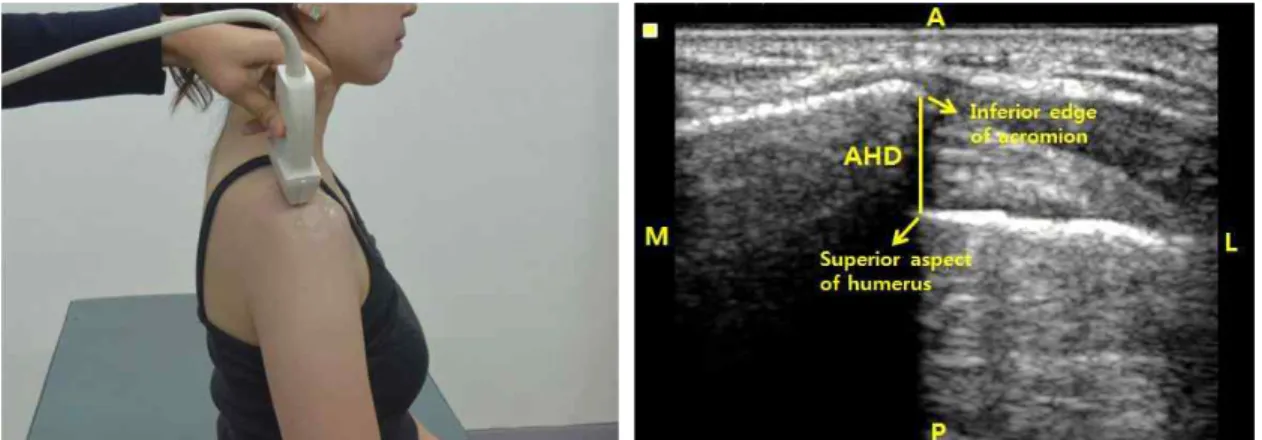
Figure 3. Acromiohumeral distance (AHD) (A: anterior, P: posterior, M: medial, L: lateral).
Figure 4. Anterior translation of humeral head (A: anterior, P: posterior, M: medial, L: lateral).
tion, the examiner stopped passive internal rotation, and in this position, the assistance examiner placed a digital inclinometer on the dorsal surface of the fore- arm aligned with the long axis of the ulna to meas- ure the ROM of internal rotation. The angle between the forearm and a line vertical to therapeutic table was measured (ICC=.93) (Kim et al, 2010; Lunden et al, 2010; Moore et al, 2011) (Figure 2).
US measurement of the AHD
The US transducer was positioned on the posterior to middle portion of the acromion in the coronal plane, and then the transducer was moved parallel to the superior aspect of the acromion so that both the acromion and humeral head were visualized (ICC=.92). AHD was measured between the most in- ferior edge of the acromion and the most superior aspect of the humeral head as the shortest distance
between the acromion and humeral head (Kalra et al, 2010; Nové-Josserand et al, 1996) (Figure 3).
US measurement of anterior translation of humeral head
We modified the US method first described by Court-Payen et al (1995) for measuring the anterior translation of the humeral head. The US transducer was placed on the anterior aspect of the shoulder at the level of the coracoid process. In this position, two well-defined bony structures could be identified:
the humeral head and the coracoid process. We de- fined the amount of anterior translation of the hum- eral head as the difference between the most anterior aspect of the coracoid process and the most anterior aspect of the humeral head (ICC=.86) (Figure 4). The increased amount of anterior translation of the hum- eral head indicated that the anterior translation of
Variable Before soft tissue massage After soft tissue massage t p
AHDa (㎝) 1.13±.13b 1.22±.17 -4.46 <.001
Anterior translation (㎝) .32±.31 .34±.34 -.84 .40
Horizontal adduction (°) 22.45±5.12 31.08±5.30 -12.54 <.001
Internal rotation (°) 61.63±9.48 68.11±9.06 -6.73 <.001
aanteriohumeral distance, bmean±standard deviation.
Table 2. Comparison of measurement of variables before and after soft tissue massage (N=27) Figure 5. Soft tissue massage.
huemral head was decreased (i.e., posterior trans- lation of the humeral head) with regard to the cora- coid process.
Soft tissue massage on posterior deltoid and teres minor
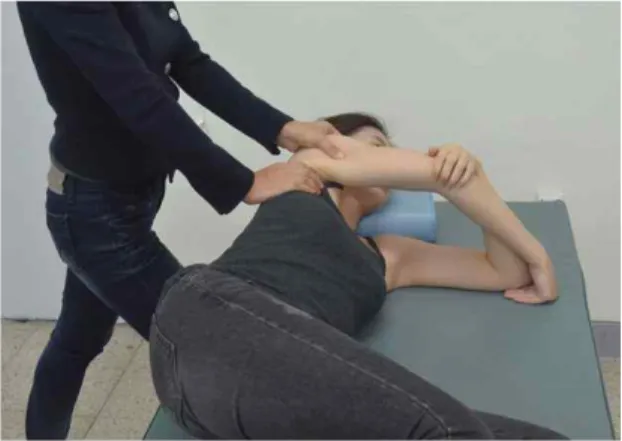
We applied soft tissue massage which is used for myofascial release. The subject was in a side-lying position on the side not being massaged, and the subject’s shoulder and elbow being massaged were placed in 90° of flexion with the humerus in neutral rotation. The scapula of the subject’s shoulder being massaged was stabilized in full retraction by exam- iner’s hand. For the soft tissue massage, the exam- iner palpated the posterior deltoid and teres minor.
The posterior deltoid is located two finger breadths caudal to the posterior margin of the acromion, and the teres minor is located one-third of the way be- tween the acromion and the inferior angle of the scapula along the lateral border (Yang et al, 2012).
The examiner’s thumb was placed on the target muscles, and then the examiner applied pressure firmly to the target muscles while asking the subject
to turn the trunk backwards slowly. This inter- vention was performed for five repetitions with each repetitions lasting for 20 seconds and resting periods of 10 seconds between repetitions (Park et al, 2010).
The intensity of massage was modulated individually by the subject’s reaction to pain or discomfort. If the subject complained of discomfort or pain, the intensity of the soft tissue massage was reduced (Figure 5).
Statistical Analysis
Descriptive statistics were calculated for all variables. Kolmogorov-Smirnov Z-tests were per- formed to assess the normality of distribution. A paired t-test was used to compare before and after applying the soft tissue massage on AHD, anterior translation of the humeral head, and GH horizontal adduction and internal rotation. The statistical sig- nificance level was set at .05. All statistical analyses were performed using PASW Statistics version 18.0 software.
Results
All dependent variables were found to approximate a normal distribution (Kolmogorov-Smirnov Z-test, p>.05). The AHD increased significantly from 1.13±.13 ㎝ to 1.22±.17 ㎝ after the soft tissue mas- sage (p<.05). The difference between the coracoid process and the greater tuberosity of the humeral head, defined as the amount of anterior translation of humeral head, increased slightly from .32±.31 ㎝ to .34±.34 ㎝ after the soft tissue massage. However, this increment was not significant (p=.40). Also, the ROM of horizontal adduction and internal rotation in
the GH joint increased significantly from 22.45±5.12°
to 31.08±5.30° and from 61.63±9.48° to 68.11±9.06°, respectively (p<.05) (Table 2).
Discussion
This preliminary study was undertaken to inves- tigate the immediate effects of soft tissue massage on AHD, anterior translation of the humeral head and the ROM of the GH joint in subjects with pos- terior shoulder muscle tightness. To the best of our knowledge, this study is the first trial to utilize US for measuring AHD and anterior translation of the humeral head to determine whether soft tissue mas- sage can benefit subjects with posterior shoulder muscle tightness.
After soft tissue massage, AHD increased sig- nificantly by 8% (p<.001), which supported the re- search hypothesis. A previous study stated that de- creased AHD associated with tightening of the pos- terior portion of the shoulder attributed to anterior and superior migration of the humeral head (Harryman et al, 1990). This is because of the in- sufficient inferior and posterior gliding caused by posterior shoulder muscle tightness, such as posterior deltoid and teres minor. Moreover, tightness of the posterior deltoid caused by decreasing subacromial space is a factor in shoulder impingement syndrome or frozen shoulder (Tyler et al, 2000). Stiffness of teres minor leads to GH internal rotation deficit, and it has been associated with superior labral lesions, subacromial impingement, and pathological internal impingement (Myers et al, 2006; Warner et al, 1990).
Thus, significant increase in AHD by soft tissue massage on tight posterior shoulder muscles in this study confirmed that soft tissue massage could be an effective method to relieve tightness in posterior shoulder muscles.
On the other hand, although anterior translation of the humeral head decreased by 6% after soft tissue massage, it did not reach statistical significance
(p=.40). Hence, this result failed to support our re- search hypothesis. One possible explanation is that the anterior joint capsule or anterior muscle of the GH was not taken into account in this study.
Studies by Gohlke et al (1994) found that incision of the GH capsule resulted in increased translation.
Speer et al (1994) indicated an increase in the ante- rior translation of the humeral head when a Bankart lesion was applied in cadaveric shoulders. These previous studies suggested that the laxity of the GH joint capsule was the main causative factor in ante- rior translation of the humeral head and not posterior muscle tightness. In our study, we applied soft tissue massage focusing on releasing posterior shoulder muscles tightness, not considering GH joint capsule conditions. In addition, the measurement technique used in this study was different from previous stud- ies in that the anterior translation of humeral head was measured in internal rotation (Court-Payen et al, 1995). The distance between the coracoid process and humeral head measured in internal rotation posi- tion was probably different from the distance meas- ured in the neutral position used in this study. For these reasons, there was no significant difference in the anterior translation of the humeral head.
Additionally, we compared the range of horizontal adduction and internal rotation in the GH joint before and after soft tissue massage. Our study showed significant increments in the ROM of horizontal ad- duction and internal rotation by 38% and 10%, re- spectively, after soft tissue massage. These results supported the research hypothesis and were in agreement with the results of previous studies showing that soft tissue massage increased the range of GH horizontal adduction and internal rota- tion significantly (Park et al, 2010). However, since the range of horizontal adduction increased more than the internal rotation in our study, we propose that horizontal adduction is likely to be more affected than internal rotation by posterior shoulder tightness.
This preliminary study has several limitations.
First, our findings could not be generalized to patient
population because healthy young subject with a 10°
or greater difference in the range of GH horizontal adduction between right and left sides participated in this study. Therefore, both young and old subjects with shoulder impingement syndrome or anterior translation syndrome should be investigated in future studies. Second, because this study examined the immediate effect of soft tissue massage, the long term effect of soft tissue massage should be inves- tigated in future research. Third, although we tried to provide consistent pressure and maintain the exact position of the US transducer during the data collec- tion, measurement errors were likely to occur. Thus, a hands-free method of attaching the transducer to subjects, such as a transducer holder, may be con- sidered in future studies. Fourth, since this is a pre- liminary study designed with pretest and posttest in one group, a randomized controlled trial is warranted to validate the results of our study.
Conclusion
This study examined the immediate effects of soft tissue massage on AHD, anterior translation of the humeral head, and the ROM of GH joint in subjects with posterior shoulder muscle tightness. Our find- ings indicate that soft tissue massage on the poste- rior deltoid and teres minor muslces resulted in sig- nificant increases in AHD, slight decrease in anterior translation, and significant increases in the ROM in horizontal adduction and internal rotation of the GH joint in subjects with posterior shoulder tightness.
Therefore, soft tissue massage could be recom- mended as an effective method to increase AHD and ROM in horizontal adduction and internal rotation of the GH joint.
References
Bahk M, Keyurapan E, Tasaki A, et al. Laxity test-
ing of the shoulder: A review. Am J Sports Med. 2007;35(1):131-144.
Court-Payen M, Krarup AL, Skjoldbye B, et al.
Real-time sonography of anterior translation of the shoulder: An anterior approach. Eur J Ultrasound. 1995;2(4):283-287.
Gohlke F, Daum P, Bushe C. The stabilizing function of the glenohumeral joint capsule. Current as- pects of the biomechanics of instability. Z Orthop Ihre Grenzgeb. 1994;132(2):112-119.
Harryman DT 2nd, Sidles JA, Clark JM, et al.
Translation of the humeral head on the glenoid with passive glenohumeral motion. J Bone Joint Surg Am. 1990;72(9):1334-1343.
Hawkins RJ, Mohtadi NG. Controversy in anterior shoulder instability. Clin Orthop Relat Res.
1991;(272):152-161.
Hung CJ, Hsieh CL, Yang PL, et al. Relationships between posterior shoulder muscle stiffness and rotation in patients with stiff shoulder. J Rehabil Med. 2010;42(3):216-220.
Kalra N, Seitz AL, Boardman ND 3rd, et al. Effect of posture on acromiohumeral distance with arm elevation in subjects with and without rotator cuff disease using ultrasonography. J Orthop Sports Phys Ther. 2010;40(10):633-640.
Kim HS, Lee WH, Chung SD. A comparison of reli- ability and anterior glide distance of humerus head of passive shoulder internal rotation range of motion measurement methods. Phys Ther Kor. 2010;17(3):1-10.
Lunden JB, Muffenbier M, Giveans MR, et al.
Reliability of shoulder internal rotation passive range of motion measurements in the supine versus sidelying position. J Orthop Sports Phys Ther. 2010;40(9):589-594.
Massimini DF, Boyer PJ, Papannagari R, et al.
In-vivo glenohumeral translation and ligament elongation during abduction and abduction with internal and external rotation. J Orthop Surg Res. 2012;7:29-37.
Matsen FA 3rd, Harryman DT 2nd, Sidles JA.
This article was received September 27, 2012, was reviewed September 27, 2012, and was accepted November 8, 2012.
Mechanics of glenohumeral instability. Clin Sports Med. 1991;10(4):783-788.
McClure P, Balaicuis J, Heiland D, et al. A random- ized controlled comparison of stretching proce- dures for posterior shoulder tightness. J Orthop Sports Phys Ther. 2007;37(3):108-114.
Moore SD, Laudner KG, McLoda TA, et al. The im- mediate effects of muscle energy technique on posterior shoulder tightness: A randomized con- trolled trial. J Orthop Sports Phys Ther.
2011;41(6):400-407.
Myers JB, Laudner KG, Pasquale MR, et al.
Glenohumeral range of motion deficits and pos- terior shoulder tightness in throwers with pathologic internal impingement. Am J Sports Med. 2006;34(3):385-391.
Nordschow M, Bierman W. The influence of manual massage on muscle relaxation: Effect on trunk flexion. J Am Phys Ther Assoc. 1962;42:653-657.
Nové-Josserand L, Lévigne C, Noël E, et al. The ac- romio-humeral interval. A study of the factors influencing its height. Rev Chir Orthop Reparatrice Appar Mot. 1996;82(5):379-385.
Park KN, Kwon OY, Kim SH, et al. Effects of soft tissue massage of the posterior deltoid muscle on shoulder horizontal adduction. Phys Ther Kor. 2010;17(4):35-40.
Poser A, Casonato O. Posterior glenohumeral stiff- ness: Capsular or muscular problem? A case report. Man Ther. 2008;13(2):165-170.
Speer KP, Deng X, Borrero S, et al. Biomechanical evaluation of a Simulated Bankart lesion. J Bone Joint Surg Am. 1994;76(12):1819-1826.
Tyler TF, Nicholas SJ, Roy T, et al. Quantification of posterior capsule tightness and motion loss in patients with shoulder impingement. Am J Sports Med. 2000;28(5):668-673.
Warner JJ, Allen AA, Marks PH, et al. Arthroscopic release of postoperative capsular contracture of the shoulder. J Bone Joint Surg Am.
1997;79(8):1151-1158.
Warner JJ, Micheli LJ, Arslanian LE, et al. Patterns of flexibility, laxity, and strength in normal shoulders and shoulders with instability and impingement. Am J Sports Med. 1990;18(4):
366-375.
Wiktorsson-Möller M, Oberg B, Ekstrand J, et al.
Effects of warming up, massage, and stretching on range of motion and muscle strength in the lower extremity. Am J Sports Med. 1983;11(4):
249-252.
Yang JL, Chen SY, Hsieh CL, et al. Effects and predictors of shoulder muscle massage for pa- tients with posterior shoulder tightness. BMC Musculoskelet Disord. 2012;13:46-53.