• 검색 결과가 없습니다.

Phytophthora Blight of Pepper and Genetic Control of the Disease

N/A
N/A
Protected

Academic year: 2021

Share "Phytophthora Blight of Pepper and Genetic Control of the Disease"

Copied!
7
0
0

로드 중.... (전체 텍스트 보기)

전체 글

(1)

Review

Phytophthora Blight of Pepper and Genetic Control of the Disease

Byung-Soo Kim

Department of Horticultural Science, College of Agriculture and Life Science, Kyungpook National University, Korea

고추 역병과 그 유전적 방제

김병수

농업생명과학대학 원예과학과

Received: September 12 2014 / Revised: September 26 2014 / Accepted: September 26 2014

Abstract Phytophthora blight caused by Phytophthora capsici Leonian is a dangerous disease threatening pepper growers worldwide. The efficacy of chemical control is generally low as the pathogen is soil-borne and rapidly spread by zoospores during the rainy season. Thus, based on the demand for re- sistant varieties, various good resistant sources, such as CM334, AC2258, and PI201234, have been reported and their inheritance of resistance studied by many different authorities.

However, the mode of inheritance remains unclear, as 1 or 2 independent dominant genes, 3 genes, or multiple genes have all been reported as responsible for resistance. Recently, QTL mappings of the gene factors for resistance have been reported, and molecular markers for resistance used in breeding programs. With the release of many resistant commercial hy- brid cultivars, differentiation of pathotypes of the pathogen is attracting interest among breeders and plant pathologists.

Various authorities have already classified the pathogen strains into different races according to the inter-action between resistant host plants, including the source of resistance, such as CM334 and PI201234, and resistant commercial varieties and P. capsici isolates. However, no standard differential host sets have yet been established, so the results are good

only for the pathogen strains used in the experiments. Thus, for breeding varieties with durable resist-ance, it is important to introduce resistance from different sources and use di- verse local pathogen strains collected in the target area for distribution in a breeding program.

Keywords: Phytophthora capsici, Capsicum annuum, breeding, resistance, pathotype

서 언

고추 역병은 세계 각지의 고추 산지에서 생산의 주요 위험요 인이 되고 있다. 병원균, Phytophthora capsici Leonian은 난포 자의 형태로 병든 조직과 함께 토양에서 월동하여 다음 해의 작물에 병을 일으키며, 따뜻하고 비가 오는 날씨가 계속되면 병든 식물의 뿌리나 줄기 밑동에 형성된 병반 위에 유주자낭 이 형성되고, 그 유주자낭은 물을 만나면 유주자를 방출하게 된다. 유주자는 2개의 편모를 가지고 있어서 물을 따라 기주 식물을 향해 헤엄쳐가서 다시 병을 일으키게 된다. 우기가 지 속되는 상황에서는 유주자가 수막(水막, water film)을 타고, 잎, 줄기, 열매로 올라가 병을 일으키면서 포장 전체의 식물 체가 말라 죽는 대발생으로 이어진다.

다수의 역병 방제 약제가 개발되어 있으나 연작으로 토양 의 병원균 밀도가 높아지면 약제에 의한 방제 효과는 매우 낮 아 저항성 품종의 개발이 요망되어 왔다. 그간에 다수의 역병 저항성 유전자원이 보고되었으며, 저항성의 유전에 대한 연구 도 다수 보고되었다. 그러나 유전양식에 대하여는 결론이 일 치하지 않았다. 최근에는 분자유전학의 발전으로 역병 저항성 을 다수의 유전자에 의한 양적유전으로 보고 양적유전자좌에 대한 연구가 활발하다. 최근 저항성 품종이 보급됨에 따라 새

*Corresponding author: Byung-Soo Kim Tel: 82-53-950-5729; Fax: 82-53-950-5722 E-mail: [email protected]

This is an Open Access article distributed under the terms of the Creative Commons Attribution Non-Commercial License (http://creativecommons.

org/licenses/by-nc/3.0/) which permits unrestricted non-commercial use, distribution, and reproduction in any medium, provided the original work is properly cited.

© 2014 Institute of Agricultural Science and Technology, Kyungpook

National University

(2)

로운 병원형(pathotype), 즉, 레이스(race)의 출현 가능성에 관심 이 높아지고 있으며, 이에 대한 연구가 보고되고 있다. 이러한 배경에서 고추 역병의 유전적 방제를 위한 연구 결과를 정리 해 보고 보다 안정된 저항성 품종 육성 방안에 대하여 고찰 해 보고자 한다.

고추 역병의 발견과 주 기주식물

고추 역병은 1918년도부터 미국 뉴멕시코주립대학 농장에서 발견되었으며, 병든 식물에서는 일종의 Phytophthora속균이 분 리되어 그 병원성이 확인되었다. 분리된 병원균은 기존에 알 려진 병원균과는 다른 종으로 확인되어 Phytophthora capsici Leonian 으로 명명되었다(Leonian, 1922). 곧 이어 플로리다에 서도 이 병의 발생이 보고되었으며(Weber, 1932). 이 병원균 은 고추뿐만 아니라 토마토, 오이, 호박, 수박에 시들음, 열매 썩음 등의 병을 일으키는 것으로 알려졌다(Kreutzer et al., 1940; Tompkins and Tucker, 1941; Wiant and Tucker, 1930). 이와 같이 고추 역병균은 고추와 더불어 토마토, 가지 등 가지과 채소와 오이, 수박, 참외, 수박, 호박 등 박과채소 를 침해하는 것으로 알려져 있다(Erwin and Ribeiro, 1996; Jee et al., 2000; Korean Soc. Plant Path., 2009).

고추 역병균의 생활환

이 병원균은 오이에서 분리한 다른 균주와 대치배양할 경우 에만 두 균사가 만나는 지점에서부터 유성기관인 장란기와 장 정기를 형성하여 교배과정을 거쳐 난포자를 형성하는 것이 관 찰되었다(Kreutzer et al., 1940b). Phytophthora속에는 단일 균 주로 유성기관을 형성하여 수정이 일어나는 동주성(同株性, homothallic) 의 종(species)과 서로 다른 성의 균사가 만나야 유 성기관을 형성하는 이주성(異株性, heterothallic) 종이 있다. 고 추 역병균은 이주성으로서 유성생식을 위해서는 서로 다른 성 의 균사와 만나야 유성기관을 형성하고 수정과정을 거쳐 유 성포자인 난포자(oospore)를 형성한다(Erwin과 Ribeiro, 1996).

고추 역병과 같은 이주성의 역병균의 경우, 성은 고등 동식물 의 자웅과 달라 단일 균주가 자성기관인 장란기(藏卵器, oogonium)와 웅성기관인 장정기(藏精器, antheridium)을 형성할 수 있는 양성(bisexual)이다. 따라서 역병균의 성, 즉 교배형 (mating type)은 자웅 대신에 서로 대응하는 성으로 A1, A2로 나타낸다. 역병균의 성현상은 호르몬에 의하여 제어되므로 균 사의 물리적 접촉이 없어도 반대 성의 균사에서 내는 호르몬 의 자극을 받으면 생식기관을 형성하여 자식에 의해 난포자 (oospore)를 형성할 수 있다(Ko, 1978, 1980). 따라서 서로 다 른 종간에도 A1균사는 A2균사와 만나거나 A2균사의 호르몬 을 받으면 장란기와 장정기를 형성하여 자식하여 난포자를 형 성하게 된다. 고추 역병균의 타가수정성, 즉 이주성은 다른 균 주와 교배와 분리에 의해서 약제나 저항성 품종에 대응하여 병 원력(virulence)의 증대나 병원형(pathotype)의 분화(differentiation) 에 유리하게 작용할 것으로 기대된다. 국내에 분포하는 고추 역병균도 A1과 A2가 분포하며, 같은 포장에서도 A1과 A2가 분포하여(Kim 등, 1988; Song 등, 2002) 최근 보급되고 있는 역병 저항성 품종에 대응하여 시간과 함께 유전적 진화가 일 어날 것으로 예상된다.

세포학적으로 역병균의 균사는 2배체(2n)이며, 장란기와 장 정기에서 감수분열(meiosis)가 일어나 반수체(n)의 핵이 만들 어져 장란기로 들어가 장란기의 반수체 핵과 결합하여 이배 체(2n)의 난포자를 형성한다(Sansome, 1976). 난포자는 불량 환경에 견디는 능력이 우수하여 월동기관으로서 역할을 한다 (Ansaniand Matsuoka, 1983a, 1983b; Ansani, 1984). 고추 역 병균의 경우에도 병든 식물의 조직 속에 형성된 난포자의 형 태로 월동하여 환경이 적당하면 발아하여 균사를 내고, 균사 에 형성되는 유주자낭(sporangia)이 물을 만나면 유두돌기가 열 리면서 유주자(zoospores)를 방출하며, 유주자는 물을 따라 헤 엄쳐 기주식물로 이동하여 식물체를 침입, 감염하게 된다 (Katsura, 1972).

고추 역병의 증세와 피해

고추 역병은 난포자의 형태로 월동한 균이 활동을 시작하여 고추의 뿌리를 감염하면서 시작된다. 뿌리가 썩으면서 식물체 는 시들고, 뿌리와 함께 줄기 밑동이 썩으면서 그 위에 유주 자낭(sporangia)을 형성하게 되고 유주자낭이 물을 만나게 되 면 유주자를 방출하고 유주자가 기주식물을 향해 헤엄쳐 가 서 제2차 전염을 하게 된다. 한 개의 유주자낭에서는 8-41개, 평균 19.46 ± 5.33개의 유주자가 방출된다(Katsura, 1972). 따라 서 노지재배 고추의 경우 병에 쉽게 감염되는 이병성 식물을 역병 발생 포장에 재배할 경우 비가 3-4일 오게 되면 상당부 분의 식물체가 시들고 날씨가 건조해지면 말라 죽게 되는 것 을 볼 수 있다. 고추 역병균은 난포자의 상태로 월동하여 다 음 작물에 피해를 주기 때문에 연작지에서는 해마다 발생하 여 피해를 주게 된다.

고추 역병의 방제를 위해서는 보르도액 등 동제, metalaxyl 등 약제를 살포할 수 있으나 연작지에서는 방제효과가 낮고, 예방이나 방제 적기를 놓쳐 실패하는 경우가 많아 농가에서 는 저항성 품종을 기대해왔다(Foster and Hausbeck, 2010; Yeh and Kim, 1991).

유전적 방제 (1) 저항성 유전자원

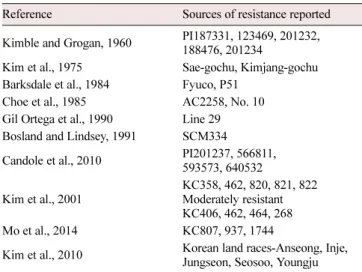
고추 역병은 토양 전염하는 특성 때문에 약제에 의한 방제효 과가 낮아 저항성 품종의 개발이 요망되어 왔다. 그래서 저항 성 재료의 검색이 꾸준히 진행되어 왔으며 이를 정리하면 Table 1과 같다. 세계적으로 알려진 저항성 유전자원 중에서는 SCM(CM)334 의 저항성이 제일 강하고, Line 29가 다음이며, PI123469, PI201232, PI201234은 서로 비슷한 수준이나 PI201234 의 과실이 Chilli형이어서 PI 자원 중에서 육종에 가 장 많이 이용되었다(Gil Ortega et al., 1991, 1992). 현재 국내 외적으로는 CM334, AC2258, PI201234가 육종에 우선적으로 사용되고 있다. Gil Ortega 등(1990)에 의하여 보고된 Mexican pepper Line 29을 도입하여 특성을 조사한 결과 AC2258과 같 은 것으로 확인되었다. 국내에서는 필자가 국내 재래종 중에 서 새고추와 김장고추가 역병에 저항성이라고 보고한 바 있 으며(Kim et al., 1975), 이후 꾸준히 역병 저항성 자원을 도 입하고 수집자원에서 저항성을 검색해 왔다(Kim, 1986, 1988;

Kim et al., 2001, 2012). 검색된 저항성 유전자원들은 역병 저

(3)

항성은 물론 원예적 특성에서도 다양성을 보여 필요에 따라 우선적으로 선택할 수 있으며, 신미성분 등 함유성분 특성을 조사하면 보다 효과적으로 활용이 가능할 것으로 기대된다 (McGregor et al., 2011).

(2) 저항성의 유전

Kimble과 Grogan(1960)에 의하여 역병에 저항성으로 보고된 PI123469, PI201232, PI201234 의 저항성의 유전연구에서 저항 성은 선발계통에 따라 1개 혹은 2개의 우성유전자에 지배되 는 것으로 보고되었다(Smith et al., 1967)(Table 2). 필자의 시 험에서도 PI20134와 AC2258은 1개의 우성유전자 분리 가설 에 맞게 나왔다(Kim and Hur, 1990; Hur et al., 1990). 그러 나 역병에 대한 저항성의 유전양식은 연구자에 따라 다른 결론을 얻고 있다. 이를 정리하면 Table 2와 같다. 특히, SCM334의 저항성과 관련해서는 3개의 유전자(Gil Ortega et al., 1991), 2 개의 유전자(Reifschneider et al., 1992), 뿌리 역병 에 대한 저항성과 경엽에 대한 저항성은 서로 독립적이며 각 각 1개의 저항성 유전자가 관여한다(Walker and Bosland,

1999)는 등의 보고가 있어서 연구자에 따라 결론이 일치하지 않는다. 근년에는 분자표지를 활용하여 양적유전자좌(Quantitative trait locus, QTL) 지도를 작성하고 마크의 도움을 받은 유전 자 도입 (Marker-assisted introgression)을 하는 등 고추에서 역 병 저항성은 폴리진(polygene)으로 간주되고 있다(Bartual et al., 1991; Lefebvre and Palloix, 1996; Naegele et al., 1014;

Thabuis et al., 2003, 2004a, 2004b).

(3) 저항성 연구를 위한 접종과 평가

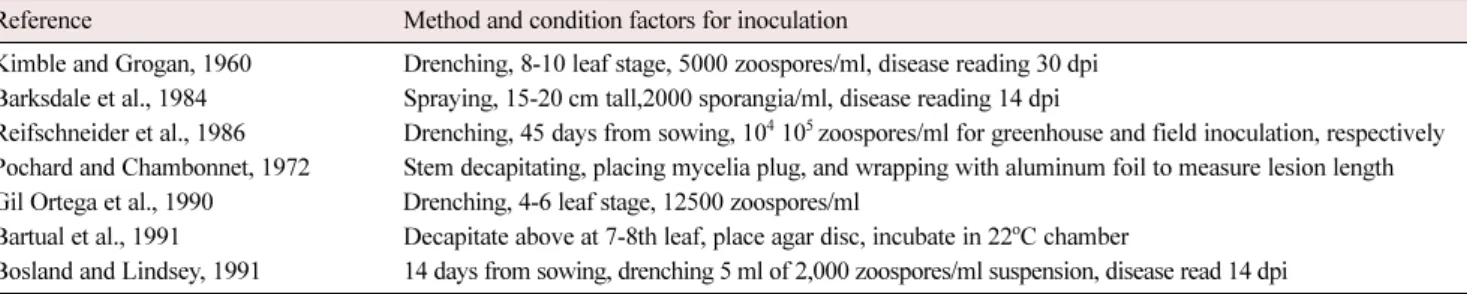
저항성 평가에 사용된 접종방법은 유주자 혹은 유주자낭 현탁 액을 식물체 줄기 밑동부근의 토양에 부어주는 관주법(drenching) 이 가장 일반적으로 사용되고 있다(Kimble and Grogan, 1960;

Reifschneider et al., 1986; Bosland and Lindsey, 1991).

이 방법은 자연 포장에서 역병의 전파, 감염과 비슷하여 유묘 의 인공접종 결과와 자연 감염포장에서의 반응과 일치하는 장 점이 있다. 그러나 이 방법은 발병도를 조사할 때 정량적으로 조사하기 곤란한 점이 있다. 통상 몇 단계의 등급을 매겨 조 사 기록하는 방법, 발병률 조사 방법 등이 사용되고 있다(Kim et al., 1975; Kimble and Grogan, 1960; Reifschneider et al., 1986). 또 다른 한 가지 방법은 8-10엽기 묘의 줄기 끝을 자 른 다음 그 위에 역병균 균사를 원판모양으로 잘라 뒤집어 얹 어놓고 알루미늄 호일로 싼 다음 22-25

o

C 온도를 유지해주고 9-10 일 후 알루미늄 호일을 벗기고 아래로 내려오면서 형성된 줄기 병반의 길이를 측정하는 방법이다(Bartual et al., 1991).

이 방법으로 접종하면 길이를 측정하여 연속적 변이 자료를 얻을 수 있어서 통계유전학적 분석을 할 수 있는 점이 장점 이다. 그러나 육종 현장에서는 노력이 많이 들고 자연 발생 과 다른 점 등 때문에 거의 사용되지 않고 있다. 저항성 연 구에 사용된 방법과 조건들을 정리하면 Table 3과 같다.

Reifschneider et al(1986) 은 역병 저항성 검정을 위한 접종방 법, 병원균의 균주, 접종원의 밀도에 대하여 실험적으로 검토 한 다음과 같이 추천하였으며, 필자의 연구실에서도 대체로 이 방법을 적용하고 있다.

(1) 병원균주: 중간 정도의 병원력(virulence)을 가지고 포자

Table 2. Inheritance of resistance to P. capsici reported

Reference Sources of resistance Mode of inheritance

Smith et al., 1967 PI123469, 201232, 201234 2 independent dominant genes

Saini and Sharma, 1978 Waxy Globe 1 dominant gene

Barksdale et al., 1984 Fyuco, P51 1 dominant gene with modifier

Kim and Hur, 1990 PI201234 1 dominant gene

Gil Ortega et al., 1990 Line 29 3 genes at least 4 alleles for resistance

Kim et al., 1991 PI123469 1 incompletely dominant gene

Hur et al., 1990 AC2258 1 dominant gene

Bartual et al., 1991 Phyo 636, P51, PM217, Smith 5, Mirasol, Line 29, Serrano

Epistasis effect important

Recurrent selection method of breeding recommended

Gil Ortega et al., 1991 SCM-334 3 genes, at least 3 alleles in heterozygous for resistance

Reifschneider et al., 1992 SCM-334 2 genes with recessive epistasis

Walker and Bosland, 1999 CM334 1 dominant gene for resistance to root rot, another 1

dominant gene for foliar blight resistance

Thabuis et al., Vania, PI201234, Perennial, CM334 QTL mapping

Naegele et al., 2014 F6 RILs of CM334 × Early Jalapeno for fruit rot Additive and epistatic QTLs identified Table 1. Sources of resistance to P. capsici reported

Reference Sources of resistance reported

Kimble and Grogan, 1960 PI187331, 123469, 201232, 188476, 201234

Kim et al., 1975 Sae-gochu, Kimjang-gochu Barksdale et al., 1984 Fyuco, P51

Choe et al., 1985 AC2258, No. 10

Gil Ortega et al., 1990 Line 29 Bosland and Lindsey, 1991 SCM334 Candole et al., 2010 PI201237, 566811,

593573, 640532 Kim et al., 2001

KC358, 462, 820, 821, 822 Moderately resistant KC406, 462, 464, 268

Mo et al., 2014 KC807, 937, 1744

Kim et al., 2010 Korean land races-Anseong, Inje,

Jungseon, Seosoo, Youngju

(4)

형성이 잘 되는 균주를 사용한다.

(2) 관주법: 유주자현탁액 3 ml을 줄기 밑동부근에 부어주는 방법으로 접종한다.

(3) 접종묘령: 파종 후 35일 이상, 가급적 45일묘를 접종한다.

유주자현탁액의 밀도: 온실접종에서는 최소 10

4

유주자/ml, 포 장접종에서는 최소 10

5

유주자/ml을 사용한다.

(4) 역병 저항성 육종

저항성 유전자원이나 유전에 관한 연구 보고는 많으나 실제 육종에 관한 보고는 매우 적다. 실제 저항성 품종의 개발은 종자회사에서 활발하게 하고 있으며, 종자회사에서는 연구결 과를 학술지에 보고하기보다 제품을 개발하여 이윤을 추구하 기 때문에 육종과 관련한 연구보고는 매우 적은 실정이다. 필 자의 연구실에서는 경북 영양지방의 재래종에 역병 저항성을 도입하는 연구와 세포질웅성불임계의 유지계와 회복계를 육성 한 연구결과를 보고한 바 있다(Hwang and Kim, 2002; Kim and Shon, 1992; Kim et al., 1996). 그 간 종자회사들의 꾸준 한 노력으로 최근에 시장에 나오는 신품종들은 대부분 역병 저항성을 보유하고 있어서(Kim et al., 2010) 재배 현장에서 역 병 발생이 크게 줄어들고 있다.

저항성과 병원균의 병원성 분화

고추 역병균 균주 간의 병원성의 변이는 Polach와 Webster (1972) 에 의하여 관찰되었으며, 국내에서는 Hwang et al(1996) 에 의하여 관찰되었다. 먼저 Yang et al(1989)은 병원균과 품 종 간에 특이관계가 없는 것으로 보고한 바 있으나 당시에는 저항성 품종이 보급되기 전이었으며, 실험에 사용된 품종들이 모두 이병성 품종들이어서 병원성의 분화가 검정될 수 없 었다. 이후 CM334, PI201234 등 대표적인 저항성 유전자원과

저항성 품종들을 공시하여 병원균주와의 상호작용을 조사하여 생리형(physiological race) 혹은 병원형(pathotype)으로 분류한 연구가 보고되었다. 이를 정리하면 Table 4와 같다. 국내에서 도 Lee et al(2010)에 의하여 저항성 유전자원과 상업용 품종 에 대한 저항성 반응을 토대로 국내 균주를 11개 병원형(race) 로 분류하였다. 그러나 현재까지의 연구된 병원형 분류 방법 을 적용할 경우 검정에 들어가는 병원 균주와 품종에 따라 모 두 달라지게 되어있어서 세계적으로 통일된 race 분류체계는 될 수 없는 상황이다. 이것은 역병 저항성의 유전양식이 연구 자에 따라 다르고, 최근에는 관여하는 유전자가 양적유전자좌 (QTL)에 의한 것으로 보고되고 있어서 고추의 세균성점무늬 병균(Xanthomonas euvesicatoria)과 고추의 과민반응형 저항성 유전자(Bs)(Stall et al., 2009)와 같이 유전자-유전자 모델(gene for gene model) 에 맞는 결과를 기대하기는 곤란한 실정이다.

유전적 방제 전략

고추 역병에 대한 저항성은 다수의 유전자에 지배되며 양적 유전을 하는 것으로 받아들여지고 있다. 이러한 유전양식은 한편 역병의 유전적 방제 측면에서 유리하다고 할 수 있다.

감자역병이나 고추의 세균성점무늬병의 경우 단일 유전자 저 항성을 도입하여 저항성 품종을 만들면 곧 이를 무력화하는 새로운 병원형의 출현으로 효과가 없어지는 문제가 있다. 그 래서 다수 혹은 양적유전자에 의한 수평저항성을 도입하려고 하고 있다. 고추 역병의 경우에도 대목으로 사용되고 있는

‘ 탄탄’ 대목 품종의 경우 출시되고 15년정도 되었으나 아직도 대목품종으로 굳게 자리를 지키고 있는 것을 보면 잘 육성된 저항성 품종은 비교적 오래 갈 수 있을 것으로 예상된다. 고 추 역병균은 공기전염은 거의 하지 않으며 주로 토양과 물을 통해서 전염하는 것으로 알려져 있어서(Granke et al., 2009) Table 3. Factors used or recommended for testing resistance to P. capsici

Reference Method and condition factors for inoculation

Kimble and Grogan, 1960 Drenching, 8-10 leaf stage, 5000 zoospores/ml, disease reading 30 dpi Barksdale et al., 1984 Spraying, 15-20 cm tall,2000 sporangia/ml, disease reading 14 dpi

Reifschneider et al., 1986 Drenching, 45 days from sowing, 10

4

10

5

zoospores/ml for greenhouse and field inoculation, respectively Pochard and Chambonnet, 1972 Stem decapitating, placing mycelia plug, and wrapping with aluminum foil to measure lesion length Gil Ortega et al., 1990 Drenching, 4-6 leaf stage, 12500 zoospores/ml

Bartual et al., 1991 Decapitate above at 7-8th leaf, place agar disc, incubate in 22

o

C chamber

Bosland and Lindsey, 1991 14 days from sowing, drenching 5 ml of 2,000 zoospores/ml suspension, disease read 14 dpi

Table 4. Reports on pathotype differentiation in P. capsici

Reference Resistance source Conclusion

Polach and Webster, 1972 Tomato, eggplant, squash, watermelon, 6 pepper lines 14 distinct pathogenic strains among 23 strains Yang et al., 1989 Susceptible commercial cultivars No interaction between isolates and cultivars

Hwang et al., 1996 PI201234, 201238 Differential interaction

Oelke and Bosland, 2003 18 varieties including CM334, PM217, Phyo, etc. 10 isolates differentiated into 9 races Glosier et al., 2007 CM334, PI201234, Fidel, Jupiter, etc. 14 different physiological races identified.

Sy et al., 2008 RILs from CM334 × Early Jalapeno 17 isolates into 13 races

Foster and Hausbeck, 2010 CM334, NY07-8001, NY07-8006, NY07-8007 4 isolates used reacted differentially to 31 cultivars.

Lee et al., 2010 Commercial cultivars CM334,

NuMex Joe E. Parker, 11 differential strains identified

(5)

특이 변이 균주가 출현하여도 타 지역으로 퍼지는데 시간이 걸릴 것으로 예상된다.

육종의 측면에서는 어떻게 하면 만들어 놓은 저항성 품종 이 병에 걸리지 않고 오래 갈 수 있느냐가 관심이다. 이를 위 해서는 가급적 다양한 저항성 유전자원을 검색해놓고, 이들에 들어있는 저항성 성분을 최근의 분자유전학적 방법 등을 통 하여 특성을 분석하고 분류하는 것이 필요하다. 육종에서는 정밀한 유전자 분석결과가 없더라도 가급적 여러 가지 저항 성 자원에서 유래한 저항성 성분을 도입하면 보다 안정한 저 항성 품종을 만들 수 있을 것으로 기대된다. 한편으로는 보급 대상 지역의 병원균을 계속 분리하여 이들을 선발과정에 사 용하는 것이 필요할 것이다. 이러한 관점에서 세계적으로 알 려진 고도 저항성 유전자원은 물론 중도 저항성 유전자원들 도 원예적 특성을 자세하게 조사하여 필요에 따라 활용할 수 있도록 하여야 할 것이다. 국내 재배 고추는 다소 간 매운 고 추로 되어 있으며, 저항성 유전자원에도 매운 자원들이 많아 활용이 용이하게 되어있다.

결 론

고추 역병은 세계 각국의 고추 산지에 발생하여 큰 피해를 주 는 주요 병이다. 병원균 (Phytophthora capsici Leonian)은 유 성포자인 난포자의 형태로 토양에서 월동하여, 이듬해에 고추 의 뿌리를 침입하여 뿌리와 줄기 밑동이 썩는 병징을 나타낸 다. 비가 계속되면 줄기 밑동의 병반에 형성된 유주자낭이 유 주자를 방출하면서 병이 격발(outbreak)하게 된다. 역병은 병 원균의 토양전염성과 강우기에 물에 의한 급속한 전파와 발 병으로 약제에 의한 방제가 어려워 저항성 품종의 개발이 요 망되었다.

저항성 품종의 개발을 위한 유전자원은 다수가 발견되었으 며, 저항성의 유전은 저항성 재료와 검정 조건에 따라 1, 2, 3 개의 유전자 등에 의한 것으로 보고되었다. 그러나 최근에는 다수의 유전자에 의한 양적유전자(QTL)에 의한 것으로 인식 되고 있다. 근년 다수의 저항성 품종이 개발되어 나오면서 고 추 역병균에서도 감자역병의 경우와 같이 병원형(race)의 분화 에 관심이 높았다. 국내외에서 저항성 유전자원 및 품종들과 역병균주들 간에 특이적 상호작용이 보고되고 있으나 아직 유 전자-유전자 모델(gene for gene model)에 맞지는 않는 것으로 보인다. 이는 저항성이 단일 유전자가 아니라 양적유전을 하 기 때문에 이 또한 선명하지 않은 것으로 사료된다.

따라서 고추 역병에 대한 저항성은 감자역병이나 고추의 세 균성점무늬병에 대한 단일 유전자 저항성과 같이 저항성 품 종이 나오자 곧 바로 이를 무력화하는 새로운 병원형이 출현 하는 상황은 일어나지 않을 것으로 사료된다. 그러나 저항성 품종들이 많이 보급되고 있는 만큼 이에 대응하여 병원력을 서서히 증강하여 저항성 수준이 낮은 품종부터 병을 유발하 는 균이 나오게 되는 것은 예상할 수 있다.

이러한 경우에 대처하기 위해서는 가급적 여러 가지 자원 에서 저항성을 도입하여 품종을 만드는 것이 필요하고, 육종 과정에 육성 품종의 보급 대상지역에서 여러 균주를 수집하

여 저항성 검정에 사용함으로써 육성 품종의 대항력을 높이 는 것이 필요할 것으로 사료된다.

적 요

고추 역병은 그 병원균의 토양전염성 때문에 약제에 의한 방 제효과가 낮아 저항성 품종의 개발이 기대되어 왔다. 고추 역 병에는 CM334, AC2258, PI201234 등 다수의 저항성 유전자 원이 보고되었으며, 이들의 저항성의 유전에 관한 연구로 진 행되었다. 그러나 저항성의 유전양식은 실험에 사용한 재료와 연구자에 따라 1개, 2개, 혹은 3개 이상의 유전자, 다수의 유 전자에 의한 양적 유전 등 다양하였다.

최근에는 분자적 방법으로 양적형질유전자좌(QTL)를 구명 하는 연구가 보고되고 있으며, 분자표지를 이용한 선발 기술 도 이미 육종 현장에서 활용되고 있다.

최근 저항성 품종이 다수 출시됨에 따라 새로운 병원형 (pathotype), 즉, 레이스(race)의 출현에 관심이 높아지면서 이 에 대한 연구가 보고되고 있다. 모두 품종과 병원균주간에 특 이적 변이가 있으며, 이를 토대로 몇 개의 병원형(race)으로 분 류할 수 있었다. 그러나 판별품종이 통일되지 않았고 시험에 사용한 품종들의 저항성 유전자의 조성도 달라 세계적으로 통 일된 레이스분류체계는 아직 없는 실정이다. 이러한 배경에서 보다 안정된 저항성 품종의 육성을 위해서는 한 가지 저항성 재료보다는 다수의 저항성 유전자원에서 저항성을 도입하고, 육성과정에 육성품종의 보급 대상지역의 여러 균주를 사용하 여 선발하는 것이 필요할 것이다.

References

Ansani CV, Matsuoka K (1983a) Survival of Phytophthora capsici in soil.

Fitopatol Bras 8: 269-276.

Ansani CV, Matsuoka K (1983b) Infectivity and viability of oospores of Phytophthora capsici in soil. Fitopatol Bras 8: 137-146.

Barksdale TH, Papavizas GS, Johnston SA (1984) Resistance to foliar blight and crown rot of pepper caused by Phytophthora capsici. Plant Dis 68: 506-509.

Bartual R, Carbonell EA, Marsal JI, Tello JC, Campos T (1991) Gene action in the resistance of peppers (Capsicum annuum) to phytophthora stem blight (Phytothora capsici L.). Euphytica 54: 195-200.

Bosland PW, Lindsey DL (1991) A seedling screen for phytophthora root rot of pepper, Capsicum annuum. Plant Dis 75: 1048-1050.

Candole BL, Conner PJ (2010) Screening Capsicum annuum accessions for resistance to six isolates of Phytophthora capsici. HortSci 45:

254-259.

Choe JS, Kang KY, Ahn JK, Um YC, Ban CD (1985) Control of Phytophthora root rot (Phytophthora capsici) of green pepper under plastic house by grafting of resistant rootstocks. Res Rep RDA 27:

6-11.

Erwin DC, Ribeiro OK (1996) Phytophthora diseases worldwide. APS Press.

Foster JM, Hausbeck MK (2010) Managing phytophthora crown and root rot in bell pepper using fungicides and host resistance. Plant Dis 94:

697-702.

Gil Ortega R, Palazón Español C, Cuartero Zueco J (1990) Genetics of

resistance to Phytophthora capsici in the Mexican pepper ‘Line 29’.

(6)

BullOEPP 20: 117-112.

Gil Ortega R, Palazón Español C, Cuartero Zueco J (1991) Genetics of resistance to Phytophthora capsici in the pepper line ‘SCM-334’.

Plant Breed 107: 50-55.

Gil Ortega R, Palazón Español C, Cuatero Zueco J (1992) Genetic relationships among four pepper genotypes resistant to Phytophthora capsici. Plant Breed 108: 118-125.

Glosier BR, Ogundiwin EA, Sidhu GS, Sischo DR, Prince JP (2007) A differential series of pepper ( Capsicum annuum) lines delineates fourteen physiological races of Phytophthora capsici. Euphytica 162: 23-30.

Granke LL, Windstam ST, Hoch HC, Smart CD, Hausbeck MK (2009) Dispersal and movement mechanisms of Phytophthora capsici sporangia. Phytopathology 99: 1258-1264.

Hur JM, Lee YS, Kim BS, Cho CH (1990) Evaluation and inheritance of resistance to phytophthora blight in pepper. Plant Pathol J 6: 447-451.

Hwang BK, Kim YJ, Kim CH (1996) Differential interactions of Phytophthora capsici isolates with pepper genotypes at various plant growth stages. Eur J Plant Pathol 102: 311-316.

Hwang HS, Kim BS (2002) Breeding maintainer and restorer lines of cytoplasmic male sterility resistant to Phytophthora capsici in Capsicum pepper. J Kor Soc Hort Sci 43: 143-150.

Jee HJ, Cho WD, Kim CH (2000) Phytophthora diseases in Korea.

National Institute of Agricultural Science and Technology, Suwon, Korea.

Katsura K (1972) Phytophthora diseases of plants, Theory and Practice.

Yokendo, Tokyo, Japan.

Kim BS (1986) Resistance to phytophthora root rot in introduced peppers ( Capsicum spp.). J Kor Soc Hort Sci 27: 11-14.

Kim BS (1988) Characteristics of bacterial spot resistant lines and phytophthora blight resistant lines of Capsicum pepper. J Kor Soc Hort Sci 29: 247-252.

Kim BS, Ahn JH, Lee JM, Park DG, Kim HY (2012) Restorer genotype for male sterile cytoplasm of genetic resources moderately resistant to Phytophthora capsici in Capsicum pepper. Kor J Hort Sci Technol 30: 73-78.

Kim BS, Chung BJ, Lee WS (1975) Studies on seasonal changes in occurrence of phytophthora blight and varietal resistance in peppers. J Kor Soc Hort Sci 16: 214-219.

Kim BS, Hur JM (1990) Inheritance of resistance to bacterial spot and to phytophthora blight in pepper. J Kor Soc Hort Sci 31: 350-357.

Kim BS, Hwang HS, Kim JY, Han JH (2001) Additional sources of resistance to phytophthora blight in pepper. J Kor Soc Hort Sci 42:

233-237.

Kim BS, Kim JS, Lim YS (1996) Selection in the generations after backcrosses of the crosses for incorporation of resistance to bacterial spot into Korean local cultivars of pepper. Kor J Plant Pathol 12:

437-444.

Kim BS, Kwon TR, Hwang JE, Lee JM, Park DG, Ahn JH, Kim HY (2010) Resistance to phytophthora blight of commercial pepper cultivars in Korea. Res Plant Dis 16: 141-147.

Kim BS, Kwon YS, Shon EY, Hur JM (1991) Inheritance of resistance to phytophthora blight and to bacterial spot in pepper. Kor J Plant Pathol 7: 17-24.

Kim BS, Shon EY (1992) Testing early generations of crosses for incorporation of resistance to phytophthora blight into Korean local cultivars of pepper. J Kor Soc Hort Sci 33: 312-317.

Kim JS, Do TH, Cho EK, Lee MW (1988) Mating types of Phytophthora capsici leonian from red-pepper (Capsicum annuum L.) in Korea. Kor J Mycol 16: 60-63.

Kim JS, Kim WI, Jee HJ, Gwang JG, Kim CK, Shim CK (2010) Evaluation of resistance in hot pepper germplasm to phytophthora blight on biological assay. Kor J Hort Sci Technol 28: 802-809.

Kimble KA, Grogan RG (1960) Resistance to phytophthora root rot in pepper. Plant Dis Rep 44: 872-873.

Ko WH (1978) Heterothallic phytophthora: evidence for hormonal

regulation of sexual reproduction. J Gen Microbiol 107: 15-18.

Ko WH (1980) Hormonal regulation of sexual reproduction in Phytophthora. J Gen Microbiol 116: 459-463.

Korean Society Plant Pathology (2009) List of plant diseases in Korea, 5th ed. The Korean Society of Plant Pathology, Suwon, Korea.

Kreutzer WA, Bodine EW, Durrell LW (1940a) Cucurbit diseases and rot of tomato fruit caused by Phytophthora capsici. Phytopathology 30:

972-976.

Kreutzer WA, Bodine BW, Durrell LW (1940b) A sexual phenomenon exhibited by certain isolates of Phytophthora capsici. Phytopathology 30: 951-957.

Lee SJ, Park YJ, Kim HT, Kim BS (2010) The race differentiation of Phytophthora capsici in Korea. Res Plant Dis 16: 153-157.

Lefebvre V, Palloix A (1996) Both epistatic and additive effects of QTLs are involved in polygenic induced resistance to disease: a case study, the interaction pepper - Phytophthora capsici Leonian. Theor Appl Genet 93: 503-511.

Leonian LH (1922) Stem and fruit blight of peppers caused by Phytophthora capsici sp. nov. Phytopathology 12: 401-408.

Ansani CV (1984) Formation of oospores by Phytophthora capsici in the roots and stems of sweet pepper capsicum annuum. Fitopatologia Brasileira 9: 27-36.

McGregor C, Waters V, Nambeesan S, MacLean D, Candole BL, Conner P (2011) Genotypic and phenotypic variation among pepper accessions resistant to Phytophthora capsici. HortSci 46: 1235-1240.

Mo HS, Kim SY, Wai KPP, Siddique MI, Yoo HJ, Kim BS (2014) New sources of resistance to Phytophthora capsici in Capsicum spp. Hort Environ Biotechnol 55: 50-55.

Naegele RP, Ashrafi H, Hill TA, Chin-Wo SR, Van Deynze AE, Hausbeck MK (2014) QTL mapping of fruit rot resistance to the plant pathogen Phytophthora capsici in a recombinant inbred line Capsicum annuum population. Phytopathology 104: 479-483.

Oelke LM, Bosland PW (2003) Differentiation of race specific resistance to phytophthora root rot and foliar blight in Capsicum annuum. J Amer Soc Hort Sci 128: 213-218.

Polach FJ, Webster RK (1972) Identification of strains and inheritance of pathogenicity in Phytophthora capsici. Phytopathology 62: 20-26.

Reifschneider FJB, Café-filho AC, Rego AM (1986) Factors affecting expression of resistance in pepper ( Capsicum annuum) to blight caused by Phytophthora capsici in screening trials. Plant Pathol 35:

451-456.

Reifschneider FJB, Boiteux LS, Vecchia PTD, Poulos JM, Kuroda N (1992) Inheritance of adult-plant resistance to Phytophthora capsici in pepper. Euphytica 62: 45-49.

Saini SS, Sharma PP (1978) Inheritance of resistance to fruit rot ( Phytophthora capsici Leon.) and induction of resistance in bell pepper ( Capsicum annuum L.). Euphytica 27: 721-723.

Sansome E (1976) Gametangial meiosis in Phytophthora capsici. Can J Bot 54: 1535-1545.

Smith PG, Kimble KA, Gregan RG, Millett AH (1967) Inheritance of resistance in pepper to Phytophthora root rot. Phytopathology 57:

377-379.

Song JY, Yoo SJ, Kim HG (2002). Distribution and alteration of mating type of Phytophthora capsici population from red pepper in Korea.

Kor J Mycol 30: 152-156.

Stall RE, Jones JB, Minsavage GV (2009) Durability of resistance in tomato and pepper to xanthomonads causing bacterial spot. Annu Rev Phytopathol 47: 265-284.

Sy O, Steiner R, Bosland PW (2008) Recombinant inbred line differential identifies race-specific resistance to Phytophthora root rot in Capsicum annuum. Phytopathology 98: 867-870.

Thabuis A, Palloix A, Pflieger S, Daubèze AM, Caranta C, Lefebvre V (2003) Comparative mapping of phytophthora resistance loci in pepper germplasm: evidence for conserved resistance loci across solanaceae and for a large genetic diversity. Theor Appl Genet 106:

1473-1485.

(7)

Thabuis A, Lefebvre V, Bernard G, Daubèze AM, Phaly T, Pochard E, Palloix A (2004a) Phenotypic and molecular evaluation of a recurrent selection program for a polygenic resistance to Phytophthora capsici in pepper. Theor Appl Genet 109: 342-351.

Thabuis A, Palloix A, Servin B, Daubèze AM, Signoret P, Hospital F, Lefebvre V (2004b) Marker-assisted introgression of 4 Phytophthora capsici resistance QTL alleles into a bell pepper line: validation of additive and epistatic effects. Mol Breeding 14: 9-20.

Tompkins CM, Tucker CM (1941) Buckeye rot of tomato in California. J Agr Res 62: 467-474.

Walker SJ, Bosland PW (1999) Inheritance of Phytophthora root rot and

foliar blight resistance in pepper. J Amer Soc Hort Sci 124: 14-18.

Weber GF (1932) Blight of pepper in Florida caused by Phytophthora capsici. Phytopathology 22: 775-780.

Wiant JS, Tucker CM (1940) A rot of Winter Queen water-melons caused by Phytophthora capsici. J Agr Res 60: 73-88.

Yang SS, Sung NK, Choi DI, Kim CH (1989) Pathogenic variation of Phytophthora capsici Leonian on red pepper in Korea. Kor J Plant Pathol 5: 370-376.

Yeh WH, Kim CH (1991) Integrated management of phytophthora blight

of red-pepper by host resistance and fungicide application. Kor J Plant

Pathol 7: 226-229.

수치

Table 2. Inheritance of resistance to P. capsici reported
Table 4. Reports on pathotype differentiation in P. capsici

참조

관련 문서

Identifying Candidate Genes for Phytophthora capsici Resistance in Pepper (Capsicum annuum) Via Genotyping-By-Sequencing-Based QTL Mapping and Genome- Wide Association Study

Selection procedures for breeding genic male sterile lines for resistance to both Phytophthora blight caused by Phytophthora capsici and bacterial spot caused

Restorer Genotype for Male Sterile Cytoplasm of Genetic Resources Moderately Resistant to Phytophthora capsici in Capsicum Pepper.. Byung-Soo Kim * , Joon-Hyung Ahn, Jae Moo

Bacillus subtilis S54 균주를 이용한 고추 역병과 탄저병의 생물학적 방제 89 in vitro 와 in vivo 조건에서 실험한 결과를 바탕으로 평가. 하였을 때 분리된

Four promising biocontrol agents against Phytophthora capsici were selected from 507 bacterial isolates collected from rhizosphere soils and roots of pepper plants.. In

In the field test, when the microbial fungicides (B. polymyxa AC-1) and the chemical fungicide(De) for the control of Phytophthora blight of red pepper were mixed-soil