133
Arc h Aesthet Plast Surg
보형물을 이용한 유방재건술에서 새롭게 개발된 무세포 동종사체진피(CG Derm TM )사용의 유용성에 대한 전향적 연구
김영석· 정보람· 홍종원· 노태석· 나동균
연세대학교 의과대학 강남세브란스병원 성형외과학교실-인체조직복원연구소
Application of Newly Developed Acellular Dermal Matrix Allograft (CG DermTM) in Breast Reconstruction with the Implant:
The Prospective Study
Young Seok Kim, M.D., Bo Rham Jeong, M.D., Jong Won Hong, M.D., Tai Suk Roh, M.D., Dong Kyun Rah, M.D.
Institute for Human Tissue Restoration, Department of Plastic & Reconstructive Surgery, Gangnam Severance Hospital, Yonsei University College of Medicine, Seoul, Korea
Several freeze-dried human acellular dermal matrix have been introduced and they helped to facilitate implant based breast reconstruction by providing support to the breast lower pole, firm fixation of inframammary fold, and simple operation procedure. We evaluated clinical outcomes of recently produced human acellular dermal matrix, CG Derm
TM, prospectively. CG Derm
TMwas used in six patients and eight breasts for implant breast reconstruction. Complete blood cell count test, rountine chemisty(including ESR) test, and CRP test were performed before and after the surgery. Postoperative complication was evaluated including infection, seroma, implant malpostion, rippling deformity, and capsular contracture. Randomly selected two patients underwent breast MRI after reconstruction. Finally we examine patients’ satisfaction survey and plastic surgeons’ evaluation. Satisfactory breast lower pole fullness, symmetric inframammary folds and breast shapes were achieved in most patients. Overall, patients had sufficient aesthetic satisfaction and surgeon’s evaluation was also good. There was no major complication except four cases of seroma which healed with conservative management. Implant breast reconstruction using CG Derm
TMwas safe and obtain good aesthetic results. But further and larger scale study should be performed to reveal out the relatively high risk of seroma.
(Archives of Aesthetic Plastic Surgery 18: 133, 2012) Key Words: Breast reconstruction, Breast implant, Allograft, Skin substitutes
Ⅰ. INTRODUCTION
Since Breuing et al.1 introduced the insertion of implant into the dual plane subpectoralis major muscle-sub-AlloDerm (Al- logenic acellular dermal matrix, LifeCell Corp., Branchburg, NJ) for patients who had received mastectomy for breast cancer
and then were receiving implant breast reconstruction in 2005, studies on surgery by similar methods have reported good results,2-7 and we also reported its usefulness through ‘A Study on Breast Implant Reconstruction Using AlloDerm® Sling Tech- nique: Effects on Clinical Course and Encapsulation’ in 2009 (Journal of the Korean Society of Plastic and Reconstructive Surgeons Vol. 36, No. 6, 755-760).8
CG DermTM (CG Bio Corp., Seoul, Korea) is allogenic acel- luar dermal matrix for grafting made by processing human skin tissue obtained from domestic donors. CG DermTM is for treating soft tissue defect in burns, abdominal wall reconstruc- tion to treat hernia, and a product for above-mentioned breast reconstruction using implant has also been commercialized at Korea and is being used in surgery. However, no study has been reported on the clinical course after surgery that applied the
Received October 4, 2012 Revised October 12, 2012 Accepted October 15, 2012
Address Correspondence: Tai Suk Roh, M.D., Ph.D., Department of Plastic & Reconstructive Surgery, Gangnam Severance Hospital, Yonsei University College of Medicine, Seoul 135-720, Korea.
Tel: +82-2-2019-3420, Fax: +82-2-3463-4914, E-mail: [email protected]
*본 연구는 대웅바이오㈜(Daewoong Bio Incorp., Seoul, Korea)연구비 지원에 의하여 이루어졌음.
Or ig in al A rt ic le
134
Arc h Aesthet Plast Surg
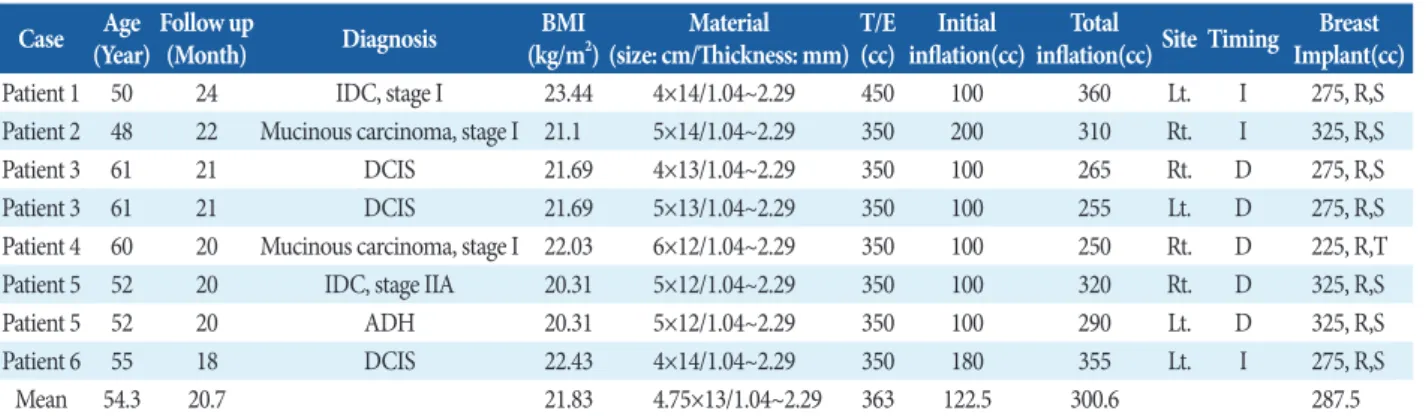
2nd operation(permanent breast implant insertion) was per- formed after 6 months on the average from the insertion of tissue expander. The used permanent breast implant was 275cc smooth round shape cohesive gel in four cases of breast, 325cc textured round shape cohesive gel in three cases, and 225cc textured round shape cohesive gel in one case(Table 1). None of the patients received radiotherapy after the surgery, and one patient (one case of breast) received chemotherapy.
B. Operation method
In case of immediate reconstruction, just after total mastec- tomy we used the incision line made in the mastectomy. And in case of delayed reconstruction, we incised over the scar left by the previous mastectomy.
The surgical procedure was the same as that described in the paper8 that the present researchers published earlier, and the only difference was that the material was switched from Allo- Derm® to CG DermTM.
After the surgical procedure was completed, CG DermTM was fixed on the inferior margin of the origin of the separated pectoralis major muscle on the superior side, to the serratus anterior muscle on the lateral side, and to the chest wall on the medial and inferior side(Fig. 1). Before suture, we resected all wound margins suspected to have the possibility of necrosis be- cause of congestion or inadequate perfusion during operation, and inserted a drain tube under the subcutaneous at the infla- mammary fold above CG DermTM. The drain tube was main- tained until daily drainage became less than 30cc, and during the admission period the patient was received with venous or oral antibiotics.
C. Evaluation
To evaluate safety of CG DermTM all patient examed com- plete blood cell count test, rountine chemisty(including ESR) product to the implant based breast reconstruction.
Thus, we purposed to examine the clinical course of breast implant reconstruction using newly developed allogenic acel- luar dermal matrix CG DermTM through a prospective study.
Ⅱ. MATERIALS AND METHODS A. Subject and material
The subjects of this study were six patients (eight cases of breast) who wanted breast reconstruction after mastectomy and gave an informed consent to the clinical experiment before surgery.
We excluded those who planned or had already had radio- therapy after mastectomy, those for whom implant insertion was impossible due to surgical site infection, and those suspect- ed to have inflammation or systemic infection in preoperative examination (ESR>20mm/hr and CRP>6.0mg/L).
Tissue expander insertion and breast implant insertion us- ing CG DermTM were performed from June 2010 to December 2011. Three patients (3 cases of breast) had immediate recon- struction, and the other three patients (5 cases of breast) had delayed reconstruction. The mean age was 54.3 (48-61) and the mean BMI was 21.83 kg/m2 (±1.08 kg/m2). The follow-up period ranged from 18 to 24 months and the mean follow-up period was 20.7 months. The cause of mastectomy was stage-0 breast cancer in two patients, stage-I breast cancer in three, and stage-II breast cancer in one, and all of them received total mastectomy.
Tissue expander used in the 1st operation was 350cc in seven cases, and 450cc in one case, and the mean inflation volume at the operating room was 122.5cc. For CG DermTM, we used one 1.04- 2.29mm in thickness and 13 x 4.75cm in the mean size.
The period taken for tissue expansion was 5.3 months on the average, and the average volume after expansion was 300.6cc.
Table 1. Summary of Patients Case Age
(Year) Follow up
(Month) Diagnosis BMI
(kg/m
2) Material
(size: cm/Thickness: mm) T/E
(cc) Initial
inflation(cc) Total
inflation(cc) Site Timing Breast Implant(cc)
Patient 1 50 24 IDC, stage I 23.44 4×14/1.04~2.29 450 100 360 Lt. I 275, R,S
Patient 2 48 22 Mucinous carcinoma, stage I 21.1 5×14/1.04~2.29 350 200 310 Rt. I 325, R,S
Patient 3 61 21 DCIS 21.69 4×13/1.04~2.29 350 100 265 Rt. D 275, R,S
Patient 3 61 21 DCIS 21.69 5×13/1.04~2.29 350 100 255 Lt. D 275, R,S
Patient 4 60 20 Mucinous carcinoma, stage I 22.03 6×12/1.04~2.29 350 100 250 Rt. D 225, R,T
Patient 5 52 20 IDC, stage IIA 20.31 5×12/1.04~2.29 350 100 320 Rt. D 325, R,S
Patient 5 52 20 ADH 20.31 5×12/1.04~2.29 350 100 290 Lt. D 325, R,S
Patient 6 55 18 DCIS 22.43 4×14/1.04~2.29 350 180 355 Lt. I 275, R,S
Mean 54.3 20.7 21.83 4.75×13/1.04~2.29 363 122.5 300.6 287.5
DCIS, Ductal carcinoma in situ; IDC, Invasive ductal carcinoma; ADH, Atypical ductal hyperplasia; T/E, Tissue expander; I, Immediate; D, Delayed;
R, Round; S, Smooth; T, Textured.
135
Arc h Aesthet Plast Surg
daily drainage even after 10 days from the surgery and they were cured completely through conservative treatment.
In the interim evaluation of reconstructed breast conducted just before the insertion of permanent breast implant, the dis- placement of tissue expander was not observed but inflamam- mary fold was slightly asymmetric in two patients (two cases of breast), so it was corrected through inframammary fold repositioning during the 2nd operation. None of the cases had capsular contracture.
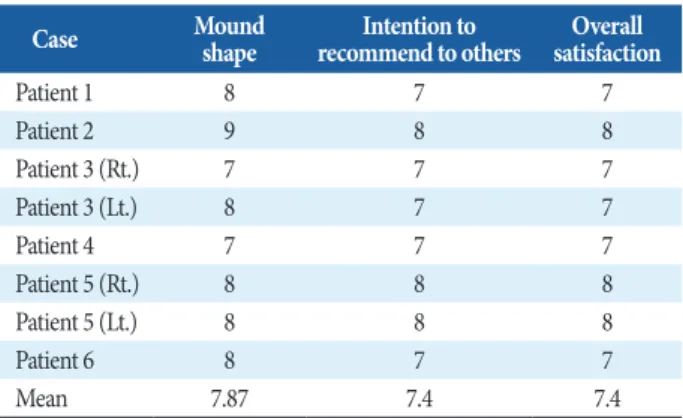
In the patients’ subjective satisfaction surveyed on their last outpatient visit, the satisfaction level was 7.87 for mound shape, 7.4 for intention to recommend to others, and 7.4 for overall satisfaction(Table 2). The results of final evaluation by plastic surgeons were 8.25 for reconstructed breast mound shape, 8.63 for the displacement of reconstructed breast mound, 8.63 for the symmetry of reconstructed breast, and 8.25 for the posi- tion of inframammary fold. Touch of reconstructed breast was 8.38 out of 10, and rippling deformity and capsular contracture were not observed. The course evaluation was 8.63, and general evaluation 8.63(Table 3).
For three cases of breast in two patients, we took MRI after three month from the 2nd operation. Even though we could not figure out CG DermTM exactly with MRI image, we observed sufficient breast lower pole soft tissue, not distorted implant shape and position, and normal capsule around implant in the mid clavicle sagittal view (Fig. 2).
Ⅳ. DISCUSSION
With the recently increasing incidence of breast cancer among young women in Korea, breast reconstruction using implant is spotlighted because it does not leave a scar in the donor site and its surgical procedure is simple. It is conducted usually through two stages, inserting tissue expander to expand insufficient skin tissue in the 1st operation and inserting implant test, CRP test before the first surgical treatment, right before
discharge and four weeks later of surgery. After first surgery, drain was checked every day. We defined seroma as over 30cc of drainage at a day after 10th postoperative day. Through all follow up period complications including infection, seroma, implant malpostion, inframammary fold asymmetry, rippling deformity, and capsular contracture were checked.
On patients’ last outpatient visit, we conducted a question- naire survey on the patients’ subjective satisfaction with the shape of breast mound, overall satisfaction, and their intention to recommend to others, giving full score 10 for ‘Very satis- fied.’ In addition, two different plastic surgeons made finial objective evaluation on breast mound shape, the presence of breast mound displacement (high score for less displacement), symmetry, the position of inflamammary fold, touch, rippling deformity, capsular contracture, overall progress, and general evaluation.
D. Magnetic resonance image examination
Selecting two out of the six patients at random, we took breast MRI after three month from the 2nd operation and con- firmed that CG DermTM was supporting the soft tissue of lower pole of reconstructed breast and that there was no capsular contracture or implant displacement.Ⅲ. RESULTS
After the insertion of tissue expander, none of the eight cases of breast showed side effects such as wound infection at the surgical site, systemic infection, hypersensitivity, immunologic response, wound dehiscence at the surgical site, and any signifi- cant hematologic or serologic abnormal value, but four cases of breast in three patients showed seroma having over 30cc of
Table 2. Patients' Subjective Satisfaction Survey
Case Mound
shape Intention to
recommend to others Overall satisfaction
Patient 1 8 7 7
Patient 2 9 8 8
Patient 3 (Rt.) 7 7 7
Patient 3 (Lt.) 8 7 7
Patient 4 7 7 7
Patient 5 (Rt.) 8 8 8
Patient 5 (Lt.) 8 8 8
Patient 6 8 7 7
Mean 7.87 7.4 7.4
Fig. 1. Intraop (Tissue expander insertion) Implant was inserted
beneath subpectoal-subAlloDerm dual-plane.
136
Arc h Aesthet Plast Surg
As pointed out by the authors8 and de Blacam C et al.,12 however, the high cost of AlloDerm increases the expense of implant breast reconstruction. Allogenic acelluar dermal matrix CG DermTM, which began to be produced in Korea in 2010 and is used in skin graft for burns and other skin wounds, is about 20% cheaper in unit price than AlloDerm. What is more, because it is thicker than AlloDerm (1.04~2.29 mm vs.
0.79~2.03 mm) its effect of soft tissue reinforcement is higher.
CG DermTM is thicker than AlloDerm, it may takes a longer time for engraftment and the risk of failure in engraftment is higher, but in this study we observed grossly in the 2nd operation that CG DermTM had been engrafted properly. And during clini- cal courses, hematologic or serologic problem was not occurred.
In addition, there were no side effects such as the thinning and perforation of skin during tissue expansion, the downward displacement of the inframammary fold, the rippling deformity, and the capsular contracture, and these results correspond to the advantages of the AlloDerm sling technique (Fig. 3).
in the 2nd operation. In general, the superior part of tissue ex- pander is placed below the pectoralis major muscle and its infe- rior part on the dual plane below the subcutaneous tissue. But Asian women have thin skin and subcutaneous tissue, the skin may be perforated while the tissue expander expands and, as a result, the implant can be exposed or bottoming out deformity can take place, and later when permanent implant is inserted it can be followed by complications such as rippling deformity.
In 2005, Breuning1 introduced the AlloDerm sling technique that grafts AlloDerm on the inferior of pectoralis major muscle and then inserts implant into the pocket sub-pectoralis major muscle-subAlloDerm plane and, by doing so, fixes the position of inframammary fold firmly and obtains satisfactory recon- structed breast lower pole fullness. Since then, several studies reported cosmetically superior results without increasing other complications,9,10 and according to a survey in the U.S. in 2010, 50% of implant breast reconstruction patients were operated by the AlloDerm sling technique.11
Table 3. Evaluation by Plastic Surgen
Case Mound
shape
Displacement of reconstructed breast
mound
Symmetry of
reconstructed breast Position of inframammary fold
Touch of reconstructed
breast
The course
evaluation General evaluation
Patient 1 8 9 9 9 8 9 9
Patient 2 9 9 9 9 9 9 9
Patient 3 (Rt.) 7 8 8 7 8 8 8
Patient 3 (Lt.) 8 8 8 8 8 8 8
Patient 4 8 9 9 8 8 8 8
Patient 5 (Rt.) 9 9 9 8 9 9 9
Patient 5 (Lt.) 9 9 9 8 9 9 9
Patient 6 8 8 8 9 8 9 9
Mean 8.25 8.63 8.63 8.25 8.38 8.63 8.63
Fig. 2. 48/F patient. Comparison between preop (Left), 1st stage postop (5 month after Tissue expander insertion)(Right).
137
Arc h Aesthet Plast Surg
Ⅴ. CONCLUSION
In implant breast reconstruction with CG DermTM, it was safe and simple procedure, its’ aesthetic result was good, so it could another good choice in implant breast reconstruction. But in our study seroma formation was higher than previous report using AlloDerm, so it is need to more lager study require.
REFERENCES
1. Breuning KH, Warren SM: Immediate Bilateral Breast Recon- struction With Implants and Inferolateral AlloDerm Slings.
Ann Plast Surg 55: 232, 2005
2. Gamboa-Bobadilla GM: Implant Breast Reconstruction Using Acellular Dermal Matrix. Ann Plast Surg 56: 22, 2006
3. Salzberg CA: Nonexpansive Immediate Breast Reconstruction Using Human Acellular Tissue Matrix Graft (AlloDerm). Ann Plast Surg 57: 1, 2006
4. Bindingnavele V, Gaon M, Ota KS, Kulber DA, Lee DJ: Use of acellular cadaveric dermis and tissue expansion in postmastec- tomy breast reconstruction. Plast Reconstr Surg 60: 1214, 2007 5. Breuing KH and Colwell AS: Inferolateral AlloDerm Hammock
for Implant Coverage in Breast Reconstruction. Ann Plast Surg 59: 250, 2007
6. Zienowicz RJ, Karacaoglu E: Implant-Based Breast Reconstruc- tion with Allograft. Plast Reconstr Surg 120: 373, 2007
7. Spear SL, Parikh PM, Reisin E, Menon NG: Acellular Dermis- Assisted Breast Reconstruction. Ann Plast Surg 59: 250, 2008 8. Yoon JH, Kim YS, Roh TS, Rah DK: Implant Breast Reconstruc-
tion using AlloDerm Sling; Clinical Outcomes and Effect to Capsular Formation. J Korean Soc Plast Reconstr Surg 36(6):
755-760, 2009
9. Preminger BA, McCarthy CM, Hu QY, Mehrara BJ, Disa JJ: The Influence of AlloDerm on Expander Dynamics and Complica- tions in the Setting of Immediate Tissue Expander/Implant Re- construction. A Matched-Cohort Study. Ann Plast Surg 60: 510, 2008
10. Vardanian AJ, Clayton JL, Roostaeian J, Shirvanian V, Da Lio A, Lipa JE, Crisera C, Festekjian JH: Comparison of implant-based immediate breast reconstruction with and without acellular dermal matrix. Plast Reconstr Surg 128(5): 403e-410e
11. Gurunluoglu R, Gurunluoglu A, Williams SA, Tebockhorst S:
Current Trends in Breast Reconstruction: Survey of American Society of Plastic Surgeons 2010. Ann Plast Surg 22: 2011 [Epub ahead of print]
12. de Blacam C, Momoh AO, Colakoglu S, Slavin SA, Tobias AM, Lee BT: Cost Analysis of Implant-Based Breast Reconstruction With Acellular Dermal Matrix. Ann Plast Surg 16: 2011[Epub ahead of print]
13. Sbitany H, Serletti JM: Acellular dermis-assisted prosthetic breast reconstruction: a systematic and critical review of efficacy and associated morbidity. Plast Reconstr Surg 128(6): 1162-9, 2011
In the MRI of three cases of breasts taken after three month from the 2nd operation, the mid clavicle sagittal view showed that the superior part of the implant was covered with pecto- ralis major muscle and the inferior part was reinforced firmly with capsule formed with CG DermTM. The implant shape was not distorted and its’ position was proper. With these results, surgeons gave 8.63 out of 10, which is a relatively high score, in their final evaluation, but the patients’ subjective satisfaction in the questionnaire survey was 7.4, somewhat lower than the surgeons’ evaluation. This is probably because patients’ expec- tation for breast reconstruction is usually higher than surgeons’
therefore it may be necessary to lower patients’ excessively high expectation through giving a sufficient explanation before sur- gery.
In the results of this study, seroma occurred in four out of the eight cases of breast and this incidence is higher than that in other studies with AlloDerm (2.3~14.6%).13 What is more, seroma was cured through conservative treatment without other complications, but considering that two cases of them received inframammary fold repositioning and one received capsulectomy in the 2nd operation, we cannot exclude the pos- sibility that seroma might have a negative effect on the cosmetic outcome. Because the sample size was small, however, further larger-scale research may be necessary on how the incidence of seroma affects cosmetic outcomes in the use of CG DermTM.