Received: Jul 4, 2017; Revised: Aug 25, 2017; Accepted: Sep 14, 2017; Published online Nov 21, 2017 Correspondence to: Jong Kwan Park https://orcid.org/0000-0001-9682-2081
Department of Urology, Chonbuk National University Medical School, 20 Geonji-ro, Deokjin-gu, Jeonju 54907, Korea.
Tel: +82-63-250-1510, Fax: +82-63-250-1564, E-mail: [email protected]
*These authors contributed equally to this work as co-first authors.
Penile Erection Induced by Scoparone from Artemisia capillaris through the Nitric Oxide-Cyclic Guanosine Monophosphate Signaling Pathway
Bo Ram Choi1,*, Hye Kyung Kim2,*, Jong Kwan Park1
1Department of Urology, Research Institute of Clinical Medicine, Biomedical Research Institute, and Clinical Trial Center of Medical Device, Chonbuk National University Medical School, Jeonju, 2College of Pharmacy, Kyungsung University, Busan, Korea
Purpose: The objective of this study was to evaluate the relaxant effect of scoparone from Artemisia capillaris on rabbit penile corpus cavernosum smooth muscle (PCCSM) and to elucidate the mechanism of action of scoparone for the treatment of erectile dysfunction (ED).
Materials and Methods: PCCSM that had been precontracted with phenylephrine was treated with 3 Artemisia herbs (A. princeps, A. capillaris, and A. iwayomogi) and 3 fractions (n-hexane, ethyl acetate, and n-butanol) with different concentrations (0.1, 0.5, 1.0, and 2.0 mg/mL). Four components (esculetin, scopoletin, capillarisin, and scoparone) isolated from A. capillaris were also evaluated. The PCCSM was preincubated with Nω-nitro-L-arginine methyl ester hydrochloride (L-NAME) and 1H-[1,2,4]
oxadiazolo [4,3-a]quinoxalin-1-one (ODQ). Cyclic nucleotides in the perfusate were measured by a radioimmunoassay. The interactions of scoparone with udenafil and rolipram were also evaluated.
Results: A. capillaris extract relaxed PCCSM in a concentration-dependent manner. Scoparone had the highest relaxant effect on PCCSM among the 4 components (esculetin, scopoletin, capillarisin, and scoparone) isolated from the ethyl acetate fraction. The application of scoparone on PCCSM pretreated with L-NAME and ODQ led to significantly less relaxation. Scoparone also increased the cyclic guanosine monophosphate (cGMP) levels in the perfusate in a concentration-dependent manner.
Furthermore, scoparone enhanced udenafil- and rolipram-induced relaxation of the PCCSM.
Conclusions: Scoparone relaxed the PCCSM mainly by activating the nitric oxide-cGMP signaling pathway, and it may be a new promising treatment for ED patients who do not completely respond to udenafil.
Key Words: Coumarins; Erectile dysfunction; Nitric oxide; Phosphodiesterase 5 inhibitors
www.wjmh.org
INTRODUCTION
Erectile dysfunction (ED) is defined as a recurrent inabil- ity to achieve and/or maintain an erection sufficient to per- mit satisfactory sexual activity [1]. ED is a significant global health problem in aging men, affecting approximately 150 million men worldwide [2]. The causes of ED have been classified as psychogenic, organic (neurogenic, hormonal, arterial, venous, and cavernosal), and mixed psychogenic and organic [3]. A number of common risk factors are asso- ciated with ED, including age, heart disease, diabetes, hy- pertension, metabolic syndrome, and physical inactivity [4]. Normal penile erection is dependent upon nitric oxide (NO). NO is supplemented by release from the vascular endothelium, and leads to relaxation of the smooth mus- cle in the penile arteries [5]. NO activates soluble guany- late cyclase to increase the levels of the cellular second messenger cyclic guanosine monophosphate (cGMP) in smooth muscle cells [6]. The activation of cGMP-specific protein kinases induces the opening of potassium chan- nels, which act together with calcium channels to de- crease the intracellular level of calcium ions and to lead to smooth muscle relaxation in the cavernosum [7].
Artemisia plants, particularly A. princeps, A. capillaris, and A. iwayomogi, are important medicinal materials in traditional Asian medicine [8]. A. capillaris Thunb has been widely used as a traditional herbal medicine for liver cirrhosis, liver cancer, jaundice, and cholecystitis in Asian countries [9]. Several compounds have been isolated from A. capillaris, including capillarisin and coumarin de- rivatives, such as esculetin, scopoletin, and scoparone [10]. 6,7-dimethoxy coumarin (scoparone) is an active constituent isolated from the shoot of A. capillaris that has been used as an anti-inflammatory and choleretic agent for the treatment of hepatitis [11,12]. In addition, it was found that scoparone exerted vasodilatory activity in a heart per- fusion model in rats [13].
The objective of the present study was to evaluate the effect of scoparone on penile corpus cavernosum smooth muscle (PCCSM) and to elucidate the possible mechanism of the action of scoparone on ED.
MATERIALS AND METHODS
1. Chemicals and reagents
Nω-nitro-L-arginine methyl ester hydrochloride (L-NAME), 1H-[1,2,4]oxadiazolo[4,3-a]quinoxalin-1-one (ODQ), L-phenylephrine (Phe), dimethyl sulfoxide, roli- pram, scopoletin, and scoparone (Fig. 1) were purchased from Sigma-Aldrich (St. Louis, MO, USA). Esculetin and capillarisin were purchased from Wako Pure Chemical Industries (Osaka, Japan). Udenafil was donated by Dong-A ST Company (Seoul, Korea). All other chemicals were purchased from standard suppliers.
2. Activity-guided isolation
Shade-dried samples of A. princeps, A. capillaris, and A.
iwayomogi (2.5 kg) were pulverized and extracted 3 times with ethanol for 3 hours using an ultrasonic bath (model 8510 DHT; Branson, Danbury, CT, USA). The ethanol ex- tract (98.55 g) from A. capillaris was partitioned with n-hexane, ethyl acetate, and n-butanol in succession. The active ethyl acetate fraction (35.03 g) was chromato- graphed on silica gel using a gradient dichloromethane- ethyl acetate system to yield 24 fractions. Among these fractions, fraction 13 (1.08 g) showed relaxant effects and scoparone was identified as the active component by fur- ther purification on a Sephadex LH-20 with methanol elution. The chemical structure of scoparone was de- termined by 1H and 13C nuclear magnetic resonance and electrospray ionization mass spectroscopy data (Fig. 1).
3. Ethics statement
All animal procedures for this study were performed in accordance with the regulations for the care and use of laboratory animals that were approved by the Institutional Animal Care and Use Committee of the Laboratory Animal Center (IACUC, cuh-IACUC-2016-12), and all efforts were made to minimize animal suffering.
4. Tissue preparation
The rabbits were intravenously anesthetized with 50 mg/kg of ketamine plus 25 mg/kg of rumpun (xylazine hy- drochloride) (Bayer, Ansan, Korea) and exsanguinated.
The penis was excised rapidly.
An ex vivo penile perfusion model was constructed,
Fig. 1. Total ion chromatograms of the ethyl acetate extract of Artemisia capillaris and purified scoparone. Crude ethyl acetate extract of A. capillaris extract (A), purified scoparone (B), ultraviolet spectrum of scoparone at 34.09 minutes from the crude extract photodiode array chromatogram (C), and a mass spectrogram of scoparone at 34.09 minutes from the crude extract total ion chromatogram (D).
with the penis prepared as described previously [14]. The entire penis, including the urethra, was rapidly excised from the pubic bone. The urethra was dissected free from the penile body. The glans penis was cut out until the cor- pus cavernosum was exposed to air through a small open- ing measuring 5 mm in diameter. Two small polyethylene tubes (inner diameter, 1.2 mm; outer diameter, 1.7 mm;
Natsume, Tokyo, Japan) were inserted into the proximal opening of the cruses for inflow and ligated with a purse string silk suture to prevent leakage. The penis was imme- diately perfused interstitially through the cannula with a 4- (2-hydroxyethyl)-1-piperazineethanesulfonic acid (HEPES) buffer using a peristaltic pump (0.5 mL/min). After mount- ing, the tissue was equilibrated for 100 minutes with sev- eral adjustments of length until a baseline force was stabi-
at the bottom to allow collection of the perfusate. The penis was perfused with scoparone for 2 hours to measure cGMP concentration in the perfusate.
5. Measurement of tension in the penile corpus cavernosum smooth muscle
The PCCSM was then carefully dissected free from the surrounding tunica albuginea. A strip of PCCSM (1.5×
1.5×7.0 mm) was prepared from a healthy male New Zealand white rabbit weighing 2.5 to 3.0 kg and was verti- cally placed in a 2 mL organ chamber with one end con- nected with a thread to the prong of a force transducer (FT03; Grass Telefactor, West Warwick, RI, USA) and the other end secured with a thread to a holder for isometric tension measurement. After stabilization, 10−5 M of Phe
www.wjmh.org Fig. 2. Percentage of relaxation induced by the ethanol extract of Artemisia herbs (n=4). The penile corpus cavernosum smooth muscle that had been precontracted with 10−5 M of phenylephrine (Phe) was treated with 4 concentrations of Artemisia herbs. The submaximal penile contractile responses induced by the Phe solution were taken as 100%, and all subsequent responses to Artemisia herbs were expressed as a percentage of this value. Each point represents the mean±
standard deviation of the percentages (*p<0.05 vs. 0.1 mg/mL,
**p<0.01 vs. 0.1 mg/mL).
then the samples were added to the organ chamber with the desired final concentration. Experiments were per- formed via cumulative dose-dependent relaxation re- sponses to A. princeps, A. capillaris, and A. iwayomogi ex- tracts (0.1, 0.5, 1.0, or 2.0 mg/mL) in the PCCSM that had been precontracted with 10−5 M of Phe. The relaxant ef- fects of the fractions (n-hexane, ethyl acetate, and n-buta- nol) from A. capillaris were studied by cumulative addi- tion at concentrations of 0.1 to 2.0 mg/mL at the plateau of the Phe‐induced contraction. Scoparone (10−7, 10−6, 10−5, and 10−4 M) was added to the perfusion medium in se- quence, each for 10 minutes. The PCCSM was preincu- bated with L-NAME (10−3 M) for 30 minutes to block NO synthase or preincubated with ODQ (10−5 M) for 30 mi- nutes to block guanylate cyclase.
6. Radioimmunoassay of cyclic guanosine monophosphate concentrations
Levels of cGMP were measured with a specific radio- immunoassay, as described previously [15]. Briefly, stand- ards or samples were taken up in a final volume of 100 μL of 50 mM sodium acetate buffer (pH 4.8) containing theo- phylline (8 mM), and then 100 μL of diluted cGMP anti- serum (Calbiochem-Novabiochem, San Diego, CA, USA) and iodinated 2′-O-monosuccinyl-guanosine 3′,5′-cyclic monophosphate tyrosyl methyl ester (125 I-ScGMP-TME, 10,000 counts/min/100 μL) were added for the measure- ment of cGMP. For the acetylation reaction, 5 μL of a mix- ture of acetic anhydride and triethylamine (1:2 dilution) was added to the assay tube before antiserum and tracer were also added. The bound form was separated from the free form by charcoal suspension. The amount of cGMP was expressed as femtomoles per milligram of PCCSM.
7. Interaction of scoparone with the effects of udenafil or rolipram on penile corpus cavernosum smooth muscle tension
The strip of PCCSM was preincubated with udenafil (10−7 M) or rolipram (10−6 M) for 30 minutes, and scoparone (10−6 M) was added to the organ chamber after Phe-induced contraction. Inversely, udenafil or rolipram was also added to the organ chamber of PCCSM preincubated with scopar- one for 30 minutes after Phe-induced contraction.
8. Statistical evaluation
The submaximal penile contractile responses induced by Phe were considered to be the values corresponding to 100%, and all subsequent responses to scoparone were expressed as a percentage of this value. The results were expressed as the mean±standard deviation, with n repre- senting the number of tissues in each group. The statistical significance of the differences was calculated by 1-way analysis of variance, followed by the Bonferroni multiple comparison test. Concentration-dependent responses be- fore and after the treatment with blockers were compared by the paired Student t-test. The p-values <0.05 were con- sidered to indicate statistical significance.
RESULTS
1. Evaluation of the cumulative dose of the ethanol extract of Artemisia herbs
Artemisia herbs demonstrated a significant and concen- tration-dependent relaxant effect (Fig. 2). The amount of relaxation induced by 0.1, 0.5, 1.0, and 2.0 mg/mL of A.
capillaris extract was 21.95%±1.71%, 41.19%±1.10%,
Fig. 3. Percentage of relaxation induced by the fractions partitioned with n-hexane, ethyl acetate, and n-butanol (n=4).
The penile corpus cavernosum smooth muscle that had been precontracted with 10−5 M of phenylephrine (Phe) was treated with 4 concentrations of each fraction. The submaximal penile contractile responses induced by Phe were taken as 100%, and all subsequent responses to Artemisia capillaris fractions were expressed as a percentage of this value. Each point represents the
Fig. 4. Percentage of relaxation induced by esculetin, scopoletin, capillarisin, and scoparone (n=4). The penile corpus cavernosum smooth muscle that had been precontracted with 10−5 M of phenylephrine (Phe) was treated at 4 concentrations of esculetin, scopoletin, capillarisin, and scoparone. The submaximal penile contractile responses induced by Phe were taken as 100%, and all subsequent responses to esculetin, scopoletin, capillarisin, and scoparone were expressed as a percentage of this value. Each point represents the mean±standard deviation of the percentages.
Statistical analysis was carried out by analysis of variance followed 60.28%±1.44%, and 68.27%±1.24%, respectively. A.
capillaris had the most potent relaxant effect among the 3 Artemisia herbs.
2. Effect of Artemisia capillaris fractions on penile corpus cavernosum smooth muscle
The Phe-precontracted PCCSM was treated with n-hex- ane, ethyl acetate, and n-butanol fractions. The relaxant ef- fect of the ethyl acetate fraction was found to be the most potent among the 3 fractions. Compared with that of n-hexane and n-butanol fractions, the ethyl acetate frac- tion attained a maximum value of 122.92%±1.95%, as shown in Fig. 3. This value was obtained for the 0.1 mg/mL of ethyl acetate fraction, which relaxed the PCCSM in a concentration-dependent manner.
3. Percentage of relaxation induced by esculetin, scopoletin, capillarisin, and scoparone
Experiments were performed to investigate the cumu- lative dose-dependent relaxant responses to esculetin, scopoletin, capillarisin, and scoparone in the Phe-precon- tracted PCCSM. Fig. 4 shows that esculetin, scopoletin, capillarisin, and scoparone exerted a significant and con-
centration-dependent relaxant effect. Scoparone had the most potent relaxant effect of the 4 compounds. The amount of relaxation induced by 10−4 M of esculetin, sco- poletin, capillarisin, and scoparone was 6.82%±3.31%, 21.68%±5.62%, 77.95%±4.67%, and 102.82%±3.97%, respectively.
4. Cumulative effect of scoparone on penile corpus cavernosum smooth muscle with/without Nω- nitro-L-arginine methyl ester hydrochloride preincubation
The amount of relaxation induced by 10−7, 10−6, 10−5, and 10−4 M of scoparone was 6.30%±2.50%, 12.54%±
1.34%, 30.63%±1.58%, and 89.63%±1.87%, respec- tively (Fig. 5A). Scoparone exerted a significant and con- centration-dependent relaxant effect. The application of scoparone on PCCSM preincubated with L-NAME sig- nificantly decreased the relaxation. The amount of relaxa- tion induced by scoparone in L-NAME-preincubated PCCSM was 5.40%±1.12%, 8.75%±0.83%, 19.40%±
0.94%, and 54.26%±2.75%, respectively.
www.wjmh.org Fig. 5. Relaxant effect of scoparone in L-phenylephrine (Phe)-induced contraction (n=4). Penile corpus cavernosum smooth muscle contracted by Phe (10−5 M) that was preincubated with Nω-nitro-L-arginine methyl ester hydrochloride (L-NAME, 10−3 M) (A) or 1H-[1,2,4]oxadiazolo[4,3-a]quinoxalin-1-one (ODQ, 10−5 M) (B) was treated with 4 concentrations of scoparone (10−7, 10−6, 10−5, and 10−4 M). The submaximal penile contractile responses induced by Phe were taken as the 100% values, and all subsequent responses to scoparone were expressed as a percentage of this value. Each point represents the mean ± standard deviation of the percentages. Statistical analysis was carried out by analysis of variance followed by the Bonferroni test (*p<0.05 vs. scoparone, **p<
0.01 vs. scoparone).
Fig. 6. Effects of scoparone (10–7, 10–6, 10–5, and 10–4 M) on cyclic guanosine monophosphate (cGMP) levels in the perfusate. Each point represents the mean±standard deviation of the percentages. Statistical analysis was carried out by analysis of variance followed by the Bonferroni test (**p<0.01 vs. control).
5. Cumulative effect of scoparone on penile corpus cavernosum smooth muscle with/without 1H-[1,2,4]oxadiazolo[4,3-a]quinoxalin-1-one preincubation
As shown in Fig. 5B, scoparone relaxed the PCCSM in a dose-dependent manner, with a maximum value of 85.02%±2.74% at a concentration of 10−4 M. The relaxa- tion induced by scoparone on ODQ-preincubated PCCSM was significantly inhibited. Preincubation with ODQ reduced the amount of relaxation to 4.99%±
0.77%, 8.73%±1.76%, 13.06%±0.87%, and 51.13%±
2.07%, respectively.
6. Effect of scoparone on cyclic guanosine monophosphate in the perfusate
cGMP levels significantly increased in PCCSM perfused by scoparone in a concentration-dependent manner (Fig.
6). The highest level of cGMP was obtained at 10−4 M.
cGMP levels increased by 223.10±15.40, 285.70±6.00, 386.80±14.70, and 450.90±29.70 fmol/mg in response to 10−7, 10−6, 10−5 and 10−4 M of scoparone, respectively.
7. Effect of scoparone on penile corpus cavernosum smooth muscle preincubated with udenafil or rolipram
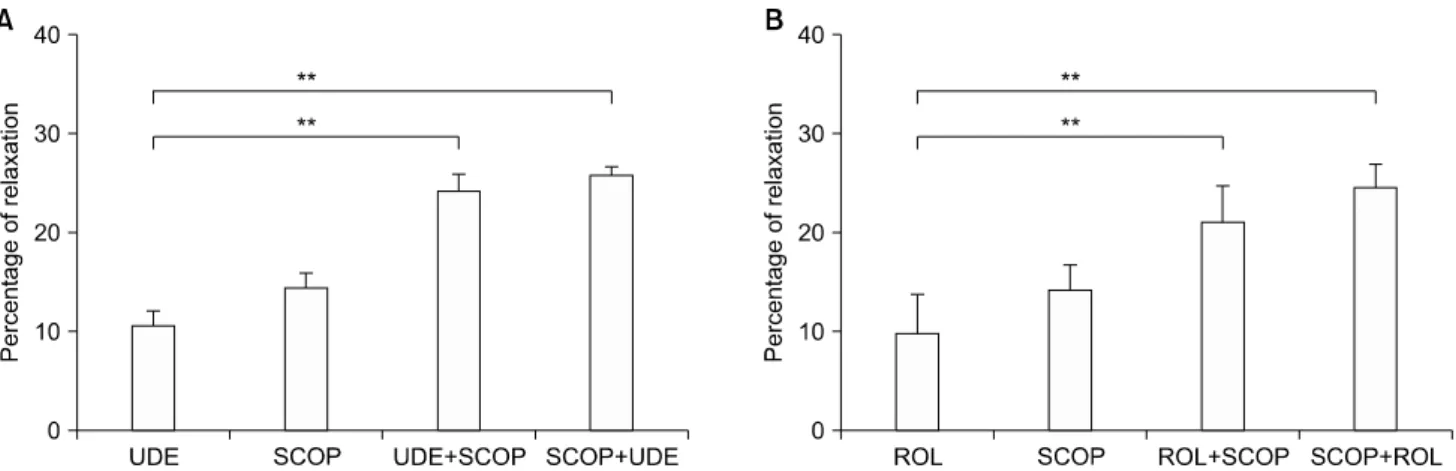
The relaxation induced by a single dose of udenafil (10−7 M) in Phe-precontracted PCCSM was 10.57%±1.58%, and the application of scoparone (10−6 M) alone induced a relaxation of 14.36%±1.53% in Phe-precontracted PCCSM (Fig. 7A). The combined relaxation induced by
Fig. 7. Interaction of scoparone (SCOP, 10−6 M) with udenafil (UDE, 10−7 M) or rolipram (ROL 10−6 M) (n=4). Effects of different concentrations of UDE (A) and ROL (B) in penile corpus cavernosum smooth muscle (PCCSM) contracted by phenylephrine (Phe, 10−5 M). Each point represents the mean ± standard deviation of the percentages of maximal relaxation of the preceding submaximal contractile responses. Statistical analysis was carried out by analysis of variance followed by the Bonferroni test (**p<0.01 vs. UDE or ROL). (A) UDE+SCOP refers to scoparone-induced relaxation in the udenafil-preincubated PCCSM. (A) SCOP+UDE indicates udenafil-induced relaxation in the scoparone-preincubated PCCSM. (B) ROL+SCOP refers to scoparone-induced relaxation in the rolipram-preincubated PCCSM. (B) SCOP+ROL indicates rolipram-induced relaxation in the scoparone-preincubated PCCSM.
udenafil and scoparone was 24.14%±1.66% in udena- fil-preincubated PCCSM and 25.77%±0.85% in scopar- one-preincubated PCCSM, respectively. Scoparone mark- edly enhanced udenafil-induced relaxation more than 2-fold (p<0.01). The relaxation induced by a single dose of rolipram (10−6 M) in Phe-precontracted PCCSM was 9.76%±3.93%, and the application of scoparone (10−6 M) alone induced a relaxation of 14.20%±2.47% in Phe-pre- contracted PCCSM (Fig. 7B). The combined relaxation in- duced by rolipram and scoparone was 21.03%±3.63% in rolipram-preincubated PCCSM and 24.60%±2.23% in the scoparone-preincubated PCCSM, respectively. Scoparone significantly enhanced the rolipram-induced relaxation more than 2-fold (p<0.01).
DISCUSSION
This study showed that compounds such as esculetin, scopoletin, capillarisin, and scoparone from A. capillaris had a significant relaxant effect on rabbit PCCSM in a con- centration-dependent manner over the consecutive range of 10−7, 10−6, 10−5, and 10−4 M. Scoparone had the most potent relaxant effect of the 4 compounds. As shown in Fig. 3∼5, scoparone significantly relaxed the PCCSM and increased the cGMP levels in the perfusate. These results
mediated by the NO-cGMP pathway. Chuang et al [16]
demonstrated that NO activated cytosolic guanylate cy- clase to increase intracellular second messenger cGMP levels in smooth muscle cells, leading to the relaxation of smooth muscle cells.
We hypothesized that scoparone-induced relaxation would be attenuated after treatment with ODQ and L-NAME, if activation of the NO-cGMP pathway was in- volved in the signal pathway. The present study showed that ODQ and L-NAME significantly inhibited scopar- one-induced relaxation. Those results suggest that scopar- one may contribute to penile erection by activating the NO-cGMP signaling pathway.
Artemisia herbs are widely used as botanical and phar- maceutical medicines because they contain medicinally active compounds [17]. Our results showed that A. capil- laris had the most potent relaxant effect among the 3 Artemisia herbs. A. capillaris has antioxidant effects and antimicrobial effects, inhibits the expression of in- flammatory proteins in rat liver, and has anticancer activ- ity [18-20]. Previous studies have also demonstrated that several compounds have been successfully isolated from A. capillaris, including coumarins (scoparone, esculetin, and scopoletin) and a chromone (capillarisin), and that the concentrations of these compounds are related to the sea-
www.wjmh.org
mone in A. capillaris, was reported to be an effective chol- eretic substance and to possess a potent inhibitory effect on xanthine oxidase [22]. Scoparone, a major coumarin in A. capillaris, caused peripheral vasodilation and showed antioxidant properties by reducing the malondialdehyde and alanine aminotransferase levels in various test ani- mals, as well as anti-hypertensive abilities [23]. Herein, we investigated the possible ex vivo effects of A. capillaris extracts on rabbit PCCSM. The ethyl acetate fraction of A.
capillaris extract significantly relaxed PCCSM in compar- ison to the n-hexane fraction and the n-butanol fraction.
The main effective ingredients of A. capillaris, including coumarins (scoparone, esculetin and scopoletin) and a chromone (capillarisin), which induce vascular relaxation [24], were isolated in the ethyl acetate fraction. Scoparone had the most potent relaxant effect among scoparone, es- culetin, scopoletin, and capillarisin.
Oral phosphodiesterase type 5 inhibitors (PDE5Is), such as udenafil, have been commonly used for the treatment of ED patients and have proven to be a valuable therapy in the management of ED, but these medications do have some limitations [25,26]. Most convincingly, Salonia et al [27] reported that PDE5Is were able to improve the erec- tions of approximately 30% to 50% of the patients they studied. Our results showed that scoparone (10−6 M) effi- ciently enhanced udenafil (10−7 M)-induced relaxation more than 2-fold. Scoparone enhanced udenafil-induced relaxation as a complementary form of medicine and may improve ED in patients who do not completely respond to udenafil. Men who suffer sexual dysfunction and women who have a husband with ED are searching for alternative medicines to improve erectile function and homeostatic balance [28]. Phosphodiesterase type 4 is characterized by its specific sensitivity to rolipram, which preferentially inhibits cyclic adenosine monophosphate (cAMP) phos- phodiesterase in vascular tissues [29]. Intracellular cAMP is generated by adenylyl cyclase and is degraded by cyclic nucleotide phosphodiesterase, the enzyme that catalyzes the hydrolysis of cAMP to 5′-AMP [30]. In this study, we showed that scoparone efficiently enhanced rolipram-in- duced relaxation more than 2-fold. This finding suggests that scoparone might be useful as an additional agent to improve the erections induced by PDE5Is.
CONCLUSIONS
In conclusion, scoparone exerted a significant relaxant effect on Phe-precontracted PCCSM and increased udena- fil-induced relaxation. The increased cGMP levels in the perfusate and the inhibition of scoparone relaxation with L-NAME and ODQ suggest that mechanism of action of scoparone involves the NO-cGMP pathway. This research supports the possibility that scoparone may be a good can- didate as a medication or supplement for ED patients who do not completely respond to udenafil. Scoparone also might be used as an additional herbal medicine to im- prove erectile function when a PDE5I induces an in- complete erection.
ACKNOWLEDGEMENTS
This research was supported by Kyungsung University Research Grants in 2016.
Disclosure
The authors have no potential conflicts of interest to disclose.
Author Contribution
Designed the experiments: Choi BR, Kim HK. Performed the ex- periments: Kim HK. Analyzed the data: all authors. Wrote the manu- script: all authors. Directed the research project: Park JK. Approved the final manuscript: all authors.
ORCID
Bo Ram Choi, https://orcid.org/0000-0002-0203-7080 Hye Kyung Kim, https://orcid.org/0000-0001-5982-5005 Jong Kwan Park, https://orcid.org/0000-0001-9682-2081
REFERENCES
1. Hatzimouratidis K, Amar E, Eardley I, Giuliano F, Hatzichristou D, Montorsi F, et al. Guidelines on male sex- ual dysfunction: erectile dysfunction and premature ejacula- tion. Eur Urol 2010;57:804-14.
2. Yaman O, Gulpinar O, Hasan T, Ozdol C, Ertas FS, Ozgenci E. Erectile dysfunction may predict coronary artery disease: relationship between coronary artery calcium scor- ing and erectile dysfunction severity. Int Urol Nephrol 2008;40:117-23.
3. Moon HW, Park JW, Lee KW, Jeong HC, Choi JB, Choi SW,
et al. Administration of Goji (Lycium Chinense Mill.) ex- tracts improves erectile function in old aged rat model.
World J Mens Health 2017;35:43-50.
4. Gupta BP, Murad MH, Clifton MM, Prokop L, Nehra A, Kopecky SL. The effect of lifestyle modification and car- diovascular risk factor reduction on erectile dysfunction: a systematic review and meta-analysis. Arch Intern Med 2011;
171:1797-803.
5. Eardley I. Pathophysiology of erectile dysfunction. Br J Diabetes Vasc Dis 2002;2:272-6.
6. Hosogai N, Takakura S, Manda T, Mutoh S. Enzyme activ- ities of the nitric oxide-cGMP pathway in corpus caverno- sum isolated from middle-aged rats. Eur J Pharmacol 2003;
473:65-70.
7. Sun K, Zhao C, Chen XF, Kim HK, Choi BR, Huang YR, et al. Ex vivo relaxation effect of Cuscuta chinensis extract on rabbit corpus cavernosum. Asian J Androl 2013;15:134-7.
8. Lee MY, Doh EJ, Park CH, Kim YH, Kim ES, Ko BS, et al.
Development of SCAR marker for discrimination of Artemisia princeps and A. argyi from other Artemisia herbs.
Biol Pharm Bull 2006;29:629-33.
9. Hong JH, Lee IS. Cytoprotective effect of Artemisia capillaris fractions on oxidative stress-induced apoptosis in V79 cells.
Biofactors 2009;35:380-8.
10. Kwon OS, Choi JS, Islam MN, Kim YS, Kim HP. Inhibition of 5-lipoxygenase and skin inflammation by the aerial parts of Artemisia capillaris and its constituents. Arch Pharm Res 2011;34:1561-9.
11. Okuno I, Uchida K, Nakamura M, Sakurawi K. Studies on choleretic constituents in Artemisia capillaris THUNB.
Chem Pharm Bull (Tokyo) 1988;36:769-75.
12. Cho DY, Ko HM, Kim J, Kim BW, Yun YS, Park JI, et al.
Scoparone inhibits LPS-simulated inflammatory response by suppressing IRF3 and ERK in BV-2 microglial cells.
Molecules 2016;21.
13. Yamahara J, Kobayashi G, Matsuda H, Katayama T, Fujimura H. The effect of scoparone, a coumarin derivative isolated from the Chinese crude drug Artemisiae capillaris flos, on the heart. Chem Pharm Bull (Tokyo) 1989;37:1297-9.
14. Zhao C, Chae HJ, Kim SH, Cui WS, Lee SW, Jeon JH, et al.
A new perfusion model for studying erectile function. J Sex Med 2010;7:1419-28.
15. Cui X, Lee SJ, Kim SZ, Kim SH, Cho KW. Effects of pituitary adenylate cyclase activating polypeptide27 on cyclic AMP efflux and atrial dynamics in perfused beating atria. Eur J Pharmacol 2000;402:129-37.
16. Chuang AT, Strauss JD, Murphy RA, Steers WD. Sildenafil, a type-5 CGMP phosphodiesterase inhibitor, specifically am- plifies endogenous cGMP-dependent relaxation in rabbit corpus cavernosum smooth muscle in vitro. J Urol 1998;
160:257-61.
17. Schmidt BM, Ribnicky DM, Lipsky PE, Raskin I. Revisiting the ancient concept of botanical therapeutics. Nat Chem Biol 2007;3:360-6.
18. Choi E, Park H, Lee J, Kim G. Anticancer, antiobesity, and anti-inflammatory activity of Artemisia species in vitro. J Tradit Chin Med 2013;33:92-7.
19. Hong SH, Seo SH, Lee JH, Choi BT. The aqueous extract from Artemisia capillaris Thunb. inhibits lipopolysaccharide- induced inflammatory response through preventing NF-kappaB activation in human hepatoma cell line and rat liver. Int J Mol Med 2004;13:717-20.
20. Cha JD, Jeong MR, Jeong SI, Moon SE, Kim JY, Kil BS, et al.
Chemical composition and antimicrobial activity of the es- sential oils of Artemisia scoparia and A. capillaris. Planta Med 2005;71:186-90.
21. Choi SR, Ju IO, You DH, Song YE, Jang I, Ryu J. Changes of major components and growth characteristics according to harvesting times of Artemisia capillaris thunberg. Korean J Medicinal Crop Sci 2007;15:189-93.
22. Komiya T, Tsukui M, Oshio H. Studies on "Inchinko". I.
Capillarisin, a new choleretic substance (author's transl).
Yakugaku Zasshi 1976;96:841-54.
23. Yang CC, Lee MR, Hsu SL, Chang CMJ. Supercritical fluids extraction of capillarisin from Artemisia capillaris and its in- hibition of in vitro growth of hepatoma cells. J Supercrit Fluids 2007;42:96-103.
24. Huang HC, Lee CR, Weng YI, Lee MC, Lee YT. Vasodilator effect of scoparone (6,7-dimethoxycoumarin) from a Chinese herb. Eur J Pharmacol 1992;218:123-8.
25. Kloner R. Erectile dysfunction and hypertension. Int J Impot Res 2007;19:296-302.
26. Thorve VS, Kshirsagar AD, Vyawahare NS, Joshi VS, Ingale KG, Mohite RJ. Diabetes-induced erectile dysfunction: epi- demiology, pathophysiology and management. J Diabetes Complications 2011;25:129-36.
27. Salonia A, Rigatti P, Montorsi F. Sildenafil in erectile dys- function: a critical review. Curr Med Res Opin 2003;19:
241-62.
28. Shin YS, Zhao C, Zhang LT, Park JK. Current status and clin- ical studies of oriental herbs in sexual medicine in Korea.
World J Mens Health 2015;33:62-72.
29. Yamashita N, Yamauchi M, Baba J, Sawa A. Phosphodie- sterase type 4 that regulates cAMP level in cortical neurons shows high sensitivity to rolipram. Eur J Pharmacol 1997;
337:95-102.
30. Beavo JA. Cyclic nucleotide phosphodiesterases: functional implications of multiple isoforms. Physiol Rev 1995;75:725- 48.