INTRODUCTION
Alzheimer’s disease (AD) is the most common neurodegen- erative disorder and is characterized by molecular pathogen- esis, including amyloid plaques and neurofibrillary tangles in the brain. Several studies have suggested that amyloid-ß (Aß) and tau proteins in the cerebrospinal fluid (CSF) may act as re- liable biomarkers of AD1,2 which can reflect the pathological process in the brain. Based on this knowledge, recently revised research criteria for AD have proposed these biomarkers as
standards for diagnosis.3,4 Thus, the use of CSF biomarkers in clinical trials has been increased in both individuals with de- mentia and mild cognitive impairment, as well as in cognitive- ly normal people of all ages. Moreover, with this increase comes a greater chance for individuals to receive lumbar punctures (LP) in memory clinics.
Although LP is classified as an invasive approach, many pre- vious studies have demonstrated that it is a simple and safe pro- cedure.5 The most common complication of LP is post-lumbar puncture headache (PLPH), the incidence of which has report- edly increased up to 50%.6 However, most studies about PLPH have analyzed LP in instances of spinal anesthesia,6,7 and not for outpatients. Moreover, no Korean study has evaluated wheth- er the risk of PLPH after LP is increased in cognitively normal people or in individuals with AD.
Risk Factors for Post-Lumbar Puncture Headache in a Study of Alzheimer’s Disease Biomarkers
So Young Park,1 Min Jeong Wang,1 Jae-Won Jang,2 Young Ho Park,1 Joon Woo Lee,3 SangYun Kim1
1Clinical Neuroscience Center, Seoul National University Bundang Hospital, Department of Neurology, Seoul National University College of Medicine, Seongnam, Korea
2Department of Neurology, Kangwon National University Hospital, Chuncheon, Korea
3Department of Radiology, Seoul National University Bundang Hospital, Seongnam, Korea
Background and Purpose In memory clinics, the lumbar puncture (LP) is increasingly being used to evaluate cerebrospinal fluid for bio- markers of Alzheimer’s disease (AD). Post-lumbar puncture headache (PLPH) is the most frequent complication of LP, and can prove to be a barrier for the performance of LP.
Methods We retrospectively collected data from 59 subjects (patients with AD and cognitively healthy controls) who were enrolled in a study aimed to identify AD biomarkers via LP. In order to determine whether subjects experienced PLPH, we assessed recorded follow-up telephone interviews. To analyze the association between the occurrence of PLPH and several demographic- and procedure-related factors, a multiple lo- gistic regression analysis with backward stepwise method was performed.
Results The overall frequency of PLPH was 49.15%. PLPH was more frequent in younger subjects and clinical diagnosis was associated with PLPH. The use of cutting-edge needles was also suggested as a statistically significant factor in the development of PLPH, and was determined to be the only factor that could be modified in order to lower the frequency of PLPH.
Conclusions Age, clinical diagnosis, and needle type were all determined to be predictive factors of PLPH.
Key Words post-lumbar puncture headache, Alzheimer’s disease, risk factor.
Received: January 13, 2015 Revised: March 9, 2015 Accepted: March 9, 2015
Correspondence: SangYun Kim, MD, PhD, Clinical Neuroscience Center, Seoul National University Bundang Hospital, Department of Neurology, Seoul Na- tional University College of Medicine, 82 Gumi-ro 173beon-gil, Bundang-gu, Seongnam 463-707, Korea
Tel: +82-31-787-7462, Fax: +82-31-787-4059, E-mail: [email protected]
cc This is an Open Access article distributed under the terms of the Cre- ative Commons Attribution Non-Commercial License (http://creative- commons.org/licenses/by-nc/3.0) which permits unrestricted non-com- mercial use, distribution, and reproduction in any medium, provided the ori- ginal work is properly cited.
DND
Print ISSN 1738-1495 / On-line ISSN 2384-0757
Dement Neurocogn Disord 2015;14(1):12-16 / http://dx.doi.org/10.12779/dnd.2015.14.1.12
ORIGINAL ARTICLE
DND
In this study, we retrospectively analyzed the frequency of PLPH and its associated factors in a single-center study in Korea.
METHODS
We retrospectively collected data from patients with AD and cognitively normal people who were enrolled in a case-con- trolled study that was aimed to identify biomarkers of AD. The study was conducted at the Neurocognitive Behavior Center at Seoul National University Bundang Hospital in Korea be- tween April 2012 and November 2014. The inclusion criteria for cognitively normal people were as follows: age of 50 to 90 years, satisfied normal aging criteria,8 normal cognitive status using the Mini-Mental State Examination (MMSE) and Seoul Verbal Learning test, and no brain lesion correlated with cog- nitive decline. The inclusion criteria for patients with AD were as follows: age of 50 to 90 years, satisfied the criteria set forth by the National Institute on Aging-Alzheimer’s Association4 for probable AD, and no hemorrhagic lesion or other infarc- tions that could influence cognition. We excluded subjects who did not perform the LP due to fear. Moreover, subjects that had dropped out of the study prior to its completion or those that had other side effects were also excluded.
An interventional radiologist with expertise in the LP pro- cedure carried out LP testing using fluoroscopy. All LPs were performed in the morning (8–12 a.m.) in the lateral decubitus position at the space between levels L3/L4 or L4/L5. LP was performed using either cutting-edge Quincke needles (20 gauge) or pen-point “atraumatic” Whitacre needles (20 or 22 gauge).
Opening pressure was measured in all cases, and a total of 10–15 mL of CSF was collected by free flow of CSF. All sub- jects were advised to rest in the supine position for more than 2 h after the test and recommended to drink additional fluids, avoiding activity in the upright position.
Within 7 days after the procedure, subjects were contacted by telephone and were interviewed to assess whether they were experiencing any complications. Close attention was paid to reports of headache, and characteristics of the headache, as as- sociated with criteria of PLPH,9 were recorded. Headaches were either classified as mild in intensity (needed simple analgesics or no treatment), moderate (needed to limit daily activity and stay in bed for several hours of the day), and severe (condition requiring hospitalization or were invalidating).10
To identify the association between PLPH and several vari- ables including age, sex, clinical diagnosis, body mass index, opening pressure, needle type, and CSF Aß, we performed sta- tistical analysis on the frequency of PLPH using the Mann-Whit- ney test for continuous variables and Fisher’s exact test for cat-
egorical variables. To identify the association between PLPH and several variables, a multiple logistic regression analysis was performed. Variables with p values of <0.20 or whose associa- tion with PLPH were clinically relevant were considered for en- trance into the model. These variables were then examined us- ing a multiple logistic regression with backward stepwise method.
All statistical analyses were performed using IBM SPSS Statis- tical software version 19.0 (IBM Inc., Armonk, NY, USA).
RESULTS
We identified 62 participants who were enrolled in the case- controlled study about on AD biomarkers. In total 3 (4.84% of 62) subjects were excluded because of LP refusal or dropout.
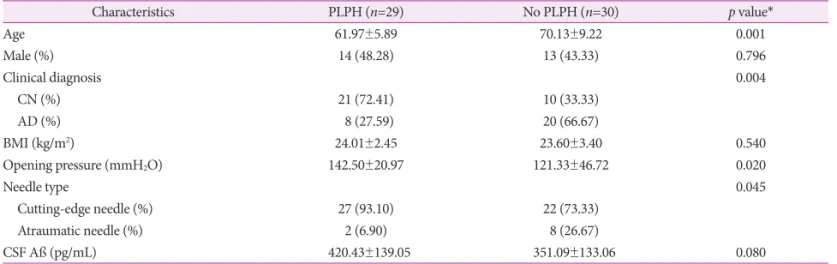
Thus, we reviewed the remaining 59 subjects (patients with AD=28, cognitively normal subjects=31). Of the 59 cases, 29 (49.15%) satisfied the HIS criteria of PLPH.9 The severity of pain in PLPH was graded as more than moderate in most cas- es (mild=5, moderate=17, severe=7), and 2 subjects were treat- ed by epidural blood patch. Table 1 summarizes the character- istic demographics between groups of subjects with and without PLPH. Interestingly, when compared to subjects without PLPH, subjects with PLPH tended to be younger and cognitively nor- mal. Opening pressure and ratio of using cutting-edge needles also tended to be higher in subjects with PLPH. Body mass in- dex and CSF Aß were not different between the two groups.
Table 2 shows the association between PLPH and related vari- ables. In the multiple logistic regression analysis, several demo- graphic variables and factors related to the LP procedure were included into Model 1. Among the demographic variables, old- er subjects were associated with a significantly lower incidence of PLPH [odds ratio (OR) 0.869 per year, p=0.003]. Clinical di- agnosis was also found to correlate with PLPH incidence, and patients with AD were less likely to develop PLPH than cogni- tively normal individuals (OR 0.229, p=0.035). Regarding nee- dle type, in Model 1 atraumatic needles did not influence the occurrence of PLPH when compared to cutting-edge needles.
Likewise, the occurrence of PLPH was not influenced by sex or opening pressure (Table 2, Model 1). However, the back- ward stepwise logistic regression analysis showed that needle type did significantly correlate with PLPH (OR 0.165, p=0.014), and this was maintained with age and clinical diagnosis (Table 2, Model 2).
DISCUSSION
In a study aimed to identify AD biomarkers from CSF, we found an overall 49% incidence of PLPH in patients with AD and cognitively normal subjects. Among the variables that could
So Young Park et al.
Risk Factors for Post-Lumbar Puncture Headache
increase an individual’s risk for PLPH, we found that age, clini- cal diagnosis, and needle type were strong predictors of the occurrence of PLPH after LP.
Previous reports have suggested that the frequency of PLPH ranges between 20 to 50%.6,10 In contrast, other studies have reported considerably low frequencies of less than 2%.5,11 Dis- crepancies in the frequency of PLPH could be explained by dif- ferences in the populations examined and/or in the method- ologies employed. For example, as demonstrated here and as reported by other studies, age and diagnosis could influence whether an individual develops PLPH, while different degrees of psychological factors might affect the frequency of head- ache.12 In terms of the LP method, it has been shown that nee- dle type, needle size, and procedure technique might all be ma- jor factors in the development of PLPH.13,14
In the current study, younger, cognitively normal individu- als receiving LP via cutting-edge needles were demonstrated as predictive factors of PLPH development. The effect of age
and needle type on PLPH development has been reported previously.15-17 The lower incidence of PLPH in older individ- uals can be explained by the fact that pain sensitivity decreas- es with aging, and there is less leakage of CSF through narrow- er intervertebral foramina.11 Moreover, regarding the LP pro- cedure, elderly individuals tend to be less anxious.18 Peskind et al.5 measured the anxiety and pain scale by subject group, which included older normal subjects and patients with AD/
mild cognitive impairment and then suggested that patients with AD/mild cognitive impairment tend to endure LP well with lower pain and anxiety. The other predictive factor, clin- ical diagnosis, shows discrepancy among reports.5,10,11,18 For ex- ample, cerebral atrophy and, consequently, larger CSF space, may explain the low frequency of PLPH in patients with de- mentia. However, additional study is needed to identify the in- fluence of brain atrophy and concentration of CSF protein/cell count of patients with dementia.
Although headache after lumbar puncture is usually a tem- Table 1. Comparison of baseline characteristics between groups of subjects with and without PLPH
Characteristics PLPH (n=29) No PLPH (n=30) p value*
Age 61.97±5.89 70.13±9.22 0.001
Male (%) 14 (48.28) 13 (43.33) 0.796
Clinical diagnosis 0.004
CN (%) 21 (72.41) 10 (33.33)
AD (%) 8 (27.59) 20 (66.67)
BMI (kg/m2) 24.01±2.45 23.60±3.40 0.540
Opening pressure (mmH2O) 142.50±20.97 121.33±46.72 0.020
Needle type 0.045
Cutting-edge needle (%) 27 (93.10) 22 (73.33)
Atraumatic needle (%) 2 (6.90) 8 (26.67)
CSF Aß (pg/mL) 420.43±139.05 351.09±133.06 0.080
If not otherwise indicated, data are presented as means±standard deviation.
*p values were obtained using the Mann-Whitney test or Fisher’s exact test where appropriate.
Aß: amyloid-ß, AD: Alzheimer’s disease, BMI: body mass index, CN: cognitively normal, CSF: cerebrospinal fluid, PLPH: post-lumbar puncture head- ache.
Table 2. Adjusted ORs and their 95% CIs for PLPH according to demographic- and procedural-related variables
Variables Model 1, adjusted OR* (95% CI) Model 2, adjusted OR† (95% CI)
Age 0.869 (0.792–0.952) 0.868 (0.792–0.951)
Sex (male) 0.723 (0.308–5.475) Removed
Clinical diagnosis
CN Reference Reference
AD 0.229 (0.058–0.902) 0.213 (0.055–0.823)
Opening pressure 1.009 (0.990–1.029) Removed
Needle type
Cutting-edge needle Reference Reference
Atraumatic needle 0.226 (0.045–1.138) 0.165 (0.039–0.695)
Age, sex, clinical diagnosis, opening pressure, and needle type were entered into the model, but were removed through the backward stepwise process.
*ORs, obtained by multiple logistic regression analysis, †ORs, obtained by multiple logistic regression analysis using backward stepwise method.
AD: Alzheimer’s disease, CI: confidence interval, CN: cognitively normal, OR: odds ratio, PLPH: post-lumbar puncture headache.
DND
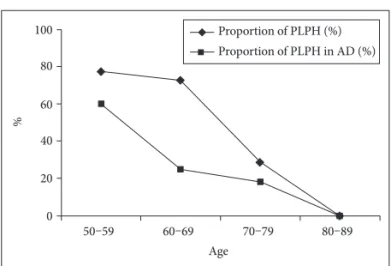
porary symptom that lasts several days, it can result in patient discomfort. Furthermore, serious complications like seizure and subdural hematoma can arise from PLPH.19 Considering our result of the relatively high frequency of PLPH in up to 60%
of young individuals (Fig. 1), more aggressive protocols that prevent PLPH are needed. We suggest that needle type is the key modifiable factor that will be able to ensure the safety, and thus maximize the acceptability, of LP in memory clinics. More specifically, the use of atraumatic needles could be useful be- cause of their blunt tips and higher flexibility; however, clini- cians performing LPs with atraumatic needles need to pay clos- er attention during procedures because it is often difficult to penetrate the skin and good handling technique is required.20
The current study had a number of limitations that should be addressed. First, the sample size in the current study was small. This was due to the characteristics of the base study de- sign; future studies across a larger population are needed. Sec- ond, this was a retrospective review; thus, we did not control for conditions such as resting time after the procedure or total volume of CSF extracted. Moreover, we did not assess subjects’
anxiety or stress before the LP was performed.
Despite these limitations, this is the first Korean report, to our knowledge, to evaluate PLPH risk factors by targeting pa- tients with AD and cognitively normal people in a memory clin- ic. In such clinics, exposure to LP procedures will increase with the approval of CSF protein as an appropriate diagnostic test.
Furthermore, the number of clinical trials on young subjects at pre-symptomatic stages may increase in the coming years. Here, we determined that PLPH was a relatively common complica- tion of LP, especially in young, cognitively normal individuals that had undergone the procedure with a certain needle type.
Based on these results, we advocate the use of an atraumatic needle for the prevention of PLPH; however, the difficulty of
performing LPs with this needle type should be discussed in future studies.
Conflicts of Interest
The authors have no financial conflicts of interest.
REFERENCES
1. Seppälä TT, Nerg O, Koivisto AM, Rummukainen J, Puli L, Zetterberg H, et al. CSF biomarkers for Alzheimer disease correlate with cortical brain biopsy findings. Neurology 2012;78:1568-1575.
2. Tapiola T, Alafuzoff I, Herukka SK, Parkkinen L, Hartikainen P, Soin- inen H, et al. Cerebrospinal fluid {beta}-amyloid 42 and tau proteins as biomarkers of Alzheimer-type pathologic changes in the brain. Arch Neurol 2009;66:382-389.
3. Dubois B, Feldman HH, Jacova C, Dekosky ST, Barberger-Gateau P, Cummings J, et al. Research criteria for the diagnosis of Alzheimer’s disease: revising the NINCDS-ADRDA criteria. Lancet Neurol 2007;6:
734-746.
4. McKhann GM, Knopman DS, Chertkow H, Hyman BT, Jack CR Jr, Kawas CH, et al. The diagnosis of dementia due to Alzheimer’s disease:
recommendations from the National Institute on Aging-Alzheimer’s As- sociation workgroups on diagnostic guidelines for Alzheimer’s disease.
Alzheimers Dement 2011;7:263-269.
5. Peskind ER, Riekse R, Quinn JF, Kaye J, Clark CM, Farlow MR, et al.
Safety and acceptability of the research lumbar puncture. Alzheimer Dis Assoc Disord 2005;19:220-225.
6. Vilming ST, Kloster R, Sandvik L. The importance of sex, age, needle size, height and body mass index in post-lumbar puncture headache.
Cephalalgia 2001;21:738-743.
7. Kim M, Yoon H. Comparison of post-dural puncture headache and low back pain between 23 and 25 gauge Quincke spinal needles in patients over 60 years: randomized, double-blind controlled trial. Int J Nurs Stud 2011;48:1315-1322.
8. Christensen H. What cognitive changes can be expected with normal ageing? Aust N Z J Psychiatry 2001;35:768-775.
9. Headache Classification Subcommittee of the International Headache Society. The International Classification of Headache Disorders: 2nd edition. Cephalalgia 2004;24 Suppl 1:9-160.
10. Alcolea D, Martínez-Lage P, Izagirre A, Clerigué M, Carmona-Iragui M, Alvarez RM, et al. Feasibility of lumbar puncture in the study of cerebrospinal fluid biomarkers for Alzheimer’s disease: a multicenter study in Spain. J Alzheimers Dis 2014;39:719-726.
11. Zetterberg H, Tullhög K, Hansson O, Minthon L, Londos E, Blennow K. Low incidence of post-lumbar puncture headache in 1,089 consec- utive memory clinic patients. Eur Neurol 2010;63:326-330.
12. Kaplan G. The psychogenic etiology of headache post lumbar punc- ture. Psychosom Med 1967;29:376-379.
13. Vilming ST, Schrader H, Monstad I. Post-lumbar-puncture headache:
the significance of body posture. A controlled study of 300 patients.
Cephalalgia 1988;8:75-78.
14. Toyka KV, Müller B, Reichmann H. “Atraumatic” Sprotte needle re- duces the incidence of post-lumbar puncture headaches. Neurology 2002;
59:1120; author reply 1120-1121.
15. Kuntz KM, Kokmen E, Stevens JC, Miller P, Offord KP, Ho MM. Post- lumbar puncture headaches: experience in 501 consecutive procedures.
Neurology 1992;42:1884-1887.
16. Popp J, Riad M, Freymann K, Jessen F. [Diagnostic lumbar puncture performed in the outpatient setting of a memory clinic. Frequency and risk factors of post-lumbar puncture headache]. Nervenarzt 2007;78:
547-551.
17. Hammond ER, Wang Z, Bhulani N, McArthur JC, Levy M. Needle type and the risk of post-lumbar puncture headache in the outpatient neu- 100
80 60 40 20 0
%
50–59 60–69 70–79 80–89 Age
Proportion of PLPH (%) Proportion of PLPH in AD (%)
Fig. 1. The line with diamond symbols indicates PLPH occurrence as a function of age group in cognitively healthy subjects. The line with square symbols indicates PLPH occurrence as a function of age in patients with AD. AD: Alzheimer’s disease, PLPH: post-lumbar punc- ture headache.
So Young Park et al.
Risk Factors for Post-Lumbar Puncture Headache
rology clinic. J Neurol Sci 2011;306:24-28.
18. Blennow K, Wallin A, Häger O. Low frequency of post-lumbar punc- ture headache in demented patients. Acta Neurol Scand 1993;88:221- 19. Ahmed SV, Jayawarna C, Jude E. Post lumbar puncture headache: di-223.
agnosis and management. Postgrad Med J 2006;82:713-716.
20. Strupp M, Schueler O, Straube A, Von Stuckrad-Barre S, Brandt T. “Atrau- matic” Sprotte needle reduces the incidence of post-lumbar puncture headaches. Neurology 2001;57:2310-2312.