Introduction
Hand-held x-ray system means x-ray equipment that is designed to be hand-held during operation while portable x-ray equipment designed to be hand-carried.1Two terms in the literature have been somewhat confused. Hand- held dental x-ray system is a self contained x-ray machine designed to be held in one or two hands to perform intrao- ral radiography. It was first developed by Kevex X-Ray Corporation in USA in 1993 for the military field use.2 Currently, there are several kinds of hand-held dental x-ray
systems on the market. Since they are easy to adjust for limited patients, they can be conveniently used in certain circumstances such as nursing homes, temporary health clinics, and forensic investigations in the field. However, since the operator adjoins the x-ray source assembly, hand- held x-ray system raises concerns about increased operator exposure due to x-ray leakage and backscatter radiation.3,4
Some manufacturers have received Food and Drug Administration (FDA) approval in the United States for clinical use. Some states in the USA permitted its usage for routine dental radiography in dental clinics with very strict requirement. For example, it must be equipped with a permanently attached backscatter shield of 0.25 mm Pb equivalent.5-7Operators must wear the personal dosimeter on the hand while holding the beam limiting devices.5 Storage and security procedures shall be developed and implemented to assure that the system is secured against
─ 1 ─
Effect of the amount of battery charge on tube voltage in different hand-held dental x-ray systems
Eun-Kyung Kim
Department of Oral and Maxillofacial Radiology, Dankook University College of Dentistry, Cheonan, Korea ABSTRACT
Purpose : Hand-held dental x-ray system is a self contained x-ray machine designed to perform intraoral radiography with one or two hands. The issue about its usage as general dental radiography is still in dispute. The aim of the pre- sent study was to assess the relationship between the amount of battery charge and the tube voltage in different hand- held dental x-ray systems.
Materials and Methods : Seven hand-held dental x-ray units were used for the study. Tube voltage was measured with Unfors ThinX RAD (Unfors Instruments AB, Billdal, Sweden) for 3 consecutive exposures at the different amount of battery charge of each unit. The average and the deviation percentage of measured kV from indicated kV of each unit were calculated.
Results : Tube voltage of only 1 unit was 70 kV (indicated by manufacturer) and those of the others were 60 kV. Tube voltage deviation percentage from the indicated kV at the fully charged battery was from 2.5% to -5.5% and from -0.8% to -10.0% at the lowest charged battery.
Conclusion : Tube voltages of all units decreased as the residual amount of the battery charge decreased. It is sug- gested that the performance test for hand-held x-ray system should be performed for the minimum residual charged battery as well as the full charged one. Persistent battery charging is suggested to maintain the proper tube voltage of the hand-held portable x-ray system. (Imaging Sci Dent 2012; 42 : 1-4)
KEY WORDS : Radiography, Dental; Occupational Exposure; Radiation, Ionizing; Radiation Protection
*The present research was conducted by the research fund of Dankook University in 2010.
Received September 27, 2011; Revised October 26, 2011; Accepted November 20, 2011 Correspondence to : Prof. Eun-Kyung Kim
Department of Oral and Maxillofacial Radiology, Dankook University College of Dentistry, 119 Dandae-ro, Dongnam-gu, Cheonan, Chungnam 330-714, Korea Tel) 82-41-550-1924, Fax) 82-41-556-7127, E-mail) [email protected]
Imaging Science in Dentistry 2012; 42 : 1-4 http://dx.doi.org/10.5624/isd.2012.42.1.1
Copyright ⓒ 2012 by Korean Academy of Oral and Maxillofacial Radiology
This is an Open Access article distributed under the terms of the Creative Commons Attribution Non-Commercial License (http://creativecommons.org/licenses/by-nc/3.0) which permits unrestricted non-commercial use, distribution, and reproduction in any medium, provided the original work is properly cited.
Imaging Science in Dentistry∙pISSN 2233-7822 eISSN 2233-7830
unauthorized use. Unsafe procedure would be abandoned when it not under the control and constant surveillance of the registrant.5It should be reported to the Authority within 72 hours if it is lost or stolen.6Besides, it shall meet the requirements for dental radiation-generating equipment such as kVp accuracy within plus or minus 10% of the in- dicated value, source-skin distance (SSD) not less than 18 cm if operable above 50 kVp.5
Although several states of USA permitted to use the handheld dental x-ray device for general dental radiogra- phy as stated above, other states of USA, Canada, and the European Union do not have the regulation specifically for this device. Hand holding of the x-ray tube housing is prohibited in the countries. The issue about its usage as general dental radiography is still in dispute.
Hand-held dental x-ray system is wireless and battery- operated. It can be assumed that the kV of this system might decrease as the amount of the battery charge decreas- es. Few studies on the effect of the remaining battery life on the tube voltage have been found in the literature. The aim of the present study was to assess the effect of the amount of battery charge on the tube voltage in different hand-held dental x-ray systems.
Materials and Methods
Seven hand-held dental x-ray units were used for the present study: 1 unit of Rextar (Poskom Co. Ltd., Goyang, Korea), 1 unit of Anyray (Vatech Co. Ltd., Yongin, Korea), 1 unit of Nomad Pro (Aribex Inc., Orem, USA), 1 unit of Point-X (Bemems Co. Ltd., Seoul, Korea), 1 unit of Prox (Digimed Co., Seoul, Korea), 1 unit of DX 3000 (Dex-
cowin Co. Ltd., Seoul, Korea) and 1 unit of Port X-II (Genoray Co. Ltd., Seongnam, Korea). All of them are battery-operated. They used various display methods to show the remaining battery amount. Remaining amount of battery charge was displayed as the percentage in Rextar, the remaining number of exposure in Anyray, the number of remaining bars among five bars in Nomad Pro and Point- X, the number of remaining bars among four bars in Prox, and the number of remaining bars among three bars in DX 3000 and Port X-II.
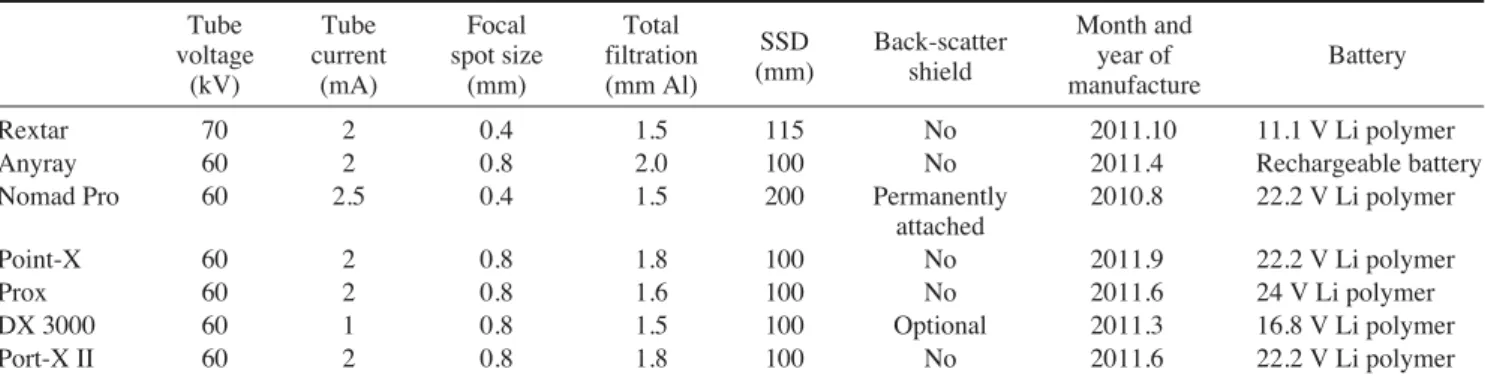
Their specifications described in the manual are shown in Table 1. Tube voltage was measured with Unfors ThinX RAD (Unfors Instruments AB, Billdal, Sweden). Exposure time applied for adult mandibular molar periapical radio- graphy using digital sensor (Vatech Co. Ltd., Yongin, Korea) was used for the measurement of kV of each sys- tem. Tube voltage (kV) was measured for 3 consecutive exposures at the different residual battery amount of each unit. The average and deviation percentage of measured kV from indicated kV of each unit was calculated.
Results
The measured tube voltage and deviation percentage of the indicated kV at the different battery charge amount at 7 hand-held dental x-ray units are shown in Tables 2-8. Tube voltages of all units except Rextar were 60 kV. That of Rextar unit was 70 kV. Rextar unit showed 67.0 kV at full charge and 66.5 kV at 40% charge (Table 2). Anyray unit showed 60.5 kV at full charge and 58.0 kV at its lowest charge (Table 3). Nomad Pro unit showed 59.5 kV at full charge and 57.0 kV at its lowest charge (Table 4). Point-X
─ 2 ─
Effect of the amount of battery charge on tube voltage in different hand-held dental x-ray systems
Table 1.Technical specifications of hand-held dental x-ray systems used in the present study
Tube Tube Focal Total
SSD Back-scatter Month and voltage current spot size filtration
(mm) shield year of Battery
(kV) (mA) (mm) (mm Al) manufacture
Rextar 70 2 0.4 1.5 115 No 2011.10 11.1 V Li polymer
Anyray 60 2 0.8 2.0 100 No 2011.4 Rechargeable battery
Nomad Pro 60 2.5 0.4 1.5 200 Permanently 2010.8 22.2 V Li polymer
attached
Point-X 60 2 0.8 1.8 100 No 2011.9 22.2 V Li polymer
Prox 60 2 0.8 1.6 100 No 2011.6 24 V Li polymer
DX 3000 60 1 0.8 1.5 100 Optional 2011.3 16.8 V Li polymer
Port-X II 60 2 0.8 1.8 100 No 2011.6 22.2 V Li polymer
Table 2.Tube voltage and deviation % from indicated kV (70 kV) according to different battery charge amount in Rextar unit
Battery charge amount (remaining battery %) 100 90 80 70 60 50 40
Measured kV 67.0 66.7 66.8 66.7 66.5 66.8 66.5
(deviation % from indicated kV) (-4.3) (-4.7) (-4.6) (-4.7) (-5.0) (-4.6) (-5.0)
unit showed 59.0 kV at full charge and 58.5 kV at its lowest charge which can be measured (Table 5). Prox unit showed 56.7 kV at full charge and 54.0 kV at its lowest charge (Table 6). DX 3000 unit showed 60.8 kV at full charge and 56.5 kV at its lowest charge (Table 7). Port-X II unit showed 61.5 kV at full charge and 59.5 kV at its lowest charge (Table 8).
Discussion
The effect of the remaining amount of battery charge on the tube voltage in 7 hand-held dental x-ray units was evaluated in the present study. Tube voltages of all units decreased as the remaining amount of the battery charge
decreased. Tube voltage deviation percentage of the indi- cated kV was from 2.5% to -5.5% at the full battery charge and from -0.8% to -10.0% at the lowest battery charge. Prox with 60 kV (indicated by manufacturer) showed 54.0 kV (-10.0 deviation % of indicated kV) at the lowest battery charge. According to the regulations about diagnostic x-ray equipments of Korean Food and Drug Administration (KFDA),8tube voltage of dental radiogra- phic system should be within ±10% of the indicated kV value. One unit among 7 units examined at the present study did not meet with this regulation at the low battery level. Potential cause of this deviation from the indicated kV might be due to faulty battery or faulty x-ray generator.
Other units except the above unit also showed that their kV decreased as the remaining amount of the battery charge decreased although there were some differences in severity.
According to the Korean regulation about safety manage- ment of diagnostic x-ray equipments,9 periodic perfor- mance test should be performed every 3 years and reported to the health authorities. However, it is suggested that the interval of the performance test should be shortened in case of battery-operated x-ray system because the life of battery is short and its performance can be rapidly degrad- ed. Also, it is suggested that the performance test for hand- held x-ray system should be performed for the minimum residual charged battery as well as the full charged one. In
─ 3 ─
Eun-Kyung Kim
Table 3.Tube voltage and deviation % from indicated kV (60 kV) according to different battery charge amount in Anyray unit
Battery charge amount 100 90 80 70 60 50 40 30 20
(remaining number of times of exposure)
Measured kV 60.5 60.3 59.3 59.3 58.2 58.5 58.5 58.5 58.0
(deviation % from indicated kV) (0.8) (0.5) (-1.2) (-1.2) (-3.0) (-2.5) (-2.5) (-2.5) (-3.3)
Table 4.Tube voltage and deviation % from indicated kV (60 kV) according to different battery charge amount in Nomad Pro unit
Battery charge amount 5/5 bars 4/5 bars 3/5 bars 2/5 bars 1/5 bars
Measured kV 59.5 59.3 58.5 58.3 57.0
(deviation % from indicated kV) (-0.8) (-1.2) (-2.5) (-2.8) (-5.0)
Table 5.Tube voltage and deviation % from indicated kV (60 kV) according to different battery charge amount in Point-X unit
Battery charge amount 5/5 bars 4/5 bars 3/5 bars 2/5 bars 1/5 bars
Measured kV 59.0 59.0 58.0 58.5 (no exposure)
(deviation % from indicated kV) (-1.7) (-1.7) (-3.3) (-2.5)
Table 6.Tube voltage and deviation % from indicated kV (60 kV) according to different battery charge amount in Prox unit
Battery charge amount 4/4 bars 3/4 bars 2/4 bars 1/4 bars
Measured kV 56.7 56.3 54.5 54.0
(deviation % from indicated kV) (-5.5) (-6.2) (-9.2) (-10.0)
Table 7.Tube voltage and deviation % from indicated kV (60 kV) according to different battery charge amount in DX 3000 unit
Battery charge amount 3/3 bars 2/3 bars 1/3 bars
Measured kV 60.8 58.5 56.5
(deviation % from indicated kV) (1.3) (-2.5) (-5.8)
Table 8.Tube voltage and deviation % from indicated kV (60 kV) according to different battery charge amount in Port-X II unit
Battery charge amount 3/3 bars 2/3 bars 1/3 bars
Measured kV 61.5 60.0 59.5
(deviation % from indicated kV) (2.5) (0) (-0.8)
case of wall-mounted dental x-ray system, the tube voltage is almost always maintained consistently. In contrast, the inconsistency of tube voltage of hand-held dental x-ray systems could be one of serious considerations for its usage as general dental radiography.
Goren et al10reported that Nomad portable system pre- sented risks to the operator and patients that are no greater than with standard dental x-ray units. However, it should be considered that each model of hand-held x-ray units had to be evaluated respectively for safety purposes because the design characteristics could vary significantly from one manufacturer to another.4
Especially, most of them except Nomad Pro showed short SSD (10.0-11.5 cm) less than 18 cm and did not offer a permanently attached backscatter shield. Only one model (DX 3000) provided an optional backscatter shield. The author recently carried out the study measuring the opera- tor dose in the same units as the present study and found out the considerable dose difference in different hand-held units. For the safe use of these hand-held dental x-ray sys- tems, the strict permission requirement and an individual performance test are imperative.
In conclusion, the tube voltages of all hand-held dental x-ray units measured in this study decreased as the remain- ing amount of the battery charge decreased. It is suggested that the performance test for hand-held x-ray system should be performed for the minimum residual charged battery as well as the full charged one. Persistent battery charging is suggested to maintain the proper tube voltage of the hand-held dental x-ray system.
References
1. CRCPD [Internet]. Suggested state regulations for control of
radiations. Volume I. Part F. Diagnostic x-rays and imaging systems in the healing arts. [cited 2011 Aug 30]. Available from: http://www.crcpd.org/ssrcr.aspx.
2. Van Dis ML, Miles DA, Parks ET, Razmus TF. Information yield from a hand-held dental x-ray unit. Oral Surg Oral Med Oral Pathol 1993; 76 : 381-5.
3. FDA Center for Devices and Radiological Health [Internet].
Radiation safety considerations for x-ray equipment designed for hand-held use [cited 2011 Aug 30]. Available from: http://
www.fda.gov/MedicalDevices/DeviceRegulationandGuidance/
GuidanceDocuments/ucm094345.htm.
4. CRCPD [Internet]. Q.A. Collectible: hand-held dental x-ray units. [cited 2011 Aug 30]. Available from: http://www.crcpd.
org/Pubs/QAs.aspx.
5. Ohio Department of Health [Internet]. 3701:1-66-06 Dental radiation-generating equipment. [updated 2009 Apr 15; cited 2011 Aug 30]. Available from: http://www.odh.ohio.gov/
ASSETS/BE4ED49EB661492CA41902FCAA455F5A/Fr66_
06.PDF.
6. Oregon Public Health Division [Internet]. Oregon administra- tive rules: x-rays in the healing arts. [cited 2011 Aug 30].
Available from: http://public.health.oregon.gov/HealthyEnvi ronments/RadiationProtection/Documents/Rules/2011/106_pr oposed.pdf.
7. Washington State Legislature [Internet]. Hand-held x-ray sys- tem. Chapter 246-225A WAC. Radiation safety and diagnostic image quality standards for dental facilities. [updated 2011 Sep 7; cited 2011 Nov 30]. Available from: http://apps.leg.wa.gov/
WAC/default.aspx?cite=246-225A&full=true#246-225A-085.
8. Korean Food and Drug Administration [Internet]. Electro- medical equipment standards. Diagnostic x-ray equipments;
2011 - [cited 2011 Aug 30]. Available from: http://www.kfda.
go.kr/medicaldevice/index.do?nMenuCode=22.
9. Korean Food and Drug Administration [Internet]. Regulation for the safety management of diagnostic x-ray equipments; 1995 - [cited 2011 Aug 30]. Available from: http://likms.assembly.
go.kr/law/jsp/law/Main.jsp.
10. Goren AD, Bonvento M, Biernacki J, Colosi DC. Radiation exposure with the NOMAD portable X-ray system. Dento- maxillofac Radiol 2008; 37 : 109-12.
─ 4 ─
Effect of the amount of battery charge on tube voltage in different hand-held dental x-ray systems