Influence of metabolic and other clinicopathologic factors on the prognosis of patients with hepatocellular carcinoma
undergoing hepatic resection
Kui Sun Choi, Dong-Sik Kim, Sung Won Jung, Young-Dong Yu, and Sung Ock Suh
Department of Surgery, Korea University College of Medicine, Seoul, Korea
Backgrounds/Aims: The prognosis of hepatic resection for hepatocellular carcinoma (HCC) in patients with cirrhosis is worse than in those without cirrhosis. In Korea, the hepatitis B virus prevalence rate is higher than in other countries.
Therefore, we investigated patients’ clinicopathologic and metabolic factors that affect the postoperative outcomes of hepatic resection for HCC in our hospital in Korea. Methods: From August 2000 to December 2012, 171 HCC patients underwent hepatic resections at our institution. Two operative mortality cases and two short-term follow up cases were excluded. Data was collected from a retrospective chart review. There were 133 males (79.6%) and 34 females (20.3%), with a mean age of 58.2±10.2 years (range, 22-81 years), and the relationship between clinicopathologic and metabolic factors and the prognosis of patients with HCC undergoing hepatic resection were evaluated by uni- variate and multivariate analysis. Results: Hypertension, major surgery, perioperative transfusion, resection with radio- frequency ablation (RFA) or cryoablation, and resection margin were risk factors for overall survival, and hypertension, albumin, resection with RFA or cryoablation, perioperative transfusion, and tumor size were risk factors for disease-free survival. Conclusions: We found that hypertension, perioperative transfusion, and resection with RFA or cryoablation were risk factors for both disease-free and overall survival after hepatic resection in HCC patients. Further study is required to clarify the influence of metabolic and other clinicopathologic factors on the prognosis of HCC. (Korean J Hepatobiliary Pancreat Surg 2014;18:105-111)
Key Words: Hypertension; Hepatocellular carcinoma; Hepatic resection; Prognosis
Received: September 11, 2014; Revised: October 16, 2014; Accepted: October 23, 2014 Corresponding author: Dong-Sik Kim
Department of Surgery, Anam Hospital, Korea University Medical Center, 73, Inchon-ro, Seoungbuk-gu, Seoul 136-705, Korea Tel: +82-2-920-6620, Fax: +82-2-921-6620, E-mail: [email protected]
Copyright Ⓒ 2014 by The Korean Association of Hepato-Biliary-Pancreatic Surgery
This is an Open Access article distributed under the terms of the Creative Commons Attribution Non-Commercial License (http://creativecommons.org/
licenses/by-nc/3.0) which permits unrestricted non-commercial use, distribution, and reproduction in any medium, provided the original work is properly cited.
Korean Journal of Hepato-Biliary-Pancreatic Surgery ∙ pISSN: 1738-6349ㆍeISSN: 2288-9213
INTRODUCTION
The liver is important in the metabolic processes of the body, and hepatocellular carcinoma (HCC) is the most common primary liver cancer. Radiofrequency ablation (RFA), hepatic resection, and liver transplantation are per- formed for curative treatment of HCC.1 Hepatic resection is still the most common treatment for HCC patients, and there have been many studies about the clinicopathologic factors that affect the prognoses of HCC patients under- going hepatic resection. However, the hepatitis B virus (HBV) prevalence rate is higher in Korea than in other countries, and patients with HBV have a high incidence of liver cirrhosis. Therefore, it is important to determine the risk factors in order to estimate the prognosis of HCC patients undergoing hepatic resection in Korea.
Metabolic syndrome is a constellation of problems that include insulin resistance, obesity, dyslipidemia, and hypertension.2 Obesity and metabolic syndrome are asso- ciated with both an increased risk of, and worsened out- comes for, many types of cancer.3 In the liver, in- flammatory and angiogenic changes due to of underlying insulin resistance and fatty liver disease likely will lead to an increase in the number of patients with HCC in the near future.3 Also, hypertension is a risk factor for poor prognoses after resection of hepatitis C virus infection (HCV)-associated HCC.4
The clinicopathologic factors that affect the prognosis of HCC patients undergoing hepatic resection are trans- fusion, prothrombin time, age, glucose, diabetes, trans- catheter arterial embolization, the multifocality of the tu- mor, the tumor’s capsule, tumor staging, infiltration of the
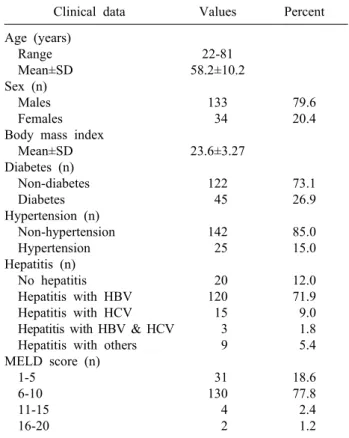
Table 1. Clinical characteristics of patients in the study
Clinical data Values Percent
Age (years) Range Mean±SD Sex (n) Males Females Body mass index Mean±SD Diabetes (n) Non-diabetes Diabetes Hypertension (n) Non-hypertension Hypertension Hepatitis (n) No hepatitis Hepatitis with HBV Hepatitis with HCV Hepatitis with HBV & HCV Hepatitis with others MELD score (n) 1-5
6-10 11-15 16-20
22-81 58.2±10.2
133 34 23.6±3.27
122 45 142 25 20 120 15 3 9 31 130 4 2
79.6 20.4
73.1 26.9 85.0 15.0 12.0 71.9 9.0 1.8 5.4 18.6 77.8 2.4 1.2 HBV, hepatitis B virus; HCV, hepatitis C virus; MELD, mod- el for end-stage liver disease
cut margin, vascular invasion, lymph nodal infiltration, se- rum albumin, tumor differentiation, and operation time.5-8 With this background, we questioned the relationship between the clinicopathologic factors like hepatitis, dia- betes, and hypertension, and the prognosis of HCC pa- tients undergoing hepatic resection in our hospital. We in- vestigated the influence of clinicopathologic and metabol- ic factors on the outcome of patients with HCC under- going hepatic resection in our hospital from August 2000 to December 2012.
MATERIALS AND METHODS
Patient characteristics and evaluation
A retrospective analysis was done with 167 HCC pa- tients who underwent hepatic resections from August 2000 to December 2012, at the Department of Surgery, Anam hospital, Korea University Medical Center, Seoul, Korea. The last follow-up day was set as the end of December 2012.
All of the patients underwent preoperative clinical eval- uation, imaging studies (e.g. chest x-ray and abdominal computed tomography), electrocardiography, and labo- ratory studies. We could not evaluate complications di- rectly due to the limitations of the retrospective study, so we chose “hospital days after surgery” to be an indirect measurement of the severity of any immediate compli- cations. Also, we chose diabetes, body mass index (BMI), and hypertension to be the measurements of metabolic factors.
Data and statistical analysis
Data was collected retrospectively with medical record review. We reviewed patient data, including their demo- graphic characteristics, symptoms, past medical histories, family medical histories, laboratory tests, liver function evaluations, operative findings, pathologic findings, treat- ment, and postoperative prognoses. Diabetic patients were defined as patients who had been previously diagnosed previously at any medical center, and as patients who had been diagnosed at a preoperative evaluation. In addition, hypertensive patients were defined as patients who had been previously diagnosed at any medical center, and as patients who had been diagnosed a preoperative evaluation. Major surgery was defined as the resection of
three or more segments.
We used the American Joint Committee on Cancer (AJCC) 7th edition for TNM staging, and differentiation and margin invasion were defined as pathological findings after surgery.
Statistical analysis were performed using SPSS software version 20.0. Continuous variables were compared using the Mann-Whitney U test, and categorical variables with the χ2-test or Fisher’s exact test as appropriate. Survival curves were generated using the Kaplan-Meier method and Cox regression analysis. All tests were two-tailed, and stat- istical significance was defined as p< 0.05.
RESULTS
In total, 167 patients were involved. There were 133 males (79.6%) and 34 females (20.3%), with a mean age of 58.2±10.2 years (range, 22-81 years). The mean BMI was 23.6±3.271 kg/m2. There were 45 diabetic patients (26.9%) and 122 non-diabetic patients (73.1%). There were 25 hypertension patients (15.0%) and 142 non-hy-
Table 2. Perioperative surgical profiles
Perioperative data Number Percent Surgery
Major Minor Surgery type Open Laparoscopic
Perioperative transfusion Non-transfusion Transfusion
Hospital days after surgery Range
Mean±SD
49 118 156 11 138 29 5-309 16.2±24.7
29.3 70.7 93.4 6.6 82.6 17.4
Table 3. Postoperative pathological results
Pathological data Number Percent Edmonson-Steiner grade
I II III IV Tumor size <5 cm 5-10 cm >10 cm Margin invasion No
Yes
Not reported T stage 1 2 3 4 N stage 0 1
TNM stage I
II IIIa IIIb IIIc Iva
(148) 9 52 57 30 119 32 16 157 9 1 109 34 20 4 166 1 108 34 15 5 4 1
6.1 35.1 38.5 20.3 71.3 19.1 9.6 94.0 5.3 0.5 65.3 20.4 2.0 2.4 99.4 0.6 64.7 20.4 9.0 3.0 2.4 0.6 pertension patients (85.0%) (Table 1).
There were 120 patients with HBV-associated hepatitis (71.9%), 15 patients with HCV-related hepatitis (9.0%), three patients with HBV- and HCV-related hepatitis (1.8%), 9 patients with other causes-related hepatitis (5.4%), and 20 patients without hepatitis (12.0%). There were 31 patients with a model for end-stage liver disease (MELD) score of 1-5 (18.6%), 130 patients with a MELD score of 6-10 (77.8%), four patients with a MELD score of 11-15 (2.4%), and two patients with MELD score of 16-20 (1.2%) (Table 1).
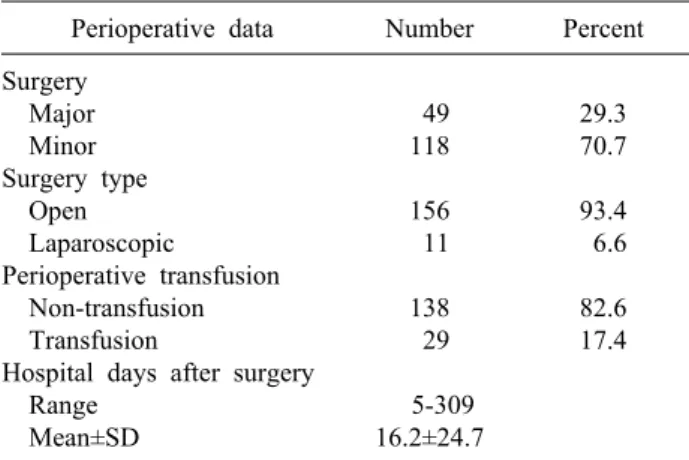
Major hepatic resection was performed in 49 patients (29.3%) and minor hepatic resection was performed in 118 patients (70.7%). Additionally, laparoscopic hepatic resection was performed in 11 patients (6.6%) and open hepatic resection was performed in 156 patients (93.4%).
There were 29 patients who required perioperative trans- fusions (17.4%) while 138 patients did not have perioper- ative transfusions (82.6%). The mean hospital days after surgery were 16.2±24.7 days (range, 5-309 days) (Table 2).
The postoperative pathological examination reports of148 patients showed there were nine patients with Edmonson-Steiner grade I (6.1%), 52 patients with grade II (35.1%), 57 patients with grade III (38.5%), and 30 pa- tients with grade IV (20.3%). The sizes of tumor varied from less than 5 cm in 119 patients (71.3%) to more than 10 cm in 16 patients (9.6%). There were nine patients with margin invasion (5.1%) and one patient did not have a reported margin statues (Table 3).
The mean disease-free survival period was 23.2±27.7 months, and the mean overall survival period was
34.8±33.1 months. Nine of the 167 patients were mar- gin-positive and one did not have a reported margin status. Recurrence was noted in 73 patients among the 157 during follow-up, and 56 patients among the 167 died.
The 1-, 3-, and 5-year disease-free survival rates of the 157 patients were 70.0%, 56.6%, and 54.1%, respectively, and the respective overall survivalof the total patients were 91.6%, 79.0%, and 73.0%, respectively (Fig. 1).
We analyzed the effect of the metabolic factors such as diabetes, BMI, and hypertension on the prognosis of HCC patients undergoing hepatic resection. In this study, the influences of diabetes and BMI on disease-free and overall survival were not significant. However, hyper- tension was found to be a risk factor for disease-free and overall survival (Table 4).
In multivariate analysis, hypertension (HR 2.459, CI 1.359-4.449, p=0.003), perioperative transfusion (HR 1.923, CI 0.973-3.800, p=0.060), major surgery (HR 3.023, CI 1.670-5.473, p<0.001), resection with RFA or cryoablation (HR 7.351, CI 2.433-22.203, p<0.001), and margin invasion
Fig. 1. Disease-free survival curve of 157 patients (A) and overall survival curve of all patients (B).
Table 4. Univariate analysis of metabolic factors predictive of overall survival and disease-free survival
Parameter Overall survival Disease-free survival
HR 95% CI p-value HR 95% CI p-value
Hypertension Diabetes BMI
2.238 1.371 1.010
1.268 0.764 0.931
3.951 2.460 1.096
0.005 0.290 0.811
2.098 1.261 0.997
1.243 0.769 0.932
3.542 2.070 1.067
0.006 0.358 0.936 HR, hazard ratio; CI, confidence interval; BMI, body mass index
Table 5. Multivariable analysis of prognostic factors that affect overall survival of HCC patients undergoing hepatic resection
Parameter HR 95% CI p-value
Hypertension Transfusion Major surgery
Resection with RFA or cryoablation Margin
2.459 1.923 3.023 7.351 4.346
1.359-4.449 0.973-3.800 1.670-5.473 2.433-22.203 1.750-10.791
0.003 0.060
<0.001
<0.001 0.002 HR, hazard ratio; CI, confidence intervals; RFA, radiofrequency ablation
Table 6. Multivariable analysis of prognostic factors that affected the disease-free survival of HCC patients undergoing hepatic resection
Parameter HR 95% CI p-value
Hypertension Albumin
Resection with RFA or cryoablation Tumor size
Transfusion
3.827 2.426 10.014 1.128 2.361
1.863-7.860 1.141-5.158 3.206-31.275 1.044-1.219 1.162-4.797
<0.001 0.021
<0.001 0.002 0.018 HR, hazard ratio; CI, confidence intervals; RFA, radiofrequency ablation
(HR 4.346, CI 1.750-10.791, p=0.002) were risk factors for overall survival (Table 5, Fig 2). Hypertension (HR 3.827, CI 1.863-7.860, p<0.001), albumin (HR 2.426, CI 1.141-5.158, p=0.021), resection with RFA or cryoablation
(HR 10.014, CI 3.206-31.275, p<0.001), tumor size (HR 1.128, CI 1.044-1.219, p=0.002), and perioperative trans- fusion (HR 2.361, CI 1.162-4.797, p=0.018) were all risk factors for disease-free survival (Table 6, Fig. 3).
Fig. 3. Comparison of disease-free survival curves according to hypertension.
Fig. 2. Comparison of overall survival curves according to hypertension.
DISCUSSION
Metabolic syndrome is a constellation of problems that includes insulin resistance, obesity, dyslipidemia, and hypertension.2 In HCC, the relation with obesity appears to be mediated primarily by factors related to metabolic syndrome, nonalcoholic fatty liver disease, and non- alcoholic steatohepatitis.3 With this background, we stud- ied the influence of certain metabolic factors, like dia- betes, BMI, and hypertension on the prognosis of HCC patients undergoing hepatic resection.
Diabetes is considered a risk factor for the prognosis of HCC patients undergoing hepatic resection.9-12 Diabetes is not only developed as a complication of cirrhosis, but also is found in aggravated cirrhosis and HCC.13 However, other studies have shown that diabetes does not increase perioperative morbidity or mortality after re- section of the liver in HCC, nor does it significantly influ- ence long-term prognosis.14 We investigated the relation- ship between diabetes and the prognosis of HCC patients undergoing hepatic resection, and found no statistical rela- tionship; however, there were more diabetic patients in our HCC population than in the general population (45 patients among 167). This high incidence of diabetes in HCC patients was mainly related to their underlying liver cirrhosis.13,15
In our study, hypertension was a risk factor of overall and disease-free survival in both univariate and multi- variate analysis. Kaibori et al.4 suggest that hypertension is a risk factor for a poor prognoses after the resection of HCV-related HCC. Their study also showed there were
no significant differences between overall and disease-free survival with or without diabetes, and that a higher pre- operative BMI was not associated with the outcome of surgical treatment.4 However, some studies have indicated that hypertension is a positive factor in the prognosis of patients with HCC. Hu et al.16 showed that baseline hyper- tension is associated with better overall survival in pa- tients with HCC in two independent cohorts, and that the mechanism was associated with low vascular endothelial growth factor receptor 1 (VEGFR-1) expression levels in patients with HCC. Hence, the nature of the influence of hypertension on the prognosis of patients with HCC un- dergoing hepatic resection remains uncertain.
HCC is the most common primary cancer occurring in liver, and HBV is a main cause of HCC. In our study, viral hepatitis was not important to overall and dis- ease-free survival. Although our results showed viral hep- atitis were not related the prognosis of HCC patients with hepatic resection, Kubo et al.17 showed that hepatitis B status, tumor factors, and the type of operation affected cancer recurrence after surgery for HCC in patients with concurrent chronic HBV, as opposed to patients with pre- vious chronic hepatitis B, in which only tumor factors af- fected the cancer recurrence rate. In addition, Ercolani et al.18 showed that HCV-positive patients with serum aspar- tate transaminase levels above twice the normal level have the highest risk for intrahepatic recurrence, and should be monitored carefully or offered alternative treatments.
Abdel-Wahab et al.7 showed that the factors that sig- nificantly predict survival were preoperative serum albu- min, tumor differentiation, staging, tumor capsule, resection
margin, vascular invasion, and operative blood transfusion, but that tumor differentiation was the only independent fac- tor on multivariate analysis affecting long-term survival.
Similarly, margin invasion affected overall in our study.
Previous studies showed that perioperative transfusion was prognostic factor for HCC patients undergoing hepatic resection.19,20 Accordingly, our results also showed that per- ioperative transfusion affected overall and disease-free survival. In our study, tumor size affected disease-free survival. Nagao et al.21 showed that significant differences in survival patterns were noted when analyzed on the basis of preoperative alpha-fetoprotein level, tumor size, and tu- mor capsule.
Zarzavadjian et al.22 showed that metabolic syndrome, perioperative bleeding (≥1000 ml), middle hepatic vein resection, and primary hepatic malignancy were all related poor prognoses under a univariate analysis, and both mid- dle hepatic vein resection and underlying primary hepatic malignancy were related to mortality under a multivariate analysis. Yeh et al.23 showed that the overall survival for HCC patients with liver cirrhosis who underwent hepatic resection could be stratified on the basis of the high value of alkaline phosphatase, tumor size, satellite lesions, and vascular invasion.
There were a few limitations of our study; a more de- tailed study of continuous variables like hospital days af- ter surgery, alpha-fetoprotein level, and albumin level should be gathered, along with more evidence such as cut-off values. In addition, in the case of a large quantity of missing data regarding a specific factor, the factor was excluded from data; as such, we could not evaluate these factors.
In conclusion, hypertension, perioperative transfusion, and resection with RFA or cryoablation were identified as risk factors for both disease-free and overall survival after hepatic resection of HCC patients in our study. In terms of metabolic factors, diabetes and BMI were not asso- ciated with the prognosis of HCC patients undergoing hepatic resection, but hypertension was associated with disease-free and overall survival of HCC patients under- going hepatic resection. However, these results remain controversial. Further research is needed to elucidate the influences of metabolic factors on the prognosis of pa- tients with HCC, especially in the current era of increas- ing incidence of metabolic syndrome.
REFERENCES
1. Bruix J, Sherman M; American Association for the Study of Liver Diseases. Management of hepatocellular carcinoma: an update. Hepatology 2011;53:1020-1022.
2. Farrell GC, Larter CZ. Nonalcoholic fatty liver disease: from steatosis to cirrhosis. Hepatology 2006;43:S99-S112.
3. Siegel AB, Zhu AX. Metabolic syndrome and hepatocellular car- cinoma: two growing epidemics with a potential link. Cancer 2009;115:5651-5661.
4. Kaibori M, Ishizaki M, Matsui K, Kitade H, Matsui Y, Kwon AH. Evaluation of metabolic factors on the prognosis of patients undergoing resection of hepatocellular carcinoma. J Gastroenterol Hepatol 2011;26:536-543.
5. Shimada M, Matsumata T, Akazawa K, Kamakura T, Itasaka H, Sugimachi K, et al. Estimation of risk of major complications after hepatic resection. Am J Surg 1994;167:399-403.
6. Kim WW, Lee KW, Choi SH, Heo JS, Kim YI, Kim SJ, et al.
Risk factors of morbidity and mortality following surgical re- section for hepatocellular carcinoma. Korean J Hepatol 2004;10:
51-61.
7. Abdel-Wahab M, El-Husseiny TS, El Hanafy E, El Shobary M, Hamdy E. Prognostic factors affecting survival and recurrence after hepatic resection for hepatocellular carcinoma in cirrhotic liver. Langenbecks Arch Surg 2010;395:625-632.
8. Shimada M, Takenaka K, Fujiwara Y, Gion T, Shirabe K, Yanaga K, et al. Risk factors linked to postoperative morbidity in patients with hepatocellular carcinoma. Br J Surg 1998;85:
195-198.
9. Teoh NC, Fan JG. Diabetes mellitus and prognosis after curative therapy for hepatocellular carcinoma: alas, still grave for those who are hyperglycemic. J Gastroenterol Hepatol 2008;23:1633- 1634.
10. Huo TI, Lui WY, Huang YH, Chau GY, Wu JC, Lee PC, et al. Diabetes mellitus is a risk factor for hepatic decompensation in patients with hepatocellular carcinoma undergoing resection:
a longitudinal study. Am J Gastroenterol 2003;98:2293-2298.
11. Yanaga K, Matsumata T, Hayashi H, Shimada M, Urata K, Suehiro T, et al. Effect of diabetes mellitus on hepatic resection.
Arch Surg 1993;128:445-448.
12. Ikeda Y, Shimada M, Hasegawa H, Gion T, Kajiyama K, Shirabe K, et al. Prognosis of hepatocellular carcinoma with dia- betes mellitus after hepatic resection. Hepatology 1998;27:1567- 1571.
13. García-Compean D, Jaquez-Quintana JO, Maldonado-Garza H.
Hepatogenous diabetes. Current views of an ancient problem.
Ann Hepatol 2009;8:13-20.
14. Poon RT, Fan ST, Wong J. Does diabetes mellitus influence the perioperative outcome or long term prognosis after resection of hepatocellular carcinoma? Am J Gastroenterol 2002;97:1480- 1488.
15. Kaczynski J, Hansson G, Wallerstedt S. Diabetes: one of few remarkable differences in clinicopathologic features between cir- rhotic and noncirrhotic Swedes with hepatocellular carcinoma.
Dig Dis Sci 2006;51:796-802.
16. Hu YF, Chen TC, Chau GY, Yang TL, Liu CJ, Chen MH, et al. Baseline hypertension: new insight into the potential pre- dictors of survival in patients with hepatocellular carcinoma. Int J Cardiol 2013;168:2979-2981.
17. Kubo S, Tanaka H, Shuto T, Takemura S, Yamamoto T, Kanazawa A, et al. Clinicopathologic features and outcome after liver resection for hepatocellular carcinoma in patients with con- current versus previous chronic hepatitis B. Surg Today 2005;35:216-222.
18. Ercolani G, Grazi GL, Ravaioli M, Del Gaudio M, Gardini A, Cescon M, et al. Liver resection for hepatocellular carcinoma on cirrhosis: univariate and multivariate analysis of risk factors for intrahepatic recurrence. Ann Surg 2003;237:536-543.
19. Asahara T, Katayama K, Itamoto T, Yano M, Hino H, Okamoto Y, et al. Perioperative blood transfusion as a prognostic indicator in patients with hepatocellular carcinoma. World J Surg 1999;23:
676-680.
20. Poon RT, Fan ST, Lo CM, Ng IO, Liu CL, Lam CM, et al.
Improving survival results after resection of hepatocellular carci- noma: a prospective study of 377 patients over 10 years. Ann Surg 2001;234:63-70.
21. Nagao T, Inoue S, Goto S, Mizuta T, Omori Y, Kawano N, et al. Hepatic resection for hepatocellular carcinoma. Clinical fea- tures and long-term prognosis. Ann Surg 1987;205:33-40.
22. Zarzavadjian Le Bian A, Costi R, Constantinides V, Smadja C.
Metabolic disorders, non-alcoholic fatty liver disease and major liver resection: an underestimated perioperative risk. J Gastrointest Surg 2012;16:2247-2255.
23. Yeh CN, Chen MF, Lee WC, Jeng LB. Prognostic factors of hepatic resection for hepatocellular carcinoma with cirrhosis:
univariate and multivariate analysis. J Surg Oncol 2002;81:195- 202.