205 Introduction
Carbon monoxide (CO) is a colorless, odorless, and nonirri- tant gas that is lighter than air, and it is a product of incom- plete combustion of hydrocarbons.1) Accidental, suicidal or homicidal intoxications with CO have a long history. Acute CO poisoning is an important clinical problem and may lead large proportion of patients to fatal death. Moreover, frequent neurologic and cardiovascular consequences have been de- scribed.2-4) The neurologic manifestations of CO poisoning have been well described, and include headache, dizziness, weakness, nausea, and confusion.3)4) Cardiac consequences have been reported, including arrhythmias and electrocardiograph- ic alterations, acute myocardial infarction, pulmonary edema, and cardiogenic shock.5)6) Among these, myocardial injury is common in patients with moderate to severe CO poisoning,2) manifested as elevated cardiac biomarkers and the changes of regional wall motion abnormality in echocardiography.7)
On the other hand, an association between thromboembolic accidents and CO poisoning has been shown less frequently in the literatures.8-14) We report a CO poisoning case complicated by intracardiac thrombus.
Case
A 24-year-old female patient with no preexisting disease was
brought to the emergency unit for altered mentality due to sui- cidal exposure to CO. The duration of the exposure was unclear.
She showed a good general appearance, the level of conscious- ness was alert: Glasgow Coma Scale was measuring up to 15.
Vital signs were blood pressure of 132/101 mmHg, pulse rate of 87/min, respiration rate of 20/min and body temperature of 35.4°C. Oxygen saturation measured using pulse oxymetry was 100% when 15 L/min oxygen was applied through a reservoir bag mask. She was 164 cm tall and weighed 50 kg, and her body mass index was 18.6 kg/m2. Lower and upper limb arte- rial and venous examination revealed normal circulation. In detailed system examinations, no pathological neurologic signs were detected.
The chest radiography showed mild cardiomegaly with pul- monary edema in both lung fields. Laboratory analyses re- vealed the following: white blood cells, 21200/μL; blood urea nitrogen, 17 mg/dL; creatinine, 0.75 mg/dL, and blood glu- cose, 101 mg/dL, D-dimer 0.28 ug/mL. Cardiac enzymes were elevated (CK: 3306 U/L, CK-MB: 90.6 ng/mL, troponin I: 1.899 ng/mL, lactate dehydrogenase: 334 U/L). Arterial blood gas was performed and revealed pH 7.40, PaCO2 33 mmHg, PaO2 380 mmHg, HCO3 20 mmol/L, and the frac- tion of carboxyhemoglobin 16.0% (reference range < 2%). QT interval was prolonged in the electrocardiograph (ECG). The
pISSN 1975-4612/ eISSN 2005-9655 Copyright © 2012 Korean Society of Echocardiography www.kse-jcu.org http://dx.doi.org/10.4250/jcu.2012.20.4.205
CASE REPORT J Cardiovasc Ultrasound 2012;20(4):205-208
A Case of Carbon Monoxide Poisoning with Thrombus in Right Atrium
Hyoin Choi, MD, Dae-Hee Kim, MD, PhD, Byung Joo Sun, MD, Joon-Seok Kim, MD, Jeeeun Yang, MD, Sun-Mok Kim, MD, So Young Park, MD, Jong-Min Song, MD, PhD, Duk-Hyun Kang, MD, PhD and Jae-Kwan Song, MD, PhD
Cardiac Imaging Center, Asan Heart Institute, Asan Medical Center, University of Ulsan College of Medicine, Seoul, Korea
Carbon monoxide is a nonirritant, odorless, colorless gas. Its effects are prominent in organs most sensitive to oxygen deprivation, such as the heart, brain, and kidney. Although less frequently, an association between thromboembolic events and carbon monoxide poisoning has been shown in the literatures. In this case, we report a case of atrial thrombus associated with carbon monoxide poisoning.
KEY WORDS: Carbon monoxide · Intoxication · Thrombus.
• Received: August 3, 2012 • Revised: September 7, 2012 • Accepted: November 21, 2012
• Address for Correspondence: Dae-Hee Kim, Cardiac Imaging Center, Asan Heart Institute, Asan Medical Center, University of Ulsan College of Medicine, 88 Olympic-ro 43-gil, Songpa-gu, Seoul 138-736, Korea Tel: +82-2-3010-3151, Fax: +82-2-486-5918, E-mail: [email protected]
• This is an Open Access article distributed under the terms of the Creative Commons Attribution Non-Commercial License (http://creativecommons.org/licenses/by-nc/3.0) which permits unrestricted non-commercial use, distribution, and reproduction in any medium, provided the original work is properly cited.
Journal of Cardiovascular Ultrasound 20 | December 2012
206
patient was transferred to the intensive care unit. At that time, she complained of newly onset chest pain, and cardiology con- sultation was requested. Pain was mainly retrosternal, lasted for several minutes, with no aggravating or relieving factors, and no change in position or respiration. ECG showed sinus rhythm with T wave inversion in precordial leads. Coronary computed tomography (CT) angiography performed to rule out coronary artery disease revealed normal coronary artery. Transthoracic echocardiography on the same day showed moderately reduced ejection fraction (42%), and akinesia of left ventricular apex.
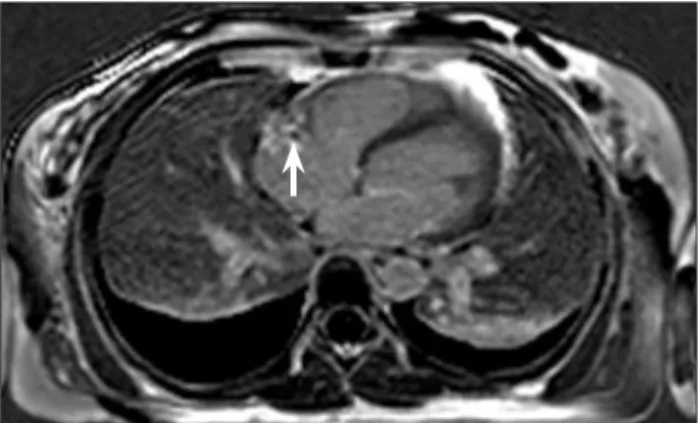
Stress induced cardiomyopathy or ischemic insult of left anteri- or descending artery were suspected. During comprehensive echocardiographic examination, echogenic mass with multi- ple nodularity in right atrium (RA) was identified. The size measured about 30 × 15 mm, and it appeared to be attached to the junction of superior vena cava. Transesophageal echo- cardiography and cardiac magnetic resonance imaging (MRI) were requested for further characterization of the mass. In mid-esophageal 140 degree view, a large nodular mass was at- tached to appendage of RA. Moreover, the mass was highly mobile and oscillating up and down across the tricuspid valve throughout the cardiac cycle (Fig. 1). The foremost diagnosis to exclude in this patient was intracardiac thrombus, and therefore we started anticoagulation therapy immediately. Cardiac MRI 1 day after anticoagulation therapy showed delayed enhance-
ment suggestive of a thrombus, and an obvious reduction in size of the thrombus to 8 mm (Fig. 2). For the purpose of de- termining the etiology of thrombosis, she was questioned con- cerning recent potential precipitating conditions, such as sur- gery, immobilization and use of medications including oral contraceptives. Furthermore, she was evaluated for genetic and connective tissue disease leading to thrombophilic conditions.
There were no identifiable risk factors for hypercoagulable state.
Complete lower extremity ultrasound and abdominopelvic CT was conducted for suspicion of peripheral vein thrombosis and it demonstrated no thrombosis in other organs. The fol- low-up transthoracic echocardiogram was done on sixth day after anticoagulation, and showed no residual thrombus in the RA and normalized left ventricular (LV) systolic function (Fig.
3). The patient was discharged without any complication. The patient has been free of symptoms and there have been no clinical features of neurologic or thromboembolic complica- tions during the 3-months of follow-up.
Discussion
CO poisoning has special impact on organs sensitive to oxy- gen deprivation such as the heart, brain, and kidney. Myocar- dial injury assessed by ECG and cardiac enzyme elevation from moderate to severe CO poisoning is common (~40%) than expected.2) The proposed mechanism of global left ven- tricular dysfunction is tissue hypoxia and resultant myocardial stunning. The affinity of hemoglobin for CO is more than 200 times greater than its affinity for oxygen, and competitive inhibition of oxygen release leads to tissue hypoxia.3) Usually, the left ventricular dysfunction was transient and would be normalized with conventional treatment including high con- centration of oxygen. In our case, left ventricular systolic dys- function with regional wall motion abnormalities was associat- ed with CO poisoning and recovered with conventional therapy.
In contrast, an association between thromboembolic acci- dents and CO poisoning has been shown less commonly in the literatures. To our knowledge, this is the first Korean case of acute CO poisoning combined with RA thrombus forma- tion. Besides LV thrombus formation associated with transient
Fig. 1. Transesophageal echocardiography showed a mass (arrow) attached to right atrial appendage with to (A) and fro (B) motion through tricuspid valve.
Fig. 2. Delayed enhancement images (DE-MRI) showed an 8 mm sized thrombus (arrow) in the right atrium.
A B
Tricuspid valve
Complications in Acute Carbon Monoxide Poisoning | Hyoin Choi, et al.
207 apical ballooning of LV,15) there have been several reports regard-
ing arterial and venous system thrombosis and related embo- lism including popliteal artery,8)9) superior sagittal sinus,10) vein of Labbe,11) mesenteric artery,12) basillar trunk,13) and popliteal vein.14) A plausible explanation for thromboembolic events is the effect of CO on platelets aggregation. CO poisoning leads to some changes in blood vessel and CO and nitric oxide exchange on platelet. Disturbed mitochondrial mechanisms by NO and its derivatives facilitate production of free oxygen radicals.16) Oxidative stress enhanced by free oxygen radicals may lead to endothelial damage, and subsequent platelet aggregation.17) Although the optimal therapy and duration of anticoagula- tion for CO induced RA thrombus is still unknown, the use of anticoagulant therapy in the acute phase and until complete resolution of thrombus appears to be appropriate in patients with atrial thrombus.18)19)
In conclusion, myocardial injury is common in CO poison- ing. Thromboembolism could occur in cardiac chambers and peripheral vessels, although it was less frequent. Therefore, pa- tients presented with CO poisoning should undergo echocar- diographic examination followed by serial ECG and cardiac enzyme evaluation. Careful examination should be performed for the assessment of intracardiac thrombus, in addition to the exact evaluation of ventricle function.
References
1. Van Meter KW. Carbon monoxide poisoning. In: Tintinalli JE, Kelen GD, Stapczynski JS; American College of Emergency Physicians, editors.
Emergency medicine: a comprehensive study guide. 5th ed. New York: Mc- Graw-Hill;2000. p.1303.
2. Satran D, Henry CR, Adkinson C, Nicholson CI, Bracha Y, Henry TD. Cardiovascular manifestations of moderate to severe carbon monoxide
poisoning. J Am Coll Cardiol 2005;45:1513-6.
3. Ernst A, Zibrak JD. Carbon monoxide poisoning. N Engl J Med 1998;339:1603-8.
4. Weaver LK. Carbon monoxide poisoning. Crit Care Clin 1999;15:297- 317, viii.
5. Marius-Nunez AL. Myocardial infarction with normal coronary arteries after acute exposure to carbon monoxide. Chest 1990;97:491-4.
6. Middleton GD, Ashby DW, Clark F. Delayed and longlasting electro- cardiographic changes in carbon-monoxide poisoning. Lancet 1961;1:12-4.
7. Jang WI, Park JH. Transient left ventricular systolic dysfunction associated with carbon monoxide toxicity. J Cardiovasc Ultrasound 2010;18:12-5.
8. Enzer N, Spilberg S. Gangrene of lower extremity following carbon mon- oxide asphyxia. Am J Clin Pathol 1946;16:111-6.
9. Fowler PB. Gangrene of the leg following carbon-monoxide asphyxia.
Lancet 1954;266:240-1.
10. Nagy Z, Kenéz J, Simon L, Mórocz K. [Partial thrombosis of the supe- rior sagittal sinus following carbon monoxide poisoning]. Orv Hetil 1984;125:3181-4.
11. Cambria S. [Thrombosis of the vein of Labbé with haemorrhagic cerebral infarction (author’s transl)]. Rev Neurol (Paris) 1980;136:321-6.
12. Condi M, Devaux C, Sallerin T. [A case of thrombosis of the mesenteric artery after carbon monoxide poisoning]. Anesth Analg (Paris) 1973;30:
353-8.
13. Breton J, Caroff J, Martin R, Dehouve A, Dehouve P. [Fatal obstruc- tion of the basilar trunk following benign carbon monoxide poisoning]. Med Leg Dommage Corpor 1969;2:409-11.
14. Heidrich H, Klems H. [Bilateral thrombosis of the popliteal vein with diffuse muscular necrosis following CO intoxication]. Dtsch Med Wochen- schr 1969;94:1367-70 passim.
15. Lee SJ, Kang JH, Kim NY, Baek IW, Park MY, Shim BJ, Koh YS, Shin WS, Lee JM, Jeon HK. A case report of carbon monoxide poisoning induced cardiomyopathy complicated with left ventricular thrombus. J Car- diovasc Ultrasound 2011;19:83-6.
16. Davis MR, Fitzpatrick CM, Dixon PM, Kashyap VS. Thrombus-in- duced endothelial dysfunction: hemoglobin and fibrin decrease nitric oxide bioactivity without altering eNOS. J Surg Res 2004;122:121-9.
Fig. 3. Echocardiographic follow-up at sixth day of anticoagulation (B) showed disappearance of mass originally attached to right atrial wall (A, arrow).
A B
Journal of Cardiovascular Ultrasound 20 | December 2012
208
17. Felner JM, Churchwell AL, Murphy DA. Right atrial thromboemboli:
clinical, echocardiographic and pathophysiologic manifestations. J Am Coll Cardiol 1984;4:1041-51.
18. de Gregorio C, Grimaldi P, Lentini C. Left ventricular thrombus forma- tion and cardioembolic complications in patients with Takotsubo-like syn-
drome: a systematic review. Int J Cardiol 2008;131:18-24.
19. Haghi D, Papavassiliu T, Heggemann F, Kaden JJ, Borggrefe M, Suselbeck T. Incidence and clinical significance of left ventricular thrombus in tako-tsubo cardiomyopathy assessed with echocardiography. QJM 2008;101:381-6.