• 검색 결과가 없습니다.

Effects of School Bullying Prevention Camp on the Adolescent Perpetrators of School Violence

N/A
N/A
Protected

Academic year: 2021

Share "Effects of School Bullying Prevention Camp on the Adolescent Perpetrators of School Violence"

Copied!
11
0
0

로드 중.... (전체 텍스트 보기)

전체 글

(1)

INTRODUCTION

Approximately 40% of middle school students in South Korea have been involved in school violence or bullying [1].

In 2008, 10.2% of 2926 students aged 11–16 years in South Korea were reported to have experienced bullying from their peers [2]. Persistent school violence may damage the victim’s adaptive functions and leave serious mental scars, as well as lead to various other issues, such as behavioral problems, substance abuse, and legal complications for the adolescent perpetrators.

The Act on the Prevention of and Countermeasures against Violence in Schools in South Korea was enacted in 2004. How- ever, the law focuses on protection and treatment of the vic- tims while focusing on social and legal regulations for the perpetrators, but fails to address the perpetrators’ mental

vulnerability related to behavioral problems, thus limiting the fundamental prevention of repeated school violence [3].

Thus, the Act on the Prevention of and Countermeasures against Violence in Schools was amended in 2012, which introduced a therapeutic perspective for the perpetrators [3].

In 2013, the Korean Neuropsychiatric Association and Na- tional Police Agency jointly developed a school bullying pre- vention program (the Standard Guidance Program). The pro- gram is currently being run in hospitals and clinics nationwide [4,5].

The Standard Guidance Program is an 8-session cognitive behavioral therapy-based school bullying prevention pro- gram that was developed for the purpose of improving the capability in impulsivity, emotional control, and empathy of school violence perpetrators [5]. The program is run by psy- chiatrists or psychologists, who perform baseline and post- intervention psychiatric assessments, supervise the overall program, and advise on future intervention for the partici- pants. The effectiveness of the program has been verified

This is an Open Access article distributed under the terms of the Creative Commons Attribution Non-Commercial License (https://creativecommons.org/licenses/by-nc/4.0) which permits unrestricted non-commercial use, distribution, and reproduction in any medium, provided the original work is properly cited.

Effects of School Bullying Prevention Camp

on the Adolescent Perpetrators of School Violence

Je Jung Lee

1

, Jong Hyun Kim

1

, and Bung-Nyun Kim

2,3

1

Department of Psychiatry, Gongju National Hospital, Gongju, Korea

2

Department of Psychiatry, Seoul National University Hospital, Seoul, Korea

3

Department of Psychiatry, College of Medicine, Seoul National University, Seoul, Korea

Objectives: The purpose of this study was to evaluate the effects of a school bullying prevention camp for adolescent perpetrators of school violence.

Methods: A total of 95 adolescents (boys=73, girls=22) were included in this study. The changes after the program were evaluated using several self-rating scales for the assessment of the degree of depression, loneliness, impulsivity, self-esteem, and interpersonal reactivity compared with the baseline scales.

Results: The school bullying prevention camp significantly reduced the degree of depression severity (z=-5.874, p<0.001) and impul- sivity scale (z=-3.861, p<0.001), while increasing self-esteem (z=-2.091, p=0.037). The degree of depression severity (z=-4.635, p<0.001), loneliness (z=-2.168, p=0.030), and impulsivity (z=-2.987, p=0.003) significantly reduced, whereas self-esteem significantly increased (z=-2.221, p=0.026) for male students who had no history of child abuse. However, there were no significant changes after the program for the degree of depression, loneliness, impulsivity, self-esteem, and interpersonal reactivity among female students with a history of child abuse.

Conclusion: The results of our study suggest that the development of diverse standardized guidance programs is necessary for teenagers with different characteristics and backgrounds. Such programs are expected to be more effective in preventing school violence.

Key Words: School bullying prevention camp program; Depression; Impulsivity; Self esteem; Empathy; Bullying; Adolescents;

Child abuse.

Received: November 12, 2020 / Revision: December 8, 2020 / Accepted: December 9, 2020

Address for correspondence: Je Jung Lee, Department of Psychiatry, Gongju National Hospital, 623-21 Gobunti-ro, Gongju 32601, Korea Tel: +82-41-850-5700, Fax: +82-41-855-6969, E-mail: [email protected]
J Korean Acad Child Adolesc Psychiatry 2021;32(2):43-50

https://doi.org/10.5765/jkacap.200043

(2)

previously [4,5].

Physical activity reduces depression and anxiety and in- creases self-esteem in adolescents [6,7]. Meditation-based camp programs can reduce depression and anxiety, increase self-esteem and positive emotions, and decrease negative emotions [8]. Although a clustered randomized controlled trial evaluation on the effectiveness of the program presum- ably failed to find meaningful outcome, the ‘Boost Camp’, a two-day school-based transdiagnostic prevention program in Belgium, reportedly had the effect on short-term emotion- al control [9].

As the Chungnam region in South Korea has a low popu- lation density, and it is difficult for the school police to bring school violence perpetrators to a psychiatrist, the Gongju Na- tional Hospital implemented a two-day school bullying pre- vention camp based on the Standard Guidance Program for perpetrators called the Standard Guidance School with co- operation from the Chungnam Provincial Police Agency. In this study, we aimed to examine the sociodemographic char- acteristics and diagnosis of students who participated in the Standard Guidance School from 2017 to 2019 and evaluate their changes after treatment to determine the effectiveness of the Standard Guidance School. We also examined the fac- tors related to treatment, ultimately to present foundational data for developing various programs tailored to school vio- lence perpetrators.

METHOD

Participants and procedure

Among school violence adolescent perpetrators identified by the Chungcheong Provincial Police Agency from 2017 to 2019, 97 first-time offenders involved in minor incidents with a high potential for change through guidance, as indicated by the school police officers, consented to participate in the study. After excluding two students who were only victims of school violence, data from 95 participants were analyzed.

With a consent from the developer [5] of the Standard Guid- ance Program, the Standard Guidance School was run 5–6 times annually from 2017 to 2019, and a meeting and men- tal health training were held for the Chungnam and Sejong school police officers in the beginning of the year. This pro- gram is an 8-session cognitive behavioral therapy program with 4–8 participants per program and 60 minutes per ses- sion (Supplementary Table 1 in the online-only Data Supple- ment) [4]. In the past, the program was run once a week (2 ses- sions for visit) for 4 weeks, but our Standard Guidance School was run as a 2-day, 1-night camp program during which all 8 sessions were run by a psychologist, with ‘physical activities for improving relationships’ and ‘breathing relaxation pro-

gram’ added. Additionally, 2 or 3 school police officers in each region participated in ‘a talk with a mentor’ with our team and stayed with the adolescents in their rooms (Supplementary Table 2 in the online-only Data Supplement). A psychiatrist first interviewed the students and provided overall advice on the program, including the approach to be taken for each ad- olescent, during our team meeting and upon completion of the program. The psychiatrist and our team provided advice to the school police officers in the respective regions based on the results of the interview and program. The timetable for the program is shown in Supplementary Table 3 (in the on- line-only Data Supplement).

Data collection and instruments

This study was approved by the Institutional Review Board of the Gongju National Hospital in 2020 (2020-07). The study was conducted with reference to the final report for the Stan- dard Guidance Schools conducted from 2017 to 2019 [10-12].

The report cards sent to each student included the question- naire coding data before and after the program and a report from a psychiatrist on each student (history of child abuse, living with parents, socioeconomic status, history of school violence perpetration/victimization, provisional diagnosis, and future intervention plans). The following questionnaires were used for the baseline and post-program assessments.

The Children’s Depression Inventory (CDI) is a modified version of the Beck’s Depression Inventory for use in chil- dren and adolescents, and this scale was developed by Ko- vacs [13] and adapted into Korean by Cho and Lee [14]. The scale consists of 27 items, with each item rated on a 3-point scale from 0 to 2, with a higher score indicating a higher level of depression.

The UCLA Loneliness Scale was developed by Russell et al. [15] and adapted by Kim and Kim [16]. The scale consists of 20 items, with each item rated on a 4-point scale from 1 to 4, with a higher score indicating lower loneliness.

The Barratt Impulsiveness Scale (BIS) was developed by Barratt [17] and adapted by Lee [18]. The scale consists of 23 items rated on a 4-point scale, with a higher score indicat- ing greater impulsiveness.

The Self-Esteem Scale (SES) was developed by Rosenberg [19] and adapted by Jeon [20]. The scale consists of 10 items rated on a 4-point scale from 1 to 4, with a higher score indi- cating greater self-esteem.

The Interpersonal Reactivity Index (IRI) was developed

by Davis [21] and adapted by Park [22]. The scale consists of

28 items rated on a 5-point scale from 0 to 4, with a higher

score indicating greater empathy.

(3)

Statistical analysis

The distribution of participants’ demographic data and suspected diagnosis were analyzed using descriptive statis- tics. Differences in provisional diagnoses and history of child abuse according to sex were analyzed using chi-square tests.

Changes in depression, loneliness, impulsiveness, self-esteem, and empathy after the program were analyzed using Wilcox- on’s signed rank test, and post-program changes were ana- lyzed specifically for sex, age, and child abuse subgroups. All statistical analyses were performed using IBM SPSS statistics version 24.0 (IBM Corp., Armonk, NY, USA), and statistical significance was set at p<0.05.

RESULTS

Participants’ characteristics

Of the 95 participants, 73 were boys (76.8%) and 22 were girls (23.2%). The mean age was 15.7±1.19 years (range, 13–

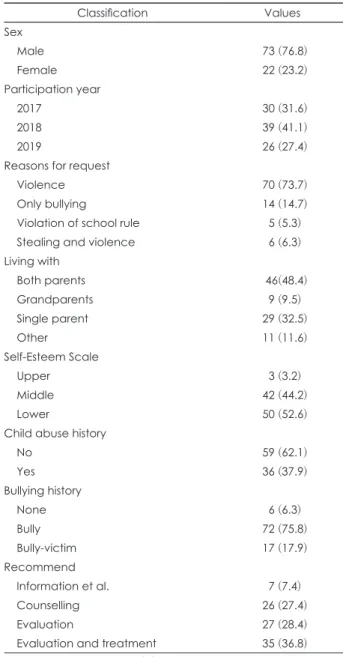
18 years). The female group (16.23 years) was significantly older than the male group (15.60 years). Socioeconomic sta- tus was predominantly low (n=50, 52.6%) and middle (n=42, 44.2%). The reason for referral was primarily violence (n=70, 73.7%), specifically, 14 students with school violence prob- lems, 5 students with school rule violations, and 6 students with both violence and theft. Forty-six (48.4%) participants lived with both biological parents, while the remaining par- ticipants lived with their grandparents, single parent, step- parents, or lived in an orphanage. Seventy-two (75.8%) had only been the perpetrators of school violence, while 17 (17.9%) were both perpetrators and victims of school violence. After the program, 26 (27.4%) were recommended to undergo coun- seling, and 27 (28.4%) were recommended to undergo psy- chiatric evaluation. Thirty-five participants (36.8%) were rec- ommended to undergo psychiatric treatment (Table 1).

Distribution of provisional diagnosis by sex

The provisional diagnoses were attention-deficit/hyperac- tivity disorder (ADHD, n=22, 23.2%), depressive disorder (n=19, 20.0%), conduct disorder (CD, n=10, 10.5%), opposi- tional defiant disorder (ODD, n=5, 5.3%), adjustment disor- der (n= 5, 5.3%), posttraumatic stress disorder (PTSD, n=4, 4.2%), social anxiety disorder (n=3, 3.2%), internet gaming disorder (IG, n=1, 1.1%), and social communication disor- der (n=1, 1.1%). Twenty-four patients (25.3%) were not di- agnosed. Thirty-three participants (34.7%) met the criteria for 2 or more diagnoses.

The participants were divided into externalizing group (ADHD, CD, ODD, etc.), internalizing group (depressive dis- order, anxiety disorder, PTSD, etc.), and mixed group (both externalizing and internalizing) and were compared based

on sex (Table 2). There were more male students with an ex- ternalizing group and more female students with an inter- nalizing group, and the differences were statistically signifi- cant (odds ratio=22.318, p<0.001).

Changes after the program

Compared to the baseline, the participants showed signifi- cant reductions in the depression score (Z=-5.874, p<0.001) and impulsiveness score (Z=-3.861, p<0.001), and a signifi- cant increase in the self-esteem score (Z=-2.091, p=0.037) af- ter the program. On the other hand, there were no significant changes in loneliness and empathy scores (Table 3). Addition- ally, the participants with an empathy score of 60 or lower were further analyzed, and these participants did not show

Table 1. Descriptive characteristics of sample

Classification Values

Sex

Male 73 (76.8)

Female 22 (23.2)

Participation year

2017 30 (31.6)

2018 39 (41.1)

2019 26 (27.4)

Reasons for request

Violence 70 (73.7)

Only bullying 14 (14.7)

Violation of school rule 5 (5.3)

Stealing and violence 6 (6.3)

Living with

Both parents 46(48.4)

Grandparents 9 (9.5)

Single parent 29 (32.5)

Other 11 (11.6)

Self-Esteem Scale

Upper 3 (3.2)

Middle 42 (44.2)

Lower 50 (52.6)

Child abuse history

No 59 (62.1)

Yes 36 (37.9)

Bullying history

None 6 (6.3)

Bully 72 (75.8)

Bully-victim 17 (17.9)

Recommend

Information et al. 7 (7.4)

Counselling 26 (27.4)

Evaluation 27 (28.4)

Evaluation and treatment 35 (36.8)

Data are presented as n (%)

(4)

a significant change in their empathy scores.

Changes after the program by sex and history of child abuse

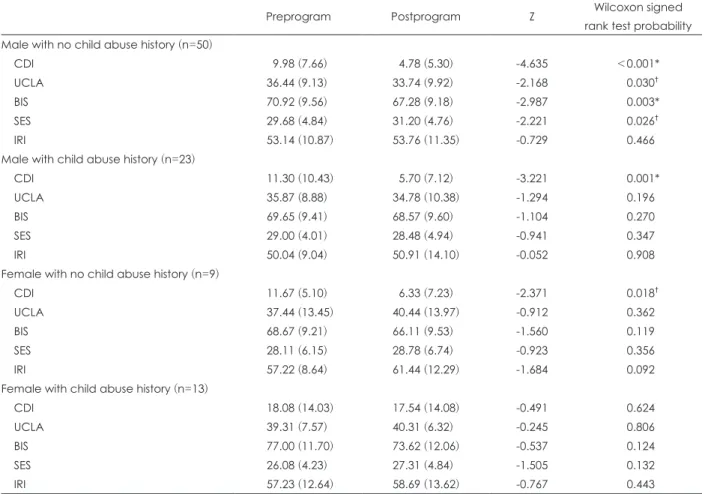
A total of 37.9% of the participants reported a childhood abuse experience, and the rate of childhood abuse experi- ence was 5.466 times higher among female participants than male participants (odds ratio=5.466, p=0.019). Thus, we com- pared the changes after the program based on sex and histo- ry of childhood abuse, as shown in Table 4. The results showed that male participants without childhood abuse experience

Table 2. Provisional diagnostic distribution Male

(n=73)

Female (n=22)

Total (n=95)

None 21 (28.8) 3 (13.6) 24 (25.3)

Externalizing 32 (43.8)* 1 (4.55) 33 (34.7) Internalizing 11 (15.1) 12 (54.6)* 23 (24.2)

Mixed 9 (12.3) 6 (27.3) 15 (15.8)

Data are presented as n (%). Externalizing: attention-deficit/hy- peractivity disorder, conduct disorder, oppositional defiant dis- order, etc.; internalizing: depression, anxiety disorder, posttrau- matic stress disorder, etc.; mixed: internalizing and externalizing disorder. *p<0.001

Table 3. Comparison of depression, loneliness, impulsivity, self-esteem, and interpersonal reactivity scales between pre and post school bullying prevention camp in subjects

Preprogram Postprogram Z Wilcoxon signed rank test probability

Children’s Depression Inventory 11.57 (9.52) 6.89 (8.64) -5.874 <0.001*

UCLA Loneliness Scale 36.79 (9.26) 35.53 (10.27) -1.721 0.085

Barratt Impulsiveness Scale 71.23 (9.95) 68.35 (10.08) -3.861 <0.001*

Self-Esteem Scale 28.87 (4.79) 29.78 (5.18) -2.091 0.037

Interpersonal Reactivity Index 53.34 (10.67) 54.47 (12.68) -1.207 0.227

Data are presented as mean (standard deviation). *p<0.01,

p<0.05

Table 4. Changes in scales after the school bullying prevention camp in each grouped according to sex and child abuse history

Preprogram Postprogram Z Wilcoxon signed

rank test probability Male with no child abuse history (n=50)

CDI 9.98 (7.66) 4.78 (5.30) -4.635 <0.001*

UCLA 36.44 (9.13) 33.74 (9.92) -2.168 0.030

BIS 70.92 (9.56) 67.28 (9.18) -2.987 0.003*

SES 29.68 (4.84) 31.20 (4.76) -2.221 0.026

IRI 53.14 (10.87) 53.76 (11.35) -0.729 0.466

Male with child abuse history (n=23)

CDI 11.30 (10.43) 5.70 (7.12) -3.221 0.001*

UCLA 35.87 (8.88) 34.78 (10.38) -1.294 0.196

BIS 69.65 (9.41) 68.57 (9.60) -1.104 0.270

SES 29.00 (4.01) 28.48 (4.94) -0.941 0.347

IRI 50.04 (9.04) 50.91 (14.10) -0.052 0.908

Female with no child abuse history (n=9)

CDI 11.67 (5.10) 6.33 (7.23) -2.371 0.018

UCLA 37.44 (13.45) 40.44 (13.97) -0.912 0.362

BIS 68.67 (9.21) 66.11 (9.53) -1.560 0.119

SES 28.11 (6.15) 28.78 (6.74) -0.923 0.356

IRI 57.22 (8.64) 61.44 (12.29) -1.684 0.092

Female with child abuse history (n=13)

CDI 18.08 (14.03) 17.54 (14.08) -0.491 0.624

UCLA 39.31 (7.57) 40.31 (6.32) -0.245 0.806

BIS 77.00 (11.70) 73.62 (12.06) -0.537 0.124

SES 26.08 (4.23) 27.31 (4.84) -1.505 0.132

IRI 57.23 (12.64) 58.69 (13.62) -0.767 0.443

Data are presented as mean (standard deviation). *p<0.01,

p<0.05. CDI: Children’s Depression Inventory, UCLA: UCLA Loneliness

Scale, BIS: Barratt Impulsiveness Scale, SES: Self-Esteem Scale, IRI: Interpersonal Reactivity Index

(5)

had significant reductions in the depression score (Z=-4.635, p<0.001), loneliness score (Z=-2.168, p=0.030), and impulsive- ness score (Z=-2.987, p=0.003), and a significant increase in the self-esteem score (Z=-2.221,p=0.026), but they did not show significant changes in the empathy score. Male partici- pants with childhood abuse experience showed a significant reduction only in the depression score (Z=-3.221, p=0.001), with no significant changes in loneliness, impulsiveness, self- esteem, and empathy scores. Female participants without childhood abuse experience showed a significant reduction only in the depression score (Z=-2.371, p=0.018) with no sig- nificant changes in loneliness, impulsiveness, self-esteem, and empathy scores. Female participants with childhood abuse experience did not show significant changes in depression, loneliness, impulsiveness, self-esteem, and empathy scores.

Changes after the program by age

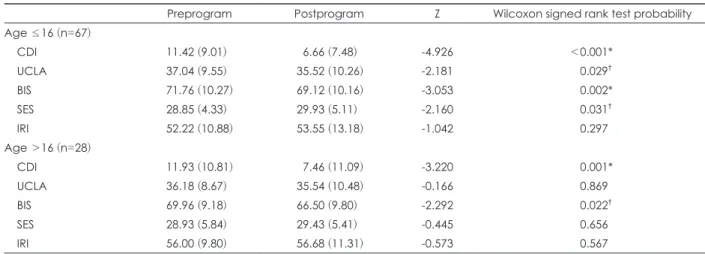
The participants were divided into age groups of ≤16 years and >16 years to compare their changes after the program.

There were 67 participants in the ≤16 years group, and this group showed significant reductions in the depression (Z=

-4.926, p<0.001), loneliness (Z=-2.181, p=0.029), and impul- siveness scores (Z=-3.053, p=0.002), and a significant increase in the self-esteem score (Z=-2.160, p=0.031), with no signifi- cant changes in the empathy score after the program. The

>16 years group consisted of 28 participants, and they showed significant reductions in the depression (Z=-3.220, p=0.001) and impulsiveness scores (Z=-2.292, p=0.022), with no signifi- cant changes in loneliness, self-esteem, and empathy scores (Table 5).

DISCUSSION

This study examined the changes in depression, loneli-

ness, impulsiveness, self-esteem, and empathy after partici- pation in the Standard Guidance School, a camp-type school violence prevention program for perpetrators, among ado- lescent school violence perpetrators referred by the school police officers in the Chungnam region of South Korea. A total of 47.4% of the participants lived with both of their bi- ological parents, which is a markedly lower percentage com- pared to 87% reported in a large-scale study [23]. While 57.6%

of the participants in a nationwide Standard Guidance Pro- gram administered in 2015 were middle class, 52% of the paticipants in this study reported their socioeconomic level as ‘low.’ It can be observed that the subjects of this program were socioeconomically vulnerable. A provisional psychiat- ric diagnosis was established for 73.2% of the participants in this study, which is higher than the percentage of 21.5% re- ported for the 2015 Standard Guidance Program. A previ- ous study reported that children and adolescents exposed to poverty, child welfare system, and adolescent legal system are at a higher risk for mental health problems [24].

School violence programs are known to be effective when run by experts and when they directly deal with the problem of school violence in a small number of participants [25,26].

Additionally, these programs are reported to be effective not only in reducing violent behaviors but also in reducing de- pression and reinforcing positive emotions, such as self-es- teem [26]. Depression is a potent psychological factor that best explains violent and delinquent behaviors in adolescents [27,28]. Furthermore, adolescents with low self-esteem are vulnerable to engaging in antisocial behaviors or delinquen- cy because they depreciate themselves and society [29], and to compensate for their self-esteem, they may demonstrate aggressive behaviors toward others [30]. As with the 2015 Standard Guidance Program [4], the present program is also expected to lower participants’ involvement in school vio-

Table 5. Changes in scales after the school bullying prevention camp in each grouped according to age

Preprogram Postprogram Z Wilcoxon signed rank test probability

Age ≤16 (n=67)

CDI 11.42 (9.01) 6.66 (7.48) -4.926 <0.001*

UCLA 37.04 (9.55) 35.52 (10.26) -2.181 0.029

BIS 71.76 (10.27) 69.12 (10.16) -3.053 0.002*

SES 28.85 (4.33) 29.93 (5.11) -2.160 0.031

IRI 52.22 (10.88) 53.55 (13.18) -1.042 0.297

Age >16 (n=28)

CDI 11.93 (10.81) 7.46 (11.09) -3.220 0.001*

UCLA 36.18 (8.67) 35.54 (10.48) -0.166 0.869

BIS 69.96 (9.18) 66.50 (9.80) -2.292 0.022

SES 28.93 (5.84) 29.43 (5.41) -0.445 0.656

IRI 56.00 (9.80) 56.68 (11.31) -0.573 0.567

Data are presented as mean (standard deviation). *p<0.01,

p<0.05. CDI: Children’s Depression Inventory, UCLA: UCLA Loneliness

Sscale, BIS: Barratt Impulsiveness Scale, SES: Self-Esteem Scale, IRI: Interpersonal Reactivity Index

(6)

lence perpetration by reducing their depression and increas- ing self-esteem.

In addition to the reduced depression score and increased self-esteem score observed in the Standard Guidance Pro- gram, the present program also significantly reduced the impulsiveness score. The two programs differed in their par- ticipant pool, as 16.7% of the participants of the previous pro- gram had an externalizing disorder (ADHD 6.8%) and an impulsiveness score of 45.64 (before program), 34.0% of the participants of our program had an externalizing disorder (ADHD 22.7%) and an impulsiveness score of 70.95 (before program). The difference in participant selection may be at- tributable to the fact that the school police officers were in- troduced to and trained about potential clinical groups who could be referred for treatment based on a psychiatric evalu- ation during an annual meeting with the officers. Moreover, the results are in line with past findings that improvement of impulsiveness, which had been a focus when developing the Standard Guidance Program, was better shown in participants with high baseline impulsiveness [4,31]. Although it was re- ported that the Standard Guidance Program improved em- pathy in adolescent school violence perpetrators with low baseline empathy [4], no such changes were observed in this program. In the light of study results showing that empathy can only be improved by implementing various techniques in the long term [32], it is speculated that a short camp for 2 days would have been insufficient to induce changes in empathy.

After participation in this program, male students without childhood abuse experience (n=50) had decreased depres- sion, loneliness, and impulsiveness with improved self-es- teem, showing that the program was effective in all aspects with the exception of empathy. Positive childhood experi- ences serve as a buffer against negative emotions that occur during growth, such as depression and anxiety [33], but ad- verse childhood experiences, such as child abuse may induce various mental health problems [7] and hinder the improve- ment of symptoms, such as depression, loneliness, and im- pulsivity. Moreover, impulsiveness in male students is fur- ther related to sensation seeking [34], and physical activities reduce depression and anxiety and increase self-esteem [6,7].

In addition to the existing 8-session cognitive behavioral ther- apy program, some factors might supposedly take meaning- ful therapeutic roles within our program. Those are: First, camp style program environment in which all participants (adoles- cents, school police officers, and mental health professionals) stay naturally close together to improve mutual understand- ing; second, ‘relationship-promoting physical activities,’ ‘ab- dominal relaxed breathing training,’ and ‘talking with men- tors (polices, mental health professional) are added. But more structural follow-up studies are necessary.

While our program effectively reduced depression in male students with childhood abuse experience and female stu- dents without childhood abuse experience, the program was not effective in female students with childhood abuse expe- rience. Students with childhood abuse experience display trauma-related emotions, such as fear, anger, guilt, shame, disgust, sadness, and helplessness, but these symptoms can be improved through dialectical behavior therapy [35]. In the future, our program should additionally implement such a therapeutic approach focused on PTSD for female adoles- cent perpetrators with childhood abuse experience.

In this study, adolescent participants aged >16 years showed decreased depression and impulsiveness. Participants aged 16 years or younger also showed decreased loneliness, de- pression, and impulsiveness, and had improved self-esteem.

This is consistent with previous findings that the Standard Guidance Program is particularly effective for middle school students, who are in turbulent period in terms of emotional and physical development [4], and the present program seems to have been effective in improving loneliness and self-es- teem because of the nature of a camp-type program with additional activities for improving relationships.

This study modified the Standard Guidance Program, which was developed as a psychiatric evaluation and cogni- tive behavioral program for use in Korea, to a camp-type pro- gram for use in a non-metropolitan region and investigated its effectiveness. Particularly, this study was significant in that it observed that the camp-type Standard Guidance School was more effective for male students without experience of childhood abuse.

This study has several limitations. First, we did not com- pare the participants with a control group that did not par- ticipate in the program. Second, post-program changes were only analyzed with a self-reported questionnaire. Third, a considerable number of the participants were considered to be potential patients who would benefit from psychiatric treatment, which limits the generalizability of the findings.

Fourth, because the duration of the program was only 2 days, we could not observe long-term changes. Fifth, the analyses were performed without controlling for various therapeutic factors. Sixth, the number of female students and students with childhood abuse experience was relatively small, which limits statistical interpretation even with nonparametric sta- tistical methods.

CONCLUSION

This study analyzed the changes in depression, loneliness,

impulsiveness, self-esteem, and empathy after participation

in the Standard Guidance School, a camp-type school vio-

(7)

lence prevention program for perpetrators, among adoles- cent school violence perpetrators referred by school police officers in the Chungnam region of South Korea. After the program, the participants showed reduced depression and impulsiveness with improved self-esteem. One notable find- ing was that the male students without childhood abuse ex- perience showed reduced depression, loneliness, and impul- siveness and improved self-esteem, while female students with childhood abuse experience showed no significant changes.

Furthermore, while high school students showed decreased depression and impulsiveness, middle school students also showed decreased loneliness and improved self-esteem. This study is expected to contribute to modifying the Standard Guidance Program to be tailored to participants of different backgrounds.

Supplementary Materials

The online-only Data Supplement is available with this ar- ticle at https://doi.org/10.5765/jkacap.200043.

Acknowledgments

This study was funded by the Gongju National Hospital in 2020.

We extend our gratitude to the Child and Adolescent Mental Health Center at Gongju National Hospital for supporting the program from 2017 to 2019.

Conflicts of Interest

The authors have no potential conflicts of interest to disclose.

Author Contributions

Conceptualization: Je Jung Lee, Bung-Nyun Kim. Data curation: Je Jung Lee. Formal analysis: Je Jung Lee. Funding acquisition: Je Jung Lee.

Investigation: Je Jung Lee, Jong Hyun Kim. Methodology: Je Jung Lee, Bung-Nyun Kim. Supervision: Je Jung Lee, Bung-Nyun Kim. Visualiza- tion: Je Jung Lee, Jong Hyun Kim. Writing—original draft: Je Jung Lee, Jong Hyun Kim. Writing—review & editing: all authors.

ORCID iDs

Je Jung Lee https://orcid.org/0000-0002-0606-2304 Jong Hyun Kim https://orcid.org/0000-0003-2525-0084 Bung-Nyun Kim https://orcid.org/0000-0002-2403-3291

REFERENCES

1) Kim YS, Koh YJ, Leventhal BL. Prevalence of school bullying in Korean middle school students. Arch Pediatr Adolesc Med 2004;

158:737-741.

2) Koo HJ, Kwak KJ, Smith PK. Victimization in Korean schools: the nature, incidence, and distinctive features of Korean bullying or Wang-Ta. J Sch Violence 2008;7:119-139.

3) Lee SH, Jeong JY, Kang TH, Kim MY. A Study on the effectiveness of policies for Aggressor of school violence. Seoul: Korean Insti- tute of Criminology;2014. p.21-24.

4) Kim SA, Kim JI, Choi JW, Lim J, Kim BN. Effects of cognitive be- havioral therapy-based program for the adolescent perpetrators of school violence. J Korean Neuropsychiatr Assoc 2017;56:118-126.

5) Sakong JK, Lee YJ, Kim BN, Oh KS, Han SM. The development of national standard program for guiding juvenile delinquents and victims [updated 2015 April 3; cited 2020 Nov 6]. Available from

URL: http://lod.nl.go.kr/resource/CNTS-00067631177.

6) Biddle SJ, Asare M. Physical activity and mental health in children and adolescents: a review of reviews. Br J Sports Med 2011;45:886- 7) Sadock JB, Sadock AV, Ruiz P. Kaplan & Sadock’s comprehensive 895.

textbook of psychiatry. 10th ed. China: Wolters Kluwer;2017.

8) Kim MH. Comparison of the effect of Maum Meditation Program on the depression, anxiety and self-esteem of the children and the juveniles. Jour of KoCon a 2012;12:338-348.

9) Volkaert B, Wante L, Vervoort L, Braet C. ‘Boost Camp’, a univer- sal school-based transdiagnostic prevention program targeting ad- olescent emotion regulation; evaluating the effectiveness by a clus- tered RCT: a protocol paper. BMC Public health 2018;18:904.

10) The Child and Adolescent Mental Health Center. Final report on Standard Guidnace School for bullying perpeturator. Gongju: Gon- ju National Hospital;2017.

11) The Child and Adolescent Mental Health Center. Final report on Standard Guidnace School for bullying perpeturator. Gongju: Gon- ju National Hospital;2018.

12) The Child and Adolescent Mental Health Center. Final report on Standard Guidnace School for bullying perpeturator. Gongju: Gon- ju National Hospital;2019.

13) Kovacs M. The Children’s Depression, Inventory (CDI). Psycho- pharmacol Bull 1985;21:995-998.

14) Cho SC, Lee YS. Development of the Korean form of the Kovacs’

Children’s Depression Inventory. J Korean Neuropsychiatr Assoc 1990;29:943-956.

15) Russell D, Peplau LA, Ferguson ML. Developing a measure of loneliness. J Pers Assess 1978;42:290-294.

16) Kim KH, Kim JH. Korea UCLA loneliness scale. J Stud Guid 1989;

16:13-30.

17) Barratt ES. Anxiety and impulsiveness related to psychomotor ef- ficiency. Percept Mot Ski 1959;9:191-198.

18) Lee HS. Impulsivity test. Seoul: Korean Guidance;1992.

19) Rosenberg M. Society and the adolescent self-image. Princeton, NJ: Princeton University Press;1965.

20) Jeon BJ. Self-esteem: a test of its measurability. Yonsei Nonchong 1974;11:107-130.

21) Davis MH. A multidimensional approach to individual differences in empathy. JSAS Catalog of Selected Documents in Psychology 1980;10:85.

22) Park SH. Empathy and prosocial behavior. Seoul: Moonumsa;

1997.

23) Choi IJ, Mo SH, Lee SY, Kim HI. A study on supporting plan for promoting mental health in children and adolescents II. Seoul: Na- tional Youth Policy Institute;2012.

24) Stagman S, Cooper JL. Children’s mental health: what every poli- cymaker should know. New York, NY: National Center for Chil- dren in Poverty, Columbia University;2010.

25) Park-Higgerson HK, Perumean-Chaney SE, Bartolucci AA, Grim- ley DM, Singh KP. The evaluation of school-based violence pre- vention programs: a meta-analysis. J Sch Health 2008;78:465-479.

26) Yoon CH, Park SG, Shin IS. A meta-analysis of the effects of school violence prevention programs in Korea. Asian J Educ 2014;15:189- 27) Kwak KJ, Mun EY. The relationships of psychological characteris- 215.

tics and depression and antisocial behavior in early adolescence.

The Korean Journal of Developmental Psychology 1993;6:29-44.

28) Kim CS. The effect of depression, stress coping, and hardiness on delinquency in adolecsents. The Korean Journal of Health Psychol- ogy 2007;12:587-598.

29) Kim JH. The study of art therapy for the prevention of school bul- lying: focused on aggression and self-esteem of assailant [disserta- tion]. Seoul: Korea University;2014.

30) Donnellan MB, Trzesniewski KH, Robins RW, Moffitt TE, Caspi

A. Low self-esteem is related to aggression, antisocial behavior,

(8)

and delinquency. Psychol Sci 2005;16:328-335.

31) Lee JS. The effect of the group program of cognitive-behavioral therapy on the impulsivity and empathy of juvenile delinquents [dissertation]. Daegu: Catholic University of Daegu;2010.

32) Lee KY, Choi JH, Song JY, Jeon JH. The effectiveness of preven- tion program of recidivism for school violence on juvenile proba- tion. Korean Journal of Probation 2013;13:249-274.

33) Narayan AJ, Rivera LM, Bernstein RE, Harris WW, Liebernan AF.

Positive childhood experiences predict less psychopathology and stress in pregnant women with childhood adversity: a pilot study of

the benevolent childhood experiences (BCEs) scale. Child Abuse Negl 2018;78:19-30.

34) Cross CP, Copping LT, Campbell A. Sex differences in impulsivi- ty: a meta-analysis. Psychol Bull 2011;137:97-130.

35) Bohus M, Kleindienst N, Hahn C, Müller-Engelmann M, Ludäscher

P, Steil R, et al. Dialectical behavior therapy for posttraumatic stress

disorder (DBT-PTSD) compared with cognitive processing thera-

py (CPT) in complex presentations of PTSD in women survivors of

childhood abuse: a randomized clinical trial. JAMA 2020;77:1235-

1245.

(9)

Session Topic Contents

1 Motivating participation and forming rapport Understand the purpose and necessity of participating in the program Set rules for the duration of program participation

Get to know each other in the program

2 Correctly understanding bullying Correctly understand the concept and scope of bullying

Understand the outcomes of bullying, its ripple effects, and the possible punishment for bullying in school 3 Developing perspective-taking ability

Improving empathetic ability

Understand the other person’s perspective

Think from the perspective of the protagonist in the video

Empathize with a victim’s situation and feelings through indirect experience 4 Anger management (controlling anger I) Feeling thermometer: understand the extent of anger

Discover my anger patterns, find my real feelings behind anger 5 Anger management (controlling anger II) Understand and correct automatic thinking that causes anger

Learn how to handle negative feelings

6 Self-control and problem-solving Developing a personalized conflict coping and conflict resolution mechanism Learn ways to stop and change when negative feelings begin to form 7 Communication training Learn appropriate social skills in peer relations

Train how to understand the other person and talk to him/her based on empathic understanding 8 Positive self-image, finding hope Discover how I changed through the program

Share their vision and dreams and in doing so build mutual emotional support

Consider what efforts are needed to realize my dream

(10)

Standard Guidance Program Standard Guidance School (current research program)

Duration 4-5 weeks (once a week) 1 night 2 day

Type Visit Camp

Place Program room Program room, bed room, living room, gym

Number of participants 4-8 6-8

Number of program staff 3-5 7-8 (+ SPO 3-4)

Contents of operation 8-session CBT

Pre and post self-reports

Pre and post psychiatric interviews Pre and post operator meeting

8-session CBT

Pre and post self-reports

Pre and post psychiatric interviews Pre and post staff meeting

Relationship-promoting physical activities Abdominal relaxed breathing training

Talking with mentors (SPO, mental health professional)

SPO: school police officer, CBT: cognitive-behavioral therapy

(11)

Time table Activity contents

Participants SPO or program staff

Day 1

09:30-09:40

(10 min) Introduce program hosts and the facility 09:40-11:00

(80 min) Perform pre self-report Psychiatric interview

(preliminary evaluation) Preliminary meeting (with program staff and SPO) 11:00-11:50

(50 min)

① Understanding the purpose of the program and setting rules

11:50-13:20

(90 min) Lunch Staff meeting (with program staff and psychiatrist)

13:20-14:20

(60 min) ② Correctly understanding bullying Hospital tour (due to SPO choice) 14:20-14:30

(10 min) Break 14:30-15:30

(60 min)

③ Developing perspective-taking ability and improving empathetic ability

15:30-15:40

(10 min) Change attires and move to the gym Participant management (by SPO) 15:40-17:00

(80 min) Relationship-improving physical activities 17:00-18:30

(90 min) Dinner and rest 18:30-19:30

(60 min) ④ Anger management I 19:40-20:40

(60 min)

⑤ Self-control and problem-solving

⑥ Communication training 20:40-22:00

(80 min) Talk with mentors: sharing thoughts and feelings Participation (with SPO and program staff) 22:00-23:30

(90 min)

Rest and prepare for sleep (additional tests)/

23:30 sleep Participant management (by SPO)

Day 2

07:00-08:00

(60 min) Rise and get ready Participant management (by SPO)

08:00–09:00

(60 min) Breakfast (outdoor walk)

09:00-10:00 (60 min)

Abdominal relaxed breathing training Review of previous sessions

⑦ Anger management II: relaxed breathing program

10:00-10:40

(40 min) ⑧ Building positive self-image 10:40-12:00

(80 min) Perform Post self-report Psychiatric interview (final evaluation) 12:00-13:00

(60 min) Lunch Final meeting (psychiatrists and staff discuss

participants with SPO) 13:00-13:30

(30 min) End of program; return home

SPO: school police officer

수치

Table 1. Descriptive characteristics of sample
Table 4. Changes in scales after the school bullying prevention camp in each grouped according to sex and child abuse history
Table 5. Changes in scales after the school bullying prevention camp in each grouped according to age

참조

관련 문서