INTRODUCTION
Approximately 40% of middle school students in South Korea have been involved in school violence or bullying [1].
In 2008, 10.2% of 2926 students aged 11–16 years in South Korea were reported to have experienced bullying from their peers [2]. Persistent school violence may damage the victim’s adaptive functions and leave serious mental scars, as well as lead to various other issues, such as behavioral problems, substance abuse, and legal complications for the adolescent perpetrators.
The Act on the Prevention of and Countermeasures against Violence in Schools in South Korea was enacted in 2004. How- ever, the law focuses on protection and treatment of the vic- tims while focusing on social and legal regulations for the perpetrators, but fails to address the perpetrators’ mental
vulnerability related to behavioral problems, thus limiting the fundamental prevention of repeated school violence [3].
Thus, the Act on the Prevention of and Countermeasures against Violence in Schools was amended in 2012, which introduced a therapeutic perspective for the perpetrators [3].
In 2013, the Korean Neuropsychiatric Association and Na- tional Police Agency jointly developed a school bullying pre- vention program (the Standard Guidance Program). The pro- gram is currently being run in hospitals and clinics nationwide [4,5].
The Standard Guidance Program is an 8-session cognitive behavioral therapy-based school bullying prevention pro- gram that was developed for the purpose of improving the capability in impulsivity, emotional control, and empathy of school violence perpetrators [5]. The program is run by psy- chiatrists or psychologists, who perform baseline and post- intervention psychiatric assessments, supervise the overall program, and advise on future intervention for the partici- pants. The effectiveness of the program has been verified
This is an Open Access article distributed under the terms of the Creative Commons Attribution Non-Commercial License (https://creativecommons.org/licenses/by-nc/4.0) which permits unrestricted non-commercial use, distribution, and reproduction in any medium, provided the original work is properly cited.
Effects of School Bullying Prevention Camp
on the Adolescent Perpetrators of School Violence
Je Jung Lee
1, Jong Hyun Kim
1, and Bung-Nyun Kim
2,31
Department of Psychiatry, Gongju National Hospital, Gongju, Korea
2
Department of Psychiatry, Seoul National University Hospital, Seoul, Korea
3
Department of Psychiatry, College of Medicine, Seoul National University, Seoul, Korea
Objectives: The purpose of this study was to evaluate the effects of a school bullying prevention camp for adolescent perpetrators of school violence.
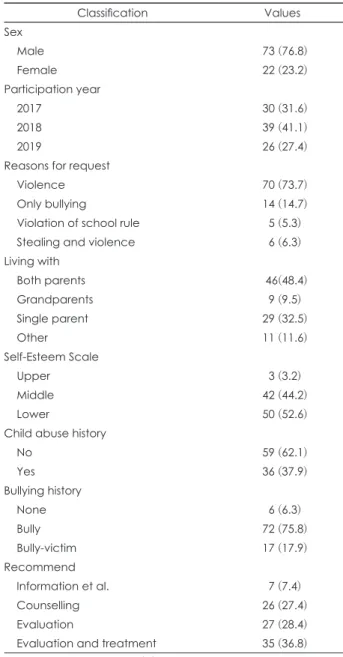
Methods: A total of 95 adolescents (boys=73, girls=22) were included in this study. The changes after the program were evaluated using several self-rating scales for the assessment of the degree of depression, loneliness, impulsivity, self-esteem, and interpersonal reactivity compared with the baseline scales.
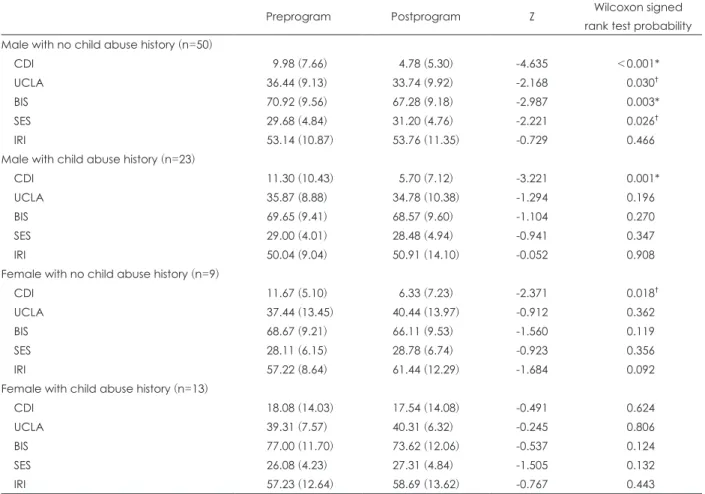
Results: The school bullying prevention camp significantly reduced the degree of depression severity (z=-5.874, p<0.001) and impul- sivity scale (z=-3.861, p<0.001), while increasing self-esteem (z=-2.091, p=0.037). The degree of depression severity (z=-4.635, p<0.001), loneliness (z=-2.168, p=0.030), and impulsivity (z=-2.987, p=0.003) significantly reduced, whereas self-esteem significantly increased (z=-2.221, p=0.026) for male students who had no history of child abuse. However, there were no significant changes after the program for the degree of depression, loneliness, impulsivity, self-esteem, and interpersonal reactivity among female students with a history of child abuse.
Conclusion: The results of our study suggest that the development of diverse standardized guidance programs is necessary for teenagers with different characteristics and backgrounds. Such programs are expected to be more effective in preventing school violence.
Key Words: School bullying prevention camp program; Depression; Impulsivity; Self esteem; Empathy; Bullying; Adolescents;
Child abuse.
Received: November 12, 2020 / Revision: December 8, 2020 / Accepted: December 9, 2020
Address for correspondence: Je Jung Lee, Department of Psychiatry, Gongju National Hospital, 623-21 Gobunti-ro, Gongju 32601, Korea Tel: +82-41-850-5700, Fax: +82-41-855-6969, E-mail: [email protected]