제주도 토양에서 분리한 xylanase 생산 균주 Streptomyces
glaucescens subsp. WJ-1의 동정 및 효소의 생화학적 특성 연구
김다솜1, 정성철2, 배창환1, 지원재1*
1국립생물자원관생물자원활용부유용자원분석과
2국립산림과학원난대·아열대산림연구소
Received: November 8, 2016 / Revised: January 9, 2017 / Accepted: January 10, 2017
서 론
Xylan은 식물체 세포벽의 약 20−40%를 차지하는 hemi- cellulose의주요구성성분이며, 주로 arabinosyl기, acetyl기, glucuronosyl기등으로치환된 xylose 단위체가β-1,4 결합 으로연결된복잡한 구조를형성한다. 자연계에존재하는 xylan은활엽수에서 acetylated xylan으로존재하고, 침엽수 에서는 arabinoxylan으로존재한다[1]. Hemicellulose의구
성성분중에서 xylan의비중은떡갈나무에서약 60−80%, 보 릿짚및볏짚에서 30−35% 정도가존재한다고보고되어있 다. 따라서식물체유래바이오매스의가수분해는, 자연계에 거대한양으로존재하는 hemicelluloses 계물질을유용하게
사용하기위한가장중요한공정이다. Xylan의화학적분해
는쉽고빠르게분해할수있는장점으로산업적으로널리 사용되고있으나, 이방법은반친환경적이고공정에서발생 한독성물질의중화에소비되는비용적부담이단점이다[2].
이에비해, xylanase에의한 xylan의효소적가수분해는보 다선택적이며특이적으로가수분해가가능하고친환경적인 방법이기때문에화학적처리법을대체할수있는차세대공 정으로주목받고있다[3].
Identification and Biochemical Characterization of Xylanase-producing Streptomyces glaucescens subsp. WJ-1 Isolated from Soil in Jeju Island, Korea
Da Som Kim1, Sung Cheol Jung2, Chang Hwan Bae1, and Won-Jae Chi1*
1Biological and Genetic Resources Assessment Division, National Institute of Biological Resources, Incheon 22689, Republic of Korea
2Warm-temperature and Subtropical Forest Research Center, Korea Forest Research Institute, Jeju 63582, Republic of Korea
A xylan-degrading bacterium (strain WJ-1) was isolated from soil collected from Jeju Island, Republic of Korea. Strain WJ-1was characterized as a gram-positive, aerobic, and spore-forming bacterium. The pre- dominant fatty acid in this bacterium was anteiso-C15:0 (42.99%). A similarity search based on 16S rRNA gene sequences suggested that the strain belonged to the genus Streptomyces. Further, strain WJ-1 shared the highest sequence similarity with the type strains Streptomyces spinoveruucosus NBRC 14228, S.
minutiscleroticus NBRC 13000, and S. glaucescens NBRC 12774. Together, they formed a coherent cluster in a phylogenetic tree based on the neighbor-joining algorithm. The DNA G+C content of strain WJ-1 was 74.7 mol%. The level of DNA–DNA relatedness between strain WJ-1 and the closest related species S.
glaucescens NBRC 12774 was 85.7%. DNA–DNA hybridization, 16S rRNA gene sequence similarity, and the phenotypic and chemotaxonomic characteristics suggest that strain WJ-1 constitutes a novel subspecies of S. glaucescens. Thus, the strain was designated as S. glaucescens subsp. WJ-1 (Korean Agricultural Culture Collection [KACC] accession number 92086). Additionally, strain WJ-1 secreted thermostable endo-type xylanases that converted xylan to xylooligosaccharides such as xylotriose and xylotetraose. The enzymes exhibited optimal activity at pH 7.0 and 55℃.
Keywords: Xylanase, Streptomyces glaucescens, identification, characterization, phylogenetic analysis
*Corresponding author
Tel: +82-32-590-7113, Fax: +82-32-590-7472 E-mail: [email protected]
© 2017, The Korean Society for Microbiology and Biotechnology
Xylan은 β-1,4-endoxylanases (EC 3.2.1.8)와 β-xylosidase (EC 3.2.1.37)에의해서기본골격이충분히분해되지만, 완 전한가수분해를위해서는다양한 side chain 방출효소인 β-arabinofuranosidase (EC 3.2.1.55), β-D-glucuronidase (EC 3.2.1.1), acetyl xylan esterase (EC 3.2.11.6) 등과의
공동 작용이 필요하다[4]. Xylanase는 펄프에 붙어 있는
hemicellulose를제거하기위한 pulp-prebleaching 과정, 가 축사료의소화촉진개선, 식품및제빵첨가물, 과일및채 소가공과정, 에탄올및자일리톨생산, 제지분야등의다 양한분야에이용되고있는데, 각분야에적합한 xylanase의 특성에관한연구가요구되고있다.
본연구에서는, 산업적으로유용한미생물유래 xylanase 를탐색하기위해토양으로부터높은 xylanase 활성을갖는 미생물을 분리·동정하였고 분리한 미생물이 생산하는 xylanase의효소적특성을조사하였다.
재료 및 방법
Xylanase 생산 미생물의 분리
제주도송악산에서썩은나무조각들이섞여있는토양샘 플을수집하여멸균수에 10-1−10-5으로희석하였다. 희석액 을각각 100 μl씩 0.2% Azurine-crosslinked (AZCL) xylan (Sigma, USA)이함유된 Luria-Bertani (LB) 고체배지에도 말한후 40℃에서 48시간배양하였다. 콜로니주변에푸른 색을형성하는균을회수하여 0.2% beechwood xylan이함 유된 새로운 LB 배지에 계대한후 40℃에서 배양하였다. AZCL-xylan은β-1,4-endoxylanase에의해서분해되면푸른 색을나타내는성질이있다. 0.2% beechwood xylan이함유 된 LB 배지에서효소활성은 congo red 용액(Sigma, USA)으 로염색하여관찰하였다. 최종적으로 xylanase 활성이가장 강한균주를선택하여본연구에사용하였다. 선택된균주는 WJ-1로명명하였다.
균주 WJ-1의 형태적·생리적 특성 분석
그람염색은 Gram stain kit (BD, USA)를사용하여제시 된방법에따라균체를염색한후광학현미경으로관찰하 였다. 생리학적 특성은 API 20NE와 API ZYM kit (Biomérieux, France)를사용하여제시된방법에따라조사 하였다. 단, 배지는 kit에서 제공된 AUX 배지에 trace element [5]와 NaCl (최종농도 1%)을첨가하여사용하였다. 동정된균의성장에미치는 pH, NaCl 농도, 온도조건등을 조사하였다. 우선, WJ-1 균주는 pH 4.0−10.0 (pH 1.0의간격)의 고체배지에접종하여 40℃에서 5일간배양하여성장을관찰 하였다. 성장에미치는온도의영향은접종후 4, 20, 30, 37, 40, 50, 55℃의조건에서 5일간배양하여판단하였다. 균주
WJ-1의성장에미치는배지내 NaCl 농도는동정된균을 0− 20% (1% 간격) NaCl이포함된고체배지에접종하여 40℃ 에서 5일간배양하여관찰하였다.
16S rRNA 유전자 염기서열 해독 및 계통수 제작
균주 WJ-1을 LB 액체배지에접종하여 40℃에서 2일간배 양한후액체배양액을 10,000 × g에서 10분간원심분리하여 균체를 회수하였다. 회수된 균체로부터 genomic DNA Extraction kit (DyneBio, Korea)를 사용하여 genomic DNA를 추출하였다. 균주 WJ-1의 16S rRNA 유전자는 bacterial universal primer (27F와 1492R)를 사용하여 genomic DNA로부터증폭하였고[6], 증폭된유전자단편의 염기서열분석은 Genotech (Daejeon, Korea)에의뢰하여수 행하였다. 균주 WJ-1의 16S rRNA 유전자염기서열결과는 GenBank에 JN578483으로등록하였다. 결정된 16S rRNA 유전자염기서열의상동성검사는 BLAST program (http://
www.ncbi.nlm.nih.gov/blast/)을사용하여수행하였고, 표 준균주(type strain)들과의유사성(similarity) 조사및관
련된 분류군의 16S rRNA 유전자 염기서열의 확보는
EzTaxon server (http://www.eztaxon.org/)에서수행하였다 [7]. Multialignment는 ClustalW software [8]를 사용하여 수행하였고, 5' 및 3'의 gap은 BioEdit program [9]을사용하 여 편집하였다. 균주 WJ-1에 대한 phylogenetic tree는 PHYLIP suit program [10]을 사용한 Neighbor-Joining (NJ)법[11]과 Maximum Parsimony (MP)법[12]으로작성하 였다. Bootstrap value는 1,000회의재구성된자료로부터 계산되었고, evolutionary distance matrices는 Kimura’s two-parameter model [13]의 algorithm에따라서 계산하 였다.
균주 WJ-1의 생화학적 특성 분석
균주 WJ-1의지방산분석은 Miller 등[14]의방법에준하 여 methyl ester화시킨 fatty acid methyl esters (FAME) mixture를 제작한 후, Microbial Identification system (MIDI)의지침에따라 gas chromatography (GC)를사용하 였다[15]. Genomic DNA 내 G+C content는 Meshbah 등 [16]에의해서제시된방법에따라 reverse phase HPLC를 사용하여분석하였다. 퀴논은 Komagata 등의방법[17]에따 라서 reverse phase HPLC를사용하여분석하였다.
DNA-DNA hybridization
DNA-DNA hybridization (DDH) 분석을 위해서, 균주 WJ-1와 16S rRNA 유전자염기서열상동성및계통분석발 생적 유연관계가 가장 높은 표준 균주 Streptomyces spinoveruucosus NBRC14228, S. minutiscleroticus
NBRC13000, S. glaucescens NBRC12774,S. glaucescens
NBRC12774를 LB 고체배지에서배양하고각균체로부터
genomic DNA를 DNA Extraction Kit 로추출하여준비하 였다. Negative standard는 E. coli KCCM12119 DNA를 사용하였다. 탐침용 DNA 준비 및 hybridization 반응은 DIG High Prime DNA Labeling and Detection Starter Kit II (Roche Applied Science, Germany)를사용하여수행 하였다. Hybridization signal은 Quantity One Program (Bio-rad, USA)으로 측정하였고, 균주 WJ-1의 signal을 100%로하여 hybridization 정도를환산하였다. 각균주들 에대한 hybridization 값은세번의반복실험을통하여얻 은평균값으로표시하였다.
균주 WJ-1의 성장 및 xylanase 생산 측정
균주 WJ-1을 LB 액체배지, 0.2% beechwood xylan이포 함된 LB 액체배지(LBX), 0.2% glucose가포함된 LB 액체배 지(LBG) 등에접종한후 40℃에서 4일간진탕배양하였다. 세포배양액은일정한간격으로채취하여균의성장을흡광 도 600 nm에서측정하였고, 균체배양액을 10,000 × g에서
20분간원심분리후균체를제거한상등액을회수하여세포
외로분비생산된 xylanase 활성을측정하였다. Xylanase 활 성은 dinitrosalicylic acid (DNS) 방법[18]에따라수행하였
으며, 흡광도 540 nm에서효소반응으로유리되는환원당
의양을 측정하였다. 효소활성의 1 U (unit)는 beechwood xylan으로부터 1분간 1 μmol의 xylose를생산하는효소의양 으로기준하였다.
Xylanase 효소의 생화학적 특성
균주 WJ-1이세포외부로분비하는 xylanase의효소반응 을위한최적조건을조사하기위해서, 균주 WJ-1의 24시간 배양액에 (NH4)2SO4를최종농도 70%가되도록첨가하여 단백질을농축, 침전시킨후 10 mM Tris-Cl 완충액(pH 8.0) 으로투석하여조효소액을준비하였다. 준비된조효소액을 사용하여최적반응 pH, 최적반응온도, 온도안정성등을 조사하였다. 최적반응 pH 조건탐색은다양한 pH 완충액
− 20 mM MOPS 완충액(pH 6.0과 7.0), 20 mM Tris-Cl 완 충액(pH 7.0−9.0, pH 1.0 간격)을사용하여 40℃에서효소 반응을수행하였다. 반응최적 온도조건의탐색은 20 mM Tris-Cl 완충액(pH 7.0)을사용하였고 40−70℃ (5℃간격)에 서반응을수행하였다. 균주 WJ-1이생산하는 xylanase의 온도안정성은, 조효소액을 60−70℃ (5℃간격)에서 2시간 동안열처리하면서일정한시간간격으로효소액을샘플링 하여잔존효소활성을최적온도인 55℃에서 30분간반응을 유도하여확인하였다.
반응산물의 Thin layer chromatography 분석
균주 WJ-1이생산하는 xylanase에의한 xylan의가수분 해산물을 thin layer chromatography (TLC)로분석하였다. 조 효소액을 0.5% xylan이함유된 20 mM Tris-Cl (pH 7.0) 완 충액에첨가하여 55℃에서 48시간반응시켰다. 효소반응동 안에일정한간격으로효소반응액을샘플링하여 Silica gel 60 plate (Merck, Germany)에점적하였다. 전개용매는 n-부 탄올:아세트산:증류수(2:1:2) 혼합물을사용하였으며, 발색시 약은에탄올:황산(9:1) 혼합액을사용하였다. 전개후발색시 약을골고루분사하고 120℃에서가열하여분해산물을확인 하였다.
결과 및 고찰
Xylanase 생산 균주 WJ-1의 분리 및 형태적 특성
Xylan 분해능을보이는균주중가장분해능력이탁월한
균주를 선별하여 WJ-1로 명명하고(Fig. 1A), Korean Agricultural Culture Collection (KACC)에 Streptomyces glaucescens subsp. WJ-1 (KACC 92086)으로 기탁하였다. 균주 WJ-1은그람양성균이며, 고체배지의형태관찰및현 미경관찰결과포자를형성하는것으로확인되었다. 균주 WJ- 1은 0−7% 사이의 NaCl 농도에서는자라는반면, NaCl 농 도가 8% 이상에서는자라지않았다. 또한 20−50℃에서활 발한성장이관찰되었고, 55℃에서는약한성장, 그이상온 도에서는성장이관찰되지않았다. 균주 WJ-1은 ISP-2, IPS-
4, YMPD, R2YE 등의고체배지에서는흰색의기균사및회
색의포자를형성하는반면, LB 고체배지및 xylan 함유 LB 고체배지에서는기균사와포자를형성하지못하는것으로 관찰되었다. 균주 WJ-1의배지별형태분화의특성은 Table 1에정리하였다.
균주 WJ-1의 생리적 특성
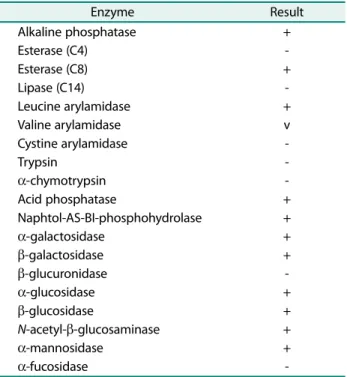
균주 WJ-1의 API ZYM strip을이용한효소생산분석결 과는 Table 2에비교하였고, API 20NE strip을이용한효소
생산및탄소원의이용에관한관찰결과는 Table 3에나타
내었다. 균주 WJ-1의 주요 cellular fatty acid는 C15:0
anteiso (42.99%)이며, 기타분석한 cellular fatty acid 성분 을 Table 4에나타내었다.
균주 WJ-1의 계통발생학적 연관관계 규명
균주 WJ-1의 16S rRNA 유전자염기서열은 PCR 법으로
증폭된 유전자 단편(1,422 bp)를분석하여 결정하였으며,
GenBank에 JN578483으로등록하였다. 16S rRNA 유전자 염기서열을토대로 EzTaxon database에등록되어있는표
Fig. 1. Isolation of strain WJ-1. (A) Xylanase activity on agar plate. Strain WJ-1 was cultured on LB agar plate supplemented with 0.2%
AZCL-xylan at 40℃ for 3 d. (B) Neighbor-Joining phylogenetic tree. The tree was constructed based on 16S rRNA gene sequences. Dis- tances was determined according to the Kimura’s two-parameter model and bootstrap values (>50%) based on 1,000 replicates are listed as percentages at nodes. Nucleotide sequence accession numbers are given in parentheses. Scale bar, 0.001 substitutions per 100 nucleotides. (C) DNA-DNA hybridization analysis. The values obtained from self hybridization of WJ-1 were taken to be 100%. (1), WJ-1;
(2), S. glaucescens NBRC12774; (3), S. spinoverrucosus NBRC14228; (4), S. minutiscleroticus NBRC13000; (5), E. coli KCCM12119 as the negative control.
Table 1. Growth and phenotype of strain WJ-1 on different media.
Media Growth Spore mass Substrate mycelium Aerial mycelium Soluble pigments
LB Good None Beige None None
LBX Good None Beige None None
ISP-2 Good Abundant, gray Beige White None
ISP-4 Good Abundant, gray Beige White None
YMPD Good Abundant, gray Beige White None
R2YE Good Abundant, gray Beige White None
Strain WJ-1 was cultured on different medium at 40℃ for 5 d. LBX is LB medium supplemented with 0.2% (w/v) xylan.
준균주들의 16S rRNA 유전자염기서열들과의상동성조사 결과, WJ-1은 S. spinoveruucosus NBRC14228 (99.225%), S. minutiscleroticus NBRC13000 (99.156%), S. glaucescens NBRC12774 (99.015%), S. purpurascens NBRC13077 (99.015%), S. lusitanus NBRC13464 (99.015%), S. gancidicus NBRC15412 (99.015%)등의방선균속의표준균주들과 99%
이상의높은상동성을보였다. PHYLIP suit 프로그램의 NJ 법을사용하여 phylogenetic tree를제작한결과, 균주 WJ- 1은 S. glaucescens NBRC 12774와독립된 branch (100%
bootstrap value)를형성하였다(Fig. 1B). 이는 MP 프로그램 을이용한 tree에서도동일하였다(결과미제시).
균주 WJ-1 유전체의 G+C 농도는 74.7 mol%로측정되었 는데일반적으로 Streptomyces 속에속하는미생물의경우 70−90%에이르는높은 G+C 농도를갖는것으로보고되고 있다.
균주 WJ-1은형태적특성뿐만아니라유전학적특성을통
해서방선균속에속하는균으로판단되었으며, 그중에서 S.
glaucescens NBRC 12774, S. spinoverrucosus NBRC14228, S. minutiscleroticus NBRC13000 등과 16S rRNA 유전 자염기서열상의상동성이가장 높았다. 따라서상동성이 가장높은 3종의표준균주 S. glaucescens NBRC 12774, S. spinoverrucosus NBRC14228, S. minutiscleroticus NBRC13000을대조균주로선택하여균주 WJ-1과의 DNA- DNA hybridization (DDH)을수행하였다.
DNA-DNA hybridization 분석
DDH 분석 결과, 균주 WJ-1은 S. glaucescens NBRC 12774와 85.7%, S. spinoverrucosus NBRC14228와 55.3%, S. minutiscleroticus NBRC13000와 39.3%의 DNA Table 2. Determination of enzymatic activity of strain WJ-1 by
API ZYM kit.
Enzyme Result
Alkaline phosphatase +
Esterase (C4) -
Esterase (C8) +
Lipase (C14) -
Leucine arylamidase +
Valine arylamidase v
Cystine arylamidase -
Trypsin -
α-chymotrypsin -
Acid phosphatase +
Naphtol-AS-BI-phosphohydrolase +
α-galactosidase +
β-galactosidase +
β-glucuronidase -
α-glucosidase +
β-glucosidase +
N-acetyl-β-glucosaminase +
α-mannosidase +
α-fucosidase -
Symbols: +, positive; -, negative; v, very weak positive.
Table 3. Determination of chemotaxonomic characteristics of strain WJ-1 by API 20NE kit.
Reaction Result
Enzymes
Reduction of nitrates to nitrites -
Indole production -
Glucose fermentation -
Arginine dihydrolase -
Urease -
Esculin hydrolysis (β-glucosidase) + Gelatin hydrolysis (protease) +
β-galactosidase +
Assimilation
Glucose + Arabionose + Mannose +
Mannitol +
N-acetyl-glucosamine +
Maltose +
Potassium gluconate +
Capric acid -
Adlpic acid -
Malate +
Trisodium citrate +
Phenylacetic acid -
Symbols: +, positive; -, negative.
Table 4. The cellular fatty acid composition (%) of strain WJ-1.
Fatty acid WJ-1
C13:0 iso 2.10
C13:0 anteiso 0.71
C14:0 1.25
C15:0 iso 8.06
C15:0 anteiso 42.99
C15:0 2.09
C16:1 iso H 0.99
C16:0 iso 8.43
C16:0 cis 9 5.71
C16:0 9.32
C16:0 9-methyl 0.92
C17:1 anteiso C 2.28
C17:0 iso 1.77
C17:0 anteiso 13.38
hybridization 값을보였다(Fig. 1C). 일반적으로 DDH 값이 70−90%일때새로운아종(subspecies)으로간주되며, 그값 이 90% 이상일때는같은종으로간주되고, 70% 이하일때 는다른종으로간주된다[19]. 따라서, 본연구에서수행된 16S rRNA 유전자염기서열분석, phylogenetic tree 제작,
DDH 분석및형태학적·생리학적특성분석등의결과들로
부터균주 WJ-1은 S. glaucescens의아종으로결론하고, 균주 WJ-1을 S. glaucescens subsp. WJ-1로 명명하였다. S.
glaucescens는 1958년 Pridham 등[20]에의해서처음동정 된후현재까지아종이보고된바가없다.
균주 WJ-1의 액체배지에서의 성장 및 xylanase 생산
WJ-1 균주의성장은 LB 액체배지에서의성장과비교하여
탄소원으로 glucose가함유된배지(LBG)에서는최대 1.3배
(A600= 6.7) 증가된반면, xylan이함유된배지(LBX)에서는 변화가관찰되지않았다(Fig. 2A). 반면, 생산된 xylanase 활 성의경우 LBG 배지에서는 LB 배지와비슷하였지만 LBX 액체배지에서는 1.8배(21.2 U/ml) 증가하였다(Fig. 2A). 이 결과로부터, WJ-1 균주는 glucose가제공되면세포성장은 촉진되지만 xylanase 생산은오히려감소하는것을알수있 었다. 또한 WJ-1의 xylanase는탄소원으로 xylan이제공되 면그생산량이증가되는것을알수있었다. 이는탄소원에 의해서조절받는 carbon catabolite repression (CCR)에의 한현상으로판단된다[3, 21]. 일반적으로 CCR은 glucose 등 과같은탄소원의존재시단백질생합성이억제되는현상을 일컫는데, Streptomyces 속의균주들에서는효소, 항생제, 생 리활성물질등의생산이 CCR에의해서영향을받는것으로 알려져 있다. S. coelicolor와 S. griseus에서는 glucose
Fig. 2. Enzymatic properties of xylanases secreted by strain WJ-1. (A) Cell growth and xylanase production. Strain WJ-1 was cultured in different liquid medium such as LB, LB supplemented with glucose, and LB supplemented with xylan at 40℃ for 3 d. Cell density and xylanase activity were measured at 600 nm and 540 nm, respectively. ●, cell density in LB; ■, cell density in LB supplemented with glucose; ▲, cell density in LB supplemented with xylan; ○, xylanase activity in LB; □, xylanase activity in LB supplemented with glucose;
△, xylanase activity in LB supplemented with xylan. (B) Optimum pH. The reaction was carried out at 40℃ at different pH conditions.
The values obtained at pH 7.0 were taken to be 100%. ●, 20 mM MOPS buffer; ■, 20 mM Tris-Cl buffer. All data shown are mean values from at least three replicate experiments. (C) Optimum temperature. The reaction was carried out at pH 7.0 at different temperatures.
The values obtained at 55℃ were taken to be 100%. The relative activities are the averages from three independent experiments. (D) Thermostability. The reactions were carried out at different temperatures, 60℃ (●), 65℃ (■), and 70℃ (◆), respectively. The values obtained at zero-incubation time were taken to be 100%. The relative activities are the averages from three independent experiments.
kinase에의해서매개되는것으로보고되어있다[22]. 특히 S. coelicolor의세포외 agarase인 DagA는 glucose에의해서 생합성이억제되는것으로보고되어있다[23]. 따라서 WJ-1 균주의 산업적 발효를 위한 배지를 개발하기 위해서는 glucose 등의 CCR에관련하는탄소원의선별이선행되어야 할것으로판단된다.
Xylanase 효소의 생화학적 특성
WJ-1 균주의조효소액을이용하여 xylan을기질로하는 활성염색을실시하여최소 4개이상의 xylanase 활성 band 를확인하였다(결과미제시). 이러한조효소액을이용하여 xylanase 활성을위한최적 pH 및온도조건을탐색하였다. 다 양한 pH에서효소반응을유도하였을때 20 mM Tris-Cl 완 충액(pH 7.0)에서 가장 높은 xylanase 활성이관찰되었다 (Fig. 2B). 20 mM Citrate 완충액(pH 6.0)과 20 mM Tris- Cl 완충액(pH 8.0)의조건에서는최대활성의약 50%의활 성이관찰되었고, 20 mM Tris-Cl 완충액(pH 9.0)의조건에 서는약 40%의활성이관찰되었다. 따라서 WJ-1 균주가외 부로분비하는 xylanase 들은중성 pH 조건에서활성이가 장좋은것으로판단되었다. 이러한특성은다른방선균으로 부터의 xylanase 들에대한최적 pH 조건(pH 5.0−7.0)과유 사하였다[3, 24−26]. 20 mM Tris-Cl 완충액(pH 7.0)에서실 시한최적반응온도실험결과, WJ-1 조효소의 xylanase 활 성은 55℃에서최대활성을나타냈으며, 65℃에서는최대활 성의 70% 활성을보였다(Fig. 2C). 또한 55℃에서 60분간방 치하였을때초기 10분동안약 50% 정도의활성을잃지만 60분동안약 30% 정도의활성을유지하는것으로부터 WJ- 1 균주가생산하는 xylanase는고온에서일정시간을견딜수 있는효소로판단되었다(Fig. 2D). 이와같이 50℃이상의고
온에서내성을갖는방선균 xylanase들은지금까지소수의
예가보고되었다[3, 24−26].
반응산물의 Thin layer chromatography 분석
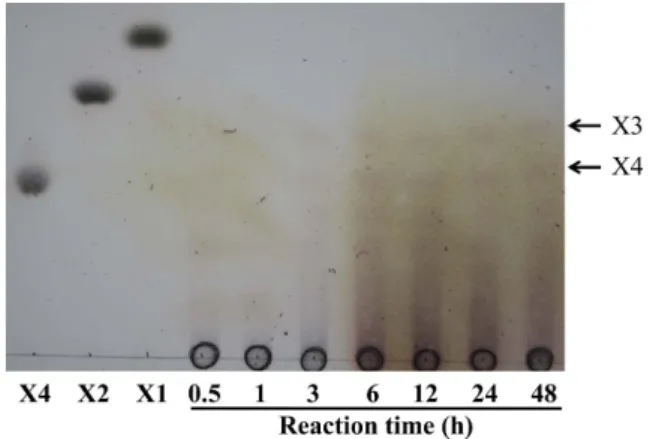
Beechwood xylan을기질로사용하여위에서결정된최적 반응조건(20 mM Tris-Cl 완충액(pH 7.0) 및 55℃)에서수행 된효소반응물을 TLC 법을이용하여분석하였다(Fig. 3). 반 응초기부터주요반응물로서 xylotriose 및 xylotetraose 등 이 확인되었다. 이러한 TLC 결과는 일반적인 endo-type
xylanase에서확인되는패턴이지만, 앞에서언급하였듯활
성염색에서 4개이상의 xylanase 활성을보이는단백질 band 가포함된조효소를이용한효소반응인점을감안하면조효
소내각각의 xylanase의순수정제를통한특성규명이이뤄
져야할것으로판단된다. 효율적인바이오매스이용을위해 서는 xylanase를이용하여 xylan을완전분해하는것도중 요하지만, 다양한생리활성을갖는것으로보고된 xylotriose
및 xylotetraose 등의 xylooligosacchades (XOSs)의생산에
xylanase를이용하는공정도산업적으로유용할것으로예
상된다[27]. 따라서, 본연구를통해서확보된새로운생물자 원인 WJ-1 균주로부터생산되는 xylanase의기능연구및 대량발현시스템을구축한다면향후바이오산업에응용가 능하리라판단된다.
요 약
본연구로부터 WJ-1 균주는제주도에서수집된토양샘플 로부터동정되었는데, 형태분화관찰및 16S rRNA 유전자 염기서열분석과 DNA-DNA hybridization 분석을통하여 S.
glaucescens의신아종으로분류되었다. 균주 WJ-1의주요 cellular fatty acid와게놈내 G+C 농도는각각 C15:0 anteiso (42.99%)와 74.73 mol%였다. 이균은배양액으로부터준비 된조효소액의 xylanase 활성은중성 pH 조건및 55℃에서 활성이가장높았다. S. glaucescens의조효소액을 이용하 여 xylan으로부터 xylotriose 및 xylotetraose를포함하는 xylooligosaccharide를 제조할 수 있다. 본 연구는 S.
glaucescens의아종에관한최초의보고이며, 관련 종에서 xylanase 활성에관한최초의보고이다. 본연구결과로부터, WJ-1 균주는 lignocellulosic biomass의 이용 및 기능성 xylooligosacchade 생산에유용하게활용될수있을것으로 기대된다.
Acknowledgments
This work was supported by a grant from the National Institute of Biological Resources (NIBR), funded by the Ministry of Environment (MOE) of the Republic of Korea (NIBR201629101).
Fig. 3. Thin layer chromatography analysis. The reaction was performed in 20 mM Tris-Cl buffer (pH 7.0) at 55℃ for 48 h. X1, xylose; X2, xylobiose; X4, xylotetraose.
References
1. Subramaniyan S, Prema P. 2002. Biotechnology of microbial xylanases: Enzyology, molecular biology, and application. Crit.
Rev. Biotechnol. 22: 33-64.
2. Beg QK, Kapoor M, Mahajan L, Hoondal GS. 2001. Microbial xylanases and their industrial applications: a review. Appl. Micro- biol. Biotechnol. 56: 326-338.
3. Bajaj BK, Singh NP. 2010. Production of xylanase from an alkali- tolerant Streptomyces sp. 7b under solid-state fermentation, its purification, and characterization. Appl. Biochem. Biotechnol.
162: 1804-1818.
4. Collins T, Gerday C, Feller G. 2005. Xylanases, xylanase families and extremophile xlanases. 2005. FEMS Microbiol. Rev. 29: 3-23.
5. Kieser H, Bibb MJ, Buttner MJ, Chater KF, Hopwood DA. 2000.
Practical Streptomyces genetics. The John Innes Foundation, Norwich, United Kingdom.
6. Baker GC, Smith JJ, Cowan DA. 2003. Review and re-analysis of domain-specific 16S primers. J. Microbiol. Methods 55: 541-555.
7. Chun J, Lee JH, Jung YY, Kim MJ, Kim SI, Kim BK, et al. 2007.
ExTaxon: a web-based tool for the identification of prokaryotes based on 16S ribosomal RNA gene sequences. Int. J. Syst. Evol.
Microbiol. 57: 2259-2261.
8. Thomson JD, Higgins DG, Gibson TJ. 1994. CLUSTAL W: improv- ing the sensitivity of progressive multiple sequence alignment through sequence weighting, position-specific gap penalties and weight matrix choice. Nucleic Acids Res. 22: 4673-4680.
9. Hall TA. 1999. BioEdit: a user-friendly biological sequence align- ment editor and analysis program for Windows 95/98/NT.
Nucleic Acids Symp. Ser. 41: 95-98.
10. Felsenstein J. 1993. PHYLIP (phylogeny inference package), ver- sion 3.5c. Distributed by the author. Department of Genome Sci- ences, University of Washington, Seatle, USA.
11. Saitou N, Nei M. 1987. The neighbor-joining method: a new method for reconstructing phylogenetic trees. Mol. Biol. Evol. 4:
406-425.
12. Kluge AG, Farris FS. 1969. Quantative phyletics and the evolu- tion of anurans. Syst. Zool. 18: 1-32.
13. Kimura M. 1983. The Neutral Theory of Molecular Evolution.
Cambridge University Press, Cambridge, UK.
14. Miller L, Berger T. 1985. Bacterial identification by gas chroma- tography of whole cell fatty acid. Hewlett-Packard Application note. pp. 228-241.
15. Sasser M. 1990. Identification of bacteria by gas chromatogra-
phy of cellular fatty acids. MIDI Inc., Newark, DE, USA.
16. Mesbah M, Premachandran U, Whitman WB. 1989. Precise mea- surement of the G+C content of deoxyribonucleic acid by high- performance liquid chromatography. Int. J. Syst. Bacteriol. 39:
159-167.
17. Komagata K, Suzuki K. 1987. Lipid and cell-wall analysis in bacte- rial systematic. Methods Microbiol. 19: 161-207.
18. Miller GL. 1959. Use of dinitrosalicylic acid reagent for determi- nation of reducing sugar. Anal. Chem. 31: 426-428.
19. Van Trappen S, Tan TL, Yang J, Mergaert J, Swings J. 2004. Alter- monas stellipolaris sp. nov., a novel, budding, prosthecate bacte- rium from Antarctic seas, and emended description of the genus Altermonas. Int. J. Syst. Evol. Microbiol. 54: 1157-1163.
20. Pridham, TG, Hesseltine CW, Benedict RG. 1958. A guide for the classification of Streptomycetes according to selected groups;
placement of strains in morphological sections. Appl. Microbiol.
6: 52-79.
21. Virupakshi S, Babu KG, Gaikwad SR, Naik GR. 2005. Production of a xylanolytic enzyme by a thermoalkaliphilic Bacillus sp. JB-99 in solid state fermentation. Proc. Biochem. 40: 431-435.
22. Miyazono K, Tabei N, Morita S, Ohnishi Y, Horinouchi S, Tanokura M. 2012. Substrate recognition mechanism and substrate- dependent conformational changes of an ROK family glucoki- nase from Streptomyces griseus. J. Bacteriol. 194: 607-616.
23. Angell S, Lewis CG, Buttner MJ, Bibb MJ. 1994. Glucose repres- sion in Streptomyces coelicolor A3(2): a likely regulatory role for glucose kinase. Mol. Gen. Genet. 244: 135-143.
24. Georis J, Giannotta F, Buyl ED, Granier B, Frere JM. 2000. Purifica- tion and properties of three endo-β-1,4-xylanases produced by Streptomyces sp. strain S38 which differ in their ability to enhance the bleaching of kraft pulps. Enz. Microbial. Technol. 26:
178-186.
25. Ninawe S, Kapoor M, Kuhad RC. 2008. Purification and character- ization of extracellular xylanase from Streptomyces cyaneus SN32. Bioresour. Technol. 99: 1252-1258.
26. Wang SL, Yen YH, Shih IL, Chang AC, Chang WT, Wu WC, et al.
2003. Production of xylanases from rice bran by Streptomyces actuosus A-151. Enz. Microbial Technol. 33: 917-925.
27. Zhang J, Matti SA, Terhi P, Ming T, Maija T, Liisa V. 2011. Thermo- stable recombinant xylanases from Nonomuraea flexuosa and Thermoascus aurantiacus show distinct properties in the hydro- lysis of xylans and pretreated wheat straw. Biotechnol. Biofuels 4:
12-25.