⋅Corresponding author: Lak-Hyung Kim, Department of Neuropsychiatry, Woosuk University Oriental Medicine Hospital, Junghwasan-dong 2-ga, Wansan-gu, Jeonju 560-833, Korea Tel: +82-63-220-8617, Fax: +82-63-227-6234
E-mail: [email protected]
⋅Received September 25, 2012, Revised November 27, 2012, Accepted November 27, 2012
This work was supported by Woosuk University(2012).
耳穴진단에서 Earlobe Crease와 고혈압의 관련성
강문수1ㆍ김진희2ㆍ김락형1
1우석대학교 한의과대학 한방신경정신과, 2정읍시노인전문병원 간호과
Association between Earlobe Crease and Hypertension in the Auricular Point Diagnosis
Mun-Su Kang1, Jin-Hui Kim2, Lak-Hyung Kim1
1Dept. of Neuropsychiatry, College of Korean Medicine, Woosuk University,
2Dept. of Nursing, Jeongeup City Geriatric Hospital
Abstract
Objectives : The objective of this study was to evaluate the correlation between earlobe crease(ELC) and Hypertension(HTN) in the auricular point diagnosis.
Methods : 140 patients who were admitted the Jeongeup City Geriatric Hospital were examined for the presence or absence of ELC and HTN. The one examined the ELC of patients and the other examined the presence of hypertension. The presence of right ELC, left ELC, right or left ELC, and right and left ELC were respectively compared with the presence of HTN. Chi-square test was used to analyze the correlation between ELC and HTN.
Results : The presence of right ELC was significantly related to presence of HTN(p=0.001).
The sensitivity, specificity, and positive and negative predictability of ELC for diagnosis of HTN were 0.755, 0.524, 0.787, and 0.478. The presence of left ELC was significantly related to presence of HTN(p=0.002). The sensitivity, specificity, and positive and negative predictability of ELC for diagnosis of HTN were 0.745, 0.524, 0.785, and 0.468. The presence of right or left ELC was significantly related to presence of HTN(p<0.001). The sensitivity, specificity, and positive and negative predictability of ELC for diagnosis of HTN were 0.806, 0.500, 0.790, and 0.525. The presence of right and left ELCs was significantly related to presence of HTN (p=0.007). The sensitivity, specificity, and positive and negative predictability of ELC for diagnosis of HTN were 0.694, 0.548, 0.782, and 0.434.
Conclusions : These results show that the presence of ELC is significantly associated with hypertension.
Key words : earlobe crease, hypertension, auricular point diagnosis, auriculotherapy
I. 서 론
이침요법은 外耳에 존재하는 耳穴을 자극하여 다른 신체부위에 나타난 병리적 소견을 개선시키 는 치료방법이다. 外耳部 자극방법은 고대로부터 사용되던 방법으로 중국에서는 耳部에 뜸을 뜨거 나 橫梁 등을 자극해 耳鳴, 耳聾, 寒暑疫毒 등을 치료하였고, 고대 이집트에서도 출산을 원하지 않
는 여성의 外耳를 바늘로 찌르거나 화상을 입혔다 고 하며, 현대 의학의 아버지라 불리는 히포크라테 스도 무기력한 환자의 치료방법으로 귀 뒤쪽의 정 맥을 刺絡하는 방법을 사용하였다고 전해지고 있 다1).
한의학에서는 “腎主耳, 腎在竅爲耳”, “腎氣通於 耳, 腎和則耳能聞五音矣”이라 하면서 귀의 생김새, 모양 및 질환 등을 보고 腎臟의 기능성쇠를 파악 하였다. 또한 “耳者宗脈之所聚也”라 하면서 12經絡 이 직간접적으로 耳部과 연계되어 있고, 기타 心ㆍ 肝ㆍ肺ㆍ腸胃 등도 耳部에 영향을 주고 있다고 언 급하고 있다2,3).
기존 한의학 문헌상에 귀와 인체의 관계에 대한 여러 언급이 있었지만, 현재와 같은 이침요법의 개 발은 프랑스 의사인 P. Nogier로부터 시작되었다.
그는 耳部에 火傷을 입어 좌골신경통이 치료되었 다는 환자들을 접한 후 연구를 시작하였고, 귀의 모양이 태아의 형상과 같음에 창안해 연구를 진행 하여, 이를 1956년 Marseille에서 개최된 국제침구 의학회에 보고하면서부터 본격적인 연구가 시작되 었다4,5).
이침연구는 계속 발전하여 왔는데, 국내 한의학 계에서는 금연에 대한 이침의 효과6,7), 불면증에 대
한 치료8-10), 청소년기 여성의 월경통 치료11,12), 요
통 및 두통 등의 통증관련 치료13,14) 등 다양한 임 상적 치료연구가 보고되었다. 그러나 이러한 연구 들은 耳穴에 침자극을 하여 질환의 치료를 목적으 로 한 연구가 대부분을 차지하고 있으며, 耳穴을 질환의 진단에 사용한 연구는 압통점탐사법을 이 용하여 신체의 증상에 따른 耳穴의 반응有無를 살 핀 연구만이 보고되고 있다15,16).
국외에서도 귀와 관련된 연구가 활발히 진행되 고 있는데, 그 중에는 耳垂에 나타나는 병리적 주 름(Earlobe Crease, ELC)이 Coronary Artery Disease1,17-19)와 Carotid intima-media thickness20) 등과 연관이 있다는 연구가 다수 보고되었으며, 국 내에서도 ELC과 Coronary Artery Disease21), ELC 와 Hemorrhagic Stroke22) 및 ELC와 Brachial- ankle pulse wave velocity23) 관련 연구가 보고된 바 있다.
본 연구에서는 심혈관계질환에서 대표적 질환인
고혈압과 ELC의 관계에 대해 조사하고자 하였다.
이에 저자는 병원에 입원 중인 환자들을 대상으 로 耳穴診斷法 중 視診法을 이용하여 ELC와 고혈 압 유병과의 관련성을 조사하였으며, 유의한 결과 를 얻었기에 이에 보고하는 바이다.
II. 재료 및 방법
1. 연구대상
1) 선정기준2012년 6월 11일부터 2012년 7월 22일까지의 기 간 동안 정읍시노인전문병원에 입원치료중인 141명 의 환자를 대상으로 하였으며, 귀걸이를 하여 耳垂 를 관찰할 수 없었던 1명을 제외한 총 140명을 연 구대상으로 하였다.
2. 연구 방법
연구대상의 ELC의 有無 관찰과 고혈압의 유병 에 대한 조사에 대하여 2명의 연구자가 독립적으 로 진행하였다. 제1검사자는 환자의 耳垂에서 ELC 의 有無를 관찰하고, 제2검사자는 환자의 입원차트 검토를 통해 혈압에 대한 기록을 조사하여 정상군 과 고혈압군으로 판별하였다. 단, 제1검사자와 제2 검사자는 조사관찰 기간 동안 조사 자료를 공유하 지 않도록 하였다.
1) ELC의 有無 관찰
① ELC의 有無 관찰은 7년 이상의 임상경험을 가진 한의사인 제1검사자에 의해 실시되었다.
② 환자의 얼굴을 정면을 향하도록 하고 양측 耳垂에 병리적 주름(ELC)의 有無를 관찰하였으며, 만약 자세에 의해 耳垂部가 눌렸다면 가볍게 풀어 준 후 관찰하였다.
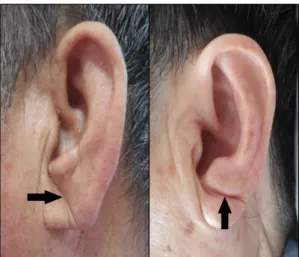
③ ELC의 有無 판별은 屛間切痕의 하부(in- cisura intertragica inferior)에서 시작해 耳垂의 後 下方으로 향한 직선 형태의 굵고 확실한 주름이 시각으로 관찰된 경우로 하였다(Fig. 1).
④ 노화에 의한 耳垂 부위의 얇고 희미한 주름 은 정상으로 판단하였다(Fig. 2).
Fig. 1. Typical earlobe crease(ELC) of patients with hypertension.
The arrow clearly identifies the crease.
Fig. 2. Earlobe wrinkles due to aging which could be shown in the normal group.
Control group HTN group p value Sex Male 15(35.7%) 28(28.6%) 0.401*
Female 27(64.3%) 70(71.4%)
Age 42
(74.52±11.05)
98 (76.72±9.00)
0.287**
Sex values are number(% within group). Age values are number and mean±SD.
Control Group : Non-hypertension group, HTN Group : Hypertension group.
*p<0.05(by Chi-square test), **p<0.05(by Independent sample t-test).
Table 1. Demographic Characteristics
2) 고혈압의 有無 조사
① 고혈압의 有無 조사는 환자의 입원 차트 검 토를 통해 이루어졌다. 차트 조사는 5년 이상의 임 상경험을 가지 간호사인 제2검사자에 의해 진행되 었다.
② 차트를 통해 성별 및 연령을 조사하였으며, 조사일로부터 일주일간의 혈압측정 기록과 복약에 대한 검토를 통해 3회 이상 고혈압 진단기준에 속 한 경우, 고혈압약을 복약중인 경우 고혈압으로 정 하였다.
③ 혈압의 측정은 병동 근무 간호사에 의해 이 루어졌으며, 5분간 안정 후에 앉거나 누운 자세로 측정되었다. 고혈압 진단의 기준은 수축기 혈압이 140 mmHg 이상이거나 이완기 혈압이 90 mmHg 이상인 경우로 하였다24).
3. 연구 자료의 분석
통계처리는 SPSS 18.0을 이용하였다. 두 검사자 가 조사 정리한 자료를 Independent sample t-test 와 Chi-square test를 사용하여 분석하고, 모든 분 석에서 p<0.05인 경우를 유의한 것으로 하였다. 또 한 sensitivity, specificity 그리고 predictability(po- sitive와 negative)를 이용해 ELC 有無의 고혈압에
대한 진단적 정확도를 살폈다.
III. 결 과 1. 일반적 특성
본 연구 대상의 성별은 남성 43명(30.70%), 여성 97명(69.30%)이며, 성별에 따른 고혈압의 有無는 유의한 차이가 없었다. 전체의 평균연령은 76.06±
9.67세였고, 정상군은 74.52±11.05세, 고혈압군은 76.72±9.00세로 통계상 유의한 차이가 없었다(Table 1).
Control group
HTN
group p value*
Right ELC Yes 20 74 0.001
No 22 24
Left ELC Yes 20 73 0.002
No 22 25
Right or left ELC
Yes 21 79 0.000
No 21 19
Right and left ELC
Yes 19 68 0.007
No 23 30
ELC is abbreviation of earlobe crease.
Control group : Non-hypertension group, HTN group : hypertension group.
*p<0.05 (by Chi-square test).
Table 2. Correlations between Earlobe Crease and Hypertension
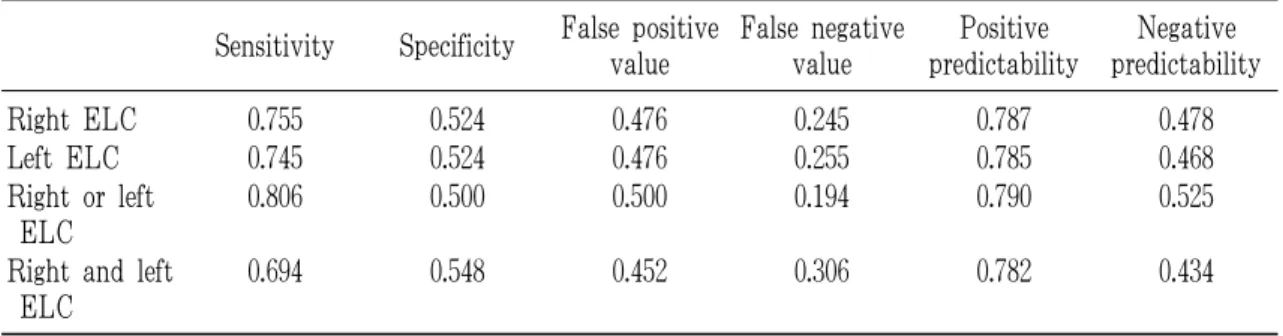
Sensitivity Specificity False positive value
False negative value
Positive predictability
Negative predictability
Right ELC 0.755 0.524 0.476 0.245 0.787 0.478
Left ELC 0.745 0.524 0.476 0.255 0.785 0.468
Right or left ELC
0.806 0.500 0.500 0.194 0.790 0.525
Right and left ELC
0.694 0.548 0.452 0.306 0.782 0.434
ELC is abbreviation of earlobe crease.
Table 3. The Diagnostic Values of Earlobe Crease for Hypertension
2. ELC와 고혈압과의 관계
우측 ELC의 有無는 고혈압의 有無에 대한 교차 분석에서 유의한 결과를 나타내었으며, 우측 ELC 의 有無에 의한 고혈압 有無 진단의 sensitivity는 0.755, specificity는 0.524, positive predictability는 0.787, negative predictability는 0.478이었다.
좌측 ELC의 有無는 고혈압의 有無에 대한 교차 분석에서 유의한 결과를 나타내었으며, 좌측 ELC 의 有無에 의한 고혈압 有無 진단의 sensitivity는 0.745, specificity는 0.524, positive predictability는 0.785, negative predictability는 0.468이었다.
좌측 또는 우측 耳垂 중 한 곳 이상에 ELC가 있는 경우를 양성 결과로 판단하여 ELC의 有無는 고혈압의 有無에 대한 교차분석에서 유의한 결과 를 나타내었으며, 이방법의 sensitivity는 0.806, spe- cificity는 0.500, positive predictability는 0.790, negative predictability는 0.525이었다.
양측 耳垂 모두에 ELC가 있는 경우를 양성 결 과로 판단하여 ELC의 有無는 고혈압의 有無에 대 한 교차분석에서 유의한 결과를 나타내었으며, 이 방법의 sensitivity는 0.694, specificity는 0.548, posi- tive predictability는 0.782, negative predictability는 0.434이었다(Table 2, 3).
IV. 고 찰
인체는 기능상 여러 부분으로 분화되어 있지만 생리적으로 상호견제와 협조를 하고, 병리적으로 서로 영향을 미치면서 끊임없이 운동하는 하나의 통일된 전체이다25,26). 따라서 인체의 어느 곳에 질 병이 발생할 경우 생리적ㆍ병리적 작용을 통해 다 른 신체부위에 독특한 현상이 발현되고, 한의학에 서는 이를 활용하여 질병의 치료에 활용하고 있는 데, 經絡ㆍ經穴이론이 그 대표적인 것이며, 근래 들어 연구되고 활용되는 分區鍼法도 그 예라 할 수 있다.
古典 文獻을 살펴보면 <靈樞:邪氣臟腑病形篇>에 는 “十二經脈 三百六十五絡 其氣血皆上於面而走孔 竅…其別氣走於耳而爲聽”, <素問․金匱眞言論篇>에는
“南方赤色入通於心. 開窺於耳藏於心”이라 하였고, 이외 다른 조문을 통해서도 耳部가 단지 일개의
기관만이 아니고 內臟과 四肢 및 여러 經絡과 밀 접한 관계가 있음을 언급되었다3).
이침요법은 인체의 질병이 귀에 나타나며, 또한 귀의 특정부위 經穴을 자극함으로써 질병을 치료 할 수 있다는 치료법이다. 그중 耳垂 부위의 병리 적 주름인 ELC가 심혈관계 질환과 관련되었다는 논문이 다수 보고된 바가 있다. ELC가 질환에 대 한 진단 지표로 처음 언급된 곳은 1974년도 New England Journal of Medicine에 Lichstein 등이 발 표한 논문이었다. 이들이 ELC와 coronary artery disease 사이에 주요한 관련성이 있음을 발표한 이 후 이와 유사한 연구가 계속 보고되었으며, 또한 여러 가지 방면에서 ELC의 진단 지표로서 가치가 연구되면서 앞에서 언급한 것 이외에도 serum cholesterol27), atherosclerosis28) 등과 ELC와의 관련 성 등에 대한 연구도 보고되었다.
본 연구는 ELC가 심혈관계 대표 질환인 고혈압 의 진단에 의미가 있는지에 대해 살펴보고자 하였 다. 좌우 각각의 耳垂에 ELC의 有無를 조사하고, 이를 차트 조사를 통해 진단된 고혈압과의 일치도 여부를 분석하였는데, 우선 좌측과 우측 耳垂 각각 을 나누어 조사하였다. 이는 좌측이나 우측 중 어 느 한 쪽에 있는 ELC가 고혈압과 통계적으로 보 다 더 유의한 일치율을 보이는가를 살펴보고, 이를 토대로 고혈압의 진단에 특정 부위의 ELC가 사용 될 수 있는가를 알아보기 위함이었다. 그 결과 좌 측이나 우측 모두 비슷하게 유의함을 보임으로서 양측 ELC 각각이 모두 고혈압의 유병과 관련이 있음을 알 수 있었다.
다음으로는 좌우를 함께 분석하였다. 첫째는 좌 우 耳垂 둘 중 한 곳 이상에 ELC가 있는 경우를 양성으로 진단하였을 경우이고, 둘째는 양측 耳垂 모두에 ELC가 동시에 있는 경우를 양성으로 진단 하였을 경우이다. 앞에서 이미 좌우 ELC 각각이 통계적으로 유의함을 보였기에 전자의 경우는 그 유의함이 더 커짐을 알 수 있었고, 후자의 경우 표 본의 수가 감소하면서 p value가 다소 증가함을 보 였지만, 통계적으로는 유의한 차이를 나타내었다.
이상에서 ELC의 존재가 고혈압 유병과 유의한 관 계가 있음을 알 수 있었다.
다음으로는 ELC를 통한 고혈압의 진단의 정확
도를 살펴보았다. 정확도에 대한 검증은 주로 어떤 질병의 진단 목적으로 이용되는 검사, 특히 많은 수의 사람을 짧은 시일 내에 쉽게 조사하여 환자 후보자를 걸러내는 집단검진에 이용되는 검사 방 법에 대하여 반드시 필요한 것이다. 뿐만 아니라 어떠한 새로운 검사 방법에 대해서는 정확도가 확 정되어야만 그 가치를 인정받게 된다29).
본 연구결과 sensitivity는 0.694∼0.806으로 假陰 性(false negative value)에 비해 2.3∼4.2배 높았는 데, 이는 ELC가 실제 고혈압 환자를 정확하게 찾 아낼 수 있는 정확도의 비율로 p value 등과 종합 해봤을 때 ELC의 有無가 고혈압 진단에 대한 screening 검사로서 의미가 있는 것으로 사료된다.
specificity는 0.500∼0.548로 假陽性(false positive value)에 비해 1.0∼1.2배 정도로 큰 차이가 없었는 데, 이는 기존 연구에 비춰 봤을 때 ELC가 coro- nary artery disease 및 atherosclerosis 등의 다른 질환과도 많은 연관을 보이는 점과 관련이 있을 것으로 생각된다.
이상의 연구 결과 높은 유의성과 sensitivity를 통해 좌우의 구분 없이 ELC 존재여부가 고혈압과 관련이 있음을 볼 수 있었다.
본 연구에서는 이혈진단에서 ELC 有無와 고혈 압의 유병율과의 관계를 살펴보고자 하였으며, 둘 사이에 유의한 관련성이 있고, ELC가 고혈압의 진 단적 가치가 있음을 알 수 있었다. 고혈압의 진단 이 혈압 측정이라는 비교적 간단한 방법으로 이루 어질 수 있음을 생각할 때 ELC가 고혈압 진단의 가치가 있다는 점보다 둘 사이에 유의한 관련성이 있고, 혈압 강하 목적으로 ELC 부위에 침치료 등 의 처치를 시행하는 것이 가치가 있을 것인지에 대한 연구 진행의 기초자료로서 의미를 가진다 생 각해볼 수 있다.
본 연구는 고혈압의 유병기간, 혈압약의 복약 여 부, 기타 질환의 유병 등이 분석되지 않았고, 고혈 압의 진단이 입원환자 차트 조사로 이루어져 교대 근무하는 여러 명의 간호사들에 의해 혈압측정이 이루어진 점, 연구대상이 일개 병원의 입원환자라 는 점, 환자군이 노인층에 한정되어 있는 점 등은 본 연구의 해석에서 고려하여야 하고, 향후 연구에 서 보완할 점으로 생각된다.
V. 결 론
이혈진단에서 Earlobe Crease(ELC)와 고혈압과 의 연관성에 대한 연구에서 다음과 같은 결론을 얻었다.
1. 우측 ELC의 有無는 고혈압의 有無와 유의한 관 계에 있었다.
2. 좌측 ELC의 有無는 고혈압의 有無와 유의한 관 계에 있었다.
3. 좌측 또는 우측 耳垂 중 한 곳 이상에 ELC가 있는 경우를 양성 결과로 판단했을 경우, ELC 의 有無는 고혈압의 有無와 유의한 관계에 있었 다.
4. 양측 耳垂 모두에 ELC가 있는 경우를 양성 결 과로 판단했을 경우, ELC의 有無는 고혈압의 有無와 유의한 관계에 있었다.
5. 본 연구에서 sensitivity는 0.694∼0.806, speci- ficity는 0.500∼0.548, positive predictability는 0.785∼0.790, negative predictability는 0.434∼
0.525였다.
이상의 결과 ELC의 존재는 고혈압 유병과 유의 한 관련이 있음을 알 수 있었다.
이후 고혈압의 치료와 진단에 ELC의 활용에 대 한 임상적 연구가 이루어져야 할 것으로 사료된다.
감사의 글
This work was supported by Woosuk Uni- versity(2012).
참고문헌
1. Terry O. Auriculotherapy Manual. 3rd ed. Los Angeles : Churchill Livingstone. 2003 : 1, 135-6.
2. Heo Jun. Tonguibogam. Seoul : Yeogang pu- blishing company. 1994 : 329, 575.
3. Korean acupuncture and moxibustion society.
The acupuncture and moxibustion (the 2nd volume). Paju : Jipmoondang. 2008 : 284-6.
4. Choi YT, Lim JK, Chae WS, Ahn CB, Kim KS, Lee SR, et al. The acupuncture and moxibustion (the 2nd volume). Seoul : Jip- moondang. 1993 : 1367-97.
5. Kwan JS. Chiness auricular therapeutics.
Shanghai : Shanghai scientific technique pu- blishing company. 1995 : 427-9.
6. Park WT, Song MJ, So WR, Lee SH, Won YH. A clinical reserch of the auricular acu- puncture treatment on stop-smoking. The Journal of Korean Acupuncture & Moxibu- stion Society. 2002 ; 19(4) : 16-26.
7. Choi WJ, Lee SG. Comparative study on effects of auricular acupuncturing at Lung, Shenmen and Endocrine point on smoking cessation. The Journal of Oriental Neuropsy- chiatry. 2008 ; 19(1) : 83-95.
8. Park SJ, Lee JA, Lee SM, Ahn HJ, Park SD.
A clinical study of acupuncture and auricular acupuncture effect on insomnia. The Journal of Oriental Neuropsychiatry. 2001 ; 12(2) : 135- 46.
9. Kim JW, Ahn JD, Wang DJ, Lee SE, Kang HW. Clinical study on 20 cases of insomnia patients with auricular acupuncture therapy.
The Journal of Oriental Neuropsychiatry. 2004
; 15(1) : 219-30.
10. So WR, Park WT, Lee SH, Sin KH, No JD, Choi SW, et al. Clinical study on effect of auricular acupuncture therapy and auricular acupuncture therapy with common acupuncture therapy(Shinmun HT7) on insomnia in stroke patients. The Journal of Korean Acupuncture
& Moxibustion Society. 2003 ; 20(5) : 38-49.
11. Lim EM, Lee KS, Song BK. The clinical study of menorrhalgia case 1 through ear acupuncture treatment. The Journal of Korean Acupuncture & Moxibustion Society. 1996 ; 13(2) : 177-83.
12. Um YK, Kim MJ, Bae KM, Song CH, Lee IS. Clinical study on the efficacy auricular
acupuncture treatment for dysmenorrhea. The Korean Journal of Meridian & Acupoint. 2004
; 21 : 121-36.
13. Ryu YS, Park JS, Hwang SY. Clinical study on the auricular acupuncture therapy for the functional headache. The Journal of Oriental Neuropsychiatry. 1997 ; 8 : 85-95.
14. Kim HJ, Kim MS, Lee UY, Park YJ. Clinical research on effect by the technique of auri- cular acupuncture therapy on lumbago pa- tients. The Journal of Korean Acupuncture &
Moxibustion Society. 2004 ; 21 : 159-67.
15. Kang MS, Park HC, Kim LH, Yu JS, Song BR. Electrical detection of ear acupuncture points and musculoskeletal pain. The Journal of Korean Acupuncture & Moxibustion So- ciety. 2007 ; 24(6) : 187-93.
16. Sung WY, Kim LH. A study on the correlation between auricular tenderness testing on mammary gland zone and postpartum breast pain. The Journal of Korean Acupunc- ture & Moxibustion Society. 2009 ; 26 : 11-7.
17. Erik E. The earlobe crease, coronary artery disease, and sudden cardiac death-an autopsy study of 520 individuals. Am J Forensic Med Pathol. 2006 ; 27(2) : 129-33.
18. Payman S, Iraj N, Mehdi A, Kambiz S, Ahmad R. Earlobe crease and coronary artery disease. Pak J Med Sci. 2008 ; 24 : 600-3.
19. Harun E, Dursun D, Asuman K, Mehdi Z, Halil T, Mustafa Z, et al. Bilateral diagonal earlobe crease and coronary artery disease : a significant association. Dermatology. 2004 ; 209 : 271-5.
20. Sukru C, Turan E, Omer G, Abdulkadir K, Cihangir E. Diagonal ear-lobe crease is associated with carotid intima-medea thickness
in subjects free of clinical cardiovascular disease. Atherosclerosis. 2007 ; 192 : 428-31.
21. Park JG, Kim HJ, Park KS, Lee SS, Jang SJ, Sin GC, et al. The case-control study on the risk factors of cerebrovascular diseases and coronary heart diseases. Korean Journal of Preventive Medicine. 1996 ; 29(3) : 639-55.
22. Jongku P, Hunjoo K, Seijin C, Sangbaek K, Sangyul K. Risk factors for hemorrhagic stroke in Wonju, Korea. Younsei Med J. 1998 ; 39 : 229-35.
23. Sangin C, Heecheol K, Choonok K, Seung- beom L, Wonju H, Dearyong K. Relationship between earlobe crease and brachial-ankle pulse wave velocity in non-hypertensive, non- diabetic adults in Korea. Epidemiol Health.
2009 ; 31 : 1-6.
24. Braunwald E, Fauci A, Kasper D, Hauser S, Longo D, Jameson J. Harrison’s principles of internal medicine. 15th ed. Seoul : MIP. 2003 : 215-6.
25. Kajsa L. Ear acupuncture. New York : Chur- chill livingstone. 2008 : 12-13.
26. Bae BC. Basic Korean medicine. Seoul : Seongbosa. 2000 : 28, 31.
27. Chen WC, Zhao TM, Xue W. Ear lobe crease, high serum cholesterol and human leukocyte antigen, risk factors in coronary artery disease.
Chin Med J. 1982 ; 95 : 839-42.
28. Kobayashi Y, Fukuo Y, Nakazawa Y. The evaluation of the diagonal ear lobe crease (ELC) as a atherosclerotic sign. Japanese Journal of Geriatrics. 1987 ; 24(6) : 525-31.
29. Kim KH, Nam CH, Lee KM, Lee SD, So KS, Kang TL, et al. Preventive medicine and eubiotics. Seoul : Gyechukmunhwa Company.
2001 : 258-64.