Original Article Urogenit Tract Infect 2017;12(1):42-48
http://crossmark.crossref.org/dialog/?doi=10.14777/uti.2017.12.1.&domain=pdf&date_stamp=2017-04-25
Symptoms of Bacillus Calmette-Guerin Cystitis in Bladder Cancer Patients according to Tuberculosis Sequelae by Chest Radiography
Won Ik Seo, Pil Moon Kang
2, Jang Ho Yoon, Seok Jin Choi
1, Wansuk Kim
Departments of Urology and
1Radiology, Inje University School of Medicine, Busan,
2Department of Urology, Kosin University Gospel Hospital, Busan, Korea
Purpose: Bacillus Calmette-Guerin (BCG) vaccination has been administered to most infants at birth in Korea; however, tuberculosis (TB) remains extant. TB can leave sequelae on chest radiography according to the immune response of the host.
We investigated the symptoms of cystitis after intravesica instillations in bladder cancer, depending on the TB sequelae on chest radiography.
Materials and Methods: One hundred forty-two patients with non-muscle invasive bladder cancer (NMIBC) underwent transurethral resection and intravesical BCG therapy for bladder cancer. Patients received a BCG induction course―with or without a maintenance course―and were divided into the two groups: Group A, which included patients with visible sequelae of TB on chest radiography (n=31) and group B, which included patients without visible sequelae of TB (n=111).
Cystitis symptoms of BCG intravesical therapy were compared between the two groups. The recurrence and progression rates of bladder cancer were also analyzed.
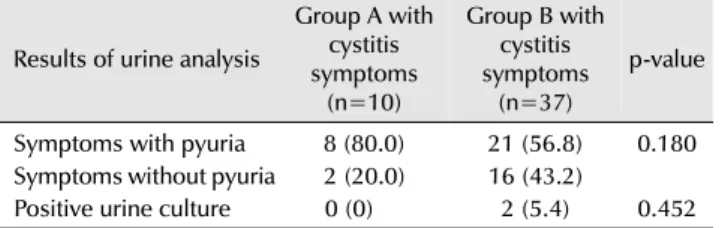
Results: The overall rate of cystitis symptoms was 32.3% (10/31) in group A and 33.3% (37/111) in group B. One patient in group A and three in group B did not complete the treatment course due to severe cystitis symptoms (p=0.876). Pyuria was reported when cystitis symptoms occurred in 80% (8/10) in group A and 56.8%
(21/37) in group B. The recurrence and progression rates were not different between the two groups.
Conclusions: Our results show that there was no significant difference of cystitis symptoms in accordance with the presence of TB sequelae in chest radiography when BCG instravesical therapy for NMIBC was performed.
Keywords: Cystitis; BCG vaccine; Tuberculosis; Radiography; Administration, intravesical
Copyright 2017, Korean Association of Urogenital Tract Infection and Inflammation. All rights reserved.
This is an open access article distributed under the terms of the Creative Commons Attribution Non-Commercial License (http://creativecommons.org/licenses/by-nc/4.0) which permits unrestricted non-commercial use, distribution, and reproduction in any medium, provided the original work is properly cited.
Received: 30 December, 2016 Revised: 13 February, 2017 Accepted: 14 February, 2017
Correspondence to: Wansuk Kim
http://orcid.org/0000-0001-8566-3353 Department of Urology, Inje University Busan Paik Hospital, 75 Bokji-ro, Busanjin-gu, Busan 47392, Korea
Tel: +82-51-890-6384, Fax: +82-51-892-2728 E-mail: [email protected]
INTRODUCTION
Korea is considered to have an intermediate tuberculosis (TB) burden [1,2]. The incidence of TB, including at extra-pulmonary sites, was 78.5 per 100,000 people in 2012 [2]. Regardless of the vaccination status or treatment status,
chest radiography indicates the presence of sequelae for
TB [3]. Cell-mediated immunity is the major host defense
mechanism against TB through macrophages and T
lymphocytes [3,4]. When host factors prevail, gradual
healing with the formation of parenchymal scars results
[3]. Therefore, the presence of sequelae on chest
radiography demonstrates previous exposure to TB.
However, in some cases, there is no presence of sequelae after successful treatment of TB infection [5]. Although not clearly understood thus far, the immune response of the host is thought to be important for the formation of sequelae on chest radiography.
Bacillus Calmette-Guerin (BCG) vaccination is a routine method for TB prevention and is also used to prevent recurrence and progression in high-risk non-muscle invasive bladder cancer (NMIBC) by intravesical instillation [6,7].
Most adverse events with respect to intravesical BCG are local reactions due to immune stimulation required for the eradication of cancer cells [8]. Within 24 to 48 hours of BCG instillation, cystitis symptoms, including transient hematuria, dysuria, urgency, and frequency, are most common [9]. Systemic reactions to BCG, including fever, pneumonitis, and miliary TB, are very rare [8,9].
We hypothesize that there may be a difference in the host factor for TB, and the presence of sequelae in chest radiography is a phenomenon reflecting such difference.
Moreover, these host factors could eventually affect the local response to BCG intravesical instillation. Based on this, we evaluated the difference of adverse events, especially cystitis symptoms that is representative of local reaction after BCG instillation for NMIBC between patients with stable TB sequelae and those without sequelae by chest radiography. Additionally, the recurrence and progression of bladder cancer were analyzed to identify the differences in the effectiveness of intravesical BCG instillation based on the findings of chest radiography.
MATERIALS AND METHODS
We retrospectively analyzed 142 bladder cancer patients, who underwent transurethral resection of bladder cancers and intravesical BCG instillation, using medical records between 2001 and 2012. This study protocol was reviewed and approved by the institutional review board of the Inje University Busan Paik Hospital (IRB no. 15-0219). Patients without residual tumor and with a diagnosis of pathologic Ta or T1 stage were included. BCG was instilled intravesically after tumor resection, according to the following inclusion criteria: i) pathologic T1 disease, ii) high grade or grade 3, iii) carcinoma in situ, iv) two or more tumors, and (v) recurrent, large (>3 cm) pathologic
Ta disease. Patients with any of the following were excluded:
i) history of muscle-invasive bladder cancer (pathologic T2 or above stage), ii) history of radiotherapy for bladder cancer, iii) incomplete resection of bladder cancer, and iv) recurrence within 3 months after resection (indicative of residual tumor). The TNM classification and World Health Organization grading system (2004) were used for pathologic staging and tumor grading.
BCG vaccine, which consists of Mycobacterium bovis and produced by Oncotice (Merck Sharp & Dohme Corporation, Kenilworth, NJ, USA), was prepared for instillation by dissolving one vial in 50 ml of normal saline.
After emptying the bladder using a Nelaton catheter, the prepared solution was instilled into the bladder through the catheter. Patients were instructed to retain the suspension for 2 hours if possible. An induction course with weekly BCG instillation for 6 weeks was performed in all patients. Following the induction course, a maintenance course involving weekly BCG instillation at 3, 6, 9, 12, 18, 24, and 36 months was performed, according to the decision of the clinician.
Chest radiography was performed in all patients for serial cancer staging. If chest radiography showed unclear results, high resolution computed tomography was performed and the patient was referred to a pulmonologist to confirm TB inactivity [10]. Following a confirmation of TB status, patients were divided into two groups: Group A, which included patients with visible sequelae of TB on chest radiography and group B, which included patients without visible sequelae. Patients who revealed active TB were excluded.
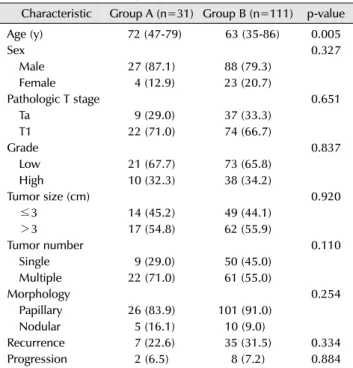
Basic demographics and clinical characteristics, including age, sex, pathologic T stage, grade, and tumor size, as well as nature (multiplicity and morphology) were analyzed in both groups. The type and incidence of cystitis symptoms were also compared between the two groups during the course of BCG induction. Cystitis symptoms were defined as transient hematuria, dysuria, urgency, and frequency after BCG intravesical instillation. The recurrence rates and progression rates were compared using a log-rank test.
Kaplan-Meier survival curves were constructed to assess
recurrence-free survival. IBM SPSS Statistics ver. 20.0 (IBM
Co., Armonk, NY, USA) was used for statistical analyses,
and a value of p<0.05 was considered to indicate statistical
significance.
Table 2. Comparison of adverse events between groups A and B Adverse events Group A
(n=31) Group B
(n=111) p-value Cystitis symptoms
a)10 (32.3) 37 (33.3) 0.910 Anti-TB medication treatment
b)1 (3.2) 1 (0.9)
Prostate TB granuloma
c)0 (0) 1 (0.9)
Discontinuation of BCG therapy 1 (3.2) 3 (2.7) 0.876
Pulmonary TB 0 (0) 0 (0)
Values are presented as number (%).
Group A: patients with visible sequelae of TB on chest radiography, group B: patients without visible sequelae of TB on chest radiography, BCG: bacillus Calmette-Guerin, TB: tuberculosis.
a)
This means persistent urinary symptoms as like dysuria, urgency, frequency and hematuria more than 24 hours after BCG instillation.
b)