대 한 생 식 의 학 회 지 : 제 35 권 제 4 호 2008
Morphologic Parameters and in vitro Maturational Competence of Human Immature Oocyte
Obtained from Stimulated IVF Cycle
So Jung An
1, Byung Chul Jee
1*, Jeong Hee Moon
1, Jung Ryeol Lee
1, Chang Suk Suh
1,2, Seok Hyun Kim
21
Department of Obstetrics and Gynecology, Seoul National University Bundang Hospital,
2
Department of Obstetrics and Gynecology, College of Medicine, Seoul National University
미성숙난자의 형태학적 지표와 체외성숙능과의 관계 안소정1·지병철1*·문정희1·이정렬1·서창석1,2·김석현2
분당서울대학교병원 산부인과1, 서울대학교병원 산부인과2
목 적: 미성숙 난자의 체외성숙에 있어 난구세포의 양상 및 미성숙 난자의 크기가 영향 인자로 작용하는지를 알아보고자 하였다.
연구방법: 체외수정을 위한 과배란유도 후 난자채취를 시행한 21명의 환자로부터 41개의 난포 단계의 난자를 얻 었다. Denudation 이전의 난구세포의 모양에 따라 dispersed 난구세포와 compacted 난구세포로 나누었다. Denudation 이후 투명대를 포함하는 난자외직경 (outer oocyte diameter)과 투명대를 포함하지 않는 난자내직경 (inner oocyte diameter)을 측정하고 체외성숙 배양액에서 체외성숙을 시도하였다. 난자의 성숙은 제1극체가 나온 경우로 정하였 다. 성숙이 확인된 난자는 ICSI 방법을 이용하여 수정시키고 다음날 두 개의 전핵이 뚜렷이 보이는 경우에 수정된 것으로 간주하였다.
결 과: 전체적인 체외성숙률은 56.1%, 수정률은 73.9%이었다. Dispersed 난구세포 난자 중에서 성숙된 난자 비 율 (91.3%)은 비성숙 난자 비율 (55.6%)보다 유의하게 높았다 (p=0.023). 성숙 또는 비성숙 난자에서 난자외경 (155.7 μm vs. 152.4 μm, NS)과 내경 (114.3 μm vs. 113.4 μm, NS) 및 투명대 두께 (41.3 μm vs. 39.1 μm, NS)는 차이가 없 었다. 체외성숙률은 dispersed 난구세포 난자에서 compacted 난구세포 난자보다 의미있게 높았으나 (67.7% vs. 20.0%, p=0.044), 수정률에 있어 두 군간의 유의미한 차이는 없었다. 난자의 외경, 내경 및 투명대 두께에 따른 체외성숙 률 및 수정률의 차이가 없었다.
결 론: Dispersed 난구세포를 가진 미성숙 난자가 compacted 난구세포를 가졌던 난자에 비하여 더 높은 체외 수정능을 가진다는 결과는 dispersed 난구세포가 미성숙 난자의 체외성숙 예측을 위한 하나의 지표로 사용될 수
있음을 시사한다. [Korean. J. Reprod. Med. 2008; 35(4): 285-291.]
중심단어: 난구세포, 미성숙 난자, 체외성숙
Human immature oocyte has provided a useful germ cell source for infertility treatment not only in unstimu-
lated
1but also stimulated in vitro fertilization (IVF) cycles.
2It has been successfully applied to natural or modified natural IVF treatment,
3and provided new female germ cell source for oocyte donation,
4fertility preservation
5,6and even for embryonic stem cell via
주관책임자: 지병철, 우) 463-707 경기도 성남시 분당구 구미동 300, 분당서울대학교 병원 산부인과
Tel: (031) 787-7254, Fax: (031) 787-4054 e-mail: [email protected]
somatic cell nuclear transfer.
7Until now, much progress has been made to enhance maturational potency and developmental capacity of human immature oocyte.
8Since in vitro maturation (IVM) of immature oocytes is the first and most crucial step for its successful clinical application, predicting its in vitro maturational capacity is an important part in IVF cycles using IVM technique. Several non-invasive, morphological parameters have been suggested to predict successful maturation of human immature oocyte in vitro.
Aspirated cumulus-oocyte complex (COC) can be classified into three types according to its surrounding cumulus cells (CCs) morphology; oocytes having ≥5 layers of CCs (grade A), oocytes having 3~4 layers (grade B), and oocytes having ≤2 layers (grade C).
9,10In FSH-primed cycle, it was reported that significantly higher fertilization and blastocyst-forming rates were observed in grade B.
10In contrast, Yang et al.
11divided COC into three groups; oocytes with dispersed CCs (group A), oocytes with compacted CCs (group B) and oocytes with sparse CCs (group C). In that report, they observed significantly higher maturation and blastocyst- forming rates in group A.
In unstimulated IVF cycles, it was observed that there is a positive relationship between immature oocyte diameter after denudation and its in vitro maturational competence.
12A recent report indicates that immature oocytes from unstimulated cycles had smaller diameter than those from stimulated cycles.
13In that report, there was a positive relationship between oocyte diameter and the likelihood of maturation in vitro in unstimulated cycles, but such effect was not observed in stimulated cycles.
We previously reported that developmental competence of human immature oocytes from stimulated cycles was comparable when matured in vitro with commercial G2 media supplemented by either human follicular fluid or human serum albumin.
2During that study, human
germinal vesicle (GV) stage oocytes, obtained from stimulated IVF cycles, could be divided into two types according to their CCs morphology; i.e. dispersed versus compacted CCs. Currently, there were no reports with regards to relation between CCs morphology and in vitro maturational competence of human immature oocyte obtained from stimulated IVF cycle.
In this report, we collected human GV stage oocytes from stimulated IVF cycles and prospectively investi- gated a relationship between cumulus morphology as well as oocyte diameter and their in vitro maturational competence.
MATERIALS AND METHODS
Forty-one GV stage oocytes were obtained from 21 patients who received controlled ovarian hyperstimulation and IVF during Mar 2007 to Jan 2008. The mean age of women was 33.8±3.8 years old with a range of 27~43 years. The infertility factors were identified as follows:
tubal (n=8), uterine (n=2), unexplained (n=5), male (n=2), endometriosis (n=2) and decreased ovarian reserve (n=2).
Ovarian hyperstimulation was performed using recom- binant FSH (rFSH, Gonal-F
®, Serono, Switzerland) be- ginning on day 3 of menstrual cycle. The pituitary was suppressed by flexible multiple dose protocol of GnRH antagonist (Cetrotide
®, Serono). Follicular development was monitored with periodic vaginal ultrasounds and serum levels of estradiol. When dominant follicles reached 19 mm in diameter, ovulation was triggered by recombinant hCG (rhCG, Ovidrel
®, Serono) 250 μg. An ultrasound-guided retrieval of oocytes was performed 35~36 hrs later.
The collected COCs were assessed according to the
presence of GV or the first polar body by stereo-
microscope (×200). Immature oocytes were defined by
the absence of the first polar body, and then classified
as GV stage or metaphase I (MI) stage depending on
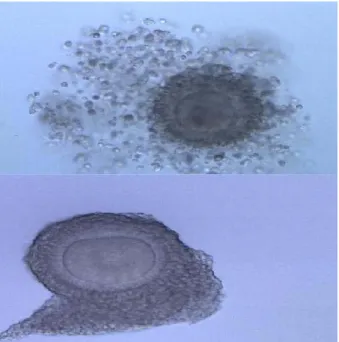
visible GV. After isolation of GV intact oocytes, they were classified and recorded into oocytes with dispersed or compacted CCs (Figure 1). They were soon stripped with 85 IU/mL hyaluronidase (Cook, Australia) and mechanical pipetting until completely denuded from their cumulus cells. The diameters of denuded oocytes, both including and excluding the zona pellucida, were measured with an eyepiece micrometer disc.
GV oocytes were then placed in organ culture dishes
(60×15 mm; Falcon) with commercial medium (Cook- BL, Australia) supplemented with rFSH 75 mIU/mL (Serono), rhCG 0.5 IU/mL (Serono), rEGF 10 ng/mL (Invitrogen, USA). All oocytes were cultured in 1 mL of each IVM medium for up to 48 hrs in an atmosphere of 5% CO
2and 95% air with high humidity.
Maturation was considered when they have the first polar body and then matured oocytes were fertilized by ICSI. The spermatozoa for ICSI were obtained on the day of oocyte retrieval and kept at room temperature for up to 48 hrs. After ICSI, normal fertilization was con- firmed when two distinct pronuclei are present 16~18 hrs later.
All data in the present study were analyzed using SPSS (Windows version 12.0). The Student's t test was used to compare parametrical variables between two groups and Chi-square test was used for the comparison of two proportions. A P-value of <0.05 (two-tailed) was considered statistically significant.
RESULTS
Overall maturation and fertilization rate were 56.1%
(23/41) and 73.9% (17/23). Dispersed CCs type was found in 75.6% (31/41) of the immature oocytes. Matured oocytes had significantly higher proportion of oocyte
Table 1. Comparison of morphologic characteristics between the matured and not matured oocytes
Matured
(n=23) Not matured
(n=18) P
Patient age (yrs) 32.7±3.5 34.4±3.1 NS
Oocytes with dispersed cumulus cells 21 (91.3%) 10 (55.6%) 0.023
Oocytes with compacted cumulus cells 2 (8.7%) 8 (44.4%)
Outer diameter (including zona) (μm) 155.7±8.0 152.4±9.9 NS Inner diameter (excluding zona) (μm) 114.3±6.6 113.4±5.0 NS Zona thickness (Difference between outer and inner diameter) (μm) 41.3±10.8 39.1±11.5 NS Mean ± SD, NS: not significant
Figure 1. GV stage oocyte with dispersed (upper) and
compacted cumulus cells (lower)
with dispersed CCs compared to oocytes failed to mature (91.3% [21/23] vs. 55.6% [10/18], p=0.023) (Table 1).
There was no difference of patients age between matured and not-matured groups. Two-thirds of oocytes (21/31) with dispersed CCs was matured, in contrast, only 20.0%
(2/10) of oocytes with compacted CCs was matured (Table 2) (p=0.04). Among 23 matured oocytes, sixteen oocytes were confirmed their maturation within 24 hrs and others were observed by 48 hrs.
Outer diameters including zona were ranged between 127.5 and 180 μm among our studied immature oocytes.
Inner diameters excluding zona were ranged between 100 and 127.5 μm. Outer and inner oocyte diameters were not related with maturational competence. Mean values of inner diameters of matured and not-matured groups were 114.3 μm and 113.4 μm. There was no significant difference between outer diameters of matured and not-matured groups (155.7 μm and 152.4 μm, respectively, NS) (Table 1).
DISCUSSION
The present study demonstrated that human GV stage oocytes obtained from hyperstimulated IVF cycles could
be classified according to surrounding CCs type and the oocytes with dispersed CCs had significantly higher capability of maturational competence than those with compacted CCs. In addition, the result of this study suggests that there is no relationship between diameter of immature oocyte collected from hyperstimulated IVF cycles and their in vitro maturational competence.
Oocyte maturation is a long and enigmatic process during which nuclear and cytoplasmic changes happen, resulting in transition from GV stage to the metaphase II stage and the extrusion of the first polar body.
14A better understanding of how to maximize immature oocyte developmental competence is the first and crucial step to the advancement and optimization of the use of immature oocyte. So far, several studies have explored the predictive value of morphologic parameters of the COC as a possible factor contributing to the success of human oocyte IVM.
10~12,15But IVM technique has been applied principally to patients with polycystic ovary syndrome (PCOS), thus the majority of studies with regard to immature oocyte have been focused on PCOS patients. There is limited data on the relationship between morphology of GV stage oocyte and its developmental competence in non-PCOS group, especially stimulated
Table 2. Comparison of in vitro outcomes between the oocytes with dispersed or compacted cumulus cellsOocytes with dispersed
cumulus cells (n=31) Oocytes with compacted
cumulus cells (n=10) P
Patient age (yrs) 33.9±3.3 32.8±3.5 NS
Matured oocytes with 1st polar body 21 (67.7%) 2 (20.0%) 0.044
Oocytes with GV breakdown 0 4 (40.0%)
GV stage oocytes 10 (32.3%) 4 (40.0%)
Fertilized oocytes by ICSI 16/21 1/2 NS
Outer diameter (including zona) (μm) 155.1±8.1 151.5±11.2 NS
Inner diameter (excluding zona) (μm) 114.7±5.9 111.5±5.7 NS
Zona thickness (μm) 40.4±10.1 40.0±14.2 NS
Mean ± SD, NS: not significant
cycles in regularly menstruating women.
In the present study, we found that maturation rate in the oocyte with dispersed CCs was significantly higher than those with compacted CCs in stimulation cycle. It is unclear why oocytes remain immature despite ovarian stimulation. The immature oocytes may originate from small antral follicles at the time of oocyte retrieval or from large preovulatory follicles which do not respond to hCG. During ovarian stimulation, the oocyte population at the time of hCG may be heterogeneous, leading to retrieval of oocytes at different stages of maturation. It is likely that oocytes with dispersed CCs are in more advanced stage of development. Yang et al.
11found mRNA expression of the LH receptor in the CCs of COCs obtained from unstimulated cycles; the CCs expressing the LH receptors were mainly dispersed, and no or very few LH receptors could be detected in com- pacted and sparse CCs. From the findings, it can be postulated that oocytes with dispersed CCs, even though not matured despite stimulation, are in more advanced stage of development than those with compacted CCs.
Studies in several animal species have highlighted the relationship between oocyte diameter and competence for its maturation and embryonic development. In bovine, several studies suggested that the oocyte diameter could be used as a non-invasive predicting parameter of its developmental competence IVM.
16~18The oocyte di- ameter of prepubertal goat oocytes was also positively related to the percentage of oocytes reaching metaphase II stage and to the percentage of oocytes developing up to blastocyst stage.
19Thus larger oocyte appears to be in more advanced stage of development.
In human, it was reported that immature oocytes from unstimulated cycles had a wide range of diameter (excluding zona pellucida) from 96 μm to 125 μm and there was a positive relationship between oocyte diameter and its in vitro maturational competence after denu- dation.
12In our study, inner diameters of immature
oocytes were similar (100~127.5 μm) to the former report, however, there was no association between oocyte diameters and their maturational competence. The impor- tant difference between the two studies was ovarian stimulation or not. A recent report indicated that the immature oocytes from stimulated cycles had larger diameter than those from unstimulated cycles and they grew during in vitro culture in contrast to oocytes from unstimulated cycles.
13Although oocytes from stimulated cycles remained at the GV stage despite stimulation, they might acquire growing potential during stimulation with coincidental increment of size. For this reason, the diameter of oocyte from stimulated cycle seems to have no relationship with its subsequent maturational com- petence.
In the present study, we did not evaluate the qualities of in vitro matured metaphase II oocytes with regards to their developmental competence. For providing more useful information, further study about the develop- mental competence of in vitro matured oocytes would be needed. Human metaphase II oocytes have distinct morphological characteristics that may be indicative of quality and thus could be used to predict embryo quality and implantation potential.
20To date, there have been numerous reports on the impact of metaphase II oocyte morphology on clinical success of infertility treatment.
21~23
Serhal et al. showed lower implantation potential when oocytes showed cytoplasmic granulations or inclu- sions.
21Xia showed significantly lower fertilization rates, embryo quality for the group of oocytes with cytoplasmic inclusions when compared with the group of oocytes with normal cytoplasm.
22A more recent study suggested that the morphological analysis of metaphase II oocyte quality by the score system with granularity, vacuoles and inclusions in cytoplasm to select top quality oocytes could increase the pregnancy rate in patients undergoing ICSI procedures.
23In conclusion, the cumulus morphology of GV stage
oocyte obtained from stimulated IVF cycle was closely associated with their in vitro maturational competence after denudation. This finding might be helpful in pre- dicting in vitro maturational potential of immature oocytes from stimulation cycles. Selection of GV stage oocytes with dispersed CCs could be one of strategies to overcome lower developmental potential of human immature oocyte. Further fundamental researches are needed with regards to the relevance of cumulus type and its biological interaction with oocytes to achieve better developmental competence of immature oocytes.
REFERENCES
1. Chian RC. In-vitro maturation of immature oocytes for infertile women with PCOS. Reprod Biomed Online 2004; 8(5): 547 -52.
2. Jee BC, Han SH, Moon JH, Suh CS, Kim SH. Influence of well-defined protein source on in vitro maturation of human oocyte: human follicular fluid versus human serum albumin.
Fertil Steril 2008; 89: 348-52.
3. Lim JH, Yang SH, Chian RC. New alternative to infertility treatment for women without ovarian stimulation. Reprod Biomed Online 2007; 14(5): 547-9.
4. Holzer H, Scharf E, Chian RC, Demirtas E, Buckett W, Tan SL. IVM of oocytes collected from unstimulated ovaries for oocyte donation. Fertil Steril 2007; 88(1): 62-7.
5. Huang JY, Tulandi T, Holzer H, Tan SL, Chian RC. Combining ovarian tissue cryobanking with retrieval of immature oocytes followed by IVM and vitrification: an additional strategy of fertility preservation. Fertil Steril 2008; 89(3): 567-72.
6. Oktay K, Demirtas E, Son WY, Lostritto K, Chian RC, Tan SL. In vitro maturation of germinal vesicle oocytes recovered after premature luteinizing hormone surge: description of a novel approach to fertility preservation. Fertil Steril 2008; 89:
228.e19-22.
7. Heindryckx B, De Sutter P, Gerris J, Dhont M, Van der Elst J.
Embryo development after successful somatic cell nuclear transfer to in vitro matured human germinal vesicle oocytes.
Hum Reprod 2007; 22(7): 1982-90.
8. Jurema MW, Nogueira D. In vitro maturation of human oocytes
for assisted reproduction. Fertil Steril 2006; 86: 1277-91.
9. Wynn P, Piclon HM, Krapez JA. Pretreatment with follicle stimulating hormone promotes the number of human oocytes reaching metaphase II by in-vitro maturation. Hum Reprod 1998; 13: 3132-8.
10. Sato C, Shimada M, Mori T, et al. Assessment of human oocyte developmental competence by cumulus cell morphology and circulating hormone profile. Reprod Biomed Online 2007; 14:
49-56.
11.Yang SH, Son WY, Yoon SH, Ko Y, Lim JH. Correlation between in vitro maturation and expression of LH receptor in cumulus cells of the oocytes collected from PCOS patients in HCG-primed IVM cycles. Hum Reprod 2005; 20(8): 2097 -103.
12. Choi J, Kim D, Cha J, Lee S, Yoon S, Lim J. The relationship between oocyte size and developmental competence in unstimulated cycles. ASRM 2006 P-705.
13. Cavilla JL, Kennedy CR, Byskov AG, Hartshorne GM. Human immature oocytes grow during culture for IVM. Hum Reprod 2008; 23(1): 37-45.
14.Loutradis D, Kiapekou E, Zapanti E, Antsaklis R. Oocyte Maturation in Assisted Reproductive Techniques. Ann NY Acad Sci 2006; 1092: 235-46.
15. Trouson A, C. wood, A. Kausche. In vitro maturation and the fertilization and developmental competence of oocytes recovered from untreated polycystic ovarian patients. Fertil Steril 1994; 62: 353-62.
16.Arlotto T, Schwartz JL, First NL, Leibfried-Rutledge ML.
Aspects of follicle and oocyte stage that affect in vitro matu- ration and development of bovine oocytes. Theriogenology 1996; 45: 943-56.
17. Raghu HM, Nandi S, Reddy SM. Follicle size and oocyte diameter in relation to developmental competence of buffalo oocytes in vitro. Reprod Fertil Dev 2002; 14: 55-61.
18. Anguita B, Vandaele L, Mateusen B, Maes D, Van Soom A.
Developmental competence of bovine oocytes is not related to apoptosis incidence in oocytes, cumulus cells and blastocysts.
Theriogenology 2007; 67(3): 537-49.
19.Anguita B, Jimenez-Macedo AR, Izquierdo D, Moga T, Paramio MT. Effect of oocyte diameter on meiotic competence, embryo development, p34 (cdc2) expression and MPF activity in prepubertal goat oocytes. Theriogenology 2007; 67(3): 526 -36.
20. Hamamah S. Oocyte and embryo quality: is their morphology good criterion? J Gynecol Obstet Biol Reprod (Paris) 2005;
34: 5S38-41.
21.Serhal PF, Ranieri DM, Kinis A, Marchant S, Davies M, Khadum IM. Oocyte morphology predicts outcome of intra- cytoplasmic sperm injection. Hum Reprod 1997; 12: 1267-70.
22. Xia P. Intracytoplasmic sperm injection: correlation of oocyte
grade based on polar body, perivitelline space and cytoplasmic inclusions with fertilization rate and embryo quality. Hum Reprod 1997; 12: 1750-5.
23. Wilding M, Matteo LD, D'Andretti S, Montanaro N, Capobianco C, Dale B. An oocyte score for use in assisted reproduction. J Assist Reprod Genet DOI 10.1007/s10815-007-9143-8.
= Abstract =
Objective: This study was performed to investigate whether cumulus morphology and oocyte diameter influence on in vitro maturation (IVM) of human germinal vesicle (GV) stage oocytes obtained from stimulated in vitro fertilization (IVF) cycles.
Methods: Forty-one GV stage oocytes were obtained from 21 patients who received ovarian hyperstimulation and IVF. According to cumulus morphology before denudation, GV oocytes were classified into oocytes with dispersed cumulus cells (CCs) or compacted CCs. The diameters of denuded oocytes, both including and excluding the zona pellucida, were measured. All oocytes were cultured in commercial IVM medium. Maturation was defined as extrusion of the first polar body and the matured oocytes were inseminated by ICSI method.
Results: Overall maturation and fertilization rate were 56.1% and 73.9%. Matured oocytes had significantly higher proportion of oocytes with dispersed CCs compared to oocytes failed to mature (91.3% vs. 55.6%, p=0.023). There were no significant differences of oocytes outer (155.7 μm vs. 152.4 μm, NS), inner (114.3 μm vs. 113.4 μm, NS) diameters and zona thicknesses (41.3 μm vs.
39.1 μm, NS) between matured and not-matured oocytes. In-vitro maturation rate of oocytes with dispersed CCs was significantly higher than which of oocytes with compacted CCs (67.7% vs. 20.0%, p=0.044). Oocyte diameters (outer and inner) and thicknesses were not related with maturational competence.
Conclusion: Our results suggest that in vitro maturational competence of GV stage oocytes obtained from stimulated IVF cycles is closely associated with the cumulus morphology but not oocyte diameter.
Key Words: Cumulus cells, Immature oocytes, In vitro maturation, Morphological parameters, Stimulated IVF cycle