감소시킨다. HbA1c는 최근 1-3개월간의 평균 혈당상태를 반영하며 장기간 혈당상태 진단에 가장 신뢰도가 높은 지표이며, 당뇨의 진 단, 치료효과의 판정 및 당뇨합병증의 조절과 예방에 사용된다[1, 2]. 또한, 혈당농도보다 만성합병증과 더 밀접하게 관련되어 있으 며, 공복상태와 무관하게 검사할 수 있으므로 당뇨병의 진단에 있 어 더 좋은 기준이 될 수 있다[3].
HbA1c 분석방법은 분자전하와 구조에 근거를 둔 방법으로 크게 2종류로 나눌 수 있다. 분자전하에 근거를 둔 방법에는 양이온교 환고성능액체크로마토그래피와 전기영동법이 있고, 구조에 근거 를 둔 방법에는 면역측정법, 붕산친화성크로마토그래피법(boro- nateaffinity chromatography), 질량분석법(mass spectrometry)이 있다[4]. HPLC법은 N말단의 발린의 당화반응이 양전하를 감소시 켜 HbA1c가 HbA로부터 분리되는 원리를 이용하며, Diabetes Con- trol and Complication Trial (DCCT)을 통하여 참고법으로 인정받 은 HbA1c 측정법으로서 가장 널리 이용되고 있다[5]. 면역측정법은
서 론
헤모글로빈 A1c (Hemoglobin A1c, HbA1c)는 HbA의 베타체인의 N말단의 발린잔기에 당분자가 비효소결합으로 만들어진다. N말 단잔기의 이와 같은 당화반응은 HbA의 구조를 바꾸고 양전하를
Hitachi Clinical Analyzer 7180을 이용한 AutoLab HbA
1c시약의 분석능 평가
Evaluation of the AutoLab HbA
1cReagent by Using Hitachi Clinical Analyzer 7180
박순호·서일혜·안정열·김경희·정지훈·박필환
Soon-Ho Park, M.D., Yiel-Hea Seo, M.D., Jeong-Yeal Ahn, M.D., Kyung-Hee Kim, M.D., Ji-Hun Jung, M.D., Pil-Whan Park, M.D.
가천의대길병원 진단검사의학과
Department of Laboratory Medicine, Gachon University Gil Hospital, Incheon, Korea http://dx.doi.org/10.3343/lmo.2012.2.2.74
Corresponding author: Pil-Whan Park, M.D.
Department of Laboratory Medicine, Gachon University Gil Hospital, 1198 Guwol 1-dong, Namdong-gu, Incheon 405-760, Korea
Tel: +82-32-460-3834, Fax: +82-32-460-3415, E-mail: [email protected]
Received: May 16, 2011
Revision received: September 30, 2011 Accepted: October 10, 2011
This article is available from http://www.labmedonline.org 2012, Laboratory Medicine Online
This is an Open Access article distributed under the terms of the Creative Commons Attribution Non-Commercial License (http://creativecommons.org/licenses/by-nc/3.0/) which permits unrestricted non-commercial use, distribution, and reproduction in any medium, provided the original work is properly cited.
Background: Hemoglobin A1c (HbA1c) is a universally used parameter for monitoring glycemic control in diabetic patients. Various methods are used for the measurement of HbA1c levels. The AutoLab HbA1c reagent was recently developed for use in immunoturbidimetric assays for mea- surement of HbA1c levels. We evaluated the reliability of using the AutoLab HbA1c reagent with the Hitachi Clinical Analyzer 7180, an automated chemistry analyzer, for measuring HbA1c levels.
Methods: We evaluated the precision, linearity, carryover rate, and stability of the samples analyzed using Hitachi clinical analyzer 7180 with the AutoLab HbA1c reagent and compared the results with those obtained with an HPLC method performed using the Variant II Turbo analyzer.
Results: The CV values for within-run imprecision at low and high levels were 0.8% and 0.6%, respectively, and the CV values for between-run imprecision at low and high levels were 1.5% and 2.9%, respectively. The linearity of the results was good in the range of 4.3-12.3%, and com- parison with the results obtained by Variant II Turbo showed an excellent correlation coefficient of 0.9914. The carryover rate was 0%, and the samples refrigerated at 4℃ for 15 days were found to be stable.
Conclusions: In comparison with Variant II Turbo, Hitachi clinical analyzer 7180 with AutoLab HbA1c reagent showed good precision, linearity, and carryover rate. Hence, Hitachi clinical analyzer 7180 with AutoLab HbA1c reagent may be used for the diagnosis of diabetes and for monitoring blood glucose levels in diabetic patients.
Key Words: AutoLab, HbA1c, Immunoassay
HbA1c에 특이적으로 결합하는 단클론항체를 이용하여 측정한다.
HPLC법보다 자동화가 쉽고, 검사가 신속하며 경제적으로 저렴하 다[6]. 최근 HbA1c의 임상적 중요성이 높아지고 이용이 증가하고 있 어, 검사의 신뢰성을 가지면서 검사의 결과보고가 신속한 검사법 이 요구된다. 이에 저자들은 면역측정법으로 개발된 AutoLab HbA1c (IVD-LAB, Suwon, Korea) 시약의 분석능력 및 HPLC법과 상관성을 평가하고자 하였다.
대상 및 방법
1. 대상
2011년 3월 중에 본원 진단검사의학과에 HbA1c 검사가 의뢰된 환자의 EDTA 검체를 이용하여 상관성, 직선성, 교차오염률과 검체 의 안정성검사를 시행하였다. 모든 시행 과정은 본원 내 임상시험 심의위원회(Institutional Review Board, IRB)의 승인에 의해 진행 되었다.
2. 장비
AutoLab HbA1c 시약은 Hitachi clinical analyzer 7180 (Hitachi Ltd, Tokyo, Japan) 생화학자동분석기를 사용하였다. AutoLab HbA1c 시약과 상관성을 평가할 장비는 HPLC법으로 본원의 기존 장비인 Variant II Turbo (Bio-Rad Laboratories, CA, USA)를 사용 하였다. Variant II Turbo는 일년에 2회 대한임상검사정도관리협회 를 통하여 외부정도관리 평가를 받고 있으며, 2010년 11월 25일에 시행한 평가에서 세 검체 모두 적합평가를 받았다.
3. 정밀도
정밀도 평가는 Clinical and Laboratory Standards Institute (CLSI) EP5-A2에 따라 수행하였다. 고농도 및 저농도의 HbA1c 정도관리물 질(IVD-LAB, Suwon, Korea)을 각각 20일간 하루에 2회(오전, 오 후) 2번씩 측정하여 평균값, 표준편차, 재현성과 검사 내, 검사 간, 검사일간 정밀도와 총정밀도를 구하였다. 재현성과 방법/장비 정 밀도의 실행표준편차는 0.1, CV값은 5%를 허용한도로 정하였다[7].
4. 직선성
직선성은 CLSI EP6-A에 따라 시행하였다. 4.3%의 낮은 HbA1c 농 도를 갖는 검체와 12.3%의 높은 HbA1c 농도를 가지는 검체를 0:4, 1:3, 2:2, 3:1, 4:0으로 혼합하여 각각 4회씩 반복하여 측정하였다[8].
5. 상관성
상관성평가는 CLSI EP9-A2에 따라 시행하였다. 기존 장비인 Variant II Turbo II에서 5.1-14.3%의 HbA1c 농도의 검체 150개를 선
정하여, AutoLab HbA1c 시약의 결과와 상관성을 비교하였다[9].
6. 검체 간 교차오염률
4.8%의 저농도검체와 11.5%의 고농도검체를 이용하여 고농도검 체부터 각각 4회씩 반복 측정하여 아래 식으로 교차오염률을 구하 였다.
Carryover rate (%) = L1− (L3 +L4)÷2
(H2+H3) ÷2− (L3 +L4)÷2 × 100
7. 검체의 안정성
동일 환자의 검체를 2개의 EDTA 용기에 채취하여 각각 실온과 4℃에서 냉장 보관한 뒤 2-3일 간격으로 하루 1번 1회씩 측정하 였다.
8. 통계
통계처리는 Excel 2007 (Microsoft Corporation, Redmond, WA, USA)과 EP Evaluator Release 9 (Data innovations, South Burling- ton, VT, USA) 프로그램을 이용하여 CLSI에서 제시한 방법으로 정 밀도, 직선성, 상관성을 비교분석하였다.
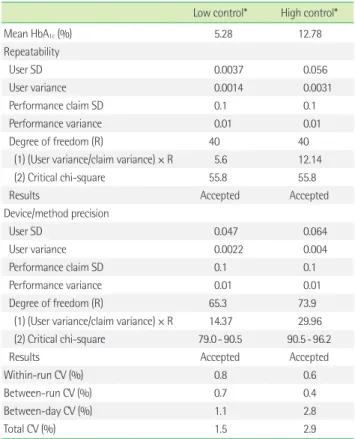
Table 1. Precision of HbA1c measurement on Hitachi clinical analyzer 7180 with AutoLab HbA1c
Low control* High control*
Mean HbA1c (%) 5.28 12.78
Repeatability
User SD 0.0037 0.056
User variance 0.0014 0.0031
Performance claim SD 0.1 0.1
Performance variance 0.01 0.01
Degree of freedom (R) 40 40
(1) (User variance/claim variance) × R 5.6 12.14
(2) Critical chi-square 55.8 55.8
Results Accepted Accepted
Device/method precision
User SD 0.047 0.064
User variance 0.0022 0.004
Performance claim SD 0.1 0.1
Performance variance 0.01 0.01
Degree of freedom (R) 65.3 73.9
(1) (User variance/claim variance) × R 14.37 29.96
(2) Critical chi-square 79.0-90.5 90.5-96.2
Results Accepted Accepted
Within-run CV (%) 0.8 0.6
Between-run CV (%) 0.7 0.4
Between-day CV (%) 1.1 2.8
Total CV (%) 1.5 2.9
*Duplicated per test, 2 times per day for 20 days.
로 혼합하여 측정한 결과 4.3-12.3%의 농도 범위 안에서 R2=0.99 로 우수한 직선성을 보였다(Fig. 1).
3. 상관성
기준 장비인 Variant II Turbo와 비교장비인 AutoLab의 HbA1c의 농도는 각각 4.8-14.3%와 4.3-11.9%에서 분포하였다. 상관계수 R2=0.9829, 기울기 0.825, 절편 0.53으로 높은 상관관계를 보였고, 평균오차는 0.81%이었다(Fig. 2).
4. 검체 간 교차오염률
저농도와 고농도의 환자 검체를 이용한 교차오염률은 0%였다.
4.8−(4.8+4.8)÷2
(11.6 +11.5) ÷2− (4.8 + 4.8) ÷2 × 100 = 0
결 과
1. 정밀도
저농도의 정도관리물질의 평균농도는 5.28%, 고농도의 평균농 도는 12.78%이었다. 재현성과 장비/방법 정밀도는 실행 표준편차 가 0.1일 때 모두 적합하였다. 검사 내 정밀도의 변이계수는 저농도 에서 0.8%, 고농도에서 0.6%, 검사 간 정밀도의 변이계수는 저농도 에서 0.7%, 고농도에서 0.4%, 작업일간 정밀도의 변이계수는 저농 도에서 1.1%, 고농도에서 2.8%, 총 정밀도의 변이계수는 저농도에 서 1.5%, 고농도에서 2.9%였다(Table 1).
2. 직선성
낮은 농도의 환자 검체와 높은 농도의 환자 검체를 5가지 농도
Fig. 1. Linearity of HbA1c values using Hitachi clinical analyzer 7180 with AutoLab HbA1c. 20
15
10
5
0
Measured (%)
Assigned (%) Scatter Plot
0 5 10 15 20 Line Fit
Poly. Fit 1
0.7 0.5
0
-0.5 -0.7 -1
Residual (%)
Assigned (%) Residual Plot
0 5 10 15 20 Allowable Nonlinearity
Means Results
Fig. 2. Comparison of HbA1c levels measured by Variant II turbo and Hitachi clinical analyzer 7180 with AutoLab HbA1c. 15
12.5
10
7.5
5
AutoLab (%)
Variant (%) Scatter Plot
5 7.5 10 12.5 15 Deming Regr
1:1 Line
3 2 1 0 -1 -2 -3
Bias (HbA1c,%)
Variant (%) Bias
5 7.5 10 12.5 15 -0.81 Mean Bias
5. 검체의 안정성
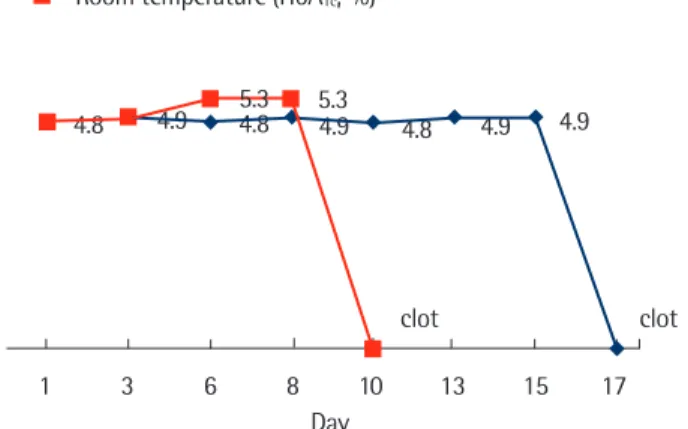
상온에서 보관한 검체는 5일 후에 5.3%로 수치가 높아졌고 10일 경과 후에는 검체가 응고되어 더 이상 검사를 진행할 수 없었다.
4℃에서 냉장 보관한 검체는 15일 후까지 결과가 첫째 날 측정치와 비교하여 결과 값의 차이가 ±0.1%로 안정하다가 17일 후에는 응 고되어 더 이상 검사를 진행할 수 없었다(Fig. 3).
고 찰
당뇨병은 우리나라를 포함해 전세계적으로 증가하는 추세이다.
Wild 등[10]의 연구에 따르면 전세계적으로 2000년에 1억 7천만 명 인 당뇨 환자는 2030년에는 3억 6천만 명으로 2배 가까이 증가할 것으로 예상된다. 아직 많은 수의 환자들이 적절한 시기에 당뇨를 진단받지 못하여 이미 미세혈관병증이 진행된 상태에서 발견되는 경우가 많다. 그러므로 당뇨의 적절한 치료와 합병증을 예방하기 위해서는 무엇보다도 조기진단이 필수적이다[11].
최근까지 당뇨를 진단하기 위해서는 공복혈당검사나 경구 당부 하검사가 시행되어 왔다. 하지만 이 검사 모두 검사 시행 전에 8시 간 이상의 금식이 필요하므로 당뇨병 진단에 어려움이 있고, 공복 혈당의 경우 민감도가 떨어지며, 공복혈당이 126 mg/dL 미만인 사 람들에게서도 당뇨병의 발생의 위험도가 높다는 보고가 있었다 [12-14]. 또한, 혈당측정이 당화혈색소에 비해 정확하지 않고, 혈액 보관이나 해당작용으로 인한 측정오류와 HbA1c의 일중변동이 2%
이하인 것에 비해 12-15%의 일중변동을 보여 낮은 안정성을 보인 다[15].
HbA1c는 금식이 필요없고, 경구 당부하검사를 위해 병원을 다시 방문할 필요가 없어 좀 더 쉽게 진단할 수 있으므로 일차진료기관 에서도 손쉽게 이용할 수 있다. 또한 급격한 생활습관 변화에 영향
을 받지 않으며, 미세혈관 합병증 관리를 위한 혈당 수준을 반영하 므로 망막증, 신증, 신경병증을 예측하는 데 도움을 줄 수 있다[16].
그럼에도 불구하고 최근까지 당뇨병의 진단기준에서 배제되어 왔 는데 그 주된 이유는 진단기준 설정 당시 HbA1c 측정이 표준화되 지 못했고, 측정의 정확도가 낮았기 때문이다. 그러나 최근에 측정 이 정확해지고 표준화가 되면서 국제전문가위원회(International Expert Committee)에서 2009년 새로운 당뇨병의 진단기준으로 HbA1c를 사용할 것을 권고하였다. 그 이유는 HbA1c의 측정이 장기 적인 혈당상태를 보다 정확히 반영하고, 합병증의 위험도와 좋은 상관관계를 보이고, 측정이 안정적이기 때문이다. 국제전문가위원 회는 진단기준으로 HbA1c 6.5% 이상을 제시하였고, 더불어 6.0%
이상 6.5% 미만을 고위험군으로 추가로 정의하여 예방적 처치가 필요하다고 하였다[16]. 이 권고안은 2010년 미국 당뇨병협회에서 수용하여 6.5% 이상을 진단기준으로 추가하였다[17]. 또한, 대한당 뇨병학회도 당뇨병진료지침을 개정 중에 있으며, 개정 중인 지침에 HbA1c를 당뇨의 선별 및 진단기준에 포함시킬 예정이다[16]. 이처 럼 HbA1c의 임상적인 요구량이 높아짐에 따라 신속하고 재현성이 있는 HbA1c의 결과보고가 중요하다.
본 연구에서 저자들은 AutoLab HbA1c의 분석능력을 평가하고 Variant II Turbo와의 상관성을 평가하였다. 정밀성 검사에서 Auto- Lab HbA1c의 검사 내 정밀도의 변이계수는 저농도에서 0.8%, 고농 도에서 0.6%였으며, 총 정밀도의 변이계수는 저농도에서 1.5%, 고 농도에서 2.9%로서 우수하였고, National Glycohemoglobin Stan- dardization Program (NGSP)에서 제시한 변이계수 5% 이내에 합 당하였다[18]. 직선성 검사에서도 R2=0.99로 높은 직선성을 보였 다. 본원의 기존장비인 HPLC법을 이용한 Variant II와의 상관성 비 교를 시행한 결과, 높은 상관관계를 보였고(R2=0.9829), 기울기 0.825, 절편 0.53으로 계통적 오차가 존재하였으나 이는 HPLC법과 면역측정법의 기본원리 간의 차이로 발생할 수 있을 것이라 판단 된다. NGSP에서 장비 간 비교의 기준으로 4.0-10.0%의 농도를 갖 는 HbA1c 40개의 검체를 검사하여 0.75% 이내를 허용 오차범위로 제시하고 있다[19]. 본 검사에서 전체 측정구간의 평균 오차범위는 0.81%였고, HbA1c값이 증가함에 따라 오차범위가 커지는 양상을 보였다. 이것은 본 실험의 검체가 NGSP에서 제시하는 검체의 수보 다 많고 범위가 넓기 때문이라고 생각된다. NGSP에서 제시하는 4.0-10.0%의 HbA1c 농도에서의 평균 오차는 0.57%로 부합하였다.
하지만 10% 이하의 HbA1c 농도에서 0.7%의 오차범위를 넘는 검체 가 존재하였기 때문에 이에 대한 보완은 필요할 것으로 생각된다.
검체당 분석속도에서 Hitachi Clinical Analyzer 7180를 이용한 AutoLab은 분당 약 2개의 검체를 분석할 수 있었고, 반면 Variant II Turbo는 한 검체당 1분이 넘게 소요되어, 검사 속도는 더 빨랐다.
HPLC법은 변이형 혈색소를 발견할 수 있지만, 그로 인해 HbA1c
Fig. 3. Stability of whole blood sample obtained using an EDTA tube at 4˚C and room temperature.
Day
1 3 6 8 10 13 15 17 clot
4.8 4.9 4.8 5.3
4.9 4.8 4.9 4.9
clot Room temperature (HbA1c, %)
4˚C (HbA1c, %)
5.3
가 높거나 낮게 측정될 수 있어 주의가 필요하다. 반면, 면역측정법 은 변이형 혈색소의 존재를 알 수는 없지만, 항체의 성격에 따라 변 이형 혈색소에 영향을 받지 않는다. 이 시약 역시 변이형 혈색소에 영향을 받지 않아, 변이형 혈색소를 가지는 환자에서 정확한 HbA1c
검사를 시행할 수 있다[20]. 검체의 안정성에서도 냉장보관을 할 경우 응고 같은 검체의 변질이 일어날 때까지 비교한 결과 첫날 시 행한 검사 값과의 차이가 ±0.1%로 매우 우수한 안정성을 보였다.
본 시약의 단점은 EDTA 시험관을 통하여 직접 검사를 할 때, 기 포가 있는 경우 장비가 검체를 제대로 채취하지 못하는 경우가 있 었고, 자동화 검사 특성상 오랜 시간 검체를 세워 둔 경우에 혈장 과 혈구가 분리될 가능성이 있어 빠른 시간에 검사를 하거나 일정 시간이 지난 검체는 검사의 중간에 섞어 주는 과정이 필요하였다.
결론적으로, Hitachi clinical analyzer 7180를 이용한 AutoLab HbA1c 시약은 면역분석법을 이용한 HbA1c 측정시약으로서 정밀도 와 직선성이 우수하였으며 Variant II Turbo 기기와 비교 시 상관성 이 높았다. 또한, 분석속도가 빠르며 자동화가 용이하므로 검사실 에서 유용하게 사용될 수 있을 것으로 생각된다.
요 약
배경: 헤모글로빈 A1c는 당뇨 환자의 혈당조절을 추적 관찰하는 데 널리 사용되고 있으며, 다양한 방법들로 HbA1c를 측정하고 있다.
최근에 면역혼탁법을 기반으로 한 AutoLab HbA1c이 개발되었다.
본 연구에서 저자들은 생화학자동분석기(Hitachi Clinical Ana- lyzer 7180)에서 AutoLab HbA1c 시약을 사용하여 평가하였다.
방법: Hitachi Clinical Analyzer 7180에서 AutoLab HbA1c 시약의 정밀도, 직선성, 교차오염률, 검체의 안정성과 HPLC법인 Variant II Turbo와 상관성을 평가하였다.
결과: 검사 내 정밀도의 변이계수는 저농도와 고농도에서 0.8%와 0.6%였고, 총 정밀도의 변이계수는 저농도와 고농도에서 1.5%와 2.9%였다. 직선성은 4.3%와 12.4% 내에서 우수하였고, 상관성 검 사에서 Variant II turbo와 AutoLab HbA1c의 상관계수는 0.9914로 좋은 상관관계를 보였다. 교차오염률은 0%였다. 4˚C에서 냉장 보관 한 검체는 15일까지 안정하였다.
결론: Hitachi Clinical Analyzer 7180에서 AutoLab HbA1c 시약은 좋은 정밀도, 직선성, 교차오염률과 Variant II turbo와 상관성을 보 였다. 이 시약은 당뇨 환자의 진단과 치료 시 혈당 조절의 추적관 찰에 사용할 수 있을 것이다.
참고문헌
1. Nathan DM, Kuenen J, Borg R, Zheng H, Schoenfeld D, Heine RJ. Trans-
lating the A1c assay into estimated average glucose values. Diabetes Care 2008;21:1473-8.
2. Steffes M, Cleary P, Goldstein D, Little R, Wiedmeyer HM, Rohlfing C, et al. Hemoglobin A1c measurements over nearly two decades: sus- taining comparable values throughout the Diabetes Control and Com- plications Trial and the Epidemiology of Diabetes Interventions and Complications study. Clin Chem 2005;51:753-8.
3. Saudek CD, Herman WH, Sacks DB, Bergenstal RM, Edelman D, Da- vidson MB. A new look at screening and diagnosing diabetes mellitus.
J Clin Endocrinol Metab 2008;93:2447-53.
4. Bry L, Chen PC, Sacks DB. Effects of hemoglobin variants and chemi- cally modified derivatives on assays for glycohemoglobin. Clin Chem 2001;47:153-63.
5. Little RR. Recent progress in glycohemoglobin (HbA1c) testing. Diabe- tes Care 2000;23:265-6.
6. Lee SY and Kim JW. Evaluation of the tosoh HLC-723 G7 hemoglobin A1c analyzer. Korean J Lab Med 2003;23:180-5.
7. Clinical and Laboratory Standards Institute. User verification of perfor- mance for precision and trueness; approved guideline. CLSI document EP15-A2. Wayne, PA: Clinical and Laboratory Standards, 2005.
8. Clinical and Laboratory Standards Institute. Evaluation of the linearity of quantitative measurement procedures: a statistical approach. Ap- proved guideline. CLSI document EP6-A. Wayne, PA: Clinical and Lab- oratory Standards, 2003.
9. Clinical and Laboratory Standards Institute. Method comparison and bias estimation using patient samples; approved guideline. CLSI docu- ment EP9-A2. Wayne, PA: Clinical and Laboratory Standards, 2002.
10. Wild S, Roglic G, Green A, Sicree R, King H. Global prevalence of dia- betes: estimates for the year 2000 and projections for 2030. Diabetes Care 2004;27:1047-53.
11. Lee YS and Moon SS. The use of HbA1c for diagnosis of type 2 diabetes in Korea. Korean J Med 2011;80:291-7.
12. Perry RC, Shankar RR, Fineberg N, McGill J, Baron AD. HbA1c mea- surement improves the detection of type 2 diabetes in high-risk indi- viduals with nondiagnostic levels of fasting plasma glucose: the Early Diabetes Intervention Program (EDIP). Diabetes Care 2001;24:465-71.
13. Nichols GA, Hillier TA, Brown JB. Normal fasting plasma glucose and risk of type 2 diabetes diagnosis. Am J Med 2008;121:519-24.
14. Tirosh A, Shai I, Tekes-Manova D, Israeli E, Pereg D, Shochat T, et al.
Normal fasting plasma glucose levels and type 2 diabetes in young men. N Engl J Med 2005;353:1454-62.
15. International Expert Committee. International Expert Committee re-
port on the role of the A1c assay in the diagnosis of diabetes. Diabetes Care 2009;32:1327-34.
16. Lee H. The role of HbA1c testing in diagnosing diabetes. Korean J Med 2010;79:495-9.
17. American Diabetes Association. Standards of medical care in diabe- tes-2010. Diabetes Care 2010;33(S):S11-61.
18. Little RR, Rohlfing CL, Wiedmeyer HM, Myers GL, Sacks DB, Gold-
stein DE. The national glycohemoglobin standardization program: a five-year progress report. Clin Chem 2001;47:1985-92.
19. National Glycohemoglobin Standardization Program. Summary of NGSP criteria. http://www.ngsp.org/critsumm.asp. (Updated on Dec 2011).
20. Sacks DB. Hemoglobin variants and hemoglobin A1c analysis: prob- lem solved? Clin Chem 2003;49:1245-7.