lower part of the mandibular condylar process is fractured by forces applied horizontally to the mandibular symphysis, and the symphysis and the mandibular condyle are fractured by vertical forces6,7. The bone quality of the mandibular angle is poor and stress is easily concentrated when force is applied to the symphysis or condyle8.
Clinically, mandibular fractures occur in diverse regions.
Olson et al.9 observed that the mandibular condyle was most frequently involved in mandibular fractures, followed by the mandibular angle and the symphysis. Ogundare et al.10 re- ported that 36% of mandibular fractures occurred in the man- dibular angle.
Many authors have observed that the presence of a mandib- ular third molar was associated with mandibular angle frac- tures and could increase the likelihood of fractures. Safdar and Meechan11 reported that an impacted mandibular third molar increased the likelihood of fractures by reducing the bone quality of the mandibular angle and reducing its bone mass. Tevepaugh and Dodson12 observed that patients with mandibular third molars were 3.8 times more likely to suffer a mandibular angle fracture. Lee and Dodson13 also reported that the presence of a mandibular third molar increased the
I. Introduction
Among the facial bones, the mandible is the strongest and most solid bone. However, it is also the most vulnerable to fractures, mainly because it protrudes more than any other facial bone1. Gassner et al.2 and Tanaka et al.3 reported that mandibular fractures accounted for 24.3% and 68.6%, re- spectively, of all maxillofacial fractures.
The mandible includes mechanically fragile regions, such as the mandibular angle, the mandibular condyle, and the symphysis4. Mandibular fractures occur when excessive local stress is transferred to the mandible. The fracture site is deter- mined by the position, direction, and strength of the external force, as well as by the properties of the bone5. Generally, the Su-Gwan Kim
Department of Oral and Maxillofacial Surgery, School of Dentistry, Chosun University, 309 Pilmun-daero, Dong-gu, Gwangju 501-759, Korea
TEL: +82-62-220-3819 FAX: +82-62-228-7316 E-mail: [email protected]
This is an open-access article distributed under the terms of the Creative Commons Attribution Non-Commercial License (http://creativecommons.org/licenses/by-nc/3.0/), which permits unrestricted non-commercial use, distribution, and reproduction in any medium, provided the original work is properly cited.
CC
Relationship between mandibular condyle and angle fractures and the presence of mandibular third molars
Deuk-Hyun Mah, Su-Gwan Kim, Seong-Yong Moon, Ji-Su Oh, Jae-Seek You Department of Oral and Maxillofacial Surgery, School of Dentistry, Chosun University, Gwangju, Korea
Abstract(J Korean Assoc Oral Maxillofac Surg 2015;41:3-10)
Objectives: We retrospectively evaluated the impact of mandibular third molars on the occurrence of angle and condyle fractures.
Materials and Methods: This was a retrospective investigation using patient records and radiographs. The sample set consisted of 440 patients with mandibular fractures. Eruption space, depth and angulation of the third molar were measured.
Results: Of the 144 angle fracture patients, 130 patients had third molars and 14 patients did not. The ratio of angle fractures when a third molar was present (1.26 : 1) was greater than when no third molar was present (0.19 : 1; odds ratio, 6.58; P<0.001). Of the 141 condyle fractures patients, the third molar was present in 84 patients and absent in 57 patients. The ratio of condyle fractures when a third molar was present (0.56 : 1) was lower than when no third molar was present (1.90 : 1; odds ratio, 0.30; P<0.001).
Conclusion: The increased ratio of angle fractures with third molars and the ratio of condyle fractures without a third molar were statistically signifi- cant. The occurrence of angle and condyle fractures was more affected by the continuity of the cortical bone at the angle than by the depth of a third molar. These results demonstrate that a third molar can be a determining factor in angle and condyle fractures.
Key words: Bone fracture, Trauma, Tooth
[paper submitted 2014. 8. 7 / revised 2014. 9. 24 / accepted 2014. 9. 29]
Copyright Ⓒ 2015 The Korean Association of Oral and Maxillofacial Surgeons. All rights reserved.
neck, and subcondyle were considered to be in this category.
3) Classification of mandibular third molar positions and angulation
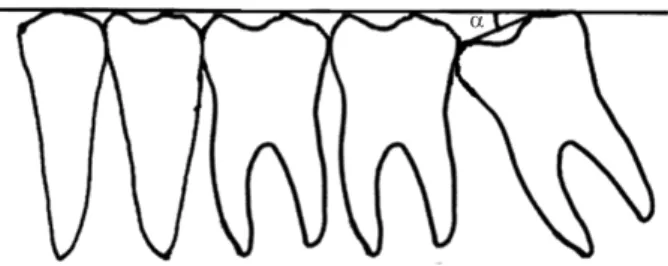
Panoramic radiographs of the patients were used to deter- mine the presence/absence of the mandibular third molar at the time the fracture occurred. When the mandibular third molar was present, classification was decided by eruption space and impaction depth, according to the method of Pell and Gregory22. An additional classification was made based on the angulation of the mandibular third molar, following the method of Shiller23.(Fig. 1)
The horizontal positions of mandibular third molars were evaluated by eruption space on the basis of the relationship between the anterior border of the ramus and the distal side of the mandibular second molar. The crown and width of the mandibular third molar was measured. Then, the presence of sufficient eruption space between the distal side of the man- dibular second molar and the anterior border of the ramus was categorized as class I, insufficient space leading to in- complete eruption as class II, and the presence of most of the mandibular third molar within the ascending ramus resulting in no eruption as class III.
The vertical positions of the mandibular third molars were evaluated by impaction depth. When the highest point of the mandibular third molar was at the same position, or at a higher position, as the occlusal plane of the mandibular sec- ond molar, this was categorized as level A. When the highest point was found to be between the occlusal plane of the man- dibular second molar and the cementoenamel junction, this was categorized as level B, and when the highest point was found to occur at the lower side of the cementoenamel junc- tion, this was classified as level C.
Regarding the angulation of the mandibular third molar, likelihood of mandibular angle fractures by 1.9 fold. On this
basis, some authors have recommended the early removal of an asymptomatic impacted third molar to prevent mandibu- lar angle fractures14-16. In contrast, a recent study reported that the absence of an impacted mandibular third molar was closely associated with mandibular condyle fractures in that it increased the likelihood of mandibular condyle fractures and reduced the incidence of mandibular angle fractures17-20.
In this study, we investigated the impact of the presence of an impacted mandibular third molar and the type and position of the impaction on the occurrence of mandibular angle and condyle fractures.
II. Materials and Methods
1. Subjects
A retrospective study was conducted on 440 patients who visited the Department of Oral and Maxillofacial Surgery, Chosun University Dental Hospital (Gwangju, Korea), pri- marily because of mandibular fractures, between January 2008 and June 2012. We got approval of Chosun Dental Hos- pital Clinical Trial Center Institutional Review Board (CDM- DIRB-1428-158).
2. Methods
1) Classification by gender, age, and cause of fracture Data were collected from the electronic medical records and panoramic radiographs of the patients. The subjects were classified by gender, age, cause of the fracture, presence and impaction type of the mandibular third molar, and the man- dibular fracture site. Causes of injury were classified as falls, slips, traffic accidents, assault, and other.
2) Classification of mandibular fracture sites
Based on the classification scheme of Kelly and Harrigan21, mandibular fracture sites were classified into the condylar process, coronoid process, ramus, angle, body, and symphy- sis. A mandibular angle fracture was defined as a fracture occurring at a site ranging from a point on the curve in the connecting part between the posterior region of the man- dibular second molar and the ramus to a point on the curve formed by the lower and posterior borders of the mandible. A mandibular condyle fracture was defined as a fracture above a line drawn from the mandibular notch to the posterior bor- der of the ramus, and fractures in the condyle head, condyle
Fig. 1. Classification of mandibular third molar angulation based on the method of Shiller. Reused from the article of Shiller (J Am Dent Assoc 1979;99:460-4)23 with original copyright holder᾽s per- mission.
Deuk-Hyun Mah et al: Relationship between mandibular condyle and angle fractures and the presence of mandibular third molars. J Korean Assoc Oral Maxillofac Surg 2015
these, 46 patients were teenagers, 36 patients were in their twenties, 41 patients were in their thirties, and 32 patients were in their forties.
The most frequent causes of mandibular angle fractures were assault (36 patients, 23.1%), being struck by an object (32 patients, 20.5%), and falls and slips (30 patients, 19.2%), while the most frequent causes of mandibular condyle frac- tures were falls (53 patients, 27.9%), traffic accidents (46 patients, 24.2%), slips (37 patients, 19.5%), and assaults (21 patients, 11.1%).
3) Relationship between the presence of mandibular third molars and mandibular angle and condyle fractures
To investigate the association between mandibular third molars and mandibular angle and condyle fractures, 320 patients with a unilateral mandibular fracture, due to lateral force, were categorized by the presence of mandibular third molars, angle fractures, and condyle fractures on the basis of age. Patients whose fracture was not caused by lateral force, including those with only a symphysis fracture or with a bilateral condyle fracture, and those with both angle and con- dyle fractures, were excluded.
Of the 144 mandibular angle fracture patients, 130 patients had a mandibular third molar and 14 patients did not; the ratio of angle fractures was statistically significantly higher when the mandibular third molar was present (1.26 : 1) than when it was not (0.19 : 1; odds ratio, 6.58; P<0.001).
Of the 141 mandibular condyle fracture patients, 84 pa- tients had a mandibular third molar and 57 patients did not;
the ratio of condyle fractures was statistically significantly lower when a mandibular third molar was present (0.56 : 1) than when it was not (1.90 : 1; odds ratio, 0.30; P<0.001).
(Table 1)
4) Relationship between mandibular third molar position and mandibular angle and condyle fractures
Based on the classification of mandibular third molars by their eruption space and impaction depth, the ratio of angle when the angle between the occlusal surface of the mandibu-
lar second molar and that of the mandibular third molar was 10° or less to the mesial-distal direction, this was categorized as vertical angulation. Angles between 11°-70° to the mesial direction were considered mesial angulation, while angles between 11°-70° to the distal direction were considered distal angulation. Angles of 71° or greater or those that were paral- lel were considered horizontal angulation. The presence of a mandibular third molar with no root development was cat- egorized as a tooth germ.
4) Statistical analysis
On the basis of these classifications, the data were analyzed using the SPSS Statistics software version 17.0 (SPSS Inc., Chicago, IL, USA). Statistical significance was determined using the chi-squared and Fisher’s exact tests.
III. Results
1) Distribution of mandibular fractures by gender, age, and fracture sites
In total, 440 patients had a mandibular fracture; 348 males (79.1%) and 92 females (20.9%) at 645 sites. Among these patients, 109 patients (24.8%) were teenagers, 88 patients (20.0%) were in their twenties, and 54 patients (12.3%) were in their thirties. Of the 645 fracture sites, 235 sites (36.4%) were in the symphysis, 217 sites (33.6%) were in the con- dyle, and 158 sites (24.5%) were in the angle.
2) Distribution of mandibular angle and condyle fractures by gender, age, and cause of fracture
Among the mandibular fracture patients, 156 patients had a mandibular angle fracture at 158 sites. These included 139 males (89.1%) and 17 females (10.9%). Of these, 58 patients were teenagers, 52 patients were in their twenties, 24 patients were in their thirties, and 13 patients were in their forties.
In total, 190 patients had mandibular condyle fractures at 217 sites; 133 males (70.0%) and 57 females (30.0%). Of
Table 1. Relationship between mandibular third molars and angle and condyle fractures
Mandibular third molars Angle fracture Condyle fracture
Total
Present Absent Ratio Present Absent Ratio
Present Absent Total
130 14 144
103 73 176
1.26 : 1 0.19 : 1 0.82 : 1
84 57 141
149 30 179
0.56 : 1 1.90 : 1 0.79 : 1
233 87 320 Values are presented as patients’ number or ratio.
P<0.001.
Deuk-Hyun Mah et al: Relationship between mandibular condyle and angle fractures and the presence of mandibular third molars. J Korean Assoc Oral Maxillofac Surg 2015
highest in class I and level A with respect to condyle frac- tures.(Tables 2, 3)
Based on both the eruption space and impaction depth of the mandibular third molars, mandibular angle fractures were most frequent in class II/level B (1.92 : 1), excluding fractures was highest in class II (1.61 : 1) and level B (1.73 :
1) and was statistically significant in the case of class alone (P<0.05). The ratio of condyle fractures was highest in class 0 (1.90 : 1) and level 0 (1.90 : 1) and was also statistically significant in the case of class alone (P<0.05). It was second
Table 2. Relationship between ramus position of mandibular third molar and angle and condyle fractures
Ramus position Angle fracture Condyle fracture
Total
Present Absent Ratio Present Absent Ratio
Class 0 Class I Class II Class III Total
14 19 87 24 144
73 29 54 20 176
0.19 : 1 0.66 : 1 1.61 : 1 1.20 : 1 0.82 : 1
57 25 43 16 141
30 23 98 28 179
1.90 : 1 1.09 : 1 0.44 : 1 0.57 : 1 0.79 : 1
87 48 141 44 320 Class 0: missing mandibular third molar, Class I: adequate space for eruption, Class II: inadequate space for eruption, Class III: located partially or completely in the ramus.
Values are presented as patients’ number or ratio.
P<0.05.
Deuk-Hyun Mah et al: Relationship between mandibular condyle and angle fractures and the presence of mandibular third molars. J Korean Assoc Oral Maxillofac Surg 2015
Table 3. Relationship between impaction depth of mandibular third molars and angle and condyle fractures
Impaction depth Angle fracture Condyle fracture
Total
Present Absent Ratio Present Absent Ratio
Level 0 Level A Level B Level C Total
14 52 57 21 144
73 48 33 22 176
0.19 : 1 1.08 : 1 1.73 : 1 0.95 : 1 0.82 : 1
57 40 29 15 141
30 60 61 28 179
1.90 : 1 0.67 : 1 0.48 : 1 0.54 : 1 0.79 : 1
87 100 90 43 320 Level 0: missing mandibular third molar, Level A: level at occlusal plane, Level B: between the cementoenamel junction of the second molar and occlusal plane, Level C: below the cementoenamel junction of the second molar.
Values are presented as patients’ number or ratio.
P<0.05.
Deuk-Hyun Mah et al: Relationship between mandibular condyle and angle fractures and the presence of mandibular third molars. J Korean Assoc Oral Maxillofac Surg 2015
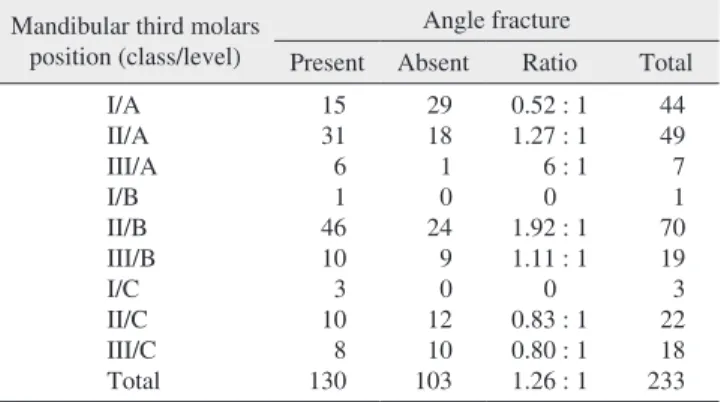
Table 4. Angle fracture associated with ramus position and im- paction depth of mandibular third molars
Mandibular third molars position (class/level)
Angle fracture
Present Absent Ratio Total I/A
II/A III/A I/B II/B III/B I/C II/C III/C Total
15 31 6 1 46 10 3 10 8 130
29 18 1 0 24 9 0 12 10 103
0.52 : 1 1.27 : 1 6 : 1
0 1.92 : 1 1.11 : 1
0 0.83 : 1 0.80 : 1 1.26 : 1
44 49 7 1 70 19 3 22 18 233 Class I: adequate space for eruption, Class II: inadequate space for eruption, Class III: located partially or completely in the ramus.
Level A: level at occlusal plane, Level B: between the cementoenamel junction of the second molar and occlusal plane, Level C: below the cementoenamel junction of the second molar.
Values are presented as patients’ number or ratio.
P<0.05.
Deuk-Hyun Mah et al: Relationship between mandibular condyle and angle fractures and the presence of mandibular third molars. J Korean Assoc Oral Maxillofac Surg 2015
Table 5. Condyle fracture associated with ramus position and im- paction depth of mandibular third molars
Mandibular third molars position (class/level)
Condyle fracture
Present Absent Ratio Total I/A
II/A III/A I/B II/B III/B I/C II/C III/C Total
25 14 1 0 21 8 0 8 7 84
19 35 6 1 49 11 3 14 11 149
1.32 : 1 0.40 : 1 1.67 : 1
0 0.43 : 1 0.73 : 1
0 0.57 : 1 0.64 : 1 0.56 : 1
44 49 7 1 70 19 3 22 18 233 Class I: adequate space for eruption, Class II: inadequate space for eruption, Class III: located partially or completely in the ramus.
Level A: level at occlusal plane, Level B: between the cementoenamel junction of the second molar and occlusal plane, Level C: below the cementoenamel junction of the second molar.
Values are presented as patients’ number or ratio.
P<0.05.
Deuk-Hyun Mah et al: Relationship between mandibular condyle and angle fractures and the presence of mandibular third molars. J Korean Assoc Oral Maxillofac Surg 2015
IV. Discussion
The frequency of mandibular fractures can vary for many reasons. Mandibular fractures caused by assault occur most frequently in the mandibular body while those caused by falls occur most frequently in the mandibular condyle24,25. The presence of the mandibular third molar can lead to the more frequent occurrence of mandibular angle fractures, as noted by many authors. Reitzik et al.6, who examined mandibular angle fractures in monkeys with impacted mandibular third molars, reported that these monkeys easily suffered frac- tures because the fracture strength was approximately 60%
compared to the normal mandible. Tevepaugh and Dodson12 found that a mandibular angle fracture was 3.8 times more likely to occur when the mandibular third molar was present than when it was absent, and that the likelihood of fracture was not correlated with eruption of the mandibular third molar. In contrast, Safdar and Meechan11 observed that the presence of an impacted mandibular third molar could be a critical factor causing mandibular angle fractures because pa- tients with it were more likely to get fractures. Furthermore, the larger the volume the mandibular third molar occupied in the mandibular angle, the more likely a mandibular angle fracture was to occur, due to the smaller area of the broken bone in the mandibular angle.
Cho et al.26 developed a three-dimensional (3D) finite ele- ment model for the mandible, including the temporomandibu- class III/level A, and the results were statistically significant
(P<0.05). Mandibular condyle fractures were most frequent in class I/level A (1.32 : 1), excluding class III/level A, and the results were not statistically significant (P>0.05).(Tables 4, 5)
5) Relationship between angulation of mandibular third molars and mandibular angle and condyle fractures
Based on the angulation of the mandibular third molars, mandibular angle fractures were most frequent with horizon- tal angulation (2.3 : 1), followed by mesial angulation (1.79 : 1), and the results were statistically significant (P<0.001).
Mandibular condyle fractures were most frequent with a tooth germ (1.15 : 1), followed by vertical angulation (0.79 : 1), and the results were also statistically significant (P<0.05).
(Table 6)
6) Relationships between the root development of mandib- ular third molars and mandibular angle and condyle fractures
Based on root development of the mandibular third mo- lars, mandibular angle fractures were more frequent when the mandibular third molar had a developed root (1.50 : 1;
P<0.001). Mandibular condyle fractures were more frequent when roots were not yet developed (1.15 : 1; P<0.05).(Table 7)
Table 6. Relationship between type of angulation of mandibular third molars, based on Shiller’s method, and angle and condyle fractures Type of angulation Angle fracture (P<0.001) Condyle fracture (P<0.05)
Total
Present Absent Ratio Present Absent Ratio
Mesioangular Vertical Distoangular Horizontal Germ Total
59 36 7 21 7 130
33 39 1 9 21 103
1.79 : 1 0.92 : 1 7 : 1 2.3 : 1 0.33 : 1 1.26 : 1
28 33 1 7 15 84
64 42 7 23 13 149
0.44 : 1 0.79 : 1 0.14 : 1 0.3 : 1 1.15 : 1 0.56 : 1
92 75 8 30 28 233 Values are presented as patients’ number or ratio.
Deuk-Hyun Mah et al: Relationship between mandibular condyle and angle fractures and the presence of mandibular third molars. J Korean Assoc Oral Maxillofac Surg 2015
Table 7. Relationship between root development of mandibular third molars and angle and condyle fractures Mandibular third molars Angle fracture (P<0.001) Condyle fracture (P<0.05)
Total
Present Absent Ratio Present Absent Ratio
Present (not germ) Present (as germ) Absent
Total
123 7 14 144
82 21 73 176
1.50 : 1 0.33 : 1 0.19 : 1 0.82 : 1
69 15 57 141
136 13 30 179
0.51 : 1 1.15 : 1 1.90 : 1 0.79 : 1
205 28 87 320 Values are presented as patients’ number or ratio.
Deuk-Hyun Mah et al: Relationship between mandibular condyle and angle fractures and the presence of mandibular third molars. J Korean Assoc Oral Maxillofac Surg 2015
trast, Zhu et al.17 recently reported that the absence of an im- pacted mandibular third molar was 3.2 times more likely to cause a mandibular condyle fracture than its presence. Duan and Zhang18 observed that patients without a mandibular third molar were relatively more likely to suffer a mandibular con- dyle fracture, that a mandibular angle fracture was most fre- quently found in class II and level B, that a mandibular con- dyle fracture was most frequently found in class 0 and level 0, and the absence of the mandibular third molar resulted in in- significant differences in other types of impaction. They also reported that the mandibular third molar had no impact on simple fractures caused by mild external forces, but affected multiple fractures caused by moderate external force in two regions: the mandibular angle and condyle18. Inaoka et al.19 found that the absence of a mandibular third molar increased the likelihood of mandibular condyle fractures and reduced the morbidity of mandibular angle fractures. Thangavelu et al.20 observed that the presence of a mandibular third molar played an important role in causing mandibular angle or con- dyle fractures among patients exposed to moderate external force, which caused multiple fractures in the two regions.
Furthermore, presence of a mandibular third molar was three times more likely to cause a mandibular angle fracture and was less likely to cause a mandibular condyle fracture than its absence. They reported that, based on mandibular third molar impaction, a mandibular angle fracture was more likely to occur in class II, level B, and with mesial angulation, and that a mandibular condyle fracture was most likely to occur when the mandibular third molar was absent, followed by cases of class III, level C, and distal angulation20. These results are consistent with the biomechanical model suggested by Kober et al.30, in which if an impacted mandibular third molar weak- ens the mandibular angle, the external force is divided by the mandibular angle, thus reducing the likelihood of mandibular condyle fractures. Conversely, when the mandibular angle is intact, the external force is delivered to the mandibular con- dyle, causing a mandibular condyle fracture30.
In this study, mandibular fractures were seen more fre- quently among young men, and the incidence of mandibular condyle fractures was more affected by age, compared with the incidence of mandibular angle fractures. Mandibular angle fractures were more frequently caused by immediate external forces, such as an assault or being struck with an object, than were mandibular condyle fractures. Mandibular third molars were seen more frequently in teenage patients and in patients in their twenties than those in their thirties or forties. This probably explains why mandibular angle frac- lar joint, and applied dynamic loads at certain sites to observe
the response to the mandibular stress. They found that the mandibular angle and the neck of the mandibular condylar process, where the stress was concentrated, were most vul- nerable to fractures under all load conditions of the mandible examined. They argued that this was probably because the mandibular angle has poor bone quality, that the root of the impacted mandibular third molar contributes to the occur- rence of fractures, and because the mandibular condyle ana- tomically links this region to the upper skull and becomes a fixation site in the mandible8. Bezerra et al.27 recently found, through a 3D finite element model analysis, that the presence of a mandibular third molar resulted in the greatest stress in the mandibular angle, whereas the greatest stress was concen- trated at the neck of the mandibular condylar process in cases of its absence. The high frequency of mandibular angle and condyle fractures is due to anatomical and structural reasons:
not only primary stress but also secondary stress at other re- gions may lead to a higher frequency of fractures.
Some authors have suggested that the impaction type, as well as the presence, of a mandibular third molar can affect mandibular fractures. Cho et al.26 observed that a horizontal position of the mandibular third molar in mandibular angle fracture patients was seen most frequently in class I, and that the relative likelihood of such a fracture, based on the frequency of occurrence, was highest in class II. Iida et al.28 found that mandibular fractures were most frequent in class I and that class III was highly vulnerable to mandibular angle fractures. Safdar and Meechan11 reported that the more deep- ly the mandibular third molar was impacted, the more likely a mandibular angle fracture was to occur, although Tevepaugh and Dodson12 failed to show this. In contrast, Lee and Dod- son13 reported that the deepest impaction was 50% less likely to cause a fracture than a complete eruption, and that the continuity of the cortical bone in the mandibular angle could play an important role in a mandibular angle fracture because it was least likely to occur when the mandibular third molar was most deeply impacted in the mandibular angle. Fuselier et al.29 suggested that the angulation and impaction of the mandibular third molar were correlated with the incidence of a fracture, and Cho et al.26 reported that among mandibu- lar angle fracture patients with mandibular third molars, the majority had a mesially impacted molar and this mesial im- paction resulted in the highest relative likelihood of fracture, based on the frequency of occurrence.
Many authors have indicated an association between man- dibular third molars and mandibular angle fractures. In con-
tures were more frequent among teenagers or people in their twenties, and why those in their thirties or forties are more vulnerable to a mandibular condyle fracture. Among patients with a mandibular angle fracture, the ratio of mandibular angle fractures was higher when the mandibular third mo- lar was present (1.26 : 1) than when it was absent (0.19 : 1;
odds ratio, 6.58), which is a statistically significant finding (P<0.001). Specifically, among patients with a mandibular angle fracture, the ratio of mandibular angle fractures was 6.58 times higher when a mandibular third molar was pres- ent. The ratio of mandibular condyle fractures was lower when the mandibular third molar was present (0.56 : 1) than when it was absent (1.90 : 1; odds ratio, 0.30), which was sta- tistically significant (P<0.001). Specifically, among patients with a mandibular condyle fracture, the ratio of mandibular condyle fractures was 3.37 times higher when a mandibular third molar was absent. When evaluated based on the man- dibular third molar position, the ratio of mandibular angle fractures was higher in class II/level B, whereas no signifi- cant difference was found for mandibular condyle fractures.
Mandibular angle fractures occurred most frequently with horizontal angulation, due to the root development of the mandibular third molar, while mandibular condyle fractures occurred most frequently with a tooth germ as the mandibular third molar. These results demonstrate that both mandibular angle and condyle fractures are significantly affected by the presence of the mandibular third molar and by the continuity of the cortical bone in the mandibular angle.
It is easy to take a therapeutic approach to a mandibular angle fracture, the fragments of which can be effectively re- duced. The most frequent complication of a mandibular angle fracture is infection, which is most notable in the mandibular angle. However, this complication can be readily managed by sequestrectomy or, in many cases, by removing the metal plate under local anesthesia31,32. In contrast, oral surgeons agree that a mandibular condyle fracture is substantially more difficult to treat because its poor accessibility makes it hard to remove the fracture fragments and difficult to correctly apply a small metal plate and screws. These difficulties can lead to many complications33,34, including malocclusion, mandibular hypomobility, facial asymmetry, dysfunction or degeneration, and facial nerve damage35. A mandibular condyle fracture is more severe, is more difficult to treat, and leads to complica- tions that last longer than a mandibular angle fracture. Thus, it seems unreasonable to suggest preventive removal of the mandibular third molar with the objective of reducing the likelihood of mandibular angle fractures.
Further research will be needed to more comprehensively examine the bone quality of the mandible, the presence and eruption of the mandibular third molar, the direction and strength of the external force applied to the mandible, and the relationships between these factors and mandibular angle and condyle fractures.
V. Conclusion
The presence of the mandibular third molar can be a de- terminant of mandibular angle and condyle fractures. When considering the intentional extraction of an asymptomatic mandibular third molar in young patients, the results of our study should be considered.
Conflict of Interest
No potential conflict of interest relevant to this article was reported.
References
1. Fonseca RJ. Oral and maxillofacial trauma. 4th ed. St. Louis: Else- vier/Saunders; 2013:186.
2. Gassner R, Tuli T, Hächl O, Rudisch A, Ulmer H. Cranio-maxillo- facial trauma: a 10 year review of 9,543 cases with 21,067 injuries.
J Craniomaxillofac Surg 2003;31:51-61.
3. Tanaka N, Tomitsuka K, Shionoya K, Andou H, Kimijima Y, Tashi- ro T, et al. Aetiology of maxillofacial fracture. Br J Oral Maxillofac Surg 1994;32:19-23.
4. Papel ID, Frodel J. Facial plastic and reconstructive surgery. New York: Thieme; 2002:769-90.
5. Rudderman RH, Mullen RL. Biomechanics of the facial skeleton.
Clin Plast Surg 1992;19:11-29.
6. Reitzik M, Schmidt E, Butters RG. Yield point of monkey man- dible. J Dent Res 1981;60:1993-5.
7. Huelke DF, Patrick LM. Mechanics in the production of mandibu- lar fractures: strain-gauge measurements of impacts to the chin. J Dent Res 1964;43:437-46.
8. Cho SJ, Kim YG. The study on mandibular fracture mechanism us- ing dynamic 3-dimensional finite analysis. J Korean Assoc Maxil- lofac Plast Reconstr Surg 2002;24:470-81.
9. Olson RA, Fonseca RJ, Zeitler DL, Osbon DB. Fractures of the mandible: a review of 580 cases. J Oral Maxillofac Surg 1982;40:23-8.
10. Ogundare BO, Bonnick A, Bayley N. Pattern of mandibular frac- tures in an urban major trauma center. J Oral Maxillofac Surg 2003;61:713-8.
11. Safdar N, Meechan JG. Relationship between fractures of the man- dibular angle and the presence and state of eruption of the lower third molar. Oral Surg Oral Med Oral Pathol Oral Radiol Endod 1995;79:680-4.
12. Tevepaugh DB, Dodson TB. Are mandibular third molars a risk factor for angle fractures? A retrospective cohort study. J Oral Maxillofac Surg 1995;53:646-9.
13. Lee JT, Dodson TB. The effect of mandibular third molar presence and position on the risk of an angle fracture. J Oral Maxillofac Surg 2000;58:394-8.
14. Schwimmer A, Stern R, Kritchman D. Impacted third molars: a contributing factor in mandibular fractures in contact sports. Am J Sports Med 1983;11:262-6.
15. Yamada T, Sawaki Y, Tohnai I, Takeuchi M, Ueda M. A study of sports-related mandibular angle fracture: relation to the position of the third molars. Scand J Med Sci Sports 1998;8:116-9.
16. Meisami T, Sojat A, Sàndor GK, Lawrence HP, Clokie CM. Im- pacted third molars and risk of angle fracture. Int J Oral Maxillofac Surg 2002;31:140-4.
17. Zhu SJ, Choi BH, Kim HJ, Park WS, Huh JY, Jung JH, et al. Rela- tionship between the presence of unerupted mandibular third mo- lars and fractures of the mandibular condyle. Int J Oral Maxillofac Surg 2005;34:382-5.
18. Duan DH, Zhang Y. Does the presence of mandibular third molars increase the risk of angle fracture and simultaneously decrease the risk of condylar fracture? Int J Oral Maxillofac Surg 2008;37:25-8.
19. Inaoka SD, Carneiro SC, Vasconcelos BC, Leal J, Porto GG. Re- lationship between mandibular fracture and impacted lower third molar. Med Oral Patol Oral Cir Bucal 2009;14:E349-54.
20. Thangavelu A, Yoganandha R, Vaidhyanathan A. Impact of im- pacted mandibular third molars in mandibular angle and condylar fractures. Int J Oral Maxillofac Surg 2010;39:136-9.
21. Kelly DE, Harrigan WF. A survey of facial fractures: Bellevue Hospital, 1948-1974. J Oral Surg 1975;33:146-9.
22. Pell G, Gregory BT. Impacted mandibular third molars: classifica- tion and modified techniques for removal. Dent Dig 1933;39:330.
23. Shiller WR. Positional changes in mesio-angular impacted man- dibular third molars during a year. J Am Dent Assoc 1979;99:460- 24. Ellis E 3rd, Moos KF, el-Attar A. Ten years of mandibular frac-4.
tures: an analysis of 2,137 cases. Oral Surg Oral Med Oral Pathol 1985;59:120-9.
25. Chidzonga MM. Mandibular fractures, analysis of 541 cases. Cent
Afr J Med 1990;36:97-103.
26. Cho SP, Lee JH, Kim CH. The influence of mandibular third molar on mandibular angle fracture. J Korean Assoc Maxillofac Plast Re- constr Surg 2006;28:49-57.
27. Bezerra TP, Silva Junior FI, Scarparo HC, Costa FW, Studart- Soares EC. Do erupted third molars weaken the mandibular angle after trauma to the chin region? A 3D finite element study. Int J Oral Maxillofac Surg 2013;42:474-80.
28. Iida S, Hassfeld S, Reuther T, Nomura K, Mühling J. Relationship between the risk of mandibular angle fractures and the status of incompletely erupted mandibular third molars. J Craniomaxillofac Surg 2005;33:158-63.
29. Fuselier JC, Ellis EE 3rd, Dodson TB. Do mandibular third molars alter the risk of angle fracture? J Oral Maxillofac Surg 2002;60:514-8.
30. Kober C, Sader R, Thiele H, Bauer HJ, Zeilhofer HF, Hoffmann KH, et al. Stress analysis of the human mandible in standard trau- ma situations with numerical simulation. Mund Kiefer Gesichtschir 2001;5:114-9.
31. Lamphier J, Ziccardi V, Ruvo A, Janel M. Complications of man- dibular fractures in an urban teaching center. J Oral Maxillofac Surg 2003;61:745-9.
32. Feller KU, Schneider M, Hlawitschka M, Pfeifer G, Lauer G, Eckelt U. Analysis of complications in fractures of the mandibular angle--a study with finite element computation and evaluation of data of 277 patients. J Craniomaxillofac Surg 2003;31:290-5.
33. Zide MF, Kent JN. Indications for open reduction of mandibular condyle fractures. J Oral Maxillofac Surg 1983;41:89-98.
34. Haug RH, Peterson GP, Goltz M. A biomechanical evaluation of mandibular condyle fracture plating techniques. J Oral Maxillofac Surg 2002;60:73-80.
35. Ellis E 3rd. Complications of mandibular condyle fractures. Int J Oral Maxillofac Surg 1998;27:255-7.