Printed in the Republic of Korea
https://doi.org/10.5012/jkcs.2017.61.5.286
Notes
Convenient Synthesis of Aryl-Substituted (Hetero)arylcarbothioamides from Bromo(hetero)arylcarboxylic Acids
Hee Ju Lee and Jae In Lee*
Department of Chemistry, College of Natural Science, Duksung Women’s University, Seoul 01369, Korea.
*E-mail: [email protected]
(Received June 15, 2017; Accepted June 30, 2017)
Key words: (Hetero)arylcarbothioamides, Substitution, Cross-coupling, Thionation
(Hetero)arylcarbothioamides are interesting molecules due to their diverse pharmacological activities, such as anti- mycobacterial,1a,b antifungal,1c,d anti-influenza,1e and anti- trypanosomal1f properties.5-Phenylfuran-2-carbothioamides also inhibit abscisic acid (ABA) signal transduction2 and rhodamines containing thiophene-2-carbothioamide core are potent inhibitors of P-glycoprotein.3 The common cyclic skel- etons of (hetero)arylcarbothioamides involve 2-furyl,2 2- thienyl,3 2-pyridyl,1a,b and phenyl1c-f groups.
The synthesis of aryl-substituted (hetero)arylcarbothio- amides can be accomplished by the conversion of bromo (hetero)arylcarboxylic acids to their carboxamides, cross- coupling with tetraarylborates, and subsequent thionation of the resulting aryl-substituted (hetero)arylcarboxamides.
(Hetero)arylcarboxamides have generally been prepared by the acyl substitution of carboxylic anhydride intermediates, which were obtained by treating (hetero)arylcarboxylic acids with alkyl chloroformates4 or trimethylacetyl chloride,5 with amines. They were also prepared by one-pot method of (hetero)arylcarboxylic acids and amines using sulfonyl chlorides,6 trichloroisocyanuric acid/triphenylphosphine,7 and dialkylcarbodiimide/1-hydroxybenzotriazole as coupling reagents.8
The cross-coupling reaction of halo(hetero)arylcarbox- ylic acids with a variety of arylboronic acids using palla- dium catalyst provided aryl-substituted (hetero)arylcarboxylic acids.9 Bromo(hetero)arylcarboxylic acids or their carbox- amides were also coupled with sodium tetraphenylborate10 or phenylboronic acids8 in the presence of palladium catalyst to give phenyl-substituted (hetero)arylcarboxylic acids or their carboxamides. Conversion of the carbonyl group to thiocarbonyl has generally been accomplished using Lawes- son’s reagent as effective thionating reagent and thus (het- ero)arylcarboxamides were easily thionated by this reagent to give (hetero)arylcarbothioamides at room temperature.11
However, reports on the synthesis of aryl-substituted
(hetero)arylcarbothioamides are rare. In the previous paper we reported that 5-(chlorophenyl)-2-furancarbothioamides were synthesized from 2-furoic acid via diazotization with chloroanilines, conversion to their carboxamides, and thi- onation.12 As the extension of our research, we now describe convenient synthesis of aryl-substituted (hetero)arylcar- bothioamides containing some cyclic groups from bromo (hetero)arylcarboxylic acids under mild conditions in high yields.
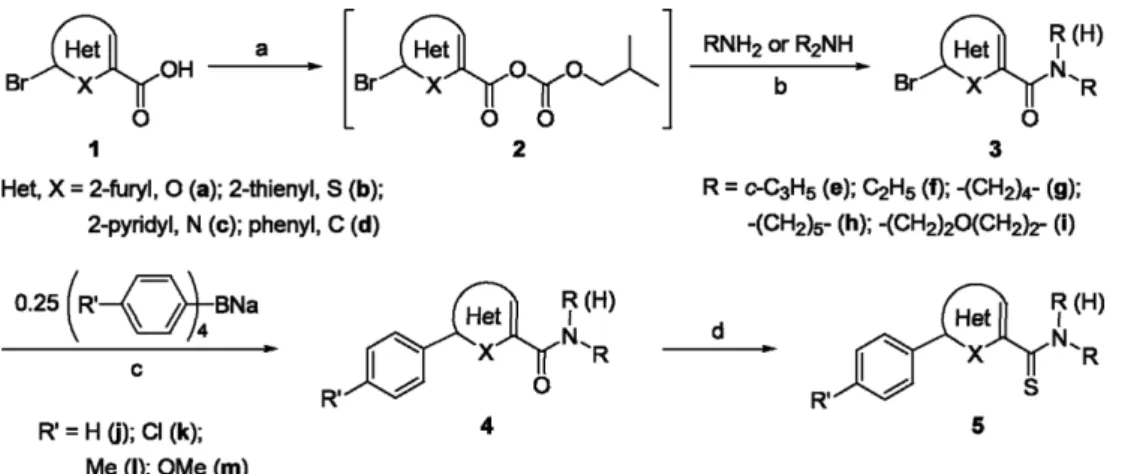
Bromo(hetero)arylcarboxamides (3) were prepared through mixed carboxylic carbonic anhydrides as activated inter- mediates (Scheme 1). The addition of isobutyl chloroformate to a mixture solution of bromo(hetero)arylcarboxylic acids (1) and triethylamine afforded the corresponding mixed carboxylic carbonic anhydrides (2). The nucleophilic acyl substitution of 2 proceeded smoothly by regioselective attack of amines to the carbon atom of carboxylic carbonyl group to give 3 together with the liberation of carbon dioxide and isobutyl alcohol. This one-pot reaction was completed within 1 h between −10oC and 0 oC, regardless of the skeletons of (hetero)aryl groups in 1. Various 3 were obtained in 79−96%
yields after the usual basic workup and chromatographic separation (3ae: 90%, 3ah: 87%, 3bf: 96%, 3bg: 84%, 3bi:
81%, 3cf: 80%, 3cg: 87%, 3ch: 79%, 3df: 82%, 3dg: 84%).
The arylation of 3 was carried out by cross-coupling with sodium tetraarylborates in the presence of palladium(II) chloride catalyst. Sodium tetraarylborates were prepared by the addition of 4 equiv of arylmagnesium bromides to a het- erogeneous solution of sodium tetrafluoroborate in THF according to the previous similar method.13 To find out the optimum conditions of cross-coupling, the effect of bases and solvents was examined for the reaction of 5-bromo-2- furoylpiperidine (3ah) and 0.25 equiv of sodium tetrap- henylborate in the presence of 0.03 equiv of palladium(II) chloride (Table 1). The cross-coupling reaction of 3ah and sodium tetraphenylborate with 3 equiv of bases such as
Na2CO3, NaHCO3, and Et3N afforded (5-phenylfuran-2- yl)(piperidin-1-yl)methanone (4ahj) in 83%, 67%, and 43%
yields, respectively, after 0.5 h, 12 h, and 12 h, respectively, in CH3OH at room temperature. The corresponding reac- tion using 1.2 equiv of Na2CO3 proceeded slowly at room temperature, and 4ahj was obtained in 68% after 12 h.
When CH3CN, CH3COCH3, and THF were employed as solvents in place of CH3OH in the presence of 3 equiv of Na2CO3, 4ahj was obtained in 76%, 7%, and 5% yields, respectively, after 1 h, 24 h, and 24 h, respectively, at room temperature. Thus, the cross-coupling reaction of 3 with 0.25 equiv of sodium tetraarylborates was carried out using 3 equiv of Na2CO3 in the presence of 0.03 equiv of palla- dium(II) chloride in CH3OH at room temperature. The reac- tion was generally completed within 2 h, and aryl-substituted (hetero)arylcarboxamides (4) were obtained in 71−90%
yields after the usual workup and chromatographic sepa- ration.
The thionation of the carbonyl group in 4 was carried out using Lawesson’s reagent. The addition of 0.5 equiv of Lawesson’s reagent to a solution of 4 in CH2Cl2 afforded thiaoxaphosphetane intermediates by nucleophilic attack of
the sulfur atom to the carbon atom of the carbonyl group in 4.
Metathiophosphonate (p-MeOC6H4POS) was eliminated from these intermediates to give aryl-substituted (hetero)- arylcarbothioamides (5). The reaction was generally com- pleted within 4 h at room temperature. However, the thi- onation of N-cyclopropyl-5-phenyl-2-furancarboxamide (4aej) proceeded sluggishly over 36 h at room temperature, pre- sumably due to the decreased electrophilicity of the carbonyl group, to give N-cyclopropyl-5-phenyl-2-furancarbothio- amide (5aej) in 90% yield. After completion of the reac- tion, the condensed mixture was directly subjected to silica gel column chromatography. The yellow bands of 5 were easily separated from metathiophosphonate, and 5 were obtained in 87−94% yields.
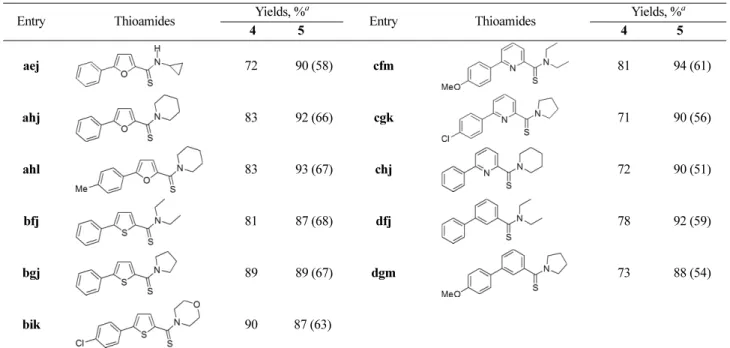
As shown in Table 2, various aryl-substituted (hetero)- arylcarbothioamides (5) were synthesized from bromo (hetero)arylcarboxylic acids (1) in high overall yields (51- 68%). The cross-coupling reaction of 3 with sodium tetraar- ylborates proceeded well at room temperature, regardless of the skeletons of (hetero)aryl groups. The cross-coupling reaction also worked well with both electron-donating sub- stituents (4ahl, 4cfm, 4dgm) and electron-withdrawing substituents (4bik, 4cgk) in the aryl groups of tetraarylbo- rates. Furthermore, the thionation of the carbonyl group in 4 using Lawesson’s reagent proceeded smoothly at room temperature, regardless of the structures of (hetero)aryl groups and tertiary amides under the present conditions.
EXPERIMENTAL
Preparation of 5-bromo-2-furoylpiperidine (3ah) To a solution of 5-bromo-2-furoic acid (1a, 764 mg, 4.0 mmol) in methylene chloride (16 mL) were added triethyl- amine (558 μL, 4.0 mmol) and isobutyl chloroformate (519 μL, Scheme 1. Reagents and conditions: (a) ClCOOCH2CH(CH3)2, Et3N, CH2Cl2, -10oC, 0.5 h; (b) -10oC~0oC, 0.5 h; (c) 3 equiv Na2CO3, 0.03 equiv PdCl2, CH3OH, rt, 1~2 h; (d) 0.5 equiv (p-MeO-C6H4)2P2S4, CH2Cl2, rt, 1~4 h; rt, 36 h for 5aej.
Table 1. Effect of bases and solvents on the cross-coupling of 5- bromo-2-furoylpiperidine (3ah) and 0.25 equiv of Ph4BNa with 0.03 equiv of PdCl2
Bases (equiv) Solvents Reaction time (h) Isolated yields (%)
Na2CO3 (3) CH3OH 0.5 83
Na2CO3 (1.2) CH3OH 12 68
NaHCO3 (3) CH3OH 12 67
Et3N (3) CH3OH 12 43
Na2CO3 (3) CH3CN 1 76
Na2CO3 (3) CH3COCH3 24 7
Na2CO3 (3) THF 24 5
4.0 mmol) at −10 oC. After stirring for 0.5 h, piperidine (415 μL, 4.2 mmol) was slowly added to the resulting solution of 5-bromo-2-furyl isobutyl carbonic anhydride at −10oC.
Stirring was continued for 0.5 h between −10oC and 0 oC.
The mixture was poured into a saturated NaHCO3 solution (40 mL) and extracted with methylene chloride (3 × 25 mL).
The combined organic phases were dried over anhydrous MgSO4, filtered, and concentrated in vacuo. The residue was purified by silica gel column chromatography using 40%
EtOAc/n-hexane to give 3ah (898 mg, 87%). mp 48−49oC;
1H NMR (300 MHz, CDCl3) δ 6.91 (d, J = 3.5 Hz, 1H), 6.41 (d, J = 3.5 Hz, 1H), 3.58−3.78 (m, 4H), 1.50−1.75 (m, 6H);
13C NMR (75 MHz, CDCl3) δ 158.0, 150.0, 123.7, 118.0, 113.1, 26.1, 24.6 (overlapped); Ms m/z (%) 259 (M++2, 70), 257 (M+, 72), 175 (99), 173 (100), 150 (57), 84 (54).
Preparation of (5-phenylfuran-2-yl)(piperidin-1-yl)- methanone (4ahj)
To a solution of 3ah (774 mg, 3.0 mmol) in CH3OH (15 mL) were added sodium tetraphenylborate (257 mg, 0.75 mmol), Na2CO3 (954 mg, 9.0 mmol), and palladium(II) chloride (16 mg, 0.09 mmol) at room temperature. After stirring for 1 h, CH3OH was evaporated in vacuo. The resulting black mixture was transferred into 5% NaCl solution (30 mL) and extracted with methylene chloride (3 × 20 mL).The con- densed residue was purified by silica gel column chroma- tography using 50% EtOAc/n-hexane to give 4ahj (636 mg,
83%). mp 45−46oC; 1H NMR (300 MHz, CDCl3) δ 7.64− 7.71 (m, 2H), 7.36−7.43 (m, 2H), 7.28−7.34 (m, 1H), 7.05 (d, J = 3.5 Hz, 1H), 6.71 (d, J = 3.5 Hz, 1H), 3.64-3.82 (m, 4H), 1.60−1.78 (m, 6H); 13C NMR (75 MHz, CDCl3) δ 159.1, 154.7, 147.5, 130.0, 128.8, 128.3, 124.2, 117.9, 106.3, 26.3, 24.8 (overlapped); Ms m/z (%) 255 (M+, 100), 171 (97), 144 (84), 115 (96), 84 (15).
Preparation of (5-phenylfuran-2-yl)(piperidin-1-yl)- methanethione (5ahj)
A solution of 4ahj (511 mg, 2.0 mmol) and Lawesson’s reagent (405 mg, 1.0 mmol) in methylene chloride (8 mL) was stirred for 2 h at room temperature. After evaporation of methylene chloride, the resulting yellow residue was directly subjected to silica gel column chromatography using 30%
EtOAc/n-hexane to give 5ahj (499 mg, 92%) as a yellow solid. mp 76−77oC; 1H NMR (300 MHz, CDCl3) δ 7.56− 7.71 (m, 2H), 7.22−7.44 (m, 3H), 7.20 (d, J = 3.5 Hz, 1H), 6.72 (d, J = 3.5 Hz, 1H), 4.05−4.36 (m, 2H), 3.76−4.05 (m, 2H), 1.62−1.89 (m, 6H); 13C NMR (75 MHz, CDCl3) δ 184.3, 154.1, 151.7, 130.0, 128.9, 128.4, 124.2, 120.4, 107.3, 53.9, 53.5, 52.7, 26.3, 24.4; Ms m/z (%) 271 (M+, 100), 187 (40), 170 (81), 115 (34), 84 (17).
N-Cyclopropyl-5-phenyl-2-furancarbothioamide (5aej):
viscous liquid; 1H NMR (300 MHz, CDCl3) δ 7.85 (br s, 1H), 7.55−7.64 (m, 2H), 7.37 (d, J = 3.7 Hz, 1H), 7.22−7.34 (m, 3H), 6.63 (d, J = 3.7 Hz, 1H), 3.23−3.32 (m, 1H), 0.89−
Table 2. Synthesis of aryl-substituted (hetero)arylcarbo(thio)amides 4 and 5
Entry Thioamides Yields, %a
Entry Thioamides Yields, %a
4 5 4 5
aej 72 90 (58) cfm 81 94 (61)
ahj 83 92 (66) cgk 71 90 (56)
ahl 83 93 (67) chj 72 90 (51)
bfj 81 87 (68) dfj 78 92 (59)
bgj 89 89 (67) dgm 73 88 (54)
bik 90 87 (63)
aThe numbers in parentheses indicate the overall yields of 5 from 1 in three steps.
0.99 (m, 2H), 0.67−0.78 (m, 2H); 13C NMR (75 MHz, CDCl3) δ 183.6, 155.1, 151.2, 129.5, 128.9 (overlapped), 124.6, 120.0, 108.5, 28.1, 7.6; Ms m/z (%) 243 (M+, 63), 228 (100), 187 (91), 115 (78), 77 (21).
[5-(4-Methylphenyl)furan-2-yl](piperidin-1-yl)methan- ethione (5ahl): mp 100−101oC; 1H NMR (300 MHz, CDCl3) δ 7.58 (d, J = 8.2 Hz, 2H), 7.23 (d, J = 8.2 Hz, 2H), 7.21 (d, J = 3.5 Hz, 1H), 6.66 (d, J = 3.5 Hz, 1H), 4.15−4.36 (m, 2H), 3.86−4.05 (m, 2H), 2.39 (s, 3H), 1.77−1.88 (m, 6H);
13C NMR (75 MHz, CDCl3) δ 184.1, 154.4, 151.3, 138.5, 129.6, 127.3, 124.2, 120.9, 106.7, 53.9, 52.2, 27.0, 26.0, 24.5, 21.4; Ms m/z (%) 285 (M+, 100), 201 (31), 184 (82), 129 (23), 84 (17).
N,N-Diethyl-5-phenyl-2-thiophenecarbothioamide (5bfj):
mp 59−60 oC; 1H NMR (300 MHz, CDCl3) δ 7.57−7.65 (m, 2H), 7.30−7.44 (m, 3H), 7.17 (d, J = 3.8 Hz, 1H), 7.08 (d, J
= 3.8 Hz, 1H), 3.52−4.20 (m, 4H), 1.39 (t, J = 6.9 Hz, 6H);
13C NMR (75 MHz, CDCl3) δ 190.3, 147.3, 144.2, 133.6, 129.0, 128.2, 126.1, 125.9, 122.5, 47.8 (overlapped), 13.7, 11.5; Ms m/z (%) 275 (M+, 46), 203 (100), 186 (10), 115 (9).
(5-Phenylthiophen-2-yl)(pyrrolidin-1-yl)methanethi- one (5bgj): mp 161−162 oC; 1H NMR (300 MHz, CDCl3) δ 7.61−7.67 (m, 2H), 7.32−7.44 (m, 3H), 7.28 (d, J = 3.9 Hz, 1H), 7.23 (d, J = 3.9 Hz, 1H), 3.99−4.08 (m, 2H), 3.91−3.99 (m, 2H), 2.05−2.12 (m, 4H); 13C NMR (75 MHz, CDCl3) δ 185.8, 149.7, 145.4, 133.5, 129.0, 128.4, 128.0, 126.0, 123.0, 55.4, 54.4, 27.0, 24.4; Ms m/z (%) 273 (M+, 100), 240 (39), 203 (62), 186 (27), 70 (20).
[5-(4-Chlorophenyl)thiophen-2-yl](morpholino)metha- nethione (5bik): mp 83−84oC; 1H NMR (300 MHz, CDCl3) δ 7.53 (d, J = 8.5 Hz, 2H), 7.37 (d, J = 8.5 Hz, 2H), 7.16 (d, J
= 3.8 Hz, 1H), 7.06 (d, J = 3.8 Hz, 1H), 4.12-4.30 (m, 4H), 3.78−3.90 (m, 4H); 13C NMR (75 MHz, CDCl3) δ 191.0, 147.2, 143.7, 134.3, 131.9, 129.3, 127.3, 127.1, 122.9, 66.7, 52.3; Ms m/z (%) 325 (M++2, 35), 323 (M+, 84), 239 (43), 237 (100), 220 (30), 86 (13).
N,N-Diethyl-6-(4-methoxyphenyl)-2-pyridinecarbothi- oamide (5cfm): mp 118−119oC; 1H NMR (300 MHz, CDCl3) δ 8.00 (d, J = 8.7 Hz, 2H), 7.76 (t, J = 7.8 Hz, 1H), 7.64 (d, J = 7.9 Hz, 1H), 7.43 (d, J = 7.6 Hz, 1H), 6.99 (d, J = 8.7 Hz, 2H), 4.17 (q, J = 7.1 Hz, 2H), 3.88 (s, 3H), 3.53 (q, J
= 7.1 Hz, 2H), 1.46 (t, J = 7.0 Hz, 3H), 1.27 (t, J = 7.0 Hz, 3H); 13C NMR (75 MHz, CDCl3) δ 197.4, 160.6, 159.5, 155.2, 137.4, 131.2, 128.4, 120.6, 118.7, 114.0, 55.4, 48.1, 46.7, 14.0, 11.2; Ms m/z (%) 300 (M+, 32), 229 (100), 185 (16), 72 (10).
[6-(4-Chlorophenyl)pyridin-2-yl](pyrrolidin-1-yl)met- hanethione (5cgk): mp 99−100 oC; 1H NMR (300 MHz, CDCl3) δ 7.94 (d, J = 8.3 Hz, 2H), 7.81 (t, J = 7.7 Hz, 1H),
7.73 (d, J = 7.1 Hz, 1H), 7.67 (d, J = 7.6 Hz, 1H), 7.43 (d, J = 8.3 Hz, 2H), 3.92−4.05 (m, 2H), 3.63−3.78 (m, 2H), 1.95−
2.13 (m, 4H); 13C NMR (75 MHz, CDCl3) δ 191.2, 159.8, 139.8, 139.0, 128.9, 128.2, 128.0, 122.9, 122.7, 120.0, 54.0, 53.3, 26.6, 24.2; Ms m/z (%) 304 (M++2, 12), 302 (M+, 32), 235 (37), 233 (100), 154 (16), 70 (20).
(6-Phenylpyridin-2-yl)(piperidin-1-yl)methanethi- one (5chj): mp 116−117 oC; 1H NMR (300 MHz, CDCl3) δ 7.98−8.04 (m, 2H), 7.80 (t, J = 7.8 Hz, 1H), 7.69 (dd, J = 7.9, 1.0 Hz, 1H), 7.54 (dd, J = 7.6, 1.0 Hz, 1H), 7.42-7.51 (m, 3H), 4.37−4.44 (m, 2H), 3.56−3.63 (m, 2H), 1.69−1.94 (m, 6H);
13C NMR (75 MHz, CDCl3) δ 196.3, 159.3, 155.7, 138.7, 137.6, 129.2, 128.7, 127.0, 121.8, 119.7, 53.3, 50.8, 26.9, 25.5, 24.2; Ms m/z (%) 282 (M+, 54), 199 (100), 155 (33), 84 (44).
N,N-Diethyl-3-phenylbenzthioamide (5dfj): mp 80−
81oC; 1H NMR (300 MHz, CDCl3) δ 7.49−7.54 (m, 2H), 7.44−7.49 (m, 1H), 7.33−7.40 (m, 4H), 7.25−7.33 (m, 1H), 7.12−7.17 (m, 1H), 4.08 (q, J = 7.1 Hz, 2H), 3.42 (q, J = 7.1 Hz, 2H), 1.34 (t, J = 7.1 Hz, 3H), 1.10 (t, J = 7.1 Hz, 3H);
13C NMR (75 MHz, CDCl3) δ 200.1, 144.3, 141.4, 140.4, 128.9, 128.8, 127.6, 127.2, 126.8, 123.9, 123.7, 47.9, 46.1, 14.0, 11.3; Ms m/z (%) 269 (M+, 66), 197 (100), 180 (28), 152 (25).
[3-(4-Methoxyphenyl)phenyl](pyrrolidin-1-yl)methane- thione (5dgm): mp 95−96 oC; 1H NMR (300 MHz, CDCl3) δ 7.54 (d, J = 8.7 Hz, 2H), 7.47−7.57 (m, 2H), 7.41 (t, J = 7.6 Hz, 1H), 7.30 (dd, J = 7.6, 1.3 Hz, 1H), 6.99 (d, J = 8.7 Hz, 2H), 3.94−4.05 (m, 2H), 3.87 (s, 3H), 3.46−3.57 (m, 2H), 2.04−2.36 (m, 2H), 1.92−2.04 (m, 2H); 13C NMR (75 MHz, CDCl3) δ 197.3, 159.4, 144.4, 140.9, 132.9, 128.8, 128.2, 127.0, 123.9 (overlapped), 114.2, 55.4, 53.9, 53.4, 26.5, 24.7; Ms m/z (%) 297 (M+, 100), 228 (44), 184 (16), 70 (5).
REFERENCES
1. (a) Klimesova, V.; Svoboda, M.; Waisser, K.; Pour, M.;
Kaustova, J. Il Farmaco 1999, 54, 666. (b) Zahajska, L.;
Klimesova, V.; Koci, J.; Waisser, K.; Kaustova, J. Arch.
Pharm. Pharm. Med. Chem. 2004, 337, 549. (c) Matysiak, J.; Niewiadomy, A.; Macik-Niewiadomy, G.; Kornillowicz, T. Eur. J. Med. Chem. 2000, 35, 393. (d) Stachowicz, J.;
Krajewska-Kulak, E.; Lukaszuk, C.; Niewiadomy, A. Ind.
J. Pharm. Sci. 2014, 76, 287. (e) Yu, K.-L.; Torri, A. F.;
Luo, G.; Cianci, C.; Grant-Young, K.; Danetz, S.; Tiley, L.; Krystal, M.; Meanwell, N. A. Bio. Med. Chem. Lett.
2002, 12, 3379. (f) Agnimonhan, F. H.; Ahoussi, L.; Kpo- viessi, S. D. S.; Gbaguidi, F. A.; Kapanda, C. N.; Bero, J.;
Hannaert, V.; Quetin-Lecleraq, J.; Moudachirou, M.; Pou- paert, J.; Accrombessi, G. C. J. App. Pharm. Sci. 2012, 2, 62.
2. (a) Kim, T.-H.; Hauser, F.; Ha, T.; Xue, S.; Bohmer, M.;
Nishimura, N.; Munemasa, S.; Hubbard, K.; Peine, N.; Lee, B.; Lee, S.; Robert, N.; Parker, J. E.; Schroeder, J. I. Current Biol. 2011, 21, 990. (b) Ristova, D.; Busch, W. Plant Physiol.
2014, 166, 518. (c) Kunz, H.-H.; Park, J.; Mevers, E.; Garcia, A. V.; Highhouse, S.; Gerwick, W. H.; Parker, J. E.; Schro- eder, J. I. Plos One 2016, 11, e0155937 doi:10.1371.
3. Gannon, M. K.; Holt, J. J.; Bennett, S. M.; Wetzel, B. R.;
Loo, T. W.; Bartlett, M. C.; Clarke, D. M.; Sawada, G. A.;
Higgins, J. W.; Tombline, G.; Raub, T. J.; Detty, M. R. J.
Med. Chem. 2009, 52, 3328.
4. (a) Murray, A.; Proctor, G. R.; Murray, P. J. Tetrahedron Lett. 1995, 36, 291. (b) Kim, M.; Lee, H.; Han, K.-J.; Kay, K.-Y. Synth. Comm. 2003, 33, 4013.
5. Raghuram, T.; Vijaysaradhi, S.; Singh, I.; Singh, J. Synth.
Comm. 1999, 29, 3215.
6. (a) Li, Z.; Wang, X. Synth. Comm. 2002, 32, 3357. (b) Woo, J. C. S.; Fenster, E.; Dake, G. R. J. Org. Chem. 2004, 69, 8984.
7. Rodrigues, R. C.; Barros, I. M. A.; Lima, E. L. S. Tetrahe- dron Lett. 2005, 46, 5945.
8. Guerrero, M.; Urbano, M.; Velaparthi, S.; Zhao, J.; Schaeffer, M.-T.; Brown, S.; Rosen, H.; Roberts, E. Bioorg. Med.
Chem. Lett. 2011, 21, 3632.
9. For a review, see: Paul, S.; Islam, M. M.; Islam, S. M.
RSC Adv. 2015, 5, 42193.
10. (a) Lu, G.; Franzen, R.; Zhang, Q.; Xu, Y. Tetrahedron Lett. 2005, 46, 4255. (b) Bai, L. Chin. Chem. Lett. 2009, 20, 158. (c) Zhou, W.-J.; Wang, K.-H.; Wang, J.-X.; Gao, Z.-R. Tetrahedron 2010, 66, 7633.
11. For reviews, see: (a) Ozturk, T.; Ertas, E.; Mert, O. Chem.
Rev. 2007, 107, 5210. (b) Larik, F. A.; Saeed, A.; Muqadar, U.; Channar, P. A. J. Sulfur Chem. 2016, doi:10.1080/
17415993.
12. Lee, H. J.; Lee, J. I. J. Korean Chem. Soc. 2016, 60, 457.
13. Yakelis, N. A.; Bergman, R. G. Organometallics 2005, 24, 3579.