Epidemiology of Abdominal Obesity among Adolescents from a Brazilian State Capital
The objective of this study was to investigate the effects of socioeconomic, demographic and lifestyle factors on abdominal obesity in adolescents from a Brazilian state capital. In this cross-sectional study, 656 high school students (423 girls and 233 boys) from public schools, ranging in age from 14 to 19 yr, were evaluated. Abdominal obesity was identified based on waist circumference. Socioeconomic data (socioeconomic status, household head’s education, and school grade), demographic data (gender and age), and information regarding lifestyle (physical activity, eating habits, aerobic fitness, and nutritional status) were collected. Logistic regression was used for multivariate analysis.
The prevalence of abdominal obesity was 6.6% (95% confidence interval [CI]: 4.6-8.4).
Being in the second (odds ratio [OR] = 0.41; 95% CI: 0.19-0.88) or third year (OR = 0.18;
95% CI: 0.06-0.59) of high school was a protective factor against abdominal obesity. In addition, students presenting low aerobic fitness (OR = 4.10; 95% CI: 1.62-10.4) and those with excess weight (OR = 208.6; 95% CI: 47.7-911.7) had a higher probability of abdominal obesity. In conclusion, demographic factors such as school grade, lifestyle habits, low aerobic fitness and excess weight are associated with central obesity.
Key Words: Abdominal Adiposity; Waist Circumference; Risk Factors; Adolescent; Brazil;
Cross-Sectional Studies Diego Augusto Santos Silva¹,
Andreia Pelegrini¹,
João Marcos Ferreira de Lima e Silva², and Edio Luiz Petroski¹
Universidade Federal de Santa Catarina1, Programa de Pós-Graduação em Educação Física,
Florianópolis, Santa Catarina; Instituto Federal de Educação2, Ciência e Tecnologia do Ceará, Campus Juazeiro do Norte, Ceará, Brazil
Received: 12 June 2010 Accepted: 7 September 2010 Address for Correspondence:
Diego Augusto Santos Silva
Universidade Federal de Santa Catarina-Centros de Desportos, Núcleo de Pesquisa em Cineantropometria e Desempenho Humano Campus Universitário-Trindade-Caixa Postal 476 Tel: +55-48-37218562
E-mail: [email protected]
DOI: 10.3346/jkms.2011.26.1.78 • J Korean Med Sci 2011; 26: 78-84
INTRODUCTION
Abdominal obesity is one of the most important risk factors for acute myocardial infarction among adults, presenting an attrib- utable risk of 20.1% (1). This concern extends to adolescents since central fat has been shown to be associated with an increased risk of cardiovascular diseases during this phase of life (2, 3).
Despite the availability of more sophisticated methods for the evaluation of abdominal fat, waist circumference (WC) is an easy-to-use, low cost and simple measure of adiposity in epide- miological studies (4). In addition, WC is an anthropometric in- dicator related to abdominal fat (4) that is strongly associated with metabolic risk factors such as diabetes and dyslipidemias (2, 3).
Studies indicate that both genetic and environmental factors contribute to increased abdominal obesity, but the latter exert a greater influence and can be modified by changes in lifestyle such as adequate dietary habits and regular physical exercise (1, 5, 6). Socioeconomic and demographic factors are also associ- ated with abdominal obesity and the identification of these char- acteristics may permit more effective interventions for the treat- ment and prevention of this condition (6).
Knowledge about factors associated with abdominal obesity in adolescents is still limited, in part, because of the lack of pop-
ulation-based studies and the scarcity of studies investigating different associated factors. Studies conducted in different coun- tries have shown variations in the factors associated with abdom- inal obesity (2, 3, 5). In India, gender, age and nutritional status were found to be associated with excess central fat (3). In con- trast, a comparison between the United States and South Korea demonstrated a relationship between metabolic factors and abdominal obesity (2). In Brazil, Fernandes et al. (5) found that family factors such as maternal and paternal nutritional status were more associated with abdominal obesity than demograph- ic characteristics.
In view of the different factors that predict abdominal obesity, the objective of the present study was to investigate the effects of socioeconomic, demographic and lifestyle factors on abdom- inal obesity in adolescent students from a Brazilian state capital.
MATERIALS AND METHODS Population and sample selection
An analytical and descriptive cross-sectional study was conduct- ed in the second semester of 2007 in the city of Florianópolis, Santa Catarina, Brazil.
The adolescents were selected from state public schools of the city of Florianópolis, Santa Catarina, Brazil, and sampling
was performed in two phases: stratification according to geo- graphic region and cluster sampling of classes. In the first phase, the city was divided into five geographic regions: center, conti- nent, east, north, and south. The largest schools in each region were selected from the list of schools (Coordination of School Census and Statistics, Ministry of Education, Sciences and Tech- nology of the State of Santa Catarina), and classes sufficient to reach representativeness of the geographic area were selected by drawing lots in each school. In the second phase, all adoles- cents who were present in the classroom on the day of data col- lection were invited to participate in the study.
Various sample sizes were calculated since this study was part of a larger research project investigating different health outcomes. The sample chosen for the present study was that selected for the analysis of the prevalence of abdominal obesity.
A prevalence of the outcome of 15% (5) was adopted, with a tol- erable error of 4%, a confidence interval of 95% and a design ef- fect of 1.5, adding 20% for possible losses. Thus, 538 students need to be evaluated. In view of the sampling process that in- volved all subjects of the clusters, 892 adolescents participated in the sample.
Eligibility criteria included enrollment in state schools, pres- ence in the classroom on the day of data collection, and age ≤ 19 yr. This cut-off was chosen based on the criteria of the World Health Organization (7) defining the beginning and end of ado- lescence (10 to 19 yr). Exclusion criteria were age > 19 yr, preg- nancy, lack of informed consent provided by the responsible person (students < 18 yr) or the participant himself (18 yr or older), refusal to participate in the study, and an incomplete questionnaire.
Data collection
The field study was conducted by a team of four physical educa- tion teachers. The examiners were trained in all necessary pro- cedures in order to standardize the data collection. Each exam- iner was responsible for the collection of one measurement and/
or test to prevent interobserver variability and to increase the reliability of the data. During the field study, the students were informed about the evaluations at least 3 days prior to the assess- ment. The tests were performed preferentially during the physi- cal education classes and the free informed consent form and detailed information about the procedures were provided to the students on that occasion.
WC was measured in duplicate using a standard method (8).
According to the protocol, WC was measured at the minimum circumference between the iliac crest and the rib cage at the end of a normal expiration. The critical values proposed by Taylor et al. (4) were used to define abdominal obesity. These values were used because WC identified a high proportion of children and adolescents with high trunk fat mass (z score ≥ 1) as measured by dual energy radiography absorptiometry (DXA) (4). More-
over, the critical values presented 89% sensitivity (95% confi- dence interval [CI]: 77%-96%) and 94% specificity (95% CI: 91%- 97%) for girls and 87% sensitivity (95% CI: 74%-95%) and 92%
specificity (95% CI: 88%-95%) for boys (4).
For the assessment of nutritional status, body weight and height were measured (8) and the body mass index (BMI) was calculated. International BMI cut-off values for adults (9) were used to define “normal weight” (< 24.99 kg/m2 for age and gen- der) and “excess weight” (> 25 kg/m2) in adolescents.
Demographic and socioeconomic data were used as expo- sure variables: gender (male and female), age (continuous), school grade (10th, 11th, and 12th grade), educational level of household head (≤ 8 and > 8 complete years), and socioeco- nomic status. The Brazilian “ensino médio” (middle school ed- ucation) corresponds to the North American High School and consists of three grades (10th, 11th, and 12th). The socioeco- nomic status was identified by application of the questionnaire of the Brazilian Association of Research Companies (ABEP) (10), which uses a sum of scores to divide the Brazilian population into the following five socioeconomic classes according to pur- chasing power, in decreasing order: A, B, C, D, and E. In the pres- ent study, a preliminary analysis of frequencies resulted in the combined classification of classes A + B, and C + D + E.
Data regarding the physical activity behavior of the adoles- cents were collected using the instrument proposed by Marcus et al. (11), which classifies the stages of change in physical ac- tivity behavior. On the basis of their replies, the students were classified as sedentary (pre-contemplation, contemplation and preparation stages) and active (action and maintenance stag- es). Data regarding the efficacy, sensitivity and specificity of this classification are reported in the literature (12).
The eating habits of the students were evaluated based on the following question: I often eat excess: 1) sugar, 2) salt, 3) an- imal fats, and 4) junk foods. Five reply options were given: (a) four items, (b) three items, (c) two items, (d) one item, and (e) no item. Replies to option (e) were classified as adequate eating habits, whereas the other options were classified as inadequate eating habits. This question is part of the Fantastic Lifestyle Ques- tionnaire (8) that was translated and validated for the Brazilian population (13).
Aerobic fitness was measured and classified according to the criteria of the Canadian Physical Activity, Fitness and Lifestyle Appraisal (8). A step ergometer was used for the bench step test, with the subject stepping on and off at a rhythm established by the test protocol. At the end of the test, an aerobic fitness score is generated as follows: aerobic fitness score = 10 × [17.2 + (1.29
× O2 consumption) – (0.09×body weight in kg) – (0.18 × age in years). This score is then used to classify each component into five categories related to health benefits: (a) requires improve- ment, (b) regular, (c) good, (d) very good, and (e) excellent. In the present study, physical fitness was classified as adequate
(categories c, d and e) and inadequate (categories a and b).
Statistical analysis
Descriptive statistic parameters (mean, standard deviation, and absolute and relative frequency) were used. The Student t-test for independent samples was used for the comparison of BMI and WC between genders.
A hierarchical multivariate model was used for the analysis of abdominal obesity (Fig. 1). In this model, the decision of in- clusion of the variables in the analysis followed the relationship hierarchy between variables. For the evaluation of abdominal obesity, the variables that belong to Block I were the first to be introduced into the model since they act on the outcome but are not determined by variables close to the outcome. The first block (Block I) included demographic and socioeconomic vari- ables. Behavioral variables that are determined by variables of the upper (distal) block were included in Block II. Block III in- cluded the aerobic fitness variable which was also determined by behavioral factors and, at the same time, influenced BMI, re- flecting on nutritional status present in Block IV that was proxi- mal to the outcome, i.e., the occurrence of abdominal obesity.
Variables with at least one category presenting a P value < 0.20 in the Wald test were introduced into and/or kept in the multi- variate model and were considered to be a potential confound- ing factor for the proximal block. Binary logistic regression was used since the outcome variable presented a low prevalence in the sample. Statistical analysis was performed with the SPSS program, version 15.0, and odds ratios and the respective 95%
confidence interval were calculated.
Ethics statement
The study was approved by the institutional review board and ethics committee on research involving humans of Universi- dade Federal de Santa Catarina (protocol 372/2006). Written informed consent was obtained from each parent or guardian
(for adolescents < 18 yr) or from the adolescents themselves (for those ≥ 18 yr).
RESULTS
In the sample selected, 16.0% of the students refused to partici- pate in the anthropometric assessment and fitness test, 8.4%
were excluded because the socioeconomic and demographic questionnaire was incomplete, and 2.0% because they were out- side the age range established. Thus, the final sample consisted of 656 high school students with a mean age of 16.1 yr (standard deviation = 1.1).
As shown in Table 1, most adolescents were females (64.5%) and from a medium to high socioeconomic class (70%), the household head had more than 8 yr of schooling (68.4%), and most students were enrolled in the 11th grade (39.3%), seden- tary (54.4%), presented inadequate eating habits (93.1%), good aerobic fitness (68.6%), and a normal nutritional status (87.2%).
The prevalence of abdominal obesity in the sample was 6.6%
(95% CI: 4.6-8.4). The highest prevalence of abdominal obesity was observed among adolescents enrolled in the 10th grade (10.6%) and among adolescents presenting low aerobic fitness (15.5%) and excess weight (48.8%). The prevalence of abdomi- nal obesity was similar for the other variables (Table 1).
As can be seen in Table 2, the BMI was similar in girls (21.0 ± Table 1. Sociodemographic and behavioral characteristics, aerobic fitness and nutri
tional status of the adolescents studied (Florianópolis, Brazil)
Parameters Sample size Abdominal obesity (%)
No. (%) Absent Present P
Gender Female Male
423 233
64.5 35.5
93.4 93.6
6.6 6.4
0.928 Socioeconomic class
A + B C + D + E
459 197
70.0 30.0
94.1 91.9
5.9 8.1
0.288 Household head’s
education ≤ 8 yr
> 8 yr 207
449 31.6
68.4 92.8
93.8 7.2
6.2 0.627 Grade
10th 11th 12th
227 258 171
34.6 39.3 26.1
89.4 94.6 97.1
10.6 5.4 2.9
0.006*
Physical activity Active Sedentary
299 357
45.6 54.4
95.3 91.9
4.7 8.1
0.076 Eating habits
Adequate Inadequate
45 611
6.9 93.1
97.8 93.1
2.2 6.9
0.224 Aerobic fitness
Good Poor
450 206
68.6 31.4
97.6 84.5
2.4 15.5
< 0.001*
Nutritional status Normal Excess weight
572 84
87.2 12.8
99.7 51.2
0.3 48.8
< 0.001*
*P < 0.05 (chisquare test).
Fig. 1. Hierarchical model used for the analysis of abdominal obesity in adolescents from Florianópolis, Brazil.
Gender Age
Physical activity Eating habits
Aerobic fitness
Nutritional status
Socioeconomic class Household head’s education
Grade
Abodominal obesity BLOCK I
BLOCK II BLOCK III
BLOCK IV
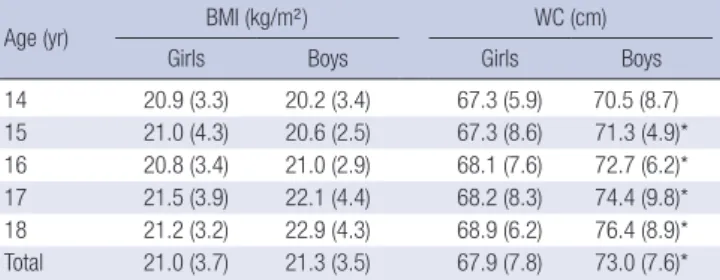
3.7 kg/m²) and boys (21.3 ± 3.5 kg/m²) at all ages (P > 0.05). Boys presented a greater WC (73.0 ± 7.6 cm) than girls (67.9 ± 7.8 cm) at most ages (P < 0.05).
Table 3 shows the crude and adjusted effect of predictors or risk factors for abdominal obesity. After adjusting for variables of Block I, being in the second year (odds ratio [OR] = 0.41; 95%
CI: 0.19-0.88) and third year (OR = 0.18; 95% CI: 0.06-0.59) of high school was found to be a protective factor against abdominal obesity. None of the variables of Block II was associated with ab- dominal obesity in the adjusted model. After adjustment, ado- lescents presenting poor aerobic fitness had a 4.10 times higher probability (95% CI: 1.62-10.4) of abdominal obesity. Excess
weight was a very strong risk factor for abdominal obesity (OR = 208.6; 95% CI: 47.7-911.7).
DISCUSSION
This school-based study was designed to investigate the distri- bution of different health outcomes among adolescents from public schools in Florianópolis, Santa Catarina, Brazil. A marked prevalence of abdominal obesity was observed among the ado- lescents studied and possible predictors of this metabolic risk were identified. These findings may contribute to the elabora- tion of collective health promotion programs aimed at combat- ing and preventing central fat.
Fernandes et al. (5) investigated students from public and pri- vate schools in Presidente Prudente, São Paulo, using the same cut-off values as the present study and found that 14.8% of the adolescents had abdominal obesity. In a cross-sectional study involving adolescents from the southeast of Brazil, the prevalence of abdominal obesity was 15.4% (14). These prevalence rates are higher than those found in the present study, indicating that es- timates of abdominal obesity differ between regions. This differ- ence between regions was demonstrated in a study comparing the prevalence of central obesity between adolescents from the United States (34.7%) and South Korea (8.4%) (2). A study con- Table 2. Body mass index and waist circumference of the adolescents studied accor
ding to age (Florianópolis, Brazil)
Age (yr) BMI (kg/m²) WC (cm)
Girls Boys Girls Boys
14 20.9 (3.3) 20.2 (3.4) 67.3 (5.9) 70.5 (8.7)
15 21.0 (4.3) 20.6 (2.5) 67.3 (8.6) 71.3 (4.9)*
16 20.8 (3.4) 21.0 (2.9) 68.1 (7.6) 72.7 (6.2)*
17 21.5 (3.9) 22.1 (4.4) 68.2 (8.3) 74.4 (9.8)*
18 21.2 (3.2) 22.9 (4.3) 68.9 (6.2) 76.4 (8.9)*
Total 21.0 (3.7) 21.3 (3.5) 67.9 (7.8) 73.0 (7.6)*
Results are reported as the mean (standard deviation). *P < 0.05 (Student ttest for independent samples). BMI, body mass index; WC, waist circumference.
Table 3. Crude and adjusted odds ratios for abdominal obesity according to sociodemographic and behavioral characteristics, aerobic fitness and nutritional status of the ado
lescents studied (Florianópolis, Brazil) Parameters
Abdominal obesity
Crude analysis Adjusted analysis
OR 95% CI P OR 95% CI P
Gender Female Male
1
0.97 (0.511.86) 0.928
Age† 0.83 (0.621.10) 0.196 1.19 (0.841.69) 0.321
Socioeconomic class A + B
C + D + E 1
1.41 (0.742.69) 0.290
Household head’s education ≤ 8 yr
> 8 yr 1.18
1 (0.612.25) 0.627
Grade 10th 11th 12th
1 0.49 0.25
(0.250.96) (0.090.68)
0.039 0.007
1 0.41 0.18
(0.190.88) (0.060.59)
0.022*
0.005*
Physical activity Active Sedentary
1
1.80 (0.933.47)
0.080 1
1.87 (0.963.62) 0.065
Eating habits Adequate Inadequate
1
3.25 (0.4424.1) 0.25
Aerobic fitness Good Poor
1
7.34 (3.6214.8) < 0.001
1
4.10 (1.6210.4) 0.003*
Nutritional status Normal Excess weight
1
271.7 (63.51161.6) < 0.001
1
208.6 (47.7911.7) < 0.001*
*P < 0.05; †Variable continuously included in the model. OR, odds ratio; 95% CI, 95% confidence interval.
ducted in India on adolescents aged 12 to 17 yr reported a prev- alence of abdominal obesity of 4% (3). The authors emphasized that, in addition to hereditary and lifestyle factors that might ac- count for differences between regions, the lack of consensus re- garding cut-off values for the prediction of abdominal obesity impairs comparisons between studies. This fact supports the need for investigations establishing predictors of abdominal obe- sity and specific cut-off values for each country.
The present study was consistent in demonstrating a higher prevalence of abdominal obesity among adolescents in the first year of high school, associated with low aerobic fitness and ex- cess weight. No studies are available that include school grade as a variable associated with abdominal obesity. However, since school grade is a predictor of educational level, it might be asso- ciated with some health outcomes as observed for maternal and paternal educational level (5).
With respect to aerobic fitness, Janz et al. (15) investigated this parameter and metabolic components in children and adoles- cents over a period of 5 yr. The authors observed that good aer- obic fitness reduces the risk of abdominal obesity by 15%, ele- vated total cholesterol levels by 11%, and elevated LDL-choles- terol levels by 5%. Supporting these findings, an experimental study investigating the effects of 16-week aerobic exercise inter- ventions found that improved aerobic fitness reduced abdomi- nal, subcutaneous and visceral fat (16). Thus, one of the strate- gies to reduce abdominal obesity and the risks associated with this condition is to encourage physical exercise that improves aerobic fitness.
Excess weight has been associated with abdominal obesity.
Park et al. (2) investigated metabolic risk factors in North Amer- ican and Asian adolescents. The authors reported a prevalence of abdominal obesity of 61.3% and 87.7% among overweight and obese adolescents from the United States, respectively, and of 26.4% and 64.9% among overweight and obese adolescents from South Korea. Fernandes et al. (5), analyzing family factors associated with abdominal obesity, observed that not only ex- cess weight of the adolescents but also excess weight of the par- ents was associated with abdominal obesity. In this respect, strategies against abdominal obesity must include the combat and prevention of excess weight. In addition to the school that should provide guidance regarding the importance of a healthy lifestyle, including regular physical activity, improvement of aerobic fitness and healthy eating habits, the family may espe- cially contribute to the combat of excess weight by encouraging and providing opportunities for these behaviors and by serving as a reference (5).
No association between abdominal obesity and physical ac- tivity was observed in the present study. In adolescents, this as- sociation is being investigated (17-19) but the results are not con- clusive. Ortega et al. (17), studying the physical activity pattern of Swedish children and adolescents by accelerometry, found
that subjects performing vigorous physical activity (> 6 METs) presented a smaller WC than those performing mild to moder- ate activities. Kelishadi et al. (18) observed no association be- tween physical activity evaluated by a questionnaire and ab- dominal obesity in Iranian adolescents. According to Kim and Lee (19), these findings suggest two situations: 1) abdominal obesity is inversely associated with vigorous physical activity; 2) there is no association between abdominal obesity and physi- cal activity level when the latter is investigated using a question- naire. Questionnaires do not directly evaluate these activities and most of them do not distinguish between different types of physical activity (19).
With respect to eating habits, international studies indicate that excess consumption of certain types of foods is associated with abdominal obesity (20, 21). Studying Irish adults, McCar- thy et al. (20) showed that subjects consuming 1 g/day addition- al red meat in the form of hamburgers, hot dogs and sausages and canned meat presented a 1% higher chance of developing abdominal obesity. An Italian cross-sectional study demonstrat- ed that excess intake of total fat was positively associated with an increased WC, irrespective of gender (21). Brazilian studies investigating the association between the consumption of cer- tain types of food and abdominal obesity are scarce. Therefore, studies performing a detailed analysis of the association between the type of food and central fat in Brazilian adolescents are nec- essary.
The cut-off values for abdominal obesity proposed by Taylor et al. (4) were developed for children and adolescents aged 3 to 19 yr from New Zealand. These values were chosen in the pres- ent study since there are no critical WC values for abdominal obesity developed for a sample of Brazilian adolescents. In ad- dition, Taylor et al. (4) found a high sensitivity and specificity between WC cut-off values and trunk fat mass evaluated by DXA.
Furthermore, previous studies involving adolescents from oth- er Brazilian cities (5, 14) also used the cut-off values proposed by Taylor et al. (4), a fact permitting comparison between differ- ent Brazilian localities.
The main limitation of the present study is that no hereditary factors were analyzed as predictors of abdominal obesity in ad- olescents. An association between parental and childhood obe- sity has been reported in other studies (5). Another limitation was the lack of critical values for abdominal obesity developed for a sample of Brazilian adolescents. The use of the New Zea- land cut-off values might have underestimated the prevalence of abdominal obesity because of its high frequency in that pop- ulation (4).
The present school-based cross-sectional study and subse- quent multivariate analysis of the data permitted to estimate the prevalence of abdominal obesity among adolescents and to identify associated factors. Knowledge about the distribution of abdominal obesity in the population contributes to the planning
of more effective measures to reduce this public health prob- lem. However, in order to propose effective actions, it is neces- sary to understand that, although factors associated with abdom- inal obesity such as level of aerobic fitness and nutritional sta- tus are considered to be modifiable, different levels of actions are used to reverse this situation. This study identified factors that require the dissemination of knowledge and specific actions addressing schoolchildren and, at the same time, distal factors in the determination chain such as school grade that require the restructuring of existing social policies in the country, especially those related to school and family.
In conclusion, demographic and lifestyle factors exert an im- pact on the quantity of abdominal fat. Factors such as school grade, low aerobic fitness and excess weight are associated with central obesity.
REFERENCES
1. Gyárfás I, Keltai M, Salim Y. Effect of potentially modifiable risk factors associated with myocardial infarction in 52 countries in a case-control study based on the INTERHEART study. Orv Hetil 2006; 147: 675-86.
2. Park J, Hilmers DC, Mendoza JA, Stuff JE, Liu Y, Nicklas TA. Prevalence of metabolic syndrome and obesity in adolescents aged 12 to 19 years:
comparison between the United States and Korea. J Korean Med Sci 2010;
25: 75-82.
3. Singh R, Bhansali A, Sialy R, Aggarwal A. Prevalence of metabolic syn- drome in adolescents from a north Indian population. Diabet Med 2007;
24: 195-9.
4. Taylor RW, Jones IE, Williams SM, Goulding A. Evaluation of waist cir- cumference, waist-to-hip, and the conicity index as screening tools for high trunk fat mass, as measured by dual-energy X-ray absorptiometry, in children aged 3-19 y. Am J Clin Nutr 2000; 72: 490-5.
5. Fernandes RA, Casonatto J, Christofaro DG, Cucato GG, Oliveira AR, Freitas Júnior IF. Family factors associated with abdominal obesity in adolescents. Rev Bras Saude Mater Infant 2009; 9: 451-7.
6. Olinto MT, Costa JS, Kac G, Pattussi MP. Abdominal obesity epidemiolo- gy amongst adult women resident in Southern Brazil. Arch Latinoam Nutr 2007; 57: 349-56.
7. World Health Organization (WHO). The Second Decade: Improving Ad- olescent Health and Development. Geneva: World Health Organization;
2001.
8. Canadian Society for Exercise Physiology (CSEP). The Canadian Physi-
cal Activity, Fitness and Lifestyle Appraisal: CSEP’s guide to health active living. 2nd ed. Ottawa: Canadian Society for Exercise Physiology; 2003.
9. Cole TJ, Bellizzi MC, Flegal KM, Dietz WH. Establishing a standard defi- nition for child overweight and obesity worldwide: international survey.
BMJ 2000; 320: 1240-3.
10. Associação Brasileira de Empresas de Pesquisa (ABEP). Critério de Clas- sificação Econômica Brasil. 2003. Available at http://www.abep.org/
codigosguias/ABEP_CCEB.pdf. [accessed on 10 April 2005].
11. Marcus BH, Rossi JS, Selby VC, Niaura RS, Abrams DB. The stages and processes of exercise adoption and maintenance in a worksite sample.
Health Psychol 1992; 11: 386-95.
12. Nigg CR. There is more to stages of exercise than just exercise. Exerc Sport Sci Rev 2005; 33: 32-5.
13. Rodriguez Añez CR, Reis RS, Petroski EL. Brazilian version of a lifestyle questionnaire: translation and validation for young adults. Arq Bras Car- diol 2008; 91: 92-8.
14. Fernandes RA, Rosa CS, Buonani C, Oliveira AR, Freitas Júnior IF. The use of bioelectrical impedance to detect excess visceral and subcutaneous fat. J Pediatr (Rio J) 2007; 83: 529-34.
15. Janz KF, Dawson JD, Mahoney LT. Increases in physical fitness during childhood improve cardiovascular health during adolescence: the Mus- catine Study. Int J Sports Med 2002; 23 Suppl 1: S15-21.
16. Irving BA, Davis CK, Brock DW, Weltman JY, Swift D, Barrett EJ, Gaess- er GA, Weltman A. Effect of exercise training intensity on abdominal vis- ceral fat and body composition. Med Sci Sports Exerc 2008; 40: 1863-72.
17. Ortega FB, Ruiz JR, Sjöström M. Physical activity, overweight and cen- tral adiposity in Swedish children and adolescents: the European Youth Heart Study. Int J Behav Nutr Phys Act 2007; 4: 61.
18. Kelishadi R, Razaghi EM, Gouya MM, Ardalan G, Gheiratmand R, Dela- vari A, Motaghian M, Ziaee V, Siadat ZD, Majdzadeh R, Heshmat R, Barekati H, Arabi MS, Heidarzadeh A, Shariatinejad K; CASPIAN Study Group. Association of physical activity and the metabolic syndrome in children and adolescents: CASPIAN Study. Horm Res 2007; 67: 46-52.
19. Kim Y, Lee S. Physical activity and abdominal obesity in youth. Appl Physiol Nutr Metab 2009; 34: 571-81.
20. McCarthy SN, Robson PJ, Livingstone MB, Kiely M, Flynn A, Cran GW, Gibney MJ. Associations between daily food intake and excess adiposity in Irish adults: towards the development of food-based dietary guidelines for reducing the prevalence of overweight and obesity. Int J Obes (Lond) 2006; 30: 993-1002.
21. Leite ML, Nicolosi A. Lifestyle correlates of anthropometric estimates of body adiposity in an Italian middle-aged and elderly population: a cova- riance analysis. Int J Obes (Lond) 2006; 30: 926-34.
AUTHOR SUMMARY
Epidemiology of Abdominal Obesity among Adolescents from a Brazilian State Capital
Diego Augusto Santos Silva, Andreia Pelegrini, João Marcos Ferreira de Lima e Silva, and Edio Luiz Petroski
We investigated the effects of socioeconomic, demographic and lifestyle factors on abdominal obesity (waist circum ference) in Brazilian high school students (n = 656) from urban area. The prevalence of abdominal obesity was 6.6% (95% CI: 4.6-8.4).
Analysis of the correlation with their socioeconomic, demographic, and lifestyle-associated data showed that the 2nd and 3rd grades in high school are protective factors against abdominal obesity. In addition, students presenting low aerobic fitness and those with excess weight had a higher probability of abdominal obesity.