INTRODUCTION
Korea has been known to be one of the endemic areas in the world for hepatitis B virus (HBV) infection. According to one review article (1), the seropositivity of Hepatitis B surface antigen (HBsAg) was estimated to be 7 to 9% in the 1980s and about 60 to 70% of adults showed evidence of present or past HBV infection, although the figures var- ied somewhat depending on the characteristics of the study subjects and/or the HBV detection methods employed.
Although there have been many studies on the epidemi- ology of HBV infection in Korea, most of them were based on non-representative or small sized samples from selected communities. Fortunately, the Ministry of Health and Wel- fare (MOHW) of Korea performed a National Health and Nutrition Survey (NHNS) in 1998, which included selective serological markers for HBV infection (2). As the survey was based on a representative sample of the entire nation, this data can provide us a more comprehensive picture of the distri- bution of HBV infection in Korea.
The purpose of this study was to investigate the epidemio- logical characteristics of HBV infection in Korea based on the NHNS of 1998. More specifically, we wanted to see whether there was a geographical variation to seropositivity of HBsAg.
If so, it might suggest a new clue to the transmission route of hepatitis B.
MATERIALS AND METHODS
Our study was based on the NHNS of 1998. The study design has been described in detail elsewhere (2). Briefly, the survey consisted of four parts; the Health Interview Survey, the Health Examination Survey, the Health Behavior Survey, and the Nutrition Survey. At first, 13,523 households were selected from across the nation using a stratified multistage probability sampling design and all the family members of those households were invited to participate in the study. A total of 12,283 households (participation rate: 90.8%) par- ticipated in the survey and 94 households of them were not family-connected, so the final sample consisted of 39,060 per- sons from 12,189 households.
With the exception of the Health Interview Survey, the other three surveys were carried out on a sub-sample, which was also randomly selected from the original sample. The final sub-sample consisted of 9,771 household members aged 10 yr or over from 4,828 households. Since the information neces- sary for this study was dispersed into all surveys, this study was based on the sub-sample.
For sex- and age-specific HBsAg seropositivity, all subjects of the final sub-sample were used. Comparing HBsAg sero- positivity by demographic factors, 7,962 of the subjects aged 20 or over were included in the analyses, as the subjects aged less than 20 yr were mostly born after the introduction of Duk-Hee Lee, Jin-Ha Kim, Jung-Ja Nam*, Hye-Reon Kim*, Hai-Rim Shin�
Department of Preventive Medicine, College of Medicine, Kosin University, Busan; *Korea Institute of Health and Social Affairs, Seoul; �Division of Cancer Epidemiology & Control, National Cancer Center Research Institute, Koyang, Korea
Address for correspondence Hai-Rim Shin, M.D.
Division of Cancer Epidemiology & Control, National Cancer Center Research Institute, 809 Madu 1-dong, Ilsan-gu, Goyang 411-764, Korea Tel : +82.31-920-2050, Fax : +82.31-920-2051 E-mail : [email protected]
457
Epidemiological Findings of Hepatitis B Infection Based on 1998 National Health and Nutrition Survey in Korea
The purpose of this study was to investigate the epidemiological characteristics of hepatitis B virus (HBV) infection in Korea based on the 1998 National Health and Nutrition Survey. Study subjects consisted of 9,771 aged 10 yr or over, who were selected from across Korea using a stratified multistage probability sampling design. The prevalence of hepatitis B surface antigen (HBsAg) was compared by age, sex, residency, household income, education, family history, family size, and frequency of eating out. The prevalence of HBsAg was 5.1% (95% confidence interval (CI): 4.5-5.7) in males and 4.1% (95% CI: 3.6-4.6) in females with a low prevalence in those under 20 yr old. Generally, HBsAg seropositivity by adminis- trative area was similar with the exception of Jeju province. HBsAg seropositivity of Jeju island was approximately three times higher in both men and women, as com- pared with the national average. HBsAg seropositivity by socioeconomic status unexpectedly showed a very consistent positive association in both gender. Com- paring HBsAg seropositivity by the frequency of eating out, in both gender, the more frequent they ate out, the higher it was. Our study suggested that there might be another transmission route of HBV, which is possibly related to diet.
Key Words : Hepatitis B; Korea; Geographical Variation; Socioeconomic Factors
Received : 16 October 2001 Accepted : 12 March 2002
the vaccination program.
A 15 mL blood sample was collected from the study sub- jects and centrifuged within 30 min after sampling. The refrigerated sera were tested for HBsAg and hepatitis B sur- face antibody (anti-HBs) using ELISA tests (CODA of BIO- RAD company, California, U.S.A.) at a single laboratory. All procedures related with laboratory tests were thoroughly su- pervised by the quality control committee. Demographic and health behavior items were selected from the questionnaire, which was administered by trained interviewers.
We compared HBsAg seropositivity by age, sex, residen- cy by administrative district (metropolitan city; city; rural), household income, education, family history of liver disease, family size, and frequency of eating out. All these variables were selected as possible risk factors, based on the results of other previous studies. If required, 2test, test for trend, and logistic regression were performed by PC-SAS program.
RESULTS
Persons aged 10 yr or over showed HBsAg seropositivity of 5.1% in males and 4.1% in females. Among children and adolescents aged less than 20 yr, the positive rate was 2.1% in males and 2.7% in females. The age-specific rates showed the peak ages of positive rate as the twenties in
males and thirties in females (Fig. 1). After that age, the rates showed plateaus of a sort until the fifties and then decreas- ing trends in both males and females. Seropositivity of anti- HBs of males and females were 57.0% and 58.9%, respec- tively. Age- specific anti-HBs positivity was the highest in those aged under 20 both in males and females (Fig. 2).
We compared the HBsAg seropositivity by administra- tive area (six metropolitan cities and nine provinces) among subjects aged 20 yr or more (Fig. 3). Those figures seemed to be rather similar, with the exception of Jeju province. On Jeju Island, located far from the main land, the HBsAg seroposi- tivity was approximately three times higher in both males and females, as compared with the national average.
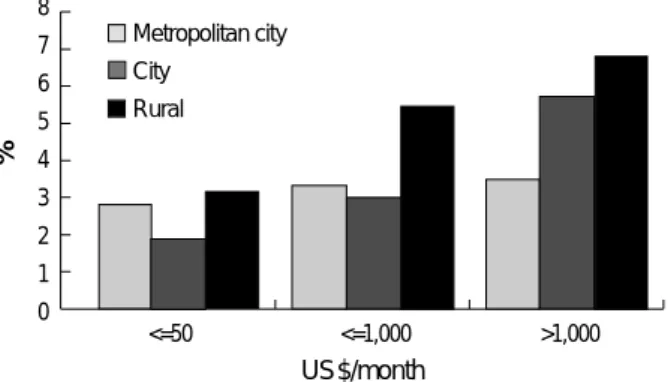
Seropositivity of HBsAg was compared by residency, house- hold income, and education, which were selected as indices of socioeconomic status (Table 1). There was little difference seen among residency. However, the HBsAg seropositivity by household income showed clear positive relationships in both males and females (p=0.001 and p=0.002, respective- ly). After being stratified by residency, the relationship rem- ained in all strata (Fig. 4). Moreover, after being stratified
Age (yr)
male female
Prevalence (%)
70 60 50 40 30 20 10
010-19 20-29 30-39 40-49 50-59 60-69 70-
Fig. 2.Age-specific prevalence of anti-HBs seropositivity based on 9,771 subjects aged 10 yr or over in Korea, 1998.
Age (yr) male
female
Prevalence (%)
8
6
4
2
0 10- 20- 30- 40- 50- 60- 70-
2.1 7 6.7 5.8 7 2.7 1.8
2.7 4.2 5.8 4.3 4.2 3.4 2.9
Fig. 1.Age-specific prevalence of HBsAg seropositivity based on 9,771 subjects aged 10 yr or over in Korea, 1998.
Seoul BusinDaeguIncheonGwangjuDaejonKyungkiKangwonChungpookChungnamChunpookChunnamKyungpookKyungnam Jeju 18
16 14 12 10 8 6 4 2 0
Fig. 3.Prevalence of HBsAgseropositivity by administrative area based on 7,962 subjects aged 20 yr or over in Korea, 1998.
male female Age-adjusted prevalence (%)
%
US$/month 8
7 6 5 4 3 2 1
0 <=50 <=1,000 >1,000
Fig. 4.Prevalence of HBsAg seropositivity according to house- hold income and residency based on 7,962 subjects aged 20 yr or over in Korea, 1998.
Metropolitan city City
Rural
by administrative area, three out of six metropolitan cities and eight out of nine provinces showed positive associations between household income and HBsAg seropositivity (data was not shown). Regarding education level, a clear positive association was also seen in males (p=0.009).
Among those with a family history of liver disease, the risk of being HBsAg-positive was about four times higher in males (20.5% vs 5.1%; p=0.001) and twice higher in females (8.8%
vs 4.1%; p=0.001) than those without a family history (Table 1). However, among HBsAg carriers, only 17.2% of males
Variables Categories Male Female
No. % p value� No. % p value�
Residency Metropolitan 1,430 5.5 0.694 1,719 4.3 0.904
City 905 6.2 1,073 4.6
Rural 1,262 5.9 1,573 4.4
Household income -500 693 3.5 0.001 978 2.9 0.002
(US$/month) 501-1000 1,048 5.3 1,249 4.1
1000- 1,856 7.0 2,138 5.3
Education (yr) -6 770 4.0 0.009 1,659 3.4 0.088
7-9 508 5.3 621 6.1
10- 2,319 6.5 2,085 4.7
Family history No 3,421 5.1 0.001 4,091 4.1 0.001
Yes 176 20.5 274 8.8
Family size 1-2 778 4.4 0.266 1,093 3.8 0.962
(number) 3-4 2,029 6.4 2,280 5.0
5- 790 5.7 992 3.7
Frequency of Rarely 1,281 4.2 0.003 2,133 3.9 0.003
eating out ≥1/month 717 6.6 1,048 3.4
≥1/week 1,416 6.5 1,097 5.9
≥1/day 183 8.7 87 9.2
Overall HBsAg Age≥20 yr* 3,597 5.8 (5.0-6.6)� 4,365 4.4 (3.8-5.0)�
seropositivity Age≥10 yr� 4,514 5.1 (4.5-5.8)� 5,257 4.1 (3.6-4.7)�
Table 1.Seropositivity of HBsAg by socioeconomic status, family history of liver disease, family size, and frequency of eating out in Korea, 1998*
*: Based on 7,962 subjects aged 20 yr or over, �: p values are based on 2test or test for trend, �: Based on 9,771 subjects aged 10 yr or over, �: 95%
confidence interval.
Variables� Categories Crude Adjusted
No. OR 95% CI OR 95% CI
Age (yr) ≥60 1,611 1.0 1.0
20-59 6,351 2.0 1.5, 2.8 1.5 1.0, 2.1
Sex Female 4,365 1.0 1.0
Male 3,597 1.3 1.1, 1.6 1.3 1.0, 1.6
Province Others 7,882 1.0 1.0
Jeju 80 3.4 1.8, 6.3 3.1 1.7, 5.9
Household income -500 1,671 1.0 1.0
(US$/month) 501-1,000 2,297 1.5 1.1, 2.1 1.3 0.9, 1.8
1,000- 3,994 2.0 1.5, 2.7 1.6 1.1, 2.6
Education (yr) -6 2,429 1.0 1.0
7- 5,533 1.6 1.3, 2.0 1.0 0.7, 2.6
Family history No 7,512 1.0 1.0
Yes 450 3.2 2.4, 4.3 3.2 2.4, 4.3
Family size 1-2 1,871 1.0 1.0
3-4 4,309 1.4 1.1, 1.9 1.0 0.8, 1.4
5- 1,782 1.2 0.8, 1.6 0.8 0.6, 1.2
Frequency of <1/week 5,179 1.0 1.0
eating out ≥1/week 2,783 1.6 1.3, 1.9 1.3 1.1, 1.7
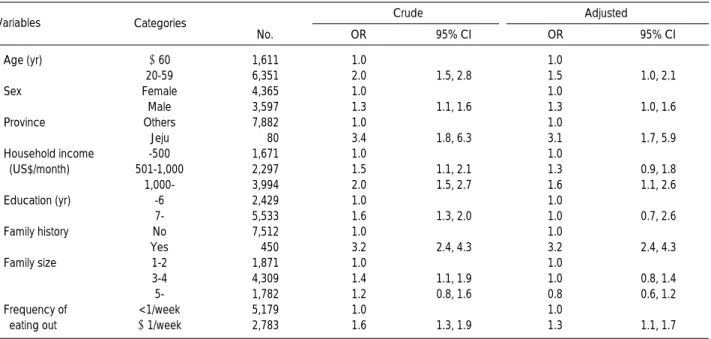
Table 2.Multiple logistic regression of the relationship between socioeconomic status, family history of liver disease, family size, and frequency of eating out risk factors and presence of HBsAg in Korea 1998*
*: Based on 7,962 subjects aged 20 yr or over, �All variables included in the final model were displayed.
and 12.5% of females demonstrated a family history of liver disease. The HBsAg seropositivity did not show any trend relating to the family size (Table 1). Comparing the HBsAg- positivity by the frequency of eating out in both males and females, the more frequent the subject ate out, the higher their HBsAg-positivity was (p=0.003 and p=0.003, respec- tively) (Table 1).
The simultaneously adjusted odds ratios are shown in Table 2. Age, sex, household income, province, family history of hepatitis, and frequency of eating out were all significantly associated with HBsAg seropositivity.
DISCUSSION
The present study is the first report for the status of HBV infection based on a representative sample from the whole population in Korea, even though there is no information concerning HBV vaccination history and several important risk factors related with HBV infection.
Seropositivity of HBsAg at 5.1% in males and 4.1% in females were approximately one-half or two-thirds of the fig- ures seen in the 1980s (1), though there was no earlier study comparable to the present one in respect to study design. In particular, seropositivity of HBsAg among children and ado- lescents aged less than 20 was dramatically decreased to 2%, about one-third of those of earlier studies. All these findings reflect the effectiveness of Korea’s vaccination program.
Except for those under 20 yr, the age-specific curves of HBsAg and/or anti-HBs positivity were very similar with those of studies performed before the introduction of the vac- cination program. Generally, early studies showed their peak of seropositivity in twenties, a rather plateau until sixties, and then a decrease.
This study presents us at least two interesting findings, which could provide a clue to the transmission route of HBV.
One is the higher HBsAg seropositivity among those living in Jeju Island and/or among those who eat out frequently. The other is an unexpectedly clear positive association between HBsAg seropositivity and socioeconomic status.
In this study, we compared HBsAg seropositivity among the various administrative areas. The HBsAg-positivity seemed to be similar across the areas with the exception of Jeju province.
It is an interesting finding considering that Korea is a small country with a very homogenous population. Jeju province, an island located far from the main land, showed an approxi- mately three times higher positivity than the national aver- age, both in males and females. We examined the association of the variables analyzed with HBsAg seropositivity among persons living on Jeju Island. Although multivariate analysis was impossible due to the small sample size, the result was similar with that of the whole sample. This suggests that Jeju island is not different from other areas in Korea in terms of risk factors of HBV infection.
This is not the first study reporting a high HBsAg seropos- itivity in Jeju Island. Studies (3, 4) performed before the intro- duction of the hepatitis vaccination program also showed the same finding. So, it may be a true figure reflecting some envi- ronmental factors existing in Jeju Island, in relation to the high HBsAg seropositivity.
In addition, several papers from Korea reported a some- what higher seropositivity in coast areas (5), small islands (6), or provinces with long coastlines (7), however, they were generally based on not-representative or small-sized samples.
Other countries (8-12) have also reported geographical vari- ations of HBsAg seropositivity within their countries. Among them, the study from China (8) showed a higher positivity of HBsAg in coast areas, comparable with ones from Korea.
These descriptive observations suggest a possibility that sea-related environmental factors are involved in the trans- mission of HBV. In this case, seafood might be thought as one of possible sources of transmission, because some seafood could be consumed as raw. Interestingly, in the 1960s and 1970s, there were two papers (13, 14) that reported detec- tion of HBsAg in shellfish taken from polluted area and evidence of shellfish to shellfish transmission. Relating to this hypothesis, another important finding of our study was that the HBsAg positivity increased depending on the frequency of eating out, suggesting HBsAg seropositivity might be associated with diet itself or diet-related behavior.
As perinatal and childhood transmission have been gener- ally regarded as important transmission routes in a highly endemic area such as Asia, the hypothesis of the current expo- sure to some food being involved in the transmission in HBV seems unlikely. However, cohort studies from Korea (6, 15) demonstrated that the HBV infection occurs commonly in adulthood, however most of those infected in their adulthood tended to be transient carriers, whereas those infected in young age tended to be chronic carriers. This finding has been supported by one prospective study from Alaska (16).
The prevalence of HBsAg carrier of the present study was determined at a single time point, so transient carriers would have been mixed with chronic carriers.
Fortunately, we had data supporting that there would be a substantial portion of transient carriers, especially among subgroups with a high seropositivity of HBsAg in our study (living in Jeju Island and/or eating out frequently). A report (17) from China showed that chronic HBV infection, which usually starts in early childhood, leads to a lower lipid con- centration in adulthood, since the liver plays a fundamental role in lipid metabolism. In their study, the blood concentra- tion of lipid was significantly lower among healthy HBsAg car- riers, as compared with than among non-carriers. Our study subjects also showed the same tendency (data not shown).
However, in case of the subgroups with a high prevalence of HBsAg, the mean concentrations of cholesterol in carriers and non-carriers were similar and that of triglyceride was even higher among carriers than among non-carriers. This suggests
that a substantial portion of carriers from these subgroups with a high seropositivity of HBsAg would have been recently infected via an unknown route of transmission, which might currently exist among these subgroups. The relationship between the carrier state and lipid concentrations will be ana- lyzed in detail in our forthcoming paper.
Surprisingly, this study demonstrated a very consistent pos- itive association between HBsAg seropositivity and socioeco- nomic status, particularly the household income level. This relationship was observed in both males and females, and even after stratification by urban-rural residency or administrative area.
Until now, the HBV infection has been also known to be more common in underdeveloped or developing countries than developed countries like other infectious diseases. Within a country, studies from U.S.A. (18), Italy (9), and Jordan (12) have indicated that the HBV infection is associated with lower socioeconomic status. It has been attributed to a crowded home environment and/or poor environmental or personal hygiene. In addition, since those with a higher socioeconomic status tend to receive vaccination more often, the positive association shown in this study is certainly an unexpected one.
As far as we know, this is the first study reporting a posi- tive association between HBsAg seropositivity and socio- economic status on an individual basis, although there is an ecological data (17) on 81 villages in rural China showing a positive correlation between the prevalence of HBsAg and the mean lipid concentration. They interpreted that differ- ences in mean lipid concentration were probably associated with differing degrees of urbanization and industrialization, which could be another index of socioeconomic status.
We believe that it is likely true, considering the random nature of sampling of study subjects and the striking consis- tency of our findings. If the negative findings of other coun- tries were also true, the association between HBV infection and socioeconomic status may not simply be a function of a crowded home environment and/or poor environmental or personal hygiene. This may reflect a relationship with other cultural factors. For example, there may be certain factors that are common in those with a high socioeconomic status in some countries but common to lower classes in other countries.
There would be a possibility that persons with higher income may be more exposed to the known exposure routes, such as transfusion, medical procedures, drug use, or sexual behavior, than those with lower income. We could not totally exclude this possibility because information on these factors was not examined in this study. However, as far as we know there has been no report suggesting this possibility in any country as well as Korea and it would be difficult to think that these known risk factors are common in the high socio- economic class only in Korea. Our data have demonstrated that the unknown factor related with the high income should be general because a positive association appeared across most strata stratified by sex, urban-rural residency, or admin-
istrative area. In this case, we could think of the relation with nutrition or diet once again. In particular, raw seafood is gen- erally an expensive food in Korea and more accessible to per- sons with high income. On the other hand, there is an inter- esting paper (19) on the epidemiology of non-A, non-B hep- atitis in the United States, comparable to ours, which showed that individuals with non-A, non-B hepatitis who had clear parenteral exposures had a lower socioeconomic status, but those without a history of parenteral exposures (possibly asso- ciated with personal contact, ingestion of raw shellfish, or no known risk factor) had a higher socioeconomic status.
Despite the limitation in interpretation due to the cross- sectional nature of the study design, our results imply the possibility of existence of another transmission route, proba- bly related to diet. Although the HBV vaccination program has resulted in a decline of HBV infection in Korea, we must uncover other possible transmission routes in order to fur- ther prevent HBV infection.
REFERENCES
1. Chun BY, Lee MK, Rho YK. The prevalence of hepatitis B surface antigen among Korean by literature review. Korean J Epidemiol 1992; 14: 54-62.
2. Korea Institute for Health and Social Affairs. Report of national health and nutrition survey 1998. Seoul 1999 (in Korean).
3. Kim SJ, Bom HS, Cho KH, Nam KW, Hong KP, Kim CS. A study for HBsAg and anti-HBs positivites in Chonnam and Cheju provin- cial officials, 1984. Korean J Int Med 1986; 31: 313-7.
4. Shin HC, Kim JS. A study on the HBsAg positive rate among Kore- an adults and the immunogenicity of hepatitis B vaccine. Korean J Epidemiol 1989; 11: 98-106.
5. Kim JS, Chung MH, Suh SC. HBsAg positive rate among Korean urban and rural middle school children. Korean J Epidemiol 1986;
8: 115-26.
6. Kim IS, Oh HC, Lee Y, Kim JD, Lee WY. Prevalence and changes of HBsAg and Anti-HBs for one year period in natural status and after hepatitis B vaccination. Korean J Epidemiol 1987; 9: 40-8.
7. Ahn YO, Kim JY, Lee JB, Park BJ, Kwon EH, Lee JH, Kim NK.
An epidemiologic observation on HBs antigenemia in Korean vol- untary blood donors for the 6 1/3 years period. J Korean Med Assoc 1983; 26: 425-37.
8. Chen J, Campbell TC, Li J. Diet, lifestyle, and mortality in China: a study of the characteristics of 65 Chinese counties. Joint publication of Oxford University Press (Oxford, England), Cornell University Press (Ithaca, NY), and China People’s Medical Publishing House (Beijing,China), 1990.
9. Pasquini P, Kahn HA, Pileggi D, Pana A, Terzi J, Guzzanti E.
Prevalence of hepatitis B markers in Italy. Am J Epidemiol 1983;
118: 699-709.
10. D’Amelio R, Matricardi PM, Biselli R, Stroffolini T, Mele A, Spada E, Chionne P, Rapicetta M, Ferrigno L, Pasquini P. Changing Epi- demiology of hepatitis B in Italy: Public health implications. Am J
Epidemiol 1992; 135: 1012-8.
11. Inskip HW, Bradley AK, McLaughlan K, Shenton F, Lamb W, Eccles J, Baker SA, Hall AJ. The pattern of childhood hepatitis B infection in two Gambian villages. J Inf Dis 1990; 161: 1112-5.
12. Toukan AL, Sharaiha ZK, Abu-el-rub OA, Hmoud MK, Dahbour SS, Abu-hassan H, Yacoub SM, Hadler SC, Margolis HS, Coleman PJ, Maynard JE. The epidemiology of hepatitis B virus among fami- ly members in the middle east. Am J Epidemiol 1990; 132: 220-32.
13. Kater RMH, Kim CY, Davidson CS. Australia antigen and viral hepatitis. J Inf Dis 1969; 120: 391-2.
14. Mahoney P, Fleischner G, Millman I, London WT, Blumberg BS, Arias IM. Australia antigen: detection and transmission in shellfish.
Science 1974; 183: 80-1.
15. Park BJ, Ahn YO. Cohort study on the asymptomatic chronic carri- er rate of hepatitis B virus among male adults in Korea. Korean J
Epidemiol 1989; 11: 263-73.
16. McMahon BJ, Alward WL, Hall DB, Heyward WL, Bender TR, Francis DP, Maynard JE. Acute hepatitis B virus infection: relation of age to the clinical expression of disease and subsequent develop- ment of the carrier state. J Infect Dis 1985; 151: 599-603.
17. Chen Z, Keech A, Collins R, Slavin B, Chen J, Campbell TC, Peto R.
Prolonged infection with hepatitis B virus and association between low blood concentration and liver cancer. BMJ 1993; 306: 890-4.
18. Szmuness W. Recent advances in the study of the epidemiology of hepatitis B. Am J Pathol 1975; 81: 629-50.
19. Alter MJ, Smallwood GLA, Sampliner RE, Deinhardt ETF, Frosner G, Matanoski GM. Sporadic Non-A, Non-B hepatitis: frequency and epidemiology in an urban U.S. population. J Inf Dis 1982; 125:
886-93.
. .