INTRODUCTION
The burden of disease of a specific group of population can be determined by measuring the difference between actual health status and ideal health status (1). As for the classical methods of measuring the actual health status of the popu- lation of interest, the typical indices are morbidity and mor- tality. In other words, the two effects of diseases in a certain population group are divided into the prevalence state and death. Other measures are related either directly or indirectly with these two effects, and include pain, suffering, fear, work- ing hours and income lost, worry, apprehension, and destruc- tion of the family (2). However, in the case of more advanced countries, measuring health status only through mortality is no longer valid, and incidence also has its drawbacks, as it does not include some measures of improved health status after suffering from diseases (3).
Ideal health status values could vary as they depend on value choices of a certain society. These might include setting lim- its of ideal life expectancy, granting an age weighting, which would account for health losses during adolescence, middle age and senescence, the issue of discounting future health status with the current level of health, and deciding upon health loss due to prevalence state and death. As a result, com- prehensive approaches to actual health status and ideal health
status, which are the two aspects of the burden of disease, are non-existent due to the lack of an agreed measuring system.
Recently, a number of approaches for measuring health status have been developed that combine the mortality and morbidity levels into a composite indicator. The main rea- son for producing such as index is that it would provide us with a measure of the benefits of health intervention. Thus, health care intervention should be expressed with a single index uni-dimensional estimation (4). However, as yet these indices have not been agreed extensively by those responsible for health care resource allocation (2).
The allocation of health care resources has recently become a more important issue in many countries that experienced resource limitation (5, 6). Thus, the allocation of such lim- ited available health care resources demands an agreed ratio- nal allocation principle and the consequent priority setting is of considerable importance. Ideally, priorities should be determined on the basis of obtaining the greatest benefit from health care expenditure (2, 7). However, approaches made in accord with the rational allocation principle, as related to deciding benefit from the aspect of health in the public health fields are nevertheless still not being applied (8).
In order to rationalize health care allocation, a rational eval- uation for improving overall health status of the applicable population must be agreed (9, 10), and to rationally evaluate
Seok-Jun Yoon, Heeyoung Lee, Youngsoo Shin*, Yong-Ik Kim*, Chang-Yup Kim�, Hyejung Chang�
Department of Preventive Medicine, Korea University College of Medicine, Seoul; Department of Health Policy and Management*, Seoul National University College of Medicine, Seoul; Department of Health Services Management�, KyungHee University, Seoul; School of Public Health�, Seoul National University, Seoul, Korea
Address for correspondence Seok-Jun Yoon, M.D.
Department of Preventive Medicine, Korea University College of Medicine,126-1 Annam-dong, Sungbuk- gu, Seoul 136-075, Korea
Tel : +82.2-920-6412, Fax : +82.2-927-7220 E-mail : [email protected]
604
Estimation of the Burden of Major Cancers in Korea
We estimated the burden of diseases in Korea especially caused by major can- cers using DALY (disability adjusted life year) measurement. Firstly, the burden of disease due to premature death was estimated by using YLLs (years life lost due to premature death) measurement developed by the global burden of dis- ease study group. Secondly, for the calculation of the YLD (years lived with dis- ability), the following parameters were estimated in the formula; incidence rate, case fatality rate and disability weight of major cancers. Thirdly, we estimated DALY of major cancers by adding YLLs and YLDs. The burden of major cancers for male per 100,000 population was attributed mainly to liver cancer (528.8 per- son-year), stomach cancer (451.4 person-year), and lung cancer (374.9 person- year). The burden of major cancers for female per 100,000 population was attribut- ed mainly to liver cancer (140.0 person-year), stomach cancer (259.7 person- year), and lung cancer (125.2 person-year). Each of these cancers was respon- sible for the loss of over 100 person-year per 100,000 population based on our DALY measurement. We found the DALY method employed was appropriate to quantify the burden of disease. Thereby, it would provide a rational bases to plan a national health policy regarding the burden of disease caused by major can- cers in Korea
Key Words : Death; Neoplasms; Health Policy
Received : 21 March 2002 Accepted : 23 May 2002
policies related to improved overall health status, the follow- ing four informational requirements are prerequisites. The first requirement is that the information has a reliable epi- demiological basis and that it accurately evaluates the dis- ease burden; the second concerns the possible use and distri- bution status of health care resources; the third involves a strategic evaluation of health care policy; and the fourth re- quires information on strategies for improving health and cost-effectiveness with respect to potentially usable technolo- gies (11). To enable the possibility of such a rational evalua- tion, it is essential that we determine what should be mea- sured and what could be measured.
Recently, the World Health Organization (WHO), the World Bank, and the School of Public Health at Harvard University sanctioned work related to the global burden of disease (GBD). This research program commenced in 1992 and involved many researchers, and the results have been pub- lished in many forms (1). Based on the study results of GBD in each country, these researchers are recommending that in- dividual nations expedite burden of disease studies at the national level (national burden of disease: NBD). As a direct consequence, NBD studies have been or are being performed in more than 20 countries, including Mexico, Japan, and several European and African countries (8, 12-15).
The disease structure in Korea is changing rapidly as in- comes improve, and the most important characteristics of the changes in disease structure are caused by the increase in non-infectious diseases and the importance of chronic diseases as opposed to acute diseases, and in particular, the mortality and morbidity status of cancer, is the most representative example of chronic diseases and which is steadily increasing (16). In Korea, interest has increased in the cancer field with the introduction of a comprehensive management plan at the national level, including the establishment of the National Cancer Center and the Cancer Research Institute (17, 18). At this moment in time to arrive at more effective policy mea- sures and establish strategies to overcome cancer we should better understand the actual disease burden imposed by can- cer in Korea and understand the basis of health care resource allocation. These are the important tasks that can make con- quering cancer possible.
As to the above background, this study was carried out to measure the gaps between ideal health status and present health status with respect to the burden of disease imposed by major cancers in Korea.
MATERIALS AND METHODS
To estimate the disease burden of major cancers in Korea, we followed closely the approach taken in the original GBD study. First, we estimated the years of life lost due to prema- ture death (YLLs) from major cancers. Secondly, we estimated years lived with disability (YLDs) due to cancer. To calculate
YLDs we estimated some of the epidemiological indicators of major cancers, such as, the incidence rates, fatality rates, and remission rates. Thirdly, using these results, we calculat- ed the disability adjusted life years (DALY) of major cancers in Korea.
The detail of study methods used were as follows.
To estimate years of life lost due to premature death (YLLs), we initially developed estimates of population and deaths by each age group and sex. The estimates of cause-specific mortality were based on vital registration data, maintained by the National Statistical Office. These data, available since 1991 in a computerized format, were regarded as being reli- able, and only 0.8 per cent of causes of death were missing as of 1995.
We estimated years of life lost due to premature death (YLLs) from major cancer diseases.
Firstly, we estimated the age-specific standard life expectan- cy, age at death, sex, and cause of death using the national death certificate data and life table, which is produced by the National Statistical Office. Estimates of cause-specific mor- tality were based on vital registration data, maintained by the National Statistical Office (NSO). Vital event registration, which contains computerized data from 1991, offers a con- tinuous means of tracking deaths by age and cause. The data used for analysis was for the year 1996.
Secondly, we estimated the age group specific years of life lost due to premature death using standard expected years of life lost (SEYLL)
Thirdly, the final burden of disease due to premature death was estimated by applying the YLLs function as suggested by the Global Burden of Disease study group.
To estimate years lived with disability (YLDs), the follow- ing epidemiological parameters were estimated in the for- mula.
Firstly, the health insurance claim data during the period 1991-1996 were converted to person-based health utiliza- tion data from claim-based data. Patients who sought health care for some particular cancer for the first time in 1996 were considered as incident cases. The estimate of incidence rate was produced by dividing the number of incident cases by the population.
Secondly, case fatality rate was estimated as follows; the number of deaths due to each type of malignant neoplasm were divided by the number of incident cases.
Thirdly, to calculate disability weight, we estimated the disability weights by the Delphi method. For each cancer type 20 professional panels were recruited to estimate disabil- ity weight.
Fourthly, to estimate the expected duration at disability and the average age at onset, the expected duration of dis- ability and average age of onset were calculated using the DISMOD method as developed by the GBD researchers (1).
We then estimated the final burden of disease due to dis- ability caused by malignant neoplasms as years lived with
the disability function, which was supplied by the Global Burden of Disease study group.
To calculate disability adjusted life years (DALY) for major cancers in Korea, we used the YLL and YLD results and DALY of major cancers in Korea were summed.
RESULTS
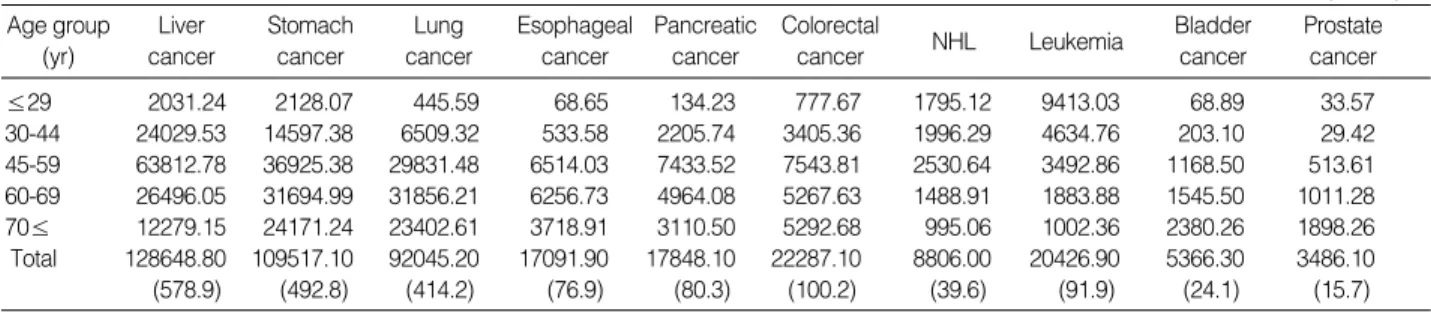
When the years of life lost due to premature death for male were calculated using SEYLL based on the 1995 life table prepared by the National Statistical Office, the results showed that the lost years due to liver cancers were 128,648 person- years, stomach cancer 109,517, lung cancer 92,045, esopha- geal cancer 17,091, pancreatic cancer 17,848, colorectal can- cer 22,287, non-Hodgkin’s lymphoma 8,806, leukemia 20, 426, bladder cancer 5,366, and prostate cancer 3,486 person- years. When the burden of disease due to premature death was calculated per 100,000 men in Korea, the results showed that the years lost per 100,000 for liver cancer was 578.9 per- son-years, stomach cancer 492.8, lung cancer 414.2, esopha- geal cancer 76.9, pancreatic cancer 80.3, colorectal cancer 100.2, non-Hodgkin’s lymphoma 39.6, leukemia 91.9, blad- der cancer 24.1, and prostate cancer 15.7. Among these can- cers, those accounting for more than 100 yr per 100,000 men lost were, liver cancer, stomach cancer, lung cancer, and col- orectal cancer (Table 1).
When the years of life lost due to premature death for fe- males were calculated using SEYLL on the basis of the 1995 life table prepared by NSO, the results showed that 33,766
person-years were lost years due to liver cancers, stomach can- cer 63,034, lung cancer 30,219, esophageal cancer 1,849, pancreatic cancer 11,213, colorectal cancer 19,194, non- Hodgkin’s lymphoma 4,754, leukemia 15,478, cervical can- cer 11,578, breast cancer 19,328, and ovarian cancer 6,436.
When burden of disease due to premature death was calcu- lated per 100,000 women in Korea, the results showed that 151.9 person-years were lost per 100,000 women for liver cancer, stomach cancer 283.7, lung cancer 135.9, esophageal cancer 8.3, pancreatic cancer 50.1, colorectal cancer 86.4, non- Hodgkin’s lymphoma 21.4, leukemia 69.7, cervical cancer 52.1, breast cancer 87.0, and ovarian cancer 28.9 person-years.
Among these cancers, those accounting for more than 100 yr per 100,000 women were liver cancer, stomach cancer, and lung cancer (Table 2).
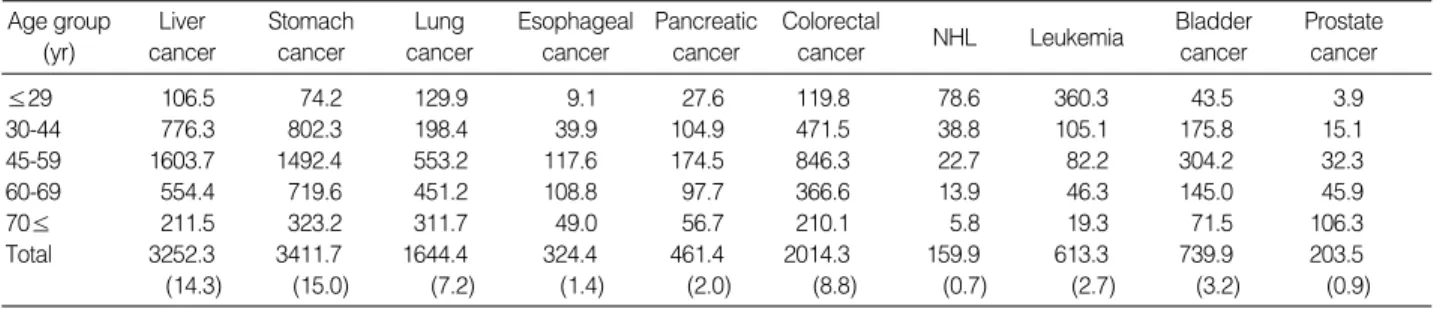
When years lived with disability for male were calculated according to the epidemiological estimate results, the calcu- lation showed that in the case of Korean men, the YLD were 3252.3 person-years for liver cancer, 3411.7 for stomach can- cer, 1644.4 for lung cancer, 324.4 for esophageal cancer, 461.4 for pancreatic cancer, 2014.3 for colorectal cancer, 613.3 for leukemia, 159.9 for non-Hodgkin’s lymphoma, 739.9 for bladder cancer, and 203.5 for prostate cancer. When these figures were converted to years per 100,000 in the general population, years lived with disability per 100,000 were 14.3 person-years for liver cancer, 15.0 for stomach cancer, 7.2 yr for lung cancer, 8.8 yr for colorectal cancer, 2.0 yr for pancre- atic cancer, 1.4 for esophageal cancer, 3.2 yr for bladder can- cer, 0.9 for prostate cancer, 2.7 for leukemia, and 0.7 for non- Hodgkin’s lymphoma. Liver cancer and stomach cancer show-
≤29 2031.24 2128.07 445.59 68.65 134.23 777.67 1795.12 9413.03 68.89 33.57
30-44 24029.53 14597.38 6509.32 533.58 2205.74 3405.36 1996.29 4634.76 203.10 29.42
45-59 63812.78 36925.38 29831.48 6514.03 7433.52 7543.81 2530.64 3492.86 1168.50 513.61 60-69 26496.05 31694.99 31856.21 6256.73 4964.08 5267.63 1488.91 1883.88 1545.50 1011.28
70≤ 12279.15 24171.24 23402.61 3718.91 3110.50 5292.68 995.06 1002.36 2380.26 1898.26
Total 128648.80 109517.10 92045.20 17091.90 17848.10 22287.10 8806.00 20426.90 5366.30 3486.10
(578.9) (492.8) (414.2) (76.9) (80.3) (100.2) (39.6) (91.9) (24.1) (15.7)
NHL Leukemia Lung
cancer
Esophageal cancer
Pancreatic cancer
Colorectal cancer
Bladder cancer
Prostate cancer Age group
(yr)
Liver cancer
Stomach cancer
Table 1.Years of life lost due to premature death by malignant neoplasm for male calculated using SEYLL in Korea
The numbers in parentheses are person-year per 100,000 population. SEYLL, standard expected years of life lost. NHL, Non-Hodgkin's lymphoma.
Unit: person-year
≤29 1014.49 3542.07 651.63 - 74.14 574.74 843.60 6819.34 130.18 1396.01 629.15
30-44 4172.01 12552.13 3413.71 127.50 916.73 3073.08 1187.09 3603.74 3463.50 11355.42 1685.18 45-59 12097.33 15458.26 7635.58 335.52 3112.19 5025.06 1121.77 2561.10 4583.01 10963.83 2213.99 60-69 8559.07 13777.00 7922.97 527.09 3585.73 4634.14 874.82 1420.78 2360.36 2662.04 1007.50 70≤ 7923.70 17705.28 10595.97 859.10 3434.81 5887.14 726.84 1072.82 1041.10 1148.06 900.14 Total 33766.6 63034.7 30219.9 1849.2 11123.6 19194.2 4754.1 15478.8 11578.2 19328.1 6436.0
(151.9) (283.7) (135.9) (8.3) (50.1) (86.4) (21.4) (69.7) (52.1) (87.0) (28.9) NHL Leukemia
Lung cancer
Esophageal cancer
Pancreatic cancer
Colorectal cancer
Breast cancer Cervical
cancer
Ovarian cancer Age group
(yr)
Liver cancer
Stomach cancer
Table 2.Years of life lost due to premature death by malignant neoplasm for females calculated using SEYLL in Korea
The numbers in parentheses are person-year per 100,000 population. SEYLL, standard expected years of life lost. NHL, Non-Hodgkin's lymphoma.
Unit: person-year
ed more than 10 person-years of disease burden per 100,000 of the population (Table 3).
When years lived with disability for females were calcu- lated according to the epidemiological estimate results, the calculations showed that in the case of Korean women, the YLD were 1119.4 person-years for liver cancer, 1718.6 for stomach cancer, 774.7 for lung cancer, 80.3 for esophageal cancer, 341.6 for pancreatic cancer, 1906.9 for colorectal can- cer, 438.7 for leukemia, 87.7 for non-Hodgkin’s lymphoma, 4,849.5 for cervical cancer, 1865.5 for breast cancer, and 569.3 person years for ovarian cancer. When these figures were con- verted per 100,000 of the female population, the years lived with disability per 100,000 were 5.0 person-years for liver cancer, 7.6 for stomach cancer, 3.4 yr for lung cancer, 8.5 yr for colorectal cancer, 1.5 yr for pancreatic cancer, 0.4 for eso-
phageal cancer, 21.6 yr for cervical cancer, 8.3 for breast can- cer, 2.5 for ovarian cancer, 2.0 for leukemia, and 0.4 for non- Hodgkin’s lymphoma. Cervical cancer accounted for more than 10 person-years of disease burden per 100,000 of the female population (Table 4).
Based on DALY per 100,000 population (the burden of disease due to premature death is calculated as standard ex- pected years of life lost (SEYLL)), the priority for burden of disease due to malignant cancers in Korean men was liver can- cer (529 person-years), stomach cancer (451 person-years), lung cancer (374 person-years), colorectal cancer (97 person- years), leukemia (84 person-years), pancreatic cancer (73 per- son-years), esophageal cancer (69 person-years), non-Hodg- kin’s lymphoma (36 person-years), bladder cancer (25 person- years), and prostate cancer (15 person-years). Among these
≤29 106.5 74.2 129.9 9.1 27.6 119.8 78.6 360.3 43.5 3.9
30-44 776.3 802.3 198.4 39.9 104.9 471.5 38.8 105.1 175.8 15.1
45-59 1603.7 1492.4 553.2 117.6 174.5 846.3 22.7 82.2 304.2 32.3
60-69 554.4 719.6 451.2 108.8 97.7 366.6 13.9 46.3 145.0 45.9
70≤ 211.5 323.2 311.7 49.0 56.7 210.1 5.8 19.3 71.5 106.3
Total 3252.3 3411.7 1644.4 324.4 461.4 2014.3 159.9 613.3 739.9 203.5
(14.3) (15.0) (7.2) (1.4) (2.0) (8.8) (0.7) (2.7) (3.2) (0.9)
NHL Leukemia Lung
cancer
Esophageal cancer
Pancreatic cancer
Colorectal cancer
Bladder cancer
Prostate cancer Age group
(yr)
Liver cancer
Stomach cancer
Table 3.Years lived with disability caused by major cancers for males in Korea
The numbers in parentheses are person-year per 100,000 population. NHL, Non-Hodgkin's lymphoma.
Unit: person-year
≤29 51.7 75.5 80.7 34.5 57.4 106.7 220.8 25.3 413.9 79.3 154.6
30-44 235.9 544.8 158.1 9.5 60.3 452.3 101.7 23.4 2832.4 1095.1 214.4
45-59 473.3 605.1 210.3 20.4 98.4 778.1 68.2 28.1 1268.8 604.5 145.4
60-69 232.5 300.0 151.4 10.4 64.8 358.0 31.2 7.2 278.1 73.6 40.8
70≤ 126.0 193.1 174.1 5.5 60.8 211.7 16.7 3.8 56.3 13.1 14.1
Total 1119.4 1718.6 774.7 80.3 341.6 1906.9 438.7 87.7 4849.5 1865.5 569.3
(5.0) (7.6) (3.4) (0.4) (1.5) (8.5) (2.0) (0.4) (21.6) (8.3) (2.5)
NHL Leukemia Lung
cancer
Esophageal cancer
Pancreatic cancer
Colorectal cancer
Breast cancer Cervical
cancer
Ovarian cancer Age group
(yr)
Liver cancer
Stomach cancer
Table 4.Years lived with disability caused by major cancers for females in Korea
The numbers in parentheses are person-year per 100,000 population. NHL, Non-Hodgkin's lymphoma.
Unit: person-year
Liver cancer 128,649 (514.5) 1 3,252.3 (14.3) 2 131,901.3 (528.8) 1
Stomach cancer 109,517 (436.4) 2 3,411.7 (15.0) 1 112,928.7 (451.4) 2
Lung cancer 92,045 (367.7) 3 1,644.4 (7.2) 4 93,689.4 (374.9) 3
Colorectal cancer 22,287 (88.0) 4 2,014.3 (8.8) 3 24,301.3 (96.8) 4
Leukemia 20,427 (81.7) 5 613.3 (2.7) 6 21,040.3 (84.4) 5
Pancreastic cancer 17,848 (71.3) 6 461.4 (2.0) 7 18,309.4 (73.3) 6
Esophageal cancer 17,092 (67.7) 7 324.4 (1.4) 8 17,416.4 (69.1) 7
NHL 8,806 (35.1) 8 159.9 (0.7) 10 8,965.9 (36.3) 8
Bladder cancer 5,366 (21.3) 9 739.9 (3.2) 5 6,105.9 (24.5) 9
Prostate cancer 3,486 (13.7) 10 203.5 (0.9) 9 3,689.5 (14.6) 10
YLL Ranking YLD Ranking DALY Ranking
Table 5.YLL calculated using SEYLL, YLD, and DALY of major cancers for male in Korea
The numbers in parentheses are person-year per 100,000 population. YLL, years of life lost; SEYLL, standard expected years of life lost; YLD, years lived with disability; DALY, disability adjusted life years; NHL, Non-Hodgkin's lymphoma.
Unit: person-year
cancers, the weight of liver cancer, stomach cancer, and lung cancer was high, showing a DALY burden of more than 100 person-years per 100,000 of the population (Table 5).
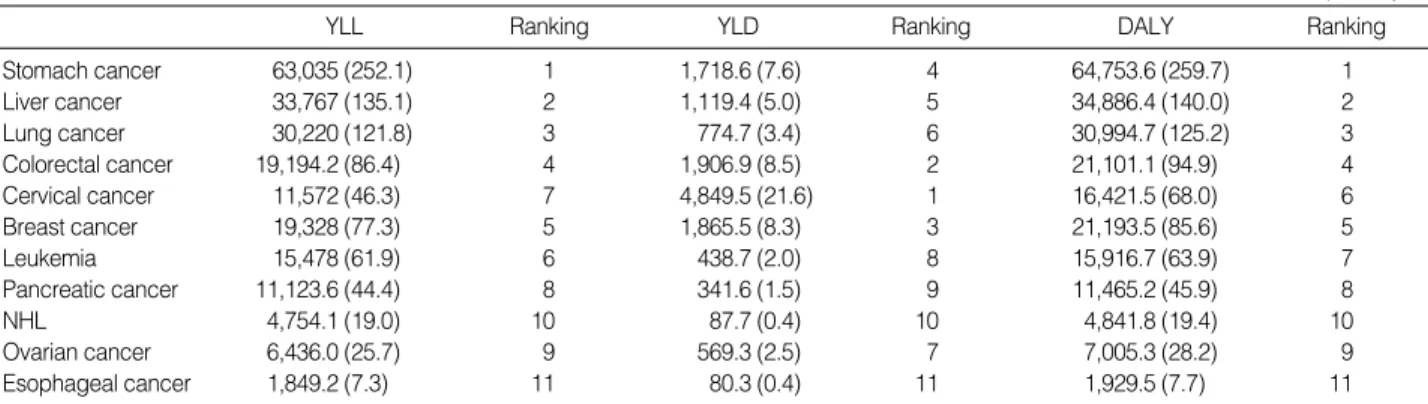
The priority for burden of disease due to malignant cancers in Korean women was stomach cancer (260 person-years), liver cancer (140 person-years), lung cancer (125 person- years), colorectal cancer (95 person-years), cervical cancer (68 person-years), breast cancer (86 person-years), leukemia (64 person-years), pancreatic cancer (46 person-years), non- Hodgkin’s lymphoma (19 person-years), ovarian cancer (28 person-years), and esophageal cancer (8 person years). Among these cancers, the weight of liver cancer, stomach cancer, and lung cancer was particularly high, showing burden of DALY exceeding 100 person years per 100,000 population (Table 6).
Fig. 1, 2 show that when the burden of disease due to pre- mature death was calculated in standard expected years of life lost (SEYLL), the distribution ratio between the burden of disease due to premature death, which is one component of DALY, and the burden of disease due to disability in the
case of men were all under 5% except for bladder cancer (13%), colorectal cancer (9%), and prostate cancer (5%) (Fig.
1, 2). In the case of women, the distribution ratio of disease burden due to disability was higher than in men, with a ratio for stomach cancer of 2.9%, liver cancer 3.5%, lung cancer 2.7%, colorectal cancer 8.9%, cervical cancer 31%, breast cancer 9%, leukemia 3.1%, pancreatic cancer 3.2%, non- Hodgkin’s lymphoma 2%, ovarian cancer 8.8%, and eso- phageal cancer 5.1%. These figures indicate that the burden of disease due to premature death caused by cervical and breast cancer is relatively higher than the burden of disease due to disability compared to other diseases.
DISCUSSION
After being first introduced by the World Bank report sponsored by the World Health Organization and the World Bank in 1993, disability adjusted life year (DALY), a single
Stomach cancer 63,035 (252.1) 1 1,718.6 (7.6) 4 64,753.6 (259.7) 1
Liver cancer 33,767 (135.1) 2 1,119.4 (5.0) 5 34,886.4 (140.0) 2
Lung cancer 30,220 (121.8) 3 774.7 (3.4) 6 30,994.7 (125.2) 3
Colorectal cancer 19,194.2 (86.4) 4 1,906.9 (8.5) 2 21,101.1 (94.9) 4
Cervical cancer 11,572 (46.3) 7 4,849.5 (21.6) 1 16,421.5 (68.0) 6
Breast cancer 19,328 (77.3) 5 1,865.5 (8.3) 3 21,193.5 (85.6) 5
Leukemia 15,478 (61.9) 6 438.7 (2.0) 8 15,916.7 (63.9) 7
Pancreatic cancer 11,123.6 (44.4) 8 341.6 (1.5) 9 11,465.2 (45.9) 8
NHL 4,754.1 (19.0) 10 87.7 (0.4) 10 4,841.8 (19.4) 10
Ovarian cancer 6,436.0 (25.7) 9 569.3 (2.5) 7 7,005.3 (28.2) 9
Esophageal cancer 1,849.2 (7.3) 11 80.3 (0.4) 11 1,929.5 (7.7) 11
YLL Ranking YLD Ranking DALY Ranking
Table 6.YLL calculated using SEYLL, YLD, and DALY of major cancers for female in Korea
The numbers in parentheses are person-year per 100,000 population. YLL, years of life lost; SEYLL, standard expected years of life lost; YLD, years lived with disability; DALY, disability adjusted life years; NHL, Non-Hodgkins lymphoma.
Unit: person-year
Prostate ca Bladder ca NHL Esophageal ca Pancres ca Leukemia Colorectal ca Lung ca Stomach ca Liver ca
0 100 200 300 400 500 600 Fig. 1. The proportion of YLD in DALY of major cancers for male in Korea. YLL, years of life lost; YLD, years lived with disability;
DALY, disability adjusted life years; NHL, Non-Hodgkins lymphoma.
Esophagus ca Ovarian ca NHL Pancres ca Leukemia Breast ca Cervix ca Colorectal ca Lung ca Liver ca Stomach ca
0 50 100 150 200 250 300
Fig. 2. The proportion of YLD in DALY of major cancers for female in Korea. YLL, years of life lost; YLD, years lived with dis- ability; DALY, disability adjusted life years; NHL, Non-Hodgkins lymphoma.
YLL YLD YLL
YLD
indicator that comprehensively evaluates health status from the point of view of premature death and disability, is hav- ing a considerable influence on the establishment of a pub- lic health policy primarily in the developing world (19).
The DALY indicator as applied in the present study is a single measure of the summation of lost time due to prema- ture death and time lived with disability. The main reason why this indicator causes so much interest in the related fields of study is the fact that this indicator may be used as a mea- suring tool that can explain the level of death and the degree of prevalence simultaneously (19).
As for the problems related to the data used in the present study, first, the fact that the medical electronic data used for the study that were utilized to estimate the incidence and the number of affected patients disagree with the actual named diagnoses is of real concern names plays an impairing factor.
Compared to the results of previous studies on estimated incidence (20, 21), the estimated incidences used in the pre- sent study showed similar rates in terms of major types of cancer. However, there is a possibility that the incidences could have been overestimated according to the medical data utilized. This is because there is currently a tendency to docu- ment cases at a more severe level because of the need to claim medical insurance.
The second problem is the inaccurate electronic statistical data on the cause of death. In the case of electronic statistical data used to estimate the mortality for each disease, a doctor diagnoses the final cause of death and those cases with a sub- mitted death certificate is low at about 50-60% (16). More- over, the statistics are difficult to verify in retrospect, never- theless, we believe that the possibility is high that the stated cause of death is probably at odds the actual cause of death, and it is likely that the estimation of mortality in the present study includes a significant bias.
The analysis results between the burden of major cancers and the ranking of causes of death showed that there was almost no difference in the order of priority. The reason for this lack of difference is interpreted as being due to the char- acteristics of malignant cancers. In other words, malignant cancers do not have unique treatment drugs and do not have high remission rates so that when early death is prevalent, the burden of disease according to the years of life lost due to early death takes on a relatively high weighting compared to the burden of disease due to disability. In this case, DALY in the majority, would be effected by a loss of disease burden, i.e., and the results of the present study could be similarly affected. However, the following difference exists in the set- ting of disease priorities according to each of the existing levels and prevalences of death.
We were able to quantitatively determine the causes and the patterns of the main burden of disease according to the distribution ratio of the burden of disease, that is, the con- tribution due to early death on one hand and disability on the other, which are the components of DALY. The results
showed that the distribution ratios of malignant cancers, other than bladder cancer (13%), colorectal cancer (9%), and prostate cancer (5%), in Korean men are less than 5%.
In the case of bladder cancer, colorectal cancer, and prostate cancer, the results were believed to have been caused by their lower mortalities compared to other cancers.
In the case of Korean women, the distribution ratio of bur- den of disease due to disability was shown to be higher than in men. This was particularly true of cervical cancer, which showed a ratio of 31% and breast cancer 9%, indicating the burden of disease due to early death is relatively high com- pared to the burden of disease due to disability compared to other cancers. This result might be interpreted to be due to the severity of the cancers themselves, requiring lower mor- tality rates and the activation of early detection programs.
The results of the present study could be used in the fol- lowing manner.
First, they could be used as basic data to determine the pri- ority of public health policies. In other words, they could provide specific quantitative data, which would allow more effective use of limited resources (22).
Secondly, the results could be used to determine the prior- ities of studies in Korea related to cancers. Thus, when bud- gets and manpower related to this type of study are limited, the results could be used as an index to determining the larg- er themes of disease burden and allow a more quantitative approach to decision making.
Thirdly, by comparing the results of the present study with burden of disease with other studies conducted abroad, DALY could provide information that would allow comparisons of health status and disease burden.
In order to activate studies on disease burden utilizing DALY, which was the health status measurement indicator applied in this study, and raise the possibility of applying these results, the development of the resource data for accu- rately estimating the related epidemiological indicators is urgently required. In other words, we need not only to im- prove the accuracy and completeness of the cause of death data of and medical claim data, which were utilized by the present study, but also to have require a monitoring system to enable us to estimate the related epidemiological indica- tors (mortality and incidences). With the precondition of improving these factors, studies need to be broadened into the area of disease burden evaluation not only of the chronic diseases, such as cancers examined in the present study, but also of the risk factors that are considered to be important health issues, which heavily affect the health of the Korean people, such as smoking and drinking. In addition, an eval- uation of the disease burden of the 10 major causes of death in Korea, and comparing these with the leading causes of death in advanced countries would allow us to assess the pos- sibility of applying such differences as a comparative index.
We measured disability adjusted life years (DALY) and the priority of disease burden for the major types of cancer,
which is the major cause of death in Korea. This study was undertaken to assess the possibility of applying the results from the basis of improved priority assessment.
Despite the limitations of the data used in the present study, these results present a very important message, as they are helpful for determining the priority of the future policies in public health, that is, they offer more specific quantitative data that can be used for more effective utiliza- tion of our limited resources.
ACKNOWLEDGMENTS
This research was supported by the research fund of Glob- al Forum for health service research in 1999 & a grant of the Korea Health 21 R&D Project, Ministry of Health & Wel- fare, Republic of Korea (01-PJ1-PG1-OICH10-0007).
REFERENCES
1. Murray CL, Lopez AD. The global burden of disease. World Health Organization, 1996.
2. Hyder AA, Rotllant G, Morrow RH. Measuring the burden of dis- ease. Healthy life-years. Am J Public Health 1998; 88:196-202.
3. Barendregt JJ, Bonneux L, Mass PJ. DALYs: the age-weights on balance. Bull World Health Org 1996; 74: 439-43.
4. Barnum H. Evaluating health days of life gained from health projects.
Soc Sci Med 1987; 24: 833-41.
5. Feachem RGA. The health of adults in the developing world. New York: Oxford University Press for the World Bank; 1992: 13-8.
6. World Bank. The world development report 1993: investing in health.
New York: Oxford University Press; 1993: 3-13.
7. Ghana Health Assessment Project Team. A quantitative method of assessing the health impact of different diseases in less developed countries. Int J Epidemiol 1981; 10: 73-80.
8. Shepard DS. Economic analysis of investment priorities for measles control. J Infect Dis 1994; 170(Suppl 1): 56-62.
9. Busschbach JJV. The utility of health at different stages in life: a quantitative approach. Soc Sci Med 1993; 37: 153-8.
10. Jba P, Ranson K, Bobadilla JL. Measuring the burden of disease and the cost effectiveness of health interventions- a case study in Guinea. Technical papers for the World Bank 1996.
11. Jamison DT. Foreword to the global burden of disease and injury series. In Murray CJL, Lopez AD ed. The global burden of disease.
Cambridge: Harvard University Press; 1996: 3-34.
12. Eisenberg L. Psychiatry and health in low-income populations. Com- prehensive Psychiatry 1997; 38: 69-73.
13. Gilson L, Mkanje R, Grosskurth H, Mosha F, Picard J, Gavyole A, Todd J, Mayaud P, Swai R, Fransen L, Mabey D, Mills A, Hayes R.
Cost-effectiveness of improved treatment services for sexually trans- mitted diseases in preventing HIV-1 infection in Mwanza Region, Tan- zania. Lancet 1997; 350: 1805-9.
14. Melse J, Hoeymans N, Essink-Bot M, Kramers P. A national burden of disease calculation: Dutch DALYs. Dutch Burden of Disease Group Activity papers, 1998.
15. Chang HJ, Myoung JI, Yoon SJ. Preliminary study on national bur- den of disease. Korea Institute of Health Services Management, 1998.
16. National Statistical Office. Annual report for cause of death, 1994 - 1997.
17. Korea Institute of Health Services Management. Facility planning report for National Cancer Institute in Korea, 1994.
18. Committee to promote the 10 year plan to overcome cancers . The 10 year plan to overcome cancers in Korea. Ministry of Health and Welfare, 1996.
19. Barker C, Green A. Opening the debate on DALYs. Health Policy and Planning 1996; 11: 179-83.
20. Ahn YO, Park BJ, Yoo KY, Kim NK, Heo DS, Lee JK, Ahn HS, Kang DH, Kim H. Incidence estimation of stomach cancer among Koreans. J Korean Med Sci 1991; 6: 7-14.
21. Park BJ, Lee MS, Ahn YO, Choi YM, Ju YS, Yoo KY, Kim H, Yew HS, Park TS. Nationwide incidence estimation of uterine cervix can- cer among Korean women. Korean J Prev Med 1996; 29: 843-50.
22. Lozano R, Murray CL, Frenk J, Bobadilla JL. Burden of disease as- sessment and health system reform: results of a study in Mexico. J Int Develop 1995; 7: 555-63.