
INTRODUCTION
Klebsiella pneumoniae is a very important cause of morbidity and mortality in Gram-negative bacteremia (1). It is a com- mon nosocomial pathogen, causing urinary tract infections, pneumonia, and intraabdominal infections (1-4). In a past decade, the emergence of extended-spectrum beta-lactamases (ESBL) in K. pneumoniae strains and their dissemination have greatly complicated chemotherapy, and outbreak due to ES- BL-producing organisms have been reported in several coun- tries (5-7). Ciprofloxacin (CIP) resistance rate in K. pneumo- niae strains is also increasing in recent years (7-9).
K. pneumoniae is also a potential community-acquired pa- thogen. A previous international collaborative study evaluat- ed geographic differences and trends in the prominent presen- tations of community-acquired Klebsiella infection (10). A striking clinical finding concerning a new manifestation of community-acquired K. pneumoniae infections has been doc- umented (10). An unusual invasive presentation of K. pneu- moniae infection, primary bacteremic liver abscess, has been
described by numerous investigators in Asia (1, 10, 11). How- ever, little data were available on the clinical and microbiologi- cal characteristics of nosocomial vs. community-acquired K.
pneumoniae bacteremia in the era of a high rate of antimicrobial resistance.
In the present study, we thus describe a recent five-year sur- vey of K. pneumoniae bacteremia, with a high rate of antimicro- bial resistance, and the clinical-epidemiological features of 377 patients. We conducted this study to compare the clini- cal features, treatment outcomes, and clinical implication of antimicrobial resistance in K. pneumoniae bacteremia acquired as community versus nosocomial infection.
MATERIALS AND METHODS Patients and bacterial strains
The database at our Clinical Microbiology Laboratory (Seoul National University Hospital, Seoul, Korea) was reviewed
Cheol-In Kang*, Sung-Han Kim*, Ji-Whan Bang*, Hong-Bin Kim*, Nam-Joong Kim*, Eui-Chong Kim�,� Myoung-don Oh*,�, Kang-Won Choe*,�,
Departments of Internal Medicine*and Laboratory Medicine�, Seoul National University College of Medicine; Clinical Research Institute�, Seoul National University Hospital, Seoul, Korea
Address for correspondence Myoung-don Oh, M.D.
Department of Internal Medicine, Seoul National University College of Medicine, 28 Yongon-dong, Chongno-gu, Seoul 110-744, Korea
Tel : +82.2-2072-2945, Fax : +82.2-762-9662 E-mail : [email protected]
816
Community-Acquired versus Nosocomial Klebsiella pneumoniae Bacteremia: Clinical Features, Treatment Outcomes, and Clinical Implication of Antimicrobial Resistance
We conducted this study to compare clinical features, outcomes, and clinical impli- cation of antimicrobial resistance in Klebsiella pneumoniae bacteremia acquired as community vs. nosocomial infection. A total of 377 patients with K. pneumoniae bac- teremia (191 community-acquired and 186 nosocomial) were retrospectively ana- lyzed. Neoplastic diseases (hematologic malignancy and solid tumor, 56%) were the most commonly associated conditions in patients with nosocomial bacteremia, whereas chronic liver disease (35%) and diabetes mellitus (20%) were the most commonly associated conditions in patients with community-acquired bacteremia.
Bacteremic liver abscess occurred almost exclusively in patients with community- acquired infection. The overall 30-day mortality was 24% (91/377), and the mortali- ty of nosocomial bacteremia was significantly higher than that of community-acquired bacteremia (32% vs. 16%, p<0.001). Of all community-acquired and nosocomial isolates, 4% and 33%, respectively, were extended-spectrum cephalosporin (ESC)- resistant, and 4% and 21%, respectively, were ciprofloxacin (CIP)-resistant. In noso- comial infections, prior uses of ESC and CIP were found to be independent risk fac- tors for ESC and CIP resistance, respectively. Significant differences were identified between community-acquired and nosocomial K. pneumoniae bacteremia, and the mortality of nosocomial infections was more than twice than that of community-ac- quired infections. Antimicrobial resistance was a widespread nosocomial problem and also identified in community-acquired infections.
Key Words : Klebsiella pneumoniae; Bacteremia; Treatment Outcome; Risk Factors; Drug Resistance, Micro- bial
Received : 5 December 2005 Accepted : 7 March 2006
in order to identify patients with K. pneumoniae bacteremia.
Patients older than 16 yr of age with K. pneumoniae bacteremia were included in the analysis. Only the first bacteremic epi- sode for each patient was included in the analysis. We reviewed the medical records of individuals diagnosed from January 1998 to December 2002 at Seoul National University Hos- pital, Seoul, Korea, a 1,500-bed tertiary care university hos- pital and referral center.
Species identification was carried out with Vitek-GNI Card (bioMerieux, Hazelwood, MO, U.S.A.) by standard methods, and antibiotic susceptibility testing was performed using the disk diffusion method, following the recommendations of the National Committee for Clinical Laboratory Standards (12). Strains showing inhibition zone diameters in the inter- mediate range were considered resistant.
Study design and data collection
A retrospective observational cohort study was conducted to evaluate clinical features, treatment outcomes, and clinical implication of antimicrobial resistance in K. pneumoniae bac- teremia. We compared data from patients with community- acquired K. pneumoniae bacteremia with data from those with nosocomial bacteremia.
We reviewed the medical records of the patients. The data collected included age, gender, underlying diseases, primary sites of infection, severity of illness as calculated by the Acute Physiology and Chronic Health Evaluation (APACHE) II score (13), and the antimicrobial therapy regimen. The pres- ence of the following comorbid conditions was also documen- ted: neutropenia, presentation with septic shock, care in inten- sive care unit (ICU), receipt of immunosuppressive agents within 30 days prior to onset of the bacteremia, corticosteroid use, the presence of a central venous catheter or of an indwel- ling urinary catheter, and post-operative state. The main out- come measure used was the 30-day mortality rate.
Definitions
K. pneumoniae bacteremia was defined as the isolation of K.
pneumoniae in a blood culture specimen. Onset of bacteremia was defined as the date when the first positive blood culture was obtained. Extended-spectrum cephalosporins (ESC) resis- tance was defined as resistance in vitro to cefotaxime or cef- tazidime. The antimicrobial therapies were classified into empirical and definitive, the former being defined as the ini- tial therapy before the results of blood culture were available, and the latter as therapy after the result of antibiotic suscep- tibility tests had been received. The antimicrobial therapy was considered ‘appropriate’ if the treatment regimen includ- ed at least one antimicrobial agent active in vitro against K.
pneumoniae, and if the dosage and route of administration con- formed to current medical standards. We considered antimi- crobial therapy to be ‘inappropriate’ if the drugs used did not
have in vitro activity against the isolated strain or if the pa- tient did not receive antimicrobial therapy. The bacteremia was categorized as polymicrobial if additional microorganisms were recovered from the blood cultures. Nosocomial infec- tion was defined as an infection that occurred ≥48 hr after hospital admission; an infection that occurred <48 hr after admission to the hospital, in patients that had been hospital- ized in the 2 weeks prior to admission; and an infection that occurred <48 hr after admission to the hospital in patients that had been transferred from another hospital or nursing home. The primary site of infection was determined using clinical criteria and isolation of the bacteremic organism from sources other than blood (14). Neutropenia was defined as an absolute neutrophil count below 500/ L. Septic shock was defined as sepsis associated with evidence of organ hypoper- fusion and a systolic blood pressure <90 or >30 mmHg less than the baseline or a requirement for the use of vasopressor to maintain blood pressure.
Statistical analysis
The Student’s t-test was used to compare continuous vari- ables, and 2or Fisher’s exact test to compare categorical vari- ables. In identifying the independent risk factors, a backward stepwise logistic regression analysis was used to control for the effects of confounding variables. Variables with a p-value
<0.1 in the univariate analysis were candidates for multivari- ate analysis. We used backward elimination of any variable that did not contribute to the model on the grounds of the likelihood ratio test, using a significance cutoff of 0.05. All p-values were two-tailed, and p-values <0.05 were considered statistically significant. The SPSS for Windows, version 11.5 software package (SPSS Inc, Chicago, IL, U.S.A.), was used for all analyses.
RESULTS
Study population and clinical characteristics
Three hundred and seventy-seven consecutive patients with K. pneumoniae bacteremia were included in this analysis. Am- ong these, 191 cases were classified to be community-acquired infection and the remaining 186 cases were classified to be nosocomial infection. The demographic and clinical charac- teristics of both groups are shown in Table 1.
As for the underlying diseases, diabetes mellitus was more common in community-acquired than in nosocomial infec- tion (20.4% vs. 4.3%, p<0.001). Hematologic malignancy was more frequently noted in patients with nosocomial com- pared with community-acquired infection (28% vs. 4.7%, p<0.001). Prior use of antibiotics, inappropriate antimicro- bial therapy, central venous catheterization, indwelling uri- nary catheter, and neutropenia were more frequent in noso-
comial infection (All p<0.05, Table 1). Also, the mean APA- CHE II score was higher in nosocomial infection (11.75± 4.52 vs. 9.80±5.08, p<0.001).
As for the primary site of infection, liver abscess were pre- dominant in community-acquired infection. Among these (n=21), 8 cases were identified to have disseminated infection with metastatic infection, whereas no case in nosocomial infec- tions was identified to have disseminated infection. Primary site of infection was unknown in 76 (40.9%) cases of nosoco- mial bacteremia, whereas in 49 (25.7%) cases of communi- ty-acquired bacteremia (p=0.002) (Table 1).
Clinical outcomes and risk factors for mortality
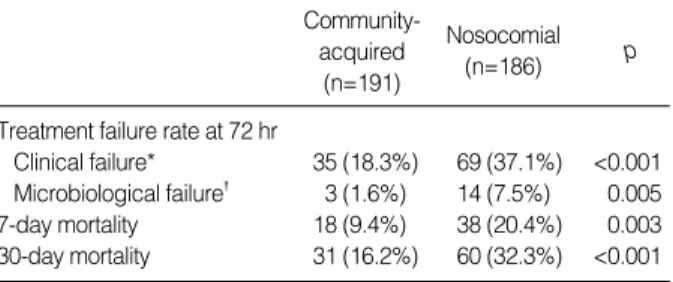
The overall 30-day mortality rate of K. pneumoniae bacteremia was 24.1% (91/377) and the mortality of nosocomial infec- tions was significantly higher than that of community-acq-
uired infections (32.3% [60/186] vs. 16.2% [31/191], p<
0.001) (Table 2). Factors associated with 30-day mortality are shown in Table 3. From the univariate analysis, the sig- nificantly associated factors were; inappropriate empirical antibiotics, inappropriate definitive antibiotics, ESC resis- tance, ICU care, septic shock at initial presentation, neutrope- nia, corticosteroid use, immunosuppressant use, nosocomial acquisition, long hospital stay, pneumonia, and peritonitis (all p<0.05) (Table 3). Pancreaticobiliary tract infection and liver abscess were more common in survival group (Table 3).
Multivariate analysis using a logistic regression model, whi- ch included the variables associated with mortality by univari- ate analysis (p<0.1), showed that nosocomial acquisition was one of the independent risk factors associated with 30-day mortality (OR=2.32, 95% CI=1.11-4.86, p=0.025). Inappro- priate definitive antibiotics, having peritonitis, having pneu- monia, unknown site of infection, septic shock at initial pre- sentation, and increased APACHE II score were also indepen- dent risk factors of mortality in overall K. pneumoniae bactere- mia cases (Table 4). When assessed the significant indepen- dent factors associated with mortality in cases of communi- ty-acquired infection, presentation with septic shock and in- creased APACHE II score were also found to be independent risk factors. Pancreaticobiliary tract infection was found to be associated with survival (OR, 0.20; 95% CI, 0.05-0.82;
p=0.026). In cases of nosocomial infection, inappropriate de- finitive antibiotics as well as presentation with septic shock and increased APACHE II score were found to be indepen- dent risk factors.
Clinical implication of antimicrobial resistance
Among 186 cases with nosocomial infection, 62 (33.3%) cases were infected by ESC-resistant isolates, and 39 (21.0%) cases were infected by CIP-resistant isolates. The ESC resis- tance was detected in 35 (89.7%) of the 39 CIP-resistant K.
pneumoniae isolates. In comparison, only 27 (18.4%) of the 147 CIP-susceptible isolates were resistant to ESC (p<0.001).
No nosocomial isolate in this study was identified to be resis-
Community- acquired
(n=191)
Nosocomial
(n=186) p
Age, mean yr±SD (range) 57±13 53±13 0.003 (17-86) (17-87)
Male 126 (66) 123 (66.1) 0.974
Underlying diseases
None 12 (6.3) 1 (0.5) 0.002
Diabetes mellitus 39 (20.4) 8 (4.3) <0.001 Benign pancreaticobiliary 24 (12.6) 7 (3.8) 0.002
tract disease
Hematologic malignancy 9 (4.7) 52 (28.0) <0.001
Solid tumor 45 (23.6) 52 (28.0) 0.329
Chronic liver disease 67 (35.1) 55 (29.6) 0.253 Primary site of infection
Pancreaticobiliary tract 50 (26.2) 39 (21.0) 0.234
Liver 21 (11.0) 4 (2.2) 0.001
Lung 10 (5.2) 11 (5.9) 0.774
Urinary tract 20 (10.5) 12 (6.5) 0.162
Peritoneum 39 (20.4) 43 (23.1) 0.524
Unknown 49 (25.7) 76 (40.9) 0.002
Prior antibiotics use 14 (7.3) 91 (48.9) <0.001 Inappropriate empirical antibiotics 4 (2.1) 29 (15.6) <0.001 Inappropriate definitive antibiotics 0 (0) 13 (7.0) <0.001 Central line catheterization 5 (2.6) 61 (32.8) <0.001 Indwelling urinary catheter 7 (3.7) 33 (17.7) <0.001
Neutropenia 18 (9.4) 52 (28.0) <0.001
CIP resistance 8 (4.2) 39 (21.0) <0.001
ESC resistance 7 (3.7) 62 (33.3) <0.001
Presentation with septic shock 42 (22.0) 50 (26.9) 0.269 APACHE II score, mean±SD 9.80±5.08 11.75±4.52 <0.001
(range) (0-28) (2-25)
Table 1.Demographic characteristics and underlying conditions of patients with community-acquired vs. nosocomial K. pneumo- niae bacteremia
Data represent patient numbers (%), otherwise indicated.
SD, standard deviation; CIP, ciprofloxacin; ESC, extended-spectrum cephalosporins; APACHE, acute physiology and chronic health evalu- ation.
Community- acquired
(n=191)
Nosocomial
(n=186) p
Treatment failure rate at 72 hr
Clinical failure* 35 (18.3%) 69 (37.1%) <0.001 Microbiological failure� 3 (1.6%) 14 (7.5%) 0.005
7-day mortality 18 (9.4%) 38 (20.4%) 0.003
30-day mortality 31 (16.2%) 60 (32.3%) <0.001 Table 2.Treatment outcome of patients with community-acquired vs. nosocomial K. pneumoniae bacteremia
Data represent patient numbers (%).
*Absence of abatement or deterioration in any clinical parameters asso- ciated with infection at 72 hr after initial antimicrobial therapy, �Isolation of the organism in follow-up blood culture.
tant to imipenem.
Among 191 cases with community-acquired infection, only 7 (3.7%) cases and 8 (4.2%) cases were infected by ESC-re- sistant and CIP-resistant isolates, respectively. Of 8 commu- nity-acquired isolates which were resistant to CIP, 3 isolates were also resistant to ESC. All community-acquired isolates in this study were susceptible to imipenem and amikacin. All patients with community-acquired infection caused by ESC- resistant K. pneumoniae had underlying illness and risk factors for infection by resistant organisms, such as prior hospitaliza- tion, prior use of antibiotics, or indwelling catheters. Of 7 cases infected by ESC-resistant isolates, 3 cases had the pre- vious receipt of cephalosporin within 30 days
In nosocomial infection cases, we assessed the risk factors for antimicrobial resistance. For ESC resistance, the signifi- cantly associated factors were; ICU care, post-surgical state, indwelling urinary catheter, invasive procedure within 72 hr before onset of bacteremia, prior antibiotics use (cephalosporins, aminoglycosides, and metronidazole) (all p<0.05). For CIP resistance, the significantly associated factors were; post-sur- gical state, indwelling urinary catheter, invasive procedure within 72 hr before onset of bacteremia, prior use of antibi- otics (cephalosporins, aminoglycosides, fluoroquinolones, and
Overall
Survivors
(n=286) p
Non- survivors
(n=91)
Community-acquired (n=191)
Survivors
(n=160) p
Non- survivors
(n=31)
Nosocomial (n=186)
Survivors
(n=126) p
Non- survivors
(n=60)
Inappropriate empirical antibiotics 17 (5.9) 16 (17.6) 0.001 2 (1.3) 2 (6.5) 0.124 15 (11.9) 14 (23.3) 0.045 Inappropriate definitive antibiotics 3 (1.0) 10 (11.0) <0.001 N.C. 3 (2.4) 10 (16.7) <0.001
ESC resistance 46 (16.1) 23 (25.3) 0.048 5 (3.1) 2 (6.5) 0.318 41 (32.5) 21 (35.0) 0.739
CIP resistance 33 (11.5) 14 (15.4) 0.333 7 (4.4) 1 (3.2) 0.770 26 (20.6) 13 (21.7) 0.872
ICU care 5 (1.7) 9 (9.9) <0.001 N.C. 5 (4.0) 9 (15.0) 0.014
Septic shock at initial presentation 27 (9.4) 65 (71.4) <0.001 20 (12.5) 22 (71.0) <0.001 7 (5.6) 43 (71.7) <0.001
Neutropenia 46 (16.1) 24 (26.4) 0.028 12 (7.5) 6 (19.4) 0.084 34 (27.0) 18 (30.0) 0.668
Polymicrobial 30 (10.5) 10 (11.0) 0.893 17 (10.6) 3 (9.7) 0.875 13 (10.3) 7 (11.7) 0.781
Corticosteroid use 26 (9.1) 18 (19.8) 0.006 4 (2.5) 4 (12.9) 0.025 22 (17.5) 14 (23.3) 0.343
Immunosuppressant use 8 (2.8) 8 (8.8) 0.031 3 (1.9) 3 (9.7) 0.055 5 (4.0) 5 (8.3) 0.296
Nosocomial acquisition 126 (44.1) 60 (65.9) <0.001 --- ---
Long hospital stay (>14 days)* 65 (22.7) 37 (40.7) 0.001 N.C. 65 (51.6) 36 (60.0) 0.282
Underlying diseases
Hematologic malignancy 43 (15.0) 18 (19.8) 0.284 5 (3.1) 4 (12.9) 0.040 38 (30.2) 14 (23.3) 0.332
Solid tumor 70 (24.5) 27 (29.7) 0.323 35 (21.9) 10 (32.3) 0.212 35 (27.8) 17 (28.3) 0.937
Chronic liver disease 92 (32.2) 30 (33.0) 0.887 57 (35.6) 10 (32.3) 0.719 35 (27.8) 20 (33.3) 0.438 Pancreaticobiliary tract disease 30 (10.5) 1 (1.1) 0.005 24 (15.0) 0 (0) 0.016 6 (4.8) 1 (1.7) 0.432
Diabetes mellitus 37 (12.9) 10 (11.0) 0.624 32 (20.0) 7 (22.6) 0.744 5 (4.0) 3 (5.0) 0.714
Primary site of infection
Pneumonia 10 (3.5) 11 (12.1) 0.002 4 (2.5) 6 (19.4) 0.002 6 (4.8) 5 (8.3) 0.337
Pancreaticobiliary tract infection 77 (26.9) 12 (13.2) 0.007 47 (29.4) 3 (9.7) 0.022 30 (23.8) 9 (15.0) 0.168
Liver abscess 24 (8.4) 1 (1.1) 0.015 20 (12.5) 1 (3.2) 0.208 4 (3.2) 0 (0) 0.307
Peritonitis 54 (18.9) 28 (30.8) 0.017 32 (20.0) 7 (22.6) 0.744 22 (17.5) 21 (35.0) 0.008
Urinary tract infection 30 (10.5) 2 (2.2) 0.013 19 (11.9) 1 (3.2) 0.207 11 (8.7) 1 (1.7) 0.107
Unknown 88 (30.8) 37 (40.7) 0.081 36 (22.5) 13 (41.9) 0.023 52 (41.3) 24 (40.0) 0.869
Table 3.Risk factors associated with 30-day mortality in patients with K. pneumoniae bacteremia [Univariate analysis]
Data represent patient numbers (%), otherwise indicated.
N.C., No Cases identified; ESC, extended-spectrum cephalosporins; CIP, ciprofloxacin; ICU, intensive care unit.
*Hospital stay prior to onset of bacteremia.
Risk factors Adjusted OR (95% CI) p
In overall
Peritonitis 3.66 (1.27-10.54) 0.016
Pneumonia 8.58 (2.22-33.20) 0.002
Unknown site of infection 5.05 (1.77-14.40) 0.002 Nosocomial acquisition 2.32 (1.11-4.86) 0.025 Inappropriate definitive antibiotics 19.29 (2.76-134.96) 0.003 Presentation with septic shock 27.11 (12.47-58.96) <0.001 Increased APACHE II score 1.15 (1.05-1.26) 0.002
(per 1-point increments) In community-acquired infections
Presentation with septic shock 18.02 (6.34-51.24) <0.001 Increased APACHE II score 1.11 (1.01-1.22) 0.031
(per 1-point increments)
Pancreaticobiliary tract infection 0.20 (0.05-0.82) 0.026 In nosocomial infections
Inappropriate definitive antibiotics 19.37 (2.61-143.75) 0.004 Presentation with septic shock 40.31 (13.17-123.42) <0.001 Increased APACHE II score 1.28 (1.12-1.46) <0.001
(per 1-point increments)
Table 4.Independent risk factors for mortality in patients with K. pneumoniae bacteremia [Multivariate analysis]
APACHE, acute physiology and chronic health evaluation.
metronidazole) (all p<0.05). However, neutropenia was more frequent in patients with ESC-susceptible K. pneumoniae bac- teremia than in those infected with ESC-resistant isolates, and also more frequent in those with CIP-susceptible K. pneumo- niae bacteremia.
By multivariate logistic regression analysis, the significant independent risk factors associated with ESC resistance were invasive procedure before onset of bacteremia, prior use of me- tronidazole, indwelling urinary catheter, and prior use of ce- phalosporins. Also, the significant independent risk factors for CIP resistance were invasive procedure before onset of bac- teremia, prior use of fluoroquinolones, prior use of metronida- zole, post-surgical state, and indwelling urinary catheter.
DISCUSSION
In the current study we present one of the largest recent studies of both community and nosocomial bloodstream infec- tions caused by K. pneumoniae. In this study of 377 episodes of bloodstream infection, we found an overall 30-day mortali- ty rate of 24%. Our study examines both community-acquired and nosocomial bloodstream infections, allowing us to esti- mate the proportion of bloodstream infection mortality that is associated with nosocomial versus community-acquired infections.
We found that 66% of the crude mortality occurred among patients with nosocomial bloodstream infection. In addition, hospital acquisition (nosocomial status) of infection was st- rongly associated with mortality in our multivariate analysis, even after adjustments were made for underlying illness and other confounding variables.
Neoplastic diseases, such as hematologic malignancy and solid tumor, were the most commonly associated condition in patients with nosocomial K. pneumoniae bacteremia. Prior antibiotics use, central line catheterization, indwelling urinary catheter, and neutropenia were common in patients with neo- plastic diseases. To the contrary, chronic liver disease (35%) was the most commonly associated condition in patients with community-acquired K. pneumoniae bacteremia. Diabetes mel- litus was more commonly associated condition in patients with community-acquired K. pneumoniae bacteremia than in those with nosocomial bacteremia. The association of diabetes mellitus and K. pneumoniae liver abscess was reported previ- ously (11, 15-17). Bacteremic K. pneumoniae liver abscess occur- red almost exclusively in patients with community-acuired infection, consistent with a growing number of reports from Asia describing this distinctive type of infection (10, 15-17).
In our study, 21 patients with liver abscess were identified among 191 patients with community-acquired K. pneumoni- ae bacteremia. Among these, 8 cases were identified to have disseminated infection with metastatic infection. Metastatic infection is a characteristic feature of K. pneumoniae liver abscess (15-17).
Pneumoniae carried a significantly poorer prognosis than urinary tract infection, a finding that is in agreement with the results of other studies (1, 5, 18). In our study, peritonitis and unknown primary site of infection were also found to be associated with higher mortality. Not surprisingly, increasing severity of illness at the onset of bacteremia, septic shock, and inappropriate definitive antimicrobial therapy were also asso- ciated with increased mortality. These results suggest that when K. pneumoniae bacteremia is suspected, the most signifi- cant prognostic variables are the primary site of infection (i.e., pneumonia, peritonitis, or unknown) and the severity of the underlying illness (i.e., higher APACHE II score or septic shock). Also, as previously reported in our other study (19), the adequacy of antimicrobial therapy was an important deter- minant of survival.
Nosocomial isolates were significantly more resistant to the antimicrobial agents that were tested, except for imipenem, when compared with the community-acquired isolates. More than 30% of the nosocomial isolates were resistant to ESC, which raises a concern over an increasing prevalence of ESBL- producing K. pneumoniae, particularly in hospitals. We found that the recent use of cephalosporins appeared to be a risk fac- tor for ESC resistance in K. pneumoniae bacteremia (20). The ESBL-producing K. pneumoniae infections are a risk factor asso- ciated with treatment failure (21, 22). Therefore, aggressive infection control and restrictions on the use of ESC should be implemented.
We noted that an invasive procedure, an indwelling urinary catheter, and post-surgical state were risk factors for infection caused by antimicrobial-resistant strains (20). This finding has important implications for nosocomial infection control, as antibiotic-resistant strains in a hospital environment pose a serious risk during the invasive procedures. As suggested by Lautenbach et al., efforts should emphasize limiting contact transmission of resistant isolates as well as controlling antibiotic use (23). Neutropenic patients were significantly less likely to have bacteremic with an ESC-resistant strain than with an ESC-susceptible strain. As previously reported by Paterson et al., this may be noteworthy because neutropenic patients are usually subjected to enhanced infection control measures (5).
We limited our analysis of antibiotic use to 30 days prior to bacteremia and were thus unable to access possible associ- ations between antimicrobial resistance and more remote an- tibiotic use. Another potential limitation was that molecular epidemiologic analysis was not performed. However, there were no evidences of clonal spread of the resistant organisms, based on the epidemiological findings and the antimicrobial susceptibility patterns of the isolates (data not shown).
As this study was of the retrospective nature, the possibility of the limitation in precluding accurate comparisons should be borne in mind. The data were limited to the hospital re- cord. Although the information concerning the in-hospital antibiotic use was available from the medical record, the record of the use of antibiotic at the outside hospital may not be accu-
rate. Finally, our study was conducted in a large tertiary care medical center, and thus many of our patients had serious un- derlying illness, including neoplastic diseases and chronic liver diseases. Also, it is noteworthy that 35% of our patients with community-acquired bacteremia had chronic liver diseases, reflecting the high prevalence of chronic hepatitis B virus in- fection among the general population in Korea (24). Thus the results regarding underlying illness of community vs. noso- comial infections may not be applicable to other institutions.
In conclusions, neoplastic diseases were the most commonly associated conditions in patients with nosocomial K. pneumo- niae bacteremia, whereas diabetes mellitus and chronic liver disease were the most commonly associated conditions in pa- tients with community-acquired bacteremia. Bacteremic K.
pneumoniae liver abscess occurred almost exclusively in patients with community-acquired infection. The mortality rate of nosocomial infections was twice higher than that of commu- nity-acquired infections. Of all community-acquired and no- socomial isolates, 3.7% and 33.3%, respectively, were ESC- resistant and 4.2% and 21%, respectively, were CIP-resistant.
In nosocomial infections, prior uses of ESC and CIP were found to be independent risk factors for ESC and CIP resistance, respectively. An invasive procedure, an indwelling urinary catheter, and post-surgical state were also found to be risk factors for infection.
REFERENCES
1. Tsay RW, Siu LK, Fung CP, Chang FY. Characteristics of bacteremia between community-acquired and nosocomial Klebsiella pneumoni- ae infection: risk factor for mortality and the impact of capsular sero- types as a herald for community-acquired infection. Arch Intern Med 2002; 162: 1021-7.
2. Watanakunakorn C, Jura J. Klebsiella bacteremia: a review of 196 episodes during a decade (1980-1989). Scand J Infect Dis 1991; 23:
399-405.
3. Yinnon AM, Butnaru A, Raveh D, Jerassy Z, Rudensky B. Klebsiel- la bacteraemia: community versus nosocomial infection. QJM 1996;
89: 933-41.
4. Hansen DS, Gottschau A, Kolmos HJ. Epidemiology of Klebsiella bacteraemia: a case control study using Escherichia coli bacteraemia as control. J Hosp Infect 1998; 38: 119-32.
5. Paterson DL, Ko WC, Von Gottberg A, Mohapatra S, Casellas JM, Goossens H, Mulazimoglu L, Trenholme G, Klugman KP, Bonomo RA, Rice LB, Wagener MM, McCormack JG, Yu VL. Internation- al prospective study of Klebsiella pneumoniae bacteremia: implica- tions of extended-spectrum beta-lactamase production in nosocomi- al infections. Ann Intern Med 2004; 140: 26-32.
6. Pena C, Pujol M, Ardanuy C, Ricart A, Pallares R, Linares J, Ariza J, Gudiol F. Epidemiology and successful control of a large outbreak due to Klebsiella pneumoniae producing extended-spectrum beta-lac- tamases. Antimicrob Agents Chemother 1998; 42: 53-8.
7. Kim M, Choo EJ, Kwak YG, Song MH, Nah SS, Song T, Kim SH,
Jun JB, Choi SH, Jeong JY, Kim NJ, Kim YS, Woo JH, Ryu J. The close relationship between ciprofloxacin resistance and extended- spectrum beta-lactamase production: analysis of 154 consecutive nosocomially-acquired Klebsiella pneumoniae bacteremia. Infect Chemother 2004; 36: 265-70.
8. Paterson DL, Mulazimoglu L, Casellas JM, Ko WC, Goossens H, Von Gottberg A, Mohapatra S, Trenholme GM, Klugman KP, Mc- Cormack JG, Yu VL. Epidemiology of ciprofloxacin resistance and its relationship to extended-spectrum beta-lactamase production in Klebsiella pneumoniae isolates causing bacteremia. Clin Infect Dis 2000; 30: 473-8.
9. Lautenbach E, Fishman NO, Bilker WB, Castiglioni A, Metlay JP, Edelstein PH, Strom BL. Risk factors for fluoroquinolone resistance in nosocomial Escherichia coli and Klebsiella pneumoniae infections.
Arch Intern Med 2002; 162: 2469-77.
10. Ko WC, Paterson DL, Sagnimeni AJ, Hansen DS, Von Gottberg A, Mohapatra S, Casellas JM, Goossens H, Mulazimoglu L, Trenholme G, Klugman KP, McCormack JG, Yu VL. Community-acquired Kleb- siella pneumoniae bacteremia: global differences in clinical patterns.
Emerg Infect Dis 2002; 8: 160-6.
11. Park SH, Choi SM, Nam KW, Kim SI, Wie SH, Kim YR, Moon IS, Kang MW. Two cases of Klebsiella pneumoniae liver abscess com- plicated with multiple septic metastatic lesions: Their association with diabetes mellitus. Korean J Infect Dis 2001; 33: 364-70.
12. National Committee for Clinical Laboratory Standards. Performance standards for antimicrobial disk susceptibility tests. Approved stan- dard. NCCLS document M100-S12. Wayne, PA: National Commit- tee for Clinical Laboratory Standards 2002.
13. Knaus WA, Drapier EA, Wagner DP, Zimmerman JE. APACHE II:
a severity of disease classification system. Crit Care Med 1985; 13:
818-29.
14. Blot S, Vandewoude K, De Bacquer D, Colardyn F. Nosocomial bac- teremia caused by antibiotic-resistant gram-negative bacteria in criti- cally ill patients: clinical outcome and length of hospitalization. Clin Infect Dis 2002; 34: 1600-6.
15. Wang JH, Liu YC, Lee SS, Yen MY, Chen YS, Wang JH, Wann SR, Lin HH. Primary liver abscess due to Klebsiella pneumoniae in Tai- wan. Clin Infect Dis 1998; 26: 1434-8.
16. Cheng DL, Liu YC, Yen MY, Liu CY, Wang RS. Septic metastatic lesions of pyogenic liver abscess. Their association with Klebsiella pneumoniae bacteremia in diabetic patients. Arch Intern Med 1991;
151: 1557-9.
17. Fung CP, Chang FY, Lee SC, Hu BS, Kuo BI, Liu CY, Ho M, Siu LK. A global emerging disease of Klebsiella pneumoniae liver ab- scess: is serotype K1 an important factor for complicated endoph- thalmitis? Gut 2002; 50: 420-4.
18. Korvick JA, Bryan CS, Farber B, Beam TR Jr, Schenfeld L, Muder RR, Weinbaum D, Lumish R, Gerding DN, Wagener MM. Prospec- tive observational study of Klebsiella bacteremia in 230 patients: out- come for antibiotic combinations versus monotherapy. Antimicrob Agents Chemother 1992; 36: 2639-44.
19. Kang CI, Kim SH, Park WB, Lee KD, Kim HB, Kim EC, Oh MD, Choe KW. Bloodstream infections caused by antibiotic-resistant gram- negative bacilli: risk factors for mortality and impact of inappropri-
ate initial antimicrobial therapy on outcome. Antimicrob Agents Che- mother 2005; 49: 760-6.
20. Kang CI, Kim SH, Kim DM, Park WB, Lee KD, Kim HB, Oh MD, Kim EC, Choe KW. Risk factors for and clinical outcomes of blood- stream infections caused by extended-spectrum beta-lactamase-pro- ducing Klebsiella pneumoniae. Infect Control Hosp Epidemiol 2004;
25: 860-7.
21. Paterson DL, Ko WC, Von Gottberg A, Casellas JM, Mulazimoglu L, Klugman KP, Bonomo RA, Rice LB, McCormack JG, Yu VL.
Outcome of cephalosporin treatment for serious infections due to apparently susceptible organisms producing extended-spectrum - lactamase: implications for the clinical microbiology laboratory. J Clin Microbiol 2001; 39: 2206-12.
22. Kim YK, Pai H, Lee HJ, Park SE, Choi EH, Kim J, Kim JH, Kim EC.
Bloodstream infections by extended-spectrum -lactamase produc- ing Escherichia coli and Klebsiella pneumoniae in children: epidemi- ology and clinical outcome. Antimicrob Agents Chemother 2002; 46:
1481-91.
23. Lautenbach E, Patel JB, Bilker WB, Edelstein PH, Fishman NO. Ex- tended-spectrum -lactamase-producing Escherichia coli and Kleb- siella pneumoniae: risk factors for infection and impact of resistance on outcomes. Clin Infect Dis 2001; 32: 1162-71.
24. Lee MS, Kim DH, Kim H, Lee HS, Kim CY, Park TS, Yoo KY, Park BJ, Ahn YO. Hepatitis B vaccination and reduced risk of primary liver cancer among male adults: a cohort study in Korea. Int J Epi- demiol 1998; 27: 316-9.
![Table 4. Independent risk factors for mortality in patients with K. pneumoniae bacteremia [Multivariate analysis]](https://thumb-ap.123doks.com/thumbv2/123dokinfo/5130452.89351/4.894.88.428.776.1108/independent-factors-mortality-patients-pneumoniae-bacteremia-multivariate-analysis.webp)
