INTRODUCTION
Neonatal diabetes, defined as insulin-requiring hypergly- cemia within the first three months of life, is a rare disease entity, with an estimated incidence of 1 in 400,000 neonates (1). Transient neonatal diabetes usually resolves by a median of 12 weeks and is generally associated with an abnormality of the imprinted region of 6q24 (2). By contrast, permanent neonatal diabetes (PND) requires insulin treatment for life, and until recently the genetic etiology was largely unknown.
Recently, Gloyn et al. (3) reported that heterozygous activat- ing mutations in the KCNJ11 gene are a common cause of PND. KCNJ11 encodes Kir6.2, the pore-forming subunit of the ATP-sensitive K+channel (KATP channel) (4). KATP channels play a central role in glucose-stimulated insulin secretion from pancreatic -cells (5).
Sulfonylurea stimulates insulin secretion by binding to the -cell’s high-affinity sulfonylurea receptor and closing the ATP-sensitive K+ channels by an ATP-independent mech- anism (6). Sagen et al. (7) recently reported that oral sulfo- nylurea should be considered for treatment of patients with Kir6.2 mutations.
We report the first two Korean cases of PND with muta-
tions in the KCNJ11 gene encoding Kir6.2. In addition, we also show that oral sulfonylurea therapy is as good as or bet- ter for glycemic control, compared with insulin therapy.
MATERIALS AND METHODS
Two Korean children with permanent neonatal diabetes were evaluated. Neither the parents nor their siblings had diabetes. The mothers did not have gestational diabetes.
Written informed consent was obtained from the parents for study participation and publication.
Case 1
Case 1, born at 40 weeks gestation, was well at birth but had intrauterine growth retardation with a birth weight of 2,300 g (<3 percentile). She was the first child of two sib- lings. At six weeks of age, diabetes was diagnosed based on hyperglycemia (1,460 mg/dL) and glucosuria (3+) with keto- acidosis. The serum C-peptide was 0.4 ng/mL (normal range:
1.0-3.5) and HbA1Cwas 6.9% (normal range, 2.1-7.7). Au- toantibodies associated with type 1 diabetes and pancreatic
Min Sun Kim*, Sun-Young Kim�, Gu-Hwan Kim�, Han Wook Yoo�,�, Dong Whan Lee‖, Dae-Yeol Lee*,�
Department of Pediatrics*, Research Institute of Clinical Medicine�, Chonbuk National University Medical School, Jeonju; Medical Genetics Clinics and Labortory�, Department of Pediatrics�, University of Ulsan College of Medicine, Seoul; Department of Medicine‖, Soonchunhyang University, Seoul, Korea
Address for correspondence Dae-Yeol Lee, M.D.
Department of Pediatrics, Chonbuk National University Hospital, 634-18 Keumam-dong, Deokjin-gu, Jeonju 561-712, Korea
Tel : +82.63-250-1469, Fax : +82.63-250-1464 E-mail : [email protected]
616
Sulfonylurea Therapy in Two Korean Patients with Insulin-treated Neonatal Diabetes due to Heterozygous Mutations of the KCNJ11 Gene Encoding Kir6.2
Permanent neonatal diabetes (PND) is a rare form of diabetes characterized by insulin-requiring hyperglycemia diagnosed within the first three months of life. In most cases, the causes are not known. Recently, mutations in the KCNJ11 gene encoding the Kir6.2 subunit of the ATP-sensitive K+channel have been described in patients with PND. We report the first two Korean cases with PND due to a lysine- to-arginine substitution at position 170 (K179R) and a valine-to-methionine substi- tution at position 59 (V59M) mutations of KCNJ11 encoding Kir6.2, respectively.
After several years of insulin therapy, these patients were managed by oral gliben- clamide therapy at a daily dose of 0.8-0.9 mg/kg. Their basal c-peptide levels in- creased after one week of glibenclamide therapy, and one month later, the insulin and c-peptide levels were in the normal ranges without any episodes of hyper- or hypoglycemia. These cases demonstrate that oral sulfonylurea may be the treat- ment of choice in PND patients with KCNJ11 mutations even at a young age.
Key Words : Neonatal Diabetes; Permanent; Korean; Sulfonylurea; Kir6.2 Channel; Mutation
Received : 5 December 2006 Accepted : 12 January 2007
ultrasonography were negative. The patient did not have dysmorphic features. Insulin therapy was initiated and insulin doses of 0.6-0.8 units/kg/day were required. There was marked catch-up growth after birth, and the weight and height were normally distributed on follow-up after 6.5 yr.
Psychomotor development and muscle strength were with- in normal limits. We recently introduced oral sulfonylurea to the patient. We started with glibenclamide at a dose of 0.2 mg/kg/day, consisting of four doses a day and increased the doses up to 0.9 mg/kg/day over eight days. One month later, the glibenclamide dose was 7.5 mg three times a day.
Case 2
This patient was born after 37 weeks gestation by cesare- an section delivery with a birth weight of 3,000 g (10-25 percentile). He was the second child of two siblings. At six weeks of age, diabetes was diagnosed based on hyperglycemia (>500 mg/dL) and glucosuria (3+) with ketoacidosis. Auto- antibodies associated with type 1 diabetes were not present, and the pancreatic ultrasonography was negative. Insulin therapy was initiated and the average daily insulin dose before sulfonylurea therapy was 0.6 units per kg.
The patient is now 3.8 yr of age, and his weight is 13.5 kg (3-10 percentile), and height is 100.0 cm (50-75 percentile), and the head circumference is 51.0 cm (50-75 percentile).
The serum C-peptide was 0.08 ng/mL, and HbA1Cwas 8.7%.
There were no dysmorphic features. However, he had mod- erate motor and mental developmental delay. He also had muscle weakness in both extremities. He did not have epilep- sy, and the electroencephalogram was normal limits. At the age of 3.8 yr, he was admitted for a trial of glibenclamide therapy. The insulin therapy was discontinued over two days, and glinbenclamide was given with an initial dose of 0.05 mg/kg four times a day, and the dose was increased up to 0.9 mg/kg/day.
Molecular genetic analysis
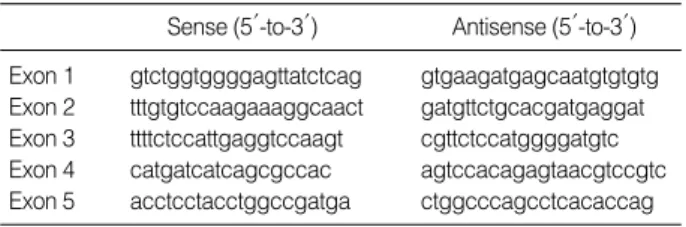
Genomic DNA was isolated from peripheral blood using a PUREGENE DNA isolation kit (Gentra, Minneapolis, MN, U.S.A.). Five exons of the KCNJ11 gene and their in- tronic flanking sequences were amplified by polymerase chain reaction (PCR) with five sets of primers (Table 1). Electro- phoresis and analysis of the reaction mixtures were performed on the ABI 3100 Genetic analyzer (Applied Biosystems, Foster city, CA, U.S.A.).
Continuous glucose monitoring system
Continuous glucose monitoring was performed using on the continuous glucose monitoring system (CGMS, Med- tronic MiniMed, Sylmar, CA, U.S.A.) three times in case 1:
at the initiation of glibenclamide therapy, one week and one month later after glinbenclamide therapy. CGMS is a Holter- style sensor that monitors glucose values continuously in sub-
Sense (5′-to-3′) Antisense (5′-to-3′) Exon 1 gtctggtggggagttatctcag gtgaagatgagcaatgtgtgtg Exon 2 tttgtgtccaagaaaggcaact gatgttctgcacgatgaggat Exon 3 ttttctccattgaggtccaagt cgttctccatggggatgtc Exon 4 catgatcatcagcgccac agtccacagagtaacgtccgtc Exon 5 acctcctacctggccgatga ctggcccagcctcacaccag Table 1.Sequences of primers for PCR reaction
PCR, polymerase chain reaction.
A
Fig. 1.Direct DNA sequence analysis of two patients with permanent neonatal diabetes revealed mutations of the KCNJ11 gene encod- ing Kir6.2. Arrows indicate the nucleotide position affected by the mutation. Case 1 (A) had a nucleotide substitution with AAG to AGG at position 509 in the exon 3. Case 2 (B) had a nucleotide substitution with GTG to ATG at position 175 in the exon 2.
Normal
GCTGCATCT TCATGA AGACTGC CCA AGC CCAC
GCTGCATCT TCATGANGACTGC CCA AGC CCAC
Patient
c.509 A>G
p.Lys170Arg (p.K170R) B
Normal
CT TC CTGCAGG ACGTGT TCAC CACGC TG
C T TC CTGCAG G ACNTGT TCAC CACGC TG
Patient
c.175 G>A p.Val59Met (p.V59M)
cutaneous tissue fluid within a range of 40-400 mg/dL. The monitor records glucose levels every five minutes for 72 hr.
RESULTS
We identified two previously reported heterozygous muta- tions (a a-to-g change at nucleotide 509, which resulted in a lysine-to-arginine substitution at position 170 of the gene encoding Kir6.2, K170R, in case 1, and a g-to-a change at nucleotide 175, which resulted in a valine-to-methionine substitution at position 59 in the gene encoding Kir6.2, V59M, in case 2, Fig. 1).
In order to assess the pancreatic -cell function, C-peptide levels were measured in the patients with PND. On admis-
sion for glibenclamide therapy, C-peptide levels were 0.1 in case 1 and 0.1 ng/mL in case 2 with corresponding blood glucose levels of 119 and 400 mg/dL, respectively. The basal levels of C-peptide levels, after one week of glibenclamide treatment, were increased to more than 18 times higher than the levels obtained during insulin therapy in case 1 and case 2 (Table 2).
In order to compare the clinical response to glibenclamide treatment with the response to the insulin therapy, frequent capillary glucose measurement and CGMS were performed.
After seven days of glibenclamide treatment, no hyper- or hy- poglycemic episode was observed in these patients. Fig. 2 shows three representative 24-hr glucose profiles obtained by the CGMS in case 1. These patients remain well and off insulin at 6 and 15 months of follow-up.
DISCUSSION
Recently, it has been shown that PND can result from mutations in Kir6.2 that reduce the ability for ATP to close the ATP-sensitive K+ channel. We report here two differ- ent heterozygous activating mutations of the KCNJ11 gene in Korean children with PND.
PND is defined as hyperglycemia diagnosed within the first three months of life and requires insulin therapy for life (1). Although PND is a rare entity and the genetic etiology is unknown in about half of affected patients, Kir6.2 muta-
NA, not available.
Days after sulfonylurea
Day 0 (Case 1/2)
Day 7 (Case 1/2)
Day 30 (Case 1/2)
Day 150 (Case 1/2)
1 yr (Case 1/2) Insulin NA/15.4 11.5/9.47 13.4/NA 10.4/15.8 NA/12.0
( IU/mL)
C-peptide 0.1/0.1 2.2/1.8 3.3/3.2 2.9/3.0 NA/2.0 (ng/mL)
Glucose 119/400 294/NA 150/NA 135/NA NA/NA (mg/dL)
HbA1C 7.4/8.7 NA/NA 6.9/7.2 6.4/5.9 NA/5.8 Table 2.Serum insulin, C-peptide, and HbA1Clevels after gliben- clamide therapy
A
Glucose (mg/dL)
400
300
200
100
0
03:00 06:00 09:00 12:00 15:00 18:00 21:00 Time of day
Fig. 2.A three representative 24-hr long recordings of glucose lev- els at one day before glibenclamide therapy (insulin therapy only, A) and one week (B) and one month (C) after glibenclamide the- rapy (only glibenclamide therapy), performed by continuous glu- cose monitoring system in case 1.
C
Glucose (mg/dL)
400
300
200
100
0
03:00 06:00 09:00 12:00 15:00 18:00 21:00 1.5T
Glibenclamide 180
70
1.5T 1T
Time of day
B
Glucose (mg/dL)
400
300
200
100
0
03:00 06:00 09:00 12:00 15:00 18:00 21:00 Time of day
Insulin Insulin Glibenclamide 1.5T 1.5T 1.5T 1.5T
tions are a common cause of PND. To date, at least 63 pati- ents with activating mutations in Kir6.2 have been described from Europe, the Middle East, Australia, and North and South America, comprising 21 different mutations in 49 families (8, 9). The majority of cases have been Caucasian, but muta- tions have been found in other ethnic groups. However, there has been only one report from Japan in Asia with PND caused by a Kir6.2 mutation (10). The cases reported here are the first cases of PND with Kir6.2 mutations identified in Korea.
We found two different mutations (V59M and K170R) in the Korean patients with PND. The V59M mutation is one of the most common mutations identified to date (8). How- ever, the K170R mutation is rare, and only one case has been reported. There is emerging evidence for a clear genotype- phenotype relationship for Kir6.2 mutations. Most patients with a mutation at R201, the most common mutation, have nonremitting neonatal diabetes without neurological fea- tures. However, patients with the V59M mutation have developmental delay and features consistent with interme- diate DEND (developmental delay, epilepsy, and neonatal diabetes) syndrome (8). The phenotypic expressions of the two patients presented here are similar to those reported in cases previously (8, 9). Our patients did not have type 1 asso- ciated antibodies and had low levels of C-peptide. One of two patients had low birth weight. Moreover, this patient was small for gestational age. Both exhibited severe hyper- glycemia and the need for subsequent exogenous insulin within three months of life. The patient with the K170R mutation had only PND. By contrast, patients with the V59M mutation have neurological features (developmental delay and muscles weakness) in addition to diabetes.
All mutations studied to date produce a marked decrease in the ability of ATP to block the KATP channels when ex- pressed in the heterologous systems (11-13). This reduction in ATP sensitivity causes the channel to open more fully at physiologically relevant concentrations of ATP, leading to an increase in the KATP current. In pancreatic -cells, an increase in KATP current will hyperpolarize the membrane, suppressing electrical activity, Ca2+influx, and insulin secre- tion, and thereby causes diabetes (14). KATP channels that are insensitive to ATP as a consequence of Kir6.2 mutations can still be closed by sulfonylurea that bind to the SUR sub- unit and directly close the channel (6). A number of patients with Kir6.2 mutations have been able to discontinue their insulin injections completely and obtain as good as, or bet- ter glycemic control, using oral sulfonylurea (7, 15-17). In our cases, we discontinued insulin injection and introduced high dose oral glibenclamide therapy (0.8-0.9 mg/kg/day).
The continuous glucose monitoring systems were compara- ble during and after insulin treatment, and the HbA1Clev- els declined after insulin had been discontinued. However, these patients still required high doses of sulfonylurea, com- pared with adults with type 2 diabetes, as has been reported in other studies (15-17). Mutations that affect the probability
of opening the channel are less sensitive to inhibition by sul- fonylurea in vitro (13, 18). Therefore, even higher drug doses may be necessary in patients with PND. To date, the longest duration recorded in a patient has remained off insulin has been about two years (8). Therefore, long-term follow-up studies are now required to assess whether the response to sulfonylurea is maintained, and whether sulfonylurea thera- py is better than insulin therapy.
In conclusion, mutations in the gene KCNJ11 encoding Kir6.2 can cause PND in Korean children, and oral sulfony- lurea therapy is as good as, or better than glycemic control, obtained with insulin therapy. All patients with PND should be tested for KCNJ11 mutations for appropriate management and follow-up.
REFERENCES
1. Shield JP. Neonatal diabetes: new insights into aetiology and impli- cations. Horm Res 2000; 53 (Suppl 1): 7-11.
2. Temple IK, Gardner RJ, Mackay DJ, Barber JC, Robinson DO, Shield JP. Transient neonatal diabetes:widening the understanding of the etiopathogenesis of diabetes. Diabets 2000; 49: 1359-66.
3. Gloyn AL, Pearson ER, Antcliff JF, Proks P, Bruining GJ, Slinger- land AS, Howard N, Srinivasan S, Silva JM, Molnes J, Edghill EL, Frayling TM, Temple IK, Mackay D, Shield JP, Sumnki Z, van Rhijn A, Wales JK, Clark P, Gorman S, Aisenberg J, Ellard S, Njolstad PR, Ashcroft FM, Hattersley AT. Activating mutations in the gene encod- ing the ATP-sensitive potassium channel subunit Kir6.2 and perma- nent neonatal diabetes. N Engl J Med 2004; 350: 1838-49.
4. Inagaki N, Gonoi T, Clement JP, Namba N, Inazawa J, Gonzalez G, Aguilar-Bryan L, Seino S, Bryan J. Reconstitution of IKATP: an in- ward rectifier subunit plus the sulfonylurea receptor. Science 1995;
270: 1166-70.
5. Aschcroft FM, Harrison DE, Ashcroft SJ. Glucose induces closure of single potassium channels in isolated rat pancreatic beta-cells.
Nature 1984; 312: 446-8.
6. Gribble FM, Reimann F. Sulfonylurea action revisited: the post-clo- ning era. Diabetelogia 2003; 46: 875-91.
7. Sagen JV, Raeder H, Eba H, Naim S, Kolbeinn G, Halvor B, Abue- lo D, Phornphutkul C, Molnes J, Bell GI, Gloyn AL, Hattersley AT, Molven A, Sovik O, Njolstad PR. Permanent Neonatal Diabetes due to Mutations in KCNJ11 Encoding Kir6.2: Patient characteristics and initial response to sulfonylurea therapy. Diabetes 2004; 53: 2713-8.
8. Hattersley AT, Ashcroft FM. Activating Mutations in Kir6.2 and neonatal diabetes: New clinical syndromes, new scientific insights and new therapy. Diabetes 2005; 54: 2503-13.
9. Flanagan SE, Edghill EL, Gloyn AL, Ellard S, Hattersley AT. Muta- tion in KCNJ11, which encodes Kir6.2, are a common cause of dia- betes diagnosed in the first 6 months of life, with the phenotype deter- mined by genotype. Diabetologia 2006; 49: 1190-7.
10. Suzuki S, Mukai T, Matsuo K, Ueda O, Ito Y, Makita Y, Fujieda K.
KCNJ11 gene activating mutations in Japanese patients with neona- tal diabetes mellitus. Horm Research 2005; 64 (Suppl 1): 136.
11. Gloyn AL, Reimann F, Girard C, Edghill EL, Proks P, Pearson ER, Temple IK, Mackay DJ, Shield JP, Freedenberg D, Noyes K, Ellard S, Ashcroft FM, Gribble FM, Hattersley AT. Relapsing diabetes can result from moderately activating mutations in KCNJ11. Hum Mol Genet 2005; 14: 925-34.
12. Yorifuji T, Nagashima K, Kurokawa K, Kawai M, Oishi M, Akaza- wa Y, Hosokawa M, Yamada Y, Inagaki N, Nakahata T. The C42R mutation in the Kir6.2 (KCNJ11) gene as a cause of transient neona- tal diabetes, childhood diabetes, or later-onset, apparently type 2 diabetes mellitus. J Clin Endocrinol Metab 2005; 90: 3174-8.
13. Proks P, Antcliff JF, Lippiat J, Gloyn AL, Hattersley AT, Ashcroft FM. Molecular basis of Kir6.2 mutations associated with neonatal diabetes or neonatal diabetes plus neurological features. Proc Natl Acad Sci USA 2004; 101: 17539-44.
14. Wildin RS, Ramsdell F, Peake J, Faravelli F, Casanova JL, Buist N, Levy-Lahad E, Mazzella M, Goulet O, Perroni L, Bricarelli FD, Byrne G, McEuen M, Proll S, Appleby M, Brunkow ME. X-linked neona- tal diabetes mellitus, enteropathy and endocrinopathy syndrome is
the human equivalent of mouse scurfy. Nat Genet 2001; 27: 18-20.
15. Zung A, Glaser B, Nimri R, Zadik Z. Glibenclamide treatment in permanent neonatal diabetes mellitus due to an activating mutation in Kir6.2. J Clin Endocrinol Metab 2004; 89: 5504-7.
16. Codner E, Flanagan S, Ellard S, Garcia H, Hattersley A. High-dose glibenclamide can replace insulin therapy despite transitory diarrhea in early-onset diabetes caused by a novel R201L Kir6.2 mutation.
Diabetes Care 2005; 28: 758-9.
17. Klupa T, Edghill EL, Nazim J, Sieradzki J, Ellard S, Hattersley AT, Malecki MT. The identification of a R201H mutation in KCNJ11, which encodes Kir6.2, and successful transfer to sustained-release sulphonylurea therapy in a subject with neonatal diabetes: evidence for heterogeneity of beta cell function among carriers of the R201H mutation. Diabetologia 2005; 48: 1029-31.
18. Trapp S, Proks P, Tucker SJ, Ashcroft FM. Molecular analysis of ATP-sensitive K channel gating and implications for channel inhi- bition by ATP. J Gen Physiol 1998; 112: 333-49.