INTRODUCTION
Neonatal respiratory distress syndrome (RDS) is a progres- sive respiratory failure that is caused primarily by a deficien- cy of pulmonary surfactants (PS). In 1959, Avery and Mead (1) showed that PS deficiency is a major factor in the patho- physiology of RDS. The first successful treatment was report- ed in 1980, when Fujiwara et al. (2) successfully administered exogenous PS to preterm infants with RDS. PS replacement therapy is now the routine method of treatment for infants with RDS, and since its introduction, morbidity and mor- tality due to RDS in preterm infants has decreased remark- ably.
In Korea, Surfacten�(Mitsubishi Tanabe Pharma Corpo- ration, Tokyo, Japan), the first artificial PS, was available in 1991. Thereafter, Exosurf� (Burroughs Wellcome Co., Re- search Triangle Park, NC, U.S.A.) was available from 1991 to 1997, Newfactan�(Yuhan Pharm Corporation, Seoul, Korea) from 1996, and Curosurf�(Chiesi Farmaceutici, Parma, Italy) from 2003 (Table 1).
In Korea, PS was first used to treat 8 RDS cases in 1990 by Namgung et al. (3), and this was followed by a report on 6 cases by Park et al. (4) in 1991. Subsequently, Bae et al. (5) reported PS therapy outcomes in neonatal RDS on a nation- al basis for 1990 and 1991. Bae et al. published again a report
on the clinical outcomes of PS therapy in Korea in 1996 and 2002, respectively (6, 7).
In the present study, we investigated improvements of clin- ical outcome achieved by PS therapy for the treatment of RDS on national data basis for the year of 2007 and compared these findings with those of the three previous reports.
MATERIALS AND METHODS Subjects
In March 2008, we sent 57 hospitals in Korea question- naires that addressed the clinical outcomes of PS replacement therapy in 2007. Details of the 57 participating hospitals and the individuals that participated in this study are includ- ed in the list of contributors.
Patients treated in the individual report periods are referred to as groups for convenience, as follows. 1) Group I-patients enrolled in a 1990 to 1991 (24 months) national survey con- ducted by Bae et al. (5); 2) Group II-patients enrolled in a national survey performed in 1996 (12 months) by Bae et al.
(6); 3) Group III-patients enrolled in a national survey per- formed in 2002 (12 months) by Bae and Kim (7); and 4) Group IV-patients enrolled in a national survey performed
1110
Chong-Woo Bae and Won-Ho Hahn
Department of Pediatrics, College of Medicine, Kyunghee University, Seoul, Korea
Address for correspondence Chong-Woo Bae, M.D.
Department of Pediatrics, East and West Neo Medical Center, Kyunghee University, 149 Sangil-dong, Gangdong-gu, Seoul 134-727, Korea Tel : +82.2-440-6130, Fax : +82.2-440-7175 E-mail : [email protected]
DOI: 10.3346/jkms.2009.24.6.1110
Surfactant Therapy for Neonatal Respiratory Distress Syndrome:
A Review of Korean Experiences over 17 Years
We undertook a multi-hospital collective study to evaluate outcomes of neonatal respiratory distress syndrome (RDS) patients treated with pulmonary surfactant (PS) over 17 yr in Korea (Group I; 1990/91, Group II; 1996, Group III; 2002, and Group IV; 2007). There were 60 neonates in Group I (16 hospitals), 1,179 in Group II (64), 1,595 in Group III (62), and 1,921 in Group IV (57). We adopted Bomsel’s classification to evaluate initial chest radiographic findings, categorized RDS severi- ties, and classified response types to PS therapy. Almost all cases were treated using a single dose in Groups I and II, but 19.5% received multiple-dose therapy in Group IV. In Group IV, Bomsel’s stages III and IV composed 62.9% and initial sever- ities of mild, moderate, and severe RDS were 23.0%, 42.0%, and 35.0%. More infants showed good response in Groups II, III, and IV than in Group I (71.7%, 66.8%, and 69.2% vs. 58.3%). Complications and mortality rate were lower in Group IV than in Groups I, II, and III (mortality rate: 14.3% vs. 40.0%, 30.0%, and 18.7%). We con- clude that PS therapy in neonates with RDS had a remarkable impact on improv- ing clinical course and outcomes over 17 yr in Korea.
Key Words : Respiratory Distress Syndrome, Newborn; Premature; Complications; Epidemiology; Mortality;
Pulmonary Surfactants; Analysis; Therapeutic Use; Data Collection
Received : 9 December 2008 Accepted : 18 December 2008
in 2007 (12 months). Approval to use previous data (5-7) was obtained from each publisher of the journals.
Details of the four study groups, numbers of cases, and the hospitals that participated in this survey are shown in Table 2. In Group I, there were 60 patients at 16 hospitals for the year of 1990 and 1991. For Group II, 1,179 cases were rec- ruited nationally at 64 hospitals for 1996, and for Group III, 1,595 cases were recruited nationally at 62 hospitals for 2002.
Finally, for Group IV, 1,921 cases were recruited from 57 hos- pitals for 2007.
In terms of all RDS births, the proportions of patients who received PS therapy are shown in Table 3 subdivided into in-hospital-born and out-hospital-born patients. For all RDS patients, the percentages that underwent PS replacement therapy increased from 47.3% and 66.2%, in Groups II and III to 77.7%, in Group IV.
Fig. 1 summarizes the proportions of RDS patients in Group IV that underwent PS replacement therapy by birth weight
and gestational period.
Exogenous PS preparations used for therapy
In Group I, Surfacten�(Japan) was the only available agent in Korea, and was used in all cases. Subsequently, several PS preparations were used, as follows; Surfacten�(70.5%) or Exo- surf�(26.3%) in Group II; Surfacten�(35.4%), Newfactan�
*Lipid extracts of bovine lung mince+DPPC, PG, PA (containing surfac- tant proteins -B and -C); �Mixture of phospholipid (not contained sur- factant proteins -B and -C); �Chloroform/methanol extracts of porcine lung mince, purified by liquid gel electrophoresis (also containing sur- factant proteins -B and -C).
Products Periods
Imported Surfacten�* (Mitsubishi Tanabe 1991-present products Pharma Corporation, Tokyo, Japan)
Exosurf��(Wellcome Foundation 1991-1997 Ltd, London, England)
Curosurf��(Chiesi Farmaceutici, 2003-present Parma, Italy)
Korean Newfactan�* (Yuhan Pharm 1996-present product Corporation, Seoul, Korea)
Table 1. Preparations of artificial pulmonary surfactant clinically available in Korea
Years Hospitals
No. of surfactant
therapies
Groups References
Group I 1990/91 16 60 5
Group II 1996 64 1,179 6
Group III 2002 62 1,595 7
Group IV 2007 57 1,921 This study
Table 2. Data collection for this multi-center study on the clinical use of surfactant therapy in neonatal respiratory distress syn- drome in Korea
Fig. 1. Total number of respiratory distress syndrome (RDS) cases and of pulmonary surfactant therapy cases (S-Tx) in Group IV (2007), by gestational period (A) and birth weight (B).
No.
400 350 300 250 200 150 100 50 0
Gestational period (week)
RDS S-Tx
RDS S-Tx
A
No.
400 350 300 250 200 150 100 50
0 1,000-1,249
Birth weight (g) B
<500 1,750-1,999 2,500-2,749 3,250-3,499 ≥4,000
≤23 26 29 32 35 38 41
Total No. of RDS Inborn Out-
born Total Groups
No. of surfactant therapy Inborn Out-
born Total
I - - - 43 17 60
II 1,999 495 2,494 947 205 1,179
(47.4) (41.4) (47.3)
III 2,014 396 2,410 1,361 234 1,595
(67.6) (59.1) (66.2)
IV 2,154 319 2,473 1,694 216 1,921
(78.6) (67.7) (77.7) Table 3. Numbers of respiratory distress syndrome (RDS) pati- ents and surfactant therapy cases
(%), No. of surfactant therapy cases/total No. of respiratory distress syn- drome cases.
(64.1%), or a mixture (0.5%) in Group III; and Surfacten� (51.3%), Newfactan�(39.3%), Curosurf�(8.3%), or a mix- ture (1.1%) in Group IV (Fig. 2).
Classifications for clinical interpretation
Initial chest radiograph findings before PS replacement therapy were classified as Stage I, II, III, or IV using Bom- sel’s classification (8). The classification of Fujiwara et al. (9) uses ventilatory index as a respiratory index. Ventilatory index is calculated using FiO2×mean airway pressure (MAP)/arte- rial oxygen pressure (PaO2). Using ventilatory index values, respiratory distress was classified into 3 groups in the present study, namely, mild respiratory distress <0.047; moderate respiratory distress ≥0.047 and <0.133; and severe respira- tory distress ≥0.133.
We classified the early response to PS therapy using the classification of Fujiwara et al. (10), which utilizes fraction of inspired oxygen (FiO2), MAP, and arterial-alveolar oxygen tension ratio (a/A PO2). Patients were classified into good res-
ponse, relapse, and poor response groups. The good response group was composed of patients that showed clinical improve- ments in FiO2, MAP, and a/A PO2after PS administration.
The relapse group was composed of patients that experienced a recurrence of respiratory distress after an initial good res- ponse, as determined using respiratory markers. Poor response group members showed no respiratory marker improvement and continued respiratory distress.
RESULTS Epidemiology
The incidences of in-hospital-born RDS by birth weight and gestational period in Group IV are shown in Fig. 3. This data shows that RDS incidence increased with decreasing
Fig. 2. Preparations of PS used to treat RDS patients in the four study Groups. Surfacten�(51.3%), Newfactan�(39.3%), Curosurf� (8.3%), and mixtures of these (1.1%) were administrated in Group IV.
Surfacten Exosurf Newfactan Curosurf Mixed
Group IV
Group III
Group II
Group I
% 20
0
51.3%
45.6% 0.0%
70.5%
100%
26.3%
53.8%
39.3%
0.0% 8.3% 1.1%
0.6%
0.6%
0%
60
40 80 100
Fig. 3. Overall incidence of RDS by gestational period (A) and birth weight (B) among in-born neonates in Group IV. Gestational age and birth weight were found to be inversely proportional to the incidence of RDS.
%
100.0 90.0 80.0 70.0 60.0 50.0 40.0 30.0 20.0 10.0 0
Gestational period (week)
%
100.0 90.0 80.0 70.0 60.0 50.0 40.0 30.0 20.0 10.0 0 A
750-999
Birth weight (g) B
<500
1,250-1,4991,750-1,9992,250-2,4992,750-2,9993,250-3,4993,750-3,999
≤
≤23 25 27 29 31 33 35 37 39 41
%
100.0 90.0 80.0 70.0 60.0 50.0 40.0 30.0 20.0 10.0 0.0
Gestational period (week)
26 29 32 35 38 41
≤23
Fig. 4. Proportions of RDS patients in Group IV who received PS replacement therapy by gestational period. The figure shows that use of pulmonary surfactant therapy increased as gestational age is short.
birth weight and gestational period.
The proportions of patients in Group IV who received PS replacement therapy among all RDS births by gestational period are illustrated in Fig. 4. The data show that the need for PS replacement therapy increased with decreasing gesta- tional period. Interestingly, PS replacement therapy was less used in patients with a birth weight of <500 g, presumably due to the abandonment of rescue therapy due to a perceived low likelihood of survival.
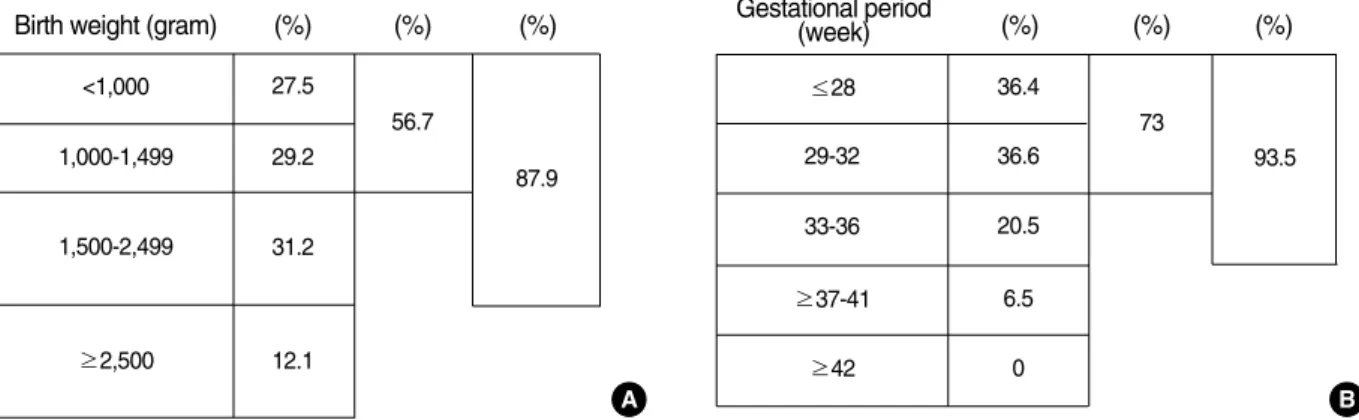
The distributions of birth weights and gestational periods among RDS patients in Group IV who received PS therapy are shown in Fig. 5. PS therapy was performed in 87.9% of low birth weight infants (<2,500 g) with RDS, in 56.7% of very low birth weight infants (<1,500 g), and in 27.5% of extremely low birth weight infants (<1,000 g).
Fig. 5 shows the distribution of RDS patients in Group IV who received PS replacement therapy by gestational peri- od. In the Group III study, PS replacement therapy was con- ducted in 93.5% of preterm patients with RDS (gestational period <37 weeks), 6.4% of term patients with RDS (gesta-
tional period 37-42 weeks), and in no post-term patient with RDS (gestational period ≥42 weeks). When preterm patients were sub-grouped by gestational period, 20.5% of the ges- tational period 33-36 weeks subgroup underwent PS replace- ment therapy, 36.4% of the gestational period 29-32 weeks subgroup, and 36.4% of the gestational period <28 weeks subgroup.
Clinical findings
In the surfactant treated RDS patients in Group IV, initial chest radiograph findings (before PS therapy) showed that 11.3%, 25.3%, 36.9%, and 26.0% of patients were of Stages I, II, III, and IV, respectively, according to Bomsel’s classifi- cation. In Groups III and IV the rates of those with relative- ly severe RDS (Stage III and IV) were high at 67.7% and 62.9%, respectively (Fig. 6).
Fig. 5. Birth weight (A) and gestational period (B) distributions in RDS patients that received PS therapy. Low birth weight infants (<2,500 grams), very low birth weight infants (<1,500 grams), and extremely low birth weight infants (<1,000 grams) constituted 87.9%, 56.7%, and 27.5% of total RDS patients, respectively (A) and prematurity (gestational period <37 weeks) was 93% of total RDS patients (B).
(%), Percentage in RDS patients that received PS therapy.
A B
(%) 27.5
29.2
56.7
87.9 31.2
12.1 Birth weight (gram)
<1,000
1,000-1,499
1,500-2,499
≥2,500
(%) (%) Gestational period (%)
(week) (%) (%)
93.5 73
≤28 36.4 29-32
33-36
≥37-41
≥42
36.6
20.5
6.5 0
Stage I Stage II Stage III Stage IV Mild Moderate Severe Unknown
Group IV 11.3%
Group III 6.7% 25.4% 33.2% 34.7%
25.3% 36.9% 26.0%
Fig. 6. Initial chest radiographic findings in Groups III (2002) and IV (2007). Initial chest radiographic findings before pulmonary sur- factant therapy were classified using Bomsel’s Classification. Pati- ents with relatively severe RDS (stages III and IV) composed 67.7%
and 62.9% of patients in Groups III and IV, respectively.
% 20
0 40 60 80 100
Fig. 7. Initial ventilatory indices of each study Group according to the classification of Fujiwara et al. (8). Ventilatory index is a rec- ognized respiratory index. Mild respiratory distress patients were 23.0% of total RDS patients, moderately affected patients were 42.0%, and severe respiratory distress patients were 35.0% in Group IV.
Group IV
Group III
Group II
Group I
% 20
0
23.0% 42.0% 35.0%
28.4% 47.4% 30.9%
8.8% 40.7% 50.5%
63%
25%
60
40 80 100
2 10%
%
Distributions of severity according to ventilatory index in each Group before PS replacement therapy are shown in Fig. 7.
In Group IV, 23.0%, 42.0%, and 35.0%, of patients had mild, moderate, or severe respiratory distress, respectively.
In Groups I and II, all cases received a single dose of PS, probably because repeated administrations were limited by medical insurance policies at that time. However, because repeated PS administration was approved in part prior to 2002, in Groups III and IV second and third administrations were reported in some cases. Single and multiple uses were report- ed in 79.9% and 20.1% of cases in Group III, and these were similar to those reported in Group IV (80.5% and 19.5%, respectively). Summarizing, multiple PS was used in about 20% of all RDS patients in Groups III and IV (Table 4).
In terms of early response to PS therapy, using the Fuji- wara et al. classification, i.e., good response, relapse, and poor response, responses in Group IV were 69.2%, 14.4%, and 16.4%, respectively. Response results for Groups I, II, III, and IV are shown in Fig. 8.
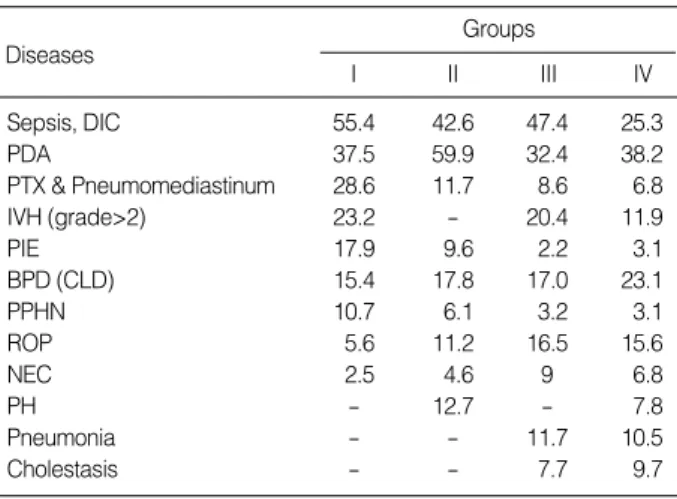
Complications frequently developed during the manage- ment of RDS patients and preterm babies (Table 5). The occurrence rates of infections (including disseminated intra- vascular coagulopathy [DIC]) were high in Groups I, II, and III at 55.4%, 42.6%, and 47.4%, but the rate was apprecia- bly lower in Group IV (25.3%). These changes were accom- panied by decreases in pneumothorax and intraventricular hemorrhage. Furthermore, the frequencies of bronchopulmo-
nary dysplasia (BPD) and retinopathy of prematurity (ROP) were found to be higher in Group IV, in parallel with the improved survival of extremely premature infants in 2007.
Mortality
As shown in Fig. 9, mortality rates (defined as the percent- age of neonates who died within 28 days of birth) dramati- cally decreased over the study period (40% in Group I, 30%
in Group II, 18.7% in Group III, and 14.3% in Group IV).
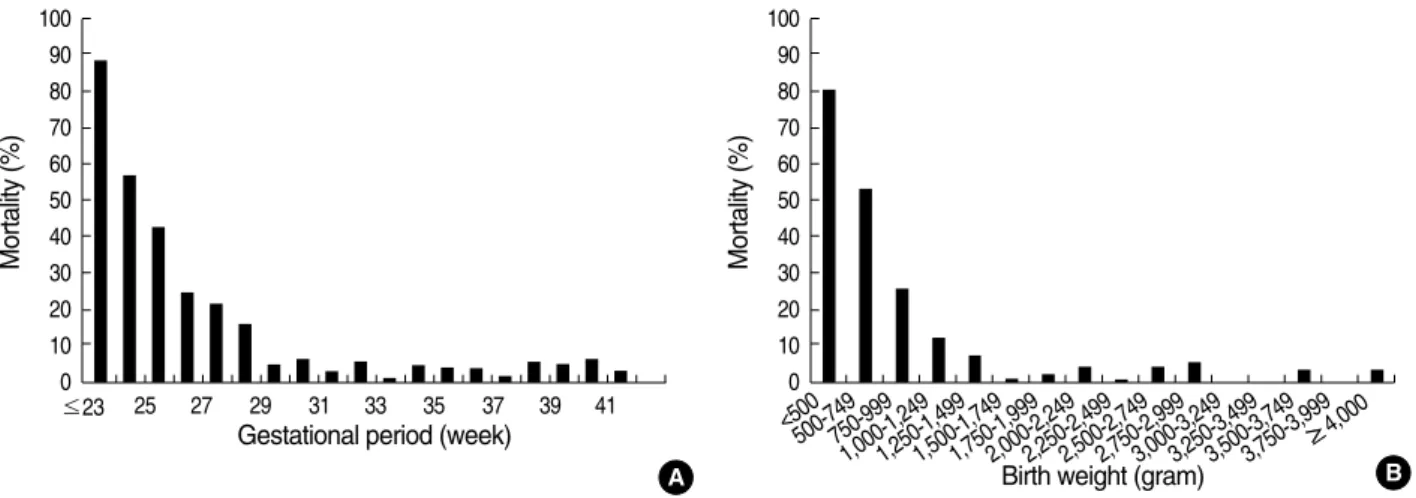
Mortality rates of surfactant treated patients by birth weight and gestational period in Group IV are illustrated in Fig. 10.
In term babies, mortality rates were found to be high, which appears to be due to some co-morbidities other than RDS
Good Relapse Poor
Fig. 8. Early response rates to pulmonary surfactant therapy in the four study groups. In Group IV, 69.2% responded well, 14.4%
relapsed, and 16.4% responded poorly.
Group IV
Group III
Group II
Group I
% 20
0
69.2% 16.4%
66.8% 16.0% 15.1%
71.7% 23.5% 5.7
%
25%
60
40 80 100
35.0%
14.4%
58.3% 0.0%
*multiple doses not available due to limited insurance coverage, �multiple doses available due to sopports of national insurance requirements.
Single dose (%) Multiple doses (%) Groups
I 100* -
II 100* -
III 79.9 20.1�
IV 80.5 19.5�
Table 4. Surfactant doses (single vs. multiple doses)
DIC, disseminated intravascular coagulation; PDA, patent ductus arte- riosus; PTX, pneumothorax; IVH, intraventricular hemorrhage; PIE, pul- monary interstitial emphysema; BPD, bronchopulmonary dysplasia; CLD, chronic lung disease; PPHN, persistent pulmonary hypertension; ROP, retinopathy of prematurity; NEC, necrotizing enterocolitis; PH, pulmonary hemorrhage.
Groups
I II III IV
Diseases
Sepsis, DIC 55.4 42.6 47.4 25.3
PDA 37.5 59.9 32.4 38.2
PTX & Pneumomediastinum 28.6 11.7 8.6 6.8
IVH (grade>2) 23.2 - 20.4 11.9
PIE 17.9 9.6 2.2 3.1
BPD (CLD) 15.4 17.8 17.0 23.1
PPHN 10.7 6.1 3.2 3.1
ROP 5.6 11.2 16.5 15.6
NEC 2.5 4.6 9 6.8
PH - 12.7 - 7.8
Pneumonia - - 11.7 10.5
Cholestasis - - 7.7 9.7
Table 5. Associated diseases and complications (%)
Mortality (%)
100.0 90.0 80.0 70.0 60.0 50.0 40.0 30.0 20.0 10.0 0.0
Group
I II III IV
Fig. 9. Changes in RDS mortality rates over the past 17 yr among those that received PS replacement therapy. Mortality rates were found to have reduced dramatically, that is, from 40%, 30%, 18.7%, to 14.3% in Groups I (1990/1), II (1996), III (2002), and IV (2007), respectively.
40.0%
30.0%
18.7%
14.3%
causing respiratory distress such as, persistent pulmonary hypertension, meconium aspiration, sepsis, and so on, which also influence negatively the function of surfactant. Many of co-morbidities are known to bring their clinical courses severe enough even leading to death.
As shown in Fig. 11, in Groups III and IV, mortality rates of those who underwent PS once were 15.6% and 13.0%, respectively. These rates were lower than mortalities among those who underwent repeated treatment (24.1% in Group III and 16% in Group IV), probably because more severe cases were administered multiple PS.
DISCUSSION
In 1980, Fujiwara et al. (2) first successfully administered exogenous PS to preterm infants with RDS, and subsequent- ly several PS preparations were developed. These preparations
have since been shown to reduce mortality and morbidity effectively among RDS patients by several double blind, ran- domized, controlled studies. Today PS replacement therapy has become a routine method of treating infants with RDS.
The PS preparations used today are either animal-sourced or synthesized. Animal-sourced agents, include; 1) Alveofact� (Bovactant, Germany), BLES�(Canada), Infasurf�(Calfactant, U.S.A.), Survanta�(Beractant, U.S.A.), Surfacten�(Surfactant- TA, Japan), and Newfactan�(Korea), which are all extracted from bovine lungs, and 2) Curosurf�(Poractant alfa, Italy) from porcine lungs. Synthetic agents include; ALEC�(Pul- mactant, U.K., no longer manufactured), Exosurf�(Colfos- ceril palmitate, U.S.A.); phospholipid synthetics, and Sur- faxin�(Lucinactant, U.S.A., not FDA licensed), a surfactant protein B synthetic (11). Of these, Surfacten�, Newfactan�, and Curosurf�are currently being used, but Exosurf�, which was used for short time, is no longer available in Korea. The PS agents used in Korea are listed in Table 1.
Surfacten�and Newfactan�contain phospholipids extract- ed from bovine lung, and surfactant proteins -B and -C, which increase surface physical activity and reduce surface tension on the alveolar surface. Curosurf�is produced from porcine lung by chloroform/methanol extraction and liquid gel elec- trophoresis for purification, and contains surfactant proteins -B and -C. In Group IV, Surfacten�(51.3%) was adminis- tered in more than half cases, and Newfactan�(39.3%), Curo- surf�(8.3%), and mixtures of these agents (1.1%) were fol- lowed. Several meta-analyses concluded that PS replacement therapy reduces mortality in RDS patients. In 1993, Jobe et al. (12) after integrating results from 1985 to 1992, report- ed that mortality is decreased by PS therapy when used as a prophylactic or rescue therapy with an odds ratio of 0.6. Fur- thermore, in 1993 Ptamanik et al. (13) reported that PS agents of synthetic or animal origin administered as prophylactic or rescue therapies effectively reduce mortality among RDS patients (odds ratio 0.5-0.6). In a meta-analysis conducted by the Committee on Fetus and Newborn of the American
Mortality (%)
100 90 80 70 60 50 40 30 20 10 0
Fig. 10. The mortality rates of RDS patients in Group IV who received PS replacement therapy by gestational period (A) and birth weight (B).
The figure shows that mortality rates were found to be inversely related to gestational age and birth weight.
Gestational period (week)
25 27 29 31 33 35 37 39 41
≤23
Mortality (%)
100 90 80 70 60 50 40 30 20 10 0
B
<500 500-749750-999
1,000-1,2491,250-1,4991,500-1,7491,750-1,9992,000-2,2492,250-2,4992,500-2,7492,750-2,9993,000-3,2493,250-3,4993,500-3,7493,750-3,999≥≥4,000 Birth weight (gram)
A
Mortality (%)
100 90 80 70 60 50 40 30 20 10 0
Fig. 11. The mortality rates among RDS patients who received PS therapy according to the number of PS treatments administered.
Mortality rates for single use in Groups III and IV were 15.6% and 13.0%, respectively, and for multiple use were 24.1% and 16% in Groups III and IV. Presumably because more severe cases were administered multiple PS.
Group
III IV
Single Multiple
Academy of Pediatrics (2008) (14), attributed remarkable reductions in the mortalities of RDS patients to these agents (odds ratio of 0.6 for agents of animal origin and of 0.7 for those of synthetic origin when administered with prophy- lactic intent; and of 0.67 for agents of animal origin PS and 0.73 for those of synthetic origin when administered as res- cue therapies).
The use of PS therapy obviously decreased mortality among Korean RDS patients over the 17-yr study period, i.e., from 40.0%, 30.0%, 18.7%, and 14.3% for the periods 1990/91, 1996, 2002, and 2007, respectively. Furthermore, PS thera- py reduced mortalities not only among RDS patients, but also among prematurities and neonates in Korea. In the pre- PS era (before 1990), mortality due to RDS was much higher.
In addition, several advances in neonatal supportive care, such as, improvements in artificial ventilator strategies, and the prevention and early management of infections and compli- cations, have also undoubtedly contributed to these reduc- tions in mortality (15-17).
A double blind, randomized, controlled study on Surfacten� conducted in Japan found lower mortality among RDS pa- tients (8%, birth weight<1,750 g) than we found in the pre- sent study (9). On the other hand, other double blind, ran- domized, controlled study performed on Survanta�, which has the same composition as Surfacten�, reported a RDS mor- tality of 18.4% (birth weight <1,750 g) (18).
In the present study, we investigated the frequency of RDS among in-hospital-born patients in 2007 treated at 57 hos- pitals and found that the frequency of RDS decreases as birth weight is light or gestational period is short.
Furthermore, in the present study, PS was administered to a greater proportion of RDS patients with time, i.e., 47.3%, 66.2%, and 77.7% in Groups II, III, and IV, respectively. This appears to be due to changed attitude of the Korean Medi- cal Insurance Association in terms of PS administration. In terms of our 2007 data, rates of PS use were found to be grea- ter in patients with a smaller gestational period, which im- plies that RDS is more severe among these patients. Further- more, PS replacement therapy was used in 87.9% of low birth weight infants (<2,500 g) and in 56.7% of very low birth weight infants (<1,500 g) in terms of birth weight, and in 93.5% of preterm infants in terms of gestational period (espe- cially 73% had a gestational period of <32 weeks). In brief, infants with a gestational period of <32 weeks and a birth weight of <1,500 g were major members.
In terms of the classification of initial chest radiographic findings in RDS patients, stage distributions were similar for Groups III and IV. The proportions of patients with stage III or IV (severely affected) composed about 2/3 of Groups III and IV, which confirms that patients with more severe ini- tial chest findings by radiography require more PS therapy.
Initial respiratory distress classifications using ventilatory index showed that patients who received PS therapy in Groups I and II had milder conditions than those in Groups III and
IV, which appears to be due to the extended indication for PS referred to above. Groups III and IV had similar initial respiratory distress distributions. In Group IV, 23.0% had mild respiratory distress, 42.0% had moderate, and 35.0%
had severe respiratory distress. Furthermore, those with mod- erate or severe respiratory distress constituted as much as 77%
of Group IV RDS patients, and thus, more aggressive man- agement is required in these patients.
Korean medical insurance policies did not permit multi- ple administration of PS in 1990/91 (Group I) or in 1996 (Group II), when only a single dose was administered in all cases. However, the policy was changed to a direction per- mitting multiple dose in 2001. In Groups III and IV mul- tiple administrations were performed in roughly 1/4 of cases.
In Groups III and IV 14.4% and 16.0% of patients relapsed and these patients were treated with multiple doses of PS.
The classification of early response to the PS treatment show- ed better results in Groups III and IV than in Groups I and II. In Group IV, 69.2% responded well, 14.4% relapsed, and 16.4% responded poorly, which means that about 1/5th of RDS patients relapsed after initial PS treatment. In a Japanese report (10), 79% responded well, 16% relapsed, and 5% res- ponded poorly, which is a substantially better response rate that observed in our 2007 study.
To improve the prognosis of RDS patients early detection and adequate management of co-morbidities, including asso- ciated diseases and complications, are as important as gener- al supportive care. We examined data for the past 17 yr in terms of complications and associated diseases that developed during the management of RDS patients and preterm babies (Table 5).
Mortalities of RDS neonates in Korea were found to dra- matically improve over the 17-yr study period, i.e., from 40.0%, 30.0%, 18.7%, to 14.3% for 1990/91, 1996, 2002, and 2007, respectively. Furthermore, our study of birth wei- ghts and gestational periods showed that both are inversely related to mortality, which means that these high-risk pati- ents require more attention.
In this longitudinal study, we analyzed clinical findings, disease severity, dose schedule of PS administration, response to treatment, associated diseases, complications, and mor- talities, with respect to RDS and PS treatment in neonates over a 17-yr period in Korea. We conclude that surfactant treatments in neonates with RDS have had a marked impact on clinical course and outcome, together with substantial reduction of mortality rates among RDS patients over the last 17 yr in Korea.
LIST OF CONTRIBUTORS
We list the following 57 hospitals and individuals who par- ticipated in this research by providing information in this nationwide study; Byeong Il Kim (Seoul National Universi-
ty Bundang Hospital), Chang Ryul Kim (Hanyang Univer- sity Guri Hospital), Chan Hoo Park (Gyeongsang National University Hospital), Chong Woo Bae (Kyunghee Univer- sity East-West Neo Medical Center), Chung Sik Chun (The Catholic University of Korea Kangnam St. Mary’s Hospital), Eun Ae Park (Ewha Womans University Mokdong Hospi- tal), Eun Sil Lee (Yeungnam University Medical Center), Han Suk Kim (Seoul National University Children’s Hospi- tal), Heng Mi Kim (Kyungpook National University Hos- pital), Hye Sun Yoon (Eulji General Hospital), Hyun Kyung Park (Hanyang University Medical Center), Hyun Seung Jin (Gangneung Asan Hospital), Hyun Seung Lee (The Catholic University of Korea Uijeongbu St. Mary’s Hospital), Il Sung Park (Soonchunhyang University Gumi Hospital), Il Tae Hwang (Hallym University Kangdong Sacred Heart Hos- pital), In Kyung Sung (The Catholic University of Korea St.
Mary’s Hospital), Jang Hoon Lee (Korea University Anam Hospital), Jang Hoon Lee (Korea University Ansan Hospi- tal), Jong Hee Hwang (Inje University Ilsan Paik Hospital), Jung Are Kim (Hanil General Hospital), Jung Hyun Lee (The Catholic University of Korea St. Vincent’s Hospital), Jung Ju Lee (Chung-Ang University Medical Center), Ki Soo Kim (University of Ulsan Asan Medical Center), Kyu Hyung Lee (Pochon Jungmun University Cha Hospital), Kyung Hee Lee (Gumi CHA General Hospital), Kyung Og Ko (Konyang University Hospital), Kyun Woo Lee (Dae Dong Hospital), Mea Young Chang (Chungnam National University Hospital), Mi Jung Kim (Chungbuk University Hospital), Mi Lim Koo (Sowha Children’s Hospital), Min Soo Park (Yonsei University Yongdong Severance Hospital), Moon Sung Park (Ajou University Hospital), Myoung Jae Chey (Inje University Sanggye Paik Hospital), Myung Ho Oh (Soonchunhyang University Cheonan Hospital), Ran Namgung (Yonsei University Severance Children’s Hospi- tal), Sang Geel Lee (Daegu Fatima Hospital), Sang Kee Park (Chosun University Hospital), Sang Lak Lee (Keimyung Uni- versity Dongsan Medical Center), Sang Young Bae (Halla General Hospital), Son Moon Shin (Cheil General Hospital
& Women’s Health Care Center), Soo Chul Cho (Chonbuk National University Hospital), So Young Kim (The Catholic University of Korea Holy Family Hospital), Su Eun Park (Pusan National University Hospital), Sung Mi Kim (Busan St. Mary’s Medical Center), Sung Min Choi (Dongguk Uni- versity Gyongju Hospital), Sung Shin Kim (Soonchunhyang University Bucheon Hospital), Sun Ju Lee (Dongguk Univer- sity Pohang Hospital), Tae Jung Sung (Hallym University Kangnam Sacred Heart Hospital), Won Ho Hahn (Kyunghee University Kyunghee Medical Center), Woo Taek Kim (Daegu Catholic University Medical Center), Yeun Kyun Oh (Won- kwang University Hospital), Yong Hoon Jun (Inha Univer- sity Hospital), Yong Won Park (College of Medicine Inje University Seoul Paik Hospital), Young Hee Kim (Bundang Jaesang General Hospital), Young Sook Hong (Korea Uni- versity Guro Hospital), Young Youn Choi (Chonnam Nation-
al University Hospital), and Youn Woo Kim (Cheju Nation- al University Hospital).
REFERENCES
1. Avery ME, Mead J. Surface properties in relation to atelectasis and hyaline membrane disease. AMA J Dis Child 1959; 97: 517-23.
2. Fujiwara T, Maeta H, Chida S, Morita T, Watabe Y, Abe T. Artifi- cial surfactant therapy in hyaline-membrane disease. Lancet 1980;
1: 55-9.
3. Namgung R, Lee C, Park KI, Han DG. Exogenous surfactant replace- ment therapy of hyaline membrane disease: a controlled clinical trial. J Korean Pediatr Soc 1990; 33: 22-35.
4. Park CO, Lim BY, Yeo BG, Song JH, Sohn EK, Bae CW, Chung SJ, Ahn CI. Surfactant replacement therapy in neonatal respiratory distress syndrome. J Korean Pediatr Soc 1991; 34: 1211-22.
5. Bae CW, kwon YD, Ko SJ, Kim KS, Kim HM, Park WS, Byun SH, Son CS, Ahn HS, Lee SG, Chang YP, Chung YJ. Surfactant replace- ment therapy in neonates with respiratory distress syndrome: a col- lective evaluation of trials from 16 hospitals. J Korean Pediatr Soc 1993; 36: 244-65.
6. Bae CW, Kim MH, Chun CS, Lee C, Moon SJ, Yoo BH, Lim BK, Lee SG, Choi YY, Byun SH, Choi AH, Pi SY, Han DG, Cho SH, Yoon JK. Surfactant replacement therapy in RDS: A collaborative study of multi-center trials in Korea. J Korean Soc Neonatol 1997;
1: 124-35.
7. Bae CW, Kim YM. Surfactant therapy for neonatal respiratory dis- tress syndrome: experience in Korea over 15 Years. Korean J Pedi- atr 2004; 47: 940-8.
8. Bomsel F. Radiologic study of hyaline membrane disease: 110 cases.
J Radiol Electrol Med Nucl 1970; 51: 259-68.
9. Fujiwara T, Konishi M, Chida S, Okuyama K, Ogawa Y, Takeuchi Y, Nishida H, Kito H, Fujimura M, Nakamura H, Hashimoto T. Sur- factant replacement therapy with a single postventilatory dose of a reconstituted bovine surfactant in preterm neonates with respiratory distress syndrome; final analysis of a multicenter, double-blind, ran- domized trial and comparison with similar trials. Pediatrics 1990;
86: 753-64.
10. Fujiwara T, Konishi M, Chida S, Maeta H. Factors affecting the res- ponse to a postnasal single dose of a reconstituted bovine surfactant (surfactant-TA). In: Lachmann B, editor, Surfactant replacement therapy in neonatal and adult respiratory distress syndrome. Berlin:
Springer-verlag 1988; 91-107.
11. Sweet D, Bevilacqua G, Carnielli V, Greisen G, Plavka R, Didrik Saugstad O, Simeoni U, Speer CP, Valls-I-Soler A, Halliday H. Euro- pean consensus guidelines on the management of neonatal respira- tory distress syndrome. J Perinat Med 2007; 35: 175-86.
12. Jobe AH. Pulmonary surfactant therapy. N Engl J Med 1993; 328:
861-8.
13. Pramanik AK, Holtzman RB, Merritt TA. Surfactant replacement therapy for pulmonary disease. Pediatr Clin North Am 1993; 40:
913-36.
14. Engle WA; American Academy of Pediatrics Committee on Fetus
and Newborn. Surfactant-replacement therapy for respiratory distress in the preterm and term neonate. Pediatrics 2008; 121: 2419-32.
15. Bae YM, Bae CW. The changes in the mortality rates of low birth weight infant and very low birth weight infant in Korea over the past 40 years. J Korean Med Sci 2004; 19: 27-31.
16. Bae CW. The changes in the birth and mortality rates of newborn in Korea. J Korean Med Assoc 2006; 49: 975-82.
17. Kim KS, Bae CW. Trends in survival rate for very low birth weight
infants and extremely low birth weight infants in Korea, 1967-2007.
Korean J Pediatr 2008; 51: 237-42.
18. Liechty EA, Donovan E, Purohit D, Gilhooly J, Feldman B, Noguchi A, Denson SE, Sehgal SS, Gross I, Stevens D, Ikegami M, Zachman RD, Carrier ST, Gunkel JH, Gold AJ. Reduction of neonatal mor- tality after multiple doses of bovine surfactant in low birth weight neonates with respiratory distress syndrome. Pediatrics 1991; 88:
19-28.