http://dx.doi.org/10.9721/KJFST.2014.46.1.39
39
©The Korean Society of Food Science and Technology
상산나무 잎 추출물의 항균활성 및 안정성 조사
최수빈·강성태*
서울과학기술대학교 식품공학과
Investigation of Antimicrobial Activity and Stability of
Orixa japonica Thunb. Leaf Extract
Su-Bin Choe and Sung-Tae Kang*
Department of Food Science and Technology, Seoul National University of Science and Technology
Abstract The antimicrobial activity of Orixa japonica Thunb. leaf extract towards 13 microorganism strains was evaluated. Both methanol (MEex) and 70% ethanol extracts showed antimicrobial activity towards Streptococcus mutans, Bacillus cereus, Staphylococcus aureus, and Pseudomonas aeruginosa. MEex showed a higher antimicrobial activity than the 70% ethanol extract. In addition, the dichloromethane fraction (DCMfr) of the MEex also had an antimicrobial effect against the microorganisms examined. The minimum inhibitory concentrations (MICs) towards S. mutans, B. cereus, S. aureus, and P. aeruginosa were 49.22, 24.61, 49.22, and 49.22 mg/mL, respectively. In contrast, the MICs of the DCMfr tpwards S. mutans, B. cereus, S. aureus, and P. aeruginosa were 3.31, 0.21, 1.7, and 1.7 mg/mL, respectively. The MEex antimicrobial activity was not affected by a 3 h exposures to pH in the range of 3-11 or by temperatures were maintained between 80oC-100oC for 6 h. However, the MEex antimicrobial activity decreased at a heat treatment of 121oC 1 h. Keywords: Orixa japonica Thunb., antimicrobial activity, heat stability, pH stability
서
론
오늘날 UR 협상에 따른 농산물의 수입개방 및 물질 특허 제 도가 국가 간 마찰의 쟁점으로 부각됨에 따라 한국산 생물종의 보존 및 개발, 응용 등의 문제가 급격히 대두되고 있다. 또한 주 로 사용되고 있는 항균물질의 부작용을 극복할 수 있는 안전성 이 확보된 천연물로부터 항균제를 개발하고자 하는 연구가 많이 이루어지고 있다. 이들 문제의 대처방안으로 학계 및 산업계를 비롯하여 다양한 분야에서 수많은 연구가 수행되고 있으며, 그 중 신물질의 탐색 및 이용과 관련하여 유용식물을 비롯한 생약 및 민간 처방약 등 으로부터 새로운 기능을 가진 천연물질의 연구가 활발히 진행되 고 있다. 최근 동서양을 막론하고 전통 한약재는 현대의약에서 사용되고 있는 많은 의약품의 중요한 자원으로 이용되고 있으며, 따라서 약용식물, 식용식물로부터의 항미생물효과 및 항암효과를 갖는 새로운 물질에 대한 연구가 활발히 이루어지고 있다. 그 예로 와송추출물(1), 마두령추출물(2)에서의 항균효과를 비 롯하여 자몽추출물의 항진균효과(3)를 연구하였고 털새부동추출 물(4), 유백피추출물(5)은 항균효과를 비롯하여 항균 효과를 가지 는 성분을 분리, 정제하고 항균력을 가지는 성분을 규명하기 위해 노력해왔다. 고삼의 (+)-kurarinone, (2S)-2'-methoxy kurarinone (6), 황련 추출물의 berberine과 palmatine(7), 계피의 trans-cinnam-aldehyde(8), 호장근의 emodin(9), 개암풀 종자의 bakuchiol(10), 열 대약용식물인 temu kunci의 isopanduratin A(11), 뽕나무의 kuwanon G(12) 등이 지속적으로 보고되어 왔다. 최근에는 광범 위한 천연물 추출물을 대상으로 다양한 병원균, 식품 위해균에 대한 항균물질의 선별(13)이 시도된 바 있다.
상산나무(Orixa japonica Thunb.)는 운향과 낙엽활엽관목으로 열대아시아가 원산지이며 일본, 인도, 월남, 네팔과 함께 우리나 라 제주도를 비롯한 남쪽지방 해안에 자생하고 있다(14). 상산 나무는 유효성분으로 dichroine을 함유하고 있으며 뿌리와 잎에 함유된 alkaloid는 각각 0.1%, 0.5%이다. 그 중 주요한 성분은 α-dichronine, β-dichronine, γ-dichronine이며 뿌리와 잎에서 추출 한 alkaloid 중 하나인 febrifugine는 α-dichronine과 동일한 화합 물로 약 2,000년 전부터 말라리아로 인한 고열 치료에 사용되어 져 왔으며 말라리아 원충에 대한 살충작용을 한다고 알려져 왔 다(15-18). 이 밖에 상산나무의 해충방체 효과에 관한 연구는 진드기(19,20), 나비(21) 등에 관하여 국외에서 이루어진 바가 있고 항미생물에 관련된 연구 논문으로는 충치유발균인 Streptococcus mutans 증식 억제효과를 가진 생약제 및 향신료을 연구한 내용 중 상산나무 의 잎과 가지의 methanol 추출물이 S. mutans의 증식억제효과를 가지는 것으로 나타났다(22,23). 그러나 지금까지 상산나무 추출 물의 항미생물 효과를 검토한 연구는 미비한 실정이다. 본 연구에서는 상산나무의 다양한 효능이 구체적으로 밝혀진 다면 항균제, 방충제, 보존제 등 그 시장성을 확대할 수 있을 것 으로 기대되므로 먼저 상산나무잎의 항균성에 주목하고 다양한 식품 위해 미생물에 대한 항균력을 검색해 보고자 하였다. *Corresponding author: Sung-Tae Kang, Department of Food
Sci-ence and Technology, Seoul National University of SciSci-ence and Technology, Seoul 139-743, Korea
Tel: 82-2-970-6736 Fax: 82-2-970-6460 E-mail: [email protected]
Received September 30, 2013; revised November 21, 2013; accepted November 26, 2013
재료 및 방법
실험재료본 연구에 사용된 상산나무 잎은 제주도에서 2012년 6월 중에 수확한 것을 공급받아 증류수로 수세한 후 60oC에서 48시간 동
안 열풍건조기(LDO-250F, Labtech, Namyangju, Korea)를 사용하 여 건조하였다. 건조된 상산나무 잎을 믹서기(HMF-3250S, Hanil, Seoul, Korea)로 분쇄하여 2-4oC에서 냉장 보관하며 사용하였다. 상산나무 잎 추출물 및 분획물의 제조 상산나무 잎 분말의 methanol 추출물을 얻기 위해 분말의 20 배의 methanol을 넣고 24시간 동안 상온에서 325 rpm으로 교반 추출하는 것을 2회 반복하였다. 2번에 걸쳐 나온 추출액을 합쳐 서 1차 여과(No. 5A, Whatman International Ltd., Maidstone, UK)한 후 45oC의 수욕상에서 회전증발농축기(rotary vaccum evap-orator, EYELA, Tokyo, Japan)로 감압 농축하고 2차 여과(PTFE membrane filter, 0.45µm, GelmanSciences Inc., Ann Arbor, MI, USA)를 하여 총 부피를 분말 무게의 2배로 정용하여 시료로 하 였다. 70% ethanol 추출물 또한 methanol 추출물과 같은 방법으 로 행하였으며 열수추출물의 경우 65oC에서 추출한 후 methanol
추출물과 같은 방법으로 처리하였다.
상산나무 잎 methanol 추출물은 극성에 따라 n-hexane, dichlo-romethane, ethyl acetate, butanol로 Fig. 1에 나타난 바와 같이 순 차적으로 용매 분획하였다. 즉 methanol 추출물 200 mL에 2배의 증류수와 n-hexane을 첨가하여 분획한 후 감압 농축하여 n-hexane 분획물을 얻었다. 동일한 방법으로 dichloromethane, ethyl acetate,
butanol, water 층을 분획하여 각각의 분획물을 얻었으며, 모든 과 정은 2회 반복 실시하였다. 각 분획물은 0.45 µm membrane filter (Advantec Mfs, Inc., Dublin, CA, USA)로 제균한 후 4oC의 냉장 고에 보관하면서 실험에 사용하였다. 고형분 함량은 농축된 분획 물 1 mL을 취하여 105℃에서 건조 후 증발잔사량을 계산하였다. 사용균주 및 배지 상산나무 잎 메탄올 추출물의 항균활성 실험에 사용한 균주는 한국 유전자은행(KCTC), ATCC, KCCM에서 각각 분양 받아 휴 면 상태로 있는 균을 각각의 균 생육 조건에 따라 배양하는 것 을 3회 반복하여 활성화시켰다(Table 1). 배지는 Difco (Difco Laboratories, Detroit, MI, USA) 제품을 사용하였다.
상산나무 잎에 대한 항미생물 효과 측정
상산나무 잎의 항미생물 활성은 paper disc diffusion법으로 측 정하였다. bacteria와 yeast를 각각의 액체 배지에 배양한 후 OD625
0.08-0.1로 하여 105-106 CFU/mL로 희석하고 각각의 한천배지에 0.1 mL 접종하고 petri dish에 분주하였다. 배지위에 멸균된 paper disc (Whatman AA discs, Whatman International)를 놓고 상산나 무 잎 메탄올 추출물을 20 µL씩 점적한 후 각 균주에 조건에 맞 추어 배양하였다.
최소저해농도(MIC) 측정
상산나무 잎 추출물에 생육억제 효과를 보인 미생물의 MIC (minimum inhibitory concentration)를 측정하기 위해 항미생물 효 과 측정과 동일한 방법으로 미생물이 접종된 한천배지를 만들고 상산나무 잎 추출물 및 분획물을 농도별로 20 µL씩 점적한 후 각 균주에 조건에 맞추어 배양하여 disc 주위의 clear zone의 유무로 MIC 값을 정하였다.
pH 안정성
상산나무 잎 추출물의 pH 안정성을 알아보기 위하여 methanol 추출물을 1 N NaOH, 1 N HCl를 이용하여 pH 3, 7, 11로 조절한 후 실온에서 1, 2, 3 및 6시간 동안 방치하였다. 방치한 시료는 Table 1. Microorganisms and media used for antimicrobial activity test
Microorganism Strain number Media
Bacteria
Streptococcus mutans KCTC 3065 BHIB&BHIA1) Bacillus cereus KCTC 1093 NB&NA2) Bacillus subtilis ATCC 6633 NB&NA Staphylococcus epidermis ATCC 12228 NB&NA Staphylococcus aureus KCTC 1916 NB&NA Listeria monocytogenes KCTC 13064 BHIB&BHIA Escherichia coli KCTC 1039 NB&NA Salmonella enteritidis KCCM 12021 NB&NA Pseudomonas aeruginosa ATCC 9027 NB&NA Shigella flexneri KCTC 2993 NB&NA Yeast Candida albicans ATCC 10231 YMB&YMA
3)
Saccharomyces cerevisiae KCCM 11991 YMB&YMA Mold Aspergillus niger ATCC 16404 PDB&PDA4) 1)Brain Heart Infusion Broth & Brain Heart Infusion Agar 2)Nutrient Broth & Nutrient Agar
3)Yeast Malt Broth & Yeast Malt Agar
4)Potato Dextrose Broth & Potato Dextrose Agar Orixa japonica Thunb. leaves
powder
extracted with methanol concentrated Methanol extract
n-Hexane : H2O (1:1)
n-Hexane layer Aqueous layer
CH2Cl2 : H2O (1:1)
CH2Cl2 layer Aqueous layer
Ethyl acetate : H2O (1:1)
Ethyl acetate layer Aqueous layer Butanol : H2O
(1:1)
Butanol layer
Water layer Fig. 1. Scheme of extraction and solvent fractionation of methanol extract from Orixa japonica Thunb. leaves.
본래의 pH로 중화하고 paper disc diffusion법으로 항미생물 활성 을 측정하였다.
열 안정성
상산나무 잎 추출물의 열 안정성을 알아보기 위하여 추출물을 80oC, 100oC, 121oC에서 각각 1, 2, 3 및 6시간 동안 처리한 후 30분간 냉각시켜 paper disc diffusion법으로 항미생물 활성을 측 정하였다.
결과 및 고찰
상산나무 및 추출물과 용매별 분획물의 수율상산나무 및 시료의 methanol, 70% ethanol, 65oC water 추출물
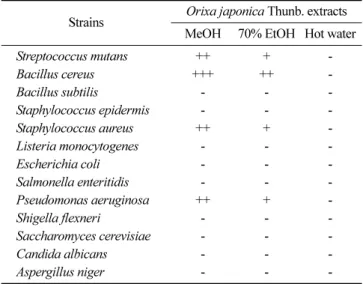
과 용매별 분획물의 수율은 Table 2와 같다. Methanol 추출물이 19.418%로 가장 높은 수율을 나타내었고, 그 뒤를 이어 70% ethanol, 65oC water 추출물이 각각 18.198%, 18.242%이었다. 항 균활성이 가장 높은 methanol 추출물을 용매 극성에 따라 n-hexane, dichloromethane, ethyl acetate, butanol로 분획한 분획물의 수율은 water 분획물이 6.427%로 가장 높았고 그 뒤를 이어 butanol, n-hexane dichloromethane, ethyl acetate 분획물의 수율이 각각 2.904%, 2.547%, 0.554%, 0.073%의 순으로 수율이 감소하 였다. 상산나무 잎 추출물의 항미생물 활성 시험 균주에 대한 상산나무 잎의 생육저해 효과를 paper disc diffusion법의 생육 저해환의 유무를 통해 관찰한 결과를 요약하 여 Table 3, 4에 나타내었다. 총 13개의 미생물 중 4개 균주 S. mutans, B. cereus, S. aureus, P. aeruginosa가 상산나무 잎 메탄 올 추출물 및 70% 에탄올 추출물에서 clear zone을 형성하여 추 출물에 의하여 생육이 저해되는 것을 확인할 수 있었고 65oC 열
수 추출물에서는 항미생물 활성을 나타내지 않았다(Table 3). 메 탄올 추출물의 항미생물 활성은 70% 에탄올 추출물에 비하여 약 간 더 미생물의 생육저해 활성이 컸으며 S. mutans, S. aureus, P. aeruginosa 3개 균주가 15 mm 이하의 clear zone을 형성하는 것 에 비하여 B. cereus의 경우 clear zone 크기가 21 mm 이상으로 가장 큰 생육저해능을 보여주었다. 항균활성이 가장 높은 methanol 추출물을 용매 극성에 따라 n-hexane, dichloromethane, ethyl ace-tate, butanol로 분획하여 얻은 분획물의 항균 효과는 dichlo-romethane 분획물에서 4균주 모두에 대해 항균효과를 나타내었고 특히 B. cereus에 대해 강한 항균 효과를 나타내었으며 그 외 균 주에 대해서는 약한 항균 효과를 나타내었다(Table 4). 한편, dichloromethane 분획물에서만 항균 효과가 나타나 dichloromethane 분획물에 항균 활성 물질이 존재하는 것으로 판단되었다. 최소 저해농도(MIC) 상산나무 잎 추출물 중 가장 큰 항균활성을 보인 methanol 추 출물과 methanol 추출물을 용매극성별로 분획하여 항균활성을 나 타낸 dichloromethan 분획물로 생육저해 효과가 있는 균주인 S. mutans, B. cereus, S. aureus, P. aeruginosa 4개 균주에 대하여 추출물의 생육저해 효과를 paper disc diffusion을 이용하여 MIC 로 나타내었다(Table 5). S. mutans, S. aureus, P. aeruginosa에 대한 methanol 추출물의 최소저해농도는 49.22 mg/mL이었으며 B. cereus의 경우 24.61 mg/mL로 나타났다. S. mutans, B. cereus, S. aureus, P. aeruginosa에 대한 dichloromethane 분획물의 MIC는 각 각 3.31, 0.21, 1.7, 1.7 mg/mL으로 나타났다. Dichloromethane 분 획물은 methanol 추출물에 비하여 적은 양으로도 항균활성이 나 타났으며 특히 B. cereus에 대하여 생육저해 활성이 높은 것으로 나타났다. pH 및 열 안정성 가공식품의 대부분의 열처리 및 pH 처리 과정을 거치기 때문 에 식품에 첨가하는 보존료는 가공공정상에서 활성이 유지되어 Table 3. Antimicrobial activity of Orixa japonica Thunb. extracts against microorganisms using the paper disc diffusion method
Strains Orixa japonica Thunb. extracts MeOH 70% EtOH Hot water
Streptococcus mutans ++ + -Bacillus cereus +++ ++ -Bacillus subtilis - - -Staphylococcus epidermis - - -Staphylococcus aureus ++ + -Listeria monocytogenes - - -Escherichia coli - - -Salmonella enteritidis - - -Pseudomonas aeruginosa ++ + -Shigella flexneri - - -Saccharomyces cerevisiae - - -Candida albicans - - -Aspergillus niger - -
-*Growth inhibition size of clear zone: -, not detected; +, under 12 mm; ++, 12-21 mm; +++, over 21 mm
*The extract concentration: 98.44 mg/mL.
Table 4. Antibacterial activity of solvent fraction from Orixa japonica Thunb. methanol extract
Strains Solvent fraction of methanol extract
H D E B W
S. mutans - + - -
-B. cereus - ++ - -
-S. aureus - + - -
-P. aeruginosa - + - -
-*Fraction: H, n-Hexane layer; D, Dichloromethane layer; E, Ethyl acetate layer; B, Butanol layer; W, Water layer
*Growth inhibition size of clear zone: -, not detected; +, under 12 mm; ++, 12-21 mm; +++, over 21 mm
Table 2. Extraction yields of Orixa japonica Thunb. leaves by various solvents Solvent Yield (%, w/w)1) Methanol extract 19.418 70% Ethanol extract 18.198 65oC Water extract 18.242 n-Hexane fraction 2.547 Dichloromethane fraction 0.554 Ethyl acetate fraction 0.073
Butanol fraction 2.904
Water fraction 6.427
1)Yield ratios (%)=solid in extract or fraction (g)/raw material (g) (dry
야 한다. 이에 상산나무 잎 methanol 추출물의 열 및 pH 안정성 을 조사하였고 이를 Table 6, 7에 나타내었다. 상산나무 메탄올 추출물의 pH 안정성을 조사한 결과 pH 11로 6시간 처리한 경우 항균활성이 실활되지는 않았으나 약간 저하되었며 이 pH 처리 조건을 제외하고 pH 3, 7로 1-6시간 처리하거나 pH 11로 1-3시 간 처리한 methanol 추출물의 경우 항균활성이 저하되지 않았고 넓은 pH에 걸쳐서 항균력이 유지되었다(Table 6). Methanol 추출 물에 함유되어 있는 항균물질의 열 안정성을 조사하기 위하여 methanol 추출물을 여러 조건으로 열처리한 후 항균활성을 측정 한 결과 80oC, 100oC에서 1-6시간 동안 열처리한 경우 항균활성 에 영향이 없었다. 가장 높은 열처리 구간인 121oC에서 2시간 이 상 열처리함에 따라 항균활성이 약간 저하되었지만 항균활성이 실활되지는 않았으며 1시간 동안 열처리 조건에서 항균활성에 변 화가 없었다(Table 7). 이러한 결과는 지충이(24), 모자반(25)을 121oC에서 15분간 열처리하였을 때보다 안정하였으며 상산나무 잎 methanol 추출물의 항균물질이 열에 안정한 물질임을 알 수 있었다. 따라서 상산나무 잎 methanol 추출물 유래 항균물질은 열처리공정이 필요한 가공식품이나 pH에 영향을 받는 식품 가공 공정 중에도 활성이 유지되어, 이를 통해 식품의 저장 및 유통 중 S. mutans, B. cereus, S. aureus, P. aeruginosa의 미생물 생육 억제 효과를 지속적으로 얻을 수 있어 천연보존료로서 사용 가 능성이 높을 것으로 보인다.
요
약
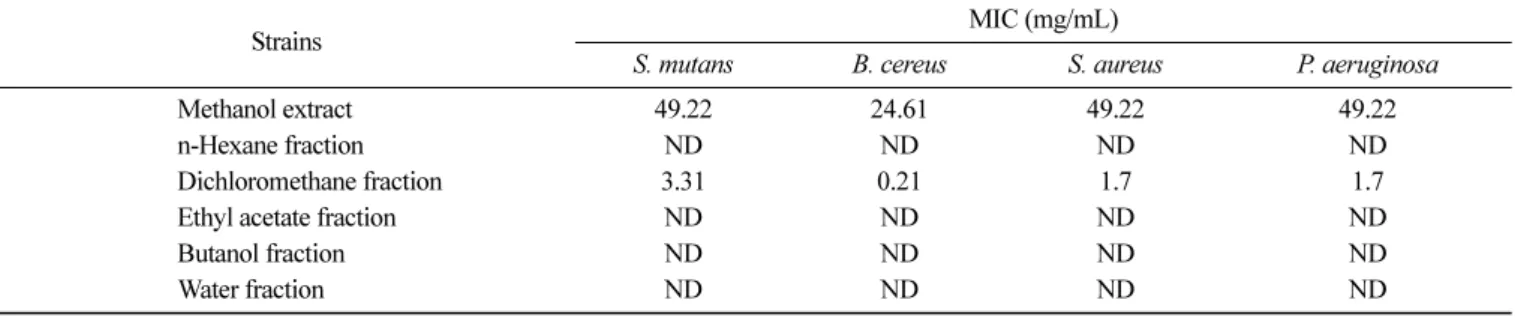
상산나무 잎의 항미생물 활성을 알아보기 위하여 상산나무 잎 을 메탄올, 70% 에탄올, 65oC 열수로 추출하였고 각각의 추출물 에 대하여 13종의 미생물에 대하여 항미생물 활성을 paper disc diffusion법으로 측정하였다. 그 결과 4개 균주 S. mutans, B. cereus, S. aureus, P. aeruginosa가 메탄올 추출물, 70% 에탄올 추 출물에서 clear zone을 형성하여 추출물에 의하여 생육이 저해되 는 것을 확인할 수 있었고 methanol 추출물이 70% ethanol 추출 물에 비하여 항균활성이 크게 나타났다. 이에 methanol 추출물을 극성이 다른 여러 용매로 분획추출하고 항균활성을 측정한 결과 dichloromethane 분획물에서 항균활성을 나타냈으며 다른 분획물 인 n-hexane, ethyl acetate, butanol, water 분획물에서는 항균활성 이 나타나지 않았다. 가장 활성이 크게 나타났던 메탄올 추출물 의 항균활성을 보인 4개의 균에 대하여 최소저해농도를 측정한 결과 S. mutans, S. aureus, P. aeruginosa는 추출물의 농도가 49.22 mg/mL에서 항균활성이 나타났으며 B. cereus의 경우 24.61 mg/mL에서 항균활성을 나타내었으며 S. mutans, B. cereus, S. aureus, P. aeruginosa에 대한 dichloromethane 분획물의 최소저해 Table 5. Minimum inhibitory concentration (MIC) of the extract and the fraction of Orixa japonica Thunb. leaves against several microorganisms using the paper disc diffusion methodStrains MIC (mg/mL)
S. mutans B. cereus S. aureus P. aeruginosa
Methanol extract 49.22 24.61 49.22 49.22
n-Hexane fraction ND ND ND ND
Dichloromethane fraction 3.31 0.21 1.7 1.7
Ethyl acetate fraction ND ND ND ND
Butanol fraction ND ND ND ND
Water fraction ND ND ND ND
*ND: Not detected.
Table 6. Effect of pH on antimicrobial activity of the Orixa japonica Thunb. leaf methanol extracts
S. mutans B. cereus S. aureus P. aeruginosa
Control ++ +++ ++ ++ pH 3 1 h ++ +++ ++ ++ 2 h ++ +++ ++ ++ 3 h ++ +++ ++ ++ 6 h ++ +++ ++ ++ pH 7 1 h ++ +++ ++ ++ 2 h ++ +++ ++ ++ 3 h ++ +++ ++ ++ 6 h ++ +++ ++ ++ pH 11 1 h ++ +++ ++ ++ 2 h ++ +++ ++ ++ 3 h ++ +++ ++ ++ 6 h + ++ + +
*Control: untreated methanol extract
*Growth inhibition size of clear zone: -, not detected; +, under 12 mm; ++, 12-21 mm; +++, over 21 mm
*The extract concentration: 98.44 mg/mL.
Table 7. Effect of heating temperature on antimicrobial activity of the Orixa japonica Thunb. leaf methanol extracts
S. mutans B. cereus S. aureus P. aeruginosa
Control ++ +++ ++ ++ 80oC 1 h ++ +++ ++ ++ 2 h ++ +++ ++ ++ 3 h ++ +++ ++ ++ 6 h ++ +++ ++ ++ 100oC 1 h ++ +++ ++ ++ 2 h ++ +++ ++ ++ 3 h ++ +++ ++ ++ 6 h ++ +++ ++ ++ 121oC 1 h ++ +++ ++ ++ 2 h + ++ + + 3 h + ++ + + 6 h + ++ + +
*Control: untreated methanol extract
*Growth inhibition size of clear zone: -, not detected; +, under 12 mm; ++, 12-21 mm; +++, over 21 mm
농도는 각각 3.31, 0.21, 1.7, 1.7 mg/mL으로 나타났다. 메탄올 추 출물의 pH에 대한 안정성을 알아보기 위하여 pH 3, 7, 11로 조 절하여 1-3시간 동안 처리한 결과 항균활성에는 영향을 주지 않 았고 열에 대한 안정성을 확인하기 위하여 80, 100oC에서 1-6시 간 동안 처리한 결과 대조군과 차이가 없었고 120oC 처리한 경 우 항균활성이 약간 저하되었으나 항균활성이 완전히 실활 되지 않은 것으로 보아 상산나무 잎 methanol 추출물은 열과 pH에 비 교적 안정하여 식품의 가공 처리에도 적합한 천연 식품첨가물로 유용하게 이용될 수 있을 것으로 사료된다.
감사의 글
본 연구는 2013년도 서울과학기술대학교 교내 학술연구비 지 원에 의해 수행되었으며, 이에 감사드립니다. 또한 상산나무 잎 을 제공하여 주신 (주)한라환경에 감사드립니다.References
1. Yoon SY, Lee SY, Kim KBWR, Song EJ, Kim SJ, Lee SJ, Lee CJ, Ahn DH. Antimicrobial activity of the solvent extract from different parts of Orostachys japonicus. J. Korean Soc. Food Sci. Nutr. 38: 14-18 (2009)
2. Lee IE, Cho SH. Antimicrobial effect of Aristolochia contorta Bge. extract on the growth of pathogenic and putrefactive micro-organisms. J. Korean Soc. Food Sci. Nutr. 29: 1107-1111 (2000) 3. Ha YM, Lee BB, Bae HJ, Je KM, Kim SR, Choi JS, Choi IS.
Anti-microbial activity of grapefruit seed extract and processed sulfur solution against human skin pathogens. J. Life Science 19: 94-100 (2009)
4. Kim HY. Antimicrobial activity and characteristics of Amblytropis pauciflora Kitagawa extract. J. Korean Soc. Food Sci. Nutr. 27: 993-999 (1998)
5. Park JS, Shim CJ, Jung JH, Lee GH, Sung CK, Oh MJ. Antimi-crobial activity of Ulmi cortex extracts. J. Korean Soc. Food Sci. Nutr. 28: 1022-1028 (1999)
6. Lee HO, Han DM, Baek SH. Isolation and identification of anti-cariotic compound from Sophora flavescens Ait. Kor. J. Microbiol Biotechnol. 30: 420-424 (2002)
7. Jang GH, Ahn BY, Oh SH, Choi DS, Kwon YJ. Anticariogenic effects of Coptis chinensis Franch extract. Korean J. Food Sci. Technol. 32: 1396-1402 (2000)
8. Bae KH, Ji JM, Park KL. The antimicrobial component from Cinnamomi cortex against a cariogenic bacterium Streptococcus mutans OMZ 176. Arch. Pharm. Res. 15: 239-241 (1992)
9. Bae KH, Kim BH, Myung PK, Chung KS, Baek JH. The isola-tion and evaluaisola-tion of bioactive components from crude drugs against a cariogenic bacterium, Streptococcus mutans OMZ 176. Yakhak Hoeji 34: 277-281 (1990)
10. Katsura H, Tsukiyama RI, Suzuki A, Kobayashi M. In vitro
anti-microbial activities of bakuchiol against oral microorganisms. Antimicrob. Agents Ch. 45: 3009-3013 (2001)
11. Hwang JK, Chung JY, Baek NI, Park JH. Isopanduratin A from Kaempferia pandurata as an active antibacterial agent against cariogenic Streptococcus mutans. Int. J. Antimicrob. Ag. 23: 377-381 (2004)
12. Park KM, You JS, Lee HY, Baek NI, Hwang JK. Kuwanon G: antibacterial agents from the root bark of Morus alba against oral pathogens. J. Ethnopharmacol. 84: 181-185 (2003)
13. Sohn HY, Kum EJ, Kwon YS, Kwon GS, Jin I, Kwon HY, Kwon CS, Son KH. Screening of anticandidosis agent from medicinal and wild plants. Kor. J. Life Sci. 13: 604-617 (2003) 14. Lee YN. New Flora of Korea. Vol. 1. Kyohaksa, Seoul, Korea.
pp. 401-490 (2006)
15. Hong WS. The use of herbs and herbal ingredients. Vol. 2. Ilwolseogak, Seoul, Korea. p. 317 (1999)
16. Jang CS, Fu FY, Huang KC, WANG CY. Pharmacology of Ch’ang Shan (Dichroa febrifuga), a chinese antimalarial herb. Nature 161: 400-401 (1948)
17. Koepfli JB, Mead JF and Brockman JA. An alkaloid with high antimalarial activity from Dichroa febrifuga. J. Am. Chem. Soc. 69: 1837 (1947)
18. Coatney GR, Cooper WC, Culwell WB, White WC and Imboden CA. Studies in human malaria. XXV. Trial of febrifugine, an alkaloid obtained from Dichroa febrifuga Lour., against the Ches-son strain of Plasmodium vivax. J. Natl. Malar. Soc. 9: 183-186 (1950)
19. Katsura Ito. Overwintering survival and postdiapause fecundity in a population of the Kanzawa spider mite Tetranychus kanzawai (Acari: Tetranychidae) on Orixa japonica Thunb.(Rutaceae). Exp. Appl. Acarol. 53: 51-56 (2011)
20. Katsura Ito. Effect of host plants on diapause induction in imma-ture and adult Tetranychus kanzawai (Acari: Tetranychidae). Exp. Appl. Acarol. 52: 11-17 (2010)
21. Ono H, Kuwahara Y, Nishida R. Hydroxybenzoic acid derivatives in a nonhost rutaceous plant, Orixa japonica Thunb., deter both oviposition and larval feeding in a rutaceae-feeding swallowtail butterfly, Papilio xuthus L. J. Chem. Ecol. 30: 287-301 (2004) 22. Kim KW, BaekJ K, Jang YW, Kum EJ, Kwon YS, Kim HJ,
Sohn HY. Screening of antibacterial agent against Streptococcus mutans from natural and medicinal plants. J. Life Science 15: 715-725 (2005)
23. Badk DH. Screening of the natural plant extracts for the antimi-crobial activity on dental pathogens. Kor. J. Microbiol. 43: 227-231 (2007)
24. Lee SY, Song EJ, Kim KBWR, Yoon SY, Kim SJ, Lee SJ, Hong YK, Lim SM, Ahn DH. Antimicrobial activity of ethanol extract from Sargassum thunbergii. J. Korean Soc. Food Sci. Nutr. 38: 502-508 (2009)
25. Yoon SY, Lee SY, Kim KBWR, Song EJ, Lee SJ, Lee CJ, Park NB, Jung JY, Kwak JH, Nam KW, Ahn DH. Antimicrobial activ-ity of the Sargassum fulvellum ethanol extract and the effect of temperature and pH on their activity. Korean J. Food Sci. Tech-nol. 42: 155-159 (2010)