• 검색 결과가 없습니다.

A Framework for Agile Development in Cloud Computing Environment

N/A
N/A
Protected

Academic year: 2021

Share "A Framework for Agile Development in Cloud Computing Environment"

Copied!
8
0
0

로드 중.... (전체 텍스트 보기)

전체 글

(1)

Journal of Internet Computing and Services(JICS) 2016. Oct.: 17(5): 67-74 67

A Framework for Agile Development in Cloud Computing Environment

Muhammad Younas

1

Imran Ghani

2*

Dayang N. A. Jawawi

1*

Muhammad Murad Khan

1

ABSTRACT

Distributed agile software development faces difficulties for instance lack of visibility across development and delivery processes, complex and disjointed development processes, inability to capitalize on business opportunities, lack of communication agility between disconnected owners, development teams, and users or clients. However these difficulties are solved with the help of cloud computing services. This study proposes a framework to provide a skeletal or structural environment for distributed agile software development in cloud computing environment. The framework guide towards the best tooling to deliver a consistent, automated, governed, and unified agile software development process with reduced technical debt, and minimized project backlog. In addition to this, the study highlights the benefits of cloud computing in agile software development.

keyword : Global Agile Development, Cloud computing, Challenges, benefits, Framework, cloud-based agile tools

1. Introduction

There are different software development approaches such as waterfalls, spiral, and iterative agile development. Unlike the traditional approaches, agile development approach accommodates changes in software during development due to small iterative cycles [1]. Murphy et al [2] surveyed that the use of agile software development approach increasing in Microsoft Corporation.

In agile software development, the requirement of a project is flourished by the collaboration of team members and customers [3]. Agile software development methodology promotes and accommodates rapid change during all development phases and confirms the project completion time, by time-boxed iterations. Transparency in projects increases due to daily meetings and shows off the progress of each team member on the wall. However distributed or global agile software development faces many challenges such as communication gap due to global, cultural, and linguistic

1

Department of Software Engineering, Universiti Teknologi Malaysia (UTM), Skudai, Johor Bahru, 81310, Malaysia

2

School of Information Technology, Monash University, Malaysia

*

Corresponding author ([email protected])

[Received 9 May 2016, Reviewed 24 May 2016, Accepted 18 June 2016]

☆ A preliminary version of this paper was presented at ICONI 2015 and was selected as an outstanding paper.

differences between team members. Moreover due to distance there are difficulties in knowledge sharing,[5, 7] work sharing and lack of communication and development infrastructure.

On the other hand, cloud computing solves these problems by providing different services famous as (SaaS, Paas, and IaaS).

Cloud computing has several benefits for software development [5] like virtualization, reduced cost, and scalability. In cloud computing infrastructure is invisible to the customer, no hardware engineer require, no worry of up gradation, change etc. No compromise on performance, the customers can select resource as per their need. By using cloud services, multiple users may use a single instance of a process.

The variable agile models adopt cloud services in cloud-based global agile development [5, 7], moreover theoretical models, infrastructure support features, and the social issue can focus in this era [8]. There need systems which provide a way to develop the industry-level projects in cloud computing environment [4]. The study provides a framework for agile development in distributed environment, where the team is scattered logistically at distant locations.

In this section, we have discussed the introduction of global agile development and the cloud computing. The coming sections organize as follows. The Section 2 discusses the existing models and theories in this area, Section 3 presents a proposed framework and Section 4 describes cloud enhancing factors which reinforce agile development. In section 5, there is a discussion about the future work and gap in this area.

ISSN 2287-1136 (Online)

http://www.jksii.or.kr

(2)

Study Team

Collaboration agile cloud tool project magnet Code repository /

Development IDE Agile Model

Kalem,S. et, al[6] Skype Google App Engine   Eclipse DSDM

Wei-Tek Tsai et

,al[8]
Confl_uences Chef / puppet Cloud Spoke on

Top_ coder gitHub, Cloud IDE  

Chung Yung and

Yu-Tang Lin [9]    

TOAST Tool Of Agile Soft_ ware Techno_

logy

  Scrum, XP

Willie Wang[10]

Discu_ ssion forum, wikis, real-time

reports

Team Forge, Cloud

Forge Team Forge Eclipse, Visual studio Agile

Neil Caithness and Milo Thurston [11]

  mongoDB   Ruby on Rails Agile

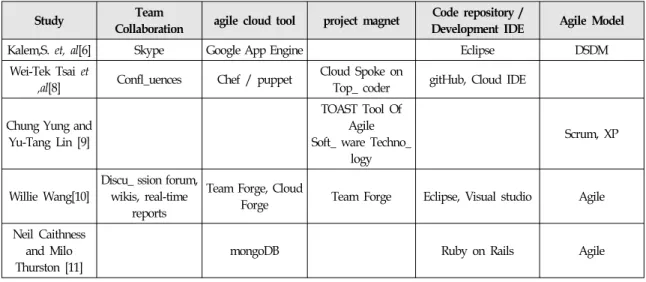
(Table 1) EXISTING AGILE AND CLOUD MODELS USED IN DIFFERENT STUDIES

2. RELATED LITERATURE

This section discusses the existing models, frameworks, tools and techniques in agile softwre development using cloud computing.

Kalem et al[6] proposes a model Dynamic Systems Development Method (DSDM). They use Google appEngine as a cloud platform. Skype is used for team collaboration. They develop an application for a warehouse management and compare the development time for agile-with-cloud and agile-without-cloud. This DSDM model has three phases.

1) Pre-Project phase: project goal, feasibility, and priorities are decided.

2) Project Life Cycle phase: functional model iteration, design, and build iteration are decided, also the implementation of the project include in this phase.

3) Post project phase: it deals with efficiency and effectiveness of functioning, also deals function up gradation and error correction.

A study Irum inayat et al[7] describes interaction and connection between the agile and cloud. They conduct a survey in Alpha Company, a product development organization.

Questions based on collaboration in the team members and the cloud service used in this organization. The Alpha uses Skype

for collaboration of team and scrum as an agile process.

Another study by wei-Tek Tsi et al [8] proposes a model.

They used confluences for communication and gitHub as a code repository. Chef and Puppet Lab are used as agile cloud integration. Their study is actually for crowdsourcing; however, it can be mapped over agile-cloud development.

Willie Wang[10] in his white paper presents a good solution for agile cloud development. They use CollabNet’s teamForge and cloudForge tools. The features and practices of some other studies are shown in table 1.

Agile Project management and Software Development Support: There are several software development tools for design, coding, debugging and testing in a cloud environment, for example, chef, puppet [8] and atlassian Jira support large scale systems, manage software problems and enhance reliability using logs. Project management tools Assembla, TeamForge [7, 8], and AgileFant provide support for cost estimation, planning, bug tracking, software repository management and decision making. By using these tools, projects build in the smooth and effective way in agile and cloud environment.

Table 2 describes the feature of different tools used in agile

cloud development. This table contains project management,

collaboration tools and code management tools.

(3)

Tool Name Description

Jira software Project management and issue tracking

Zapier Connect Axosoft with many other services and tools.

Jenkins

open source automation server, plugins to support building, testing, deploying and automation for virtually any project

Apache Stratos

Provide an environment for developing, test, and run cloud-based applications. Paas framework to run PHP, MySql, and tomcat.

Salesforce.

com

Customer Relationship Management (CRM), automation server, platform to manage all interactions with customers and prospects

Puppet Enterprise

IT automation solution, deploy, manage infrastructure, patching and configuration of operating systems and devices,

Google App Engine, Compute

Engine

building scalable web applications, virtual machines, scalable cloud resources

Microsoft azure

The integrated tools, pre-built templates and managed services, PaaS

Amazon Web Services

reliable, scalable, and inexpensive cloud computing services, storage, database, analytics, application, and deployment services

Collaboration and chat

HipChat a free private chat service, Share ideas and files

Confluence team collaboration, create, organize, and discuss work with your team

Code and Build and deploy BitBucket

Code collaboration using pull requests and comments. It is used to build and deploy software.also manage Git repositories Bamboo Code collaboration

FishEye Used for searching and tracking Subversion code repositories

Crucible Enhance quality of code by peer reviews, also use to find bugs and errors in code

BugHerd Bug tracking for web design and development. Requires Zapier

Legend: all information extracted from tool’ s websites.

(Table 2) AGILE AND CLOUD TOOLS Communication and Collaboration Support: In global agile development, communication between team members at different levels is very important. Transparency and continuous feedback are practiced by the face to face meeting of a team member in agile development [7]. Project requirement clarifies with the collaboration of team members and client involvement.

Devlopementent teams use Facebook, blogs [8], Skype [6, 7], for general discussion, code and ideas sharing. The details of such tools described in Table 2.

Code Repositories: gitHub [8], BitBucket, FishEye and Bamboo are especially for code sharing and versioning. In distributed and parallel programming environment number of developers work on the project i.e. more than one person work and enhance some piece of code and maintain it.

Cloud Platform: there are a number of cloud services which have different prices range, logistically locations and support for different tools integrations. Cloud model is public, private, community and hybrid. It can be selected as per need and requirement. Due to security reasons, some organizations like private cloud and some due to limited budget rely on the public or hybrid cloud. The details of cloud services given in Table 2.

3. PROPOSED FRAMEWORK

For global agile development, several practices are adopted.

Many practices are non-cloud based, however, this study proposed a cloud-based global agile development framework.

This framework guides for the smooth and well-managed

environment for agile development. There are four (4) steps

to explain the working mechanism of the framework. Global

agile development requires hardware and software infrastructure

such development IDEs to code. For sharing of code requires

some code versioning software. For communication and

deployment there are different tools exists. Team leader manage

projects by using project management tools. Solution to all these

needs of agile software development is described in framework

as shown in Figure 1.

(4)

(Figure 1) EXECUTION PHASES OF PROPOSED FRAMEWORK IN AGILE AND CLOUD

3.1 AGILE FEATURE SELECTION

There are different tools for coding, testing, integration and deployment of project. Teams at distributed environment code and share their work. The team leaders view the progress of work, integration of different modules and their maintenance.

Furthermore the features like analytics, budgeting and expense calculation of project, capacity and velocity metrics to progress, different reporting features, resource management, team tracking and sprint management are needed in global agile development.

In the first step, the agile tool according to the desire of development team are selected, there are different practices/models for agile development, Scrum, Extreme Programming, Kanban board and others. The details of agile tools are given in Table 2.

3.2 CLOUD-BASED FEATURES SELECTION

In the second step, we select the cloud platform. The selection of cloud platform is taken by keeping in mind organization size, business need, existing base of the organization, and security need of organization [14]. The important cloud features are virtualizations, Scalability, provision of infrastructure at zero capital investment, low cost, high performance and multi-tenancy [13]. In private cloud customer of the cloud may access storage and application services.

CloudForge [10] is a development platform which facilitates cloud services for distributed teams and provides various tools for development. In addition, to this, there is a list of cloud

platforms discussed in Table 1. Furthermore, our last study Younas et, al [12] presents detailed information about different cloud platforms and the services offered by them. Furthermore, type cloud service and the integration supported in different tools with other tools were described in that study. The next step discusses code repository.

3.3 CODE MANAGEMENT AND REPOSITORY

In the third step, the selection of code repository is performed. It is a very important phase. In distributed and parallel programming environment, a number of developers work on the same project, more than one person work and enhance some piece of code and maintain it. Versioning tools help code branching and merging. gitHub [8], BitBucket, FishEye and Bamboo are especially for code sharing and versioning. Central traceability of code, a minor change in code will be reflected globally, these changes can be viewed and observed in each level in the organization and the even customer may be updated due to instant deployment on the cloud.

3.4 COMMUNICATION AND COLLABORATION

In the fourth step, the communication and collaboration practices between different level of teams and client of the project are selected. What is going on in the project is called Transparency, is controlled by the face to face meeting of a team member in agile development [7]. Teams also share data.

Project requirement clarifies with the collaboration of team members and client involvement.

(Figure 2) PROPOSED FRAMEWORK FOR

CLOUD-BASED AGILE DEVELOPMENT

(5)

  Platform and Services 

Jira Application

[5,13, 14]

AxoSoft Planbox Assembla Yodiz Team

Forge Chef Agile fant

Puppet Enterprise

[18]

automati on Server

Cloud Bees Jenkins       X X X      

Sales. force   X              

Google App Engine             X    

Google Comp_ ute Engine             X   X

Microsoft Window Azure             X   X

IBM AIS             X    

Amazon Web Service             X   X

Docker                 X

collabor ation

Slack   X   X X        

Confluence X  

HipChat X    

code

BitBucket X X X        

Bamboo X      

FishEye X                

Crucible X         X      

gitHub   X X X X        

Git       X X X      

Legend:

- “X” shows an integration support relationship - empty cell shows no relationship

(Table 3) Agile-Cloud integration and Team Collaboration support

Continuous feedback is a feature of agile development, is achieved through the cloud by establishing communication between teams and customer. So a strong communication requires between them. There are several tools and techniques for collaboration listed in Table 2.

In addition to collaboration, integration support between different applications/tools is discussed in Table 3. Some tools provide direct integration with the other tools and some provide API support to connect. This table also shows that which collaboration tool and code repositories can be integrated with other development environment. For example, the table shows that Jira Application provides support for “Confluences” as a collaboration tool and “BitBucket” as a code repository. The combinations of these tools may help to make a Framework for smooth cloud-based global agile development environment.

In proposed application framework we provide a fundamental structure to support the development of applications in the global agile environment. This framework provides a basic Skelton to work in distributed environment.

In Figure 2 Pentagon represents the global agile development environment needs for application development. The cloud computing facilitates development environment by selecting cloud platform. The cloud shares data between different stakeholders of development. The deployment of application occurred in the cloud. Cloud computing; enhances visibility across development and deployment process.

In pentagon second entity is code repository which is

necessary for code management across the distributed team. The

third entity is the communication and collaboration between

different levels of the development team, and also the client

of software. This comes from the collection of tools show in

Figure 2. The fourth and last is agile project management

practices which come from the collection of agile management

tools supported by cloud computing environment. In Figure 2

the arrows shows how the services come in pentagon from

different sources. These all as a whole provide an environment

to work globally.

(6)

4. FACTORS THROUGH WHICH CLOUD ENHANCE AGILE DEVELOPMENT

By review of several studies, we find that Cloud Computing is very important in global agile development. The following features of cloud computing reinforce global agile development.

Software testing support: cloud provides a large number of test servers [3, 10 and 15]. The developer becomes tension free from the availability of a server or to establish and manage hardware for the requirement of testing. In other words our framework enhances testing facility.

Virtualization: Are the characteristics of cloud which enable the user of cloud, to set service of cloud infrastructure as per requirement. Agile development based on small iterations, so facilitate parallel development [7]. Cloud provides an environment to work in parallel. Scalability allows a subscriber of the cloud to change the size of cloud e.g. space, and processing.

Build and Other services: due virtualization developer can test and build [3] user story at any time and face no wait for it. “Cloudforce.com”, Google app engine and Amazon web service provides infrastructure to develop, test, build and deploy projects.

Continuous Feedback: the main feature of the agile development is achieved easily by cloud. Team members can communicate and share resources and code with each other when needed. Customer and team members become quick and responsive.

Transparency: with the help of pre-integrated cloud service team members can share data with each other. These services continuously receive and save the data and avoid lapses.

Traceability: cloud provide central traceability of code, a minor change in code will be reflected globally, these changes can be viewed and observed in each level in the organization and the even customer may be updated due to instant deployment.

Prototypes and Demo versions: due instant deployment it is easy to share prototypes with customers and customer feedback becomes fast.

Performance: Agile development enhances the spirit of creativity and excitement. As the companies grow the centralized decision become a bottleneck for performance. Agile

promote decentralize environment so as the decision can be taken at the different level of development teams [15], ultimately increase performance. Cloud also provide parallel processing environment of development.

Reduce cost: as cloud based on “pay per use” method, so it help to global agile development with zero capital cost and running cost depends on the usage of cloud resources.

Ultimately reduce agile development cost [3].

Predictability: due to small iteration cycle agile is more predictable that waterfall model. And short cycles of development are incorporated by the quick customer feedback, and which is achieved by cloud. Predictability achieved by Time-boxing, by keeping the date, resource, and quality control while taking functional decisions.

5. CONCLUSION AND FUTURE WORK

In this study, a framework is proposed which presents the way to adopting the agile development in cloud environment.

It explains the all needs during global agile development.

Furthermore, the study highlights the benefits due to amalgamation of agile software development methodology and cloud computing. This would efficiently facilitate the researcher and practitioners to practice the global agile software development in the cloud environment. We try to explore infrastructure features required for agile development in distributed environment. The practitioners just select the features in framework and get environments established according to their will. We aim to conduct a case study in future using this framework to explore the more challenges in this area. Social issues faced during distributed environment can be explored. Optimization methods are open issues yet.

ACKNOWLEDGEMENT

We are thankful to Ministry of Science, Technology and

Innovation (MOSTI) to support this research under eScience

grant vote: 4S113. We are also thankful to Universiti Teknologi

Malaysia (UTM) for providing us with the research facilities.

(7)

Reference

[1] Tuli, A., et al., Empirical investigation of agile software development: cloud perspective. SIGSOFT Softw. Eng.

Notes, 39(4), pp. 1-6, 2014.

http://dx.doi.org/10.1145/2632434.2632447

[2] Murphy, B., et al. Have Agile Techniques been the Silver Bullet for Software Development at Microsoft? in Empirical Software Engineering and Measurement, 2013 ACM/IEEE International Symposium on. 2013. IEEE.

http://dx.doi.org/10.1109/esem.2013.21

[3] Manuja, M. and Manisha. Moving agile based projects on Cloud. in Advance Computing Conference (IACC), 2014 IEEE International. 2014.

http://dx.doi.org/10.1109/iadcc.2014.6779530

[4] Yung, C. and Y.-T. Lin, Implementing TOAST, a Tool for Agile Software Project Management in Cloud Computing Environments. Journal of Software (JSW), pp.

1310-1318, 2015.

http://dx.doi.org/10.1007/978-1-4471-5031-2_10 [5] Cocco, L., K. Mannaro, and G. Concas, A Model for

Global Software Development with Cloud Platforms, in 2012 38th Euromicro Conference on Software Engineering and Advanced Applications, V. Cortellessa, H. Muccini, and O. Demirors, Editors, pp. 446-452, 2012.

http://dx.doi.org/10.1109/seaa.2012.67

[6] Kalem, S., D. Donko, and D. Boskovic. Agile methods for cloud computing. in Information & Communication Technology Electronics & Microelectronics (MIPRO), 2013 36th International Convention on. 2013.

[7] Zarinah, I.I.S.S.S. and M. Kasirun, AGILE-BASED SOFTWARE PRODUCT DEVELOPMENT USING CLOUD COMPUTING SERVICES: FINDINGS FROM A CASE STUDY. Science International journal (Lahore), pp. 1045-52, 2013.

[8] Wei-Tek, T., W. Wenjun, and M.N. Huhns, Cloud-Based Software Crowdsourcing. Internet Computing, IEEE, 18(3), pp. 78-83, 2014.

http://dx.doi.org/10.1109/mic.2014.46

[9] Yung, C. and Y.-T. Lin, Implementing TOAST, a Tool for Agile Software Project Management in Cloud Computing Environments. Journal of Software (JSW), pp.

1310-1318, 2015.

http://dx.doi.org/10.17706//jsw.10.11.1310-131

[10] Wang, W. Reinforcing Agile Software Development in the Cloud. 2011 30 Jan 2016]; Available from:

https://www.open.collab.net/media/pdfs/CollabNet%20Wh itepaper_Reinforcing%20Agile%20Dev%20in%20the%20 Cloud.pdf?_=d.

[11] Caithness, N. and M. Thurston, A simple drop and compute model for a SaaS cloud infrastructure for advanced research computing, 2013.

[12] Muhammad Younas, I.G., Seung Ryul Jeong, Do Young Kwon. A survey of Cloud-based Agile Tools. in KSII The 7th International Conference on Internet (ICONI) 2015.

Kuala Lampur, 2015.

[13] Hashmi, S.I., et al. Using the cloud to facilitate global software development challenges. in Global Software Engineering Workshop (ICGSEW), 2011 Sixth IEEE International Conference on. 2011. IEEE.

http://dx.doi.org/10.1109/icgse-w.2011.19

[14] Misra, S.C. and A. Mondal, Identification of a company’s suitability for the adoption of cloud computing and modelling its corresponding Return on Investment.

Mathematical and Computer Modelling, 53(3), pp.

504-521, 2011.

http://dx.doi.org/10.1016/j.mcm.2010.03.037

[15] salesforce. Agile Development Meets Cloud Computing for Extraordinary Results at Salesforce.com. 2008 21-02-2016]; Available from:

http://www.developerforce.com/media/ForcedotcomBook

Library/WP_Agile_112608.pdf.

(8)

◐ Authors ◑

Muhammad Younas PhD. Student,

Faculty of Computing Universiti Teknologi Malaysia Lecturer,

Computer Science Department Government College University Faisalabad, Pakistan

Imran Ghani, PhD

Senior Lecturer Faculty of Computing Universiti Teknologi Malaysia

Dayang Norhayati Abang Jawawi Associate Professor, Dr.

Faculty of omputing, Universiti Teknologi Malaysia

Muhammad Murad Khan PhD. Student,

Faculty of Computing

Universiti Teknologi Malaysia

수치

Table  2  describes  the  feature  of  different  tools  used  in  agile  cloud  development

참조

관련 문서

Walker, D. A naturalistic model for curriculum development. Guidelines for better staff development.. A Study on the Development of Early Childhood Parental

In this paper, a software policy considering testing time and the number of errors corrected is presented.. The software is tested until a specified testing

model development and empirical testing. Brand authenticity: Towards a deeper understanding of its conceptualization and measurement.. Brand authenticity: Testing

The suggested architecture has been authenticated in the cloud computing platform-based testbed conferred in Section 3.4. Initially it is essential to produce the work load

In the proposed framework, we propose an interference graph partioning based virtual-cell association and customized physical-cell association for multi-homed users in

parallel processing (e.g. ETL) of large data sets in Google Cloud Supports both Streaming and Batch processing (no need for separate pipeline code development). Autoscales

(Charge Management Pack, Configuration Management Pack for Oracle Database, Provisioning and Patch Automation Pack for Database)..  Cloud Management Pack

Agricultural Value Chain Development in Practice; Private Sector-Led Smallholder Development.. Land Rights and Land Conflicts in Africa: A Review of issues