A Cross-layer Link Adaptive HD Video Transmission Scheme in WiMedia D-MAC based UWB Systems
Yang-Ick Joo
†ABSTRACT
In this paper, we propose a QoS (Quality of Service)-aware and cooperative resource reservation scheme using cross-layer link adaptation for wireless high definition video transmission through UWB (Ultra Wide Band) network with D-MAC (Distributed Medium Access Control). A wireless high defi- nition video transmission system usually requires stable high throughput even without line-of-sight, e.g., a destination device in another room separated by a wall. Since the WiMedia D-MAC supporting DRP (Distributed Reservation Protocol) scheme causes lots of DRP resource reservation conflicts due to failure of beacon detection in wireless channel environment, overall performances of the WiMedia D-MAC can be deteriorated. And the current WiMedia MAC standard has not considered QoS provision- ing even though QoS parameters such as a range of service rates are provided to each traffic stream.
Therefore, we propose Relay DRP protocol with QoS-based relay node selection criterion, which makes a relay path to avoid DRP resource reservation conflicts and guarantee QoS more stably through cross-layer link adaptation of cooperative relay transmission scheme and is compliant with the current WiMedia D-MAC protocol. Simulation results demonstrate performance improvements of the proposed method for throughput and QoS provisioning.
Key words: UWB (Ultra Wide Band), WiMedia, Distributed MAC (D-MAC), Distributed Reservation Protocol (DRP), cooperative communication
※ Corresponding Author : Yang-Ick Joo, Address : #727 Taejong-ro, Youngdo-gu, Busan, Korea, TEL : +82-51- 410-4419, FAX : +82-51-404-3986, E-mail : yijoo@hhu.
ac.kr
Receipt date : Nov. 2, 2012, Revision date : Nov. 12, 2012 Approval date : Nov. 12, 2012
†
Division of Electrical and Electronics Engineering, Korea Maritime Univ.
1. INTRODUCTION
The prosperity of wireless communication tech- nology has been providing various new communi- cation opportunities and services for personal use.
A tremendous growth in popularity of wireless personal devices is essentially requiring extremely high rate and short-range wireless networks.
Hence, UWB technology is being taken an interest for WPAN (Wireless Personal Area Network) ap- plications such as home entertainment and se- curity/medical/military applications.
UWB is able to support data rates of 0.5 Gbps
within a range of up to 10 m and is allowed to oper- ate with limited transmit power in a unlicensed manner in the 3-10 GHz band [1,2]. Due to the lim- ited transmission power, UWB devices do not make fatal interference, and therefore can coexist with other users and technologies in the same band. The salient features of UWB networks such as high-rate communications, low interference with other radio systems, and low power con- sumption bring many benefits to users, thus enable several new applications such as wireless univer- sal serial bus (WUSB) for connecting personal computers (PCs) to their peripherals and the con- sumer-electronics (CE) in people’s living rooms [3, 4].
The WiMedia Alliance has specified D-MAC protocol based on UWB for High-Rate WPANs [5].
In contrast to centralized MAC such as IEEE
802.15.3, the D-MAC UWB supports DRP mecha-
Fig. 1. Relay-based Cooperative Communication.
nism which makes all devices be connected using self-organizing approach. In the distributed archi- tecture, the WiMedia D-MAC removes the SOP (Simultaneous Operating Piconet) problem, i.e., packet collisions between overlapped piconets in the centralized IEEE 802.15.3 MAC by exchanging resource reservation and control information among the devices [5], especially via DRP IE (Information Element) and DRP Availability IE in each device’s beacon signal. In the D-MAC, each node broadcasts its own beacon containing IEs, per periodic interval called superframe. The IEs convey certain control and management information. The distributed nature of the D-MAC protocol can pro- vide a full mobility support with scalable and fault tolerant medium access method [5].
However, the conventional WiMedia D-MAC has DRP conflict problem due to failure of beacon detection in wireless communication environment [5]. Thus, in order to get full benefits of the dis- tributed MAC approach, we have to guarantee the detection of beacon and overcome the resource reservation conflicts among devices. There have been prevention and resolution methods for the DRP reservation conflicts among the WiMedia D-MAC devices in [6,7]. These schemes take mul- ti-hop range DRP conflicts due to mobile hidden node problem into account and show improvement of throughput performance. However, these meth- ods do not consider QoS requirement of each traffic stream and only try to prevent and/or resolve MAC-level conflicts in a fixed link without consid- ering another link which can provide more stable data service. Therefore, the algorithms in [6,7]
cannot use wireless resources efficiently and may not meet the QoS requirement even with the con- flict-resolved link.
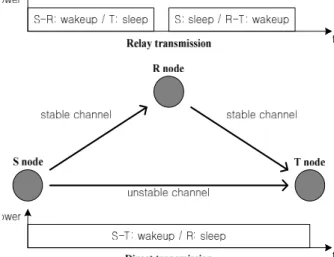
There have been previous works to improve system performance by using cooperative commu- nication scheme [8,9]. As shown in Fig. 1, if the wireless channel status is coarse between Source node (S node) and Target node (T node), the direct
communication between S node and T node causes time delay and extra power consumption. In the situation, Adaptive Modulation and Coding (AMC) scheme can be applied in physical layer as a link adaptation solution. However, if the channel status between S node and T node is not good enough to guarantee the minimum required data rate for the link, the corresponding channel resources are wasted even after the link adaptation in physical layer, and QoS requirement of the stream cannot be gratified. In this case, we can try to find a detour e.g., the path via the Relay node (R node) in Fig.
1 as an indirect communication link with good channel status in order to avoid the coarse wireless link. In [8], throughput is increased through an ef- ficient relay communication of the proposed CoopMAC scheme. However, the CoopMAC scheme needs additional CSMA-CA based HTS (Helper ready To Send) signaling overhead for de- livering relay confirm/deny messages from a help- er station, and QoS of each traffic stream are not guaranteed.
Therefore, in this paper, Relay DRP scheme with
QoS-based relay node selection criterion is pro-
posed as a cross-layer link adaptation for the
WiMedia D-MAC devices to avoid harsh channel
conditions and to meet QoS requirement of traffic
stream in non-LOS (non-line of sight) home net-
work environment of wireless High Definition
Fig. 2. Superframe structure in WiMedia D-MAC.
Fig. 3. The format of DRP IE.
(HD) video transmissions. For efficient wireless video transmission, several studies have been done in [10-12] in terms of optimal buffering or coded cooperation.In order to improve the quality of the video transmission, some technical challenges such as efficient communication to enhance throughput and buffering to absorb expected delay [11] have to be taken into account. For the technical im- provements, we propose and evaluate the Relay DRP algorithm as an efficient transmission scheme to improve throughput performance. In addition, for efficient QoS provisioning, we introduce the Satisfaction ratio of QoS (SoQ) method that was defined in our previous study [13].
This paper is organized as follows: In Section 2, we describe the WiMedia D-MAC protocol. In Section 3, a relay-based cooperative communica- tion protocol is proposed to make a relay path to avoid DRP conflicts and/or bad channel conditions and to guarantee QoS. In Section 4, a simulation model for the proposed scheme is proposed and its performances are demonstrated. Finally, in Section 5, concluding remarks are presented.
2. WIMEDIA D-MAC PROTOCOL
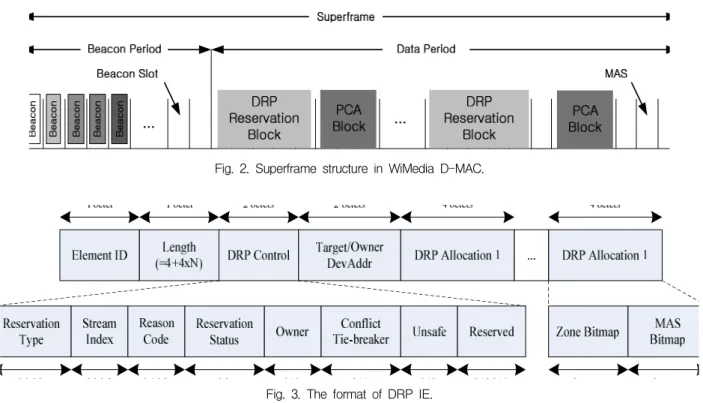
As shown in Fig. 2, WiMedia D-MAC operates with a time unit called superframe. A superframe is divided into a BP (Beacon Period) and a DTP (Data Transfer Period). Unlike other MAC proto- cols, the BP of WiMedia D-MAC consists of bea- con slots and each device sends its own beacon in a non-overlapping beacon slot. This feature of the BP helps to find other devices fast and to syn- chronize time with other devices. Also, it provides information of power control and reservation status for each MAS (Medium Access Slot).
The current WiMedia D-MAC exchanges re- source reservation and control information among the devices via DRP IE and DRP Availability IE.
The DRP IE illustrated in Fig. 3 is used to negotiate
a reservation for certain MASs and to announce
the reserved MASs for a traffic stream. The DRP
Availability IE notifies the current status of the
MAS utilization of 1-hop neighbors of the sender
device, using the 256-bit long bitmap field in which
one bit per each MAS in a superframe (One super-
Table 1. Reason Code Field Encoding
Value Code Description
0 Accepted The DRP reservation request is granted.
1 Conflict The DRP reservation request or existing reservation is in conflict with one or more existing DRP reservations.
2 Pending The DRP reservation request is being processed.
3 Denied The DRP reservation request is rejected or existing DRP reservation can no longer be accepted.
4 Modified The DRP reservation is still maintained but has been reduced in size or multiple DRP IEs for the same reservation have been combined.
5~7 Reserved Reserved
frame consists of 256 MASs). It is filled by com- bining all the DRP IEs transmitted by the 1-hop range neighbor devices.
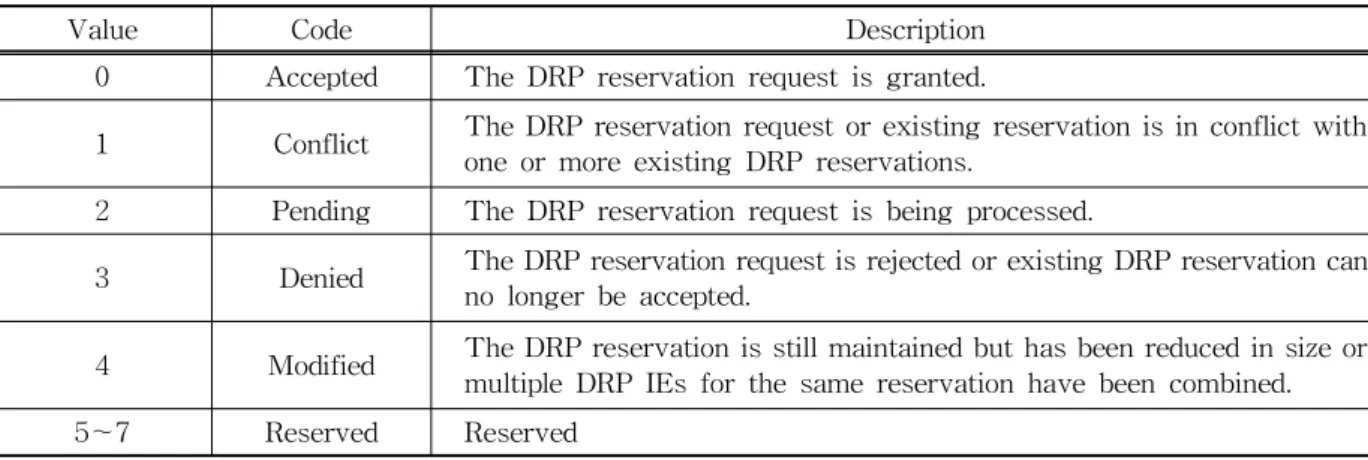
In Fig. 3, the DRP Control field contains the in- formation to detect and resolve the conflicts among DRP blocks and to identify the stream to be sent in the reserved MAS block. The Target/Owner DevAddr field shows the DevAddr (Device Address) of the corresponding device, i.e., it is set to the DevAddr of the reservation target (Receiving device) if the device transmitting the DRP IE is the reservation owner (Transmitting de- vice), and vice versa. The Reason Code is used by a reservation target to indicate whether a DRP res- ervation request was successfully accepted or not, and it is encoded as described in Table 1.
3. RELAY DRP
In this Section, we propose Relay DRP protocol with a policy for suitable relay node selection. The proposed scheme is compatible with the existing WiMedia standard and can be easily applied with small amount of overhead.
3.1 QoS-aware relay node selection
To select a suitable relay node for efficient coop- erative communication, we need a criterion for the selection. In this paper, SoQ which was defined in our previous study [10] is introduced as the
criterion.
The SoQ for traffic stream j at the n -th super- frame, SoQ
j,nis defined as follows:
(1) where SR
j,ndenotes the service rate allocated to traffic stream j at the n -th superframe and is a function of PHY data rate. MR
jand PR
jare the lower and the upper bound of a service rate to guarantee QoS of traffic stream j respectively.
In the WiMedia D-MAC protocol, a device can predict transmission rate and power level for each link by listening Link Feedback IEs from one or more source devices. The IEs contain information of the recommended change to the optimal PHY data rate and transmission power level [5]. Fig. 4 illustrates the Link Feedback IE format. The DevAddr field is set to the device address of the source device for which this feedback is provided.
The Transmit Power Level Change field denotes the change in transmit power level that the recipi- ent device sending this IE recommends to the source device, and the Data Rate field is filled with the PHY data rate that the recipient device trans- mitting this IE recommends to the source device.
After archiving all expected PHY transmission
rate information in its beacon group, a source de-
vice can get the SoQ of each link and determine
if it sends data packets to target device directly
or via relay device based on QoS-based relay node
Fig. 4. The format of Link Feedback IE.
Table 2. Additional Reason Code Fields Encoding for Relay DRP
Value Code Description
5 Relay Req Sent by a reservation owner to a relay device to request the DRP reservation between the owner device and the relay device
6 Relay Ntf Sent by a reservation owner to a target device to request the DRP reservation between a relay device and the target device
7 Relay Accepted The DRP reservation request via corresponding relay device is granted.
selection criterion as defined in (2).
arg
≤ ≤
(2)
where SoQ
mis the SoQ value of path m . When comparing SoQ
musing (2), if the path m includes a relay node, the SoQ is calculated by using (3).
min
(3) After selecting a suitable relay node using the criterion in (2), DRP resource reservation consid- ering cooperative relay transmission can be done according to the Relay DRP procedure explained in the next subsection.
3.2 Resource reservation procedure using Relay DRP
Since a wireless HD video transmission system usually requires stable high throughput, the sys- tem is generally defined in higher carrier frequency to guarantee wider spectrum bandwidth. Although it can achieve a high transmission rate, it has many technical problems such as signal attenuation with increasing propagation distance and LOS depend- ency of signal quality [12]. Therefore, we need to consider a cooperative communication scheme for
efficient HD video transmission. To provide coop- erative relay transmission, Relay DRP, proposed in this subsection, uses newly defined three code- points in the reserved field of Reason Code in Table 1. Thus, the Relay DRP conforms to WiMedia D-MAC standard for interoperability. The newly defined Reason Code Fields are explained in Table 2. The Reason Code of ‘Relay Req’ is sent by a reservation owner to a relay device to request a DRP reservation between the owner and the relay device. The Reason Code of ‘Relay Ntf’ is sent by a reservation owner to a target device to request a DRP reservation between a relay device and the target. These ‘Relay Req’ and ‘Relay Ntf’ Reason Codes ultimately intend to reserve DRP resources for relay transmission to the target node via the relay node. The Reason Code of ‘Relay Accepted’
denotes that the DRP reservation request via cor- responding relay device is granted. Accordingly, if both the Reason Codes from the relay node and the target node are set to ‘Relay Accepted’, it means that the DRP resources from the reservation owner to the target node via the relay node are success- fully reserved.
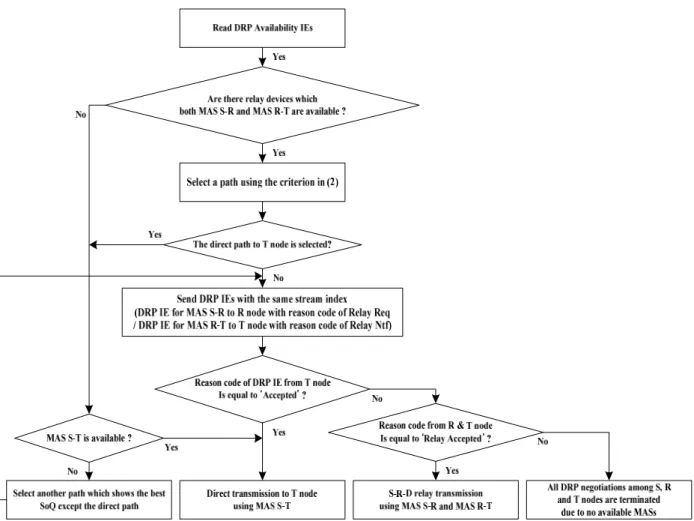
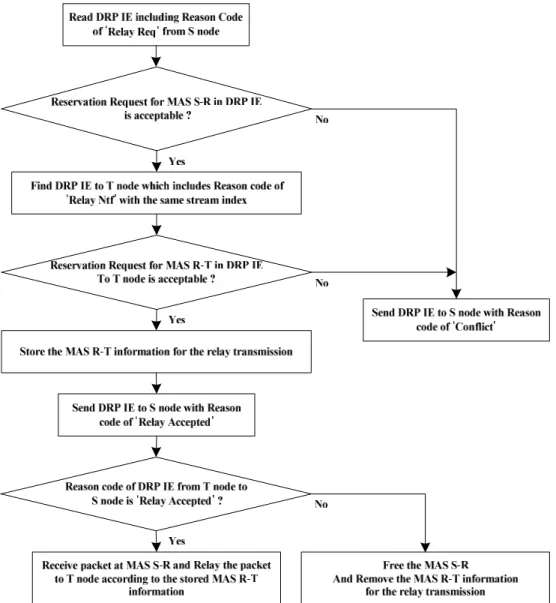
From Fig. 5 to Fig. 7, we depict the proposed
Fig. 5. Relay DRP procedure of reservation owner device.
Relay DRP procedures of reservation owner node, relay node, and target node in detail.
The reservation owner reserves DRP resources as shown in Fig. 5. After archiving expected PHY transmission rate information and reading DRP Availability IEs from other devices’ beacons in its beacon group, the reservation owner checks if there exists at least one relay device which both MAS S-R and MAS R-T for the relay device are free to use for the relay transmission. If there are several suitable relay nodes meeting the condition, the reservation owner selects a communication path using the criterion in (2). In case that the di- rect path to the target node is not selected, it sends DRP IEs for the relay transmission with the same stream index. In this case, the DRP IE for MAS S-R sent to the relay node includes the Reason Code of ‘Relay Req’, and the DRP IE for MAS R-T
with the Reason Code of ‘Relay Ntf’ is delivered to the target node.
After sending the DRP IEs using beacon, the reservation owner waits for the responses from the relay node and the target node. In case of ‘Relay Accepted’ Reason Code from both the relay node and the target node, the reservation owner sends data packets using the resources for the relay transmission. For other Reason Codes, we just fol- low the legacy DRP standard.
Fig. 6 shows the Relay DRP procedure for relay
node. When a relay node has enough energy for
relay transmission and receives a DRP IE from the
reservation owner with Reason Code of ‘Relay
Req’, the relay node checks whether the resource
request for MAS S-R in the received DRP IE is
acceptable or not. If the resource request is agree-
able to the relay node, the relay node should read
Fig. 6. Relay DRP procedure of relay node.
DRP IE to target node which includes Reason Code of ‘Relay Ntf’ with the same Stream Index and checks whether the requested MAS R-T is also acceptable or not. If the relay node agrees the relay transmission using the MAS S-R and the MAS R-T, it stores the MAS R-T information for the relay transmission and sends DRP IE to the reser- vation owner with Reason Code of ‘Relay Accepted’. After sending the DRP IE, the relay node waits for the response from the target node.
If the Reason Code of the DRP IE from the target node is ‘Relay Accepted’, the relay node receives packets at the MAS S-R and relays the received packets to the target node according the stored
MAS R-T information. Otherwise, the relay node frees the MAS S-R and removes the MAS R-T information.
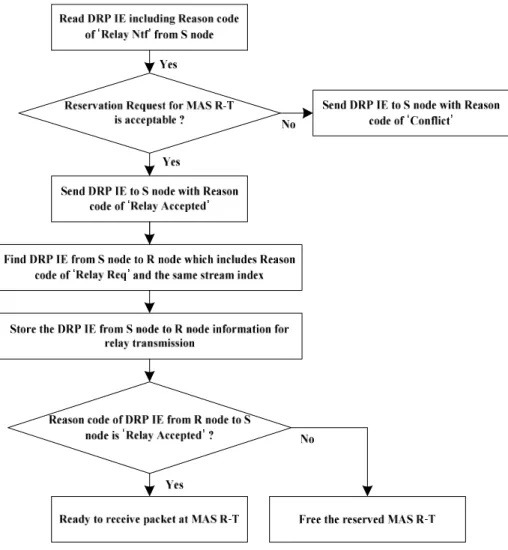
The Relay DRP procedure of target node is
shown in Fig. 7. When a target node receives a
DRP IE from the reservation owner with Reason
Code of ‘Relay Ntf’, the target node checks whether
the resource request for MAS R-T in the received
DRP IE is acceptable or not. If the resource request
is agreeable to the target node, the target node
stores the MAS R-T information for the relay
transmission and sends DRP IE to the reservation
owner with Reason Code of ‘Relay Accepted’. After
sending the DRP IE, the target node waits for the
Fig. 7. Relay DRP procedure of target node.
response from the relay node to the reservation owner. If the Reason Code of the DRP IE from the relay node to the reservation owner is ‘Relay Accepted’, the target node receives packets at the MAS R-T. Otherwise, the target node frees the re- served MAS R-T.
4. PERFORMANCE EVALUATION
Performance of the proposed Relay DRP scheme with the QoS-based relay node selection criterion is evaluated through NS-2 simulations. The net- work size covered by randomly distributed WiMedia D-MAC devices is 10m*10m. And we assume multiple WiMedia D-MAC application clusters for home network composed of 30 devices randomly distributed in the network area [6,7].
Each device has two kinds of mobility with each corresponding probability of m
INand m
OUT. The m
INis a probability that a device gets 1-hop near to the reference device, e.g., that device moves from 2-hop to 1-hop distance range, and the m
OUTis a probability that a device goes 1-hop away from the reference device, e.g., that device moves from 1-hop to 2-hop distance range. The transmission power of a device is fixed to -41.25dBm/MHz and the packet size transmitted in a beacon group is fixed to 2048 bytes [1,2]. In the WiMedia D-MAC performance analysis, the WiMedia PHY/MAC pa- rameters in the WiMedia specifications [1,5] are considered and are found in Table 3.
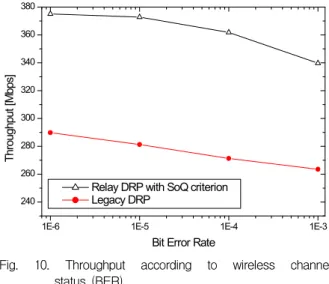
Fig. 8 shows average throughput performance
of the WiMedia D-MAC devices in the simulated
network according to m
INvalue of neighbor
Parameter Value
T
SYM312.5ns
T
syncStandard Preamble:
9.375μs
pMIFS 1.875μs
pSIFS 10μs
mMAXFramePayloadSize 4,095 octets mMAXBPLength 96 beacon slots
mBeaconSlotLength 85μs
mSuperframeLength 256* mMASLength
mMASLength 256μs
mBPExtension 8 beacon slots
mTotalMASLimit 112 MASs
0 10 20 30 40 50 60 70 80 90 100
0 50 100 150 200 250 300 350 400
Throughput [Mbps]
mIN mobility [%]
Relay DRP with SoQ criterion Legacy DRP
Fig. 8. Throughput performance according to mIN mobility.
Table 3. WiMedia PHY/MAC Simulation Parameters
0 5 10 15 20 25 30 35 40 45 50
0.0 0.1 0.2 0.3 0.4 0.5 0.6 0.7 0.8 0.9 1.0
SoQ
Available resources [Mbps]
Relay DRP with SoQ criterion Legacy DRP
Fig. 9. SoQ variation.
1E-6 1E-5 1E-4 1E-3
240 260 280 300 320 340 360 380
Throughput [Mbps]
Bit Error Rate Relay DRP with SoQ criterion Legacy DRP