186
[Note]
Spatio-temporal Variation of Intertidal Microphytobenthos in the Nakdong Estuary
GUOYING DU AND IK KYO CHUNG*
Division of Earth Environmental System, Pusan National University
The species composition and the biomass of intertidal microphytobenthos (MPB) were investigated at four sites in the Nakdong Estuary from Feb. to Dec. 2006. The chlorophyll (chl) a concentration showed a positive correlation with MPB abundance, and depth profiles showed similar patterns: high at the surface, rapidly decreasing within 4 cm from the surface, and slowly decreasing thereafter. A MANOVA analysis revealed that the chl a concentration varied significantly not only with depth, month, and site, but also with combinations of these factors. Among the four investigated sites, site D (Baekhabdeung) showed a seasonal biomass variation trend distinct from those of the other sites: higher in summer, decreased in autumn and with sustained low val- ues until winter. As indicated, the other sites contrastingly showed low biomasses in summer, after which the biomasses continuously increased, with some variation among the sites. A cluster analysis of species compo- sition indicated that sites near to each other and with similar sediment structures had closer similarities in the same seasons. The species of genus Amphora and Navicula were dominant at the four sites throughout the study period.
Key words: Microphytobenthos, Species Composition, Biomass, Spatial-temporal Variation
INTRODUCTION
Microphytobenthos (MPB) are the most important estuarine primary producers. They contribute up to 50% of estuarine primary production (Underwood and Kromkamp, 1999; Serôdio and Catarino, 2000), despite the fact that microalgal cells are active only in the thin surface-sediment layer, which is subject to rapid fluctuations in light, temperature and salinity. MPB is an artificial grouping of microalgae and photosynthetic bacteria incorporating taxonomic groups such as cyanobacteria, euglenoids, chrysophyceans, dinoflagelates and diatoms (MacIntyre et al., 1996). Among these groups, diatoms are the most frequently dominant. The distribution and variation of MPB biomasses are influenced by a combination of physical, chemical and biological factors. These factors include removal processes such as grazing and resuspension (Blanchard et al., 2001; Mitbavkar and Anil, 2002), and factors affecting the growth rate and/or health of MPB, such as light, temperature, salinity and nutrient availability (Underwood et al., 1998; Perissinotto et al., 2002). Additionally, tidal flows give MPB the ability to migrate (Consalvey et al., 2004). Under the influence of all such factors, MPB biomasses and communities often show seasonal and regional patterns (Sabbe, 1993; Montani et al., 2003; Herlory, 2004).
Vertical distribution of MPB in the intertidal sediment is found mostly on the very surface, within depths of less than
1 cm. However, active forms of chlorophyll (chl) a can be observed as deep as 10 cm, in the aphotic layer (Varela and Penas, 1985), and viable diatoms have been observed as deeply as 15cm (Mitbavkar and Anil, 2002). Euglena proxima and the diatom Hantzschia virgata have been found at depths of 12 and 8 cm, respectively (Kingston, 1999). Also, Kingston (2002) found that high concentrations of subsurface nutrients could enhance the downward migration of E. proxima to a depth of 5 cm in experimental mesocosm systems. The presence of MPB at these depths might reflect either their voluntary or forced migration, in the latter case by suspension and re-sedimentation owing to waves, tidal currents or other kinds of circulation. Not- withstanding the important roles that MPB play in estuarine environments, research on the physiology and ecology of these organisms in Korea is still at an early stage. Oh and Koh (1991, 1995) investigated benthic diatoms in the surface sediments of the Mangyung-Dongjin tidal flats, on the west coast of Korea, documented the abundances of diatom taxa and the related distributional patterns, and correlated these with certain environmental factors.
The objectives of the present study were primary investigation of intertidal MPB, aiming i) to investigate chl a and MPB vertical surface-sediment distributions to the depth of 10 cm; ii) to model the relation of chl a with MPB abundance; iii) to investigate the seasonal and annual patterns of intertidal MPB;
and iv) to investigate the correlation of MPB species composition with different sites in the estuary.
*Corresponding author: [email protected]
MATERIALS AND METHODS
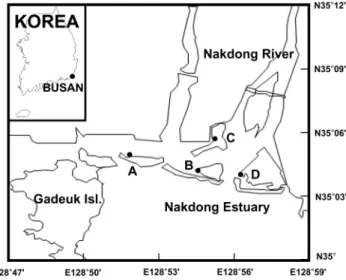
The study was conducted on the Nakdong Estuary, located on the southeastern coast of the Korean peninsula between 35°03’
and 35°06’N, and 128°51’ and 128°57’E (Fig. 1). Four sites were sampled at bimonthly intervals from Feb. to Dec. 2006.
Three sediment cores of 8 cm diameter and 10 cm depth were collected during the ebb tide at each site, and were sectioned into 1 cm slices. A subsample of 2.7 cm diameter was placed in a 50 ml centrifuge tube; after 15 ml of 90% acetone was added, the subsample was kept in darkness at 0-4 °C for 24 h in order to extract the pigments. One set of slices was put in a Petri dish for latter microscopic observation. The chl a concentration was determined using a spectrophotometer (HP, Agilent 8453), applying a correction for pheopigments and using the equations of Lorenzen (1967). A 0.4 cm3 sediment sample was taken from each slice, washed thoroughly, and sieved through 63 µm mesh with 1 min vigorous vibration to elute the diatoms. The sieved solution was allowed to settle over 24 h, and the clear supernatant was decanted using an aspirator. Lugol’s iodine solution was added, as a preservative, at a final concentration of 1%. The MPB were identified and numerated under 400× light microscopy.
The MPB cell density (cm3 sediment) was calculated by multiplying the number of cells of a taxon by the dilution factor. Species were identified by microscopy combined with scanning electronic microscopy (SEM). The chl a concentration data were subjected to Multiway ANOVA (MANOVA) by site, depth and month.
The Apr. to Dec. 2006 species-abundance data were subjected to cluster analysis. Both the study sites and the diatom taxa were clustered on the basis of the Euclidean similarity index and the unweighted pair group method average (UPGMA). The PRIMER program was used in the cluster analysis. A regression correlation between the chl a concentration and the MPB abundance was performed using SPSS.
RESULTS AND DISCUSSION
Biomass temporal variations
The chl a concentration per unit volume of sediment (cm3) was selected as the biomass proxy parameter. It showed slightly different patterns at the different sites (Fig. 2). Site D was most different from the other sites: it had a lower biomass than the others, and its variation pattern was higher in summer, lower in autumn and winter, and increased again from the following spring. As indicated, the other sites contrastingly showed low biomasses in summer, after which their biomasses continually increased with little variation. The chl a concentrations ranged from 2.74 to 25.17µg·cm-3 over the entire 10 cm, and from 0.87~8.84µg·cm-3 in the upper 1 cm, and the total values for the four sites, in descending order, followed the sequence A>B>C>D.
The total cell numbers at the sampling sites were 27.76~
2149.26×103 cells·cm-3 over the entire 10 cm (15.0~871.5×10³ cells·cm-3 in the upper 1 cm), also in the A>B>C>D sequence.
Most studies have used the chl a concentration (mg·m-2)to express the MPB biomass sediments of less than 1 cm depth. In the present study, considering the three-dimensional distribution of MPB in the sediment, especially the exponential vertical distribution of MPB (as shown next), the chl a concentration (µg·cm-3) was used to express the biomass. If 0.87~8.84 µg·cm-3 for the upper 1 cm is converted to mg·m-2, the result is 8.7~88.4 mg·m-2, close to Vilbaste and Sundach’s (2000) 15~66 mg·m-2 (< 1 cm) in the littoral zone of Riga Gulf, the Baltic Sea as well as Montani et al.’s (2003) 27.7~120 mg·m-2 (0.5 cm) on the estuarine sand flats of Seto Inland Sea, Japan, but less than Agatz et al.’s (1999) 130~238 mg·m-2 (1 cm) and marginally higher than Jeremiah’s (2005) 4.5~19.4 mg·m-2 (0.5 cm). As for MPB abundance (cell numbers), previous studies have shown values of 4~130×104 cells·cm-3 benthic diatoms in the upper 1 cm sediment in the mangroves of Houyu Bay, China (Chen et al., 2005), 1.5
~16.0×10⁵ cells·cm-2 benthic diatoms in the upper 1 cm sediment on tidal flats in Germany (Agatz et al., 1999), and in Oh and
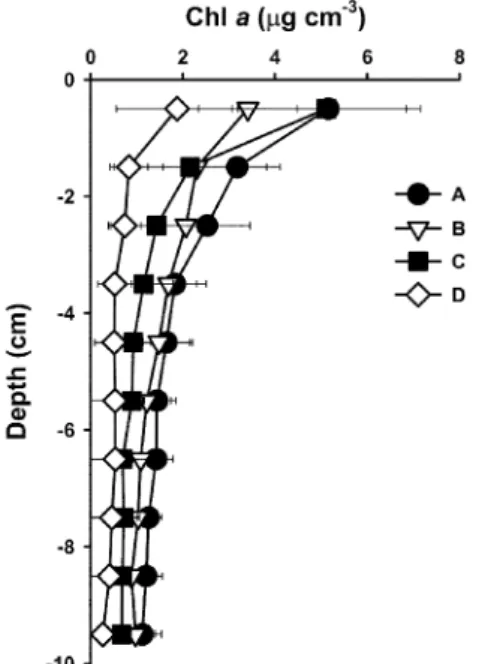
Fig. 1. Study sites in Nakdong Estuary intertidal flats. Fig. 2. Temporal variation of chl a concentration at four sites (in 10 cm sediment).
Koh’s (1995) Korean study, 9.6~631.6×10⁴ cells·cm-2. Factors influencing the horizontal distribution of MPB biomasses in a temperate climate such as Korea’s include seasonal change, and theoretically, to some extent, the temporal variation of chl a should reflect the effect of seasonal change. In the present study, the low biomass in the spring and summer of 2006 at sites A, B and C could be explained by high grazing pressure.
However, the unclear seasonal pattern after that at those sites indicated that the effect of these factors actually is very complex.
Chlorophyll (chl) a depth profile
The chl a vertical distribution throughout the study period was averaged, and the depth profiles for the four sites were obtained (Fig. 3). All of the profiles showed similar patterns: highest at the surface and declining exponentially with depth. However, the profile shapes were clearly different: sites A and C had higher values at the surface and rapid decreases with depth, whereas sites B and D had lower values at the surface and com- parably slow decreases with depth. On the whole, the chl a values for the four sites were A>B>C>D, in descending order.
This pattern might be related to the differences in sediment type among the sites. The vertical distribution has been observed to be highly correlated with the sediment type (Jesus et al., 2006), according to corresponding variations in light penetration and re-sedimentation caused by waves, tidal currents or other kinds of circulation. MPB present at greater depths as a result of vol- untary or forced (by suspension and re-sedimentation) migra- tion, whether in the resting stage or not, could at least be an important pool of potential primary producers. Therefore, in the
present study, we investigated 10 cm-deep sediment at 1 cm intervals. Although most researchers focus on very superficial MPB (at less than 1 cm depths), Montani et al. (2003), Mundree et al. (2003) and Varela and Penas (1985) investigated to 10, 5 and 10 cm depths (at 1 cm intervals) respectively, and obtained an intertidal flats chl a profile similar to ours. In fact, the light attenuation coefficient is known to be strongly influenced by sediment type. In the present study, even without the data from other, previously investigated sites, the difference affected by the sediment type was obvious. The chl a distributed in the deeper sediment, in this study, was a result probably of forcible relo- cation by suspension and re-sedimentation caused by physical processes such as waves, tidal currents or other kinds of circulation, rather than of voluntary migration.
Species composition
A total of 39 MPB taxa, mostly diatoms, were identified in the course of the study period. The top 10 dominant species are listed in Table 1. The genera Amphora and Navicula were most dominant in cell numbers. Navicula had more species than others, those species including N. digitoradiata, N. granulate, N. fortis, N. ramosissima, Navicula sp. 1and sp. 2, amounting from 24.9% to 52.5% of the totals. The species Amphora coffeaeformis was abundant at all of the study sites, accounting for 48.1% to 12.5% of the totals. It is very interesting that at sites A, B, C and D, in order, as Amphora’s% values declined, Navicula’s grew larger. Hantzschia amphioxys was most abundant at site D, occupying 10.5%.
The MPB species community was found to be intensively structured by many factors such as light, salinity, nutrients, temperature, and sediment type. Diverse species communities have been discovered in different intertidal zones all over the world. In the surface sediments of the Mangyung-Dongjin tidal flats, 88% were pinnate diatoms, and the most abundant species were Paralia sulcata, Navicula spp., N. arenaria and Cymatosira belgica (Oh and Koh, 1995). In the sand flats at Dias Beach, India, the dominant genera, similarly to the findings of our study, were Amphora, Navicula, and Thalassiosira (Mitbavkar and Anil, 2002). The Navicula sp. was found to be abundant in Japan as well (Montani et al., 2003). However, in the littoral zone of Riga Gulf, the Baltic Sea, the abundant taxa were Martyana atomus, Fragilariceae sp., Achnanthes delicatula (Vilbaste and Sundbach, 2000), and in mud flats of the mangroves, China, the dominant genera were Nitzschia and Gyrosigma (Chel et al., 2005).
Statistical analysis
The chl a concentration showed a positive correlation with MPB abundance (Fig. 4). A linear regression produced the fol- lowing equation:
Fig. 3. Depths profiles of chl a concentrations at four sites.
Abundance = 29.54 chl a+ 48.73 (r = 0.543**, n = 240).
The low slope of the line might be the result of counting all of the cells, including the empty cells (lacking chloroplasts). However, this positive correlation indicates not only that the chl a could be a biomass proxy parameter, but also that it could be the index of the MPB standing stock.
A MANOVA analysis revealed that the chl a varied signifi- cantly with depth, month, and site as well as with the combi- nations of depth x site, month x site, depth x month, and depth x site x month (Table 2).
A cluster analysis of the species-abundance data for the four sites indicated that the sites near to each other and with similar sediment types had closer similarities in the same seasons (Fig.
5). However, the species assemblages were difficult to cluster analyze, probably because of the complexity inherent in the
species-abundance data, which was sampled at different sites and in different months.
ACKNOWLEDGEMENT
This work was supported for two years by Pusan National University Research Grant to IKC.
Table 1. Dominant-species abundance and their % value at four sites (The cell numbers are the sum for the total 10 cm-depth sediment)
Species A B C D
Abundance
(103cell·cm-3) % Abundance
(103cell·cm-3) % Abundance
(103cell·cm-3) % Abundance (103cell·cm-3) %
Amphora sp.1 30.75 2.3 35.28 3.4 35.28 3.8 6.68 1.4
Amphora coffeaeformis 654.78 48.1 370.29 36.1 230.77 24.7 61.11 12.5
Amphora ovalis 52.33 3.8 36.11 3.5 29.79 3.2 10.56 2.2
Amphora lineata 127.85 9.4 25.90 2.5 16.33 1.7 3.75 0.8
Cymbella turgidula 42.78 3.1 33.20 3.2 32.18 3.4 10.93 2.2
Navicula digitoradiata 50.65 3.7 52.62 5.1 39.86 4.3 49.50 10.2
Navicula fortis 105.46 7.7 123.87 12.1 107.04 11.5 67.43 13.8
Navicula ramosissima 14.63 1.1 30.00 2.9 45.11 4.8 31.01 6.4
Navicula sp.1 124.18 9.1 113.20 11.0 160.90 17.2 88.84 18.2
Navicula sp.2 12.58 0.9 35.80 3.5 34.87 3.7 11.50 2.4
Hantzschia amphioxys 0 0 4.50 0.4 3.00 0.3 51.33 10.5
Total abundance of all species 1362.17 1026.35 934.66 487.31
Fig. 4. Correlation between abundance and chl a.
Table 2. Univariate analysis of variance among sites, depths and months
Source df MS F Significance
Depth 119 50.36 88.29 0.00000
Site 113 51.04 89.47 0.00000
Month 115 10.52 18.45 0.00000
Depth × Site 127 15.31 19.31 0.00000
Depth × Month 145 10.54 10.94 0.58510
Site × Month 115 11.93 13.39 0.00002
Depth × Site × Month 135 10.96 11.69 0.00003
Error 479 10.57
Total 719
(Computed using alpha = 0.05; Dependent variable: chl a)
Fig. 5. Cluster analysis of four sites based on species composition.
REFERENCES
Agatz, M., R.M. Asmus and B. Deventer, 1999. Structural changes in the benthic diatom community along a eutrophication gradient on a ticdal flat. Helgol. Mar. Res.53: 92−101.
Blanchard, G.F., J. Guarini, F. Orvain and P. Sauriau, 2001. Dynamic behaviour of benthic microalgal biomass in intertidal mudflats. J.
Exp. Mar. Biol. Ecol.264: 85−100.
Chen, C., Y. Gao and P. Lin, 2005. Biomass, species composition and diversity of benthic diatoms in mangroves of the Houyu Bay, China. Acta Oceanol. Sinica24: 141−150.
Consalvey, M., D.M. Paterson and G.C. Underwood, 2004. The ups and downs of life in a benthic biofilm: migration of benthic dia- toms. Diatom Res.19: 181–202.
Herlory, O., J.-M. Guarini, P. Richard and G.F. Blanchard, 2004.
Microstructure of microphytobenthic biofilm and its spatio- temporal dynamics in an intertidal mudflat. Mar. Ecol. Prog. Ser.
282: 33−44.
Jeremiah, T.E., 2005. Temporal patterns of benthic microalgal migration on a semi-protected beach. Estuar. Coast. Shelf Sci. 64: 486−496.
Jesus, B., C.R. Mendes, V. Brotas and D.M. Paterson, 2006. Effect of sediment type on microphytobenthos vertical distribution:
modeling the productive biomass and improving ground truth measurements. J. Exp. Mar. Biol. Ecol. 332: 60−74.
Kingston, M.B., 1999. Wave effects on the vertical migration of two benthic microalgae: Hantzschiavirgata var. intermedia and Euglena proxima. Estuaries22: 81–91.
Kingston, M.B., 2002. Effect of subsurface nutrient supplies on the vertical migration of Euglena Proxima (Euglenophyta). J. Phycol.
38: 872−880.
Lorenzen, C.J., 1967. Determination of chlorophyll and pheo-pig- ments: Spectrophotometric Equations. Limnol. Oceanogr. 12: 343− MacIntyre, H.L., R. Geider and D.C. Miller, 1996. Microphytob-346.
enthos: the ecological role of the “Secret garden” of unvegetated, shallow-water marine habitats. I. Distribution, abundance and pri- mary production. Estuaries 19: 186–201.
Mitbavkar, S. and A.C. Anil, 2002. Diatoms of the microphytobenthic community: population structure in a tropical intertidal sand flat.
Mar. Biol.140: 41−57.
Montani, S., P. Magni and N. Abe, 2003. Seasonal and interannual patterns of intertidal microphytobenthos in combination with laboratory and areal production estimates. Mar. Ecol. Prog. Ser.
249: 79−91.
Mundree, S., R. Perissinotto and C. Nozais, 2003. Seasonal Variations in the Vertical Distribution of Benthic Microalgae in the Upper Sediment of the Mdloti Estuary, South Africa. Bot. Mar.46: 323−33.
Oh, S.H. and C.H. Koh, 1991. Distribution pattern of dominant benthic diatoms on the Mangyung-Dongjin tidal flat, west coast of Korea. J. Oceanol. Soc. Korea26: 24−37.
Oh, S.H. and C.H. Koh, 1995. Distribution of diatoms in the surficial sediments of the Mangyung-Dongjin tidal flat, west coast of Korea (Eastern Yellow Sea). Mar. Biol.122: 487−496.
Perissinotto, R., C. Nozais and I. Kibirige, 2002. Spatio-temporal dynamics of phytoplankton and microphytobenthos in a South African temporarily-open estuary. Estuar. Coast. Shelf Sci. 55: 47−58.
Sabbe, K., 1993. Short-term fluctuations in benthic diatom numbers on an intertidal sandflat in the Westeschelde estuary (Zeeland, the Netherlands). Hydtrobiologia269/270: 275−284.
Serôdio, J. and F. Catarino, 2000. Modelling the primary productivity of intertidal microphytobenthos: time scales of variability and effects of migratory rhythms. Mar. Ecol. Prog. Ser.192: 13–30.
Underwood, G.J.C. and J. Kromkamp, 1999. Primary production by phytoplankton and microphytobenthos in estuaries. Adv. Ecol.
Res.29: 93–153.
Underwood, G.J.C., J. Philips and K. Saunders, 1998. Distribution of estuarine benthic diatom species along salinity and nutrient gra- dients. Eur. J. Phycol. 33: 173−183.
Varela, M. and E. Penas, 1985. Primary production of benthic microalgae in an intertidal sand flat of the Ria de Arosa, NW Spain. Mar. Ecol. Prog. Ser. 25: 111−119.
Vilbaste, S. and K. Sundbach, 2000. Distribution of benthic diatoms in the littoral zone of the Gulf of Riga, the Baltic Sea. Eur. J.
Phycol. 35: 373−385.
2007년 7월 18일 원고접수 2007년 8월 6일 수정본 채택 담당편집위원: 강성호