• 검색 결과가 없습니다.

The Effects of Spring Kimchi Cabbage Pre-treatment and Storage Conditions on Kimchi Quality Characteristics

N/A
N/A
Protected

Academic year: 2021

Share "The Effects of Spring Kimchi Cabbage Pre-treatment and Storage Conditions on Kimchi Quality Characteristics"

Copied!
11
0
0

로드 중.... (전체 텍스트 보기)

전체 글

(1)

The Effects of Spring Kimchi Cabbage

Pre-treatment and Storage Conditions on Kimchi Quality Characteristics

Sun-Duk Cho

1

, Eun-Ji Lee

1

, Hye-Yeol Bang

1

, Byeong-Sam Kim

2

, and Gun-Hee Kim

1*

1

Plant Resources Research Institute, Duksung Women's University, Seoul 01369, Korea

2

Research Group of Smart Food Distribution System, Korea Food Research Institute, Wanju 55365, Korea

*Corresponding author: [email protected]

Kimchi is a widely consumed food in Korea, and the quality of the final fermented product is affected by properties of the cabbage used to produce it. The objective of this study was to determine optimal means of storing spring kimchi cabbage by analyzing kimchi produced from cabbage subjected to one of six combinations of pre-treatment and storage conditions. Kimchi quality evaluation was through sensory tests, measurement of antioxidant effects, and analysis of associated microorganisms. The kimchi produced from cabbage stored under T6 conditions (upside down orientation, pre-cooling, high density polyethylene (HDPE) film wrap, and photocatalytic storage) possessed a static pH, which implied a slow progression of ripening that was also verified in sensory tests by a low sour taste score of 3.60 and a high green taste score of 3.00. The kimchi produced from T3 cabbage (upright orientation and low-temperature storage) showed the highest consumer preference according to the sensory test results, with scores of 6.40 and 5.40 from the time of making kimchi through to the fourth week of ripening, respectively.

Analysis of antioxidant effects showed that the highest phenol content of 243.75 GAE mg·g

-1

was in kimchi produced from T2 cabbage (upside down orientation, pre-cooling, HDPE film wrap, and plasma storage). Furthermore, both the highest flavonoid content of 70.54 QE mg·g

-1

and the highest DPPH radical-scavenging activity level of 70.54% was in kimchi produced from T4 cabbage (upside down orientation, pre-cooling, HDPE film wrap, and low-temperature storage).

Over eight weeks of maturation, the volume of lactic acid bacteria constantly rose by 7.98 log CFU·mL

-1

in kimchi produced from T3 cabbage and by 7.81 log CFU·mL

-1

in kimchi produced from T1 cabbage (upright orientation and plasma storage). The results of this study indicate that the T3 cabbage storage conditions are optimal for producing high-quality kimchi.

This work was supported by Korea Institute of Planning and Evaluation for Technology in Food, Agriculture, Forestry and Fisheries (IPET) through Agri-Bio industry Technology Development Program, funded by Ministry of Agriculture, Food and Rural Affairs (MAFRA) (514002-03).

HORTICULTURAL SCIENCE and TECHNOLOGY 35(6):747-757, 2017

URL: http://www.kjhst.org pISSN : 1226-8763 eISSN : 2465-8588

This is an Open-Access article distributed under the terms of the Creative Commons Attribution NonCommercial License which permits unrestricted non-commercial use, distribution, and reproduction in any medium, provided the original work is properly cited.

Copyrightⓒ2017 Korean Society for Horticultural Science.

OPEN ACCESS Received:

Revised:

Accepted:

May 12, 2017 July 26, 2017 August 3, 2017

Abstract

Additional key words: photocatalysis, plasma, pre-cooling, quality evaluation, sensory tests

Introduction

Kimchi is a leading Korean food made with fermented vegetables . It has drawn global attention as a

health food because of its abundant lactic acid bacteria , vitamin , carotene , and acetate contents that have

outstanding anti - cancer , anti - inflammatory , and anti - mutagenic effects ( Bae et al ., 2009 ). The kimchi

(2)

cabbage (Brassica compestris L . ssp . pekinensis), one of the main ingredients for making kimchi , is a biennial leafy green of the family Cruciferae ( Jung et al ., 2009 ). Every year , two million tons of kimchi cabbage are produced in Korea , accounting for 25 % of national vegetable consumption ( Kim et al ., 2014 ). The cruciferous vegetable is rich in plant secondary metabolites such as glucosinolate , flavonoid , phenol , and sulfur compounds ( Cho et al ., 1993 ). The kimchi cabbage is particularly known for its abundant contents of antioxidative flavonols such as hydroxy benzoic acid , hydroxy cinamic acid , kaempferol , and quercetin ( Ku et al ., 2007 ). The kimchi cabbage is the fundamental ingredient , alongside white radish , scallions , and chili , to make kimchi , meaning that kimchi quality heavily depends on the variety of kimchi cabbage as well as growth time , climatic condition , cultivation method , and other environmental factors ( Lee et al ., 2008 ). The kimchi cabbage is large in size and has soft tissue , which creates difficulties for its storage and distribution . Thus , the price and supply of the kimchi cabbage vary substantially according to the season ( Han et al ., 2000 ). In the past , most kimchi was made with kimchi cabbage available in November . However , in current times , advanced breeding technology has made kimchi cabbage available to the market year round . The quality and processing suitability of kimchi cabbage are affected not only by the specific variety and genetic factors , but also by pre - harvest variables such as soil quality and time of cultivation and by post - harvest factors such as storage period and conditions . Subsequently , these same factors greatly influence the quality of kimchi made from the kimchi cabbage ( Lee et al ., 2013 ). The diversification of dietary choices resulting from recent social changes in Korea has increased the number of consumers purchasing kimchi cabbage regardless of season . The growth of kimchi export markets has also boosted the use of spring kimchi cabbage , because kimchi manufacturers need to sustain production year round . However , there is still a poor understanding of how properties of spring kimchi cabbage affect the quality characteristics of kimchi ( Cho et al ., 2016 ).

Therefore , the objective of this study was to establish optimal conditions for storing spring kimchi cabbage by analyzing kimchi made from cabbages that had been through various pre - treatment and storage conditions .

Materials and methods

Experimental Materials and Kimchi Production

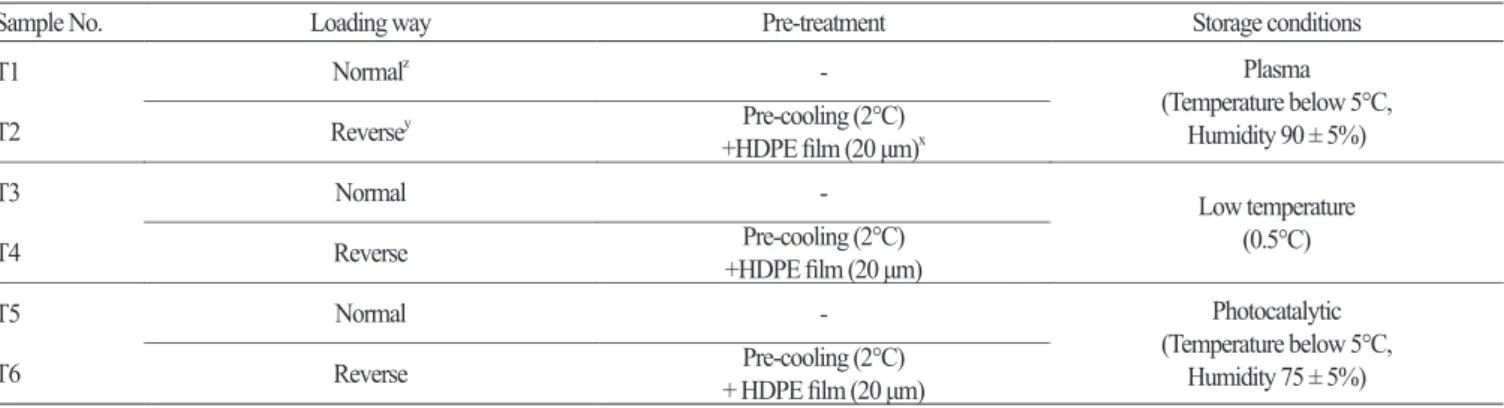
The spring kimchi cabbage ‘ Chunkwangused in these experiments was sourced from a kimchi cabbage – growing district ( Pyeongchang ) where a certain quantity can be supplied , pretreated , and stored in early July . Immediately after the harvest , kimchi cabbage were treated and stored following one of six regimes , as described in Table 1 . Specifically , kimchi cabbage was placed in plastic containers ( 55 × 37 × 32 cm ) either in an upright or upside down orientation . Containers containing upside down cabbages were pre - cooled at 2 ° C and covered with HDPE film ( 20 mm ) to prevent water loss . Cabbages were then placed in either plasma curing storage ( temperature below 5 ° C , humidity 90 ± 5 %; Water Link Co ., Gyeonggi , Korea ), low temperature storage ( 0 . 5 ° C ), or photocatalytic storage ( temperature below 5 ° C , humidity 75 ± 5 %; Wizfresh Co ., Seoul , Korea ) to maintain freshness and prevent disease .

Prior to conducting the experiments , the kimchi cabbage was stored in the various conditions for six weeks at a storeroom

within the shipment control facilities of Daegwallyeong Horticultural Nonghyup . Each kimchi cabbage was cut in half , soaked

in brine with 15 % salt ( Solar Salt , Shinan , Korea ) content for 17 hours , washed three times , and dried for two hours . Following

this , seasoning was made by mixing 4 . 5 g of red pepper powder ( Sun Dried Red Pepper , Goesan ), 2 . 0 g of garlic ( Seosan ), 1 . 0 g

of ginger ( Seosan ), 5 . 0 mL of anchovy sauce ( CJ Cheiljedang , Korea ), and 0 . 5 g of white sugar ( Beksul , Korea ) per 100 g of salted

(3)

kimchi cabbage , which was according to the recipe for general kimchi seasoning of the Rural Development Administration . In addition , 10 g of white radish ( Jeju ) and 5 g of onions ( Muan ) were ground and added to the seasoned kimchi cabbage ( RDA , 2013 ). The final kimchi product was sealed in vacuum - packed polyethylene bags ( 200 × 300 × 55 mm ) and allowed to ripen at 4 ° C for eight weeks . In the meantime , experiments were carried out that analyzed the differences between each kimchi type regarding quality and sensual properties .

Quality Characteristics

Trimming loss rate and yields of salted kimchi cabbage and kimchi

To maintain the freshness of spring Kimchi cabbage and tap the possibility of commercializing kimchi , we calculated a trimming loss rate by measuring the weights of original kimchi cabbage and kimchi cabbage whose unusable outer leaves were removed because they were too dry or rotten . In addition , the weights of salted kimchi cabbage and kimchi were measured using the measurement method commonly used by kimchi manufacturers to determine each sample ’ s potential for becoming quality kimchi . Then the weight of salted kimchi cabbage was converted against that measured after selection into a percentage to calculate the yield of salted kimchi cabbage . For the yield of kimchi , we converted the total weight of kimchi against that of raw materials into a percentage as shown below .

Weight of raw materials - Weight measured after selection

Trimming loss rate (%) = × 100

Weight of raw materials

Weight of salted kimchi cabbage Yield of salted kimchi cabbage (%) = Weight measured after selection × 100

Weight of kimchi

Yield of kimchi (%) = Weight × of raw materials 100

Sample No. Loading way Pre-treatment Storage conditions

T1 Normal

z

- Plasma

(Temperature below 5°C, Humidity 90 ± 5%)

T2 Reverse

y

Pre-cooling (2°C)

+HDPE film (20 μm)

x

T3 Normal - Low temperature

(0.5°C)

T4 Reverse Pre-cooling (2°C)

+HDPE film (20 μm)

T5 Normal - Photocatalytic

(Temperature below 5°C, Humidity 75 ± 5%)

T6 Reverse Pre-cooling (2°C)

+ HDPE film (20 μm)

z

Placing cabbages in plastic containers (55 × 37 × 32 cm) by making their roots face downward.

y

Placing cabbages in plastic containers (55 × 37 × 32 cm) by making their roots face upward.

x

Packing the containers in pallets by using 20 μm HDPE film with micro orifices at 10 mm intervals, and pre-cooling at 2°C.

Table 1. Pre-treatment processes and storage conditions of spring Kimchi cabbage after the harvest

(4)

Measurement of pH, salinity and hardness

We took approximately 100 g of samples from each kimchi stored for various periods and made juice with juicer ( Do9901 , Dongaoscar , Korea ) to measure pH and salinity . The pH was measured by an automatic titrator ( Titroline easy , SchottInstruments , Mainz , Germany ) at room temperature , whereas a digital salimeter ( SB - 2000 , Gimisanggung , Korea ) was used to measure salinity . The hardness of kimchi was gauged by cutting off the seventh leaf from the outer leaves and measuring the thickest part of the stem , which is 5 cm away from its dwarf stem , by using a texture analyzer ( TAplus 2006 , LLOYD Instruments , USA ). At this point , the probe used a crisp fracture support rig and the measurement was performed at a test speed of 60 mm · min

-1

and trigger of 0 . 5 N ( Lee , 2004 ).

Sensory Evaluation

For the sensory evaluation of kimchi , 10 evaluators under age 40 were invited to form a panel . After explaining the purpose of the tests to them , the kimchi was evaluated for appearance , texture , flavor , and overall acceptability based on a nine - point hedonic scale ( Kim et al ., 2014 ).

Analysis of Antioxidant Activity DPPH radical-scavenging activity

To measure the 1 , 1 - Diphenyl - 2 - picrylhydrazyl ( DPPH ) radical - scavenging activity of each extract , we slightly altered Bloiss method ( Blois , 1958 ). The experiment was performed by mixing a 0 . 2 mM DPPH solution ( Sigma Chemical Co ., St . Louis , MO , USA ) with individual samples of various concentrations , waiting for 25 minutes and measuring their absorbance at 515 nm . As a result , the samples showed activity in radical removal compared to those with no solution added . The experiment on DPPH radical - scavenging activity was conducted three times and suggested an average value through the following formula .

A - B

% DPPH = A × 100

A : Absorbance of the control B : Absorbance of the sample

Measuring total phenol content

To measure total phenol content , we followed the Folin - Denis method by mixing each extract ( 50 μL ) with 300 μL of folin reagent , exposing the extracts to room temperature for 3 min , adding 150 μL of 2 % Na

2

CO

3

to make them react at room temperature for two hours and measuring their absorbance at 760 nm . Gallic acid was used as a standard reference material and total phenol content was calculated from the calibration curve obtained through the same method for analyzing the specimens . This experiment was conducted three times to formulate an average value .

Measuring total flavonoid content

We followed the Davis method to measure total flavonoid content . Each sample solution ( 0 . 1 mL ) was mixed with 1 mL of

diethylene glycol and 0 . 1 mL of 1 N NaOH . The samples were exposed to a temperature of 30 ° C for 60 minutes and their

(5)

absorbance was measured at 420 nm . Quercetin was used as a standard reference material and total flavonoid content was calculated from the calibration curve obtained through the same method for analyzing the samples . This experiment was conducted three times to calculate an average value .

Quality Characteristics of Microorganisms

We applied 0 . 85 % NaCl sterile water to 10 g of the sample that combined the inner and outer leaves of kimchi . The total volume of the sterile water had to be 100 mL to become 1 : 10 w / v compared to the sample . Then a homogenizer was used to homogenize the sterile water whose homogenate was diluted 10 times at each phase and smeared on 3 m badges . After the inoculation , the sample was incubated at 37 ° C for 36 hours and colonies were counted . The number of detected lactic acid bacteria was expressed by the log colony forming unit per milliliter of sample .

Statistical Analyses

All experiments except those for measuring the loss rate and yields were repeated in triplicate to calculate average values and standard deviations . Each measured value went through the analysis of variance ( ANOVA ) using the SPSS Win program ( Version 19 . 0 , Chicago , IL , USA ), which was then verified by Duncans multiple range test where p < 0 . 05 .

Results

Trimming Loss Rate and Yields of Salted Kimchi cabbage and Kimchi

Pepper spot is a physiological disorder that affects the white midrib tissues of spring Kimchi cabbage . The first symptoms of pepper spots are small , dark , circular or elongated spots that first appear on the white midribs of the outer leaves and then spread to the middle inner leaves . Spots develop on both outer and inner surfaces of leaves ( Studistill et al ., 2007 ). Table 2 shows the results of trimming loss rate and yields of salted kimchi cabbage and kimchi for each combination of pre - treatment and storage conditions . The trimming loss rate among treated material ranged between 17 . 69 % and 35 . 81 %. For the T2 , T4 , and T6 cabbage , which were packed upside down , received a pre - cooling treatment , and were covered by HDPE film , subsequent low temperature storage of T4 cabbage resulted in a trimming loss rate of 17 . 69 %, which was substantially lower than the trimming loss rates from T2 ( 29 . 06 %) and T6 ( 35 . 81 %) cabbage that were stored under plasma and photocatalytic conditions , respectively . All treatments resulted in satisfactory yields of salted kimchi cabbage of over 80 %. The yield of

Sample No.

z

Trimming loss (%) Salted spring Kimchi cabbage yield (%) Kimchi yield (%)

T1 25.10 89.86 86.15

T2 29.06 93.43 84.84

T3 24.21 89.90 87.22

T4 17.69 87.46 92.14

T5 24.20 91.00 88.29

T6 35.81 84.92 69.76

z

Abbreviations are same as in Table 1.

Table 2. Trimming loss, salted spring kimchi cabbage yield and kimchi yield of spring kimchi cabbage following different pretreatment processes

and storage conditions

(6)

kimchi , affected by the trimming loss rate , ranged widely from 69 . 76 % to 92 . 14 %. The yield of kimchi was in inverse proportion to the trimming loss rate , as reflected by the yield of kimchi from T4 cabbage ( 92 . 14 %), which was approximately 20 % higher than that from T6 cabbage ( 69 . 76 %).

Kimchi pH, Salinity, and Hardness

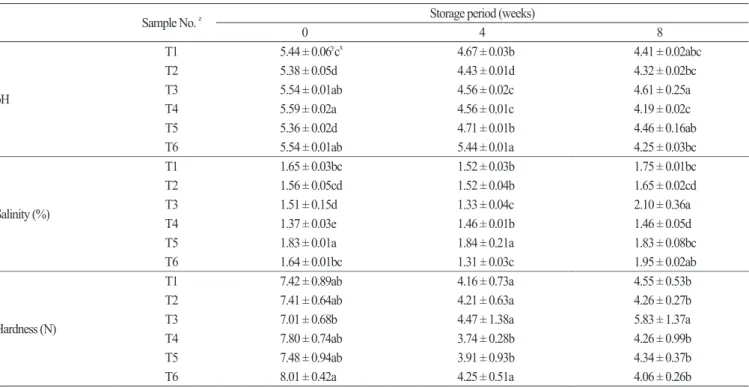
A change in pH is a significant indicator of the degree of kimchi ripening ( Cho et al ., 2016 ), with kimchi at pH 4 . 2 - 4 . 6 with a lactic acid content of 0 . 50 - 0 . 75 % considered to be at optimum maturity . Kimchi produced from all treated material was ripened at 4 ° C over eight weeks , and the pH values , salinity , and hardness were measured following various ripening periods ( Table 3 ) . The pH prior to kimchi ripening was 5 . 36 - 5 . 59 , which decreased to 4 . 43 - 5 . 44 and 4 . 19 - 4 . 61 following four and eight weeks of ripening , respectively . Kimchi from T4 cabbage showed the largest drop in pH during ripening , and continued to ripen in the eighth week , whereas other treated cabbage produced kimchi that maintained a pH range within that of optimum maturity . Kimchi from T6 cabbage had a pH following four weeks of ripening that was considerably unchanged from that measured prior to ripening , indicating that the ripening process progressed slowly . The salinity prior to kimchi ripening was 1 . 51 - 1 . 83 %, which decreased to 1 . 31 - 1 . 84 % following four weeks of ripening and then increased to 1 . 46 - 2 . 10 % following eight weeks of ripening . The hardness of kimchi is a significant quality factor and is considered in the sensory test for evaluating kimchi texture . Hardness values prior to kimchi ripening were 7 . 01 - 8 . 01 N , with T6 cabbage producing kimchi exhibiting the highest value of 8 . 01 N .

Sample No.

z

Storage period (weeks)

0 4 8

pH

T1 5.44 ± 0.06

y

c

x

4.67 ± 0.03b 4.41 ± 0.02abc

T2 5.38 ± 0.05d 4.43 ± 0.01d 4.32 ± 0.02bc

T3 5.54 ± 0.01ab 4.56 ± 0.02c 4.61 ± 0.25a

T4 5.59 ± 0.02a 4.56 ± 0.01c 4.19 ± 0.02c

T5 5.36 ± 0.02d 4.71 ± 0.01b 4.46 ± 0.16ab

T6 5.54 ± 0.01ab 5.44 ± 0.01a 4.25 ± 0.03bc

Salinity (%)

T1 1.65 ± 0.03bc 1.52 ± 0.03b 1.75 ± 0.01bc

T2 1.56 ± 0.05cd 1.52 ± 0.04b 1.65 ± 0.02cd

T3 1.51 ± 0.15d 1.33 ± 0.04c 2.10 ± 0.36a

T4 1.37 ± 0.03e 1.46 ± 0.01b 1.46 ± 0.05d

T5 1.83 ± 0.01a 1.84 ± 0.21a 1.83 ± 0.08bc

T6 1.64 ± 0.01bc 1.31 ± 0.03c 1.95 ± 0.02ab

Hardness (N)

T1 7.42 ± 0.89ab 4.16 ± 0.73a 4.55 ± 0.53b

T2 7.41 ± 0.64ab 4.21 ± 0.63a 4.26 ± 0.27b

T3 7.01 ± 0.68b 4.47 ± 1.38a 5.83 ± 1.37a

T4 7.80 ± 0.74ab 3.74 ± 0.28b 4.26 ± 0.99b

T5 7.48 ± 0.94ab 3.91 ± 0.93b 4.34 ± 0.37b

T6 8.01 ± 0.42a 4.25 ± 0.51a 4.06 ± 0.26b

z

Abbreviations are same as in Table 1.

y

Mean ± SD.

x
Different letters within columns indicate significant differences in the same storage period by Duncan’s multiple range test at p < 0.05.

Table 3. Changes of pH, salinity, hardness in kimchi made from spring kimchi cabbage following different pre-treatment processes and storage

conditions. Measurements were made during an eight-week fermentation at 4 °C following 0, 4, and 8 weeks

(7)

Sensory Evaluation

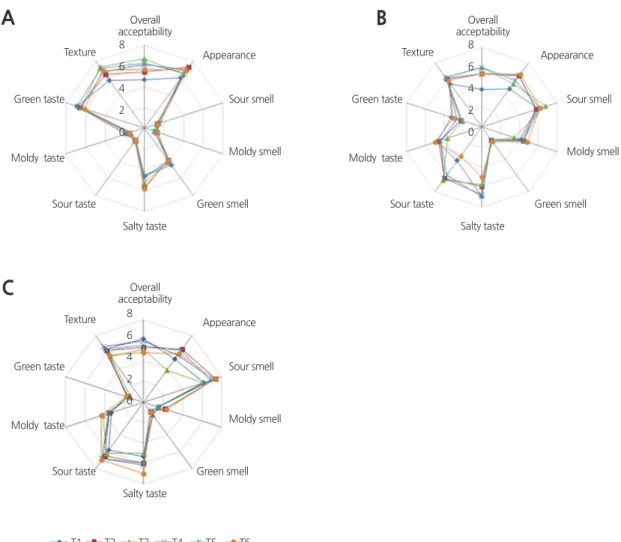
For sensory evaluation , evaluating panel members were presented with kimchi at various stages of ripening ( Fig . 1 ). Following evaluation of kimchi that had not undergone fermentation ( 0 weeks ripening ), kimchi produced from T3 cabbage received the highest scores of 7 . 29 and 6 . 71 for its texture and preference , respectively , whereas kimchi produced from T1 cabbage received the lowest score of 4 . 71 for preference . Regarding appearance , kimchi made from T2 , T4 and T6 cabbage all received a high score of 6 . 80 . As for other evaluated characters , differences were observed between values but these were not statistically different . Sensory evaluation of kimchi following four weeks fermentation showed that kimchi produced from T3 and T5 cabbage received the highest score of 6 . 00 for preference , although this value was not significantly different to that for kimchi made from other treated cabbage . In addition , kimchi produced from T5 cabbage received the highest scores of 5 . 80 and 6 . 20 for appearance and texture , respectively , although again these values were not significantly different . However , significant differences were found in evaluation of sour and green tastes following four weeks fermentation . Specifically , kimchi made from T3 cabbage received the highest score of 6 . 60 for sour taste , whereas T2 and T4 cabbage scored 6 . 40 and T5 cabbage

2

2

0

0

4

4

T1

6

6 2 0 4 6

8 8

8

T3

T2 T4 T5 T6

Overall acceptability

Overall acceptability

Overall acceptability Appearance

Appearance

Appearance

Sour smell

Sour smell

Sour smell

Moldy smell

Moldy smell

Moldy smell

Green smell

Green smell

Green smell Salty taste

Salty taste

Salty taste Sour taste

Sour taste

Sour taste Moldy taste

Moldy taste

Moldy taste Green taste

Green taste

Green taste Texture

Texture

Texture

A B

C

Fig. 1. Sensory evaluation of kimchi made from spring Kimchi cabbage following different pre-treatment processes and storage

conditions. Evaluated kimchi was fermented at 4°C for 0 weeks (A), 4 weeks (B), and 8 weeks (C). Abbreviations are the same

as in Table 1.

(8)

scored 6 . 00 . T6 cabbage produced kimchi that received a relatively lower sour taste score of 3 . 60 . For green taste , T1 and T6 cabbage produced kimchi that had high scores of 3 . 20 and 3 . 00 , respectively , whereas kimchi from T5 cabbage had the lowest score of 2 . 00 . These results resembled those for kimchi made from T6 cabbage , which exhibited slow ripening over four weeks as described above . Following eight weeks fermentation , differences were observed between values for evaluated characters but these were not statistically different . Regarding preference , appearance , and texture , kimchi with the highest scores was made from T1 and T4 cabbage ( 6 . 17 and 6 . 00 ), T2 and T5 cabbage ( 6 . 33 and 6 . 17 ), and T4 cabbage ( 6 . 67 ), respectively .

DPPH Radical-Scavenging Activity

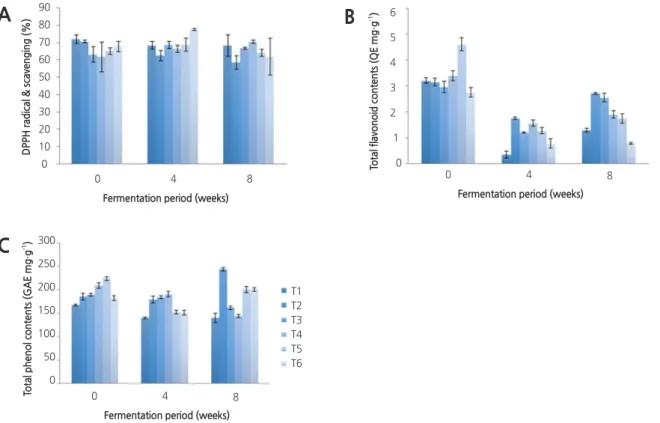
For DPPH radical - scavenging activity , in vitro experiments were carried out to measure the effects of antioxidant activity ( Kim et al ., 2013 ). In a biological system , the protective performance of an antioxidant is determined by examining its free radical - scavenging activity , metal catalyst - chelating ability , antioxidant enzyme activity , and inhibitory effects on oxidizing enzymes . In particular , the DPPH radical is a chemically stable radical whose unique purple color fades when receiving an electron from a certain reaction system ( Hyun et al ., 2009 ), a process through which antioxidant activity can be measured . The DPPH radical - scavenging activity was measured in kimchi produced from each type of stored cabbage over various ripening periods ( Fig . 2 ). Prior to fermentation , kimchi made from T2 and T5 cabbage showed significantly high radical scavenging activities of 70 . 50 % and 65 . 06 %, respectively . Following four weeks fermentation , kimchi from T6 cabbage displayed the highest level of radical - scavenging activity ( 77 . 52 %), which was followed by that from T3 ( 68 . 61 %) and T1 ( 68 . 27 %) cabbage . Following eight weeks fermentation , the highest levels of radical - scavenging activity were observed in kimchi made from T4 ( 70 . 54 %), T3 ( 68 . 31 %), and T2 ( 67 . 58 %) cabbage , although there were no significant differences among these values .

Total Content of Phenols and Flavonoids

A phenolic compound is a sulfated substance that hinders the oxidation of unsaturated fatty acids , and is known to cure and

prevent skin cancer . Total phenol content was increased in mature fermented kimchi compared to that in kimchi prior to

fermentation . Furthermore , results verified a higher phenol content in kimchi made from T2 and T6 cabbage . Moreover , kimchi

from T2 cabbage , which showed a relatively higher level of DPPH radical - scavenging activity , also showed the highest total

phenol content ( 243 . 75 GAE mg · g

-1

) following eight weeks fermentation , the optimum maturity for storing kimchi , by

maintaining pH between 4 . 2 and 4 . 6 . Kimchi from T5 and T6 cabbage contained a high phenol content of 200 . 59 GAE mg · g

-1

( Fig . 2 ). The flavonoids composition of plants is mainly anthocyanidins , flavonols , flavones , cathechins , and flavanones ( Doh et

al ., 2011 ). Flavonoids are known to have anti - bacterial activity as well as antioxidant , anti - inflammatory , cholesterol reduction ,

and fatty liver - inhibiting effects , and display a tendency to prevent the growth and differentiation of various tumor cells ( Ahn et

al ., 2015 ). Compared to that measured prior to fermentation , total flavonoid content in kimchi made from all stored cabbage

decreased following four weeks fermentation and increased again after eight weeks fermentation . When total flavonoid content

was measured following eight weeks fermentation , which is considered the optimal maturity period for storing kimchi , that

made from T4 cabbage had the highest flavonoid content ( 70 . 54 QE mg · g

-1

), which was followed by kimchi made from T1

( 68 . 31 QE mg · g

-1

) and T3 ( 66 . 80 QE mg · g

-1

) cabbage ( Fig . 2 ) .

(9)

Number of Lactic Acid Bacteria

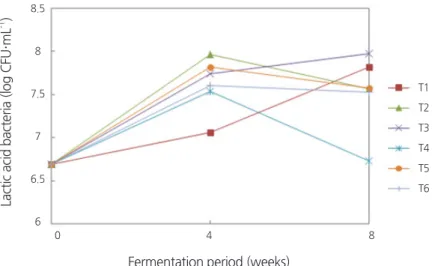
The volume of lactic acid bacteria was measured in individual kimchi samples over an eight - week fermentation at 4 ° C ( Fig . 3 ) . Following four weeks fermentation , kimchi from T2 cabbage contained the highest number of lactic acid bacteria ( 7 . 97 log CFU · mL

-1

), which was followed by kimchi from T5 ( 7 . 82 log CFU · mL

-1

) and T3 ( 7 . 74 log CFU · mL

-1

) cabbage . In contrast , kimchi produced from T1 cabbage showed the lowest number of lactic acid bacteria ( 7 . 06 log CFU · mL

-1

). Following eight weeks fermentation , kimchi from T3 cabbage contained the highest number of lactic acid bacteria ( 7 . 98 log CFU · mL

-1

) and kimchi from T1 cabbage exhibited a significant increase in lactic acid bacteria ( 7 . 81 log CFU · mL

-1

) compared to that measured following four weeks fermentation .

Discussion

Our results showed that the pH of ripened kimchi was less than that prior to fermentation , which is similar to previously reported results ( You and Kim , 2013 ) that described a tendency for pH to decrease and acidity to rise due to the increase of organic acid content created by lactic acid fermentation during kimchi ripening . Regarding salinity , our results revealed an overall decrease following four weeks of kimchi fermentation followed by an increase following eight weeks fermentation . Such fluctuation in salinity is known to influence the storage performance , organoleptic properties , and ripening speed of

60

150

3

20

0

0

0 0

0

0 Fermentation period (weeks)

Fermentation period (weeks)

Fermentation period (weeks)

DPPH radical & scavenging (%) Total phenol contents (GAE mg ·g

-1

) Total flavonoid contents (QE mg ·g

-1

)

4

4

8 4

T1 T2 T3 T4 T5 T6

8

8 80

250

5

40

50

1 70

200

4

30

10 90

300

6

50

100

2

A B

C

Fig. 2. Antioxidant activity of kimchi made from spring Kimchi cabbage following different pre-treatment processes and storage conditions. Measurements were made during an eight-week fermentation at 4°C following 0, 4, and 8 weeks. (A) DPPH radical scavenging activity, (B) Total flavonoid contents, and (C) Total phenol contents. Values are averages ± SD (n=3).

Abbreviations are the same as in Table 1.

(10)

kimchi ( Kim et al ., 1995 ). In the production and storage of kimchi , deaeration from the inner tissues of salted kimchi cabbage causes water loss ( Kim and Kim , 2000 ). In other words , the longer kimchi is stored , the less elastic it becomes because the softening of kimchi cabbage causes polygalacturonase and pectin methylesterase to escape from the tissue . This enzymatic reaction causes changes in the behavior of pectic substances ( Kim et al ., 2013 ). Kimchi hardness was also seen to decrease following four weeks fermentation , yet increase again following eight weeks fermentation . This is attributed to a rise in the number and density of cellulose in sections due to the destruction and reiteration of cellular walls ( Park , 2002 ), rendering the mechanical texture of kimchi harder following eight weeks fermentation .

T2 cabbage produced kimchi that showed a relatively higher level of DPPH radical - scavenging activity , and also showed the highest total phenol content ( 243 . 75 GAE mg · g

-1

) following eight weeks fermentation , the optimum maturity for storing kimchi , by maintaining pH between 4 . 2 and 4 . 6 . This was because phenolic acid such as p - coumaric and ferulic acid reacted with microorganisms and created an ethyl or vinyl derivative through which total phenol content increased as fermentation progressed normally ( Park et al ., 2001 ). The lactic acid bacterium of kimchi has anti - bacterial and anti - tumor activity , and immunity improvement and anti - cancer effects ( Kim et al ., 2013 ). Kimchi produced from cabbage where the proliferation of lactic acid bacteria is most active is considered likely to show these effects well . Upon maturity following eight weeks fermentation , kimchi produced from T2 , T4 , T5 , and T6 cabbage showed a lower number of lactic acid bacteria compared to that measured following four weeks fermentation . In particular , kimchi from T4 cabbage exhibited a substantial decrease of 6 . 73 log CFU · mL

-1

over this extended fermentation period . Thus , we assume that an inappropriate environment for microorganisms to live in was created in kimchi from T4 cabbage over eight weeks of fermentation , and that the kimchi from this type of stored cabbage does not possess the advantageous functions of lactic acid bacteria . In general , as the fermentation of kimchi progressed , the number of lactic acid bacteria drastically increased . When this number reaches a maximum level , lactic acid bacteria impart a carbonated flavor and unique odor to kimchi , which is the typical flavor of kimchi at optimal maturity . The main microorganism within kimchi is Leu. mesenteroides, which positively influences the flavor and odor of kimchi . The number of Leu. mesenteroides reaches a maximum level when kimchi achieves optimal maturity . In contrast , Lac. plantarum, which causes the acidification of kimchi , is known to increase when the number of lactic acid bacteria starts to fall ( Jung et al .,

4 6.5

6 7 8

8 7.5

8.5

0

Fig. 3. Lactic acid bacteria counts of kimchi made from spring Kimchi cabbage following different pre-treatment processes and storage conditions. Measurements were made during an eight-week fermentation at 4°C following 0, 4, and 8 weeks.

Abbreviations are the same as in Table 1.

T1 T2 T3 T4 T5 T6

Lactic acid bacteria (log CFU ·mL

-1

)

Fermentation period (weeks)

(11)

2014 ).

In summary , the combination of all the experiment results of this study indicate that the storage conditions applied to T3 cabbage , namely storage in an upright orientation at low temperature ( 0 . 5 ° C ), are the most effective way to store spring Kimchi cabbage for making high - quality kimchi .

Literature Cited

Ahn HY, Choe DJ, Kim BK, Lee JH, Cho YS (2015) Bioactive materials and antioxidant properties of fermented rice-bran extract. J Life Sci 25:1014-1020. doi:10.5352/JLS.2015.25.9.1014

Bae MO, Kim HJ, Cha YS, Lee MK, Oh SH (2009) Effects of kimchi lactic acid bacteria Lactobacillus sp. OPK2-59 with high GABA producing capacity on liver function improvement. J Korean Soc Food Sci Nutr 38:1499-1505. doi:10.3746/jkfn.2009.38.11.1499 Blois MS (1958) Antioxidant determination by the use of a stable free radical. Nature 181:1199-1200. doi:10.1038/1811199a0 Cho YS, Ha BS, Park SK, Chun SS (1993) Contents of carotenoids and chlorophylls in dolsan leaf mustard ( Brassica Juncea ). Korean J

Diet Cult 8:153-157

Cho SD, Bang HY, Lee EJ, Kim GH (2016) Quality characteristics of spring napa cabbage Kimchi harvested at different times. J Korean Soc Diet Cult 31:188-193. doi:10.7318/KJFC/2016.31.2.188

Doh ES, Chang JP, Kil KJ, Choi MS, Yang JK, Yun CW, Jeong SM, Jung YH, Lee GH (2011) Antioxidative activity and cytotoxicity of fermented Allium victorialis L. extract. Korean J Plant Res 24:30-39. doi:10.7732/kjpr.2011.24.1.030

Han ES, Koo BY, Kim KH (2000) Cooling and packing characteristics of salted Baechu. Food Eng Prog 4:156-161

Hyun JS, Kang SM, Han SW, Kang MC, Oh MC, Oh CK, Kim DW, Jeon YJ, Kim SH (2009) Flavonoid component changes and antioxidant activities of fermented Citrus grandis Osbeck peel. J Korean Soc Food Sci Nutr 38:1310-1316. doi:10.3746/

jkfn.2009.38.10.1310

Jung JI, Hong EY, Kim MK, Jung JW, OH JY, Kwon MS, Lee KP, Kim GH (2009) Changes in total glucosinolates levels and physico- chemical properties of Kimchi using Korean Chinese cabbage of harvest time according to various storage conditions. Korean J Food Preserv 16:612-617

Jung SJ, So BO, Shin SW, Noh SO, Jung ES, Chae SW (2014) Physiochemical and quality characteristics of young radish (Yulmoo) Kimchi cultivated by organic farming. J Korean Soc Food Sci Nutr 43:1197-1206. doi:10.3746/jkfn.2014.43.8.1197

Kim HY, Kil JH, Park KY (2013) Comparing the properties and functionality of kimchi made with Korean or Japanese baechu cabbage and recipes. J Korean soc Food Sci Nutr 42:520- 526. doi:10.3746/jkfn.2013.42.4.520

Kim MJ, Kim SD (2000) Quality characteristics of kimchi prepared with major spring Chinese cabbage cultivars. Korean J Postharvest Sci Technol 7:343-348

Kim MS, Song JE, Han JS (1995) The effect of sodium chloride concentrations of soaking-water and submaterials on tongbaechu- kimchi taste and fermentation. J East Asian Soc Diet Life 5:49-62

Kim SS, Seong GU, Hwang HY, Jeong MC, Chung SK (2014) The short-term storage characteristics of cut kimchi cabbages treated with Ca

2+

. Korean J Food Preserv 21:157-162. doi:10.11002/kjfp.2014.21.2.157

Ku HS, Noh JS, Kim HJ, Cheigh HS, Song YO (2007) Antioxidant effects of sea tangle added Korean cabbage kimchi in vitro and in vivo. J Korean Soc Food Sci Nutr 36:1497-1502. doi:10.3746/jkfn.2007.36.12.1497

Lee JS, Park SH, Lee YS, Lim BS, Yim SC, Chun CH (2008) Characteristics of growth and salting of Chinese cabbage after spring culture analyzed by cultivar and cultivation method. Korean J Food Preserv 15:43-48

Lee JY (2004) A simplified method to evaluate major quality factors and its application to determine inheritability of tissue firmness and total soluble solids in Chinese cabbage. MS Thesis, Chung-Ang Univ., Korea

Lee KH, Kuak HS, Jung JW, Lee EJ, Jeong DM, Kang KY, Chae KI, Yun SH, Jang MR, et al (2013) Comparison of the quality characteristics between spring cultivars of kimchi cabbage ( Brassica rapa L. ssp. pekinensis ). Korean J Food Preserv 20:182-190.

doi:10.11002/kjfp.2013.20.2.182

Park MK (2002) Effect of NaCl concentration on the quality of kimchi during fermentation. J Korean Acad Ind Soc 3:27-31

Park MS, Jeon YS, Han JS (2001) Antioxidative activity of mustard leaf kimchi added green tea and pumpkin powder. J Korean Soc Food Sci Nutr 30:1053-1059

Studstill D, Simone E, Brecht J, Gilreath P (2007) Pepper spot ("gomasho") on napa cabbage. University of Florida, IFAS Fact sheet 352:1-5

You BR, Kim HJ (2013) Quality characteristics of kimchi added with Allium hookeri root. J Korean Soc Food Sci Nutr 42:1649-1655.

doi:10.3746/jkfn.2013.42.10.1649

수치

Table 1. Pre-treatment processes and storage conditions of spring Kimchi cabbage after the harvest
Table 2. Trimming loss, salted spring kimchi cabbage yield and kimchi yield of spring kimchi cabbage following different pretreatment processes  and storage conditions
Table 3. Changes of pH, salinity, hardness in kimchi made from spring kimchi cabbage following different pre-treatment processes and storage  conditions
Fig. 1. Sensory evaluation of kimchi made from spring Kimchi cabbage following different pre-treatment processes and storage  conditions
+3

참조

관련 문서

The number of lactic acid bacteria increased in early fermentation period in both Kimchi containing boiled and fresh red sea cucumber, however, more lactic acid bacteria found

The objective of this study was to determine the quality characteristics of cabbage juice fermented by lactic acid bacteria from Kimchi (Leuconostoc mesenteroides, Lactobacillus

Development of novel medium with Chinese cabbage extract and optimized fermentation conditions for the cultivation of Leuconostoc citreum GR1. Culture medium for lactic acid

Keywords: kimchi, kimchi refrigerator, fermentation · storage, long-term storage, lactic acid bacteria.. 서 론 김치는 배추와 무를 주원료로 하여 마늘, 생강, 파, 고춧가루,

5 Effect of red sea cucumber on lactic acid bacteria changes of Kimchi during fermentation at 4 o C for 28 days.. Squeezed Kimchi liquid was diluted with saline solution and

Abstract: Kimchi cabbage ‘Choon Gwang’ cultivar that was grown in highlands in Gangneung was subjected to predrying, room cooling, and forced air cooling,

In this study, cabbage ( Brassica oleracea var. capitata ) Kimchi was made packed into four kinds of packaging materials, PET vessel, PP tray, OPP/AL/PE film

In order to develop and propagate the low sodium kimchi for preventing high sodium related diseases, the salinity, pH and acidity of cabbage(Bachu) kimchi sampled from home