무와 무청의 활성 성분 함량 및 지방세포분화 억제 효과 비교
이현희․허진영․최상윤 한국식품연구원
Comparison of Active Ingredient Contents and Adipocyte Differentiation Suppressing Effect in Radish Roots and Leaves
Hyun Hee L. Lee, Jinyoung Hur, and Sang Yoon Choi Korea Food Research Institute
ABSTRACT Radish (Raphanus sativus) has been reported to exert antioxidant, anti-microbial, anti-coagulant, anti-hy- perlipidemic, and anti-hypertensive effects. However, there have been no reports so far on the comparison of active ingredients and adipogenesis inhibitory activity between various parts of the radish. In this study, we analyzed the glucoraphenin and ferulic acid content in radish root and leaf extracts using a UPLC TQ-MS system. Also, their adipogenesis inhibitory effects were examined using 3T3-L1 preadipocytes. The results of this study showed that radish leaf extract has higher glucoraphenin (11,971.8 μg/g in EtOH extract) and ferulic acid (851.7 μg/g in EtOH extract) content than radish root extracts and the adipocyte differentiation suppressing activity was also higher than the radish root extracts. These results indicate that the radish leaf is rich in active ingredients and has a higher inhibitory effect on adipocyte differentiation than the radish root. Therefore, radish leaves could be used in the active compound extraction and development of functional material for adipogenesis suppression.
Key words: radish, leaf, root, glucoraphenin, ferulic acid
Received 4 Jan 2021; Revised 23 Feb 2021; Accepted 23 Feb 2021 Corresponding author: Sang Yoon Choi, Korea Food Research Institute, 245, Nongsaengmyeong-ro, Iseo-myeon, Wanju-Gun, Jeon- buk 55365, Korea, E-mail: [email protected]
Glucoraphenin Ferulic acid Fig. 1. Chemical structure of glucoraphenin and ferulic acid.
서 론
무(Raphanus sativus)는 십자화과에 속하는 초본식물로 뿌리와 지상부를 모두 식용으로 사용하며 국내 생산량이 연 간 약 100만 톤에 이르는 주요한 작물이다. 뿌리인 무는 항 산화, 암세포 성장억제, 배변촉진 활성이 있으며(Yim 등, 2004; Beevi 등, 2012), 지상부인 무청은 항산화, 항균, 항 혈전, 항고혈압 활성에 대해 보고된 바 있다(Ku 등, 2008;
Kim 등, 2010; Lee 등, 2013). 무에 함유된 주요 성분으로는 glucoraphenin과 glucoraphasatin 등의 glucosinolates가 알려져 있으며(Lee 등, 2017), 지상부인 무청에는 이들 이 외에 ferulic acid 등의 폴리페놀이 함유되어 있다(Beevi 등, 2010)(Fig. 1). 이들 성분의 생리활성에 대한 연구로 gluco- raphenin은 항암, 항비만 활성(Nagata 등, 2017; Kntayya 등, 2018)이, ferulic acid는 항염증, 항산화, 항지질, 항비만 활성에 관하여 보고된 바 있다(Kikuzaki 등, 2002; Koh 등, 2017; Liu 등, 2017; Bumrungpert 등, 2018). 이처럼 무와 무청에 함유된 성분에 관한 항비만 연구는 보고되었으나, 부위별 및 추출 용매별 성분 함량에 대한 직접적인 비교 및
제조된 추출물의 항비만 활성에 대한 비교연구는 미비한 실 정이다.
체내에서의 지방생성은 preadipocyte로부터 지방세포가 분화되어 지방이 축적되는 과정을 거쳐 일어나며, 성숙한 지 방세포는 fibroblast와 같은 미성숙 지방세포로부터 분화되 어 세포 내에 lipid droplet을 형성하게 된다(Koutnikova와 Auwerx, 2001). 이러한 과다한 체내 지방생성으로 인한 비 만은 심장질환의 주요한 원인일 뿐만 아니라 암, 고혈압, 당 뇨 등을 일으킨다(Alpert 등, 2016; Kim 등, 2016; Engin, 2017). 본 연구에서는 무와 무청을 식용 가능한 용매인 주정 과 물을 사용하여 추출하고, 활성 성분 함량 및 지방세포분
화억제 활성을 비교하여 항비만 기능성 식품소재로서의 활 용성이 높은 추출물 제조를 위한 자료를 제시하고자 하였다.
재료 및 방법
실험재료 및 분석시약
본 연구에서 사용한 무는 제주도 서귀포시에서 재배된 것 을 2018년 3월에 채취하여 사용하였다. 무를 세척 후 뿌리 와 잎(무청)으로 분리하고 건조 후 파쇄하였다. 70% 주정과 증류수를 사용하여 각각 50°C와 100°C에서 3시간씩 2회 반복하여 환류 추출하고 여과 후 얻어진 상등액을 감압농축 및 동결건조 하여 -20°C에 보관하면서 실험시료로 사용하 였다. Glucoraphenin과 ferulic acid 표준시약은 Sigma- Aldrich사(St. Louis, MO, USA)로부터 구입하여 사용하였 다. Formic acid(FA) 또한 Sigma-Aldrich사에서 구매하였 으며, UPLC-MS/MS 분석에 사용한 물과 메탄올은 LCMS 등급을 Merck사(Darmstadt, Germany)에서 구매하여 사 용하였다. 여과에 사용한 0.2 μm PVDF 주사기 필터는 Whatman사(Maidstone, UK)로부터 구입하여 사용하였다.
분석용 표준원액 및 표준용액의 조제
Glucoraphenin과 ferulic acid 표준시약을 50% 메탄올 을 사용하여 4 mg/mL가 되도록 하여 표준원액을 각각 조제 하였다. 조제한 두 표준원액들은 glucoraphenin과 ferulic acid의 동시 분석을 위해 동량으로 혼합한 뒤 물로 희석하여 각 추출물 시료에 대한 검량곡선을 작성하는 데 사용하였다.
검량곡선을 위한 표준용액의 농도는 0.015625, 0.031250, 0.062500, 0.125000, 0.250000, 0.500000, 1.000000 μg/
mL였고 위 표준용액은 실험 직전에 제조하여 사용하였다.
분석시료 정제
UPLC-MS/MS 분석을 위해 제조된 동결건조 추출물 고 형에 8 mg/mL가 되도록 메탄올을 가한 뒤 1시간 동안 초음 파처리 하였다. 이후 4 mg/mL가 되도록 증류수를 가한 뒤 다시 한번 1시간 동안 초음파처리 과정을 거쳤다. 마지막으 로 각 추출물 용액을 0.2 μm PVDF 필터로 여과한 뒤, 증류 수를 사용하여 적정 농도로 희석해 분석에 사용하였다.
기기분석 조건
UPLC-MS/MS 정량 실험은 UPLC 시스템이 결합한 삼 중 사중극자 질량분석기(Xevo TQ-MS, Waters, Man- chester, UK)에서 수행되었다. 분석용 column으로는 Wa- ters사의 ACQUITY UPLC HSS C18 Vanguard Pre-col- umn(1.8 μm, 2.1×5 mm)과 ACQUITY UPLC HSS C18 column(1.8 μm, 2.1×100 mm)이 사용되었다. 이동상 용매 A와 B는 각각 0.1% FA 물과 0.1% FA 메탄올이 사용되었 다. 용매는 0.2 mL/min의 속도로 흘려주었으며 column oven 온도는 40°C를 유지하였다. 용매의 시간별 gradient
과정은 0.0~1.0분, 0% B; 1.0~16.0분, 0% B에서 90% B로 선형 증가; 16.0~17.0분, 90% B; 17.0~17.5분, 90% B에 서 0% B로 선형 감소; 17.5~22.0분, 0% B로 설정하였고, 데이터마다 분석시료는 5 μL씩 주입하였다. Capillary volt- age, source 온도, desolvation 온도, desolvation gas 속도 는 각각 2.9 kV, 150°C, 500°C, 1,000 L/h이다. 또한, 분석 을 위해 조사될 각 화합물의 생성이온을 정하고 그 생성이온 에 맞추어 측정 조건을 정립하기 위해 Waters사의 Intellis- tart를 사용하여 multiple reaction monitoring(MRM) 기법 을 활용하였다.
세포배양 및 분화
마우스 유래 3T3-L1 지방전구세포는 American Type Culture Collection(ATCC; Manassas, VA, USA)으로부 터 분양받아 fetal bovine serum(Gibco, Grand Island, NY, USA) 10%가 함유된 Dulbecco’s modified Eagle’s medium(DMEM) 배지를 사용하여 37°C, 5% CO2 조건에서 배양하였다. 3T3-L1 세포는 48-well plate에 가득 키운 후 hormone mixture(10 μg/mL insulin, 0.5 μM dexa- methasone, 0.5 mM IBMX)를 48시간 동안 처리하고 인슐 린이 포함된 DMEM 배지로 교환하면서 무와 무청 추출시료 를 8일간 처리하여 adipocytes로의 분화를 관찰하였다.
세포생존율 측정
시료처리가 완료된 후 3-(4,5-dimethylthiazol-2-yl)- 2,5-diphenyltetrazolium bromide(MTT)를 0.5 mg/mL 농도로 첨가하고 37°C에서 4시간 동안 배양하였다. MTT solution을 제거 후 200 μL dimethyl sulfoxide를 첨가하고 540 nm에서 흡광도를 측정하여 세포생존율을 측정하였다.
지방축적량 측정
시료처리가 완료된 세포를 PBS로 2회 세척한 후 3.7%
formaldehyde로 고정시켰다. 1시간 동안 Oil Red O dye와 배양한 후 isopropanol을 가하고 510 nm에서 흡광도를 측 정하여 지방축적량을 측정하였다.
통계방법
각 실험 결과는 평균±표준편차(mean±SD)로 표시하였 으며 Student’s t-test로 분석하였고 P<0.05일 때 유의성이 있는 것으로 판단하였다.
결과 및 고찰
무와 무청 추출물 내 활성 성분 함량 분석
활성 성분 정량을 위한 UPLC-MS/MS 실험을 수행하기 에 앞서 glucoraphenin과 ferulic acid의 MRM 조건을 확립 하여 MS/MS 조건을 최적화하였다(Table 1). 위 조건을 기 반으로 UPLC-MS/MS에 0.015625~1.000000 μg/mL 사
Table 1. UPLC-MS/MS conditions of glucoraphenin and ferulic acid Compounds Ion mode Precursor ion
(m/z) Product ion
(m/z) Cone
voltage (V) Collision
energy (eV) r2 LOD
(μg/mL) LOQ (μg/mL) Glucoraphenin
Ferulic acid
+ +
436.19 195.09
176.11 145.04
10 12
16 16
0.999 0.999
0.01391 0.00647
0.04637 0.02156 All values were obtained by repeating UPLC-MS/MS experiments three times.
A
B
Fig. 2. UPLC-MS/MS chromatograms (A) and calibration curves (B) of standard glucoraphenin and ferulic acid. The UPLC-MS/MS experiments were performed three times to obtain all values of the calibration curves.
이의 glucoraphenin과 ferulic acid 표준용액을 흘려주어 두 화합물의 머무름 시간이 각각 3.70분과 9.91분임을 확인 하였다(Fig. 2A). 이후 해당 머무름 시간에서 두 화합물의 peak area를 확인하여 검량곡선의 상관계수(coefficient of correlation, r2)와 검출한계(limit of detection, LOD) 및 정량한계(limit of quantification, LOQ)를 조사하였다.
Table 1과 Fig. 2B에서 볼 수 있듯이 측정 영역 안에서 검량 곡선의 직선성이 유지되며(r2=0.999), glucoraphenin과 ferulic acid의 검출한계와 정량한계가 수십 ng/mL 안에 있 음을 확인하였다.
추출물 내 glucoraphenin과 ferulic acid의 함량을 확인 하기 위하여 본 연구에서는 standard addition 방법을 적용 하였다. 위 방법의 적용을 위해 정제한 추출물에 추가한 표 준용액의 농도가 0, 0.100, 0.200 μg/mL가 될 수 있도록
spike 한 뒤 용액을 UPLC-MS/MS로 측정하였다. 이후 각 추출물 내 화합물들의 분석을 수행하기 위해 전체 추출물의 농도를 0.1 mg/mL가 되도록 조정하였다. Fig. 3A에서 볼 수 있듯이 glucoraphenin의 머무름 시간이 추출 용매와 관 계없이 무와 무청 추출물 모두에서 3.81~3.89분 사이에 존 재하며, 이 머무름 시간이 표준용액에 비해 0.11~0.19분 차이가 남을 확인할 수 있었다. Glucoraphenin과 유사하게 ferulic acid 또한 시료에서 0.22~0.25분 정도 머무름 시간 이 증가하였다(Fig. 3B). 두 화합물의 머무름 시간 증가 원 인을 이해하기 위해 0.2 mg/mL로 추출물 농도를 조정하여 크로마토그램에서의 머무름 시간을 조사해 보았다. Fig. 4 에서 볼 수 있듯이 0.2 mg/mL 추출물에서 0.1 mg/mL일 때 보다 glucoraphenin과 ferulic acid의 머무름 시간이 각각 0.01~0.13분, 0.15~0.20분 정도 증가함을 확인하였다. 따
A
B
Fig. 3. LC-MS/MS chromatograms of glucoraphanin (A) and ferulic acid (B) in the Raphanus sativus extracts of 0.1 mg/mL.
A
B
Fig. 4. LC-MS/MS chromatograms of glucoraphanin (A) and ferulic acid (B) in the Raphanus sativus extracts of 0.2 mg/mL.
0 20 40 60 80 100 120
RRW RLW RRE RLE
Cell viability (%) .
25 ppm 50 ppm 100 ppm
A
*
0 20 40 60 80 100 120
RRW RLW RRE RLE
Lipid accumulation (%) .
25 ppm 50 ppm 100 ppm
B
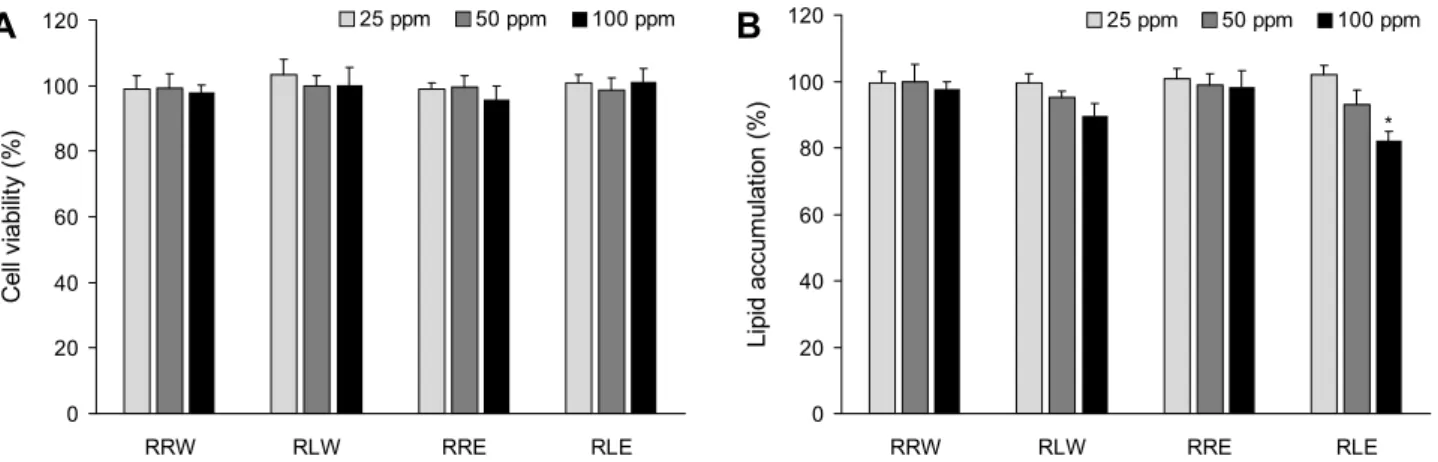
Fig. 5. Inhibitory effects of radish (Raphanus sativus) extracts on 3T3-L1 cells differentiation. (A) Effects on cell viability, (B) Effects on lipid accumulation. RRW: radish root water extract, RLW: radish leaf water extract, RRE: radish root ethanol extract, RLE: radish leaf ethanol extract. The result of the untreated group was set to 100%. *P<0.05 compared with untreated group.
Table 2. Estimated concentrations of glucoraphenin and ferulic acid in the Raphanus sativus extracts (μg/g extract)
Compounds Root Leaf
EtOH Water EtOH Water
Glucoraphenin Ferulic acid
3,425.3±503.2 ND1)
2,357.4±58.6 ND1)
11,971.8±3,655.8 851.7±10.8
2,729.7±150.0 616.5±17.9 All values were obtained by repeating UPLC-MS/MS experiments three times.
1)Not detected.
라서 시료와 표준시료 간의 머무름 시간 차이는 시료 내 matrix 혹은 염에 의해 발생한다고 추측할 수 있었다.
Standard addition 방법을 기반으로 spike 한 용액들의 UPLC-MS/MS에서의 peak area를 확인하여 각 추출물 내 glucoraphenin과 ferulic acid의 함량을 확인하였다. Table 2에서 볼 수 있듯이 glucoraphenin은 2,357.4~11,971.8 μg/g 추출물 농도를 가지며 모든 추출물에 함유되어 있음을 확인하였다. 반면에 ferulic acid의 경우 무청 추출물에서는 616.5~851.7 μg/g 추출물의 농도로 추출물 내에 함유되어 있지만(Table 2), 무 추출물에서는 1.0 mg/mL까지 추출물 의 농도를 높여도 LOQ 이하의 농도를 가짐을 확인하였다 (데이터 미제시). 결과적으로 glucoraphenin의 경우 무 추 출물 대비 무청 추출물이 주정 및 열수 추출에서 각각 3.5배 그리고 1.2배의 함량을 가지고 있었으며, ferulic acid의 경 우 무청 추출물에서만 수백 μg/g 추출물의 함량을 갖고 있음 을 확인하였다. 또한 모든 경우에서 glucoraphenin과 ferul- ic acid가 주정 추출을 수행할 경우 열수 추출 대비 1.4~4.4 배의 함량을 갖고 있음을 확인하였다. 다음으로 위 연구 결 과를 기존에 보고된 결과 값들과 비교해보았다. Glucora- phenin은 무 추출물보다 무청 추출물에서 최대 2.9배의 함 량을 가지고 있었으며(Hanlon과 Barnes, 2011; Han 등, 2015), ferulic acid는 무 추출물에서 관찰된 사례를 확인하 지 못하였고 무청 추출물에서만 약 174.6~310.0 μg/g 추출 물의 농도로 존재하였으며, 이때 건조시료 기준 농도 비교를 위해 무청의 수분 함유량(Ku 등, 2006)을 고려하여 계산하
였다(Eugenio 등, 2017; Stagnari 등, 2018). 이는 본 연구 의 무 그리고 무청 추출물에서의 농도 비율 및 화합물의 유 무와 일치하는 경향을 보였다. 결론적으로 무청을 주정으로 추출할 경우 glucoraphenin과 ferulic acid의 함량이 높은 추출물을 얻을 수 있을 것으로 판단된다.
무와 무청 추출물이 지방세포분화에 미치는 영향 무와 무청의 3T3-L1 지방세포분화 억제 효과를 측정한 결과, 무청의 주정 추출물이 100 ppm에서 세포독성 없이 17.8%의 지방세포분화 억제 효과를 나타내어 무 주정 추출 물의 1.7%에 비하여 높았다(Fig. 5). 또한 물 추출물 역시 무보다 무청이 소폭 높은 지방세포분화 억제 효과를 나타내 었고 각각의 주정 추출물보다는 저해도가 낮은 경향을 나타 내었다. 따라서 추출물 제조 시 부위로는 무청을, 용매로는 주정을 사용하는 것이 지방세포분화 억제 효과 극대화에 유 리할 것으로 판단된다. 또한 이러한 지방세포분화 억제 활성 은 glucoraphenin과 ferulic acid의 함량을 정량한 결과와 비례하는 경향을 나타내어 이들 성분이 주요한 역할을 하는 것으로 추측되었다. Jang 등(2008)은 고콜레스테롤 식이 흰 쥐에 무청 파우더를 공급한 결과, 분변 중으로 총지질, 총콜 레스테롤, 중성지방 등의 배설이 증가한다고 보고한 바 있어 무청 추출물의 항비만 소재로서의 활용 가능성을 뒷받침하 며, 향후 다양한 추출온도, 시간, 압력 등에 따른 최적 추출조 건에 관한 연구를 진행할 예정이다.
요 약
본 연구에서는 무와 무청에 함유된 활성 물질인 glucora- phenin과 ferulic acid의 함량을 UPLC TQ-MS system을 이용하여 정량 분석하였다. 정량 결과 무청 주정 추출물이 11,971.8 μg/g의 glucoraphenin과 851.7 μg/g의 ferulic acid를 함유하고 있어 무의 주정 추출물과 무와 무청의 물 추출물보다 높은 함량을 나타내었다. 3T3-L1 세포를 이용 한 지방세포분화 억제 시험에서도 무청 주정 추출물이 100 ppm 농도에서 세포독성 없이 유의적인 지방세포분화 억제 효과를 보였고, 이는 무청 물 추출물이나 무 추출물보다 가 장 높게 나타났다. 따라서 무청 주정 추출물은 향후 활성 성분을 다량 함유한 기능성 식품소재로서 활용될 가능성이 높을 것으로 사료된다.
감사의 글
본 연구는 한국식품연구원 주요연구개발사업(E0210300) 의 지원에 의해 이루어졌으며 이에 감사드립니다.
REFERENCES
Alpert MA, Omran J, Bostick BP. Effects of obesity on car- diovascular hemodynamics, cardiac morphology, and ven- tricular function. Curr Obes Rep. 2016. 5:424-434.
Beevi SS, Mangamoori LN, Gowda BB. Polyphenolics profile and antioxidant properties of Raphanus sativus L.. Nat Prod Res. 2012. 26:557-563.
Beevi SS, Narasu ML, Gowda BB. Polyphenolics profile, anti- oxidant and radical scavenging activity of leaves and stem of Raphanus sativus L.. Plant Foods Hum Nutr. 2010. 65:8-17.
Bumrungpert A, Lilitchan S, Tuntipopipat S, Tirawanchai N, Komindr S. Ferulic acid supplementation improves lipid pro- files, oxidative stress, and inflammatory status in hyperlipi- demic subjects: a randomized, double-blind, placebo-con- trolled clinical trial. Nutrients. 2018. 10:713. https://doi.org/
10.3390/nu10060713
Engin A. The definition and prevalence of obesity and metabolic syndrome. Adv Exp Med Biol. 2017. 960:1-17.
Eugenio MHA, Pereira RGFA, de Abreu WC, de Angelis Pereira MC. Phenolic compounds and antioxidant activity of tuberous root leaves. Int J Food Prop. 2017. 20:2966-2973.
Han N, Su’udi M, Kim J. The major aliphatic glucosinolate con- tent in Korean radish during vegetative and reproductive growth. Hortic Environ Biotechnol. 2015. 56:152-158.
Hanlon PR, Barnes DM. Phytochemical composition and bio- logical activity of 8 varieties of radish (Raphanus sativus L.)
sprouts and mature taproots. J Food Sci. 2011. 76:C185-C192.
Jang HS, Ahn JM, Ku KH, Rhee SJ, Kang SK, Choi JH. Effect of radish leaves powder on the gastrointestinal function and fecal triglyceride, and sterol excretion in rats fed a hyper- cholesterolemic diet. J Korean Soc Food Sci Nutr. 2008. 37:
1258-1263.
Kikuzaki H, Hisamoto M, Hirose K, Akiyama K, Taniguchi H.
Antioxidant properties of ferulic acid and its related com- pounds. J Agric Food Chem. 2002. 50:2161-2168.
Kim BR, Park JH, Kim SH, Cho KJ, Chang MJ. Antihyperten- sive properties of dried radish leaves powder in spontaneously hypertensive rats. Korean J Nutr. 2010. 43:561-569.
Kim NY, Lee JM, Lee JY, Lee HY. Enhancement of anti-obesity activities of Aronia melanocarpa elliot extracts from low tem- perature ultrasonification process. Korean J Med Crop Sci.
2016. 24:309-316.
Kntayya SB, Ibrahim MD, Mohd Ain N, Iori R, Ioannides C, Abdull Razis AF. Induction of apoptosis and cytotoxicity by isothiocyanate sulforaphene in human hepatocarcinoma HepG2 cells. Nutrients. 2018. 10:718. https://doi.org/10.3390/nu1006 0718
Koh EJ, Kim KJ, Seo YJ, Choi J, Lee BY. Modulation of HO-1 by ferulic acid attenuates adipocyte differentiation in 3T3-L1 cells. Molecules. 2017. 22:745. https://doi.org/10.3390/mole- cules22050745
Koutnikova H, Auwerx J. Regulation of adipocyte differentia- tion. Ann Med. 2001. 33:556-561.
Ku KH, Lee KA, Kim YE. Physiological activity of extracts from radish (Raphanus sativus L.) leaves. J Korean Soc Food Sci Nutr. 2008. 37:390-395.
Ku KH, Lee KA, Kim YL, Lee YW. Quality characteristics of hot-air dried radish (Raphanus sativus L.) leaves. J Korean Soc Food Sci Nutr. 2006. 35:780-785.
Lee JG, Lim S, Kim J, Lee EJ. The mechanism of deterioration of the glucosinolate-myrosynase system in radish roots during cold storage after harvest. Food Chem. 2017. 233:60-68.
Lee YS, Kwon KJ, Kim MS, Sohn HY. Antimicrobial, antioxi- dant and anticoagulation activities of Korean radish (Rapha- nus sativus L.) leaves. Korean J Microbiol Biotechnol. 2013.
41:228-235.
Liu YM, Shen JD, Xu LP, Li HB, Li YC, Yi LT. Ferulic acid inhibits neuro-inflammation in mice exposed to chronic un- predictable mild stress. Int Immunopharmacol. 2017. 45:128- 134.
Nagata N, Xu L, Kohno S, Ushida Y, Aoki Y, Umeda R, et al. Glucoraphanin ameliorates obesity and insulin resistance through adipose tissue browning and reduction of metabolic endotoxemia in mice. Diabetes. 2017. 66:1222-1236.
Stagnari F, Galieni A, D’Egidio S, Pagnani G, Pisante M. Res- ponses of radish (Raphanus sativus) to drought stress. Ann Appl Biol. 2018. 172:170-186.
Yim HB, Lee G, Chae HJ. Cytotoxicity of ethanol extract of Raphanus sativus on a human lung cancer cell lines. J Korean Soc Food Sci Nutr. 2004. 33:287-290.