압출성형 산삼배양근의 발효 특성
양혜진1․기염청1․정기화2․류기형1†
1공주대학교 식품공학과
2공주대학교 생명과학과
Fermentation Characteristics of Extruded Tissue Cultured Mountain Ginseng
Hye-Jin Yang1, Yan-Qing Ji1, Ki-Wha Chung2, and Gi-Hyung Ryu1†
1
Dept. of Food Science and Technology, Kongju National University, Chungnam 340-702, Korea
2
Dept. of Life Science, Kongju National University, Chungnam 314-702, Korea
Abstract
The aim of this study was to compare the fermentation characteristics of tissue cultured mountain ginseng, extruded tissue cultured mountain ginseng, and root hair of red ginseng. Also, pH, acidity, brix, reducing sugar, total sugar, and alcohol were analyzed. The extrusion conditions were barrel temperature of 110 and 140oC and moisture content of 25 and 35%. Fermentation temperature was 27oC for 15 days and the cultivation was fixed with Saccharomyces cerevisiae, Aspergillus usamii, and Rhizopus japonicus. The results showed that pH, brix, reducing sugar content, and total sugar content of fermented broths were decreased after 5 days and then maintained steadily for the following 10 days. Acidity of final fermented broths were 1.12% (root hair of red ginseng), 1.19% (tissue cultured mountain ginseng), and 0.97~1.02% (extruded tissue cultured mountain ginseng), respectively. Alcohol content of final fermented broths were 3.82% (root hair of red ginseng), 0.91% (tissue cultured mountain ginseng), and 1.86~2.18% (extruded tissue cultured mountain ginseng). The fermentation efficiency of extruded tissue cultured mountain ginseng (barrel temperature 140oC, moisture content 25%) were the highest. In conclusion, the fermentation efficiency was increased by extrusion process.
Key words: extruded tissue cultured mountain ginseng, fermentation, extrusion process
†Corresponding author. E-mail: [email protected]
†Phone: 82-41-330-1484, Fax: 82-41-335-5944
서 론
인삼(Panax ginseng C.A. Meyer)은 두릅나무과(Aralia- ceae)에 속하는 다년생 식물로 자생, 또는 재배되고 있다.
인삼은 자연 상태에서 생육하고 있었으나 뛰어난 약효로 인 해 오랜 기간의 순화기간을 거쳐 이를 재배하게 되었는데, 전자를 산삼이라 하고 후자를 재배인삼으로 구분하고 있다 (1). 산삼은 다시 천종, 지종, 장뇌로 구분한다(2). 산삼은 생 장속도가 느려서 최소 10~15년 된 것을 이용하고 있으며 산삼의 약효가 재배인삼에 비해 우수하다고 보고되고 있다 (3). 그러나 재배가능 면적이 점점 감소하고 있으며, 특수한 시설 조건하에서 재배가 가능하다. 이러한 재배인삼의 문제 점을 보완하는 방안으로 식물의 조직배양 기술을 이용하여 인삼을 대량생산하고 있으며, 최근에는 pilot plant 시설에 의해 대량의 산삼배양근이 생산되고 있어 많은 관심을 끌고 있다(4). 이와 같이 생산된 산삼배양근은 천연 산삼과 성분 에서 매우 유사하며, 대체로 인삼보다 사포닌 함량이 높고 인삼에서 볼 수 없는 다양한 약리성분도 함유되어 있는 것으
로 알려지고 있으며, 이를 이용한 다양한 제품개발이 시도되 고 있다(5).
한편, 발효식품은 각 지역의 토착미생물이 식품원료에 자 연 접종된 결과 생성된 것으로 독특한 관능특성을 갖는 식문 화를 형성하는데 크게 기여하였다(6). 더욱이 최근에는 발효 식품의 생리활성 작용이 알려지면서 세계적으로 건강기능 성 장수식품으로서 인식되고 있다. 특히, 인삼은 60% 이상 의 전분을 함유하고 있어서 발효소재로서 많은 가능성이 있 지만, 산삼은 발효소재로서의 개발이 미흡한 실정이다.
압출성형공정은 혼합, 분쇄, 가열, 성형, 건조와 같은 단위 조작이 단시간에 일어나는 단일공정으로, 다른 열처리 가공 공정과 비교하여 효율적이고 경제적인 공정으로서(7), 전분 의 수화, 팽윤, 호화, 무정형화 및 덱스트린화, 단백질의 변 성, 효소의 불활성화, 미생물의 사멸 및 살균, 냄새의 제거, 조직 팽창, 밀도 조절 및 갈색화 반응 등이 단시간에 일어나 고(8), 원료투입속도, 수분함량, 스크루 회전속도, 사출구의 구조, 스크루 배열에 따라 목적하는 제품의 특성을 조절할 수 있기 때문에 다양한 특성을 가지는 제품을 생산할 수 있
Fig. 1. Screw configuration for ex- truding cultured mountain ginseng (model THK 31T).
다(9). 인삼의 압출성형에 대한 연구는 배럴온도와 스크루 회전속도에 따른 압출성형 백삼의 이화학적 특성을 비교하 였을 때 홍삼화가 가능함을 보여준 연구(10)가 있었고, 압출 성형 미삼분말을 제조하여 수용성 성분의 추출수율과 추출 물의 성분 분석에 대한 연구(11)결과가 발표되었다. 최근에 는 인삼 전분의 전처리로 압출성형공정을 이용하였을 때 효 소처리에 의한 전분의 액화와 당화율이 증가한다는 연구 결 과가 발표되었다(12). 그러나 압출성형 공정을 통한 인삼 및 기타 발효소재 개발에 대한 연구가 미흡한 실정이고, 압출성 형을 통한 산삼배양근의 알코올 발효특성에 대한 연구는 진 행되지 못한 상태이다.
따라서 본 연구는 산삼배양근을 이용한 발효소재 개발과 산삼배양근의 홍삼화를 목적으로 압출성형 산삼배양근 발 효액의 pH 및 산도측정, 당도, 총당, 환원당, 알코올 함량의 변화를 홍삼과 비교하여 살펴보았다.
재료 및 방법
재료
본 실험에 사용된 인삼은 4년근 홍삼분말(Dongjin pha- macy Co., Gumsan-gun, Korea)을 이용하였고 산삼배양근 을(CBN Biotech Co., Cheongju, Korea) 사용하였다.
균주
발효에 사용된 누룩은 Aspergillus usamii와 Rhizopus
japonicus가 포함된 바이오 누룩(Koreaenzyme, Hwaseong,
Korea)을 사용하였으며, 효모는 Saccharomyces cerevisiae (Koreaenzyme)를 사용하였다.압출성형 산삼배양근
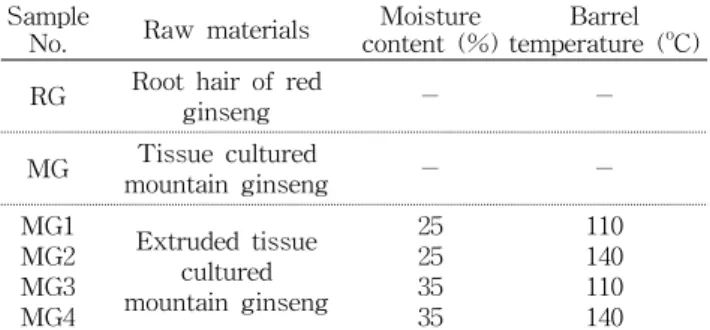
압출성형 산삼배양근 제조에 사용된 압출성형기는 자체 제작한 실험용 쌍축압출성형기(THK 31T, Inchon Machinery Co., Incheon, Korea)이며 압출성형기의 스크루 직경은 29.0 mm, 직경과 길이의 비(L/D ratio)는 25:1이며 스크루 배열은 Fig. 1과 같다. 압출성형공정에 따른 산삼배양근의 발효특성 을 알아보기 위하여 배럴온도는 110/110/80oC, 140/140/80oC (배럴순서 1/2/3)로 조절하였으며, 수분함량은 25, 35%로 조 절하였다. 스크루 회전속도는 200 rpm, 원료 사입량 100
g/min로 고정하였으며, 사출구 직경 1.0 mm 사출구 3개로 고정하여 사용하였다. 산삼배양근을 압출성형하여 제조한 시료는 Table 1과 같다.
압출성형된 산삼배양근 시료는 열풍건조기(HB-502MP, Han Beak Co., Bucheon, Korea)를 사용하여 50oC에서 8시 간 건조하였으며, 건조된 시료는 가정용 분쇄기(FM-681, Hanil, Haman, Korea)로 분쇄한 다음, 35 mesh 표준체 (Testing sieve, Chung-gye Sanggong Co., Seoul, Korea) 를 통과한 분말을 분석 및 발효용 시료로 사용하였다.
발효액의 제조
산삼배양근 분말 10 g에 증류수를 50 mL씩을 가하여 혼 합한 후 각각의 혼합액에 누룩 0.13 g과 효모 0.05 g을 접종 하여 각각 7개의 시료를 만들었다. 발효조건은 27oC에서 정 치배양을 하였으며, 15일간 발효하였다. 시료의 채취는 발효 시작 후 0, 1, 2, 3, 4, 10, 15일에 한 개씩 채취하였으며, 발효 시간에 따른 발효액은 원심분리기(Mega 21R, Hanil Science Industrial Co., Incheon, Korea)에서 7,121×g로 20분간 원심 분리 하여 상등액을 분석시료로 사용하고 4oC에서 보관하였다.
pH 및 산도
발효액의 pH는 Microprocessor pH meter(pH 213, Hanna instruments, Seoul, Korea)를 이용하여 측정하였다.
발효액의 산도는 식품공전(13)의 조미식품 식초 시험방법에 준하여 측정하였다. 10% 발효액 25 mL에 1% phenolph- thalein alcohol 0.5 mL을 가한 후 0.1 N NaOH 용액으로 적정하여 엷은 홍색이 30초 유지되는 시점에서의 소비량을
Table 1. Sample of extruded tissue cultured mountain gin- seng
Sample
No. Raw materials Moisture content (%)
Barrel temperature (oC) RG Root hair of red
ginseng - -
MG Tissue cultured
mountain ginseng - -
MG1 MG2 MG3 MG4
Extruded tissue cultured mountain ginseng
25 25 35 35
110 140 110 140
측정하여 acetic acid percentage(%)로 환산하였다.
당도
발효액의 당도는 아날로그 당도계(Hand Refractometer, ATAGO N1, Tokyo, Japan)를 이용하여 측정하였다.
총당
발효액의 총당 함량은 Phenol-H2SO4법(14)으로 정량하 였다. 1% 발효액 1 mL에 5% 페놀수용액 1 mL를 가한 다음 진한 황산(98%, v/v) 5 mL를 가하여 혼합하고 15분간 상온 에서 방치하여 반응시킨 후 분광광도계(Libra S35, Bio- chrom Co., Cambridge, England)를 이용하여 550 nm에서 흡광도를 측정하여 검량곡선을 이용해 정량하였다. 총당 함 량의 검량곡선은 글루코오스를 이용하여 작성하였다.
환원당
발효액의 환원당 함량은 DNS법(15)으로 정량하였다. 2%
발효액 1 mL에 DNS 시약 3 mL를 혼합하여 끓는 물에서 5분간 반응시키고, 얼음물에서 15분간 급속 냉각하였다. 냉 각된 반응액에 증류수를 가하여 25 mL로 정용한 후 분광광 도계를 이용하여 550 nm에서 흡광도를 측정하여 검량곡선 을 이용하여 정량하였다. 환원당 함량의 검량곡선은 글루코 오스를 이용하여 작성하였다.
알코올 함량
발효액의 알코올 함량은 국세청기술연구소 주류분석규정 (16)에 의한 주정분 분석법과 산화․환원법(17)을 응용하여 측정하였다. 발효액 1 mL과 CaCO3 1 g, 증류수 200 mL를 혼합한 후 가열증류를 하였다. 증류액이 70~80 mL 정도 채워진 후 증류수를 이용해 100 mL로 정용하였다. 증류액 1 mL에 0.2 N 중크롬산칼륨용액 2 mL와 진한 황산(98%, v/v) 1 mL를 혼합 후 냉암소에서 1시간 동안 반응시킨 후 분광광도계를 이용하여 590 nm 파장에서 흡광도를 측정하 였다. 알코올 함량의 검량곡선은 에틸알코올을 이용하여 작 성하였다.
결과 및 고찰
pH 및 산도
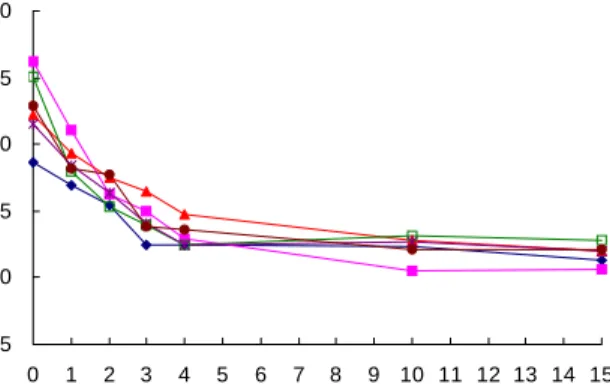
발효과정에서 생성되는 유기산, 탄산가스 및 기타 산 물질 은 pH에 영향을 미친다(18). 발효액의 발효시간에 따른 pH 의 변화는 Fig. 2와 같다. pH는 발효시작 시 홍삼이 4.87
±0.00, 산삼배양근이 5.62±0.00, 산삼배양근 압출성형물이 5.15±0.00~5.51±0.00의 범위로 압출성형물 중에서 MG2 (배럴온도 140oC, 수분함량 25%)가 가장 높게 측정되었으 며, MG3(배럴온도 110oC, 수분함량 35%)가 가장 낮게 측정 되었다. 발효시작 후 pH는 발효시작 후 2일까지 크게 낮아졌 으며, 이후 15일까지 완만하게 감소하여 안정된 상태를 나타 내었다. 산삼배양근 압출성형물에서 MG2(배럴온도 140oC,
3.5 4.0 4.5 5.0 5.5 6.0
0 1 2 3 4 5 6 7 8 9 10 11 12 13 14 15 Fermentation time (day)
pH
Fig. 2. Changes in pH of tissue cultured mountain ginseng fermentation product during fermentation at 27oC.
-◆-, root hair of red ginseng; -■-, tissue cultured mountain gin- seng; -▲-, extruded tissue cultured mountain ginseng (barrel temperature 110oC, moisture content 25%); -□-, extruded tissue cultured mountain ginseng (barrel temperature 140oC, moisture content 25%); -Ж-, extruded tissue cultured mountain ginseng (barrel temperature 110oC, moisture content 35%); -●-, extruded tissue cultured mountain ginseng (barrel temperature 140oC, moisture content 35%).
수분함량 25%)가 감소폭이 가장 크게 나타났으며(5.51±
0.00~4.28±0.00), MG3(배럴온도 110oC, 수분함량 35%)가 5.15±0.00~4.20±0.00으로 가장 적은 감소폭을 나타내었 다. 발효 15일에서의 pH는 홍삼이 4.13±0.00, 산삼배양근이 4.06±0.00, 산삼배양근 압출성형물이 4.20±0.00~4.28±
0.00로 압출성형 공정 간에 큰 차이는 없었다. Min과 Cho (19)의 연구결과에서 발효 인삼주의 pH가 3.8~4.2로 보고된 결과와 비교하였을 때, 본 연구에서도 유사한 결과를 나타내 었다.
발효시간에 따른 발효액의 산도 변화는 Fig. 3과 같다. 최 종 인삼발효액 산도는 홍삼이 1.12±0.06%, 산삼배양근이 1.19±0.06%, 산삼배양근 압출성형물이 0.97±0.01~1.02±
0.01%로 측정되어 압출성형 공정 간의 산도에 대한 차이는 나타나지 않았다. Han 등(20)의 연구결과에서 압출성형백삼 의 산도는 20일 이후부터 크게 증가하였다고 하였을 때, 본 연구에서 압출성형 공정 간의 산도가 크게 차이를 보이지 않은 이유는 발효시간이 상대적으로 짧아 각종 미생물에 의 한 유기산 생성이 활발하게 일어나지 않은 것으로 사료된다.
산도의 증가는 발효기간 동안 계속하여 증가하였고, 발효 초기 2일 동안 가장 많이 증가하였다.
pH의 감소에 따라 산도는 증가하였는데 4일 이후의 산도 의 증가와 비교하여 pH의 변화가 나타나지 않은 것은 발효 기간 중에 생성되는 아미노산 등에 의한 완충작용으로 인하 여 pH의 범위가 안정한 것으로 판단되었다(21).
당도
발효 시간에 따른 당도의 변화는 Fig. 4와 같다. 발효 전 인삼발효액의 당도는 홍삼 11.6±0.00oBrix, 산삼배양근 8.3
±0.00oBrix, 산삼배양근 압출성형물 9.8~10.0±0.00oBrix로
0.0 0.2 0.4 0.6 0.8 1.0 1.2 1.4
0 1 2 3 4 5 6 7 8 9 10 11 12 13 14 15 Fermentation time (day)
Acidity (%) .
Fig. 3. Changes in acidity of tissue cultured mountain gin- seng fermentation product during fermentation at 27oC.
-◆-, root hair of red ginseng; -■-, tissue cultured mountain gin- seng; -▲-, extruded tissue cultured mountain ginseng (barrel temperature 110oC, moisture content 25%); -□-, extruded tissue cultured mountain ginseng (barrel temperature 140oC, moisture content 25%); -Ж-, extruded tissue cultured mountain ginseng (barrel temperature 110oC, moisture content 35%); -●-, extruded tissue cultured mountain ginseng (barrel temperature 140oC, moisture content 35%).
7.0 8.0 9.0 10.0 11.0 12.0
0 1 2 3 4 5 6 7 8 9 10 11 12 13 14 15 Fermentation time (day)
°Brix
Fig. 4. Changes in oBrix of tissue cultured mountain ginseng fermentation product during fermentation at 27oC.
-◆-, root hair of red ginseng; -■-, tissue cultured mountain gin- seng; -▲-, extruded tissue cultured mountain ginseng (barrel temperature 110oC, moisture content 25%); -□-, extruded tissue cultured mountain ginseng (barrel temperature 140oC, moisture content 25%); -Ж-, extruded tissue cultured mountain ginseng (barrel temperature 110oC, moisture content 35%); -●-, extruded tissue cultured mountain ginseng (barrel temperature 140oC, moisture content 35%).
홍삼이 가장 높게 측정되었다. 산삼배양근을 압출성형 하였 을 때 현탁액의 당도는 최대 10.0±0.00oBrix(배럴온도 110oC, 수분함량 35%)까지 증가하였다. 발효액의 당도는 발효 초기 2일 동안 급격하게 감소하였고 이후 완만하게 감소하여 안 정된 수치를 보여주었다.
이는 Jung 등(22)이 산삼배양근을 첨가한 발효주의 당도 가 발효시간에 따라 낮아지는 것과 유사한 결과를 나타내었 지만 당도가 감소하는 시간이 20일 동안 계속된 것과 비교하 여 본 연구에서는 발효 2일만에 급격히 감소하였다. 이와 같은 결과는 발효시작 시 효모만을 접종한 Jung 등(22)의
연구와는 달리 누룩을 혼합하여 첨가에 의해 당류의 전환이 빨리 일어나 알코올 전환율이 증가한 것으로 판단되었다.
최저 당도는 발효 10~15일에 나타났으며, 홍삼이 7.9±
0.00oBrix, 산삼배양근 8.0±0.00oBrix, 산삼배양근 압출성형 물이 7.8~8.0±0.00oBrix로 홍삼이 가장 낮게 측정되었다.
총당
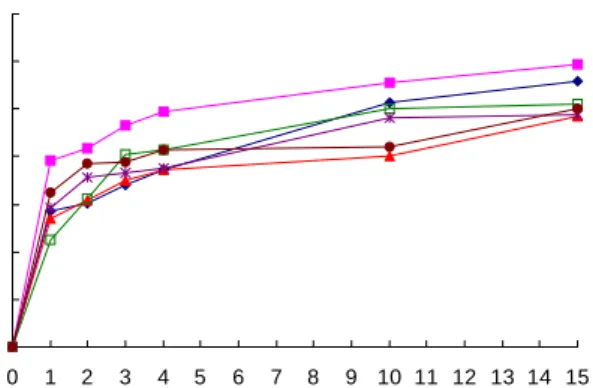
발효시간에 따른 총당의 변화는 Fig. 5에 나타내었다. 발 효 전 현탁액의 총당 함량은 홍삼 133.92±6.81 mg/mL, 산삼 배양근 49.68±0.71 mg/mL, 산삼배양근 압출성형물 79.23
±4.17~84.25±1.10 mg/mL로 측정되었다. 압출성형물에서 는 MG2(배럴온도 140oC, 수분함량 25%)가 84.25±1.10 mg/mL로 총당 함량이 가장 높게 측정되었고, MG1(배럴온 도 110oC, 수분함량25%)가 79.23±4.17 mg/mL로 가장 낮게 측정되었다. 산삼배양근이 압출성형공정을 통하여 최고 70% 증가함을 확인할 수 있었다.
Kim 등(18)은 팽화미분을 첨가한 탁주 양조 제조에서 팽 화미분의 첨가량이 증가할수록 총당의 함량이 높아졌다고 보고하였는데 본 연구에서도 압출성형물의 경우 고온․고압 에서 압출성형 하여 팽화가 일어났기 때문에 압출성형현탁 액의 총당 함량이 높은 것으로 사료된다. 또한, 발효 초기에 총당의 함량이 급격히 감소하였다는 보고와도 동일한 결과 임을 확인할 수 있었다.
발효액의 총당 함량 변화는 발효 2일까지 급격히 감소하 다가 발효 15일까지 완만하게 감소하는 패턴을 나타내었다.
이러한 결과는 당도의 감소 패턴과도 유사하였다. 최종 발효 액의 총당 함량은 홍삼이 24.34±1.51 mg/mL, 산삼배양근이 18.61±0.47 mg/mL로 측정되었고, 산삼배양근 압출성형물 에서는 MG1(배럴온도 110oC, 수분함량 25%)가 24.23±0.40
0 20 40 60 80 100 120 140
0 1 2 3 4 5 6 7 8 9 10 11 12 13 14 15 Fermentation time (day)
Total sugar (mg/mL) .
Fig. 5. Changes in total sugar of tissue cultured mountain ginseng fermentation product during fermentation at 27oC.
-◆-, root hair of red ginseng; -■-, tissue cultured mountain gin- seng; -▲-, extruded tissue cultured mountain ginseng (barrel temperature 110oC, moisture content 25%); -□-, extruded tissue cultured mountain ginseng (barrel temperature 140oC, moisture content 25%); -Ж-, extruded tissue cultured mountain ginseng (barrel temperature 110oC, moisture content 35%); -●-, extruded tissue cultured mountain ginseng (barrel temperature 140oC, moisture content 35%).
mg/mL로 가장 높게 측정되었으며, MG2(배럴온도 140oC, 수분함량 25%)가 19.09±4.03 mg/mL로 가장 낮게 측정되어 MG2(배럴온도 140oC, 수분함량 25%)가 가장 발효 적성이 좋은 것으로 판명되었다.
환원당
발효 전 현탁액의 환원당 함량은 홍삼이 53.12±1.42 mg/
mL, 산삼배양근이 11.23±0.22 mg/mL, 압출성형산삼배양 근이 21.67±0.58~25.96±0.55 mg/mL로 측정되었다(Fig. 6).
압출성형물에서는 MG2(배럴온도 140oC, 수분함량 25%) 가 25.96±0.55 mg/mL로 가장 높게 측정되었고, MG1(배럴 온도 110oC, 수분함량 25%)이 21.67±0.58 mg/mL로 가장 낮게 측정되었다. 산삼배양근과 산삼배양근 압출성형물을 비교하였을 때 산삼배양근은 압출성형공정을 통해서 2배 정 도의 환원당 함량이 증가한 것을 확인할 수 있었으며, 이는 압출성형공정을 통해 인삼 전분의 호화와 함께 전분의 사슬 이 절단되어 환원당 함량이 증가한다는 Ha와 Ryu(23)의 연 구와 유사한 결과였다. 발효액의 환원당은 발효 2일까지 급 격히 감소하였고, 이후 발효 종료 시까지 서서히 감소하는 양상을 나타내었다. 이러한 양상은 당도와 총당의 패턴과도 유사하였다.
환원당의 감소량은 홍삼 발효액이 43.00±0.29 mg/mL로 가장 컸으며, 산삼배양근 발효액의 경우 발효 초기 환원당 함량의 감소량이 7.00±0.48 mg/mL로 가장 낮게 측정되었 는데 이는 초기 환원당 농도가 낮기 때문인 것으로 판단되었 다. 압출성형물에서는 MG2(배럴온도 140oC, 수분함량 25%) 가 24.00±0.39 mg/mL 감소되어 가장 많은 환원당을 소모하 는 것으로 확인되었다. 최종 환원당의 함량은 홍삼 발효액이
0 10 20 30 40 50 60
0 1 2 3 4 5 6 7 8 9 10 11 12 13 14 15 Fermentation time (day)
Reducing sugar (mg/mL) .
Fig. 6. Changes in reducing sugar of tissue cultured mountain ginseng fermentation product during fermentation at 27oC.
-◆- Root hair of red ginseng, -■- Tissue cultured mountain gin- seng, -▲- Extruded tissue cultured mountain ginseng (barrel temperature 110oC, moisture content 25%), -□- Extruded tissue cultured mountain ginseng (barrel temperature 140oC, moisture content 25%), -Ж- Extruded tissue cultured mountain ginseng (barrel temperature 110oC, moisture content 35%), -●-Extruded tissue cultured mountain ginseng (barrel temperature 140oC, moisture content 35%).
9.83±0.01 mg/mL, 산삼배양근 발효액이 0.41±0.02 mg/
mL, 산삼배양근 압출성형물이 1.57±0.34~2.17±0.12 mg/
mL로 측정되었다.
알코올 함량
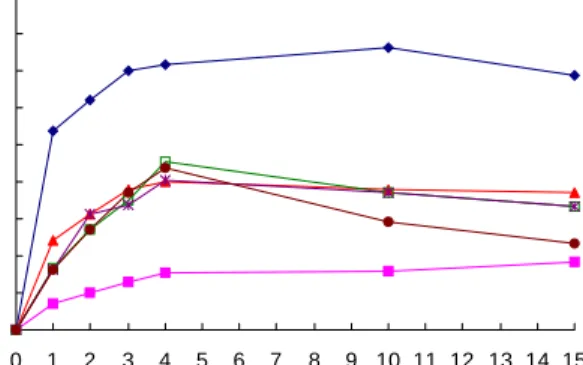
인삼 발효액의 알코올 함량은 발효 초기 4일까지 꾸준한 증가를 보이다가 이후 완만하게 증가하는 경향을 나타내었 다(Fig. 7). 반면, 산삼배양근을 제외한 산삼배양근 압출성형 물, 홍삼 발효액에서는 발효 10일 이후에 알코올 함량이 약 간 감소하는 결과를 나타내었는데 이는 장기간의 발효기간 중 알코올의 부분적인 휘발로 인해 이러한 결과가 나타나는 것으로 판단되었다.
인삼발효액의 최대 알코올 함량은 홍삼 3.82±0.10%, 산 삼배양근 0.91±0.06%, 산삼배양근 압출성형물 1.86±0.10
~2.28±0.06%로 측정되었다. 압출성형물에서는 MG2(배럴 온도 110oC, 수분함량 25%)가 2.28±0.06%로 가장 높게 측 정되었다. 산삼배양근은 압출성형을 통해 알코올 함량이 2~3배로 증가하였는데 이로써 산삼배양근을 압출성형 함 으로써, 발효효율을 높일 수 있음이 확인되었다. Moon 등 (24)은 고온․고압 압출성형 공정을 통하여 알코올 발효를 하였을 때 비처리구에 비하여 18% 이상 알코올 수율이 증가 하였다고 보고하였는데 본 연구결과에서도 유사한 결과가 확인되었다.
본 연구에서 산삼배양근이 홍삼에 비해 알코올 함량이 비 교적 낮게 측정되었는데, 이는 산삼배양근이 홍삼에 비해 알코올 발효의 기질이 되는 전분의 양이 적기 때문에 액화 당화가 느리고 수율이 낮은 것으로 판단되었다. 발효가 진행 될수록 알코올이 생성됨에 따라 당은 점점 줄어드는데 본
0.0 0.5 1.0 1.5 2.0 2.5 3.0 3.5 4.0 4.5
0 1 2 3 4 5 6 7 8 9 10 11 12 13 14 15 Fermentation time (day)
Alcohol (%) .
Fig. 7. Changes in alcohol of tissue cultured mountain gin- seng fermentation product during fermentation at 27oC.
-◆- Root hair of red ginseng, -■- Tissue cultured mountain gin- seng, -▲- Extruded tissue cultured mountain ginseng (barrel temperature 110oC, moisture content 25%), -□- Extruded tissue cultured mountain ginseng (barrel temperature 140oC, moisture content 25%), -Ж- Extruded tissue cultured mountain ginseng (barrel temperature 110oC, moisture content 35%), -●-Extruded tissue cultured mountain ginseng (barrel temperature 140oC, moisture content 35%).
연구에서도 알코올이 생성됨에 따라 당도, 총당, 환원당이 감소하는 패턴을 나타내었다.
요 약
본 연구에서는 산삼배양근과 압출성형 산산배양근의 발 효특성을 알아보기 위해 발효액의 pH 및 산도, 당도, 총당, 환원당, 알코올 함량의 변화를 홍삼발효액과 비교하였다.
Saccharomyces cerevisiae와 Aspergillus usamii, Rhizopus japonicus를 함유한 누룩을 접종하여 15일간 발효시킨 알코
올 발효액의 pH, 당도, 환원당, 총당은 발효 시간 5일 전에 급격히 감소하여 이후 완만하게 감소하여 안정된 상태를 보 여주었다. 또한, 산삼배양근을 압출성형 시킴으로써 환원당, 총당, 알코올 함량이 2배 이상 증가함을 확인할 수 있었다.발효액의 최종 산도는 홍삼 1.12±0.06%, 산삼배양근 1.19
±0.06%, 압출성형 산삼배양근 0.97±0.01~1.02±0.01%로 측정되었다. 알코올 발효를 시킨 발효액의 최대 알코올 함량 은 홍삼 3.82±0.10% 산삼배양근 0.91±0.06%, 압출성형 산 삼배양근 1.86±0.10~2.18±0.06%로 측정되어 산삼배양근 을 압출성형 시킴으로써 최대 2.5배 알코올 함량을 향상시킬 수 있었다. 압출성형물 중에서도 배럴온도 140oC, 수분함량 25%로 압출성형 시킨 산삼배양근이 환원당, 총당, 알코올 함량이 가장 높게 측정되었다. 결론적으로 본 연구에서 압출 성형공정을 통하여 산삼배양근 발효적성의 향상과 함께 새 로운 산삼발효제품과 식품개발의 가능성을 발견하였다.
감사의 글
본 연구는 농림수산식품부에서 시행한 농림기술개발사업 의 연구과제로 수행된 결과의 일부이며 이에 감사드립니다.
문 헌
1. Kim HD. 2005. Mountain ginseng of Korea. Kim-Young Sa, Paju, Gyeonggi-do.
2. Park H, Park SM, Sang H. 2002. Production and quality of mountain ginseng. Proceedings of the 8th Int. Sympos- ium on Ginseng, Korean Society of Ginseng. p 456-466.
3. Wang ZH, Li CH, Zhang CG, Wang XD. 1998. Study on the wild ginseng and cultivated ginseng in Northeast of China. Proceedings of International Symposium on Gin- seng. p 109-114.
4. Son SH, Hall RB. 1990. Multiple shoot regeneration from root organ cultures of Populus grandidentata. Plant Cell
Tissue Organ Cul 20: 53-57.
5. Son SH, Choi SM, Hyung SJ, Yun SR, Choi MS, Shin EM, Hong YP. 1999. Induction and culture of mountain ginseng adventitious roots and AFLP analysis for identifying mountain ginseng. Biotechnol Bioprocess Eng 4: 119-123.
6. Lim SI. 2005. Health fermentation food of functional evalu- ation and production process conceptual design symposium.
Bio Venture Center of KRIBB, Daejeon. p 69.
7. Harper JM. 1989. Food extruders and their application. In
Extrusion Cooking. Mercier C, Linko P, Harper JM, eds.
AACC, St. Paul, MN. p 1-18.
8. Lee CH, Kim DC, Kim CJ, Jeon JH, Kim JD, Son JC. 1987.
Food extrusion technology. Yu-Lim Sa, Seoul. p 167-178.
9. Meuser F, Wiedmann W. 1989. Extrusion plant design. In
Extrusion Cooking. Mercier C, Linko P, Harper JM, eds.
AACC, St. Paul, MN. p 91-155.
10. Ha DC, Lee JW, Ryu GH. 2005. Effect of barrel temperature and screw speed on characteristics of extruded raw ginseng.
J Ginseng Res 29: 107-112.
11. Ryu GH, Remon JP. 2004. Extraction yield of extruded gin- seng and granulation of its extracts by cold extrusion- spheronization. J Korean Soc Food Sci Nutr 33: 899-904.
12. Han JY, Kim MH, Jin T, Budiasih WS, Ryu GH. 2006.
Extrusion of ginseng root in twin screw extruder:
Pretreatment for hydrolysis and saccharification of ginseng extrudate. J Food Sci Nutr 11: 318-322.
13. Food code. 2002. Korea Food & Drug Administration, Seoul, Korea. p 389-390.
14. Dubois M, Gillers KA, Hamilton JK, Rdbers PA, Smith F.
1956. Colormetric method for determination of sugar and related substance. Anal Chem 28: 350-352.
15. Miller GL. 1959. Use of dinitrosalicylic acid reagent for de- termination of reducing sugar. Anal Chem 31: 426-428.
16. 주류분석규정. 2006. 국세청기술연구소. 서울. p 39-41.
17. Chae SK, Kang Ks, Lew ID, Ma SJ, Bang KY, Oh MH, Oh SH. 2004. The average food analytics theory and exper-
iment. Jigu Publishing Co., Paju, Gyeonggi-do. p 563-567.
18. Kim JY, Sung KW, Bae HW, Yi YH. 2007. pH, acidity, color reducing sugar, total sugar, alcohol and organaleptic char- acteristics of puffed rice powder added Takju during fermentation. Korean J Food Sci Technol 39: 266-271.
19. Min YK, Cho JG. 1994. Fermentation characteristics of some medicinal herb rice wine. J Appl Biol Chem 37:
175-181.
20. Han JY, Kim C, Ryu GH. 2007. Comparison of ferment- ability and characteristics of fermented broths for extruded white ginseng at different barrel temperature. J Korean Soc
Food Sci Nutr 36: 1211-1218.
21. Jang KJ, Yu TJ. 2007. Studies on the components of Sokoju and commercial Yakju. Korean J Food Sci Technol 13:
307-313.
22. Jung HS, Kang TS, Woo KS, Paek KY, Yu KW, Yang SJ.
2005. Effect of cultured wild ginseng roots on the alcoholic fermentation. Korean J Food Preserv 12: 402-410.
23. Ha DC, Ryu GH. 2005. Chemical components of red, white and extruded root ginseng. J Korean Soc Food Sci Nutr 34: 247-254.
24. Moon HS, Kwon HJ, O PS. 1998. Studies on the alcohol fermentation with extruded tappioca starch. Korean J Appl
Microbiol Biotechnol 16: 231-237.
(2008년 10월 8일 접수; 2008년 11월 17일 채택)