ISSN 1598-6438 (Print), ISSN 2287-8831 (Online)
≪ Review Paper ≫
Design of Passive Treatment Systems for Mine Drainage Waters
Sung-Wook Jeen*
Department of Earth and Environmental Sciences & The Earth and Environmental Science System Research Center, Chonbuk National University
ABSTRACT
Passive treatment systems are commonly used for remediation of mine drainage waters because they do not require continuous chemical inputs and operation. In this study, the selection and design criteria for such systems were evaluated, particularly the two most commonly used ones, i.e., permeable reactive barriers (PRBs) and vertical flow biological reactors (VFBRs). PRBs and VFBRs are operated on the same principles in terms of biochemical reaction mechanisms, whereas differences relate to configuration, engineering, and water management. In this study, each of these systems were described with respect to key design variables, such as metal removal mechanisms and removal rates, effectiveness and longevity, general design and construction, flow capacity, and cost. The information provided from this study could be used as a design guideline when a passive treatment option is considered for potential remediation of a mine site.
Key words : Passive treatment system, Mine drainage water, Permeable reactive barrier, Vertical flow biological reac- tor, Design
1. Introduction
In mine-impacted areas, passive treatment systems are often designed to neutralize acidity and remove metals in drainage waters (Jung et al., 2014; Underwood et al., 2014).
Such systems do not require continuous chemical inputs because they are sustained by naturally occurring chemical and biological processes (Hedin et al., 1994; Hengen et al., 2014). In general, passive treatment systems are best suited for the treatment of waters with low acidity (< 800 mg CaCO3/L), low flow rates (< 50 L/s), and therefore low acid- ity loads, where the key chemical outcomes are low metal concentrations and circumneutral pH. Over the past decade, a variety of passive treatment systems have been devel- oped, and a large body of literature now exists with respect to the effectiveness of those systems for the treatment of acidic and neutral-pH mine drainage (e.g., Watzlaf et al., 2004; Johnson and Hallberg, 2005; Rose, 2010). Although a majority of the literature addresses the treatment of coal mine drainages, the data are also relevant for the treatment of drainages for metal mines (Gusek and Figueroa, 2009).
Considerations for the utility of passive treatment at a typical remediation project are based on three fundamental criteria: 1) availability of proven and demonstrable tech- niques for effluent treatment, 2) robustness and longevity, and 3) ability to operate with minimal intervention over the long term. Based on the literature, the two most popular passive treatment systems that have been considered for mine drainage waters are permeable reactive barriers (PRBs) and vertical flow biological reactors (VFBRs) (Jeen and Mattson, 2016).
Passive treatment systems are designed to provide a sequence of chemical reactions or biological processes that convert mobilized metals and complexes contained in the leachate into immobile or inert compounds. In this regard, passive treatment systems require consideration of several variables, including influent water chemistry, flow rate, vol- umetrics of the treatment cells, anticipated residence times, and effluent water quality targets.
The purpose of this study was to provide selection and design criteria from which to assess the potential applicabil- ity of PRBs and VFBRs at a particular remediation project.
*Corresponding author : [email protected]
Received : 2017. 3. 29 Reviewed : 2017. 4. 7 Accepted : 2017. 4. 7 Discussion until : 2017. 6. 30
It is expected that from the criteria, primarily derived from the experiences in Canadian and U.S. sites, general guide- lines for remediation of mine-impacted sites, including Korean sites, could be drawn. In this paper, each of the pas- sive treatment systems are described with respect to key variables, such as metal removal mechanisms and removal rates, effectiveness and longevity, general design and con- struction, flow capacity, and cost.
2. Passive Treatment Options
2.1. Permeable reactive barriers (PRBs)
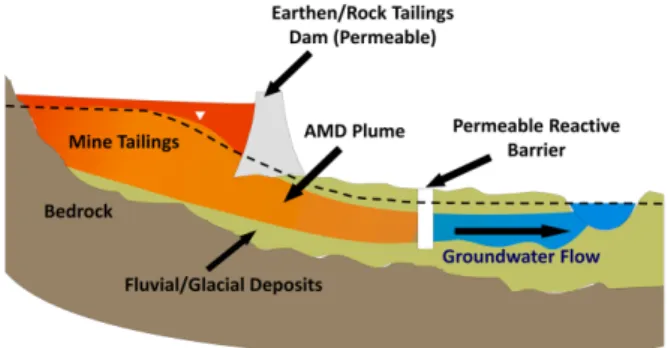
In the mining sector, PRBs are typically designed to inter- cept plumes of mine-influenced groundwater that show ele- vated concentrations of trace elements and, often, low pH (Fig. 1). The use of PRBs involves installing an appropriate reactive material into the aquifer so that contaminated water flows through the reactive zone. The reactive material induces chemical transformations that remove the contami- nants through physical, chemical, or biological processes (ITRC, 2005). In particular, PRBs containing organic car- bon (e.g., sawdust, spent brewing grain, compost, and peat) promote the removal of dissolved constituents in mine drainages under natural groundwater flow conditions by creating conditions suitable for microbially mediated sul- fate reduction (Eq. 1) and the subsequent precipitation of metal sulfide minerals (Eq. 2) (Benner et al., 1997; Blowes et al., 2000; Guha and Bhargava, 2005):
SO42− + 2CH2O → H2S + 2HCO3− (1)
Me2+ + H2S → MeS + 2H+ (2)
where CH2O represents an organic carbon substrate, Me2+ is a divalent metal (such as Fe, Cd, or Zn), and MeS is a spar- ingly soluble amorphous metal sulfide (e.g., FeS2, CdS, or ZnS). Because sulfate reduction generally occurs in excess compared to the amount of metal sulfide precipitation that occurs, and given that sulfate reduction liberates bicarbon- ate at neutral pH, the net result is generally a decrease in the overall acidity of the treated water. Metal removal by adsorption onto organic carbon and by metal hydroxide/car- bonate precipitation may also be enhanced because of alka- line conditions in the PRB (Gibert et al., 2005). In most
cases, sulfate reduction and subsequent metal sulfide precip- itation should provide sufficient attenuation to achieve water quality targets for elements. Sulfate removal rates strongly depend on the organic carbon source, but for most forms of organic carbon, the sulfate removal rate is typically 100 mg/
L per day of residence time.
As an example of actual treatment cases, a full-scale PRB for the removal of mine-related contaminants was installed at the Nickel Rim Mine near Sudbury, Ontario (Benner et al., 1997, 1999). The PRB was successful in treating mine- influenced water with slightly acidic pH (5 < pH < 6) and elevated concentrations of sulfate (1000-4000 mg/L), Fe (200-1000 mg/L), and Ni (up to 30 mg/L) over a period of 5 years. A pilot-scale PRB was installed in Vancouver, Brit- ish Columbia to remediate sulfate-rich groundwater con- taining elevated levels of Cu, Ni, Zn, Cd, and Co (Ludwig et al., 2002). The reactive material was compost based and installed in a guar gum slurry trench. The trench was 10 m wide, 6.7 m deep, and approximately 2.5 m thick in the gen- eral direction of groundwater flow. Cd concentrations decreased from 15.3µg/L to 0.2 µg/L, and Zn concentra- tions decreased from values in excess of 2 mg/L to < 0.1 mg/L. Groundwater velocity estimates were as high as 1 m/
day (total flow 0.3 L/s), and the input concentration of sulfate was approximately 1000 mg/L. A full-scale PRB was constructed at the same site between November 2000 and February 2001. It is the largest organic-based PRB yet installed and is approximately 400 m in width, as much as 15 m in depth, and 2.5 m to 5 m in thickness (Mountjoy and Blowes, 2002).
Recently, PRBs containing organic carbon and granular zero-valent iron (ZVI) have gained attention (Lindsay et al.,
≅
Fig. 1. Schematic of a PRB. Note that AMD represents acid mine drainage.
2008; Guo and Blowes, 2009; Jeen et al., 2014). ZVI is a strong reductant and, when mixed with organic carbon, sus- tains conditions suitable for the growth and activity of sul- fate-reducing bacteria (SRB). This is partly due to the acid- consuming nature of the reduction of water during anaero- bic corrosion of ZVI, which can generate neutral or alka- line conditions (preferred by SRB). Eq. 3 describes the anaerobic corrosion of ZVI.
Fe0 + 2H2O → Fe2+ + H2 + 2OH− (3) The hydrogen gas released in this reaction may be used by SRB in addition to organic carbon as an electron donor (Lovley and Goodwin, 1988). The surfaces of commer- cially produced granular iron materials are moderately cor- roded. These iron oxide surfaces are well suited for the adsorption of metals from mine waters (Wilkin and McNeil, 2003). Dissolved metals may also precipitate or co-precipi- tate with corrosion products that form on the surfaces of the ZVI. Because of these properties, mixtures of organic car- bon and ZVI may offer improved removal of dissolved met- als from water over use of organic carbon alone.
The economics of PRBs are tied to the longevity of the media and long-term hydraulic capture in the system. Lon- gevity of reactive barriers may be limited by the chemical characteristics of the barrier, including the total mass of reactive material and the rate of reaction within the barrier.
Potential processes leading to decreased reaction rates include consumption of reactive material, declining reac- tive surface area resulting from the precipitation of second- ary minerals on reactive surfaces, clogging, and develop- ment of preferential flow paths (Blowes et al., 2000). Bar- rier life may also be limited by physical changes to the bar- rier, including decreases in porosity and permeability. In general, the longevity of PRBs is anticipated to be 15-20
years (ITRC, 2011). Given that PRBs are contained within the subsurface environment, they are minimally influenced by atmospheric temperature and have been shown to func- tion well in cold climates (e.g., Benner et al., 1997).
2.2. Vertical flow biological reactors (VFBRs)
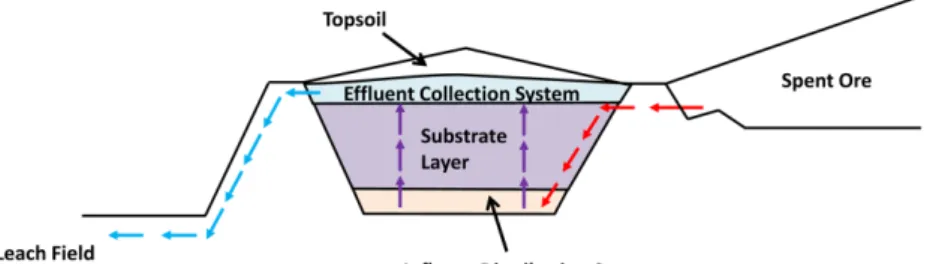
VFBRs are operated on the same basic principles as PRBs in terms of biochemical reaction mechanisms (Neculita et al., 2011). Differences relate to configuration, engineer- ing, and water management (Fig. 2). A VFBR is a particu- lar design of a general class of passive treatment systems similar to vertical flow wetlands (VFWs) or reducing and alkalinity producing systems (RAPSs). A VFBR is con- structed in a geomembrane-lined facility, typically with the following structure, from the bottom upward in the direc- tion of flow: 1) foundation, which may include excavation into natural substrates; 2) geo-membrane liner to provide containment and minimize downward seepage; 3) influent distribution system (perforated pipe), laid in gravel matrix;
4) reactive substrate layer, comprising a permeable matrix with reactive amendment (e.g., sawdust, spent brewing grain, compost, peat, and ZVI); 5) effluent collection system, con- sisting of perforated pipe; and 6) vegetative soil cover.
Post-aeration prior to discharge to the receiving environ- ment may also be required to oxygenate the effluent and oxidize parameters that may be elevated in the suboxic out- let flow (e.g., ammonia, ferrous iron, and hydrogen sul- fide). This can be achieved via the draining of treated effluents by gravity to an aerobic leach field (Fig. 2).
In a VFBR system, influent waters are forced upward through a permeable reactive matrix where reactions, iden- tical to those described above for PRBs, take place. In this manner, a primary difference between VFBRs and PRBs is the nature of the hydraulic gradient. For PRBs, natural
Fig. 2. Schematic cross section of a VFBR.
groundwater flow paths dictate the gradient and flow direc- tion. For VFBRs, the upward flow path is afforded by con- tainment (lined system) and water pressure. Given the imposed hydraulic containment of VFBRs, they are less dependent on natural substrate features in comparison to PRBs, which operate most effectively for well-constrained groundwater flow paths. This affords increased flexibility regarding VFBR placement.
Similar to PRBs, VFBRs operate by producing reducing conditions that promote metal removal via sulfide precipita- tion. In addition, the organic component provides sites for metal adsorption. In some cases, effluent pH can be expected to decrease as a result of acidity generated through the oxi- dation of Fe(II) and precipitation of Fe(III) hydroxides. If required, circumneutral surface water and groundwater col- lecting in the outer perimeter of the VFBR can be intro- duced into the effluent drain to contribute sufficient alkalinity to promote circumneutral pH conditions.
An example VFBR system is the one constructed at a closed cyanide heap leach facility at the Santa Fe Mine in Mineral County, Nevada (Cellan et al., 1997). The system was designed for a minimum 20 days residence time and a
peak flow rate of 2.8 L/s to treat weak acid dissociable (WAD) cyanide (CN), sulfate (SO4), nitrate (NO3), mercury (Hg), and selenium (Se). Monitoring results indicated that all the contaminants of concern were removed sufficiently from the effluent to meet mandated discharge criteria. A similar but downward-flow vertical biochemical reactor (BCR) was operated between September 2008 and October 2009 at a gravel pit adjacent to the Colorado River in west- ern Grand Junction, Colorado (Walker and Golder, 2010). A single 124 m3 pilot-scale BCR was constructed to afford a flow rate of 0.13-1.5 L/s to treat selenium-contaminated surface water. The pilot BCR achieved maximum selenium removal rates of 98% with a hydraulic retention time of 2.4 days and a minimum effluent Se concentration of 0.0005 mg/L from the average influent concentration of 0.034 mg/L.
Given the nature of the effluent collection and distribu- tion system, VFBRs are potentially more susceptible to atmospheric influences (e.g., temperature) compared to PRBs;
therefore, care must be taken in the design of VFBRs intended for use in cold climates. Like PRBs, VFBRs may require maintenance and rehabilitation during their life, although maintenance requirements for the latter may be
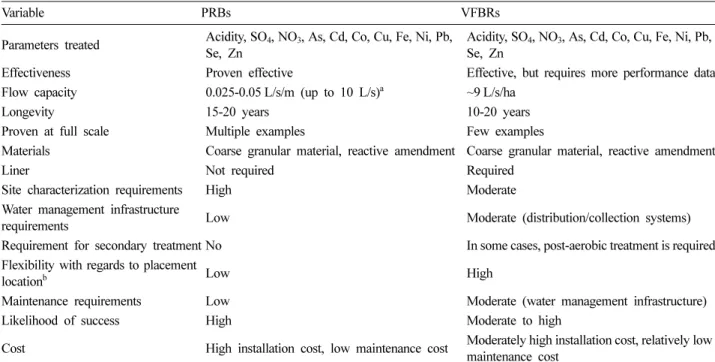
Table 1. Comparison of PRBs and VFBRs
Variable PRBs VFBRs
Parameters treated Acidity, SO4, NO3, As, Cd, Co, Cu, Fe, Ni, Pb, Se, Zn
Acidity, SO4, NO3, As, Cd, Co, Cu, Fe, Ni, Pb, Se, Zn
Effectiveness Proven effective Effective, but requires more performance data
Flow capacity 0.025-0.05 L/s/m (up to 10 L/s)a ~9 L/s/ha
Longevity 15-20 years 10-20 years
Proven at full scale Multiple examples Few examples
Materials Coarse granular material, reactive amendment Coarse granular material, reactive amendment
Liner Not required Required
Site characterization requirements High Moderate
Water management infrastructure
requirements Low Moderate (distribution/collection systems)
Requirement for secondary treatment No In some cases, post-aerobic treatment is required Flexibility with regards to placement
locationb Low High
Maintenance requirements Low Moderate (water management infrastructure)
Likelihood of success High Moderate to high
Cost High installation cost, low maintenance cost Moderately high installation cost, relatively low maintenance cost
a10 L/s represents the highest flow for the largest PRB currently in use, but higher flows are feasible.
bLocation for a PRB is dictated by the location of a tailings storage facility and underlying hydrostratigraphy. Greater flexibility is afforded for the location of VFBRs.
more onerous given the nature of the distribution and col- lection systems. With improper design, VFBRs are suscep- tible to clogging by suspended sediments. Elevated total suspended solids (TSS) in influent waters can result from poor design of the influent collection and distribution sys- tem or from the oxidation and precipitation of Fe and Mn within the aerobic portions of the VFBR. In general, TSS levels should be reduced to < 50 mg/L in the influent to maximize performance and life span of the system. Like PRBs, accumulation of Fe and/or Al precipitates can lead to short circuiting and reduced rates of reaction (Rose, 2010).
Saturated conditions must be maintained for VFBRs to be effective. In this regard, water elevation within the VFBR must be controlled to minimize the potential for reoxida- tion of reduced species (e.g., metal sulfides). A general comparison of PRB and VFBR systems is summarized in Table 1.
3. Design and Construction
The design of subsurface passive treatment systems depends on several variables, including topography, hydrol- ogy, hydrogeology, influent water quality, and desired efflu- ent water quality. Specifically, residence time, flow rate, and depth of flow are critical considerations in the design stage.
Required residence time depends upon contaminant types, removal rates, and treatment goals. Site conditions must also be evaluated to assess the suitability and potential effectiveness of the proposed system. In general, site-spe- cific data requirements include water balance information, influent characteristics (major ions, TSS, trace elements, etc.), treatment targets, and site suitability features. Site suit- ability features include hydrogeologic conditions, available area, site topography, soil data and depth to the bedrock, availability of construction materials, availability of reac- tive media, climatic conditions, and presence of sensitive downstream environments. Based on these general charac- teristics of passive treatment systems, specific consider- ations for PRBs and VFBRs are as follows.
3.1. Permeable reactive barriers (PRBs)
Construction of PRBs involves digging a trench or pit in the flow path of the contaminated groundwater plume, fill-
ing the void with reactive materials (e.g., a mixture of organic solids, ZVI, and possibly limestone gravel) that are sufficiently permeable to allow the unimpeded flow of groundwater, and finally landscaping the disturbed surface.
The site characterization data needed for PRB design are extensive. In particular, data gathering on a smaller scale is necessary for placement of a PRB, including the complete vertical and horizontal delineation of the groundwater plume and characterization of the hydrogeologic, geochemical, geotechnical, and microbiological conditions. Work associ- ated with PRB design includes treatability studies (e.g., lab- based column test work) and groundwater modeling.
The most common PRB design is the continuous PRB configuration. In such a system, the reactive media is dis- tributed across the width and vertical extent of the ground- water contaminant plume. Continuous PRBs have minimal impact on natural groundwater flow when properly designed and constructed. Theoretically, PRBs do not need to be keyed into a low-permeability layer, as long as the perme- ability of the PRB is the same as or greater than that of the aquifer. However, it is good practice to key the PRB into an underlying low-permeability layer (e.g., bedrock or clay- rich till) if one is present or to a sufficient depth to ensure complete plume capture and as a safeguard in the event the permeability of the PRB is compromised. Ensuring suffi- cient permeability of the reactive matrix is one of the design considerations for PRBs. Installation methods include unsup- ported excavation, supported excavation, continuous trench- ing, and biopolymer trenching.
The flow capacity of PRBs depends on parameter con- centrations of the influent water, metal removal rates of the reactive materials, and associated residence time. The high- est flow rate for which a PRB can be applied is up to about one pore volume a week (i.e., 7 days of residence time).
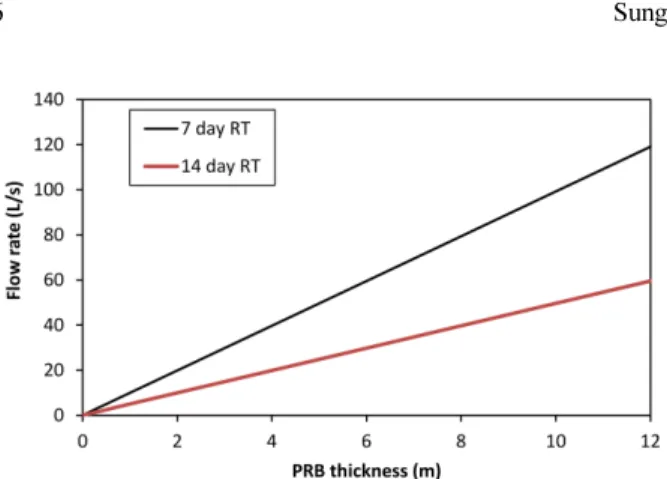
The largest PRB currently in use globally (i.e., 400 m wide, 15 m deep, and 2.5 m thick; Mountjoy and Blowes, 2002) operates at a flow rate of ~10 L/s. Theoretically, if land and resources are available, a bigger PRB, capable of treating higher flow rates, is feasible. This is illustrated in Fig. 3, which shows flow rate as a function of PRB thickness, assuming residence times of 7 days and 14 days. In Fig. 3, the flow rate of a PRB was calculated using Eqs. 4 and 5:
1 PV of a PRB =n × volume of a PRB (thickness × width
× depth) (4)
Flow rate = 1 PV/RT (5)
where PV represents pore volume, n represents porosity (assumed as 40%), and RT represents residence time. The width and depth of a PRB were assumed 1000 m and 15 m, respectively. Based on a residence time ranging from 7 days to 14 days, a 1 m-thick PRB can afford flow rates of approx- imately 5 L/s to 10 L/s.
3.2. Vertical flow biological reactors (VFBRs) There is not one uniform standard substrate design nor standard depth regarding the construction of VFBRs, but the general design includes the following specifications:
• Area/depth - Sizing of the facility is dependent on the range of flow volumes that will report to the system;
• Organic substrate - Combination of cellulosic (wood chips and hay) and organic waste (manure and peat) should have sufficient hydraulic conductivity to ensure that the system can handle design flows. Additions of organic materials may be required periodically to main- tain treatment efficiency;
• Gravel/limestone - To maintain permeability (e.g., hydrau- lic conductivity of 10−3 to 10−4m/s) and provide alkalin- ity, if necessary;
• Liner - Preferably, the base and sides of the vertical flow system will be constructed of compacted material with low hydraulic conductivity to prevent influent water from seeping through the sides and short-circuit-
ing the treatment system; and
• Drains - The network configuration will be dependent on the actual configuration of the vertical flow system but should have sufficient coverage to encourage verti- cal flow through the entire vertical cross section.
Similar to PRBs, flow rate is critical when sizing VFBRs.
Furthermore, VFBRs perform best over time when receiv- ing influent at a consistent flow rate. Flow velocity should be low (less than 0.15 m/s) to provide sufficient contact time to attain target removal rates (Burton and Tchobano- glous, 1991). In general, a residence time of 7-14 days is recommended. Flow depths vary from system to system depending on these factors. Based on a residence time rang- ing from 7-14 days, a 2 m depth of the active vertical flow bed, and an active pore volume of 40%, flow rates of approximately 6.6 L/s per hectare to 13.2 L/s per hectare are achievable (or average of ~9 L/s/ha based on a residence time of ~10 days). This is illustrated in Fig. 4a, which Fig. 3. Flow capacity for PRBs as a function of thickness,
assuming residence time (RT) of 7 days and 14 days. A 1000 m width and 15 m depth of the barrier and an active pore volume of 40% were assumed.
Fig. 4. Flow capacity for VFBRs as a function of surface area, assuming residence time (RT) of 7 days and 14 days. A (a) 2 m and (b) 4 m depth of the active vertical flow bed and an active pore volume of 40% were assumed. Note the difference in scale for the VFBR area between (a) and (b).
shows flow as a function of surface area for water resi- dence times of 7 days and 14 days. VFBRs can be con- structed to support the upward flow of waters through a permeable reactive matrix that may be up to 4 m thick.
Increased depth of the reactive bed allows for greater unit flow yields per area (Fig. 4b). In Fig. 4, the flow rate of a VFBR was calculated using equations similar to Eqs. 4 and 5; however, the volume of a VFBR was calculated as area × depth (assumed as either 2 m or 4 m). The flow rate was plotted as a function of area.
4. Cost
The main costs of PRBs are related to the site character- ization, design, and construction. Whereas the initial instal- lation cost may be substantial, there is little expense thereafter to maintain or operate the barrier (i.e., no active energy costs nor need for employees to monitor and main- tain the system). Generally, the cost factors that should be evaluated for a PRB installation include the following: site characterization, design, construction, purchase and installa- tion of reactive media, licensing fees, operation and main- tenance (O&M) costs, annual monitoring and reporting costs, and media replacement/rejuvenation.
Capital and operating costs for PRBs vary from site to site depending on the size of the barrier, barrier design, reactive material used, and physical and chemical character- istics of the contaminated groundwater plume. Usually the capital costs are similar to a pump-and-treat system, but operating costs are much lower. Of the various costs, the media costs are generally the greatest. Sources of organic carbon are highly variable; thus, cost estimates rely heavily on treatability studies for design. Whereas limited informa- tion is available with regard to the construction costs of operational-scale PRBs, material and installation costs for the PRB at the Nickel Rim mine site (15 m long, 3.6 m deep, and 4 m wide) were approximately $42,600 (Benner et al., 1997). This includes the cost for construction, mate- rials, and the reactive mixture, but does not include costs for design, operation, monitoring, and periodic maintenance.
Approximately half of that cost was incurred for materials and the other half for installation. Based on this informa- tion, the unit capital cost for the Nickel Rim site was calcu-
lated as approximately $197 per cubic meter of PRB volume.
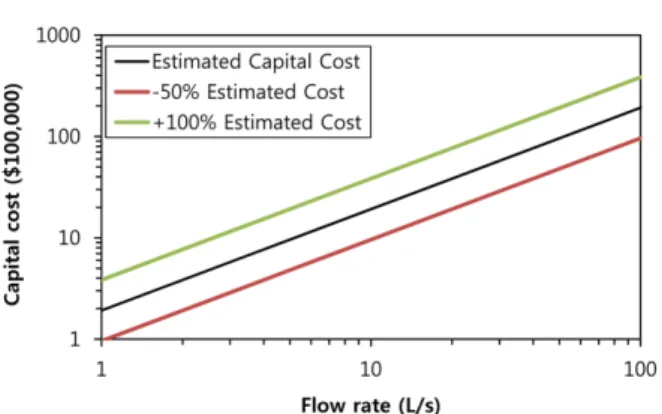
Using the unit capital cost approximated from the Nickel Rim site, capital costs for constructing PRBs were esti- mated assuming a residence time of 7 days (Fig. 5). Capital cost was calculated by multiplying a volume of PRB with the unit capital cost ($197/m3 of a PRB). The capital cost was plotted as a function of a flow rate, which has a corre- sponding volume a PRB (using Eqs. 4 and 5). According to the estimation, capital costs for a PRB, with a volume of
~7,500 m3 to handle a flow of ~5 L/s (residence time of 7 days), are estimated at $1,470,000 (range of $740,000 to
~$2,960,000; Fig. 5). The assumed -50% (×1/2) and +100%
(×2) ranges represent uncertainties associated with the unit capital cost estimation. Annual monitoring and reporting costs are estimated as $27,000/year to $42,000/year (ITRC, 2011).
Factors that affect the costs of VFBRs include required land area, pretreatment requirements (e.g., TSS removal), water management infrastructure, topography, soil type, land use, and site complexity. In general, VFBRs are considered more expensive to construct than surface wetland systems because of the engineered media and the likely requirement for a liner. VFBRs require less land and plants, but more piping and a better control of flow. Other site-specific fac- tors such as water chemistry, treatment goals, and source and availability of construction media can also influence the cost. Typical cost factors for VFBRs can be proportioned as follows: 1) land cost: 3%, 2) clearing and grubbing: 4-5%, 3) excavation and earthworks: 15-25%, 4) liner: 12-25%, 5) media: 50-55%, and 6) miscellaneous: 10-12%.
Similar to PRBs, the media costs are usually the greatest of these costs. The unit capital cost for VFBRs is estimated Fig. 5. Estimated capital cost for PRBs as a function of flow rate.
at approximately $127 per cubic meter of VFBR volume (Jack Adams, University of Utah, personal communica- tion). Capital cost for a VFBR (Fig. 6) was calculated using a method similar to the one used for a PRB, whereas in this case, the unit capital cost of $127/m3 for a VFBR was used instead. Based on this, capital costs for a 1 ha system, with a volume of ~7,500 m3 to handle a flow of ~5 L/s (resi- dence time of 7 days), are estimated at $950,000 (range of
$475,000 to ~$1,900,000; Fig. 6). Annual maintenance, mon- itoring, and operational costs are estimated at ~2.5% of the construction costs, or roughly $25,000 per hectare per year (U.S. EPA, 2000).
5. Conclusions
This study provides generic information about passive treatment systems that could be considered for treating seepage from a mine site. Passive treatment systems, such as PRBs and VFBRs, are designed to provide a sequence of chemical reactions or biological processes that convert mobilized metals contained in the mining-influenced water into immobile or inert compounds. The systems require consideration of several variables, including influent water chemistry, flow rate, volumetrics of the treatment cells, anticipated residence times, and effluent water quality targets.
From this study, it is suggested that actual design and installation of passive treatment systems should be deter- mined based on site-specific conditions. Thus, accurate site characterization and water balance calculations should be conducted to determine feasibility and capacity of passive treatment systems that can afford the anticipated seepage
from a tailings storage facility. The feasibility of passive treatment can be assessed through a combination of labora- tory-scale testing, pilot-scale field verification, and hydro- geologic/geochemical modelling. It should also be noted that replenishment of the reactive materials or installation of additional reactive materials (e.g., in front of an existing PRB) may be required, as the reactivity and treatment potential of the passive treatment systems may decrease over time. The spent PRB reactive materials may be left in place if no significant changes in redox conditions are expected, whereas spent materials from VFBRs can be con- sidered stable as long as they are stored under permanently saturated conditions. Overall, the selection and design crite- ria provided in this study could be used as a basis from which the potential applicability of passive treatment sys- tems is assessed at a particular mine site.
Acknowledgements
This research was supported by the Basic Science Research Program through the National Research Founda- tion of Korea (NRF) funded by the Ministry of Education (NRF-2016R1D1A1A02937479).
References
Benner, S.G., Blowes, D.W., and Ptacek, C.J., 1997, A full-scale porous reactive wall for prevention of acid mine drainage, Ground Water Monit. Rem., 17(4), 99-107.
Benner, S.G., Blowes, D.W., Gould, W.D., Herbert Jr., R.B., and Ptacek, C.J., 1999, Geochemistry of a permeable reactive bar- rier for metals and acid mine drainage, Environ. Sci. Technol., 33(16), 2793-2799.
Blowes, D.W., Ptacek, C.J., Benner, S.G., McRae, C.W.T., Ben- nett, T.A., and Puls, R.W., 2000, Treatment of inorganic contam- inants using permeable reactive barriers, J. Contam. Hydrol., 45(1-2), 123-137.
Burton, F.L. and Tchobanoglous, G., 1991, Wastewater Engi- neering, McGraw-Hill, New York, USA.
Cellan, R., Cox, A., Uhle, R., Jenevein, D., Miller, S., and Mud- der, T., 1997, Design and construction of an in situ anaerobic biochemical system for passively treating residual cyanide drainage, Proceedings of the 14th Annual Meeting of the Amer- ican Society of Surface Mining and Reclamation, ASSMR, Aus- tin, TX, p. 730.
Fig. 6. Estimated capital cost for VFBRs as a function of flow rate.
Gibert, O., de Pablo, J., Cortina, J.L., and Ayora, C., 2005, Municipal compost-based mixture for acid mine drainage biore- mediation: metal retention mechanisms, Appl. Geochem., 20(9), 1648-1657.
Guha, S. and Bhargava, P., 2005, Removal of chromium from synthetic plating waste by zero-valent iron and sulfate-reducing bacteria, Water Environ. Res., 77(4), 411-416.
Guo, Q. and Blowes, D.W., 2009, Biogeochemistry of two types of permeable reactive barrier, organic carbon and iron-bearing organic carbon for mine drainage treatment: Column experi- ments, J. Contam. Hydrol., 107(3-4), 128-139.
Gusek, J.J. and Figueroa, L.A., 2009, Mitigation of Metal Min- ing Influenced Water (Vol. 2), Society for Mining, Metallurgy, and Exploration, Littleton, CO.
Hedin, R.S., Nairn, R.W., and Kleinmann, R.L.P., 1994, Passive Treatment of Coal Mine Drainage, Bureau of Mines Informa- tion Circular IC 9389, U.S, p.35.
Hengen. T.J., Squillace, M.K., O’Sullivan, A.D., and Stone, J.J., 2014, Life cycle assessment analysis of active and passive acid mine drainage treatment technologies, Resour. Conserv. Recy., 86, 160-167.
ITRC (Interstate Technology and Regulatory Council), 2005, Permeable Reactive Barriers: Lessons Learned/New Directions.
PRB-4, The Interstate Technology & Regulatory Council.
ITRC (Interstate Technology and Regulatory Council), 2011, Permeable Reactive Barrier: Technology Update. PRB-5, The Interstate Technology & Regulatory Council.
Jeen, S.-W., Bain, J.G., and Blowes, D.W., 2014, Evaluation of mixtures of peat, zero-valent iron and alkalinity amendments for treatment of acid rock drainage, Appl .Geochem., 43, 66-79.
Jeen, S.-W. and Mattson, B., 2016, Evaluation of layered and mixed passive treatment systems for acid mine drainage, Envi- ron. Technol., 37(22), 2835-2851.
Johnson, D.B. and Hallberg, K.B., 2005, Acid mine drainage remediation options: a review, Sci. Total Environ., 338(1-2), 3-14.
Jung, S.P., Cheng, Y., Yim, G., Ji, S., and Kang, H., 2014, Per- formance and bacterial communities of successive alkalinity- producing systems (SAPSs) in passive treatment process treat- ing mine drainages differing in acidity and metal levels, Envi- ron Sci. Pollut. Res., 21(5), 3722-3732.
Lindsay, M.B.J., Ptacek, C.J., Blowes, D.W., and Gould, W.D., 2008, Zero-valent iron and organic carbon mixtures for remedi-
ation of acid mine drainage: batch experiments, Appl. Geochem., 23(8), 2214-2225.
Lovley D.R. and Goodwin, S., 1988, Hydrogen concentrations as an indicator of the predominant terminal electron-accepting reactions in aquatic sediments, Geochim. Cosmochim. Acta, 52(12), 2993-3003.
Ludwig, R.D., McGregor, R.G., Blowes, D.W., Benner, S.G., and Mountjoy, K., 2002, A permeable reactive barrier for treat- ment of heavy metals, Ground Water, 40(1), 59-66.
Mountjoy, K.J. and Blowes, D.W., 2002, Installation of a full- scale permeable reactive barrier for the treatment of metal-con- taminated groundwater, Proceedings of the Third International Conference on Remediation of Chlorinated and Recalcitrant Compounds, Battelle Press, Monterey, CA
Neculita, C.M., Yim, G.-J., Lee, G.Y., Ji, S.-W., Jung, J.W., Park, H.-S., and Song, H., 2011, Comparative effectiveness of mixed organic substrates to mushroom compost for treatment of mine drainage in passive bioreactors, Chemosphere, 83(1), 76-82.
Rose, A.W., 2010, Advances in passive treatment of coal mine drainage 1998-2009, Proceedings of the 2010 National Meeting of the American Society of Mining and Reclamation, ASMR, Pittsburgh, PA, p. 847-887.
Underwood, B.E., Kruse, N.A., and Bowman, J.R., 2014, Long- term chemical and biological improvement in an acid mine drainage-impacted watershed, Environ. Monit. Assess., 186(11), 7539-7553.
U.S. EPA, 2000, Constructed Wetlands Treatment of Municipal Wastewaters, EPA625/R-99/010. U.S. Environmental Protec- tion Agency, Office of Research and Development, Cincinnati, OH.
Walker, R. and Golder Associates Inc., 2010, Passive Selenium Bioreactor - Pilot Scale Testing: Final Report, Bureau of Recla- mation Science and Technology Program, Project No. 4414, Grand Junction, CO.
Watzlaf, G.R., Schroeder, K.T., Kleinmann, R.L.P., Kairies, C.L., and Nairn, R.W., 2004, The Passive Treatment of Coal Mine Drainage. DOE/NETL-2004/1202, U.S. Department of Energy, National Energy Technology Laboratory, Pittsburgh, PA.
Wilkin, R.T. and McNeil, M.S., 2003, Laboratory evaluation of zero-valent iron to treat water impacted by acid mine drainage, Chemosphere, 53(7), 715-725.