Hydrothermal Alteration of Limestone in the Muan-Mokpo Area, Korea
Yoon Chung-Han
1)*무안 목포지역에 분포하는 석회암의 열수변질에 관한 연구 -
윤정한*
요 약: 전남 무안읍에 분포하는 석회암은 운모편암내에 렌즈상이나 엷은 층상으로 분포하며 회색 또는 백색을
띤다 석회암체는 대체로 북동 남서방향으로 신장되어 있으며 화산암과 화강암질암의 관입에 의해 접촉부에서는. -
변질되어있다 산소동위원소 조성에 의해서. group-A(>15 ), group-B(10-15 ), group-C(5-10 )‰ ‰ ‰으로 분류 할 수 있고 산소 및 탄소동위원소비는 석회암체의 중앙부로 갈수록 부화되는 경향을 보이나 화성암과의 접촉부에서는 감소되는 경향을 보여주는 것으로 보아 산소동위원소 조성에 의해서 이 지역 석회암의 변질정도를 구분할 수 있음을 지시해 주고 있다. Al, Fe와Mn함량은18O가 감소함에 따라 증가하는 경향을 보여주며 이들 원소함량은, 변질을 받지 않은group-A석회암보다는 변질을 가장 많이 받은group-C석회암에 부화되어 있다 이들과는 달리.
및 원소함량은
S, Sr Zn 18O값과는 관련성을 보이지 않는다 따라서. Al, Fe과Mn의 부화는Al, Fe및Mn등을 포함하는 녹니석 또는 녹염석과 같은 열수성광물이 생성되면서 열수용액과 석회암사이에 산소 및 탄소동위원소 교환의 결과로 보이지만S, Sr 및Zn등은 열수용액과 충분한 교환이 없었던 것으로 사료된다 석회암중의. Al,
의 함량 및 등의 원소함량비 원소함량과 산소동위원소비의 관계는 무안석회암의
Fe, Mn , Mg/(Mg+Fe+Mn) Al/Mg ,
변질과 비변질을 구분하는 지시자로 사용할 수 있을 것으로 사료된다.
주요어: 석회암 열수용액 변질 산소 탄소동위원소 원소함량 지시원소, , , . , ,
Abstract :Limestones of Muan-eup in the province of Jeollanamdo, located in the southwestern part of Korea, occur as lenticular or thin bedded, partially silicified, and white or grey in color and crystalline. Lenticular limestones which are elongated to NE-SW trend were deposited in the mica schists. 18O and13C are enriched toward the center of the limestone formation but depleted at the contact part of limestone and igneous rocks due to hydrothermal activity in Cretaceous period. The limestones in the study area were divided into three groups based on the δ18O values ; A(>15 ), B(15-10 ) and C(<10-5 ). Group-A is the least altered and group-C is the most altered‰ ‰ ‰ limestone. The concentrations of Al, Fe and Mn tend to increase with decreasing δ18O values, while those of S, Sr and Zn are independent of δ18O values. This indicates that the enrichment of Al, Fe and Mn in the altered group-C limestone may be a consequence of the formation of hydrothermal minerals containing Al, Fe and Mn, while S, Sr and Zn did not exchange significantly with the hydrothermal fluid. The elemental compositions and relationships between elemental composition and δ18O of limestone may serve as potential tools for distinguishing altered from unaltered limestone in the Muan area. Al, Fe, Mn, Mg/(Mg+Fe+Mn) and Al/Mg can be also used as useful indicators for determining altered limestone in the Muan area.
Key words :Limestone, Hydrothermal fluid, Alteration, 18O and13C, Elemental composition, Indicator
Introduction
Many studies have indicated that changes of oxygen and carbon isotopic composition can be observed in
carbonate rocks reacted with hydrothermal fluids, since shallow intrusives and country rocks are subject to oxygen and carbon isotope exchange, in particular, oxygen isotope exchange between rock and fluid ass- ociated with hydrothermal activity(e.g., Talyor, 1973;
Matsuhisa et al., 1980; Criss et al., 1991). In general, these exchanges are characterized by decrease of 18O and 13C relative to unaltered country rocks(Enrich et al., 1958; Pinckney and Rye, 1972; Heyl et al.,1974;
년 월 일 접수 년 월 일 채택
2006 2 13 , 2006 8 17
전남대학교 공과대학 지구시스템공학전공 1)
*Corresponding Author 윤정한( ) E mail; [email protected]
Address; 300 Yongbongdong Bukgu Gwangju City, 500-757 연구논문
Ruiz and Barton, 1985; Beaty and Marchant, 1990;
Megaw, 1990; Jamtveit et al., 1997; Nakano et al., 1997; Vazquez et al., 1998; Morishita, 1999).
Oxygen isotopic compositions of sedimentary carbonate rocks of older ages are generally lower than those of younger ages(Veizer and Hoefs, 1976). For example, δ
18O values of Cambrian limestones are about +20‰
(Keith and Weber, 1964), while those of recent marine limestones are +28 to +30 (Faure, 1986). However,‰ there is a large range of oxygen isotopic compositions of limestones that formed in the same age, although limestone deposited under the same geological en- vironment(Hoefs, 1997). The different oxygen isotopic compositions may be due to many reasons: different oxygen and carbon isotopic ratios of original rocks, temperature change of sea water or variation of diagenesis after deposition. Since oxygen isotopic ratio of limestone is generally higher than that of hydrothermal fluids, the oxygen isotopic ratios of limestones generally decrease when the limestone reacts with hydrothermal fluids(Morishita et al. 1999).
Because the oxygen isotopic composition of limestone may change even in the same mass, if the temperature of the hydrothermal fluid or water-rock ratio changes(Morishita et al. 1999), oxygen isotopic ratio can provide very useful information on the alteration of limestone.
In contrast to the oxygen isotope, a change in the carbon isotopic compositions of marine limestones has not been clearly recognized from Cambrian to Tertiary (average+0.6 , Keith and Weber, 1964), although‰ those of carbonate species and carbonate minerals in fresh water range from -2 to -10 (Schwarcz, 1969).‰ Carbon isotopic compositions of limestone may depend on the hydrothermal fluid which reacts with the lim- estone(Morishita, 1999), because carbon isotopic frac- tionation factor between calcite and dissolved carbon species in hydrothermal fluid such as H2CO3 and HCO3- is influenced by temperature.
Limestone contains minor and trace elements such as Ba, Fe, Mg, Mn, P, Sr and Zn. The chemical com- position of limestone varies depending on the depositional environment and alteration by geological processes after deposition.(e.g., Schuiling and Oosterom 1966; Fujinuki, 1973; Brand and Veizer, 1980; Bellanca et al., 1981).
Carbonate rocks in the study area can be classified into three types: light color and recrystallized limestone (LLs), grey color and massive limestone(GLs), and dolomitic limestone. Dolomitic limestones are distributed in a small area. Limestones are lenticular on the surface, but stratiform in the underground. Limestones in the underground were recrystallized, and they are white. Limestones were deposited in the mica schists, and schistossities of mica schist remained in the limestone as fossils. The limestones were dissolved and the dissolution of the limestone made small or large caves here and there. Inhabitants suffered damage by cave collaspes. There was a limestone mine in the area, but it has been abandoned. Granitic and volcanic rocks are distributed in the western and eastern sides in the study area, repectively. Geological, geophysical and rock mechanical studies were carried out to survey the cave locations(Muan-gun, 2001). However, geochemical studies such as those on stable isotope and trace elements of the limestone in this area have not been attempted yet.
This paper aims to study hydrothermal alteration of the limestone in terms of the relationships between oxygen isotopic ratios and minor or trace element ratios, and between minor and trace element ratios in the study area.
Outline of Geology
The study area is located at the southwestern part of the Korean Peninsula near Mokpo City between long- itudes 126.29-126.31E and latitudes 35.01-35.57 N(Fig.
1). Low dome shape hills cover the western part, while comparatively steep mountains cover the eastern part of the area.
The geology of this area consists of metamorphic, igneous and sedimentary rocks(Fig. 1). The metamorphic rocks were classified as porphyroblastic gneiss, quartzite, mica and quartz schists of unknown age(Choi and Ko, 1971). The porphyroblastic gneiss is mainly distributed at the northwest side of this area and is gradational to the quartz schist at the east side. Porphyroblastic gneiss is composed of quartz, feldspar, microcline, biotite and opaque minerals. Metasediments consist mainly of mica schist, which is distributed in the west side of the study
area. Quartz schist is distributed in the north side of the mica schist. Their contacts are gradational. The schistosity in the rocks is developed very well, and the strike and dip of schistosity are N20-60E and 60-80NW, res- pectively. Major minerals of the mica schists are sericite, biotite, quartz and chlorite. Opaque minerals such as pyrite occur as accessory minerals.
Limestones are distributed in the mica schist at the several places as lenticular shaped(Fig. 1) or partially sillicified thin bed. Foliations in the limestone were partly well developed as shown in the mica schist.
They may be fossils of schistosity. Nodular limestone of about one meter length is often observed in the mica schists. Therefore, they indicate that limestone was deposited after schists were formed. Limestone of 70-80m in length and 250m in depth(Choi and Ko, 1971) outcrops intermittently in the mica schist along the NE-SW trend. Strikes and dips of limestones are N10E-N40E and vertical, respectively. Under the mi- croscope, calcite, quartz, opaque mineral and organic materials are observed. Calcites filled the cracks developed in quartz or they formed bands with fine quartz, alternatively.
Igneous rocks consist of volcanic and granitic rocks.
Volcanic rocks in this area consist of rhyolite, flow and brecciated tuff. Rhyolite is older than the brecciated
tuff. These volcanic rocks, which sharply contact with mica schist, are mainly distributed in the east part of this study area. A fault is developed between volcanic rocks and mica schist with limestone(Fig. 2). In the rhyolite, quartz, orthoclase, albite and biotites are observed under the microscope. They occur as phenocrysts, and orthoclase and biotite are altered to sericite and chlorite. Quartz occurs as euhedral or subhedral, and is frequently rounded. Tuffs can be grouped into welded tuff and brecciated tuff. They alternate with rhyolite. It is difficult to define the boundary between welded tuffs and brecciated tuffs because of their gradational change. Under the microscope, phenocrysts of quartz, muscovite, biotite and orthoclase are observed. Quartz grains are rectangular or round. Orthoclase and biotite are partly altered to sericite or iron oxide. Calcite in the welded tuff occurs as zoned crystals or aggregates.
Granitic rock is not observed on the surface, but its emplacement was confirmed by geophysical surveys (Muan gun, 2001). The distribution, shape and size of the granite body can be assumed based on the results of geophysical surveys(Muan gun, 2001) and core samples(Fig. 2). Granitic rock consists mainly of coarse Fig. 1. Map showing geology and location of the Muan
Eup area, modified from Choi and Ko(1971). 1;County
office, 2;Sangdong, 3; Seongnaeri, 4; Sangsaji. Fig. 2. Distribution of δ18O values and geology of the Muan-eup area. Granitic rock can not be observed on the surface. It can be recognized geophysical survey and drill core (Muangun, 2001). 1; County office, 2; Bus terminal, 3; Post office, 4; Bulmupark, 5; Muan elementary school.
grains of quartz, orthoclase, biotite and plagioclase.
Calcite and opaque minerals occur as accessory minerals.
Limestone and volcanic rocks might be hydrothermally altered by this granite activity.
Sampling and Analysis
Carbonates and calcite veins in granitic and volcanic rocks were sampled on the surface and from core specimens(Fig. 2).
The mineralogy of samples was analyzed by X-ray diffraction and by optical means by using stained thin sections. Major, minor and trace elements with REE of the selected samples were analyzed at the ACTLABS, Canada by inductively coupled plasma mass spectrometry (ICP-MS) and instrumental neutron activation analysis (INAA).
The carbon and oxygen isotope compositions of the selected samples were determined at the laboratory of Department of Geosciences, Nanjing University, China.
Extraction of CO2 from carbonates for isotope analysis followed the standard techniques(McCrea, 1950; Craig, 1957). Twenty milligrams of a limestone sample was reacted with 100% H3PO4at 25℃ for 8 hours. Samples were analyzed by the Finnigan Mat 251 mass spec- trometer for 13C and18O following the Chinese National Standard(reference number GBW 04405; 13C=0.57±
0.03PDB; 18O=-8.49±0.13PDB).
Results and Discussion
Stable Isotope Composition of Carbonates
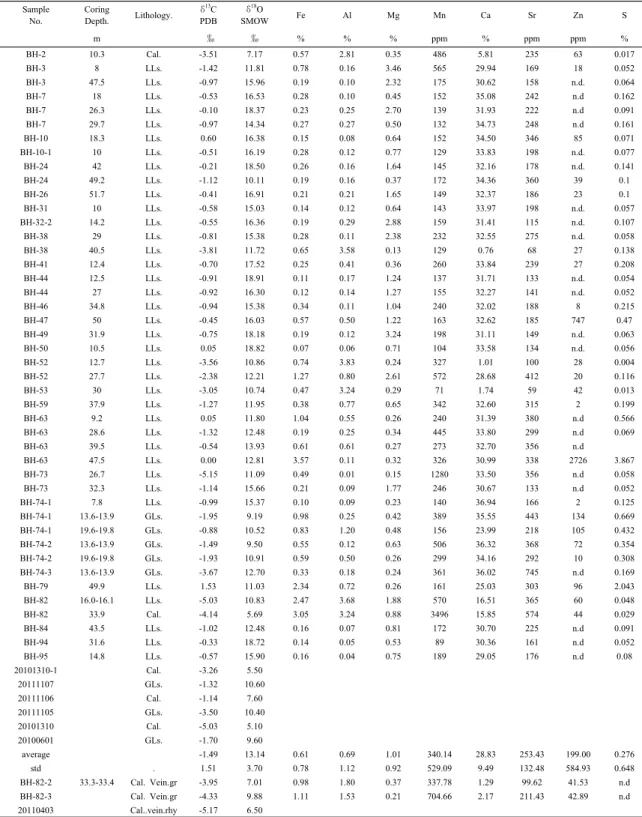
Oxygen and carbon isotopic compositions were measured for 50 carbonates from the outcrops and underground bore hole samples. The results are shown in Table 1. Limestones from the study area were classified into two types based on its texture and color:
one is the massive and grey color(GLs) type, and the other is the stratiform and milky color(LLs) type. δ18O values of the former tend to be lower than those of latter: the former range from +9.2 to +12.7 , while the‰ latter range from +10.1 to 18.9 ‰ δ. 18O values of GLs are more depleted than those of LLS, and they show very similar values. It is interesting that δ18O values of GLs are higher than those of LLs, although they were
deposited in the same age based on the stratigraphy of the formation. The range of δ18O values of the hydrothermally altered calcite and vein calcite in the granitic rocks are between +5.1 and +7.6 , and‰ between +7.01 and +9.9‰, respectively. And theδ18O value of the vein calcite in the rhyolite is +6.5 (Table‰ 1). δ18O values of hydrothermally altered calcites are very similar to the δ18O value of vein calcite in rhyolite, while they are slightly lower than those of vein calcites in the granitic rocks.
The δ13C values of GLs and LLs range from -0.88 to -3.7 . Vein calcites in the granitic rocks and‰ rhyolite have δ13C values ranging from -4.0 to -4.3 ,‰ and -5.2 , respectively. Hydrothermally altered calcites‰ show distinct δ18O and δ13C values ranging from +7.6 to +5.1‰ and from -1.14 to -5.03 , respectively‰ (Table 1), which are within the ranges of the so-called magmatic carbon and oxygen(Deines and Gold,1973).
These ranges indicate that hydrothermally altered calcite is significantly depleted in δ18O and δ13C relative to the least altered limestones in this study area, as was also suggested by some researchers (e.g., Nakano et al. 1997).
The variations of δ18O values of the limestones are generally wider and more distinct than those of δ13C values like those of other limestones as above mentioned. Thus, the limestone samples of the study area are divided into three groups based on δ18O values in 5‰intervals: higher than 15 (group A), 15-10‰ ‰ (group B) and 10-5 (group C).‰ δ18O values of vein calcites of rhyolite and granitic rock are lower than the 10‰as above mentioned. Therefore, limestones having higher than 15‰of δ18O are considered to be unaltered and unaffected by hydrothermal fluid. Limestones having δ18O values lower than 10 , particularly near‰ to 5 , are believed to be strongly affected by hyd‰ - rothermal fluid. Limestones in this study area contacted with Cretaceous volcanic rocks such as rhyolite or rhyolitic tuff and granitic rock(Fig. 2). The δ18O values tend to increase toward the center part of the limestone, but decrease in their contact part with igneous rocks(Fig. 3). The oxygen isotopic compositions did not show any variation with depth except in one bore hole(BH-63), of which the oxygen isotopic
Table 1. Sample description and chemical composition of carbonates in the Muan area
Sample No.
Coring
Depth. Lithology. δ13C PDB
δ18O
SMOW Fe Al Mg Mn Ca Sr Zn S
m ‰ ‰ % % % ppm % ppm ppm %
BH-2 10.3 Cal. -3.51 7.17 0.57 2.81 0.35 486 5.81 235 63 0.017
BH-3 8 LLs. -1.42 11.81 0.78 0.16 3.46 565 29.94 169 18 0.052
BH-3 47.5 LLs. -0.97 15.96 0.19 0.10 2.32 175 30.62 158 n.d. 0.064
BH-7 18 LLs. -0.53 16.53 0.28 0.10 0.45 152 35.08 242 n.d 0.162
BH-7 26.3 LLs. -0.10 18.37 0.23 0.25 2.70 139 31.93 222 n.d 0.091
BH-7 29.7 LLs. -0.97 14.34 0.27 0.27 0.50 132 34.73 248 n.d 0.161
BH-10 18.3 LLs. 0.60 16.38 0.15 0.08 0.64 152 34.50 346 85 0.071
BH-10-1 10 LLs. -0.51 16.19 0.28 0.12 0.77 129 33.83 198 n.d. 0.077
BH-24 42 LLs. -0.21 18.50 0.26 0.16 1.64 145 32.16 178 n.d. 0.141
BH-24 49.2 LLs. -1.12 10.11 0.19 0.16 0.37 172 34.36 360 39 0.1
BH-26 51.7 LLs. -0.41 16.91 0.21 0.21 1.65 149 32.37 186 23 0.1
BH-31 10 LLs. -0.58 15.03 0.14 0.12 0.64 143 33.97 198 n.d. 0.057
BH-32-2 14.2 LLs. -0.55 16.36 0.19 0.29 2.88 159 31.41 115 n.d. 0.107
BH-38 29 LLs. -0.81 15.38 0.28 0.11 2.38 232 32.55 275 n.d. 0.058
BH-38 40.5 LLs. -3.81 11.72 0.65 3.58 0.13 129 0.76 68 27 0.138
BH-41 12.4 LLs. -0.70 17.52 0.25 0.41 0.36 260 33.84 239 27 0.208
BH-44 12.5 LLs. -0.91 18.91 0.11 0.17 1.24 137 31.71 133 n.d. 0.054
BH-44 27 LLs. -0.92 16.30 0.12 0.14 1.27 155 32.27 141 n.d. 0.052
BH-46 34.8 LLs. -0.94 15.38 0.34 0.11 1.04 240 32.02 188 8 0.215
BH-47 50 LLs. -0.45 16.03 0.57 0.50 1.22 163 32.62 185 747 0.47
BH-49 31.9 LLs. -0.75 18.18 0.19 0.12 3.24 198 31.11 149 n.d. 0.063
BH-50 10.5 LLs. 0.05 18.82 0.07 0.06 0.71 104 33.58 134 n.d. 0.056
BH-52 12.7 LLs. -3.56 10.86 0.74 3.83 0.24 327 1.01 100 28 0.004
BH-52 27.7 LLs. -2.38 12.21 1.27 0.80 2.61 572 28.68 412 20 0.116
BH-53 30 LLs. -3.05 10.74 0.47 3.24 0.29 71 1.74 59 42 0.013
BH-59 37.9 LLs. -1.27 11.95 0.38 0.77 0.65 342 32.60 315 2 0.199
BH-63 9.2 LLs. 0.05 11.80 1.04 0.55 0.26 240 31.39 380 n.d 0.566
BH-63 28.6 LLs. -1.32 12.48 0.19 0.25 0.34 445 33.80 299 n.d 0.069
BH-63 39.5 LLs. -0.54 13.93 0.61 0.61 0.27 273 32.70 356 n.d
BH-63 47.5 LLs. 0.00 12.81 3.57 0.11 0.32 326 30.99 338 2726 3.867
BH-73 26.7 LLs. -5.15 11.09 0.49 0.01 0.15 1280 33.50 356 n.d 0.058
BH-73 32.3 LLs. -1.14 15.66 0.21 0.09 1.77 246 30.67 133 n.d 0.052
BH-74-1 7.8 LLs. -0.99 15.37 0.10 0.09 0.23 140 36.94 166 2 0.125
BH-74-1 13.6-13.9 GLs. -1.95 9.19 0.98 0.25 0.42 389 35.55 443 134 0.669
BH-74-1 19.6-19.8 GLs. -0.88 10.52 0.83 1.20 0.48 156 23.99 218 105 0.432
BH-74-2 13.6-13.9 GLs. -1.49 9.50 0.55 0.12 0.63 506 36.32 368 72 0.354
BH-74-2 19.6-19.8 GLs. -1.93 10.91 0.59 0.50 0.26 299 34.16 292 10 0.308
BH-74-3 13.6-13.9 GLs. -3.67 12.70 0.33 0.18 0.24 361 36.02 745 n.d 0.169
BH-79 49.9 LLs. 1.53 11.03 2.34 0.72 0.26 161 25.03 303 96 2.043
BH-82 16.0-16.1 LLs. -5.03 10.83 2.47 3.68 1.88 570 16.51 365 60 0.048
BH-82 33.9 Cal. -4.14 5.69 3.05 3.24 0.88 3496 15.85 574 44 0.029
BH-84 43.5 LLs. -1.02 12.48 0.16 0.07 0.81 172 30.70 225 n.d 0.091
BH-94 31.6 LLs. -0.33 18.72 0.14 0.05 0.53 89 30.36 161 n.d 0.052
BH-95 14.8 LLs. -0.57 15.90 0.16 0.04 0.75 189 29.05 176 n.d 0.08
20101310-1 Cal. -3.26 5.50
20111107 GLs. -1.32 10.60
20111106 Cal. -1.14 7.60
20111105 GLs. -3.50 10.40
20101310 Cal. -5.03 5.10
20100601 GLs. -1.70 9.60
average -1.49 13.14 0.61 0.69 1.01 340.14 28.83 253.43 199.00 0.276
std . 1.51 3.70 0.78 1.12 0.92 529.09 9.49 132.48 584.93 0.648
BH-82-2 33.3-33.4 Cal. Vein.gr -3.95 7.01 0.98 1.80 0.37 337.78 1.29 99.62 41.53 n.d
BH-82-3 Cal. Vein.gr -4.33 9.88 1.11 1.53 0.21 704.66 2.17 211.43 42.89 n.d
20110403 Cal..vein.rhy -5.17 6.50
Ls. : Limestone, Cal. : Calcite, GLs. : Grey limestone, LLs. : Crystallined white limestone, gr : granite, rhy : rhyolite
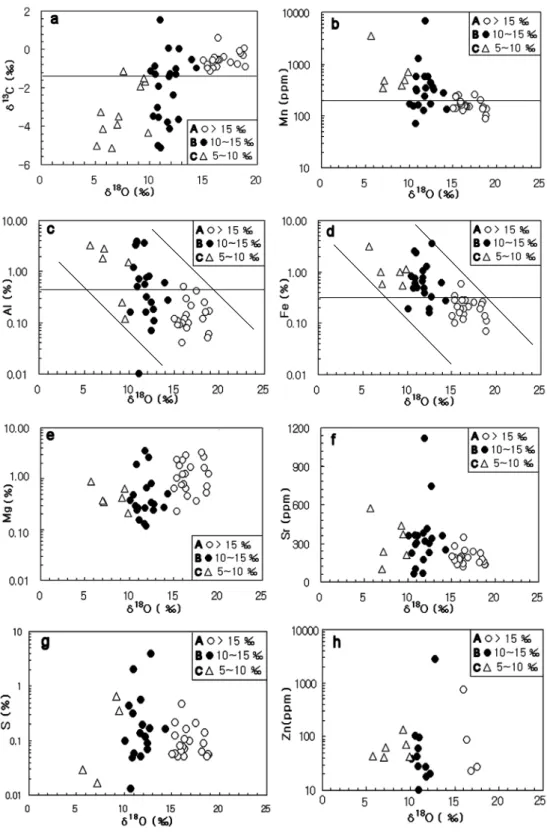
Fig. 3. Relationships of δ18O and trace elements in the Muan limestones. See text for details.
compositions increased with depth. Such variations of δ18O may be resulted from mineral compositions and fine structures of the limestone.
Mean δ13C values of marine and fresh water carbonates vary within narrow ranges, regardless of the geologic ages of the carbonates(0.56±1.55 , and -4.93±2.75 ,‰ ‰ respectively; Keith and Weber, 1964). The δ13C values of LLs and GLs in the study area range between +0.6 and -5.6 , and -0.9 and -3.67‰ ‰with averages of -1.1 and -2.1 , respectively. In contrast, the‰ δ18O values of marine carbonates varied with geologic age and change in temperature of sea water; +20‰ for Cambrian limestone(Keith and Weber, 1964), and +28 to +30‰
for recent marine limestone (Faure, 1986). Shieh and Taylor(1969) reported δ18O values of 22-27‰ for marine carbonates. The maximun δ18O values for unaltered limestones in the study area were about 18 ,‰ indicating that these limestones were significantly or slightly depleted in 18O compared with those of the reported marine carbonates or Cambrian limestones.
The δ18O and δ13C values of metamorphic rocks and hydrothermal carbonates are generally lower than the primary values because the CO2 released during decarbonation is enriched in 18O and 13C through meta- morphism and hydrothermal alteration(Shieh and Taylor, 1969; Taylor and O'neil, 1977; Kim and Nakai,1980;
Black, 1984; So et al., 1993). The depletion of δ18O values in the unaltered limestone from the study area compared with those of marine carbonates may have resulted from the interaction between limestones and hydrothermal fluids of a low δ18O value and a low CO2/H2O ratio, as suggested by Morishita et al.(1999).
Relationship between oxygen isotopic composition and elemental contents of carbonates
Chemical composition of limestone varies depending on the depositional environment and alteration of car- bonates by geological processes after deposition(e.g., Schuiling and Oosterom 1966; Fujinuki, 1973; Brand and Veizer, 1980; Bellanca et al., 1981).
Some major and trace elements for the limestone of the study area were analyzed by ICP-MS(Table 1). The concentrations of Al, Fe, Mg, Mn, S, Sr and Zn were plotted against δ18O values of the carbonates(Fig. 3).
The variation ranges of the contents of these elements
in the limestone are wider than those of the Great limestone series(Park and Han, 1986; Kim, 1980; Fig.
4). This result indicates that the elements in the limestone of the study area substituted Ca during hydrothermal alteration. The concentrations of Al, Fe and Mn tend to increase with the decrease in δ18O values, and in particular, Fe and Al show distinctive correlations with δ18O values(Fig. 3 b, c, d). The con- centrations of these elements in group-C(altered limestone) were several to hundred times higher than those in group-A(unaltered limestone), although the concentrations varied widely within each group. The altered limestone (group-C) can be also distinguished from the unaltered limestone(group-A) by Mn concentration of about 250ppm and by Fe of about 0.5% (Fig. 3 b, d). Al concentration in group-C is divided into two groups:
higher and lower group, which were divided at 1.0%
Al.(Fig. 3 c). The difference between the groups may be resulted from the different mineral and chemical compositions of the hydrothermal fluids and the lim- estones.
On the other hand, the ratios of Mg to Fe of the limestones also discriminated between group-A and group-C, which were separated at the ratio of 1 to 1(Fig. 5 a). Fe contents have positive correlations with Mn and Al (Fig. 5 b, c), and they distinguished altered limestone from unaltered limestone at 0.4% Fe(Fig. 5 b, c), respectively.
The altered limestones(group-C) are also distinguished from the unaltered limestone(group-A) by the Mg/
(Mg+Fe+Mn; hereafter Mg*) vs. δ18O values, Al/Mg vs. δ18O values, Mg* vs. Al and Mg* vs. Al/Sr (Fig.
6 a, b, c, d ). Therefore, the ratio of Mg / (Mg+Fe+Mn) can be utilized as a powerful indicator for distinguishing altered limestone from unaltered limestone in this area, as suggested by Nakano et al.(1997).
In contrast to Al, Fe and Mn, the concentration of Fig. 4. The comparisons of carbon and oxygen isotope compositions, and concentrations of some elements between Great limestone series and Muan limestone.
S and Sr did not change with δ18O values. Sr concentrations of the carbonates in the study area were less than 400ppm except for four samples(Table 1). Sr in limestone decreases (Brand and Veizer, 1980;
Schuilling and Oosterom, 1966) or increases(Bellanca et al., 1984) with diagenetic and metamorphic processes.
Sr in the unaltered limestones of the study area generally showed neither a remarkable enrichment nor depletion with δ18O values, however, the concentrations of Sr in the altered limestones(two samples) were slightly higher than those of the unaltered limestones (Fig. 3f). Thus, it is inferred that Sr slightly substituted Ca during the process of alteration of the limestone.
Although S contents may be enriched in the altered limestone due to the sulfides transported by hydrothermal fluids, most limestones and vein samples from the study area contained less than 0.2% of S, except for a few samples. It is inferred that amount of sulfides were negligible in the hydrothermal fluid. This is consistent with low Fe and Zn concentrations. Zn concentrations were several tens of ppm in most samples. The amount
of sphalerite-S from a concentration of several tens of ppm of Zn was calculated to be at most 0.005%. It is inferred that such a low Zn concentration of most samples studied was not derived from the sphalerite based on the suggestions that calcite and limestone can contain certain amounts of Zn from a few ppm to several hundred ppm(Brand and Veizer, 1980; Caldroni and Ferrini, 1984; Reeder, 1996). However, only two samples contained more than 100 ppm Zn: one is 747 ppm and another is 2,720 ppm. Because the concentration of S in the limestone sample containing 2,726 ppm Zn was identical to that of S calculated from the stoi- chiometry of sphalerite(0.13%), this sample may contain sphalerite. However, it may be impossible to be presence of Fe-sulfide, considering the significantly low average concentration of S(0.11-0.38%) in the limestones, although the relationships of Fe and S show a positive correlation in most samples of group-A(Fig.
5d). Even if Fe-sulfide was present in the unaltered limestone, the amounts of Fe-sulfide would be negligible.
Pingitore et al.(1995) suggested that several hundred Fig. 5. Relationships between elements; (a) Fe and Mg, (b) Fe and Mn, (c) Fe and Al and (d) Fe and S in the Muan limestones. See text for details.
ppm of SO4can substitute CO3in carbonate. Therefore, most S content in the limestones, except for a few samples with high concentration of Fe and Zn may be present as sulfate. Mg content do not show a distinctive trend with δ18O values(Fig. 3 e). Mg contents of the GLs were narrower and more distinct than those of LLs. Mg is a major cation which substitutes Ca in carbonate. The restricted range of Mg content in the
GLs(0.24-0.63%) indicates that Mg in carbonate was removed during alteration, while the comparatively large variation of Mg content in LLs (0.13 to 3.46 %) indicates that Mg of LLs was not removed locally during hydrothermal alteration. Therefore, it is believed that a significantly large amount of Mg substituted for Ca in the limestone during hydrothermal activity.
Although Fe may partly be derived from sulfides Fig. 6. Relationships of Mg*-δ18O(a), Mg*-Al(c), Mg*-Al/Sr(d), Al/Mg-δ18O(b), Al/Mg-Al/Sr(e) and Sr/Mn-Al/Sr(f) in Muan limestone. See text for details.
such as pyrite, the increase of Al, Fe and Mn in the
18O-depleted limestones suggest that the high Al, Fe and Mn in the altered limestones are mainly attributed to chlorite. In most of the strongly 18O depleted limestones, Al and Fe concentrations were lower than 3.0 and 1.0%, respectively, and Mn was lower than 1,000ppm. However, the combination of Al, Fe and Mn was effective for distinguishing altered limestone from unaltered limestones.
Summary and Conclusions
The oxygen and carbon isotope mesurements for the limestones distributed in the Muan area, southwestern part of Korea showed that the 18O values of the limestones were depleted at the contact part of limestones and igneous rocks, but were enriched toward the center of the limestone formation. Hydrothermally altered calcites from the study area showed the most depleted18O values. This result strongly suggested that the limestone may have been altered by hydrothermal fluid. Elements such as Al, Fe and Mn were enriched, while those such as S, Sr and Zn were depleted in 18O depleted limestone. This indicated that the enrichments of Al, Fe and Mn were probably attributed to the presence of hydrothermal Al-Fe minerals such as chlorite and epidote. In addition to the concentration of enriched elements stated above, Mg* and Al/Mg can be used as more powerful indicators for distinguishing altered limestone from unaltered limestone in this study area. In contrast, S and Sr concentrations in the limestone did not have relations to δ18O depletion and other elements analyzed. This indicates that the S and Sr in the limestone were not exchanged with the hydrothermal fluid responsible for δ18O depletion.
Oxygen isotope compositions, elemental compositions, relationship between elemental composition and δ18O, and elemental ratios of limestones may serve as potential tools for distinguishing altered limestone from unaltered limestone in the study area.
Acknowledgements
This paper was supported by Chonnam National University for my sabbatical year(2004). I thank Dr.
Kim, J. H. and Mr. Jung H. S. of the Korea Rural
Amenity and Agricultural Corporation(KRC) for providing core samples from the study area. I also thank Eric Hoffman of Actlabs, Canada for analyzing minor and trace elements of limestone and Professor Pan, J. Y. of Department of Nanjing University for measuring oxygen and carbon isotopes of limestone. Author appreciate valuable comments made by three anonymous revie- wers, which helped me to improve this paper.
References
Beaty, D. W. and Marchant, J. S., 1990, Origin of Ore Deposits at Gilman, Colorado. Econ. Geol. Monograph 7, pp. 193-265.
Bellanca,A., Censi, P., Di and Neri, R., 1984, “Textuual, Chemical and Isotopic Variations Induced by Hydrothermal Fluids on Mesozoic Limestones in Northwestern Sicily”, Mineral Deposita, 19, pp.78-85.
Black, M.P., 1984, “Oxygen Isotope Study of Metamorphic Rocks from the Ouegoa District, New Caledonia”.
Contribu. Mineral and Petrol., 47, pp. 197-206.
Brand, U. and Veizer, J., 1980, “Chemical Diagenesis of a Multicomponent Carbonate System-1;Trace Elements”.
J. Sedimentology, 50, pp. 1219-1236.
Calderoni, G and Ferrini, V,, 1984, “Abundances and Chemical Fractionation of Al, Fe, Mn, Zn, Pb, Cu and Tl in Cretaceous-Paleocene Limestones from Gubbio (CentralItaly)”. Geochem. Jour., 18 pp. 31-41.
Choi, S. O. and Ko, C. B., 1971, Explanatory text of the geological map Muan sheet, 1:50,000. Geological Survey of Korea, 12p.
Craig, H.,1957, “Isotopic Standards for Carbon and Oxygen and Correction Factors for Mass Spectrometric Analysis of Carbon Dioxide”. Geochim. Cosmochim. Acta., 12, p. 133.
Criss, R., Fleck, R.J. and Taylor, H. P. J. 1991, “Tertiary Meteoric Hydrothermal system and Their Relation to Ore Deposition, northwestern United States and southern British Colombia”. J. Geophy. Res., 94, pp. 13335-13356.
Deines, P. and Gold, D. P. 1973 “The isotopic composition of carbonatite and kimberlite carbonates and their bearing on the isotopic composition of deep-seated carbon”.
Geochim. Cosmochim. Acta., 37, pp. 1709-1733.
Enrich, A. E. J. Clayton, R.N. and Epstein, S., 1958,
“Variation of Isotopic composition of Oxygen and Carbon in Leadville Limestone(Mississipian Colorado) and Its Hydrothermal and Metamorphic Phases”. J. Geol.
66, pp. 374-393.
Faure, G., 1986, Principles of Isotope Geology. 2nd ed., John Wiley & Sons, New York, 589p.
Fujinuki, T., 1973, “Trace elements in Carbonate Rocks”.
Mining Geol., 23, pp. 295-306(in Japanese with abstract
written in English).
Heyl, A. V., Landis, G. P. and Zartman, R. E., 1974,
“Isotopic Evidencefor the Origin of Mississippi Valley- Type Mineral Deposits: A Review”. Econ. Geol., 69, pp.
992-1006.
Hoefs, J., 1997, Stable Isotope Geochemistry, Springer- Verlag. 210p.
Jamtveit, B.,Grorud, H. F. and Ragnarsdottir, K. V., 1997, Flow and Transport during Contact Metamorphism and Hydrothermal Activity; Ezamples from the Oslo rift, in Jamtveit, B. and Yardly, B., eds., Fluid flow and Transport in Rocks, Mechanism and Effects: London, Chapman and Hall, pp. 57-82.
Keith, M. L. and Weber, J. N., 1964, “Isotopic Composition and Environmental Classification of Selected Limestones and Fossils”. Geochim Cosmochim. Acta, 28, 1787-1816.
Kim, K. H., 1980, “Carbon and oxygen isotope studies of the Paleozoic limestones from the Taebaegsan region, South Korea”. Jour. Mining Geol., 13, pp. 21-27.
Kim, K. H. and Nakai, N.,1980, “Carbon and Oxygen Isotope Studies of the Carbonate Rocks from the Shinyemi Zinc-Lead Ore Deposits Western Taebaegsan Metallogenic belt, Korea”. J. Earth Sci., Nagoya Univ., 28, 57-74.
McCrea, J. M.,1950, “On the Isotopic Chemistry of Carbonates and the Paleo-Temperature Scale”. J. of Chemical Physics, 18, pp.849-857.
Matsuhisa, Y., Imaoka, T. and Murakdottami, N., 1980,
“Hydrothermal Activity Indicated by Oxygen and Hydrogen Isotopes of Rocks and Minerals from Paleogene Cauldron, Southwest Japan”. Mining Geol., Spec. Issue, 8, pp. 49-65.
Megaw, P. K. M., 1990, “Geology and Geochemistry of the Santa Eulalia Mining District, Chihuahua, Mexico”.
Unpublished Ph.D. dissertation, University of Arizona.
Morishita, J., 1999, “Three-Dimensional Isotopic Characteristics of Crystalline Limestone around the Sakonish Zn Ore Bodies in the Kamioka Mining District, Japan”. Resource Geol., 49, pp. 243-257.
Muan-gun, 2001, Detail Safety Investigation Report for Ground Subsidence of the Seongnam, Muan. 695p.
Nakano, T., Murakami, H., Miyake, K. and Nakayama, K., 1997, “Chemical Composition of18O-Depleted Limestone in the Kamioka Zn-Pb Mine as a Potential Tool for the Exploration of Skarn Deposits”. Resource Geol., 47, pp.
109-119.
Park, B. K. and Han, S. J., 1986, “Trace elements in the Pungchon limestone of Middle Cambrian”. Jour. Geol.
Soc. Korea, 22, pp. 105-122.
Pinckney, D. M. and Rye, R.O., 1972, “Variations of O18/O16 and C13/C12 Texture and Mineralogy in Altered Limestone in the Hill mine, Cave in Rock District, Illinois”. Econ. Geol., 67, pp. 1-18.
Pingitore, N. E., Merrzner, G. and Love, K. M., 1995,
“Identification of Sulfate in Natural Carbonates by X-ray
Absorption Spectroscopy”. Geochim. Cosmochim. Acta, 59, 2477-2482.
Reeder, R. J., 1996, “ Interaction of Divalent Cobalt, Zinc, Cadminium, and Barium with the Calcite Surface during Layer Growth”. Geochim. Cosmochim. Acta., 60, pp.
1543-1552.
Ruiz, J. and Barton, M. D., 1985, Geology and Geochemistry of Naica, Chihuahua, Mexico. SME-AIME Meeting, Feb.
26, 1985, New York, NY, Preprint 85-32, pp.1-7.
Schuiling, R. D. and Oosterom, M. G., 1966, ”The Metamorphic Complex on Naxos(Greece) and Strontium and Barium Content of its Carbonate Rocks”. Proc. Kon.
Red. Akad. Wetensch. B 69, pp. 166-175.
Schwarcz, H. P., 1969, The isotopes in nature. Handbook of Geochemistry, Vol. II/1, K. H. Wedelpohl,ed., Berlin:
Springer-Verlag.
Shieh, Y. N. and Taylor, H. P. Jr., 1969, “Oxygen and Carbon Isotope Studies of Contact Metamorphism of Carbonate Rocks”. J. Petro., 10, pp. 307-331.
So, C. S., Yun, S. T. and Koh, Y., 1993, “Mineralogy, Fluid Inclusion and Stable Isotope Evidence for Genesis of Carbonate-Hosted Pb-Zn(Ag) Orebodies of the Taebaeg Deposit, Republic of Korea”. Econ. Geol., 88, pp.
855-872.
Taylor, H. P. Jr., 1973, “18O/16O Evidence for Meteoric Hydrothermal alteration and Ore Deposition in the Tonopah, Comstock lode, and Goldfield mining District, Nevada”. Econ. Geol., 68, 747-764.
Taylor, B. E. and O'nail, J. R., 1977, “Stable Isotope Studies of Metasomatic Ca-Fe-Al-Si Skarns and Associated Metamorphic Rocks, Osgood Mountains Nevada”. Contribu.
Mineral and Petrol., 63, pp.1-49.
Vazquez, R., Vennemann, T. W. Kesler, S. E. and Russell, N.,1998, ”Carbon and Oxygen Isotope Halos in the Host Limestone, El Mochito Zn-Pb-(Ag) Skarn Massive Sulfide- Oxide Deposit, Honduras“ Econ. Geol., 93, pp. 15-31.
Veizer, J. and Hoefs, J.,1976, “The Nature of O18/O16and
13C/12C Secular Trends in Sedimentary Carbonate Rocks”.
Geochim. Cosmochim. Acta, 40, pp.1387-1395.
윤 정 한
1973년전남대학교 자원공학과 공학사 년 전남대학교 자원공학과 공학석사 1976
년 서울대학교 자원공학과 공학박사 1989
현재 전남대학교 공과대학 지구시스템공학전공 교수 (E-mail; [email protected])