감초 분말을 첨가한 양갱의 품질 특성과 항산화 활성
⁃연구노트⁃
최지은․이준호 대구대학교 식품공학과
Quality Characteristics and Antioxidant Activities of Yanggaeng Supplemented with Licorice Powder
Ji Eun Choi and Jun Ho Lee
Department of Food Science and Engineering, Daegu University
ABSTRACT Feasibility of incorporation of licorice powder (LP) as a value-added food ingredient into convenient food products was investigated using yanggaeng as a model system. LP was incorporated into yanggaeng at amounts of 0, 2, 4, 6, and 8% (w/w) based on total weight of cooked white beans and LP. pH level decreased while soluble solid content significantly increased with increasing levels of LP (P<0.05). In terms of color, lightness decreased while redness and yellowness increased significantly (P<0.05) with increasing levels of LP. Hardness also decreased significantly with a higher amount of LP in the formulation (P<0.05). 2,2'-Azino-bis(3-ethylbenzothiazoline-6-sulfonic acid) and 2,2'-diphenyl-1-picrylhydrazyl radical scavenging activities were significantly elevated by LP addition, and they increased significantly as LP concentration increased in the formulation (P<0.05). Finally, consumer acceptance test indicated that the highest levels of LP incorporation (8%) had an adverse effect on general consumer preferences.
In contrast, yanggaeng with moderate levels of LP (2%) is recommended based on its overall scores to take advantage of the antioxidant properties of LP without sacrificing consumer acceptability.
Key words: yanggaeng, licorice powder, quality characteristics, antioxidant activities, consumer acceptance
Received 8 March 2016; Accepted 15 June 2016
Corresponding author: Jun Ho Lee, Department of Food Science and Engineering, Daegu University, Gyeongsan, Gyeongbuk 38453, Korea
E-mail: [email protected], Phone: +82-53-850-6531
서 론
감초(Glycyrrhiza uralensis Batal.)는 Glycyrrhiza종의 뿌리와 근경을 건조한 것으로 동・서양에서 빈번하게 사용되 는 약용식물이다(1,2). 감초에는 감미 성분인 glycyrrhizin 이 6~14% 정도 함유되어 있어 설탕보다 약 200배의 단맛 을 내며(3), 이 고유의 단맛을 활용하여 감미증강제나 향미 증강제 등으로 널리 사용되고 있다(4). 감초의 주성분인 glycyrrhizin은 알레르기(3), 바이러스 질환(5), 만성간염(6) 등에 뛰어난 예방 효과가 있는 것으로 알려져 있으며, 양친 매성을 띠어 기타 성분들과 쉽게 결합하기 때문에 여러 방면 에서 활용이 용이하다는 장점이 있다(7). 이러한 감초의 우수 한 기능적 특성에도 불구하고 현재까지 제과・제빵분야인 머 핀(8), 식빵(9), 파운드케이크(10)와 발효식품인 김치(11), 탁주(12), 된장(13), 고추장(14) 등에 기능성 부재료로 한정 된 응용이 보고된 바 있다.
한편 양갱은 우리나라 고유 전통식품으로 한천과 설탕,
팥을 조려 제조되며 단맛과 부드러운 식감으로 모든 세대의 간식으로 애용되고 있다(15). 양갱의 주된 원료인 한천은 80
% 이상이 식이섬유소로 구성되어 있어 열량이 낮을 뿐 아니 라 높은 보수력으로 인해 쉽게 포만감을 제공하는 것으로 알려져 있다(16,17). 또한, 앙금의 주재료인 팥은 vitamin B1과 saponin 등을 다량 함유하고 있으며, 특히 saponin은 이뇨 효과와 각기병, 숙취 등에 효과가 뛰어난 것으로 보고 되었다(18). 현재 밤, 고구마, 녹차, 홍삼 등의 부재료를 첨가 한 기능성 양갱이 시판되고 있으며(17), 그 외에도 생강(15), 자색고구마(17), 더덕(19), 쑥(20), 진피(21) 등을 기능성 부재료로 사용한 연구 결과가 보고된 바 있다.
최근 소비자들은 영양에 대한 1차 기능, 기호성에 대한 2차 기능에 만족하지 않고 다양한 생리기능성에 대한 3차 기능을 요구하고 있으며, 이에 따라 한방 약재에 대한 소비 자들의 선호도가 증가하고 있는 추세이다(22). 본 연구에서 는 한방의 주재료 중 단맛이 강한 감초를 다양한 농도로 첨 가한 양갱을 제조하여 소비자들의 다양한 니즈에 부응하고 자 하였으며, 감초 분말의 대체 농도에 따른 물리 화학적 및 관능적 품질 특성을 조사함으로써 기능성과 기호성을 충 족하는 양갱을 개발하는 데 필요한 기초 실험자료를 제공하 고자 하였다.
재료 및 방법
실험재료
본 실험에 사용된 감초 분말은 가루나라(Seoul, Korea), 백앙금은 대두식품(Seoul, Korea)에서 구입하였으며, 한천 분말(Myoungshin Corp., Gyeongnam, Korea), 올리고당 (CJ Cheiljedang Corp., Seoul, Korea), 백설탕(CJ Che- iljedang Corp., Incheon, Korea) 및 100% 천일염꽃소금 (Chungjungone Corp., Jeonnam, Korea)은 시중에서 구입 하여 사용하였다.
양갱의 제조
먼저 여러 차례의 사전 예비실험을 통해 감초 양갱을 제조 하고, 기본적인 품질을 기준으로 백앙금 총무게(500 g)에 대해 0, 2, 4, 6, 8%의 감초 분말을 백앙금과 대체하기로 하였다. 한천 분말 10 g을 물 400 mL에 넣어 15분 불린 후 10분 동안 가열하여 한천을 녹이고, 설탕(50 g)과 올리고 당(50 g), 소금(2 g)을 넣고 5분간 가열하였다. 백앙금을 첨 가하여 5분간 끓인 후 감초 분말을 넣고 3분간 가열하고 불에서 내려 5분간 방치한 다음 성형틀(3×3×3 cm)에 넣어 4°C에서 13시간 동안 응고시켰다. 각각의 시료는 상온에서 1시간 방치한 후 실험에 사용하였다.
물리 화학적 품질 특성
감초 분말을 첨가한 양갱의 pH와 당도는 시료 10 g을 취 하여 90 mL 증류수와 혼합하고 1분간 균질하여 1시간 방치 한 후 상등액을 pH meter(pH/Ion 510, Oakton Instru- ments, Vernon Hills, IL, USA)와 당도계(PR-301, Atago Co., Tokyo, Japan)를 이용하여 각각 3회 또는 5회 반복 측정하였다. 수분함량은 실온에서 1시간 동안 방치한 양갱 5 g을 사용하여 105°C에서 상압가열건조법으로 5회 반복 측정하였다.
경도는 Advanced Universal Testing System(LRXPlus, Lloyd Instrument Ltd., Fareham, UK)을 이용해 test speed 100 mm/min, trigger 5 gf의 조건에서 직경 5 cm의 disc형 probe를 사용하여 3×3×3 cm 크기의 시료를 20회 반복 측정하였다. 색도는 양갱의 단면을 분광색차계(CM- 600d, Minolta Co., Osaka, Japan)로 4회 반복 측정하여 명도(L*), 적색도(a*) 및 황색도(b*) 값으로 나타내었으며, total color difference(ΔE*)는 아래의 식으로 계산하였다.
ΔE*=[(ΔL*)2+(Δa*)2+(Δb*)2]1/2
여기서 ΔL*=L*0-L*, Δa*=a*0-a*, Δb*=b*0-b*를 나타내며, L*, a* 및 b* 값들은 각 시료의 측정값이고 L*0, a*0 및 b*0
값은 대조군의 측정값을 의미한다.
항산화 활성
DPPH(2,2'-diphenyl-1-picrylhydrazyl)와 ABTS(2,2'-
azino-bis(3-ethylbenzothiazoline-6-sulfonic acid)) rad- ical 소거능 측정은 각각 Blois(23)와 Re 등(24)이 사용한 방법을 응용하여 측정하였다. 시료 2.5 g에 70% 에탄올 (Merck KGaA, Darmstadt, Germany) 50 mL를 넣고 1분 간 균질화한 후 실온에서 1시간 추출한 다음, 8,000 rpm에 서 10분간 원심분리 하여 얻은 상등액을 Whatman No. 1 여과지(GE Healthcare UK Ltd., Little Chalfont, UK)로 여과한 용액의 흡광도를 분광광도계(Optizen 2020 UV Plus, Mecasys Co., Ltd., Daejeon, Korea)를 사용하여 각 각 517 nm와 734 nm에서 측정한 후 아래의 식에 대입하여 계산하였다.
Radical scavenging
activity (%) =
(
1- AbssampleAbs-Abscontrol)
×100blank
소비자 기호도 검사
소비자 기호도 검사는 무작위로 선발된 성인 50명(남 28 명, 여 22명; 45~55세)을 대상으로 시행하였다. 각 시료를 3×3×3 cm 크기로 잘라 세 자리 난수표로 구분한 접시에 나열하여 제시하였으며, 7점 척도법(1=매우 싫음, 7=매우 좋음)을 사용하여 평가하였다. 전체적인 기호도(overall preference)가 다른 평가항목에 미치는 영향을 방지하고자 전체적인 기호도를 먼저 평가한 다음, 개별 평가항목인 색 (color), 향(flavor), 맛(taste), 씹힘성(chewiness)을 평가 하였으며, 시료 간 잔향과 잔미의 방해를 최소화하기 위해서 시료 사이에 물을 이용하여 입안을 헹군 후 검사를 시행하도 록 하였다.
통계처리
모든 실험 결과는 SAS ver. 9.1(25)을 이용하여 분산분 석(ANOVA) 하였고, 5% 수준에서 유의성 있는 시료 간 평 균값의 비교는 Duncan's multiple range test에 의해 분석 하였다.
결과 및 고찰
물리 화학적 품질 특성
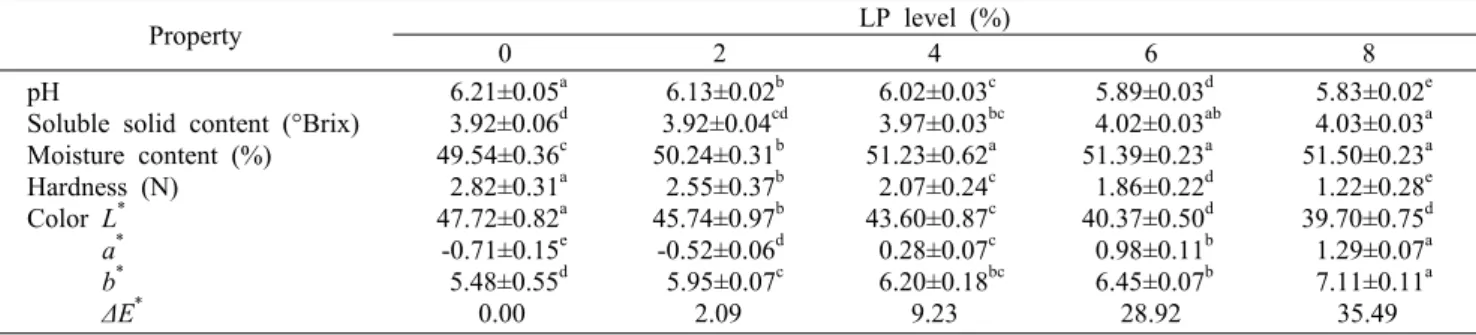
감초 분말의 첨가량을 달리한 양갱의 물리 화학적 품질 특성을 측정한 결과는 Table 1에 나타내었다. 대조군의 pH 는 6.21로 가장 높았으며, 감초 분말의 첨가량이 증가할수록 6.13, 6.02, 5.89, 5.83으로 유의적으로 감소하였다(P<0.05).
이는 pH가 5.68인 감초 분말이 첨가됨으로써 양갱의 pH에 직접적인 영향을 미쳐 점차 감소하는 경향을 나타냈으며, pH가 상대적으로 낮은 부재료가 첨가됨으로써 양갱의 pH 가 감소하는 유사한 현상은 감귤 분말(26)과 블루베리 분말 (27)을 첨가한 양갱에서도 보고된 바 있다.
감초 양갱의 가용성 고형분 함량은 3.92~4.03°Brix를 나 타내었으며(P<0.05), 이는 감초에 함유된 glycyrrhizin, glucose, sucrose, mannitol 등의 다양한 당류 성분들이 가
Table 1. Physicochemical properties of yanggaeng incorporated with different levels of licorice powder (LP)
Property LP level (%)
0 2 4 6 8
pH
Soluble solid content (°Brix) Moisture content (%) Hardness (N) Color L*
a* b* ΔE*
6.21±0.05a 3.92±0.06d 49.54±0.36c 2.82±0.31a 47.72±0.82a -0.71±0.15e 5.48±0.55d
0.00
6.13±0.02b 3.92±0.04cd 50.24±0.31b 2.55±0.37b 45.74±0.97b -0.52±0.06d 5.95±0.07c
2.09
6.02±0.03c 3.97±0.03bc 51.23±0.62a 2.07±0.24c 43.60±0.87c 0.28±0.07c 6.20±0.18bc
9.23
5.89±0.03d 4.02±0.03ab 51.39±0.23a 1.86±0.22d 40.37±0.50d 0.98±0.11b 6.45±0.07b
28.92
5.83±0.02e 4.03±0.03a 51.50±0.23a 1.22±0.28e 39.70±0.75d 1.29±0.07a 7.11±0.11a
35.49 Means with different letters (a-e) within the same row are significantly different (P<0.05).
0 10 20 30 40 50 60 70 80
0 2 4 6 8
Concentration (%)
0 10 20 30 40 50 60 DPPH
ABTS
DPPH free radical scavenging activity (%) . ABTS radical scavenging activity (%) .
d
a a b a
c b
d c
e
Fig. 1. DPPH and ABTS radical scavenging activities of yang- gaeng incorporated with different levels of LP. Means within the same property with different letters (a-e) are significantly different (P<0.05).
용성 고형분 함량의 증가에 영향을 미친 것으로 판단된다.
이와 같은 결과는 블루베리 분말(27)과 더덕 껍질 농축액 (28)의 첨가량이 증가할수록 양갱의 당도가 증가하였다는 연구 결과와 유사하였다. 한편 감초 분말의 첨가량에 따른 양갱의 수분함량은 대조군이 49.54%로 가장 낮았으며 8%
첨가구가 51.50%로 가장 높게 나타났으나, 4~8% 첨가군 사이에 유의적인 차이는 없었다(P>0.05). 이러한 변화는 감 초 분말에 함유된 당류나 식이섬유소 등에 의한 보수력 증가 에 기인하는 것으로 판단된다. 유사한 이유로 동결건조 감귤 (26), 블루베리(27), 백하수오(29) 등의 분말을 첨가한 양갱 의 품질에 관한 연구에서도 분말의 첨가량이 증가할수록 수 분함량이 증가한다는 경향이 보고된 바 있다.
대조군의 경도는 2.82 N으로 가장 높았고, 2, 4, 6, 8%
첨가군은 각각 2.55, 2.07, 1.86, 1.22 N으로 감초 분말의 첨가량에 따라 유의적으로 감소하였다(P<0.05). 이러한 경 도의 변화는 감초 분말의 첨가로 인해 보수력이 증가함으로 써 수분함량이 증가하게 되고 따라서 상대적 경도는 감소한 것으로 생각한다. 머핀 또는 파운드케이크 제조 시 각각 감 초 추출물(8) 또는 감초 분말(10)을 첨가한 경우 유사한 이 유로 인해 각 시료의 경도가 감소하였다고 보고된 바 있다.
감초 양갱의 명도(L*)는 대조군이 47.72로 가장 높았고 감초 분말의 첨가량이 증가함에 따라 유의적인 감소를 보였 으나(P<0.05), 6~8% 첨가군 사이에 유의적인 차이는 발견 되지 않았다(P>0.05). 발효홍삼 농축액(30), 블루베리 분말 (27), 흑임자 분말(31), 파프리카 분말(32) 등을 첨가한 양 갱에서도 짙은 색을 띤 부재료를 첨가함에 따라 L*값이 감소 하여 어두워지는 경향을 보였다. 적색도를 나타내는 a*값은 감초 분말의 첨가량이 증가할수록 -0.71에서 1.29로 유의 적으로 증가하는 경향을 보였으며 8% 첨가군이 1.29로 가 장 높았다(P<0.05). 황색도를 나타내는 b*값 또한 감초 분말 의 첨가량에 따라 5.48에서 7.11로 유의적으로 증가하는 경향을 보였으나(P<0.05), 2~4% 첨가군 및 4~6% 첨가군 사이에 유의적인 차이는 발견되지 않았다(P>0.05). 같은 부 재료인 감초 분말을 첨가하여 제조한 파운드케이크(10)에 서도 감초 분말의 첨가량이 증가할수록 L*값이 감소하고 a* 값과 b*값은 증가하여 본 실험과 유사한 경향을 보였다. 한 편 본 실험에 사용된 감초 분말의 L*, a*, b* 값은 각각 52.10,
1.52, 9.72로 감초 분말의 고유한 색도가 양갱의 색도에 직 접적인 영향을 미치는 것으로 생각한다. ΔE*값은 대조군을 기준으로 2~8% 첨가군이 각각 2.09, 9.23, 28.92, 35.49 로, 예상한 바와 같이 각 첨가군의 L*, a*, b* 값 변화 정도에 따라 8% 첨가군의 전체적인 색 특성의 변화(total color difference)가 가장 큰 것으로 나타났다.
항산화 활성
감초 분말을 첨가하여 제조한 양갱의 DPPH와 ABTS radical 소거능 측정 결과는 Fig. 1에 나타낸 바와 같다. 대 조군의 DPPH radical 소거능이 6.06%로 가장 낮았고, 2, 4, 6, 8% 첨가군이 각각 33.30, 48.93, 62.21, 67.19%로 감초 분말의 첨가량이 증가할수록 유의적으로 증가하였으 나(P<0.05), 6~8% 첨가군 사이에 유의적인 차이는 발견되 지 않았다(P>0.05). ABTS radical 소거능 또한 대조군이 9.99%로 가장 낮았고, 2, 4, 6, 8% 첨가군이 각각 16.21, 25.09, 39.31, 45.05%로 유의적으로 증가함을 알 수 있었 다(P<0.05). 이와 같은 항산화 활성 증가 현상은 감초 내에 함유된 산화방지 활성성분인 glycyrrhizin(6), liquiritige- nin 및 liquiritin 등의 함량(33)이 증가하였기 때문으로 판단 되며, 감초 분말을 첨가한 파운드케이크에서도 부재료의 농 도에 따라 DPPH radical 소거능이 1.85~17.46%, ABTS radical 소거능이 3.87~23.62%로 항산화능이 증가하는 것
Table 2. Consumer preference of yanggaeng incorporated with different levels of LP
Property LP level (%)
0 2 4 6 8
Color Flavor Taste Chewiness Overall preference
5.74±1.63a 4.62±1.47a 5.10±1.33b 5.50±1.53a 6.02±0.96a
5.48±1.16ab 4.68±1.36a 6.06±1.02a 5.22±1.31ab 6.12±0.87a
4.96±1.23b 4.28±1.65a 3.60±1.25c 4.86±1.32b 4.50±1.02b
4.26±1.40c 3.24±1.61b 2.54±1.27d 4.16±1.25c 3.56±1.05c
4.32±1.79c 2.00±1.18c 1.80±0.86e 3.56±1.68d 2.36±0.94d Means with different letters (a-e) within the same row are significantly different (P<0.05).
으로 보고된 바 있다(10).
소비자 기호도 검사
감초 양갱의 소비자 기호도 검사 결과는 Table 2에 나타 내었다. 색에 대한 기호도는 대조군이 5.74로 가장 높게 평 가되었으며, 대조군과 2%, 2~4% 및 6~8% 첨가군 사이에 유의적인 차이는 나타나지 않았다(P>0.05). 향에 대한 기호 도는 대조군과 2~4% 첨가군이 6~8% 첨가군에 비해 유의 적으로 높게 평가되었으며, 그중 2% 첨가군이 가장 높은 점수를 얻었다. 한편 맛에 대한 기호도는 2% 첨가군이 6.06 으로 유의적으로 가장 높게 평가되었으며(P<0.05), 감초 분 말의 첨가량이 4%를 초과하면 기호도가 유의적으로 감소하 는 경향을 나타냈다(P<0.05). 양갱의 씹힘성과 전체적인 기 호도 평가에서는 두 항목 모두 대조군과 2% 첨가군 사이에 유의적인 차이가 없는 것으로 나타났고(P>0.05), 이 또한 감초 분말이 4% 이상 첨가되면 기호도가 현저히 감소하는 것으로 나타났다(P<0.05). 이처럼 감초 분말이 4% 이상 첨 가되었을 때 소비자 기호도가 전반적으로 감소하는 것은 감 초 특유의 단맛이 강해지기 때문으로 생각한다. 한편 2%
첨가군의 기호도는 향, 맛, 전체적 기호도 등 대부분 평가항 목에서 높게 평가되어 감초 분말의 기능 특성과 소비자의 기호도를 종합적으로 고려한 최적의 첨가 농도는 2%가 가 장 적절할 것으로 판단된다.
요 약
감초 분말의 첨가량을 0~8%로 달리하여 제조한 양갱의 물 리 화학적 품질 특성 및 관능적 특성을 조사하였다. 감초 분 말의 첨가량이 증가함에 따라 양갱의 pH는 유의적으로 감소 하였으나(P<0.05), 가용성 고형분과 수분함량은 일부 첨가 군 사이에 유의적 차이가 없음에도 불구하고 유의적으로 증 가하는 경향을 나타내었다(P<0.05). 양갱의 경도는 감초 분 말의 첨가량이 증가할수록 유의적으로 감소하였고(P<0.05), 명도(L*)는 연갈색을 띠는 감초 분말의 첨가량이 증가할수 록 유의적으로 감소하였고, 적색도(a*)와 황색도(b*)는 유의 적으로 증가하였다(P<0.05). 항산화 활성을 나타내는 DPPH 와 ABTS radical 소거능은 유의적인 차이를 나타내면서 증 가하는 경향을 보였으며(P<0.05), 두 지표 간 상관관계가 매우 높은 것으로 나타났다. 소비자 기호도 평가 결과 전체
평가항목에서 2% 첨가군이 유의적으로 가장 높은 기호도 평점을 얻어 양갱의 관능적 특성을 유지하면서 감초 분말의 기능적 이점을 최대한 활용하기 위한 최적의 첨가 농도는 2%로 판단된다.
REFERENCES
1. Jung YA, Lee KJ, Kwun MJ, Row KH. 2003. Separation of glabridin from licorice by RP-HPLC. Korean J Biotech- nol Bioeng 18: 408-411.
2. Fukai T, Satoh K, Nomura T, Sakagami H. 2003. Preliminary evaluation of antinephritis and radical scavenging activities of glabridin from Glycyrrhiza glabra. Fitoterapia 74: 624- 629.
3. Kumagai A, Nanaboshi M, Asanuma Y, Yagura T, Nishino K. 1967. Effects of glycyrrhizin on thymolytic and immuno- suppressive action of cortisone. Endocrinol Jpn 14: 39-42.
4. Mun BS. 2005. Food additives. Soohaksa, Seoul, Korea. p 266-267.
5. Pompei R, Flore O, Marccialis MA, Pani A, Loddo B. 1979.
Glycyrrhizic acid inhibits virus growth and inactivates virus particles. Nature 281: 689-690.
6. Kiso Y, Tohkin M, Hikino H, Hattori M, Sakamoto T, Namba T. 1984. Mechanism of antihepatotoxic activity of glycyr- rhizin. Ⅰ: Effect on free radical generation and lipid peroxi- dation. Planta Med 50: 298-302.
7. Fenwick GR, Lutomski J, Nieman C. 1990. Liquorice Gly- cyrrhiza glabra L.-Composition uses and analysis. Food Chem 38: 119-143.
8. Kim YS, Choi HS, Woo IA, Song TH. 2004. The effect on the sensory and mechanical characteristics of functional muf- fin using Glycyrrhizae radix extract. Korean J Food Cook Sci 20: 95-99.
9. Lee SY, Choi JS, Choi MO, Cho SH, Kim KBWR, Lee WH, Park SM, Ahn DH. 2006. Effect of extract from Glycyrrhiza uralensis and Curcula longa on shelf-life and quality of bread. J Korean Soc Food Sci Nutr 35: 912-918.
10. Park GH, Lee JH. 2014. The quality and antioxidant proper- ties of pound cakes containing licorice powder. Korean J Food Sci Technol 46: 56-60.
11. Ko YT, Lee JY. 2006. Quality of licorice (Glycyrrhiza ur- alensis) powder added kimchi. Korean J Food Sci Technol 38: 143-146.
12. Kim AR, Lee SY, Kim KBWR, Song YJ, Kim JH, Kim MJ, Ji KW, Ahn IS, Ahn DH. 2008. Effect of Glycyrrhiza uralensis on shelf-life and quality of takju. Korean J Food Sci Technol 40: 194-200.
13. Lim SI, Song SM. 2010. Fermentation properties of low-salt- ed doenjang supplemented with licorice, mustard, and chito- san. Korean J Food Sci Technol 42: 323-328.
14. Lim SI, Song SM. 2010. Changes in characteristics of low- salted kochujang with licorice (Glycyrrhiza glabra), mus- tard (Brassica juncea), and chitosan during fermentation.
J Korean Soc Food Sci Nutr 39: 560-566.
15. Han EJ, Kim JM. 2011. Quality characteristics of yanggaeng prepared with different amount of ginger powder. J East Asian Soc Diet Life 21: 360-366.
16. Jeon SW, Hong CO, Kim DS. 2005. Quality characteristics and storage stability of yanggaengs added with natural col- oring ingredient. J Res Inst Eng Technol 12: 19-34.
17. Lee SM, Choi YJ. 2009. Quality characteristics of yanggeng by the addition of purple sweet potato. J East Asian Soc Diet Life 19: 769-775.
18. Choi SY, Jeong YJ, Lee SJ, Chi OH, Chegal SA. 2002. Food and health for modern people. Dongmyungsa, Seoul, Korea.
p 244-246.
19. Kim MH, Chae HS. 2011. A study of the quality character- istics of yanggaeng supplemented with Codonopsis lanceo- lata Traut (Benth et Hook). J East Asian Soc Diet Life 21:
228-234.
20. Choi IK, Lee JH. 2013. Quality characteristics of yanggaeng incorporated with mugwort powder. J Korean Soc Food Sci Nutr 42: 313-317.
21. Choi JY, Lee JH. 2015. Physicochemical and antioxidant properties of yanggaeng incorporated with orange peel pow- der. J Korean Soc Food Sci Nutr 44: 470-474.
22. Kang MA. 2003. The research about recognition degree of health food of cooks in a special grade hotel. MS Thesis.
Kyonggi University, Suwon, Korea.
23. Blois MS. 1958. Antioxidant determinations by the use of a stable free radical. Nature 181: 1199-1200.
24. Re R, Pellegrini N, Proteggente A, Pannala A, Yang M,
Rice-Evans C. 1999. Antioxidant activity applying an im- proved ABTS radical cation decolorization assay. Free Radic Biol Med 26: 1231-1237.
25. SAS. 2005. SAS user's guide. Ver. 9.1. SAS Institute, Cary, NC, USA.
26. Cha MA, Chung HJ. 2013. Quality characteristics of Yang- gaeng supplemented with freeze-dried Citrus mandarin pow- der. Korean J Food Cult 28: 488-494.
27. Han JM, Chung HJ. 2013. Quality characteristics of yang- gaeng added with blueberry powder. Korean J Food Preserv 20: 265-271.
28. Chae HS, Jung SS. 2013. A study on the quality character- istics of yanggaeng with Codonopis lancelata skin extracts.
Korean J Food Nutr 26: 990-995.
29. Na YJ, Lee JH. 2014. Physicochemical and antioxidant prop- erties of yanggaeng with Cynanchi wilfordii Radix powder.
J Korean Soc Food Sci Nutr 43: 1954-1958.
30. Kim AJ, Han MR, Lee SJ. 2012. Antioxidative capacity and quality characteristics of yanggaeng using fermented red ginseng for the elderly. Korean J Food Nutr 25: 83-89.
31. Seo HM, Lee JH. 2013. Physicochemical and antioxidant properties of yanggaeng incorporated with black sesame powder. J Korean Soc Food Sci Nutr 42: 143-147.
32. Park LY, Woo DI, Lee SW, Kang HM, Lee SH. 2014.
Quality characteristics of yanggaeng added with different forms and concentrations of fresh paprika. J Korean Soc Food Sci Nutr 43: 729-734.
33. Kondo K, Shiba M, Nakamura R, Morota T, Shoyama Y.
2007. Constituent properties of licorices derived from Gly- cyrrhiza uralensis, G. glabra, or G. inflata identified by genetic information. Biol Pharm Bull 30: 1271-1277.