산수유 에탄올 추출물의 생리활성
권승혁1․양희선1․김재용2․박경욱1․손미예3․강갑석4․심기환5․서권일1†
1순천대학교 식품영양학과, 2경북대학교 식품공학과
3경상대학교 식품영양학과, 4부산정보대학 호텔조리학과
5경상대학교 대학원 응용생명과학부․농업생명과학연구원
Biological Activities of Ethanol Extract from Corni fructus
Seong-Hyuk Kwon1, Hee-Sun Yang1, Jae-Yong Kim2, Kyoung-Wuk Park1, Mi-Yae Shon3, Kap-Suk Kang4, Ki-Hwan Shim5, and Kwon-Il Seo1†
1Dept. of Food and Nutrition, Sunchon National University, Jeonnam 540-742, Korea
2Dept. of Food Science and Technology, Kyungpook National University, Daegu 702-701, Korea
3Dept. of Food and Nutrition, Gyeongsang National University, Gyeongnam 660-701, Korea
4Dept. of Hotel Culinary Arts, Busan College of Information Technology, Busan 616-737, Korea
5Division of Applied Sciences, Graduae School, Institute of Agricultured & Life Sciences, Gyeongsang National University, Gyeongnam 660-701, Korea
Abstract
In order to use Corni fructus as functional food materials, we investigated the biological activities of ethanol extracts from Corni fructus (EECF). The hydrogen-donating activity of EECF was increased in a dose dependent manner compared with untreated control, and the activities by EECF were 64 and 74% at 300 and 500 μg/mL concentration, respectively. The NO productions in the RAW264.7 marcrophage cells treated with EECF were increased in dose dependent manners. EECF significantly inhibited the growth of MCF-7 human breast cancer cells in dose and time dependent manners. EECF of 500 μg/mL concentration inhibited the proliferation by over 60% in the MCF-7 cells when treated for 72 hr. Also, the proliferations were increased in the MCF-7 cells cultured in the charcoal-treated FBS (cFBS) medium with environmental hormones such as bisphenol or 17β- estradiol of 0.1 μM whereas the proliferations were decreased in the MCF-7 cells treated with the environmental hormones after treatment of EEFC for 72 hr. The results suggest that Corni fructus would be used as functional food materials.
Key words: Corni fructus, antioxidative effect, immuno-activities, NO, environmental hormones, cytotoxic activity
†Corresponding author. E-mail: [email protected]
†Phone: 82-61-750-3655, Fax: 82-61-752-3657
서 론
최근 국민소득 증대, 생활 패턴의 서구화, 핵가족화 등으 로 인해 식습관이 변하고 있으며, 암, 뇌혈관질환 및 당뇨 병 등과 만성퇴행성질환에 의한 사망률 증가 등으로 인하여 건강에 대한 관심이 증가함에 따라 식품의 3차기능이 강조 된 기능성식품의 요구가 증대되고 있는 실정이다(1). 최근 식품에 관한 연구는 천연식품에서 추출한 천연소재에 대한 관심이 증대되고 있으며, 특히 민간요법, 한방에서 효능이 입증된 재료들의 생리활성을 연구하여 기능성식품으로서 개발 등에 응용하고 있다(1).
산수유(Corni fructus)는 층층나무과에 속하는 산수유나 무(Cornus officinalis)의 과육으로, 가을에 성숙한 붉은색 열 매의 씨를 제거한 건조한 과육을 산수유라 하며(2), 예로부
터 우리나라를 비롯하여 중국과 일본 등에서 중요한 한약재 로 많이 사용되어 왔다(3). 산수유는 그 맛이 시고 성질은 따뜻하며, 다뇨증, 요통, 이명, 폐결핵 등의 치료제로 사용되 어 왔으며, 그 과실은 자양, 강장, 음위, 이조에 약효가 있고, 간경화, 신경에 좋고, 이뇨작용, 혈압강하작용, 항암 및 항균 작용 등의 약리작용이 있다고 한방자료에 기록되어 있다(4).
산수유의 화학성분에 관한 연구는 gallic acid, malic acid, tartaric acid, ursolic acid, morroniside, loganin, sweroside 등과 같은 배당체, tellimagrandin 1,2, 1,2,3-tri-O-galloyl- β-D-glucose, 1,2,6-tri-O-galloyl-β-D-glucose, 1,2,3,6- tetra-O-galloyl-β-D-glucose, gemin D, 탄닌 성분으로 cornusin A-G, 2,3-di-O-galloyl-D-glucose, 1,7-di-O- galloyl-D-sedoheptullose 등이 분리 보고되었다(5,6). 산수 유에 대한 연구로는 산수유 열매의 렉틴성분(2), 영양성분
(7), 산수유 종자의 항당뇨 효과(8), 물 추출물의 항히스타민 효과(9), 부종억제효과(10), 납에 의한 조직손상 억제(11), 정 자 운동성 증가에 미치는 효과(12), 항균효과(13), 티로시나 제 저해작용(14), 항산화(15,16) 및 항암 효과(17) 등이 보고 되고 있으나, 아직은 이에 대한 체계적인 연구가 미흡한 실 정으로 산수유의 유용성분을 산업적으로 이용하기 위해서는 더욱 많은 연구가 진행되어야 할 것으로 생각된다.
따라서 본 연구에서는 산수유를 기능성식품 소재로 사용 하기 위한 근거를 제시하기 위해 산수유 에탄올추출물에 대 한 항산화, 면역 활성, 항암활성 및 환경호르몬에 의한 암세 포 증식억제효과를 조사하였다.
재료 및 방법
실험재료
본 실험에 사용된 산수유는 2007년 10월에 전남 구례군에 서 수확하여 씨를 제거한 건조과실을 구입하여 분쇄시켜 4oC 냉동고에 보관하였다.
산수유 에탄올추출물 제조 및 수율
산수유 10 g 당 80% 에탄올 200 mL의 비율로 첨가하여 65oC에서 3시간 동안 3회 열수추출하고 여과하였다. 이 여과 액을 회전식감압농축기(EYELA, Rikakikai Co., Japan)로 감압․농축하여 에탄올을 완전히 제거시킨 후 동결건조기를 이용하여 건조한 후 수율을 계산하였다.
수소공여능 측정
시료에 대한 수소공여능은 a,a'-diphenyl-β-picrylhy- drazine(DPPH)의 환원성을 이용하여 540 nm에서 UV/Vis- spectrophotometer로 측정하였다(18). 대조구로 사용한 BHT 의 농도는 0.1% 되게 조제하였으며, 시료 1 mL과 5×10⁻⁴ M DPPH 용액(DPPH 12 mg 100 mL 에탄올에 완전히 용해 시킨 후 100 mL의 증류수를 가한 용액) 3 mL를 혼합하고 암실에서 30분 반응한 후 흡광도를 측정하였다. 대조구는 시료 대신 ethanol을 첨가하였으며 수소공여능을 대조구에 대한 흡광도의 감소비율로 나타내었다.
대식세포주(RAW264.7)의 NO 생성능
RAW264.7세포를 96 well culture plate에 1×10⁵ cells/
well로 분주하였다. 세포를 안정화시킨 후 산수유 에탄올추 출물을 농도별로 처리하여 48시간 더 배양하고 각 조건에 따른 NO생성 정도를 측정하였다. 반응 종료 후 NO2-
(ni- trite)의 생성량을 Griess 반응을 이용하여 측정하였다(19).
세포 배양액과 Griess reagent를 동량으로 혼합하여 10분간 반응시킨 후 540 nm에서 microplate-ELISA reader(Titertek Multiscan Plus, Finland)로 흡광도를 측정하여 NaNO2를 32 μM까지 2배씩 희석하여 얻은 표준곡선과 비교하여 NO 생 성량을 계산하였다.
Charcoal treatment FBS 제조(FBS 내의 steroid hor- mones 제거)
Serum의 estrogen 활성을 최소화하기 위해 FBS에 5%
charcoal 을 처리하여 55oC에서 30분 동안 교반한 후 3,000 rpm, 4oC, 20분 원심분리 하여 상등액을 취하였고, 이를 2회 반복하여 얻은 상등액을 0.45 μL microfilter로 여과하여 cFBS(charcoal treatment FBS)를 얻은 후 -20oC에서 보관 하며 실험에 사용하였다(20).
암세포증식억제 효과
본 실험에 사용한 인체 유방암 세포주인 MCF-7(breast carcinoma)를 한국세포주은행(KCLB)에서 분양받아 10%
FBS(fetal bovine serum)를 첨가한 RPMI1640 배지를 첨가 하여 37oC, 5% CO2 incubator에서 계대배양하면서 실험에 사용하였다.
Monolayer로 자란 유방암세포를 0.25% trypsin-EDTA 를 처리하여 single 세포로 만든 후 최종 세포농도가 1×10⁵ cells/mL로 되도록 희석하여 24 well plate에 각 well 당 분주 한 다음 37oC, 5% CO2 incubator에서 24시간 동안 배양한 후, 산수유 에탄올추출물을 농도별로 첨가하여 24, 48 및 72 시간 동안 배양한 후 세포 증식을 SRB(sulforhodamine) 방 법(21) 및 세포를 single로 만들어 혈구계산반을 이용하여 세포를 counting 하였다.
한편 환경호르몬에 의한 암세포증식억제 효과는 MCF-7 암세포주를 최종 농도가 1×10⁴ cell/mL 되도록 희석하여 96 well plate에 분주하고 37oC, 5% CO2 incubator에서 24시 간 배양하였다. 상층을 제거한 후 1% cFBS phenol free RPMI1640 배지, 환경호르몬과 산수유 에탄올추출물을 농도 별 처리하여 일정시간 동안 배양한 후 SRB 방법으로 그 억 제능을 측정하였다.
암세포 형태학적 관찰
대조구와 실험군의 세포모양 변화를 관찰하기 위해 암세 포증식 억제능을 측정하기 전에 광학현미경으로 세포의 형 태학적 변화를 관찰하였다.
통계처리
실험결과는 평균과 표준편차로 표시하였으며, 각 실험군 을 대조군에 대한 백분율로 나타내었다. 대조군과 실험군 간의 통계적 유의성에 대한 검증은 Student's t-test를 이용 하여, p-value가 0.05 미만일 때 통계적으로 유의성이 있다 고 판단하였다.
결과 및 고찰
산수유 에탄올추출물의 수소공여능
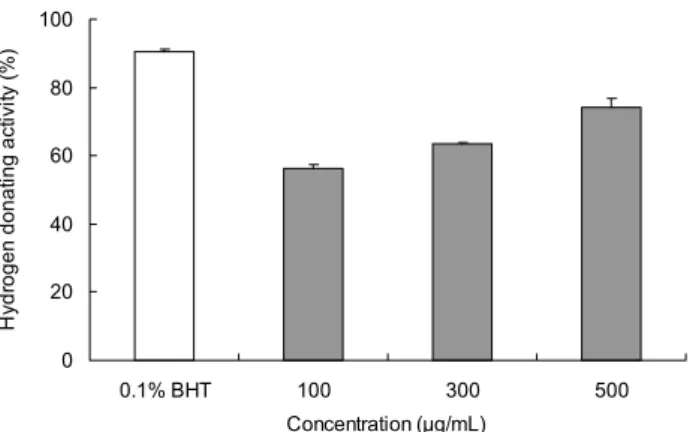
산수유(10 g)을 80% 에탄올로 추출 및 동결건조한 후 고 형분의 함량은 측정한 결과 61.8%으로 나타났으며, 에탄올 추출물의 항산화 활성을 측정한 결과는 Fig. 1과 같다. 산수
0 20 40 60 80 100
0.1% BHT 100 300 500
Concentration (μg/mL)
Hydrogen donating activity (%)
Fig. 1. Hydrogen donating activity of 80% ethanol extracts from Corni fructus. Data values were expressed as mean±SD of triplicate determinations.
유 에탄올추출물을 100, 300 및 500 μg/mL의 농도로 수소공 여능을 측정한 결과 농도 의존적으로 항산화 효과를 나타냈 으며, 500 μg/mL 농도의 경우 합성항산화제보다는 효과가 낮았지만, 73% 이상의 항산화 활성을 나타내어 그 효과를 확인할 수 있었다. Seo 등(4)은 산수유 에탄올추출물 100 μL 첨가 시 68.7%, 200 μL 첨가 시 92.3%의 높은 수소공여능 이 있음을 보고하였으며, Kim(16)의 연구에서는 산수유 에 탄올추출물 1000 mg/kg 투여로 지질의 불포화지방산들이 산화적 분해를 일으키는 lipid peroxide 반응에서 MDA와 세포 내의 자유라디칼을 제거하는 glutathione 함량이 유의 적인 감소와 증가를 나타내었다.
따라서, 본 연구 결과에서도 산수유 에탄올추출물이 항산 화 활성을 나타내는 것으로 미루어볼 때, 항산화 작용을 일 으키는 물질들이 이 추출물에 함유되어 있음을 확인할 수 있었다.
산수유 에탄올추출물의 NO 생성능
대식세포는 박테리와 같은 항원이 침입하였을 때, 일차적 인 면역반응을 담당하는 세포로서, 이러한 박테리아를 사멸 시키기 위해 대식세포는 다양한 물질을 분비하며, 이중에서 일산화질소(mitric oxide)가 대표적인 물질로 알려져 있다 (22). 따라서 산수유 에탄올추출물이 대식세포의 일산화질 소 생산에 어떤 영향을 미치는지 알아보기 위하여 대식세포 주인 RAW264.7에 산수유 에탄올추출물을 농도별로 처리하 여 48시간 배양한 후, 배양액 중의 대식세포가 생산한 일산 화질소로부터 산화된 NO2-
를 농도를 측정한 결과는 Fig. 2 와 같다. 즉 산수유 에탄올추출물을 1, 10 및 50 μg/mL 농도 로 처리한 실험군에서는 NO 생성량이 각각 9.65, 11.44 및 12.34 μM로 나타났다. Lee 등(23)은 산수유 에탄올추출물이 비장 및 흉선 림프구의 증식을 촉진시켰으며, 복강 대식세포 의 탐식능 및 NO 생성을 유발하여 면역 조절 작용이 있다고 보고하고 있다.
따라서 산수유에는 면역능을 증가시킬 수 있는 성분들이 함유되어 있다는 것을 추측할 수 있으나, 앞으로 산수유 에
0 5 10 15 20
Control 1 10 50
Concentration (μg/mL) NO 2- concentration (μM) .
**
**
**
*
*
*
Fig. 2. Effects of 80% ethanol extracts from Corni fructus on the production of nitric oxide (NO) in macrophage cells (RAW264.7). Data values were expressed as mean±SD of tripli- cate determinations. Significant differences were compared with control at *p<0.05 by Student t-test.
탄올추출물에 함유되어 있는 물질을 분리하여 보다 구체적 인 실험을 수행해야 할 것으로 사료된다.
산수유 에탄올추출물의 유방암세포증식 억제효과 산수유 에탄올추출물을 다양한 농도로 유방암세포주 (MCF-7)에 처리하여 24, 48, 72시간 동안 배양한 후 암세포 증식 억제능을 측정한 결과는 Fig. 3, 4와 같다. 즉 산수유 에탄올추출물은 대조구에 비하여 시간 및 농도에 의존적으 로 암세포의 증식을 억제하였으며, SRB 방법으로 암세포성 장억제 효과를 측정한 결과 산수유 에탄올추출물을 처리 후 24, 48 및 72시간 배양 시 500 μg/mL 농도에서 유방암세포의 성장 억제율이 각각 44, 52 및 63%으로 나타났다(Fig. 3).
또한 trypan blue 염색을 통한 결과에서도 시간 및 농도에 의존하여 세포의 증식을 억제하는 것을 확인할 수 있었다 (Fig. 4). Kim 등(17)의 연구에서 산수유 에탄올추출물은 폐 암세포주(A549)와 유방암세포주(MCF-7)의 증식을 유의하 게 억제시켰으며, 암세포의 세포주기를 변화시키는 등 항암 에 효과가 있다고 보고하였다. 또한 Chung 등(2)의 연구에 서도 산수유의 헥산 추출물이 다양한 인체 암세포주(MDA-
0 20 40 60 80 100 120
0 h 24 h 48 h 72 h
Time
Survival rate (%) .
Control 100
300 500
Fig. 3. Cell growth inhibition effects in the MCF-7 cells treated with 80% ethanol extracts from Corni fructus for 24, 48 and 72 h by SRB assay. Data values were expressed as mean±SD of triplicate determinations.
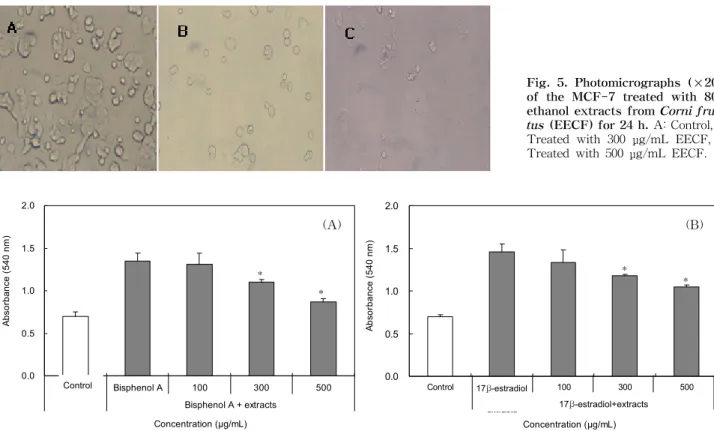
Fig. 5. Photomicrographs (×200) of the MCF-7 treated with 80%
ethanol extracts from Corni fruc- tus (EECF) for 24 h. A: Control, B:
Treated with 300 μg/mL EECF, C:
Treated with 500 μg/mL EECF.
0.0 0.5 1.0 1.5 2.0
Bisphenol A 100 300 500
Control Bisphenol A + extracts
Concentration (μg/mL)
Absorbance (540 nm) . (A)
*
*
Control 0.0
0.5 1.0 1.5 2.0
Control 17β-estradiol 17β-estradiol +
extracts
100 300 500
Concentration (μg/mL)
Absorbance (540 nm) . (B)
*
*
17β-estradiol
17β-estradiol+extracts
Fig. 6. Anti-proliferation effects of 80% ethanol extracts from Corni fructus in the MCF-7 cells treated with bisphenol A and 17β-estradiol (0.1 μM) for 72 h. Data values were expressed as mean±SD of triplicate determinations. Significant differences were compared with control at *p<0.05 by Student t-test. (A) Bisphenol A, (B) 17β-estradiol.
0 5 10 15 20
Control 100 300 500
Concentration (μg/mL) Cell density (×10 4) .
0 20 40 60 80 100
Dead cells (%) .
24 h 48 h 72 h
24 h 48 h 72 h
* * *
* *
* * *
*
Fig. 4. Cell growth inhibition effects by trypan blue dye in the MCF-7 cells treated with 80% ethanol extracts from Corni fructus for 24, 48, and 72 h. Results were expressed as the percentage of control. The bars and line are means of the cell densities and cell deaths, respectively. Data values were ex- pressed as mean±SD of triplicate determinations. Significant dif- ferences were compared with the control at *p<0.05 by Student t-test.
MB-231, B16, A549)에서 암세포 성장을 억제한다고 보고하 였다.
따라서, 본 연구결과에서도 산수유 에탄올추출물이 유방 암세포의 성장을 억제함을 확인할 수 있었으며, 이는 산수유 내에 함유된 인체 암세포억제 효능을 가진 ursolic acid와 같은 항암물질 등에 의해 기인되는 것으로 생각된다(17).
암세포의 형태학적 관찰
부착형의 세포들은 다양한 종류의 외부자극에 의해 세포 사멸이 유도되어지면 세포가 축소되어지고 크기와 수가 줄 면서 배양 plate 바닥으로부터 분리되어 부유하게 된다. 산수 유 에탄올추출물이 MCF-7 세포의 증식을 억제하는지를 알 아보기 위하여 산수유 에탄올추출물을 300 및 500 μg/mL 농도로 처리하고 24시간 배양한 후 세포의 형태학적 변화를 광학현미경으로 대조군과 비교하여 관찰한 결과는 Fig. 5와 같다. 대조구 세포는 세포막을 유지하며 plate의 기벽에 부착 되어 있었으나 산수유 에탄올추출물을 처리한 실험군은 사 멸한 세포가 배양 plat에서 떨어져 배지에 부유하는 것을 관찰할 수 있었고, 대조구에 비하여 세포의 밀도 감소현상과 세포 모양변화가 관찰되어 산수유 에탄올추출물이 MCF-7 세포의 증식을 저해함을 확인할 수 있었다.
유방암세포에서 산수유 에탄올추출물의 환경호르몬 방어 효과
산수유 에탄올추출물이 환경호르몬에 의해 자극되어진 에스트로겐 수용체를 가지는 유방암세포주(MCF-7)의 증 식을 억제할 수 있는지의 여부를 확인한 결과는 Fig. 6과 같다. 즉 bisphenol A와 17β-estradiol을 산수유 에탄올추출 물을 처리하기 전에 0.1 μM의 농도로 처리하여 암세포의 증식을 유도한 후 산수유 에탄올추출물을 농도별로 처리하
여 72시간 후에 그 활성을 측정하였다. Bisphenol A와 17β- estradiol에 의해 유방암세포는 대조구에 비하여 2배 정도의 증식을 보였으며, 산수유 에탄올추출물이 첨가된 실험군에 서는 앞서 유방암세포주에 대한 산수유추출물 억제 실험의 결과와 마찬가지로 농도에 의존적으로 bisphenol A와 17β -estradiol에 의해 유도되어진 암세포의 증식을 억제하였다.
Han 등(11)은 산수유 에탄올추출물을 투여한 실험군이 대조 군에 비하여 납과 같은 중금속을 해독하는 효과가 있다고 보고한 바도 있다.
요 약
산수유를 기능성식품 소재로서 이용하기 위하여 산수유 에탄올추출물의 생리활성을 조사하였다. 산수유 에탄올추 출물의 수소공여능은 농도 의존적으로 증가되었으며, 300 및 500 μg/mL 농도에서 각각 64, 73%의 활성을 나타내었다.
대식세포 RAW264.7에 산수유 에탄올추출물을 100, 300 및 500 μg/mL의 농도로 처리하였을 때 산수유추출물은 농도 의존적으로 NO(nitric oxide)의 생성을 유도하였다. 또한 산 수유 에탄올추출물을 유방암세포에 다양한 농도로 처리하 여 24, 48, 72시간 반응시킨 결과 농도 및 시간에 의존적으로 유방암세포의 증식을 억제하였으며, 500 μg/mL 농도로 72 시간 처리 시 60% 이상의 높은 증식억제율을 보여주었다.
또한, MCF-7 유방암 세포에 bisphenol과 17β-estradiol과 같은 환경호르몬을 0.1 μM의 농도로 처리하였을 때 세포의 증식이 유도되었으며, 이 세포에 산수유 에탄올추출물을 농 도별로 72시간 처리하였을 때 유방암 세포의 증식이 억제되 었다. 따라서 본 연구결과는 산수유의 기능성식품 소재로서 의 활용 가능성을 시사한다.
감사의 글
본 논문은 2006년도 순천대학교 친환경바이오 산업전문 인력양성사업단 산학공동 연구과제 연구비 지원으로 수행 된 연구 결과의 일부이며, 그 지원에 감사드립니다.
문 헌
1. Oh HS, Kim JH. 2006. Development of functional soy-based stew sauce including hot water extracts of Cornus officina- lis Sieb. et Z. Korean J Food Culture 21: 550-558.
2. Chung SR, Jeune KH, Park SY, Jang SJ. 1993. Toxicity lectins constituents from the seed of Cornus officinalis.
Korean J Pharmacogn 24: 177-182.
3. Lee JY. 1981. Iridoid glycosides of Cornus officinalis. MS Thesis. Seoul National University.
4. Seo KI, Lee SW, Yang KH. 1999. Antimicrobial and anti- oxidative activities of Corni fructus extracts. Korean J
Postharvest Sci Technol 6: 99-103.
5. Toheu E, Chiro TH. 1973. Constituents of Cornus officinalis.
Yakugaku Zasshi 93: 30-36.
6. Guilian T, Zhang T, Yang F, Ito Y. 2000. Separation of gallic acid from Cornus officinalis Sieb. et Zucc by high-speed counter-current chromatography. J Chromatogr A 886:
309-312.
7. Kim YD, Kim HK, Kim KJ. 2003. Analysis of nutritional components of Corni fructus. J Korean Soc Food Sci Nutr 32: 785-789.
8. Park YK, Whang WK, Kim HI. 1995. The antidiabetic ef- fects of extracts from Cornus officinalis seed. Chung-Ang J Pharm Sci 9: 5-11.
9. Seo YB, Kil GJ, Lee YK, Lee YC. 2002. Study on the effects of Corni fructus about the anti-allergic action. Korean J Herboogy 1: 1-17.
10. Won DH, Cho JH, Kim HS, Ko JH, Lee J, Park SA, Lee HJ, Yook CS, Kim IH, Won BP. 1996. Studies on the analy- sis of Corni fructus and its preparation. The Annual Report KFDA 1: 197-201.
11. Han SH, Shin MK, Lee SB. 2003. Effects of extracts of shanshuyu (Cornus officinalis Sieb). Korean J Food Culture 18: 544-550.
12. Jeng H, Wu CM, Su SJ, Chang WC. 1997. A substance iso- lated from Cornus officinalis enhances the motility of hu- man sperm. Am J Chinese Med 25: 301-306.
13. Kim YD, Kim HK, Kim KJ. 2003. Antimicrobial activity of solvent fraction from Cornus officinalis. J Korean Soc Food Sci Nutr 32: 829-832.
14. Fukushima M, Kimura S. 1989. Studies on cosmetic in- gredients from crude drugs (I). Shoyakugaku Zasshi 43:
142-147.
15. Kim YE, Lee YC, Kim HK, Kim CJ. 1997. Antioxidative effect of ethanol fraction for several Korean medicinal plant hot water extracts. Korean J Food Nutr 2: 141-144.
16. Kim OK. 2005. Antidiabetic and antioxidative effects of Corni fructus in streptozotocin-induced diabetic rats.
Korean J Oil Chem Soc 2: 157-167.
17. Kim BH, Park KU, Kim JY, Jeong IY, Yang GH, Cho YS, Lee ST, Seo KI. 2004. Purification and characterization of anticarcinogenic compound from Corni fructus. Korean J Food Sci Thechnol 36: 1001-1007.
18. Biois MS. 1958. Antioxidant determination by the use of a stable free radical. Nature 181: 1199-1200.
19. Kondo Y, Takano F. 1994. Nitric oxide production in mouse peritoneal macrophage enhanced with glycyrrhizin. Biol Pharm Bull 17: 759-761.
20. Yamada K, Chujo H, Yamasaki M, Nou S, Koyanagi N.
2003. Effect of conjugated linoleic acid isomers on growth factor-induced proliferation of human breast cancer cells.
Cancer Letters 202: 81-87.
21. Skehan P, Storeng S, Scudiero D, Monks A, McMahon J, Vistica D, Warren JT, Bokesch H, Keeney S, Boyd MR.
1990. New colorimetric cytotoxicity assay for anticancer- drug screening. J Nat Cancer Inst 82: 1107-1112.
22. Kang HI, Kim JY, Moon KD, Seo KI, Cho YS, Lee SD, Yee ST. 2004. Effect of the crude polysaccharide of Pleuro- tus eryngii on the activation of immune cells. J Korean Soc Food Sci Nutr 33: 1092-1097.
23. Lee WB, Jung HS, Kwon J, Oh CH, Lee KG. 2002. Immuno- regulatory action of Cornus officinalis Sieb. et Zucc. Korean J Orient Physiol Pathol 16: 267-271.
(2008년 12월 29일 접수; 2009년 1월 29일 채택)