한국컴퓨터정보학회 하계학술대회 논문집 제27권 제2호 (2019. 7)
407
● 요 약 ●
This thesis determines the research framework and scale design of leisure food E-Commerce consumer satisfaction degree by referring to previous theoretical model of customer satisfaction degree, the universal satisfaction evaluation index system, and the characteristics of leisure food E-Commerce in China. In this research, consumers who have bought leisure food online are taken as the research object, data are collected by questionnaires, and exploratory factor method is used to screen valid sample data. Through the Empirical Analysis which includes Descriptive Statistical Analysis, Reliability and Validity Analysis and Structural Equation Modeling, it is concluded that website design, logistics delivery service, commodity quality, and after-sales service are the main service quality on which the Leisure food E-Commerce enterprises should take focus. The service quality has significant positive influences on satisfaction degree. On the other hand consumer satisfaction has a significant positive influence on customer loyalty, which will create more earnings for the Leisure food E-Commerce enterprises.
키워드: Leisure Food E-Commerce; Influence Factors; Structural Equation Modeling; Satisfaction Degree.
중국 레저푸드 전자상거래의 서비스 품질이 소비자 만족도에 미치는 영향에 관한 실증분석
Zi-Yang Liu*, Jia MengO
Dept. of Global Business Kyonggi UniversityO Dept. of Global Business Kyonggi University*
e-mail: [email protected]O
Empirical Analysis on the Influence of Service Quality of Leisure Food E-Commerce in China on Consumer
Satisfaction Degree
Zi-Yang Liu*, Jia MengO
Dept. of Global Business Kyonggi UniversityO Dept. of Global Business Kyonggi University*
I. Introduction
In this research, the study on the influence factors of leisure food E-Commerce consumer satisfaction degree is taken as the entry point. The descending order of influence on satisfaction degree is: commodity quality, logistics delivery service, after-sales service and website design. As mentioned, consumer satisfaction degree has a positive and significant influence on consumer loyalty. Leisure food E-Commerce enterprises can increase consumer satisfaction by improving website design and logistics delivery service, controlling the quality of commodities
and optimizing after-sales service, thereby improving user stickiness and market competitiveness. In the future, those enterprises should strengthen their ability of self-marketing instead of relying on third-party E-Commerce platform in terms of selection of network marketing channels and modes.
한국컴퓨터정보학회 하계학술대회 논문집 제27권 제2호 (2019. 7)
408
II. Research Design
1. Model Building
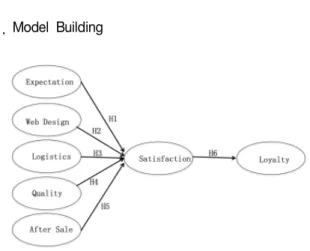
Fig. 1. Research Model
2. Research Hypotheses
The research framework of leisure food E-Commerce consumer satisfaction degree proposed in this study includes above 7 latent variables (figure. Research Model). Among them, pre-purchase expectation, website design, logistics delivery service, product quality, and after-sales service are exogenous latent variables, the outcome variable of which is satisfaction degree, while satisfaction degree and loyalty degree are endogenous latent variables, and loyalty degree is the outcome variable of satisfaction degree. The following hypothesis proposed in this thesis: Pre-purchase expectation has a significant negative influence on consumer satisfaction degree. Website design, logistics delivery, commodity quality and after-sales service have a significant positive influence on consumer satisfaction degree.
Satisfaction degree has a significant and positive influence on consumer loyalty degree.
3. Questionnaire Design
The object of survey in this research is mainly people who had purchase leisure food on the Internet. Investigation includes the behavior characteristics of consumers (who have different backgrounds), the concerns and the major types of leisure food products being purchased. Finally the evaluation scale of leisure food E-Commerce consumer satisfaction degree was designed.
This study uses the 7-point Likert scale to quantify the measured variables. It specifically includes evaluations from seven aspects:
pre-purchase expectation, website design, logistics delivery service, commodity service, after-sales service, satisfaction degree, and loyalty degree. Setting the evaluation scale can empirically analyze the survey data, what the influence factors of leisure food E-Commerce consumer satisfaction degree are,
the influence paths and effect, as well as verifying the research hypotheses.
REFERENCE
[1] Bansal, H. S., &Taylor, S. F. (1999). The service provider switching model (spsm) a model of consumer switching behavior in the services industry. Journal of service Research, 2(2), 200-218.
[2] Barroso, C., &Picón, A. (2012). Multi-dimensional analysis of perceived switching costs. Industrial Marketing Management, 41(3), 531-543.
[3] Bearden, W. O., &Etzel, M. J. (1982). Reference group influence on product and brand purchase decisions. Journal of consumer research, 9(2), 183-194.
[4] Berry, L. L., Seiders, K., &Grewal, D. (2002).
Understanding service convenience. Journal of marketing, 66(3), 1-17.
[5] Bhattacherjee, A. (2001). Understanding information systems continuance: an expectation-confirmation model. MIS quarterly, 351-370.
[6] Brady, M. K., &Cronin Jr, J. J. (2001). Some new thoughts on conceptualizing perceived service quality: a hierarchical approach. Journal of marketing, 65(3), 34-49.
[7] Burnham, T. A., Frels, J. K., &Mahajan, V. (2003).
Consumer switching costs: A typology, antecedents, and consequences. Journal of the Academy of marketing Science, 31(2), 109-126.
[8] Caruana, A. (2003). The impact of switching costs on customer loyalty: A study among corporate customers of mobile telephony. Journal of Targeting, Measurement and Analysis for Marketing, 12(3), 256-268.
[9] Castañeda, J. A., Muñoz-Leiva, F., &Luque, T. (2007).
Web Acceptance Model (WAM): Moderating effects of user experience. Information &management, 44(4), 384-396.
[10] Collier, J. E., &Bienstock, C. C. (2006). Measuring service quality in e-retailing. Journal of service research, 8(3), 260-275.