Introduction
Watermelon (Citrullus lanatus Thunb.) cultivated in a plastic film house plot tend to have a relatively long growing period. Watermelons have been cultivated using high chemical fertilizer applications as compared with those plants grown in normal field condition. When a crop is cultivated for three to four years in a continuous cropping system using heavy application of chemical fertilizers in plastic film house plots, salinity problems and soil disease damage can occur, resulting in poor productivity and quality (Jun and Park, 2001; Park et al., 1994; Ryu et al., 1995; Sohn et al., 1999;). The problems related to the continuous cropping in the plastic film house plots are site specific showing symptoms of
deficiencies, toxicities, soil diseases, or salinity, etc.
depending on soil management and cropping system.
Therefore, there are many factors to consider when trying to correct these problems for target crops and soils (Ryu et al., 1992). Many researchers have proposed various solutions to solve the problems, such as an occasional movement of indoor cropping facility, addition of soil amendments, subsoil tillage, and use of irrigation water to remove accumulated salts (Bernstein, 1975; Jung, et al., 1994). In addition, chemical application, steam sterilization, and solarization have been proposed to prevent soil disease and insect damages (Hwang et al., 1989; Jun et al., 2002; Kwon et al., 1998).
However, those proposed solutions are not feasible due to farm size and economic factors. On the other hand, if a specific crop is continuously replanted in a plot, soil problems and replanting diseases such as allelopathy can be occurred. Thus, to prevent the soil problems and Received : 22 January 2007 Accepted : 18 February 2007
*Corresponding author: Phone : +82632704321, E-mail : [email protected]
Watermelon (Citrullus lanatus Thunb.) Cultivation Plots
Byung-Koo Ahn, Dae-Hyang Kim, and Jin-Ho Lee1,*
Research Center for Biotic Environment, Jeonbuk Agricultural Research and Extension Services, Kochang, Jeonbuk 585-863, Korea
1Research Center of Bioactive Materials, Chonbuk National University, Duckjin Dong, Jeonju, Jeonbuk 561-756, Korea
Most of plastic film house plots in Korea have salinity problems caused by salt accumulations associated with continuous cropping including the heavy applications of chemical fertilizers, and high evapotranspiration. The objective of this study was to investigate soil properties and watermelon (Citrullus lanatus Thunb.) productivity in plastic film houses as influenced by the short-term crop rotation in the continuous watermelon-cultivated soils. The short-term rotational crops selected were corn, Chinese cabbage, radish, young radish, lettuce, spinach, and onion. Soil pH increased in most plots where a short- term crop was added to the crop rotation, except where radish was added. The content of soil organic matter significantly decreased in the lettuce-cultivated plot. The available phosphorus content in the soils increased with the cultivations of spinach and onion. Exchangeable Ca and Mg tended to increase in most of plots where a short-term rotational crop was grown, whereas the exchangeable K was clearly reduced by more than 50% in the same plots. Cultivation of rotational crops during the post harvest season significantly decreased the electrical conductivity (EC) and the concentrations of soluble anions, such as chloride (Cl-), nitrate (NO3-), and sulfate (SO42-) in the soils. In particular, the EC decrease was related with the decrease in soil K+to Ca2+and Mg2+ratio. In all plots cultivated with the shot-term rotational crops, the ratios of bacteria to fungi (B/F) increased. However, the improvement in soil properties after adding a rotational crop did not result in a clear improvement in watermelon quantity or quality as measured by fruit weight and sugar content. Therefore, the addition of short-term rotational crops to a continuous watermelon cropping system would be beneficial to improve target soil properties in plastic film house plots studied.
Key words: Crop rotation, Short-term rotational crop, Salt accumulation, Soil properties.
replanting diseases, the application of fallow or crop rotation may be necessary; however, the period of fallow or crop rotation is totally dependent upon what crop has been replanted in the plot. For example, after continuously cultivating watermelon, pepper, or tomato in monoculture, it would usually require five to seven years of fallow or crop rotation to reduce or remove the soil problems and replanting diseases associated with continuous monocultures (RDA, 1997). Fallow cropping system is usually not acceptable to farmers who have plastic film house plots because the facilities are prepared for intensive farming for specific, high value crops. Thus, in the plastic film house plots, a short-term crop rotation might affect the soil qualities. The post harvest short-term crop rotation is helpful in avoiding pathogen and pest buildup caused by the continuous monoculture cropping (RDA, 1997). Crop rotation helps to establish a fertility balance of various crops to avoid soil nutrient depletion and/or excessive salt accumulation. For example, when rice was cultivated as a rotational crop in plastic film house plot, fruit and vegetable cultivars grew well (Park, 2000). Cultivation, including a proper rotational crop in the plastic film house watermelon plots during the post cropping periods may be an appropriate solution to improve soil quality.
The objective of this study was to investigate soil properties and watermelon productivity as influenced by the post harvest short-term crop rotation in plastic film house plots where soils have been used for continuous watermelon production.
Materials and Methods
This study was conducted in the plastic film houses [each plot size: 144 m2(6 m × 24 m)] of Kochang Watermelon Experiment Station in Jeonbuk Agricultural Research and Extension Services in March, 2003 through November, 2005. The experimental plot was located at 35º 19' 32"N latitude and 126º 34' 29"E longitude. Before conducting this experiment, the experimental plots had been utilized for continuous watermelon monoculture cropping for seven consecutive years. Soil texture in the experimental plots is a sandy clay loam containing 51.2 ~ 56.6 % sand, 20.9 ~ 23.1% silt, and 22.5 ~ 26.5% clay.
Watermelon cultivation Seeds of watermelon (Citrullus lanatus Thunb.) and bottle gourd (Lagenaria leucanth Standl) cultivar FR-Dantos (Dongbu Hannong
Seed, Korea) were simultaneously germinated in an incubator at 30℃ for 24 hours. Plant seedlings were grown in a plant nursery for 15 days, then the watermelon plant tops were grafted onto the rootstocks of bottle gourd and were grown for approximately 30 more days in the nursery. After 45 days in the nursery, the grafted watermelon plants were transplanted (planting density: 45 × 27 cm) into plastic film house plots and grown for 40 days using two different cultivation methods, a semi forcing culture for the watermelon- watermelon- post harvest rotational crop system and a retarding culture for the watermelon-post harvest rotational crop-watermelon system. Amounts of fertilizers were 138 kg ha-1as N, 49 kg ha-1as P2O5, and 87 kg ha-1as K2O. Amounts of phosphorus required in the plots were applied as base-dressing, whereas nitrogen and potassium were applied at 50% of the fertilizer requirements as base-dressing before transplanting the watermelon plants into the plots and then the other 50%
of the fertilizer requirements were applied as top-dressing after setting the watermelon fruits. Watermelon was harvested at 90 to 95 days after transplantation, and weights and sugar contents (i.e., sweetness) of watermenon were measured from twenty samples of watermelon collected ramdomly in each plot.
Post harvest cultivation with selected rotational crops Corn (Zea mays L.), Chinese cabbage (Brassica rapa subsp. pekinensis (Lour.) Hanelt), radish (Raphanus sativus L.), young radish (Raphanus sativus L.), lettuce (Lactuca sativa L.), spinach (Spinacia oleracea L.), and onion (Allium cepa L.) were selected as short-term rotational crops for post-harvest cultivation in the plastic film house watermelon plots. Eight different plot sites for the crop rotation were prepared as follows; watermelon- watermelon-winter fallow as a control plot, watermelon- rotational crop (corn)-watermelon, and watermelon- watermelon-rotational crop (Chinese cabbage, radish, young radish, lettuce, spinach, or onion). The rotational crops were cultivated during the post-harvest periods in the summer for corn and in the winter for others selected.
The rotational crops were cultivated in triplicate using a randomized block design without the applications of any chemical fertilizers. All plots were given 4.5 mm of water for 30 min every four days using a sprinkler irrigation system. The rotational crops were harvested at 60 to 70 days after planting.
Soil samples in the plastic film house plots were collected before planting and after harvesting the selected short- term rotational crops. The soil samples were air-dried and crushed to pass through a 2-mm sieve. Soil pH was measured in 1:5 soil/water suspensions. The concentrations of water-soluble anions, nitrate (NO3-
), chloride (Cl-), sulfate (SO42-
), and phosphate (PO43-
) ions, in the soil samples were measured. To determine the water-soluble anions, soil-water mixtures (5.0g of soil / 50mL of water) were continuously agitated for 12 hrs at 200 rpm on a reciprocal shaker. The mixtures were filtered first using a Whatman No. 6 filter paper and then with a 0.22 µm membrane. Anion concentrations in the filtered soil solution were analyzed using an ion chromatography (Dionex, ICS1000) by suppressed conductivity detection with an ASRS column (4 mm in diameter) at a flow rate of 1.20 mL min-1(eluents: 3.5 mM of sodium carbonate and 1.0 mM of sodium bicarbonate). Other selected chemical soil properties were determined using methods proposed by Rural Development Administration (RDA), Korea (2000).
Analysis of selected chemicals in rotational crops Plant samples of the rotational crops were collected during the harvesting periods, washed with tap water, and then rinsed with deionized water. The plant samples were dried in an air-forced drying oven at 70℃ for 72 hrs and weighed. The dried plant samples were ground using a grinding mill (RM100 Mortar Grinder, Retsch, Germany). Selected inorganic chemicals, nitrogen (N), phosphorus (P), potassium (K), calcium (Ca), and magnesium (Mg), in the plant samples were determined using RDA methods (RDA, 2000). Standard reference material (SRM) used for those inorganic chemicals was commercially prepared apple leaves (National Institure of Standards and Technology (NIST)-1515, USA.
Procedures to determine the water soluble anions, nitrate (NO3-
), chloride (Cl-), sulfate (SO42-
), and phosphate (PO43-
) in plants were modified from the method described by Miller (1998). Two hundred mg of each ground plant sample were transferred into 50 mL plastic vial and 20 mL of 2% acetic acid were added. The mixtures were agitated for 30 min at 200 rpm on a reciprocal shaker and filtered first using a Whatman No.
6 filter paper, followed by a 0.22 µm membrane. Anion concentrations in the plant extracts were analyzed using an ion chromatography (Dionex, ICS1000). Analytical
conditions described in soil analysis section above.
Examination of soil microflora Soil samples in the rhizosphere were taken from 10 to 15 cm depth of soil surface before and after planting the rotational crops to investigate the number of bacteria and fungi. Ten grams of the rhizosphere soil samples were agitated with 90 mL of sterile solution on a reciprocal shaker at 200 rpm for 10 min. Soil suspensions (10-5to 10-6) were prepared by diluting with sterile solution. These dilutions were used to determine the total number of bacteria and fungi. Soil bacteria and fungi were inoculated into nutrient agar and Rose Bengal agar plates, respectively, using surface spreading technique with those dilutions, and then incubated at 30℃ for 7 days.
Results and Discussion
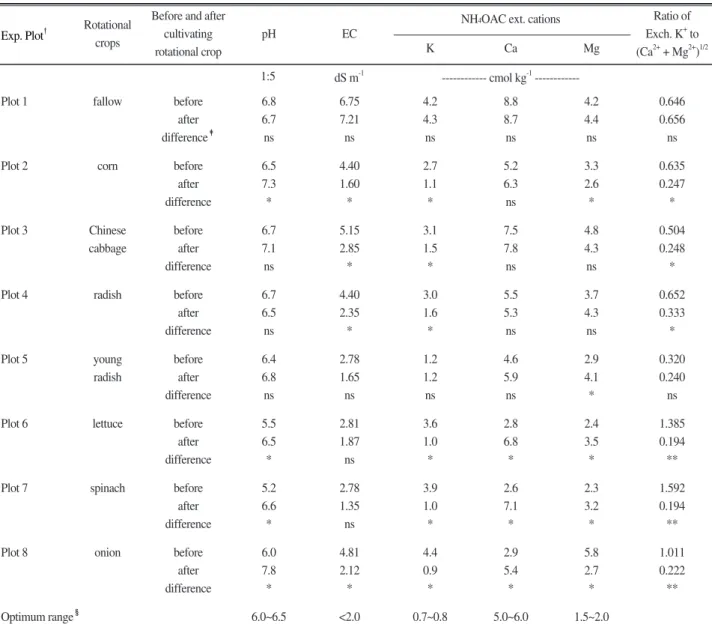
Selected soil chemical properties in the plastic film house plots before and after applying short-term crop rotation are presented in Table 1. Rural Development Administration (RDA), Korea (1999) suggested ranges of optimal conditions of selected soil properties for watermelon cultivation as shown in Table 1, except optimum values of CEC ranged between 10.0 and 15.0 cmol kg-1.
After utilizing the plastic film house plots for continuous watermelon monoculture cropping for seven consecutive years, the selected chemical properties of soils in the plastic film house plots were compared with those of optimal soil for watermelon production. Soil pH, organic matter content, and exchangeable Ca were relatively in the optimum ranges, but the plant available phosphorus and exchangeable K and Mg in the soils were mostly 2 to 3 times and 2 to 5 times higher than optimal levels, respectively. In particular, electrical conductivity (EC) of the soils was 2 to 3 times higher than optimal values for watermelon production. These results indicate that a large amount of salts accumulated in the soils in the experimental plastic film house plots.
The selected soil properties associated with the continuous watermelon monoculture were affected by post-harvest short-term crop rotation with different rotational crops. Soil pH increased in most of the plots after cultivating the short-term rotional crops, except in radish-cultivated plot. The content of soil organic matter (SOM) decreased in all the plots including the control
plot (Plot 1). The SOM decrease in the plots might be caused by the natural decomposition of SOM during the post cropping season. Nevertheless, the SOM content significantly decreased from 38.1 to 23.8 g kg-1in lettuce cultivated plot (plot 6). Kuzyalov (2002a, 2002b) reported that root exudates of ryegrass, wheat, and lettuce considerably increased soil microorganism rhizosphere activity, and this increased microbial activity can induce additional SOM decomposition.
The content of plant available phosphorus in the soils decreased in Chinese cabbage- and radish-cultivated plots, and the P levels were not significantly changed in corn-, young radish-, and lettuce-cultivated plots.
However, the P levels increased after cultivating spinach and onion. In particular, the plant available P contents significantly increased by approximately two times from 757 mg kg-1 to 1589 mg kg-1in the spinach-cultivated plot (plot 7). Before cultivating the short-term rotational crops, the specific plots where plant available P levels increased after cultivating the rotational crops have relatively lower the P levels than those in other plots.
Thus, the increase in the plant available P contents in the soils after cultivating the rotational crops might be related to the lower soil phosphorus contents. The extension of root hairs increases the depletion zone of phosphorus around the roots (Misra et al., 1988). Bates and Lynch
Exp. Plot"
"
Plots in post-harvest cultivation with selected rotational crops: Plot 1 (control plot), watermelon-watermelon-winter fallow; Plot 2, watermelon-corn- watermelon; Plot 3 to plot 8, watermelon-watermelon-rotational crop.
‡Denotes significance between the values obtained before and after applying rotational crop in each plot at the 0.05 (*) and 0.01 (**) probability levels based on least significant difference (LSD), respectively; ns = non-significant.
Ranges of optimal conditions of selected soil properties for watermelon cultivation (RDA, 1999).
Ratio of Exch. K+to (Ca2++ Mg2+)1/2 Mg
Ca K
NH4OAC ext. cations
--- cmol kg-1--- dS m-1
1:5
EC pH
Before and after cultivating rotational crop
before after difference‡
before after difference
before after difference
before after difference
before after difference
before after difference
before after difference
before after difference fallow
corn
Chinese cabbage
radish
young radish
lettuce
spinach
onion Plot 1
Plot 2
Plot 3
Plot 4
Plot 5
Plot 6
Plot 7
Plot 8
Optimum range
6.8 6.7 ns 6.5 7.3
* 6.7 7.1 ns 6.7 6.5 ns 6.4 6.8 ns 5.5 6.5
* 5.2 6.6
* 6.0 7.8
* 6.0~6.5
6.75 7.21 ns 4.40 1.60
* 5.15 2.85
* 4.40 2.35
* 2.78 1.65 ns 2.81 1.87 ns 2.78 1.35 ns 4.81 2.12
*
<2.0
4.2 4.3 ns 2.7 1.1
* 3.1 1.5
* 3.0 1.6
* 1.2 1.2 ns 3.6 1.0
* 3.9 1.0
* 4.4 0.9
* 0.7~0.8
8.8 8.7 ns 5.2 6.3 ns 7.5 7.8 ns 5.5 5.3 ns 4.6 5.9 ns 2.8 6.8
* 2.6 7.1
* 2.9 5.4
* 5.0~6.0
4.2 4.4 ns 3.3 2.6
* 4.8 4.3 ns 3.7 4.3 ns 2.9 4.1
* 2.4 3.5
* 2.3 3.2
* 5.8 2.7
* 1.5~2.0
0.646 0.656 ns 0.635 0.247
* 0.504 0.248
* 0.652 0.333
* 0.320 0.240 ns 1.385 0.194
**
1.592 0.194
**
1.011 0.222
**
Rotational crops
Table 1. Selected chemical properties of soils in the plastic film house plots as affected by the short term crop rotation.
(1996) also reported that mouseear cress (Arabidopsis thaliana) root hair length was regulated by phosphorus availability over a physiologically valid range of external phosphorus concentration. Therefore, the increase in plant available phosphorus contents may be caused by phosphorus in the fine root hairs of the short-term rotational crops contained in soil samples and/or by specific root hair exudates that might induce phosphorus available from the non-labile forms of soil phosphorus.
Soil exchangeable Ca and Mg tended to increase in most plots where the short-term rotational crop was cultivated. However, soil exchangeable K was reduced by more than 50% in all the plots after cultivating the rotational crops. The rotational crops generally uptook and utilized exchangeable K, but exchangeable Ca and Mg uptake by the rotational crops did not influence or selectively affect the changes in exchangeable Ca and Mg
contents in soils. Also, root exudates of the rotational crops might change unavailable Ca and Mg complexes into water-soluble Ca and Mg. Furthermore, after harvesting the rotational crops, the concentrations of water soluble anions, such as NO3-
, Cl-, and SO42-
, clearly decreased in most of the plots. Water soluble NO3-
and Cl- were reduced by up to 75%. The decrease in exchangeable K and water soluble anion concentrations decreased EC values. Park (2004) reported that soil EC values were lowered due to the decrease in exchangeable K and water soluble anions in soils of all plots associated with crop rotation. Also, Reis et al. (1999) reported that the highest exchangeable K+ / (Ca2++ Mg2+)1/2ratio and EC values were obtained with the highest application of K fertilizer, which indicates that the ratio of soil K+to Ca2+and Mg2+in soils is closely related to the change in EC value. In this study, exchangeable K content
Exp. Plot
SO4- Water-soluble anions
--- mg kg-1--- mg kg-1
g kg-1
Cl- NO3-
Available P2O5
OM Before and after
cultivating rotational crop
before after difference‡
before after difference
before after difference
before after difference
before after difference
before after difference
before after difference
before after difference
29.1 25.0
* 28.2 25.2
* 25.4 23.3 ns 26.0 24.2 ns 27.6 29.5 ns 38.1 23.8
* 30.1 28.4 ns 22.8 20.1
* 20.0~30.0
1317 1311 ns 1844 1946 ns 1412 1042
* 1376 1957
* 1377 1233 ns 1027 1961 ns 1757 1589
* 1739 1955
* 350~450
1089 1023 ns 1959 1478
* 1825 1605
* 1771 1241
* 1451 1264 ns 1450 1257 ns 1452 1405 ns 1366 1778
* -
385 367 ns 231 158 ns 296 183
**
275 170
**
182 165
**
162 143
**
187 169
**
331 154
* -
327 302 ns 195 229 ns 376 354 ns 363 280
* 197 187 ns 112 185 ns 203 165 ns 400 283
* - fallow
corn
Chinese cabbage
radish
young radish
lettuce
spinach
onion Plot 1
Plot 2
Plot 3
Plot 4
Plot 5
Plot 6
Plot 7
Plot 8
Optimum range
Rotational crops
decreased, but exchangeable Ca and/or Mg increased, lowering the soil K+/ (Ca2++ Mg2+)1/2ratios so that EC values in the soils were reduced after cultivating the short-term rotational crops.
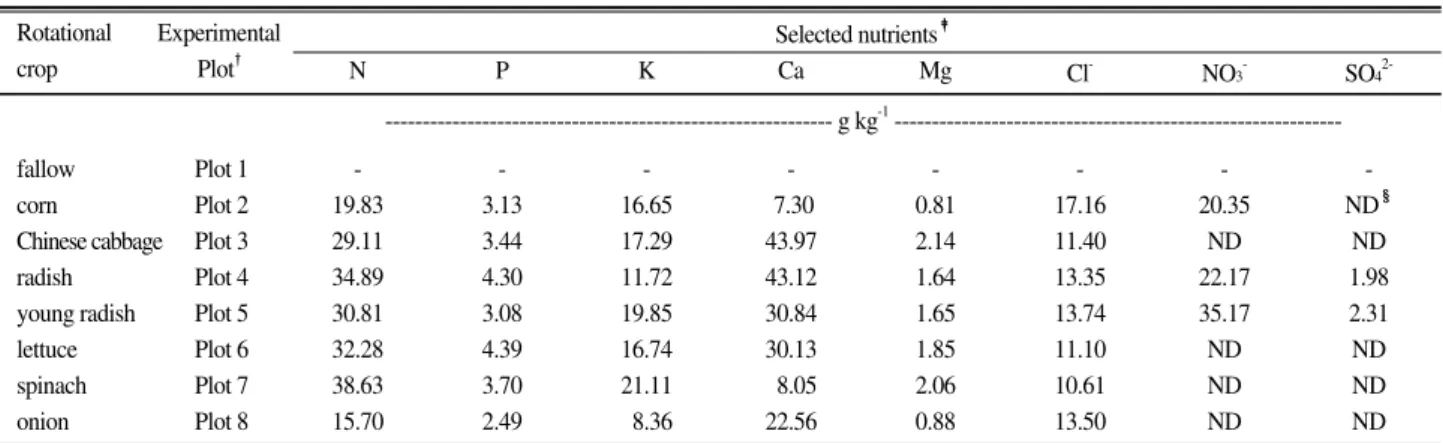
The contents of selected nutrients in the short-term rotational crops cultivated in the experimental plots are shown in Table 2. Most of the selected rotational crops removed large amounts of cations (K+, Ca2+, and Mg2+) and anions (Cl-, NO3-
, SO42-
, and PO43-
) related to salt accumulation from the soils. The contents of K+and Ca2+
in the rotational crops were ranged between 8.36 and 21.11 g kg-1 and between 7.30 and 43.97 g kg-1, respectively. The concentrations of Mg in the rotational crops were lower than the concentrations K+and Ca2+. Also, Cl-was detected in all the cultivated rotational crops and ranged between 10.61 and 17.16 g kg-1. These results indicate that a short-term crop rotation in a plastic film house watermelon cultivation plot positively
improved soils in view of salt alleviation. In particular, the short-term rotational crops removed large amounts of soluble K+, Ca2+, and Cl-from the soils. Although soluble Ca2+and Mg2+in the soils increased with the cultivation of short-term rotational crops in the specific plots (Table 1), the soil Ca2+and Mg2+could be adjusted by the short- term crop rotation. The role of the rotational crop can be described as percent base saturation (PBS) of those nutrients in the plots (Table 3).
Percent base saturation is the percent of the soil CEC that is occupied by a particular nutrient (nutrient saturation) or the sum of a group of nutrients (base saturation). For cultivating watermelon, optimal PBS values of Ca2+, Mg2+, and K+ are 45, 15, and 5%, respectively, which were indirectly calculated from the related data, exchangeable bases, CEC, and soil pH, reported by RDA (1999). In the continuous watermelon monoculture cropping plots, the PBS values of Ca2+,
Experimental Plot"
After cultivating rotational crop Before
cultivating rotational crop After
cultivating rotational crop Before
cultivating rotational crop After
cultivating rotational crop Before
cultivating rotational crop After
cultivating rotational crop Before
cultivating rotational crop
Ca
--- % ---
"
Refer to Table 1 for the experimental plots.
Mg K Sum
Rotational crop
fallow corn Chinese cabbage
radish young radish
lettuce spinach
onion Plot 1
Plot 2 Plot 3 Plot 4 Plot 5 Plot 6 Plot 7 Plot 8
45.8 34.6 39.4 33.5 45.8 63.8 33.5 39.8
44.3 39.8 47.1 45.3 39.1 55.0 39.1 42.5
27.0 20.3 27.4 20.2 25.8 22.0 16.7 19.3
28.1 19.3 23.8 22.2 25.0 22.1 25.0 18.9
22.0 35.4 17.2 30.5 34.3 44.8 28.6 35.4
22.1 7.6 6.6 5.8 4.9 8.8 7.9 6.1
94.8 90.3 84.0 84.2 105.9 130.6 78.8 94.5
94.5 66.7 77.5 73.3 69.0 85.9 72.0 67.5 Table 3. Changes in Percent Base Saturation (PBS) in the plots as affected by the cultivations of short-term rotational crops.
Rotational
crop N P K Ca Mg Cl- NO3- SO42-
Selected nutrients‡
--- g kg-1--- Experimental
Plot"
Plot 1 Plot 2 Plot 3 Plot 4 Plot 5 Plot 6 Plot 7 Plot 8
- 19.83 29.11 34.89 30.81 32.28 38.63 15.70
- 3.13 3.44 4.30 3.08 4.39 3.70 2.49
- 16.65 17.29 11.72 19.85 16.74 21.11 18.36
- 7.30 43.97 43.12 30.84 30.13 18.05 22.56
- 0.81 2.14 1.64 1.65 1.85 2.06 0.88
- 17.16 11.40 13.35 13.74 11.10 10.61 13.50
- 20.35
ND 22.17 35.17 ND ND ND
- ND
ND 1.98 2.31 ND ND ND fallow
corn
Chinese cabbage radish young radish lettuce spinach onion
"
Refer to Table 1 for the experimental plots.
‡Recovery of the selected chemicals from standard reference material (SRM): N (94.8%), P (102.2%), K (103.7%), Ca (94.3%), and Mg (97.2%) ND: not detected (negligible in part per thousand scales).
Table 2. The contents of selected nutrients in the plant tissues cultivated as short-term rotational crops in the plastic film house plot.
and 17.2 to 44.8%, respectively. These values did not meet the optimal values for cultivating watermelon. The PBS values of K+ were significantly higher than the optimal value for watermelon production. However, after cultivating the rotational crops, the PBS values of Ca2+
were reduced almost to the optimal value, 45 %, in most of the plots. The PBS values of K+ were markedly reduced by 4.9 to 8.8 % of the original values, which were close to the optimal PBS value of K+, 5%.
Nevertheless, the PBS values of Mg2+were almost not significantly influenced by the short-term crop rotation in the plastic film house plots.
Reductions in EC values and selected anions such as Cl-, NO3-
, and SO42-
in soils were impacted by the cultivation of short-term rotational crops (Table 4). In this study, the lower the anion contents, the less drop-off the EC values.
The decrease in EC values was particularly affected by the decrease in NO3-
and Cl-concentrations. EC value
as compared to other plots. According to the results of anion concentrations in the rotational crops (Table 2) and those in the soils (Table 4), the concentration of Cl-in the soils was lowered by the cultivations of radish and Chinese cabbage. Radish and corn removed excess NO3-
in the soils.
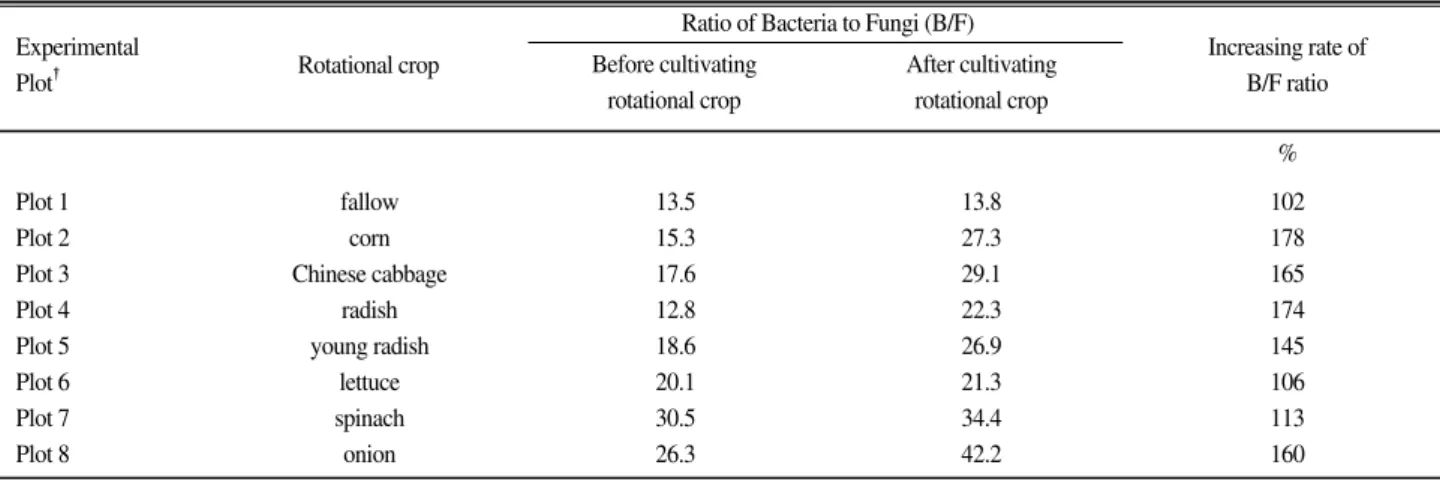
The influence of short-term crop rotation on the ratio of bacteria to fungi (B/F) is presented in Table 5. The number of bacteria increased in all the plots because the B/F ratios increased from the range between 12.8 and 30.5 before applying the short-term crop rotation to the range between 21.3 and 42.2 after harvesting the short-term rotational crops in the plastic film house plots. In the plots where corn, Chinese cabbage, radish, and onion were added to the cropping system, the increasing rate of B/F ratio was relatively higher than in other plots. A similar study reported that the number of microbes significantly increased in soils cultivated with corn and potato as compared to soils under fallow, due to the biostimulation
Experimental Plot"
Increasing rate of B/F ratio
102 178 165 174 145 106 113 160 13.8
27.3 29.1 22.3 26.9 21.3 34.4 42.2 13.5
15.3 17.6 12.8 18.6 20.1 30.5 26.3 fallow
corn Chinese cabbage
radish young radish
lettuce spinach
onion Plot 1
Plot 2 Plot 3 Plot 4 Plot 5 Plot 6 Plot 7 Plot 8
Rotational crop After cultivating
rotational crop Ratio of Bacteria to Fungi (B/F)
% Before cultivating
rotational crop
"
Refer to Table 1 for the experimental plots.
Table 5. Influence of short term crop rotation on the number of microbes as represented by the ratio of bacteria to fungi (B/F) and their increasing rate.
Experimental Plot"
"
Refer to Table 1 for the experimental plots.
‡Negative mean values are the increase of the respective parameters.
SO42- NO3-
Cl EC
Reduction in EC and anions‡
--- % --- Rotational crop
fallow corn Chinese cabbage
radish young radish
lettuce spinach onion
-6.8 63.6 44.7 46.6 40.6 33.5 24.2 55.9
4.7 31.6 72.0 74.5 20.7 30.6 20.7 53.5
6.1 50.1 26.7 68.7 41.5 42.9 10.4 43.0
7.6 -17.4 5.9 22.9 5.1 24.1 18.7 29.3 Plot 1
Plot 2 Plot 3 Plot 4 Plot 5 Plot 6 Plot 7 Plot 8
Table 4. Reduction in EC values and anions in soils as impacted by the cultivation of short-term rotational crops.
of root exudates in rhizosphere (Yun et al., 1999). The increasing rate of B/F ratio was closely related to salt accumulation tended to be identified by EC values in soil solution system. In the lettuce and spinach- cultivated plots, the increasing rates of B/F ratio were 106 and 113%, respectively, which were considerably lower than the rates (145 to 178%) in other plots. The lettuce and spinach- cultivated plots had relatively low EC reducing rates by the respective crops. According to the results reported by Kwon et al. (1998), the B/F ratio decreased in the salt accumulating soils when the B/F ratio was compared to that of normal soils. Therefore, in the salt accumulated soils, the number of bacteria and actinomyces decreased, whereas the number of fungi increased.
Influence of short-term crop rotation on the incidence of withered watermelon and fruit quality (weight and sugar content) is shown in Table 6. Before applying the short-term crop rotation, watermelon withering rate, fruit weight, and sugar content ranged between 13.2 and 16.8%, 6.8 and 7.5 kg, and 10.6 and 11.5˚Bx, respectively. However, after cultivating the short-term rotational crops, watermelon plant withering rate decreased to approximately less than 10.0% of total 150 watermelon plants in each plot with the lowest value, 7.3%, observed in the onion cultivated plot (plot 8).
However, the fruit weight and sugar content of watermelon were not significantly influenced by whether or not the short-term rotational crops were cultivated during the post cropping periods.
Conclusion
In this study, we investigated selected soil properties in continuous watermelon cultivation plots as affected by
the application of post-harvest cropping using short-term rotational crops (corn, Chinese cabbage, radish, young radish, lettuce, spinach, and onion). After cultivating the rotational crops, soil pH increased in most plots. Soil organic matter content decreased or was not changed in most plots, but it was significantly decreased in the lettuce-cultivated plot. The available phosphorus content in the soils increased with the cultivations of spinach and onion, whereas it decreased with Chinese cabbage and radish cultivation. Exchangeable Ca and Mg tended to increase in most of plots, whereas the exchangeable K was markedly reduced by more than 50% in those plots.
Electrical conductivity (EC) and the concentrations of soluble anions, such as chloride (Cl-), nitrate (NO3-
), and sulfate (SO42-
) in the soils significantly decreased with the cultivations of short-term rotational crops. The EC decrease was closely related with the decrease in soil K+ to Ca2+and Mg2+ratio. However, with the cultivations of shot term rotational crops, the ratios of bacteria to fungi (B/F) increased, but the watermelon productivity and quality was not affected. Thus, the application of short- term rotational cropping to a continuous watermelon cropping system would be beneficial to improve target soil properties in plastic film house plots studied.
Acknowledgement
This study is supported by the Technology Development Program for Regional Specialization, Rural Development Administration, Korea.
References
Bates, T. R. and J. P. Lynch. 1996. Stimulation of root hair elongation in Arabidopsis thaliana by low phosphorus availability.
Experimental Plot"
"
Refer to Table 1 for the experimental plots.
‡Refractometric sugar content.
Sugar content Fruit weight
Rate of withered watermelon plant
% kg each ˚Bx‡
Rotational crop
fallow corn Chinese cabbage
radish young radish
lettuce spinach onion Plot 1
Plot 2 Plot 3 Plot 4 Plot 5 Plot 6 Plot 7 Plot 8
14.6 9.2 8.3 9.4 9.8 10.1 10.3 7.3
7.20 7.82 7.94 8.08 7.87 7.52 7.78 8.10
10.9 12.1 11.7 11.9 11.3 10.9 11.2 11.4 Table 6. Influence of short-term crop rotation on the rate of withered watermelon and the fruit quality of watermelon.
Bernstein, L. 1975. Effect of salinity on plant growth. Ann. Rev.
Phytophology. 13:295-312.
Hwang, N. Y., J. Ryu, J. S. Na, and J. K. Kim. 1989. Studies on the cause of injury by continuous cropping and the effect of soil conditioner on red pepper (Capsicum annuum L.). II. Effects of soil conditioners applied on continuous cropping fields. Korean J.
Soil Sci. Fert. 22:205-214.
Jung, G. B., I. S. Ryu, and B. Y. Kim. 1994. Soil texture, electrical conductivity and chemical components of soils under the plastic film house cultivation in northern central areas of Korea. Korean J.
Soil Sci. Fert. 27:33-40.
Jun, H. S. and W. C. Park. 2001. Soil chemical characteristics and comparison with infested status of nematode(Meloidogyne spp.) in plastic house continuously cultivated oriental melon in Sonju.
Korean J. Environ. Agric. 20:127-132.
Jun, H. S., W. C. Park, and J. S. Jung. 2002. Effects of soil addition and subsoil plowing on the changes of soil chemical properties and the reduction of root-knot nematode in continuous cropping field of oriental melon(Cucumis melo L.). Korean J. Environ. Agric.
21:1-6.
Kuzyakov, Y. 2002a. Priming effects in rhizosphere. 17thWorld Congress of Soil Science, Abstract 600, Bankok, Thailand, August 14-21.
Kuzyakov, Y. 2002b. Review: Factors affecting rhizosphere priming effects. J. Plant Nutr. Soil Sci., 165:382-396.
Kwon, T. Y., K. C. Jung, S. D. Park, S. G. Sim, and B. S. Choi.
1998. Cultural and chemical control of root knot nematode, Meloidogyne sp., on oriental melon in plastic film house. RDA J.
Crop Protect. 40:96-101.
Miller, R. O. 1998. Extractable chloride, nitrate, orthophosphate, potassium, and sulfate-sulfur in plant tissue: 2% acetic acid extraction. In Handbook of Reference Methods for Plant Analysis.
Kalra, Y. P. (Ed). CRC press. USA.
Misra, R. K., A. M. Alston, and A. R. Dexter. 1988. Role of root hairs in phosphorus depletion from a macrostructured soil. Plant Soil 107:11-18.
Park, B. G., T. H. Jeon, Y. H. Kim, and Q. S. Ho. 1994. Status of
major crops. Korean J. Soil Sci. Fert. 27:238-246.
Park, C. Y. 2004. Solution and reason of salt accumulation in green house soil. The society of green house soil and environment.
National Yeongnam Agricultural Institute, Milyang, Korea, p.
108-109.
Park, D. K. 2000. Improvement of cropping system for reducing the rootknot nematode injury and soil salt stress in the successsive cropping of oriental melon (Cucumis melo L.). Kor. J. Hort. Sci. &
Tchnol. Supplement(1). p. 141.
RDA (Rural Development Administration). 1997. Technologies to prevent soil and crop problems caused by continuous cropping in plastic film house. National Institute of Agricultural Science and Technology, Rural Development Administration, Korea.
RDA (Rural Development Administration). 1999. Fertilization standard of crop plants. National Institute of Agricultural Science and Technology, Rural Development Administration, Korea.
RDA (Rural Development Administration). 2000. Methods of analysis of Soil and Plant. National Institute of Agricultural Science and Technology, Rural Development Administration, Korea.
Reis Jr., R. A., P. C. R. Fontes, J. C. L. Neves, and N. T. Santos.
1999. Total soil electrical conductivity and critical soil K+to Ca2+
and Mg2+ratio for potato crops. Sci. Agric. 56:993-997.
Ryu, I. S., I. H. Lee, and S. W. Hwang. 1995. The chemical properties of plastic film house soil and yield response of green pepper. Korean J. Soil Sci. Fert. 28:241-248.
Ryu, J., J. S. Na, and N. Y. Hwang. 1992. Study on the cause of injury by continuous cropping of peabut. Korean J. Soil Sci. Fert.
25:270-274.
Sohn, B. K., J. S. Cho, J. G. Kang, J. Y. Cho, K. Y. Kim, H. W.
Kim, and H. L. Kim. 1999. Physico-chemical properties of soils at red pepper, garlic and onion cultivation areas in Korea. Korean J.
Soil Sci. Fert. 32:23-131.
Yun, S. Y., J. J. Kim, J. W. Yang, Y. S. Jung, and J. D. Choi. 1999.
Effect of different cropping system and soil management on soil chemical and microbiological quality assessment in the Daekwanryung upland soil. Korean J. Soil Sci. Fert. 32:312-318.
수박을 7년간 연작한 시설재배지 토양을 개선하기 위해 수박후작물로 옥수수, 배추, 무, 총각무, 상추, 시금치, 및 양파를 재배한 후 토양특성과 수박의 생산성 및 품질의 변화를 조사하였다. 토양 pH는 무를 제외한 모든 후작물 재배지 토양에서 증가하였고, 토양 중 유기물 함량은 후작물 재배구에서 감소하는 경향을 보였으며 특 히 상추 재배구에서 현저하게 감소하였고, 유효인산 함량은 시금치, 양파 재배구에서 증가하는 경향을 보였다.
치환성 Ca 및 Mg은 대부분의 후작물 재배구에서 증가하는 경향을 보였으나, 치환성 K은 후작물 재배 후 50%
이상 현저히 감소하였다. 또한 수용성 음이온(Cl-, NO3-, SO42-)과 EC는 모든 후작물 재배구에서 감소하였다. 특 히 EC의 감소는K와 Ca+Mg의 비율의 감소에 의한 영향으로 보여진다. 모든 후작물 재배구에서 Bacteria/Fungi 비율이 재배전보다 증가하였으며, 수박의 고사주율은 모든 후작물 재배구에서 대조구보다 낮게 나타났으나, 수박의 생산성 및 품질에 있어 후작물 재배의 영향은 뚜렷하게 나타나지 않았다. 그러므로 시설수 박 연작지에서 단기윤작의 적용은 토양의 문제점을 개선하는데 있어 효과적인 방법이라고 생각된다.
시설수박 연작지 토양특성에 대한 후작물 재배의 영향
안병구·김대향·이진호1,*
전라북도 농업기술원, 1전북대학교 생리활성물질연구소