Suppression of metastasis-related ERBB2 and PLAU expressions in human breast cancer MCF 7 cells by fermented soybean extract
Jameon Park and Han Bok Kim*
Department of Biotechnology, Hoseo University, Asan 31499, Republic of Korea
발효대두추출물의 인간 유방암 MCF7 세포에서 전이 관련 ERBB2와 PLAU 발현 억제 효과
박잠언 ・ 김한복*
호서대학교 생명공학과
(Received October 12, 2018; Revised October 29, 2018; Accepted October 29, 2018)
*For correspondence. E-mail: [email protected];
Tel.: +82-41-540-5570; Fax: +82-41-548-6231
Chunkookjang, fermented soybean is rich in diverse oligopep- tides which derived from cleavage of soybean proteins during fermentation. Microarray data containing differently expressed genes in breast cancer cells treated with fermented soybean extract and well known breast cancer metastasis markers were combined, and a new network was constructed. It is used to check interactions between the marker proteins and the differently expressed genes. Based on the network analysis, PLAU (plas- minogen activator, urokinase, uPA) and ERBB2 (epidermal growth factor receptor 2) are chosen as possible metastasis genes. We treated breast cancer MCF7 cells with fermented soybean extract and measured expression levels of PLAU and ERBB2. Fermented soybean extract suppressed PLAU and ERBB2 expressions conspicuously. In the cancer cells treated with fermented soybean extracts, an inflammation marker, NO production was also reduced. It will be interesting to find specific peptides to suppress PLAU and ERBB2 expressions in human breast cancer cells.
Keywords: ERBB2, PLAU, breast cancer, fermented soybean extract, metastasis, network analysis
Chunkookjang, fermented soybean is rich in diverse oligo- peptides which derived from cleavage of soybean proteins during fermentation (Lee et al., 1999). The peptides play pivotal roles in cellular signal transduction (Hwang et al., 2011). The peptides in soybean proteins fermented by Bacillus licheniformis B1 include Ala-Phe-Pro-Gly, Gly-Val-Ala-Trp-Trp-Met-Tyr (Lee et al., 2014), Lys-Pro and Gln-Lys (Matsui et al., 2004).
The incidence of breast cancer is the second after thyroid cancer in Korean women. The incidence of breast cancer reaches the top in 40’s, and increases even in 20’s and 30’s. It was demonstrated that fermented soybean extract suppressed pro- liferation of human breast cancer MCF cells by affecting inflammation-related genes, using microarray analysis (Hwang et al., 2011).
Differently expressed genes of the fermented soybean extract microarray data (Hwang et al., 2011) and well known breast cancer metastasis markers ERBB2, MMP1, MMP9, CD9, ADAM9, and BCL2 (Del Bufalo et al., 1997; Egeblad and Werb, 2002; O’shea et al., 2003; Weigelt et al., 2005; Kischel et al., 2012) were combined, and a new network was constructed to check interactions between the marker proteins and the differently expressed genes.
PLAU (plasminogen activator, urokinase, uPA) and ERBB2
(epidermal growth factor receptor 2) are chosen as possible metastasis markers (Weigelt et al., 2005). Our previous micro- array study shows that expressions of inflammation related genes decreased in cancer cells treated with fermented soybean extract (Lee et al., 2014). We also tested whether NO related to inflammation (Choudhari et al., 2013) can be decreased with fermented soybean extract. MCF7 cells were grown in Dulbecco’s Modification of Eagle’s medium (DMEM, Cornig) supplemented with 10% Fetal Bovine Serum, 1% antibiotic-antimycotic (Caisson), and fermented soybean extract. They were incubated at 37°C with 5% CO
2. Soybean was fermented with Bacillus licheniformis B1, and the fermented soybean was extracted with ethanol as described (Lee et al., 1999).
Using RNA prep kit (GeneAll) RNA was purified. 0.2 mM dNTP each, 0.01 µmol oligo dT, 350 ng RNA template, 1 unit Rnase inhibitor were reacted at 70°C for 10 min. 2 µl RT buffer, 10 unit reverse transcriptase (Enzynomics) were added to the mixture and reacted at 43°C for 90 min and at 70°C for 5 min for cDNA synthesis. Quantitative RT PCR was performed using 2× quanti Mix SYBR (Illumina). PLAU primer sequences; A:
5'-TCACCACCAAAATGCTGTGT-3', B: 5'-AGGCCATTC TCTCTTCCTTGGT-3', β-actin A: 5'-CGACTTCGAGCAA GAGATGG-3', and B: 5'-AGCACTGTGTTGGCGTACAG-3'.
30 cycles of PCR (95°C for 15 sec and 55°C for 30 sec) were performed.
ERBB2 primer sequences; A: 5'-CAGCCTTGCCCCATC AAC-3', B: 5'-GCCCTTGTCATCCAGGTCC-3'. β-actin A:
5'-CGACTTCGAGCAAGAGATGG-3', and B: 5'-AGCACT GTGTTGGCGTACAG-3'. 30 cycles of PCR (95°C for 15 sec and 55°C for 30 sec) were performed.
MCF7 cells were treated with 0.5 mg/ml fermented soybean extracts for 1 day. The cells were mixed with NO fluorometric probe and stored for 1.5 h. The cell images were obtained under the fluorescence microscope (DMi8, Leica) with FITC filter.
The fluorescent intensity of cells were determined using Image J program (National Institute of Health).
Protein-Protein interaction (PPI) network was constructed by scanning known PPI database. PPI data was downloaded from the Human Protein Reference Database (HPRD, http://
www.hprd.org/). Interacting protein pairs were stored in the SQLite3 database engine (https://www.sqlite.org/). Python (https://www.python.org/) powered script were used to interface
with the SQLite3 database to scan PPI data. Selected proteins from the literature search and the microarray analysis were used as an input for the scanning. If a PPI pair contained an input protein, the interaction was included in the network.
Overlaps of the interactions were disregarded. Single ended input and output nodes were removed to obtain simplified core of the network (Kim et al., 2011). Graph containing the interactions was visualized and manually edited by using Cytoscape program (http://www.cytoscape.org/).
Previously we obtained the list of the 91 genes which expressed significantly different levels after the breast cancer MCF7 cells were treated with the fermented soybean extract (Hwang et al., 2011). The metastasis core markers are ERBB2, MMP1, MMP9, CD9, ADAM9, and BCL2. Interactions between the metastasis marker proteins and the differently expressed genes can be found in the combined network. The combined and simplified network is shown (Fig. 1).
Gene expression levels of the cancer metastasis marker genes such as CASP3 and PLAU decreased 1.4 and 1.3 fold, respectively after the treatment in the microarray analysis (Hwang et al., 2011). CASP3 showed interaction with ERBB2 via CTNNB1 and KPNB1 on the network (Fig. 1). We expect that the decrease of the CASP3 and PLAU expressions could disrupt the metastasis process. Some proteins did not show significant functions at the protein interaction network made with only microarray proteins. However, the integrated interaction network containing metastasis markers showed new protein interactions. CXCL2 which showed -1.4 fold expression (Hwang et al., 2011) interacted with MMP9 via PLG (Fig. 1). CCL3 showed its function as a hub in interactions with the MMP related proteins (Fig. 1). Overall, treating breast cancer cells with fermented soybean extract is expected to suppress cancer growth and metastasis process.
Cancer cell invasion is achieved by degrading ECM. uPA is
involved in detaching cancer cells leading to migration in other
sites. uPA a is overexpressed in many cancer cells and plays
a crucial role in metastatic process. uPA over-expression is
associated with poor outcome of breast cancer and metastatic
process (Foekens et al., 2000; Egeblad and Werb, 2002; Vizoso
et al., 2007). uPA interacts with transcription factors to
promote cancer stemness. Regulation of transcription by uPA
contributes to cancer stemness and clinical lethality. Lethality of
Fig. 1. Network analysis. Proteins related with the cancer metastasis markers are marked with red color while proteins from the fermented soybean
microarray data- based network were marked with blue color. Proteins with green color link the cancer metastasis marker proteins and the microarray proteins. Yellow represents both metastasis and microarray-data based network proteins.
(A)
(B)
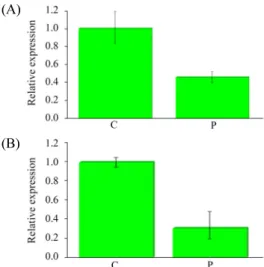
Fig. 2. Metastasis gene expressions. (A) PLAU expression. Real-time PCR
for the amplification of PLAU mRNA in MCF7 cells was performed. β- Actin mRNA was amplified as an internal control. PLAU expression in MCF cells treated with 0.1 mg/ml fermented soybean extract (P) and without (C) 24 h was compared after the Real-time PCR performance. Error bars are shown in control (C) and fermented soybean extract (P) treatment. Value of C is 1, and that of P is 0.46. (B) ERBB2 expression. Real-time PCR for the amplification of ERBB2 mRNA in MCF7 cells was performed. ERBB2 expression in MCF cells treated with 0.1 mg/ml of fermented soybean extract (P) and without (C) 24 h was compared after the Real-time PCR performance.
Error bars are shown in control (C) and fermented soybean extract (P) treatment. Value of C is 1, and that of P is 0.30.
Pancreatic ductal adenocarcinoma (PDAC) is related to cancer stem cell (CS). The poor prognosis of PDAC is correlated with increased expression of uPA (Asuthkar et al., 2013;
Moquet-Torcy G et al., 2014). ERBB2 is a member of tyrosine kinase family including epidermal growth factor receptors (EGFR). None small cell Lung Cancer (NSLC) cells and breast cancer cells have mutant forms of EGFR or its overproduction (Li et al., 2008; Chuang et al., 2017). We treated breast cancer MCF7 cells with fermented soybean extracts and measured expression levels of PLAU and ERBB2.
Surprisingly, fermented soybean extracts suppressed PLAU and ERBB2 expressions (Fig. 2). Some specific peptides in the soybeans fermented by B. licheniformis B1 seem to inhibit their expression.
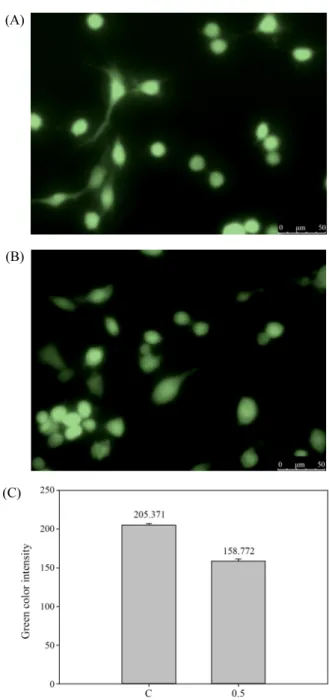
Inflammation is related to metastasis. Since fermented soybean extracts inhibited metastasis-related gene expressions, we deter- mined effect of fermented soybean extracts on the production of inflammation marker NO in breast cancer cells. In the cancer cells treated with fermented soybean extracts, NO production was reduced conspicuously (Fig. 3).
It was found that peptide H (Glu-Val-Tyr-Tyr-Met-Tyr)
(A)
(B)
(C)
Fig. 3. NO assay. MCF 7 cells were treated with 0.5 mg/ml fermented
soybean extract for 1 day (0.5). The cells were mixed with NO fluorometric probe and stored for 1.5 h. The cell images were obtained (A, B) under the fluorescence microscope (DMi8, Leica) with FITC filter. The fluorescent intensity of cells were determined using Image J program (C).
which derived from the fermented soybean (Lee et al., 2014) and was modified suppressed the expressions of TNFα in human breast cancer MDA-MB-231 cells (Sung et al., 2015). It will be interesting to find specific peptides to suppress PLAU and ERBB2 expressions in human breast cancer cells.
적 요
발효대두 청국장에는 대두단백질이 발효에 의해 분해 형성 된 다양한 펩타이드류가 들어 있다. 청국장 추출물이 처리된 유방암세포의 microarray data와 잘 알려진 유방암 전이 마커 를 합쳐서 새로운 연결망이 제조되었으며 이를 이용해 전이 마 커와 발현 차이가 있는 단백질 사이의 상호작용을 체크하였다.
연결망 분석을 통해 PLAU (plasminogen activator, urokinase, uPA)와 ERBB2 (epidermal growth factor receptor 2)를 실제 전이 가능성을 보여주는 유전자로 선택하였다. MCF7 암세포 를 청국장추출물로 처리하고 PLAU와 ERBB2 발현정도를 측 정하였다. 청국장 추출물은 PLAU와 ERBB2 발현을 상당히 억제하였다. 청국장 추출물을 처리한 암세포에서 염증 마커인 NO의 생산이 감소하였다. 인간 유방암세포에서 PLAU와 ERBB2 발현을 특이적으로 감소시키는 펩타이드를 찾아내는 것은 흥 미로운 일일 것이다.
References