Effect of Flooding and Soil Salinity on the Growth of Yam (Dioscorea batatas) Transplanted by Seedling of Aerial Bulblet in
Saemangeum Reclaimed Tidal Land
Yong-Man Sohn, Jae-Do Song, Geon-Yeong Jeon, Doo-Hwan Kim, and Moo-Eon Park*
Rural Research Institute. KARICO. Ansan 426-170, Korea
The effect of flooding and soil salinity on the growth of yam (Dioscorea batatas) were studied on the experimantal site temporally established in the south-eastern part of Saemangeum Reclaimed Tidal Land (near Gwanghwal myun, Gimjae-gun, Jellabukdo, Korea). Yam seedlings planted by using aerial bulblet as alternative of sliced tubers, were grown for 20-days and transplanted in black-vinyl mulched ridges (about 20 cm in height) at 70cm interval by 20 x 60cm spacing in the 4th of May, 2010. Soil salinity was maintained at lower than 1.2 ds m-1 during the growing period and did not result to salt injury in all plants. However, flooding injury very seriously led to plant death and plant mortality rates at 67 ± 21 and 82 ± 9% of yam plants in the compost and no compost treatment, respectively, died by heavy flooding during the rainy summer season. The main reasons of the flooding injury included the decreased rainfall acceptable capacity (RAC) after the rising of water table and a slowdown of water infiltration rate after the formation of an impermeable soil crust in the furrow bottom with continuous and heavy downpour during the rainy summer season. The effect of compost treatment was not statistically observed because of the severe spatial difference caused by wet injury, although yam tuber yield was higher at 30 kg 10-1 in the compost treatment than in the no-compost treatment at 20 kg 10-1. However, the size of tuber ranged at 1.23 to 1.60 cm in diameter and 3.7 to 5.0 cm in length in all both treatment, which means they are still reproducible for the next cropping season. Conclusively, proper counter-flooding measure and soil salinity control critically important for successful yam production in Saemangeum Reclaimed Tidal Land.
Key words: Yam, Aerial bulblet, Wet injury, Soil salinity, Flooding. Soil crust
Received : January 7. 2011 Accepted : February 25. 2011
*Corresponding author : Phone: +82312558545
E-mail: [email protected]
Introduction
Although the reclaimed tidal land has been traditionally used for agricultural purposes during the period of food shortage before the 2000’s, the land-use plan of Saem- angeum reclaimed land had focused more on non- agricultural purposes corcerns. Further more, the land-use plan for agricultural purpose of the reclaimed land had strongly recommended the cultivation of cash crops instead of food crops such as rice, wheat and others (RRI, 2006; 2007). However, research information on cash crop production such as medical herb, stimulant crop and others in this area is very limited since little research studies had been done for upland crops in Korea for several years. The main limitations for upland crop
cultivation included high soil salinity, rising of water table in summer, frequent flooding, weakness of ridge formation, low fertility, etc. (RRI, 2009; Sohn, et al., 2010b). Among the cash crops, yam has been become more popular and its consumption has sharply increased with wellbeing food boom (Chang, et al., 1997; 2000). If there is possibility of mass production by cheap cost, health food industry for yam processing can be developed for citizen’s health care as well as farmer’s income increase in Saemangeum Reclaimed Tidal Land. It is generally known that farmer used to pay a lot of money equivalent to 40% of total production cost (Kim, 2010).
Yam seedlings planted by using aerial bulblet as alternative of sliced tubers will be good solution solving tuber cost problem.
It is reported that yam is well grown and highly harvested for tuber in sandy loam or loamy soils than sandy or clayey soils (Cho, et al., 1995: Park, et al., 2000), and tuber yield of yam was 21,2-27.5 M/T ha-1 in Dan-ma,
Fig. 1. Location of experimental site and Saemangeum Reclaimed Tidal Land.
Table 1. Soil physical properties of the experimental soils before crop cultivation at the studied site of Saemangeum reclaimed land.
Depth Particle distribution Soil
texture
Soil moisture
BD Hydraulic
conductivity
Sand Silt Clay FC† WM‡
cm --- % --- --- % --- Mg m-3 cm day-1
0-20 76.0 23.2 0.8 LS 15.9 4.8 1.25
20-40 77.8 21.9 0.3 LS 14.9 4.0 1.51 66.2
†field moisture capacity, ‡wilting moisture
22.8 M/T ha-1 in Jang-ma and 22.8 M/T ha-1 in Sukunea (Cho et al., 2000; Park et al., 1996). Planting density was more beneficial in 45x20 cm for planting of the sliced tuber, and 20x10 cm for planting of the aerial bulblet (Cho et al., 1995). Deep soiling more than 60 cm in depth for Dan-ma and 90 cm in depth for Jang-ma was very profitable for tuber yield increase (Park et al., 1999). For planting sliced tuber, head section of tuber was more beneficial for tuber yield than top head section (Kang et al., 1998). However, it is very difficult to find research reference for production techniques of seed tuber by using aerial bulblets instead of sliced tuber in the reclaimed land.
This study investigated the problems of the cultural management of yam cultivated in reclaimed tidal land in Saemangeum (Jullabugdo, Korea) and secondly, deter- mined the feasibility of using cultured aerial bulblet instead of sliced tubers as seedling material for yam production.
Materials and method
Investigation and analysis of physico-chemical properties The expertimental site (50 m x 25 m) was temporally established and located in the south-eastern part of Saemangeum Reclaimed Tidal Land (near Gwang- hwal myun, Gimjae-gun, Jellabukdo, Korea). Fig. 1 showed location of experimental site and Saemangeum Reclaimed Tidal Land in Korea.
Soil samples for soil physical analysis were collected from soil depth 0-20 and 20-40 cm in the experimental site. Soil texture was decided by USDA texture triangle according to particle size distribution data analyzed by pipeting method. Bulk density was measured by core method and soil hydraulic conductivity was measured by the inversed auger-hole method (Boast & Kirkham, 1971;
Maasland, 1955; Park & Yoo, 1983). Measurement of water table level was done by installing PVC pipe (4 m in
length, 3 cm in diameter) into soil. Soil water content was measured by gravimetric method for samples taken from 0-20, 20-40 and 40-60 cm in depth during growing period of yam.
Table 1 showed the soil physical properties of the soil samples before crop cultivation.
Composite soil samples for chemical analysis were collected and mixed together from surface soils that were randomly sampled from the experimental site. The soil chemical properties were analyzed using the standard methods recommended by the Rural Development Admi- nistration (NAAS, 2000). Soil pH was prepared at 1:5 soil- water ratio measured by a pH meter. Various analysing methods for other chemical properties were used, such as Tyurin method for soil organic content, Lancaster method for available phosphate, and 1N-NH4OAc (pH 7.0) method for exchangeable cations. Soil salinity was measured from a mixture sample of soil 1 to distilled water 5 ratio by EC-meter for samples taken from 0-20, 20-40 and 40-60 cm in depth during growing period of yam (NAAS, 2000).
Soil salinity (EC) was practically expressed after being
Table 2. Soil chemical properties of the experimental soils before and after crop cultivation of yam at the studied site of Saemangeum reclaimed land.
Samples pH EC OM Av.P2O5
Exchangeable cations
Ca Mg K Na
1:5 dS m-1 g kg-1 mg kg-1 --- cmolc kg-1 ---
Before exp. 8.4 1.9 20 21 0.7 1.8 0.68 3.22
After exp. Compost 6.7 0.8 38 40 1.1 1.9 0.62 2.05
No compost 6.5 0.8 21 38 0.9 1.5 0.63 2.10
Fig. 2. The changes of soil salinity during growing period of yam (Dioscorea batatas) at the experimental site of Saemangeum Reclaimed Tidal Land.
multiplied for five times of the values obtained from the 1:5 dilution method in this paper.
Table 2 shows soil chemical properties of the soil studied before and after crop cultivation of yam at the experimental site of Saemangeum reclaimed land.
Cultivation method and measurement of growth and tuber yield. For the experiment, yam seedlings of aerial bulblets of yam (Dioscorea batatas) were grown for 20-days in plastic pots and transplanted on the black- vinyl mulched ridges (average height 20 cm) of 70 cm intervals by 20 x 60 cm spacing at the fourth of May in 2010. Amount of applied fertilizer as basal dressing was 25.2 kg 10a-1 for N, 8.4 kg 10a-1 for P2O5 and 14.4 kg 10a-1 for K2O, and 4 kg 10a-1 of nitrogen fertilizer was additionally applied at 30 days after transplanting. In addition, 800 kg 10a-1 of swine compost were mixed into soil before transplanting for half area of the experiment site, and then compared with the block without compost.
Vine length of yam was measured from an average of ten plants, and tuber and dry matter yield were harvested from the area of 1.26 m2 (0.7 x 1.8 m) and then estimated by the area of 1,000 m2 (10a). Experiment was carried out by the completely randomized design with three replications.
Results and Discussion
Soil salinity change during the growing period of yam In order to estimate the salt injury in yam plants, soil salinity were measured at 0-20, 20-40, and 40-60 cm depth during the growing period, and were below 1.2 dS m-1 , which is lower than the 4 dS m-1 as the injury limit level for low salt tolerant crops (Knott, 1962). This means that yam plants have not undergone salt injury during its growing period. Fig. 2 showed the changes of soil salinity during growing period of yam at the experimental site of
Saemangeum Reclaimed Tidal Land.
Soil salinities of top soil were generally higher in 0-20 cm than 20-40 or 40-60 cm depth at 17th of May, but were lower during summer rainy season and finally lower than 20-40 or 40-60 cm depth after the end of July. This means that in summer, natural rains acted as very effective factor for the desalinization of Saemangeum Reclaimed Tidal Land as soil salinity was apparently at lower concen- trations (below 4 dS m-1) in larger areas of the reclaimed land. This result was very similar to Shon’s report (2009) that salinity sharply dropped from 30 dS m-1 at Spring to 3.2 dS m-1 at Autumn on the closed area of the rainfed pond, but only to 17.0 dS m-1 on the open area under the condition of 1400 mm of annual precipitation in 2009, because the experimental site of low land has been frequently flooded during growing period.
Flooding and soil water change during growing period. Soil flooding by water table rise or heavy rainfall during very short period might bring severe wet injury.
Plant growth and yield was greatly decreased by reduction of stomatal conductivity, trans-evaporation rate and photo- synthesis (Lee et al., 2010; Lee et al., 1995; Park and Ha, 1984). Flooding should be greatly related with rainfall characteristics.
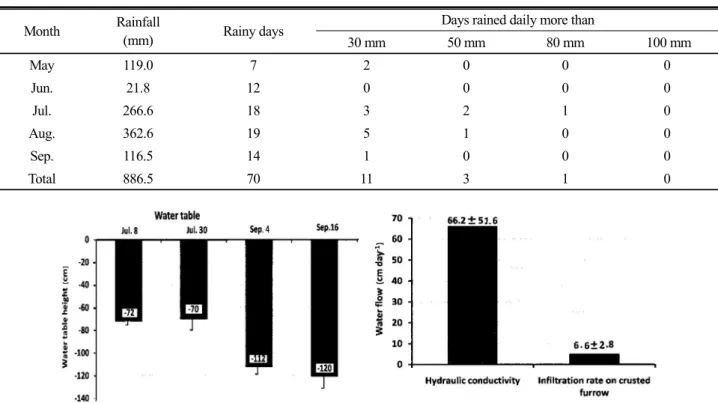
Table 3. Rainfall recorded at the Buan station of the Korea Meterological Administration near Saemangeum Reclaimed Tidal Land in 2010.
Month Rainfall
(mm) Rainy days Days rained daily more than
30 mm 50 mm 80 mm 100 mm
May 119.0 7 2 0 0 0
Jun. 21.8 12 0 0 0 0
Jul. 266.6 18 3 2 1 0
Aug. 362.6 19 5 1 0 0
Sep. 116.5 14 1 0 0 0
Total 886.5 70 11 3 1 0
Fig. 3. Changes in water table height and comparison of infiltration on the relatively low crusted furrow and hydraulic conductivity at 16th Sept., 2010.
Total rainfall amount recorded at the Buan station of the Korea Meterological Administration near Saemangeum Reclaimed Tidal Land, was 886.5 mm and rainy days were 70 during growing period of yam in 2010. Table 3 showed the rainfall recorded at the Buan station of the Korea Meterological Administration near Saemangeum Reclaimed Tidal Land in 2010.
The 70% of total rainfall came down during the rainy season of July-August, and it rained for 18 days in July and 19 days in August. Especially it rained daily for more than 50 mm for a consecutive of 3 days and more than 80 mm for one day during July. If rain intensity was compared with 66.2 ± 51.6 cm day-1 of hydraulic conductivity in Table 1 and Fig. 3, there was no possibility flooding in Saemangeum experimental site (Sohn, 2010a; 2010b).
However, it was observed that the studied field was flooded many times during the summer season, and especially the lower positions of soil crusted furrows were more often flooded for several days after the rain stopped.
For example, flooding lasted for 3 days in some furrows after 19 mm of rainfall at the 12th of September, 2010.
day. Infiltration rate was estimated at about 6.6 ± 2.8 cm day-1 in the flooded furrow measured by the installed bar with notch ark. If daily rainfall data were compared with
6.6 ± 2.8 cm day-1 of infiltration rate, flooding could last for three days during growing period in Table 3. Hillel (1980) reported that rain-pond in the relatively lower land, might result in the reduction of infiltration rate, because impermeable layer might be formed at the upmost top layer covered by soil crust. Fig. 2 showed the changes in water table height and comparison of infiltration on the relatively lower furrow and hydraulic conductivity on the 16th of September, 2010.
The rise of water table and heavy rainfall in summer affected the soil to be saturated during heavy rainy season.
Fig. 4 showed the changes of soil water content during growing period of yam at the experimental site of the Saemangeum Reclaimed Tidal Land.
Soil water content was maintained at 25-30% over 16%
of field moisture content during summer season. High soil water content directly reduced air volume of soil body, which could seriously impede root respiration. Table 4 showed the ratio of solid, liquid and gases parts in the soil volume during the rainy season at the experimental site of Saemangeum Reclaimed Tidal land.
The air volume of the soil ranged from 12.4 to 16.4% in depth 0-20 cm, 0 to 7% in depth 20-60 cm, and 0 to 2.8%
in depth 40-60 cm during rainy season. This means that
Table 4. Ratio of solid, liquid and gases parts in the soil volume during the rainy season at the experimental site of Saemangeum Reclaimed Tidal Land.
Date Soil depth 0-20 cm Soil depth 20-40 cm Soil depth 40-60 cm
Solid Liquid Gases Solid Liquid Gases Solid Liquid Gases
--- % ---
Jul.8 47.2 39.0 13.8 56.9 43.1 0 56.9 43.1 0
Jul.30 47.2 36.4 16.4 56.9 41.7 1.4 56.9 41.7 2.8
Aug.20 47.2 39.8 14.0 56.9 43.1 0 56.9 43.1 0
Sep.4 47.2 40.4 12.4 56.9 39.0 4.1 56.9 42.3 0.8
Sep.16 47.2 37.3 15.5 56.9 36.1 7.0 56.9 42.1 1.0
Fig. 4. Soil water content changes during growing period of yam (Dioscorea batatas) at the experimental site of Saemangeum Reclaimed Tidal Land.
root respiration of yam has been severely retarded and resulted to plant death by severe wet injury. Further more, soil aeration could had been more retarded because of mulching by black colored vinyl sheet. In fact, it was observed that most of plants were died after summer rainy season.
The reduction of air volume in the soil might be directly related with the decrease of RAC, and originally from the rise of water table and heavy rainfall during summer season. Shon et al. (2010b) reported that 50-200 mm of RAC might be theoretically calculated when soil water content ranged from 10% to 25% at -70 cm of water table height in Saemangeum reclaimed land. Therefore, reduction of rainfall acceptable capacity (RAC) at the summer season when water table and soil water content was very high, should be another reason to be flooded in the Saemangeum reclaimed tidal land.
In conclusion, the occurrence of soil flooding can be attributed to the retardation of water infiltration after the formation of the impermeable soil crust in the relatively lower furrow, and by reduction of RAC due to the rising of water table and heavy rainfall during summer rainy season, and resulted to severe wet injury of the plants studied in Saemangeum Reclaimed Tidal Land.
Growth and tuber yield of yam Yam seedlings of aerial bulblets were initially grown for 20-days in plastic pots and transplanted on black-vinyl mulched ridges of 70 cm intervals by 20 x 60 cm spacing at the fourth of May in 2010. All plants transplanted were successfully taken up by rooting with 100% survival at the beginning of growing period. Vine length was longer in the compost treatment than that in the no-compost treatment until the end of July, but it was impossible to measure the vine length in the later growth stages because of severe wet injury in plant. Fig. 5 showed the changes in vine length
during growing period and the ratio of plant that died after summer rainy season at the experimental site of Saemangeum Reclaimed Tidal Land.
Most plants died or most vines withered due to severe wet injury, and plant mortality rates were estimated to be at 67 ± 21% in the compost treatment and 82 ± 9% in the no-compost treatment after summer rainy season cultivation. Consequently, dry matter and tuber yield of yam were very low compared to soils planted under favorable weather conditions. Table 5 showed tuber yield and characteristics of yam grown at the experimental site of Saemangeum Reclaimed Tidal Land.
The dry matter and tuber yield of yam were 33.5 and 30.1 kg 10a-1 in the compost treatment while those were 18.3 and 19.9 kg 10a-1 in the no-compost treatment, respectively. Standard deviations of tuber yield were very big representing ± 24.2 kg 10a-1 in the compost treatment and ± 21.2 kg 10a-1 in the no-compost treatment. According to F-test for analysis of variance of completely randomized design with three replications (Table 6), difference of dry matter and tuber yield between compost treatment and no compost treatment was statistically no meaning because
Table 5. Tuber yield and characteristics of yam (Dioscorea batatas) grown at the experimental site of Saemangeum Reclaimed Tidal Land.
Treatment Dry matter (Top part) Tuber yield Tuber characteristics
Diameter Length
kg 10a-1 kg 10a-1 --- cm ---
Compost 33.5 30.1 1.34 5.0
No compost 18.3 19.9 1.23 3.7
LSD(p=0.05)† NS NS NS NS
†letter within a column followed by NS are not significantly different at 5% level by LSD (Least significant difference).
Table 6. F-test by analysis of variance of completely randomized design with three replications for the effect of compost treatment on dry matter and tuber yield of yam (Dioscorea batatas) at the experimental site of the Saemangeum Reclaimed Tidal Land.
Yield Factor d.f SS MS F-value
Dry matter.
Total 5 2446.2
Treatment 1 346.7 346.7 0.661ns
Error 4 2099.6 524.9
Tuber yield.
Total 5 2221.5
Treatment 1 156.1 156.1 0.302ns
Error 4 2065.5 516.4
ns non-significance at p=0.05
Fig. 5. Changes in vine length during growing period and dead plant ratio of yam (Dioscorea batatas) after summer rainy season at the experimental site of the Saemangeum Reclaimed Tidal Land.
spatial variation of flooding injury was very seriously observed in the compost treatment resulting to a ununiform effect on tuber yield. Tuber yield was severely low because of wet injury compared with previous research reports where average tuber yield were 21,2-27.5 M/T ha-1 in Dan-ma, 22.8 M/T ha-1 in Jang-ma and 22.8 M/T ha-1 in Sukunea (Park et al., 1996).
However, it is considered that tuber qualities of 1.23- 1.34 cm in diameter and 3.7-5.0 cm in length were good enough for seed source, because generally sliced tuber for seed are almost same as these sizes. Low tuber yield might be mainly from wet injury, some were being genetically handicapped aerial bulblet, and partly from application of
lower level of phosphate fertilizer than Kim’s recommen- dation (2010).
In conclusion, it was considered that seed tuber could be produced by using aerial bulblet, but good drainage channel system for preventing flooding as well as desalting measure should be preferentially considered for yam production in the Saemangeum Reclaimed Tidal Land.
Conclusion
The experiment was carried out to find the cultural management problems for yam cultivation and to
investigate feasibility of the seed tuber production by culturing aerial bulblet, which was very feasible to be cultivated as an alternative of sliced tubers in Saeman- geum Reclaimed Tidal Land. Yam plants did not suffer from salt injury indicating that this kind of soil below 1.2 dS m-1 can be used for cash crop cultivation. However, the occurrence of soil flooding drastically resulted to the rise of the mortality rate of the plants. The occurrence of soil flooding can be attributed to the retardation of water infiltration after the formation of the impermeable soil crust in the relatively lower furrow, and by reduction of RAC (rainfall Acceptable Capacity) due to the rising of water table and heavy rainfall during summer rainy season, and resulted to severe wet injury of the plants studied in Saemangeum Reclaimed Tidal Land. It is being recommended that a good drainage channel system aside from better desalination techniques, is very important to control flooding with yam cultivation at rainy summer seasons in Saemangeum Reclaimed Tidal Land.
References
Boast C.W. and D. Kirkham. 1971. Auger hole seepage theory.
Soil Sci. Soc. Am. Proc. 35:365-373.
Chang, K.J. S.T. Lee, and C.H. Park. 2000. Production techniques of medicinal plants and industrial crops. p 9-18. Jinyoung pub.
Chang, K.J., C.H. Yoo, N.S. Kim, P.J. Hur, and Y.U. Chang.
1997. Study on research system for mass culturing techniques of high yielding yam. harvest. Research report by Daesan foundation for rural culture.
Cho, J.H., S.P. Lee, and S.M. Oh. 2000. Study on quantitative growth analysis in yam(Dioscorea spp.). Korean J. Medicinal Crop Sci. 8(4):362-372.
Cho, J.H., T.Y. Kwon, K.K. Min, and B.S. Choi. 1995. Effect of planted organ, planting space, and fertilizer level on growth and yield of chinese yam(Dioscorea opposita Thunb). Korean J. Crop Sci. 40(1):9-15.
Cho, J.H., S.M. Oh, S.P. Lee, and S.D. Bae. 1996. Effect of irrigation time on growth and yield of Dioscorea batatas DECNE). Korean J. Medicinal Crop Sci. 4(3):205-211.
Hillel, D. 1980. Fundamentals of soil physics. p 216-217, Academy press.
Kang, D.K., J.H. Cho, S.K. Kim, K.K. Min, S.H. Chung, and B.S. Choi. 1998. Effect of seminal sections of tuber and staking methods on growth and yield of chinese yam (Dioscorea batatas Decne). Korean J. Medicinal Crop Sci.
6(3):170-175.
Kim, K.S. 2010. Industrial crop: cultural techniques of yam.
Gangwon Agricultural Research and Extension Service.
Knott, J.E. 1962. Handbook for vegetable growers. p44-45. J.W.
Willey & sons, Inc.
Lee, H.S., U.H. Park, and H.S. Song. 1995. Effect of water table depth in different soil texture on growth and yield of barley and wheat. Korean J. Crop Sci. 40(2):195-202.
Lee, J.E., H.S. Kim, Y.U. Kwon, G.H. Jung, C.K. Lee, H.T. Yun, and J.G. Kim. 2010. Responses of photosynthetic characters to waterlogging in soybean. Korean J. Crop Sci. 55(2):111-118.
Maasland, M. 1955. Measurement of hydraulic conductivity by the auger hole method in anisotropic soil. Soil Sci. 71:
379-389.
NAAS. 2000. Analysis of soil and plant. National Inst. of Agr.
Sci. & Teck. RDA, Suwon, Korea.
Park M.E. and S.H. Yoo. 1983. A comparison of soil hydraulic conductivities determined by three different methods in a sandy loam soil. J. Korean Soc. Soil Sci. Fert. 16(1):14-19.
Park M.E. and Y.W. Ha. 1984. Studies on grain filling in wheat and barley. III. Effect of flooding treatment in the maturing period of barley. Res.Rept. ORD 26-2(crop) 112-117.
Park, S.H., N.S. Seong, B.O. Ahn, C.S. Kim, and S.T. Lee. 1996.
Comparison of isozymes and growth characteristics of cultivars in Dioscorea batatas DECNE.Korean J. Medicinal Crop Sci. 4(1):52-57.
Park, S.K., D.K. Kang, Y.H. Kim, S.H. Chung, and B.S. Choi.
1999. Effect of trenching depth on tuber characteristics and yield in Dioscorea opposita Thunb). Korean J. Medicinal Crop Sci. 7(3):167-171.
Park, S.K., D.K. Kang, Y.H. Kim, S.H. Chung, and B.S. Choi.
2000. Effect of soil texture on tuber characteristics and yield in Dioscorea opposita Thunb. Korean J. Medicinal Crop Sci.
8(2):89-93.
RRI. 2006. Agricultural complex development for upland &
Horticultural crops in the Seamangeum reclaimed farmland.
Res. Rpt. Rural Research Institute. pp 1-504, Korea Rural Community & Agriculture Corporation.
RRI. 2007. Development method of the future agriculture complex in reclaimed land. Res. Rpt. Rural Research Institute.
pp. 1-400. Korea Rural Community & Agriculture Corporation.
RRI. 2009. Operation of advanced agricultural experiment complex and field test. Res. Rpt. Rural Research Institute, pp. 1-217, Korea Rural Community & Agriculture Corporation.
Sohn, Y.M., G.Y. Jeon, J.D. Song, J.H. Lee, D.H. Kim, and M.E.
Park. 2009. Operation of advanced agricultural experiment complex and field test. Res. Rpt. of Rural Research Institute.
Korea Rural Community & Agriculture Corporation.
Sohn, Y.M., G.Y. Jeon, J.D. Song, J.H. Lee, D.H. Kim, and M.E. Park. 2010a. Effect of soil salinity and soil-wetting by summer-rising of water table on the growth of fruit trees transplanted at the Saemangeum reclaimed tidal land in Korea. Korean J. Soil Sci. Fert. 43(1):8-15.
Sohn, Y.M., J.D. Song, G.Y. Jeon, D.H. Kim, and M.E. Park.
2010b. Effect of soil salinity and culturing condition on the maintenance of ridge and the growth of upland crops in the Saemangeum reclaimed tidal land. Korean J. Soil Sci. Fert.
43(5):407-417.