Effects of Green Manure and Carbonized Rice Husk on Soil Properties and Rice Growth
Weon-Tai Jeon, Ki-Yeong Seong, Jong-Ki Lee, In-Seok Oh, Young-Han Lee1, and Yong Sik Ok2*
National Institute of Crop Science, RDA, Suwon 441-857, Korea
1Gyeongsangnam-do Agricultural Research and Extension Service, Jinju 660-370, Korea
2Kangwon National University, Chuncheon 200-701, Korea
The cultivation of green manure crops plays an important role in soil quality and sustainability of agricultural system. However, the incorporation of green manure crops may be of concern because it can lead to strongly reducing conditions in the submerged soil. This study was conducted to evaluate the effects of rice husk carbon on rice (Oryza sativa L.) cultivation using green manure mixtures (hairy vetch + rye) in rice paddy. Field experiments were conducted in rice paddy soil (Shinheung series, fine loamy, mixed, nonacid, mesic family of Aeric Fluventic Haplaquepts) at the National Institute of Crop Science (NICS), Korea from October 2007 to October 2008. The experiments consisted of three treatments: application or no application of carbonized rice husk, and conventional fertilization. These treatments were subdivided into whole incorporation and aboveground removal of green manure mixtures. The redox potential (Eh) was higher upon application of the carbonized rice husk when compared to no application at 8 and 37 days after transplanting (DAT). The ammonium-N (NH4-N) in soil was highest upon the application of carbonized rice husk + whole green manure incorporation at 17 and 49 DAT. Plant height and tiller number of rice were similar to the NH4-N concentration in soil. Rice yields of application and no application of carbonized rice husk treatment were not significant.
However, application of carbonized rice husk improved the soil physical properties such as bulk density and porosity after rice harvest. Therefore, the results of this study suggest that carbonized rice husk could be used as soil amendment for environmentally-friendly rice production under a green manure mixture-rice cropping system.
Key words: Carbonized rice husk, Redox potential, Green manure, Mixture, Rice
Received : August 7. 2010 Accepted : August 12. 2010
*Corresponding author : Phone: +82332506443 E-mail: [email protected]
Introduction
Rice is the most important food for more than 50% of the world’s population, and it is grown on almost 155 million ha of the worldwide (Kögel-Knabner et al., 2010).
In Korea, rice is also the most important principal food crop, with a land area of 924,471 ha in 2009 (MAF, 2010).
Farmers and consumers have recently shown interest in environmentally-friendly rice (Park et al., 2008). To produce environmentally-friendly rice, chemical use should be reduced. One method of reducing the use of chemical fertilizers is through the use of green manure crops. The cultivation of green manure crops plays an important role
in maintaining the soil quality and sustainability of agricultural systems. However, the incorporation of green manure crops may be of concern because the decomposition of green manure and other soil organic matter may lead to strongly reducing conditions in submerged soil that may adversely affect rice growth and yield (Tanji et al., 2003). For example, when the incorporation of green manure crops such as rye result in overproduction and a high C/N ratio in submerged soils in rice paddies they may have an adverse effect on the redox potential. The decomposition of green manure crops is initially driven by aerobic respiration when oxygen is available from 7 to 10 days after the incorporation of green manure by dry tillage; however, anaerobic respiration prevails in flooding rice paddies. Under aerobic conditions using oxygen as an electron acceptor, microorganisms
Table 1. Biomass, N production and C/N ratio of green manure mixture.
Green manure mixture
Fresh weight (kg ha-1)
Dry weight (kg ha-1)
N production (kg ha-1)
C/N ratio (%)
Rye HV† Rye HV Rye HV Rye HV
HV + Rye 24,300 6,450 4,880 1,070 72.2 46.0 32.1 11.1
†HV : Hairy vetch.
oxidize soil organic matter such as the residue of green manure crops at a much faster rate, producing CO2 and H2O as end products (Manahan, 1994). Rice husk, a product of the rice milling process, is a raw material for silicon carbide production, because it contains amorphous silica and carbon in a finely mixed form (Bhat and Sanghi, 1987). Rice husk is generally used as a mulching material (Roh and Pyon, 2004) and for water absorption (Kim et al., 2004) in Korea. Rice husk ash primarily consists of silica (90-95%), as well as minor amounts of calcium magnesium, potassium, sodium, phosphorus and sulphur and amounts of aluminum, manganese and iron, which vary according to the soil and manure used (Rao et al., 1989). So, rice husk carbon could be low as fertilizer’s effect. Therefore, the carbon in rice husk could reduce the effect of fertilizer. However, rice husk carbon has an extended surface, porous structure with micropores, and macropores such as activated carbon (Chand et al., 2009).
Therefore, it is expected that it may be possible to supply oxygen to the soil via the application of carbonized rice husk.
This field study was conducted to determine if the application of carbonized rice husk reduces the redox potential in soil and improves rice growth and soil physical properties in a green manure-rice cropping system.
Materials and methods
The experiments for this study were conducted in paddy soil (Shinheung series, fine loamy, mixed, nonacid, mesic, family of Aeric Fluventic Haplaquepts) at the National Institute of Crop Science (NICS), Korea, from October 2007 to October 2008.
Green manure crop The manure crops, hairy vetch and rye, were cultivated from Oct. 2007 to May 2008. The soil characteristics in the 0-15 cm layer prior to sowing the green manure crops were as follows: 16.0% clay; 50.5%
silt; 33.5% sand; 4.03% organic matter; pH 5.5 (water 1:5).
After the soil was tilled using the rotavator of a tractor (L65, LG, Korea), a mixture of seeds of hairy vetch (Vicia villosa) and rye (Secale cereale) were drilled at the rate of 50 kg ha-1 and70 kg ha-1, respectively, using a partial tillage seeder (Jeon et al., 2008) on Oct. 8, 2007. Incorporation of a hairy vetch and rye mixture was conducted using a tractor rotavator (L65, LG, Korea) on April 30, 2008. The fresh weight of the aboveground portion of the plants was measured immediately before incorporation of the mixture, after which it was oven-dried at 70℃ for 48 hrs and the dry weight was determined. The carbon (C) and nitrogen (N) contents were analyzed using a CNS2000 combustion analyzer (Leco, USA). The biomass, N production and C/N ratio of green manure crops was determined (Table 1).
Carbonization of Rice Husk and Treatment The rice husk was carbonized for application into the soil before planting. The rice husks were first dried under sunshine for three days, after which they were carbonized in a stainless steel vessel for 7-8 h and the carbonized rice husk was poured from the stainless steel vessel after 1-2 h. The detailed methods are described in the manual for the rice husk making machine (OCI-400, OtlKorea, Korea). Rice husk carbon was appled at 2 ton ha-1 on May 27 (14 days before transplanting). The composition of the rice husk ash was as follows: 93.8% SiO2; 1.3% K2O; 0.43% P2O5
and trace elements. The three following treatments were employed in this study: application or no application of carbonized rice husk, and conventional fertilization, and these treatments were subdivided into whole incorporation and aboveground removal of green manure mixtures. Each block was 150 m2 and was arranged with a completely randomized design using three replicates.
Rice cultivation Twenty-five day old rice seedlings (cv. Pungmibyeo, Japonica type) were machine-transplanted in a space of 30 X 14 cm on June 2, 2008. With the exception of the conventional fertilization treatment, none of the treatments were applied as chemical fertilizers. The conventional fertilization was dressed into the top soil (<15cm) with 90(N)-45(P2O5)-57(K2O) kg ha-1 based on
Table 2. Changes in soil redox potential in response to carbonized rice husk application and green manure incorporation.
Carbonized rice husk Green manure
(Hairy vetch + Rye) 8 DAT† 37 DAT
- mV-
Application Aboveground removal -155c -170c
Whole incorporation -180b -190bc
No application Aboveground removal -190b -211b
Whole incorporation -236a -255a
CF‡ -158c -178c
†DAT : Days After Transplanting, ‡CF : Conventional Fertilization.
Values followed by the same letter within one column do not differ significantly by DMRT (p = 0.05).
the recommended fertilization rate for rice cultivation (RDA, 1999). The herbicide, pyrazosulfuron-ethyl (Sungbo chemical Co. LTD., Korea) was applied to all plots at a the rate of 30 kg ha-1 at 7 days after transplanting (DAT). The plant height, tiller and leaf color were measured at 17 and 48 DAT. The leaf color was determined from the uppermost leaves using a chlorophyll meter (SPAD-502, Minolta, Japan) at 48 DAT. Rice yield was determined from 4.2 ㎡ areas in each plot. Yield components such as panicle number per hill, number of grains per panicle, ripened grains, and 1,000-grain weight were also determined (RDA, 1995).
Soil analysis Physico-chemical properties of soils were determined with a methods (RDA, 1988), Korea.
After rice harvest, soil samples (0-15 cm depth) were collected from each plot. The bulk density and soil porosity were then measured by taking cores (100 ㎤) of known volume from undisturbed field soils, after which the cores were oven-dried and weighed. The soil particle density was assumed to be 2.65 Mg m-3. The soil porosity was calculated from the sum of the soil liquid and air phase. In addition, soil samples collected from the same site were air dried and sieved (<2 mm) for chemical analysis. Eh was measured using a ORP Pt/Ag/AgCl combination electrode (Orion 678BN, USA) at a depth of 5 cm. Zobell’s solution was used to calibrate the ORP electrode and to standardize the Eh reading to the standard hydrogen electrode, and 198 mV was added to the observed readings (Norddstrom, 1977; Tanji et al., 2003). The ammonium nitrogen content in the soil was determined using a FIAstar5000 analyzer (FOSS Sweden) after extraction in 2 M potassium chloride solution (RDA, 1988). The soil pH was measured using a pH meter (720P, iSTEK, USA) by mixing the soil with distilled water (1:5 with H2O). The
soil organic matter and nitrogen were analyzed using a CNS2000 combustion analyzer (Leco, USA).
Results and Discussion
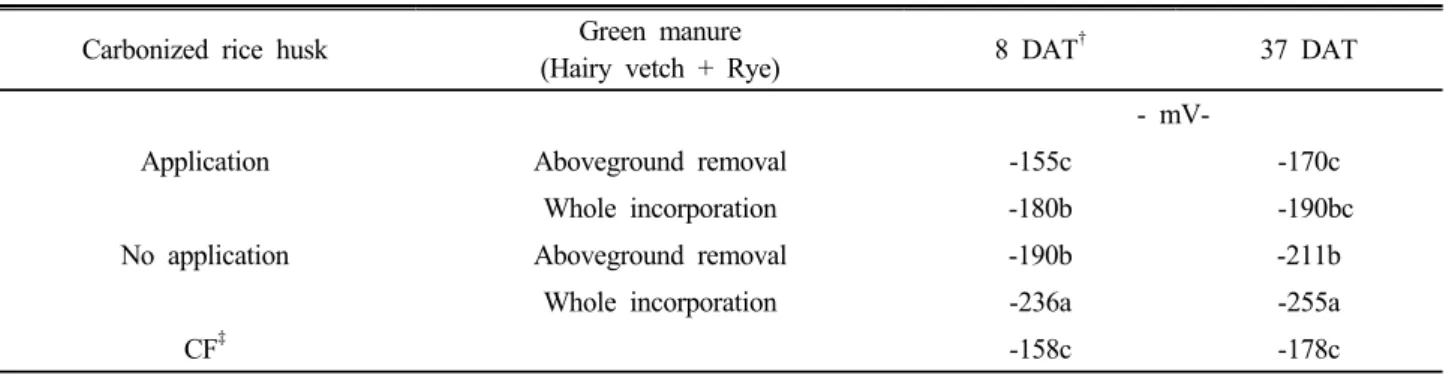
Redox potential is one of the most difficult soil quality criteria to characterize, especially in paddy soil. Soil redox potential was measured in all treatments at 8 and 37 DAT (Table 2). The redox potential showed the same pattern at 8 and 37 DAT. Specifically, it was higher in the group that received the rice husk than in those that did not as well as in the aboveground removal group than the whole incorporation group. These results indicated that the application of carbonized rice husk could lead to an increase in redox potential due to its porous property. According to a previous study, the application of porous materials supplied oxygen into the soil and thus increased the redox potential (Rao et al., 1989; Bhat and Sanghi, 1987).
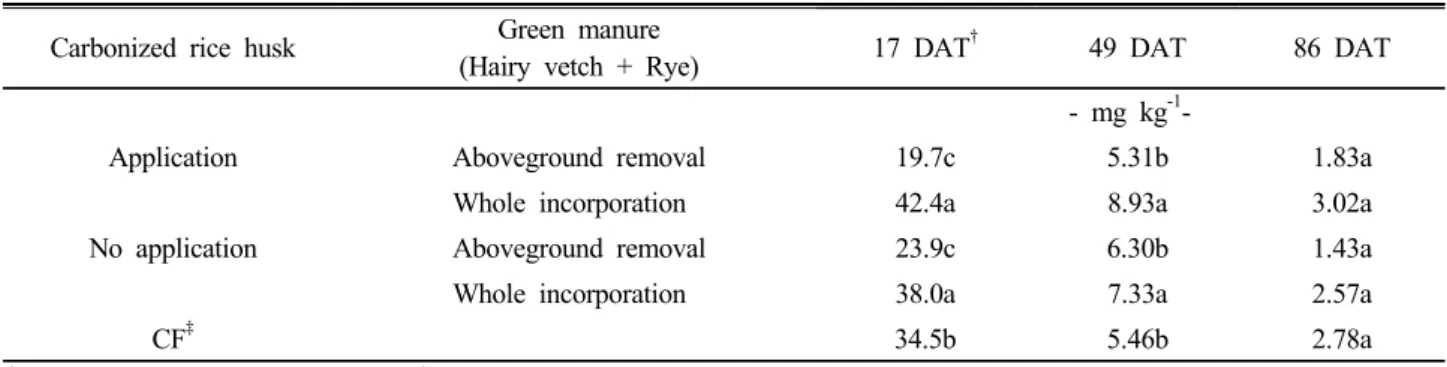
Ammonium-N (NH4-N) in soil was more strongly influenced by whole incorporation of green manure than application of carbonized rice husk (Table 3), and whole incorporation led to the elevation of ammonium-N concentration when compared to conventional fertilizer at 17 and 49 DAT. The ammonium-N concentrations decreased in all treatments with time. These findings indicate that application of porous carbon materials may have a positive effect on mineralization of green manure mixture in paddy soil.
Plant height and tiller number were examined at 17 and 48 DAT (Table 4). At 17 DAT, the rice plant height and tiller number did not differ significantly; however, at 48 DAT, they were significantly higher in the groups that received whole green manure and carbonized rice husk. It is presumed that this increase can be attributed to the high NH4-N and redox potential in soil (Table 2, 3). The leaf
Table 3. Changes in soil NH4-N concentration in response to carbonized rice husk application and green manure incorporation.
Carbonized rice husk Green manure
(Hairy vetch + Rye) 17 DAT† 49 DAT 86 DAT
- mg kg-1-
Application Aboveground removal 19.7c 5.31b 1.83a
Whole incorporation 42.4a 8.93a 3.02a
No application Aboveground removal 23.9c 6.30b 1.43a
Whole incorporation 38.0a 7.33a 2.57a
CF‡ 34.5b 5.46b 2.78a
†DAT : Days After Transplanting, ‡CF : Conventional Fertilization.
Values followed by the same letter within one column do not differ significantly by DMRT (p = 0.05).
Table 4. Rice plant height, tiller, and leaf color of rice plant in response to carbonized rice husk application and green manure incorporation at 17 and 48 DAT†.
Carbonized rice husk Green manure (Hairy vetch + Rye)
17 DAT† 48 DAT
Plant height Tiller Plant height Tiller Leaf color
cm no hill-1 cm no hill-1 SPAD
Application Aboveground removal 26a 7.1a 76ab 24b 35.4a
Whole incorporation 23a 8.3a 83a 28a 39.4a
No application Aboveground removal 23a 6.0a 75ab 22b 39.4a
Whole incorporation 22a 7.2a 79a 23b 37.8a
CF‡ 20a 6.3a 71b 21b 37.1a
†DAT and ‡CF see Table 3.
Values followed by the same letter within one column do not differ significantly by DMRT (p = 0.05).
color was similar to the plant height and tiller number but did not differ significant among plants. In this experiment, rice plants showed favorable growth during the early growth stage except gas bubbles derived from whole plant incorporation. Herrera et al (1997) reported that a redish- brown slimy film developed on the water surface of rice paddies within four days of green manure incorporation at two days after rice transplanting, which resulted in the death of seedlings.
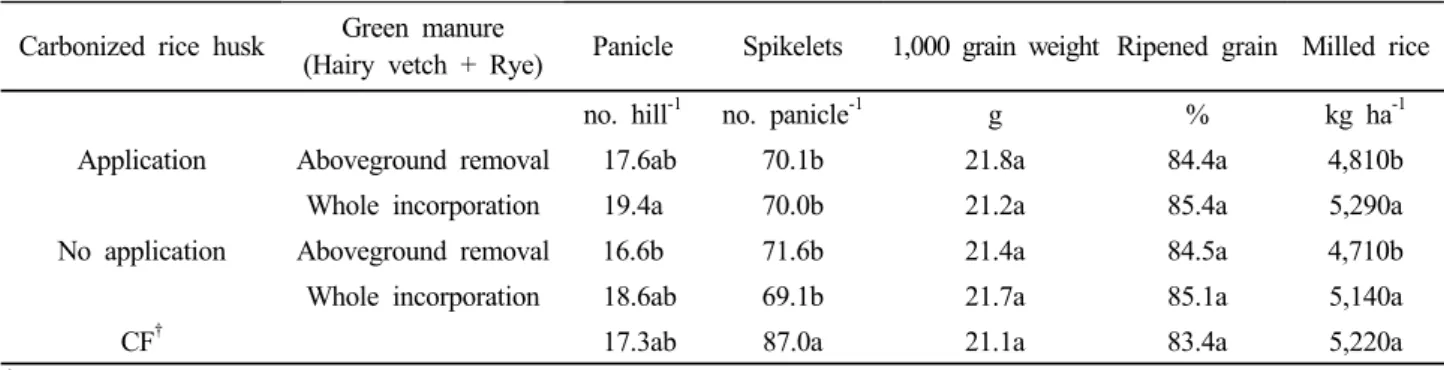
The rice yield and yield components are shown in Table 5. There were no significant differences from the conventional fertilization group in terms of ripened grain rates and 1,000-grain weight. The panicle numbers increased slightly in response to whole plant incorporation of green manure and carbonized rice husk when compared to conventional fertilization; however, this difference was not significant. Green manure incorporation also resulted in decreased spikelet development. The 1,000 -grain weight and ripening rate not differ significantly among treatments.
Additionally, the rice yields did not differ significantly between groups that received carbonized rice husk and those that did not. Moreover, carbonized rice husk had no
effect on rice yield. It has been reported that the fresh weight of the applied hairy vetch should be 20 tons ha-1 and the nitrogen production should be greater than 100 kg ha-1 to obtain a similar yield to that of the conventional practice at the time of supply (Kim et al., 2002; Jeon et al., 2008). It has also been reported that rye with a high C/N ratio during the middle period of growth caused N immobilization during decomposition (Clark, 2007). In this study, rice production equal to that obtained using conventional fertilization was shown to be strongly dependent on green manure incorporation, but not carbonized rice husk.
Table 6 shows the soil physico-chemical properties at 0-15 cm in response to carbonized rice husk application and green manure incorporation after rice harvest. Green manure incorporation improved the soil physical properties such as bulk density and porosity. In particular, carbonized rice husk application led to a great effect on an increase in porosity. These findings indicated that extended surface area and porous pores should be attributed to improving physical properties (Chand et al., 2009). The pH was slightly decreased in all treatments when compared to
Table 5. Rice yield and yield components in response to carbonized rice husk application and green manure incorporation.
Carbonized rice husk Green manure
(Hairy vetch + Rye) Panicle Spikelets 1,000 grain weight Ripened grain Milled rice
no. hill-1 no. panicle-1 g % kg ha-1
Application Aboveground removal 17.6ab 70.1b 21.8a 84.4a 4,810b
Whole incorporation 19.4a 70.0b 21.2a 85.4a 5,290a
No application Aboveground removal 16.6b 71.6b 21.4a 84.5a 4,710b
Whole incorporation 18.6ab 69.1b 21.7a 85.1a 5,140a
CF† 17.3ab 87.0a 21.1a 83.4a 5,220a
†CF see Table 3.
Values followed by the same letter within one column do not differ significantly by DMRT (p = 0.05).
Table 6. The changes in soil physical and chemical properties at 0-15 cm soil depth in response to carbonized rice husk application and green manure incorporation after rice harvest.
Carbonized rice husk Green manure (Hairy vetch + Rye)
Soil porosity
Bulk
density pH O.M T-N
% Mg m-3 1:5 g kg-1 %
Application Aboveground removal 54.5 1.21 5.32 41.3 0.21
Whole incorporation 57.7 1.12 5.28 42.8 0.22
No application Aboveground removal 52.6 1.26 5.28 44.4 0.22
Whole incorporation 53.9 1.22 5.09 46.3 0.23
CF‡ 57.3 1.13 5.35 43.1 0.22
†CF see Table 3.
Values followed by the same letter within one column do not differ significantly by DMRT (p = 0.05).
conventional fertilization. The soil organic matter decreased slightly as the carbonized rice husk was applied.
Conclusion
The use of green manure is a promising technology to reduce chemical fertilizers, especially for rice fields in Korea. However, the incorporation of green manure crops may be of concern because it can lead to strongly reducing conditions in the submerged soil. Therefore, in this study, the effects of carbonized rice husk during the rice growing season was evaluated in a field experiment. The application of carbonized rice husk had a positive effect on redox potential (Eh) and ammonium-N (NH4-N) in soil during the early rice growth stage. However, carbonized rice husk had no effect on rice yield, even though it led to improved soil bulk density and porosity. Overall, the results of this study suggest that carbonized rice husk could be applied as a soil amendment, particularly, for improving soil physical properties, to enable environmentally -friendly rice production under a green manure mixture-rice cropping system.
References
Bhat, B.V.R. and G.P. Sanghi. 1987. Increase in the yield of silicon carbide whiskers from rice husk. Bull. Master.
Sci. 9(4):295-303.
Chand R., T. Watari, K. Inoue, H. Kawakita, H.N. Luitel, D.
Parajuli, T. Torikai, and Mi Yada. 2009. Selective adsorption of precious metals from hydrochloric acid solutions using porous carbon prepared from barley straw and rice husk.
Minerals Engineering 22:1277-1282.
Clark A. 2007. Managing cover crops profitably (third edition).
Sustainable agriculture network. MD, USA.
Herrera W.T., D.P. Garrity, and C. Vejpas. 1997. Management of Sesbania rostrata green manure crops grown prior to rainfed lowland rice on sandy soils. Field Crops Research 49:259-268.
Jeon W.T., M.T. Kim, K.Y. Seong, and I.S. Oh. 2008. Changes of soil properties and temperature by green manure under rice-based cropping system. Korean J. Crop Sci. 53:413-416.
Kim C.G., J.H. Seo, H.S. Cho, S.H. Cho, and S.J. Kim.
2002. Effect of hairy vetch as green manure on rice cultivation.
Korean J. Soil Sci. 35:169-174.
Kim T.I., I.P. Craig, J.W. Jung, E.C. Hong, W.R. Bang, Y.H. Yoo, and C.B. Yang. 2004. Effects of rice hull addition and bin wall characteristics on pig slurry composting properties.
녹비작물 혼파 이용 벼 재배 시 왕겨숯 처리가 벼 생육 및 토양 특성에 미치는 영향
전원태·성기영·이종기·오인석·이영한1·옥용식2*
국립식량과학원, 1경남농업기술원, 2강원대학교
작부체계내로의 녹비작물의 도입은 토양의 건전성 향상으로 농업생산성의 지속성 유지에 중요한 역할을 한다. 그러나 벼 재 배를 위해 호밀 같은 화본과 녹비작물이 다량으로 투입 될 경우 환원장해 등의 부작용이 발생한다. 본시험은 녹비작물 헤 어리베치와 호밀의 혼파를 이용하여 벼 재배 시 왕겨숯의 처리 효과를 구명하고 수행하였다. 시험장소는 농촌진흥청 국립 식량과학원 답작시험 포장이었고 시험토양은 식양질인 신흥통이었다. 시험기간은 2007년 10월 녹비파종에서 벼 수확기인 2008년 10월까지였다. 시험처리는 왕겨숯 처리, 무처리 및 관행시비구를 두었고 왕겨숯 처리구는 혼파 녹비작물의 지상부 제거와 전체 식물체의 투입구로 구분하였다. 이앙 후 8일과 37일의 산화환원전위는 왕겨숯 무처리에 비하여 처리한 구에서 증가하였다. 이앙 후 17일과 49일의 토양 암모니아태 질소의 함량은 전식물체 투입구의 왕겨숯 처리구에서 가장 높았다.
벼의 주요 생육특성인 초장과 경수도 토양의 산화환원전위와 암모니태질소 함량 영향으로 이앙 후 48일에 전식물체 투입한 왕겨숯 처리구에서 가장 양호하였다. 쌀 수량은 전식물체 투입구의 왕겨숯 처리 (5,290 kg ha-1)와 무처리 (5,140 kg ha-1) 간 유의적 차이가 없었다. 그러나 벼 재배 후 왕겨숯 처리구에서 토양물리성인 공극률과 용적밀도가 개선되었다. 따라서 왕겨숯 처리는 쌀 수량의 유의적 증가에 기여하지는 못하였지만 벼 생육기간 및 벼 수확 후 토양 이화학성의 개선효과가 있어 토양개량제로 이용할 수 있을 것으로 판단된다.
J. L. H. E., 10:47-58.
Kögel-Knabner I., W. Amelung, Z. Cao, S. Fiedler, P.
Frenzel, R. Jahn, K. Kalbitz, A. Kölbl, and M. Schloter.
2010. Biogeochemistry of paddy soils. Geoderma 157:1-14.
MAF (Ministry of Food, Agriculture, Forestry and Fisheries, Republic of Korea). 2010. Statistical year-book of agriculture and forestry, Gwachon.
Manahan, S.E. 1994. Environmental chemistry. CRC Press, Boca Raton, FL.
Nordstrom, D.K. 1977. Thermodynamic redox equilibria of Zobell’s solution. Gosmochim. Acta 41:1835-1841.
Park S.T., W.T. Jeon, M.T. Kim, K.Y. Sung, J.H. Ku, I.S.
Oh, B.K. Lee, Y.H. Yoon, J.K. Lee, K.H. Lee, and J.H.
Yu. 2008. Understanding of environmental friendly agriculture and rice production using green manure crops. RDA, NICS, Sammi Press, Suwon, Korea.
Rao G. R., A.R.K. Sastry, and P.K. Rohatgi. 1989. Nature
and reactivity of silica available in rice husk and its ashes.
Bull. Master. Sci. 12:469-479.
RDA (Rural Development Administration). 1988. Methods of soil chemical analysis. National Institute of Agricultural Science and Technology, RDA, Suwon, Korea.
RDA (Rural Development Administration). 1995. Standard investigation methods for agricultural experiment. RDA, Suwon, Korea.
RDA (Rural Development Administration). 1999. Fertilization standard of crop. National Institute of Agricultural Science and Technology, Suwon, Korea.
Roh S.E. and J.Y. Pyon. 2004. Control of weeds in ginseng gardens by herbicides and mulching practices. Kor. J.
Weed Sci. 24:14-20.
Tanji K.K., S. Gao, S.C. Scardaci, and A.T Chow. 2003.
Characterizing redox status of paddy soils with incorporated rice staw. Geoderma. 114:333-353.