• 검색 결과가 없습니다.

The Effect of Aerobic Exercise Training Versus Resveratrol Supplementation on Mitochondrial Biogenesis in Skeletal Muscle of High-fat Diet-induced Obese Mice

N/A
N/A
Protected

Academic year: 2021

Share "The Effect of Aerobic Exercise Training Versus Resveratrol Supplementation on Mitochondrial Biogenesis in Skeletal Muscle of High-fat Diet-induced Obese Mice"

Copied!
9
0
0

로드 중.... (전체 텍스트 보기)

전체 글

(1)

The Effect of Aerobic Exercise Training Versus Resveratrol Supplementation on Mitochondrial Biogenesis in Skeletal Muscle of High-fat Diet-induced Obese Mice

Kyung-Il Kim

1

, Sang-Min An

2

, Hee-Geun Park

1

and Wang-Lok Lee

1

*

1

Department of Sports Science, Chungnam National University, Daejeon 34134, Korea

2
Department of Sport and Leisure Studies, Korea University, Sejong 30019, Korea Received June 12, 2019 /Revised August 10, 2019 /Accepted August 14, 2019

The purpose of this study was to analyze the effects of aerobic exercise and resveratrol supplementa- tion on mitochondrial biogenesis in skeletal muscle of high-fat diet-induced obese mice. In this study, 4-wk-old C57BL/6 male mice were divided into four groups, with 10 animals in each group: a normal diet group (NC), high-fat diet group (HC), high-fat diet group with resveratrol supplementation (HRe), and high-fat diet GROUP with exercise (HE). Aerobic exercise was performed on a treadmill for 40~60 min/d at 10~14 m/min, 0% grade, 4 d/wk for 16 wk. Resveratrol (25 mg/kg bodyweight) was ad- ministrated once a day, 4 d/wk for 16 wk. There was a significance difference in COX-IV mRNA ex- pression in the NC group versus that in the HC group (p<0.05). The expression of the SIRT-3, PGC- 1a, and COX-IV mRNA genes in the HE group increased significantly as compared with the ex- pression of these genes in the HC and HRe groups (p<0.05). These results indicated that high- fat di- et-induced obesity did not affect mitochondria biogenesis gene expression in skeletal muscle. In con- trast, aerobic exercise training increased the expression of mitochondria biogenesis gene expression in skeletal muscle in high-fat diet-induced obese mice. These findings suggested that aerobic exercise but not resveratrol supplementation had a positive effect on mitochondrial biogenesis in skeletal muscle in high-fat diet-induced obese mice.

Key words : Aerobic exercise, mitochondrial biogenesis, obese, resveratrol, skeletal muscle

*Corresponding author

*Tel : +82-42-821-6456, Fax : +82-42-823-0387

*E-mail : [email protected]

This is an Open-Access article distributed under the terms of the Creative Commons Attribution Non-Commercial License (http://creativecommons.org/licenses/by-nc/3.0) which permits unrestricted non-commercial use, distribution, and reproduction in any medium, provided the original work is properly cited.

Journal of Life Science 2019 Vol. 29. No. 8. 837~845 DOI : https://doi.org/10.5352/JLS.2019.29.8.837

Introduction

Obesity is characterized by increased storage of fatty acids in an expanded adipose tissue mass and in peripheral tissues [3]. Chronic obesity from lack of physical activity or high fat diet is a cause for cardiovascular disease, meta- bolic syndrome, arteriosclerosis, type-2 diabetes [46] and mi- tochondrial dysfunction [47]. Mitochondrial dysfunction is also the cause of a syndrome of metabolic defects that in- cludes hypomagnesemia, hypertension, and hyper- cholesterolemia [57]. Defective mitochondrial function in muscle can lead to reduced fatty-acid oxidation and in- hibition of glucose transport [38].

Mitochondrial biogenesis is regulated by regulatory fac- tors such as PGC-1α (peroxisome proliferator-activated re-

ceptor-γ coactivator 1α) and NRF-1 (nuclear respiratory fac- tor 1) [25]. PGC-1α is involved into mitochondrial oxidative metabolism and the maintenance of glucose and lipid [34].

Also, it is highly related to COX-IV (Cytochrome c oxidase subunit IV), ATP and citrate synthase activity [34, 41, 56].

It is known that moderate endurance exercise training im- prove metabolic and mitochondrial function [21] and regular exercise training improves the function of the mitochondria via the expression of PGC-1α and Tfam (mitochondrial tran- scription factor A) [22].

SIRT-1 (silent mating type information regulation 2, ho- molog 1) is activated by the PGC-1α and [7] recent studies have shown that SIRT-3 (silent mating type information reg- ulation 2, homolog 3) exists in the mitochondria and in- creases PGC-1α that induce mitochondrial biogenesis by reg- ulating mitochondrial number and substrate utilization [52].

In previous studies, Palacios et al. [45] showed that ex- pression level of SIRT-3 was increased in 7-week-old FVB/

NJ rats after 6 weeks of wheel-cage exercise. Hokari et al.

[20] showed that treadmill running increased the amount

of SIRT-3 protein and mitochondria density in the skeletal

muscle of the rats. And it has been known that the trained

(2)

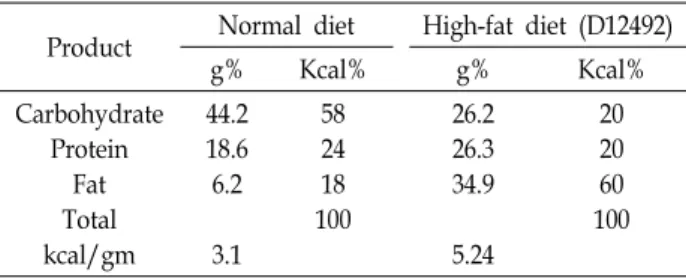
Table 1. Formulas of rodent feed

Product Normal diet High-fat diet (D12492)

g% Kcal% g% Kcal%

Carbohydrate Protein

Fat Total kcal/gm

44.2 18.6 6.2

3.1

58 24 18 100

26.2 26.3 34.9

5.24

20 20 60 100 individuals showed a higher number of SIRT-3 proteins and

mitochondria compared to sedentary individuals [31]. COX- IV protein plays an important role in aerobic exercise ca- pacity by regulation of mitochondrial oxiative phosphor- ylation [4, 13, 53]. Also, COX-IV is used as an indicator of aerobic exercise performance because it is controlled by PGC-1α that regulate mitochondrial biogenesis and function [44].

Recently, many studies have used a variety way to treat obese induced metabolic complication such as caloric re- striction and functional nutrition supplementation. Resveratrol (3, 4, 5-trihydroxystilbene, RSV), one of phytochemical, is a polyphenol compound found in berries, grapes, nuts, and several plants source [33, 39]. Resveratrol mimics the meta- bolic effects of long-term calorie restriction, and many in vi- tro studies have demonstrated that resveratrol has an anti- obesity potential by inhibiting pre-adipocyte differentiation, decreasing adipocyte proliferation, inducing adipocyte apoptosis, decreasing lipogenesis, and promoting lipolysis and fatty acid β-oxidation [9, 32]. And it has been previously identified as an antioxidation, and anti-inflammation agent.

Also, it prevents cardiovascular disease, cancer progression, and metabolic syndrome [12].

Ungvari et al. [55] that resveratrol improves endurance capacity by increasing mitochondria number, reducing re- active oxygen species (ROS) and ameliorating lipid metabolism. This result was supported by the finding that resveratrol mediated activation of AMPK increased inter- cellular NAD+ level [48, 54] and decreased PGC-1α (peroxisome proliferator activated receptor-γ coactivator-1α) acetylation through deacetylation of SIRT-1 (silent mating type information regulation 2 homolog) [5, 35]. In addition, resveratrol contributes to changing the type of muscle twitch fiber and PGC-1α activation by improving the function of mitochondria biogenesis [54]. Surprisingly, the maximal oxy- gen consumption was significantly increased and average running distance was about 2 times as long in the resveratrol supplementation group compared to the control group [54].

Also, in previous rodent studies, there were positive effects observed with resveratrol dosage (25-30 mg/kg/day or 400 mg/kg/day). These doses for mice would be equivalent to 2,100 or 28,000 mg/kg/day for humans (70 kg). Thus, these doses are unlikely to be obtained from natural or functional foods [48, 54]. Nonetheless, there are only a few studies com- paring the effects of exercise training and resveratrol supplementation. In addition, there is little research to our

knowledge, comparing the effects of either exercise training or resveratrol supplementation on high fat diet-induced met- abolic complication.

Therefore, the purpose of this study was to analyze the effects of either aerobic exercise or resveratrol supplementa- tion on mitochondrial biogenesis (SIRT-1, SIRT-3, PGC-1α, COX-IV mRNA) in skeletal muscle of high fat diet-induced obesity mice.

Material and Methods

Animals and diet

4-week-old male C57BL/6 (Central Experiment Animal, Korea, n=40) mice were housed in cages (5 mice per cage) in a standard experimental laboratory, at a temperature of 22±2℃, with 50±5% humidity. After a one-week acclimatiza- tion period, the mice were fed either a high fat diet (45%

of energy from fat, Orient Bio Inc., # D12451) or a normal diet (10% of energy from fat, Orient Bio Inc., # D12451) ad libitum for 16 weeks (Table 1).

The classification of groups was classified into total four groups such as normal diet group (NC, n=10), high fat diet group (HC), high fat diet group with resveratrol supple- mentation (HRe, n=10) and high fat diet with exercise group (HE, n=10) and then resveratrol supplementation and ex- ercise were applied for 16 weeks. All experiments were ap- proved by the Animal Care and Use Committee at the Chungnam National University (CNU-00494).

Resveratrol supplements and muscle dissection

Resveratrol supplement purchased from Sigma Aldrich

Inc. Resveratrol supplement was orally given 25 mg/kg

body weight dissolved in a 0.1 ml solution of Dimethyl

Sulfoxide (DMSO). The supplements were administered or-

ally using a disposable 1 ml syringe at dose 0.1 ml per mouse

4 times a week. All the mice were sacrificed after fasted for

12 hr under anesthesia using a mixture ketamine (80 mg/kg)

and xylazine (10 mg/kg). The gastrocnemius muscle was

(3)

Table 2. Exercise protocol

Weeks Treadmill exercise

Speed (m/min) Time (min) %VO

2

max 1~2

3~5 6~16

10 12 14

40 50 60

60 70 76

Table 3. Primer sequences used for Real-time PCR

Gene Forward Reverse primer

GAPDH SIRT-1 SIRT-3 PGC-1α COX-IV

GAGAGTGTTTCCTCGTCC GATGACGATGACAGAACGTC AGACTTGGGTCCTCTGAAAC CTGTGTGTCAGAGTGGATTG TCTTGGTCTTCCGGTTGC

AATGAAGGGGTCGTTGATGG GAATTGTTCGAGGATCGGTG CTCCCACACAGAGGGATATG GCAGCACACTCTATGTCACT CTCTGGAAGCCAACATTCTG dissected, weighed and immediately frozen in liquid nitro-

gen and stored at -70˚C until analysis.

Exercise protocol

Exercise training was performed on a motor treadmill at moderate intensity for 16 weeks, 4 days/week for 40-60 min/day. The exercise was performed at a speed of 10 m/

min for 1-2 weeks, 12 m/min for 3-5 weeks and 14 m/min for 6-16 weeks. This exercise intensity be selected to 60-76%

of maximal oxygen uptake [51] because it was known that moderate endurance exercise training affected mitochondrial biogenesis [21]. All groups were exposed to the same noise and handling as the exercise groups (Table 2).

RNA extraction and RT-PCR

In order to extract Total RNA, 40 mg of gastrocnemius muscle tissue was put into Trizol (Qiagen, Germany) and the tissue was grinded for 20 seconds using a homogenizer, and the homogenized solution prepared from the homoge- nizer was allowed to stand at room temperature for 5 minutes. Chloroform (Sigma, USA) of 200 μl was added into this solution, and then the solution was allowed to stand for 3 minutes at room temperature after mixing for 15 sec- onds so that the chloroform was wholly mixed well, and was centrifuged (13,000 rpm, 4℃, 15 min.). The only clear supernatant solution was separated from the centrifuged sol- ution into a new tube, and then was allowed to incubation at room temperature for 10 minutes after adding the same amount of isopropanol (Sigma, USA) into this supernatant solution, and it was centrifuged (13,000 rpm, 4℃, 10 min.).

70% ethanol of 1 ml was added on RNA pellet formed on the bottom of tube by centrifugation, and the pellet was

washed twice (4,500 rpm, 4℃, 5 min.). If the RNA pellet was completely dried, the RNA pellet was dissolved by add- ing the 0.01% DEPC-treated distilled water of 30 μl. The ar- ray of forward and reverse primer is the same as shown in Table 3. The amplification was performed in a total vol- ume of 20 μl, which included 2 μl of cDNA, 1 μl of each primer (10 pmol/μl), and 16 μl of DEPC (Diethyl pyrocar- bonate) water.

Statistical methods

Statistical analysis of the data was performed by SPSS Version 22.0 using one-way ANOVA with LSD post-hoc tests. Statistical significance was defined as α=.05.

Results

Changes of body weight and muscle mass Fig. 1 shows body and muscle. The body weight of high fat diet groups (HC, HRe, HE) was significantly increased, compared to that of NC group (p<0.05, Fig. 1A). The muscle mass of HE was significantly increased, compared to that of NC, HC and HRe groups (p<0.05, Fig. 1B).

Change of food and calorie intake

Fig. 2 shows food intake and calorie intake. The feed in- take of HRe was significantly lower than that of NC, HC and HE groups (p<0.05, Fig. 2A). The calorie intake of NC was lowest, compared to that of HC, HRe and HE groups (p<0.05, Fig. 2B). Notably, the calorie intake of HRe was sig- nificantly lower than that of HC and HE groups (p<0.05, Fig. 2B).

Change of SIRT-1 and SIRT-3 mRNA

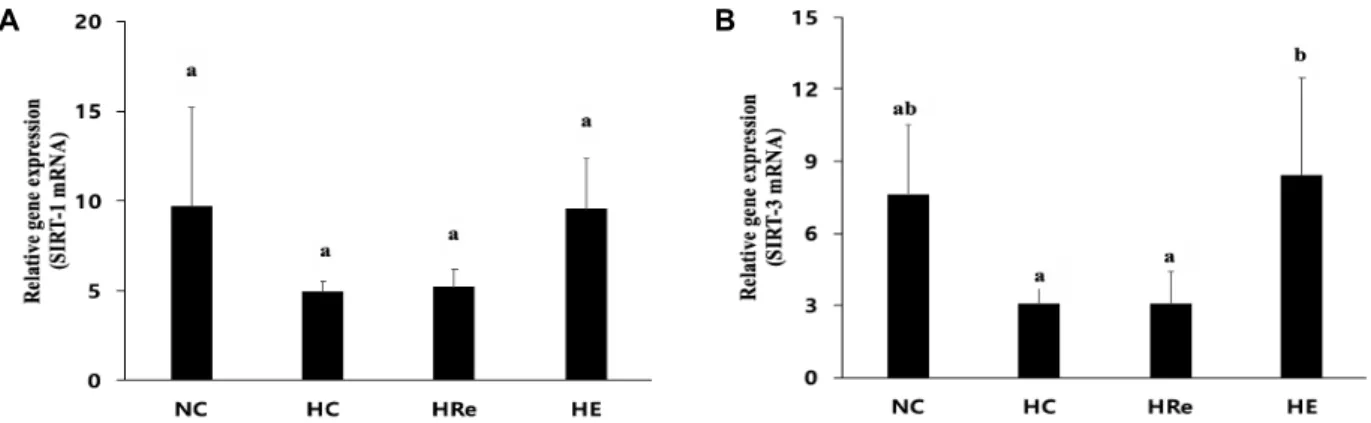
Fig. 3 shows the gene expression of SIRT-1 and SIRT-3

mRNA. There was no significance among all the groups in

SIRT-1. However, the gene expression of SIRT-3 mRNA in

HE was significantly increased, compared to that in HC and

HRe groups (p<0.05, Fig. 3B). Also, the gene expression of

SIRT-3 in NC was a little increased but not significantly

(4)

A B

Fig. 1. The comparison of body and muscle weight among groups. (A) body weight; (B) gastrocnemius muscle weight. NC, normal diet control; HC, high fat diet control: HRe, high fat diet with resveratrol; HE, high fat diet with exercise. Values represent Mean ± SD. Different alphabet shows significantly different (p<0.05).

A B

Fig. 2. The comparison of food and calorie intake among groups. (A) food intake; (B) calorie intake. NC, normal diet control; HC, high fat diet control: HRe, high fat diet with resveratrol; HE, high fat diet with exercise. Values represent Mean ± SD.

Different alphabet shows significantly different (p<0.05).

A B

Fig. 3. The comparison of SIRT-1 and SIRT-3 mRNA among groups. (A) SIRT-1 mRNA; (B) SIRT-3 mRNA. NC, normal diet control;

HC, high fat diet control: HRe, high fat diet with resveratrol; HE, high fat diet with exercise. Values represent Mean±SD.

Different alphabet shows significantly different (p<0.05).

changed, compared to HC and HRe groups.

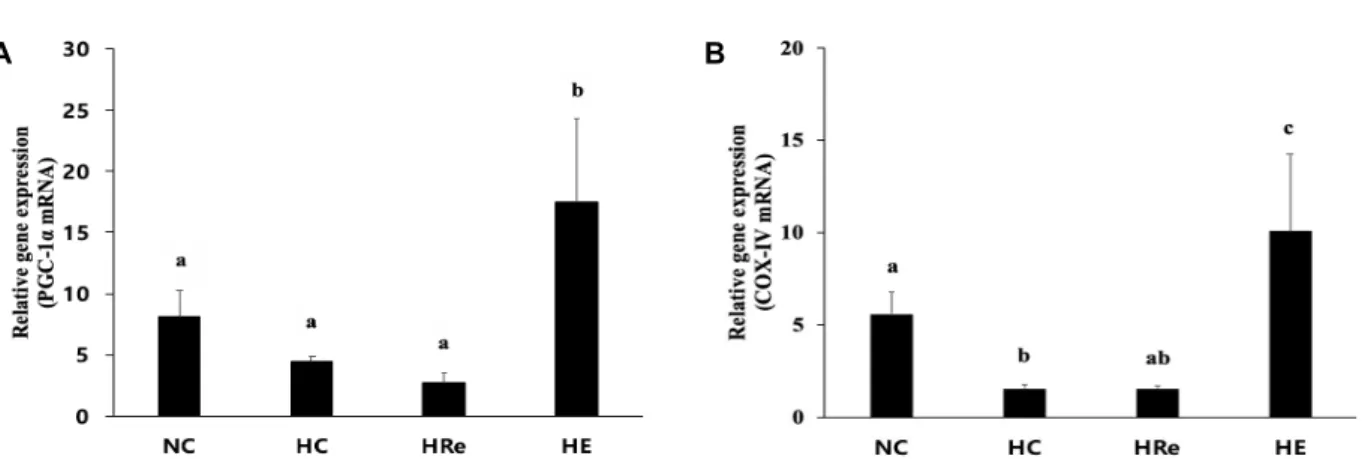
Change of PGC-1α mRNA and COX-IV mRNA Fig. 4 shows the gene expression of PGC-1α and COX-IV mRNA. The gene expression of PGC-1α mRNA in HE was

significantly increased compared to that in the other groups.

Also, the gene expression of COX-IV mRNA in HE was sig-

nificantly increased, compared to the other groups (p<0.05,

Fig. 4B). Moreover, the COX-IV mRNA of NC was sig-

nificantly increased, compared to that of HC (p<0.05, Fig. 4B).

(5)

A B

Fig. 4. The comparison of PGC-1α and COX-IV mRNA among groups. (A) PGC-1α mRNA; (B) COX-IV mRNA. NC, normal diet control; HC, high fat diet control: HRe, high fat diet with resveratrol; HE, high fat diet with exercise. Values represent Mean±SD. Different alphabet shows significantly different (p<0.05)

Discussion

A high fat diet is known to increase body weight and fat accumulation so that to make obese. Moderate exercise increases energy expenditure and has been recommended for the treatment of obesity [26]. Also, it is known that re- sveratrol treatments reduce body weight compared to non-treatment in animals [1]. In this study, we found that body weight was not significantly reduced by resveratrol supplementation for 16 weeks in high fat-induced obese mice. This result is opposed to the fact that there was sig- nificant weight reduction with resveratrol supplementation by both 10 or 30 mg/kg/day in obese mice [9]. However, our previous results with 10mg/kg had showed no sig- nificant effect on body weight [24]. Even if the dosage of resveratrol supplementation was changed to 25 mg/kg/day in this study, the body weight was not significantly changed.

It seems that the effect of resveratrol supplementation to re- duce the body weight is not clear, depending on the level of obese, duration and doses in obese mice [9, 46]. Also, the gastrocnemius muscle mass of HE group was significantly increased compared to that of other groups in this study.

It seems that exercise training not resveratrol supplementa- tion has a positive effect to increase skeletal muscle weight.

Thus, further study is needed to understand better with a various dosage and duration of resveratrol supplementation on body weight and muscle mass.

In previous studies of obese animals, resveratrol supple- mentation appears to mimic effect of caloric restriction. Also, it was reported that the effect of caloric restriction is caused by a protein called sirtuin [28]. Sirtuin is activated by NAD+-dependent deacetylases during the fasting condition

in the brain, liver and kidney [31]. Further, it has been shown that sirtuin regulates metabolism and gene expression by stimulating the activation of SIRT-1 deacetylation. It even recovers damaged genes by activating PGC-1α, inhibiting weight gain and aging [2, 3, 29, 35]. In previous studies, the expression level of the SIRT-1 molecule was significantly re- duced in the obese group compared to non-obese group [37].

Also, high fat diet-induced obese mice inhibited the activa- tion of the SIRT-1 mRNA by the influence of white adipose tissue and metabolic dysfunction of the muscle tissue [8].

In this study, the SIRT-1 mRNA was not significantly changed in all the groups. However, there was a tendency that the expression of SIRT-1 mRNA of NC and HE group were higher by 51% than that of HC and HRe group. These results are consistent with the results of previous study [8, 37]. Therefore, it is considered that the high-fat diet has a negative effect on the SIRT-1 activation of skeletal muscle in high fat diet-induced obese mice but when considering the dose of resveratrol, the negative effect size might be different.

SIRT-3 is expressed in the mitochondria of the brain, heart, liver, adipose and skeletal muscle [36] and may be increased in AMP/ATP ratio, AMPK activation and regulate oxidative phosphorylation of mitochondria [16, 43].

However, Lanza et al. [31] found that SIRT-3 protein and

number of mitochondria are less expressed in sedentary in-

dividuals, and chronic high-fat diet inhibits SIRT-3 protein

expression and induces hyperacetylation of mitochondrial

protein [19]. Several previous studies have reported that

aerobic exercise increases the expression of SIRT-3 in skeletal

muscle [20, 27, 45]. Gurd et al. [15] reported that the ex-

pression of SIRT-3, PGC-1α by treadmill running and SIRT-3

(6)

protein in the skeletal muscle were increased by exercise and dietary restriction [45]. In human studies, SIRT-3 expression in muscle was also increased by aerobic exercise [31].

In this study, there was no significance among NC, HCh and HRe groups, it means that high fat diet-induced obese did not affect to the gene expression of SIRT-3. However, there was a tendency that high fat diet-induced obese made the gene expression of SIRT-3 reduced. Because the gene ex- pression of SIRT-3 mRNA in HC was the lowest compared to that in the other groups. These results are a little similar to the results of previous study [19]. Therefore, high-fat diet may have a negative effect on SIRT-3 activation of skeletal muscle in high fat diet-induced obese mice. In this study, the expression of skeletal muscle SIRT-3 mRNA of high-fat diet and exercise group (HE) was a significantly increased compared to that of high-fat diet group (HC). These results are consistent with the results of previous studies [15, 20, 27, 45]. Therefore, it is considered that the aerobic exercise has a positive effect on the SIRT-3 activation of skeletal mus- cle in high fat diet-induced obesity mice.

Das et al. [11] was reported that resveratrol induces acti- vation of SIRT-3 protein and has been shown to have a bene- ficial effect on health by activating the SIRT-3. In this study, there was no significant difference of SIRT-3 mRNA ex- pression level in the normal diet group (NC), the high-fat diet group (HC) and high-fat diet group with resveratrol treatment (HRe) of the skeletal muscle. Those result is con- trast to the study by Das et al. [11]. It seems that even if the scientific evidence to supports the ability to regulate the SIRT-3 by resveratrol has been reported, the effect of resvera- trol supplementation would be different depending on the way of doses and treatment [11, 42]. Further, as the effect of resveratrol was compared to the exercise intervention, the effect of resveratrol might be reduced in statistics. Therefore, further research will be needed.

Excessive fat accumulation or obesity is a major cause of mitochondrial dysfunction and reducing proteins such as mitochondrial biogenesis and PGC-1α acting on oxidative phosphorylation causes skeletal muscle mitochondrial dys- function [23]. Several previous studies have reported de- creased PGC-1α expression and mitochondrial function in skeletal muscle of high-fat diet mice [30, 40, 49]. Also, the expression level of PGC-1α was significantly lower in obese subjects than in normal subjects [37]. Decreased expression of PGC-1α reduces exercise adaptability and be caused acute inflammation and mitochondrial muscle disease [17, 18].

In this study, there was no significant difference of ex- pression of skeletal muscle PGC-1α mRNA among normal diet group (NC), high-fat diet group (HC) and high-fat diet with resveratrol (HRe). However, the expression level of skeletal muscle PGC-1α mRNA in HE group was sig- nificantly higher than that in other groups. Further, there was not a significance but tendency that the expression of PGC-1α mRNA of HE group was higher than that of NC group by 83%. This is consistent with the results of previous studies [23, 30, 49]. It seems that high-fat diet is considered to have a negative effect on the PGC-1α activation of skeletal muscle in induced obesity mice. However, the study of the effect of resveratrol on PGC-1α mRNA is needed further to understand better.

COX-IV protein plays an important role in aerobic ex- ercise capacity by involved in the regulation of mitochon- drial oxiative phosphorylation [4, 13, 53] and COX-IV is used as an indicator of aerobic exercise performance because it is controlled by PGC-1α that regulate mitochondrial bio- genesis and function [44]. In this study, the expression level of the COX-IV mRNA of the skeletal muscle in the high-fat diet group (HC) was the lowest compared to that in the oth- er groups. Also, the COX-IV mRNA of the skeletal muscle was most affected by the aerobic exercise training. This re- sult is consistent with the previous study [44]. Therefore, high-fat diet group (HC) is considered to have a negative effect on COX-IV activation of skeletal muscle in induced obesity mice.

Several previous studies have reported acute high-in- tensity cycle exercise was significantly increased the protein of skeletal muscle PGC-1α and COX-IV [6, 10]. Short et al.

[53] reported that levels of PGC-1α and Cox-IV mRNA were increased after 16 weeks of aerobic exercise and Greene et al. [14] reported that the protein level of AMPK, PGC-1α and COX-IV which are closely related to mitochondrial bio- genesis were significantly increased 12 weeks of moderate intensity exercise. In this study, high-fat diet with aerobic exercise group (HE) significantly increased expression of skeletal muscle COX-IV mRNA comprared to the high-fat diet (HC). Therefore, aerobic exercise is considered to have a positive effect on the activation of skeletal muscle COX-IV in induced obesity mice.

Resveratrol supplementation has been reported to induce

transcription of nuclear-encoded mitochondrial sub-signal-

ing substances such as COX-IV and to improve mitochon-

drial function as well as mitochondrial respiration [50]. In

(7)

this study, high-fat diet group with resveratrol treatment (HRe) showed no significant difference in the expression lev- el of skeletal muscle COX-IV mRNA compared to the high-fat diet group (HC). Although these results are in con- trast to the results of Scarpulla et al. [50], it seems that the expression of COX-IV was not affected because the ex- pression of PGC-1α had not been activated. Therefore, re- svertrol supplementation is considered to have no effect on the activation of skeletal muscle COX-IV in the skeletal mus- cle of high fat diet-induced obese mice.

Taken together, in this study, there were no significant effect of resveratrol supplementation on the body weight and mitochondria biogenesis markers compared to aerobic exercise. It means that the effect of resveratrol supplementa- tion was not enough to reduce body weight and to activate mitochondrial biogenesis whereas aerobic exercise training had a positive effect to reduce body weight and improve mitochondria biogenesis gene activation. In conclusion, aero- bic exercise training was more effective than resveratrol sup- plementation to increase mitochondrial biogenesis markers in high fat diet induced obese mice. Furthermore, aerobic exercise has a kind of medicine to ameliorate high fat diet-in- duced metabolic complication. However, the effect of resver- atrol supplementation should be researched further with a variety of doses and duration.

Acknowledgment

This work was supported by Chungnam National University (2017). All experiments were approved by the Animal Care and Use Committee at the Chungnam National University (CNU- 00494).

References

1. Ahn, J., Cho, I., Kim, S., Kwon, D. and Ha, T. 2008. Dietary resveratrol alters lipid metabolism-related gene expression of mice on an atherogenic diet. J. Hepatol. 49, 1019-1028.

2. Baur, J. A. 2010. Biochemical effects of SIRT1 activators.

Biochim. Biophys. Acta. 1804, 1626-1634.

3. Borg, M. L., Omran, S. F., Weir, J., Meikle, P. J. and Watt, M. J. 2012. Consumption of a high fat diet, but not regular endurance exercise training, regulates hypothalamic lipid accumulation in mice. J. Physiol. 590, 4377-4389.

4. Burgomaster, K. A., Cermak, N. M., Phillips, S. M., Benton, C. R., Bonen, A.. and Gibala, M. J. 2007. Divergent response of metabolite transport proteins in human skeletal muscle after sprint interval training and detraining. Am. J. Physiol.

Regul. Integr. Comp. Physiol. 292, 1970-1976.

5. Canto, C., Jiang, L. Q., Deshmukh, A. S., Mataki, C., Coste, A., Lagouge, M., Zierath, J. R. and Auwerx, J. 2010.

Interdependence of AMPK and SIRT1 for metabolic adapta- tion to fasting and exercise in skeletal muscle. Cell Metab.

11, 213-219.

6. Cartoni, R., Léger, B., Hock, M. B., Praz, M., Crettenand, A., Pich, S., Ziltener, J. L., Luthi, F., Dériaz, O. and Zorzano, A. 2005. Mitofusins 1/2 and ERRα expression are increased in human skeletal muscle after physical exercise. J. Physiol.

567, 349-358.

7. Chabi, B., Ljubicic, V., Menzies, K. J., Huang, J. H., Saleem, A. and Hood, D. A. 2008. Mitochondrial function and apop- totic susceptibility in aging skeletal muscle. Aging Cell 7, 2-12.

8. Chalkiadaki, A. and Guarente, L. 2012. High-fat diet trig- gers inflammation-induced cleavage of SIRT1 in adipose tissue to promote metabolic dysfunction. Cell Metab. 16, 180-188.

9. Chang, C. C., Lin, K. Y., Peng, K. Y., Day, Y. J. and Hung, L. M. 2016. Resveratrol exerts anti-obesity effects in high-fat diet obese mice and displays differential dosage effects on cytotoxicity, differentiation, and lipolysis in 3T3-L1 cells.

Endocr. J. 63, 169-178.

10. Cobley, J. N., Bartlett, J., Kayani, A., Murray, S., Louhelai- nen, J., Donovan, T., Waldron, S., Gregson, W., Burniston, J. G. and Morton, J. P. 2012. PGC-1α transcriptional re- sponse and mitochondrial adaptation to acute exercise is maintained in skeletal muscle of sedentary elderly males.

Biogerontology 13, 621-631.

11. Das, D. K., Mukherjee, S. and Ray, D. 2011. Erratum to:

Resveratrol and red wine, healthy heart and longevity.

Heart Fail Rev. 16, 425-435.

12. Fernández, A. F. and Fraga, M. F. 2011. The effects of the dietary polyphenol resveratrol on human healthy aging and lifespan. Epigenetics 6, 870-874.

13. Geng, T., Li, P., Okutsu, M., Yin, X., Kwek, J., Zhang, M.

and Yan, Z. 2009. PGC-1α plays a functional role in ex- ercise-induced mitochondrial biogenesis and angiogenesis but not fiber-type transformation in mouse skeletal muscle.

Am. J. Physiol. Cell Physiol. 298, C572-C579.

14. Greene, N. P., Fluckey, J. D., Lambert, B. S., Greene, E.

S., Riechman, S. E. and Crouse, S. F. 2012. Regulators of blood lipids and lipoproteins? PPARδ and AMPK, induced by exercise, are correlated with lipids and lipoproteins in overweight/obese men and women. Am. J. Physiol. Endocri- nol. Metab. 303, E1212-E1221.

15. Gurd, B. J., Holloway, G. P., Yoshida, Y. and Bonen, A.

2012. In mammalian muscle, SIRT3 is present in mitochon- dria and not in the nucleus; and SIRT3 is upregulated by chronic muscle contraction in an adenosine monophosphate- activated protein kinase - independent manner. Metabolism 61, 733-741.

16. Hallows, W. C., Lee, S. and Denu, J. M. 2006. Sirtuins deace- tylate and activate mammalian acetyl-CoA synthetases.

PNAS. 103, 10230-10235.

17. Handschin, C., Choi, C. S., Chin, S., Kim, S., Kawamori,

D., Kurpad, A. J., Neubauer, N., Hu, J., Mootha, V. K. and

(8)

Kim, Y. B. 2007. Abnormal glucose homeostasis in skeletal muscle-specific PGC-1α knockout mice reveals skeletal muscle-pancreatic β cell crosstalk. J. Clin. Inves. 117, 3463-3474.

18. Handschin, C. and Spiegelman, B. M. 2006. Peroxisome pro- liferator-activated receptor γ coactivator 1 coactivators, en- ergy homeostasis, and metabolism. Endocr. Rev. 27, 728-375.

19. Hirschey, M. D., Shimazu, T., Jing, E., Grueter, C. A., Collins, A. M., Aouizerat, B., Stančáková, A., Goetzman, E., Lam, M. M. and Schwer, B. 2011. SIRT3 deficiency and mitochon- drial protein hyperacetylation accelerate the development of the metabolic syndrome. Mol. Cell 44, 177-190.

20. Hokari, F., Kawasaki, E., Sakai, A., Koshinaka, K., Sakuma, K. and Kawanaka, K. 2010. Muscle contractile activity regu- lates Sirt3 protein expression in rat skeletal muscles. J. Appl.

Physiol. 109, 332-340.

21. Hood, D. A. 2009. Mechanisms of exercise-induced mi- tochondrial biogenesis in skeletal muscle. Appl. Physiol.

Nutr. Metab. 34, 465-472.

22. Irrcher, I., Adhihetty, P. J., Sheehan, T., Joseph, A. M. and Hood, D. A. 2003. PPARγ coactivator-1α expression during thyroid hormone-and contractile activity-induced mito- chondrial adaptations. Am. J. Physiol. Cell Physiol. 284, C1669-C1677.

23. Jelenik, T. and Roden, M. 2013. Mitochondrial plasticity in obesity and diabetes mellitus. Antioxid. Redox Signal. 19, 258-268.

24. Jeong, J. H., Park, H. G., Lee, Y. R. and Lee, W. L. 2015.

Moderate exercise training is more effective than resveratrol supplementation for ameliorating lipid metabolic complica- tion in skeletal muscle of high fat diet-induced obese mice.

J. Exerc. Nutr. Biochem. 19, 131.

25. Johnson, M. L., Robinson, M. M. and Nair, K. S. 2013.

Skeletal muscle aging and the mitochondrion. Trends Endocrinol. Metab. 24, 247-256.

26. King, G. A., Fitzhugh, E., Bassett Jr, D., McLaughlin, J., Strath, S. J., Swartz, A. M. and Thompson, D. 2001.

Relationship of leisure-time physical activity and occupa- tional activity to the prevalence of obesity. Int. J. Obes. 25, 606.

27. Kong, X., Wang, R., Xue, Y., Liu, X., Zhang, H., Chen, Y., Fang, F. and Chang, Y. 2010. Sirtuin 3, a new target of PGC-1α, plays an important role in the suppression of ROS and mitochondrial biogenesis. PLoS One 5, e11707.

28. Kwon, S. M., Park, H. G., Jun, J. K. and Lee, W. L. 2014.

Exercise, but not quercetin, ameliorates inflammation, mi- tochondrial biogenesis, and lipid metabolism in skeletal muscle after strenuous exercise by high-fat diet mice. J.

Exerc. Nutr. Biochem. 18, 51.

29. Lagouge, M., Argmann, C., Gerhart-Hines, Z., Meziane, H., Lerin, C., Daussin, F., Messadeq, N., Milne, J., Lambert, P. and Elliott, P. 2006. Resveratrol improves mitochondrial function and protects against metabolic disease by activat- ing SIRT1 and PGC-1α. Cell 127, 1109-1122.

30. Laker, R. C., Lillard, T. S., Okutsu, M., Zhang, M., Hoehn, K. L., Connelly, J. J. and Yan, Z. 2014. Exercise prevents maternal high-fat diet-induced hypermethylation of the

Pgc-1α gene and age-dependent metabolic dysfunction in the offspring. Diabetes 63, 1605-1611.

31. Lanza, I. R., Short, D. K., Short, K. R., Raghavakaimal, S., Basu, R., Joyner, M. J., McConnell, J. P. and Nair, K. S.

2008. Endurance exercise as a countermeasure for aging.

Diabetes 57, 2933-2942.

32. Lee, Y. R., Pitriani, P., Park, H. G. and Lee, W. L. 2017.

Resveratrol ameliorates high-fat-induced metabolic compli- cations by changing the expression of inflammasome mark- ers and macrophage M1 and M2 markers in obese mice.

J. Life Sci. 27, 1462-1469.

33. Li, W., Park, H. G., Lee, Y. R., Jang, H. Y., Choo, S. H., Lee, Y. H., Gan, L., Jun, J. K., Lee, W. L. and Lee, S. K.

2012. Regular endurance exercise decreases blood pressure via enhancement of angiogenesis and VEGF expression in spontaneously hypertensive rats. J. Life Sci. 22, 665-670.

34. Lin, J., Handschin, C. and Spiegelman, B. M. 2005. Metabolic control through the PGC-1 family of transcription co- activators. Cell Metab. 1, 361-370.

35. Lin, J., Wu, H., Tarr, P. T., Zhang, C. Y., Wu, Z., Boss, O., Michael, L. F., Puigserver, P., Isotani, E. and Olson, E. N. 2002. Transcriptional co-activator PGC-1α drives the formation of slow-twitch muscle fibres. Nature 418, 797.

36. Lombard, D. B., Alt, F. W., Cheng, H. L., Bunkenborg, J., Streeper, R. S., Mostoslavsky, R., Kim, J., Yancopoulos, G., Valenzuela, D. and Murphy, A. 2007. Mammalian Sir2 ho- molog SIRT3 regulates global mitochondrial lysine acetyla- tion. Mol. Cell Biol. 27, 8807-8814.

37. Lopez-Lluch, G., Hunt, N., Jones, B., Zhu, M., Jamieson, H., Hilmer, S., Cascajo, M., Allard, J., Ingram, D. and Navas, P. d. 2006. Calorie restriction induces mitochondrial biogenesis and bioenergetic efficiency. PNAS. 103, 1768- 1773.

38. Lowell, B. B. and Shulman, G. I. 2005. Mitochondrial dys- function and type 2 diabetes. Science 307, 384-387.

39. Manach, C., Scalbert, A., Morand, C., Rémésy, C. and Jiménez, L. 2004. Polyphenols: food sources and bioavailability. Am.

J. Clin. Nutr. 79, 727-747.

40. Mensink, M., Hesselink, M., Russell, A., Schaart, G., Sels, J. and Schrauwen, P. 2007. Improved skeletal muscle oxida- tive enzyme activity and restoration of PGC-1α and PPARβ /δ gene expression upon rosiglitazone treatment in obese patients with type 2 diabetes mellitus. Int. J. Obes. 31, 1302.

41. Miura, S., Tomitsuka, E., Kamei, Y., Yamazaki, T., Kai, Y., Tamura, M., Kita, K., Nishino, I. and Ezaki, O. 2006.

Overexpression of peroxisome proliferator-activated re- ceptor γ co-activator-1α leads to muscle atrophy with de- pletion of ATP. Am. J. Pathol. 169, 1129-1139.

42. Mukherjee, S., Ray, D., Lekli, I., Bak, I., Tosaki, A. and Das, D. K. 2010. Effects of Longevinex (modified resvera- trol) on cardioprotection and its mechanisms of action. Can J. Physiol. Pharmacol. 88, 1017-1025.

43. North, B. J. and Sinclair, D. A. 2007. Sirtuins: a conserved key unlocking AceCS activity. Trends Biochem. Sci. 32, 1-4.

44. Olesen, J., Kiilerich, K. and Pilegaard, H. 2010. PGC-1α-

mediated adaptations in skeletal muscle. Pflügers Arch. 460,

(9)

초록:고지방식이로 유도된 비만 쥐의 골격근에서 유산소 운동 훈련 또는 레스베라트롤 투여가 미토콘드 리아 생합성에 미치는 영향

김경일

1

․안상민

2

․박희근

1

․이왕록

1

*

(

1

충남대학교 스포츠과학과,

2

고려대학교 사회체육학과)

본 연구에서는 고지방식이로 유발된 비만 쥐의 골격근에서 유산소 운동과 레스베라트롤 투여가 미토콘드리아 생합성에 미치는 영향을 조사하였다. 4주령 C57BL/6의 수컷 쥐를 이용하여, 일반 식이 그룹(NC, n=10), 고지방식 이 그룹(HR, n=10), 레스베라트롤 투여와 고지방식이 그룹(HRe, n=10), 유산소 운동 그룹(HE, n=10)으로 분류하 였다. 유산소 운동은 16주 동안 40~60 min/day 동안 10-14m/min, 0% grade의 강도로 주당 4회 트레드밀 운동을 실시하였고, 레스베라트롤은 16주 동안 1일 1회, 주당 4회 체중 당 25 mg/kg을 투여하였다. COX-IV mRNA 발현 은 NC와 HC 그룹 간에 유의한 차이가 있었으며(p<0.05), HE 그룹의 SIRT-3, PGC-1α 및 COX-IV mRNA 발현은 HC 및 HRe 그룹에 비해 유의하게 증가하였다(p<0.05). 또한, 오직 HE 그룹의 PGC-1α 및 COX-IV mRNA의 발현 만이 HC 그룹에 비해 유의하게 증가하였다(p<0.05). 이상의 결과를 종합해보면, 고지방식이로 유발된 비만 쥐는 골격근에서 미토콘드리아 생합성 유전자 발현에 영향을 나타내지 않는 것으로 보인다. 하지만, 유산소 운동 훈련 은 고지방식이로 유발된 비만 쥐의 골격근에서 미토콘드리아 생합성 유전자 발현을 증가시키는 것으로 나타났다.

이러한 연구 결과는 레스베라트롤 투여가 아닌 유산소 운동이 고지방식이로 유도된 쥐의 골격근에서 미토콘드리 아 생합성에 긍정적인 영향을 미친다는 것을 시사한다.

153-162.

45. Palacios, O. M., Carmona, J. J., Michan, S., Chen, K. Y., Manabe, Y., Ward Iii, J. L., Goodyear, L. J. and Tong, Q.

2009. Diet and exercise signals regulate SIRT3 and activate AMPK and PGC-1α in skeletal muscle. Aging (Albany NY) 1, 771-783.

46. Park, H. G., Lee, Y. R., Jun, J. K. and Lee, W. L. 2014.

Exercise training is more effective than resveratrol supple- mentation on alleviation of inflammation in peritoneal mac- rophages of high fat diet mice. J. Exerc. Nutr. Biochem. 18, 79.

47. Patti, M. E., Butte, A. J., Crunkhorn, S., Cusi, K., Berria, R., Kashyap, S., Miyazaki, Y., Kohane, I., Costello, M. and Saccone, R. 2003. Coordinated reduction of genes of oxida- tive metabolism in humans with insulin resistance and dia- betes: Potential role of PGC1 and NRF1. PNAS. 100, 8466- 8471.

48. Price, N. L., Gomes, A. P., Ling, A. J., Duarte, F. V., Martin- Montalvo, A., North, B. J., Agarwal, B., Ye, L., Ramadori, G. and Teodoro, J. S. 2012. SIRT1 is required for AMPK activation and the beneficial effects of resveratrol on mi- tochondrial function. Cell Metab. 15, 675-690.

49. Samocha Bonet, D., Dixit, V. D., Kahn, C. R., Leibel, R.

L., Lin, X., Nieuwdorp, M., Pietiläinen, K. H., Rabasa-Lhoret, R., Roden, M., Scherer, P. E., Klein, S. and Ravussin, E. 2014. Metabolically healthy and unhealthy obese–the 2013 S tock C onference report. Obes. Rev. 15, 697-708.

50. Scarpulla, R. C. 2006. Nuclear control of respiratory gene expression in mammalian cells. J. Cell. Biochem. 97, 673-683.

51. Schefer, V. and Talan, M. I. 1996. Oxygen consumption in adult and AGED C57BL/6J mice during acute treadmill ex- ercise of different intensity. Exp. Gerontol. 31, 387-392.

52. Shi, T., Wang, F., Stieren, E. and Tong, Q. 2005. SIRT3, a mitochondrial sirtuin deacetylase, regulates mitochondrial function and thermogenesis in brown adipocytes. J. Biol.

Chem. 280, 13560-13567.

53. Short, K. R., Vittone, J. L., Bigelow, M. L., Proctor, D. N., Rizza, R. A., Coenen-Schimke, J. M. and Nair, K. S. 2003.

Impact of aerobic exercise training on age-related changes in insulin sensitivity and muscle oxidative capacity. Diabetes 52, 1888-1896.

54. Um, J. H., Park, S. J., Kang, H., Yang, S., Foretz, M., McBurney, M. W., Kim, M. K., Viollet, B. and Chung, J.

H. 2010. AMP-activated protein kinase-deficient mice are resistant to the metabolic effects of resveratrol. Diabetes 59, 554-563.

55. Ungvari, Z., Sonntag, W. E., de Cabo, R., Baur, J. A. and Csiszar, A. 2011. Mitochondrial protection by resveratrol.

Exerc. Sport. Sci. Rev. 39, 128-132.

56. Wende, A. R., Schaeffer, P. J., Parker, G. J., Zechner, C., Han, D.-H., Chen, M. M., Hancock, C. R., Lehman, J. J., Huss, J. M. and McClain, D. A. 2007. A role for the tran- scriptional coactivator PGC-1α in muscle refueling. J. Biol.

Chem. 282, 36642-36651.

57. Wilson, F. H., Hariri, A., Farhi, A., Zhao, H., Petersen, K.

F., Toka, H. R., Nelson-Williams, C., Raja, K. M., Kashgar- ian, M. and Shulman, G. I. 2004. A cluster of metabolic defects caused by mutation in a mitochondrial tRNA.

Science 306, 1190-1194.

수치

Table  1.  Formulas  of  rodent  feed
Table  3.  Primer  sequences  used  for  Real-time  PCR
Fig.  3.  The  comparison  of  SIRT-1  and  SIRT-3  mRNA  among  groups.  (A)  SIRT-1  mRNA;  (B)  SIRT-3  mRNA
Fig.  4.  The  comparison  of  PGC-1α and  COX-IV  mRNA  among  groups.  (A)  PGC-1α mRNA;  (B)  COX-IV  mRNA

참조

관련 문서