• 검색 결과가 없습니다.

Effectiveness of Smartphone Addiction Intervention for University Students: A Systematic Review and Meta Analysis

N/A
N/A
Protected

Academic year: 2021

Share "Effectiveness of Smartphone Addiction Intervention for University Students: A Systematic Review and Meta Analysis"

Copied!
14
0
0

로드 중.... (전체 텍스트 보기)

전체 글

(1)

Effectiveness of Smartphone Addiction Intervention for University Students: A Systematic Review and Meta Analysis

Myung Soon Kwon

1

, Suk Jung Han

2

, Young Ran Yeun

3*

1

Professor, School of Nursing, Research Institute of Nursing Science, Hallym University

2

Professor, College of Nursing, Sahmyook University

3

Professor, Department of Nursing, Kangwon National University

대학생 스마트폰 중독 중재프로그램의 효과:

체계적 문헌고찰 및 메타분석

권명순

1

, 한숙정

2

, 연영란

3*

1

한림대학교 간호대학 교수,

2

삼육대학교 간호대학 교수,

3

강원대학교 간호학과 교수

Abstract This study aimed to evaluate the effectiveness of smartphone addiction interventions among university students. Selection criteria included university students, smartphone addiction interventions, smartphone addiction, depression, anxiety, self-control and time of smartphone usage. A total of 915 articles were retrieved. From those, 15 studies from 13 articles fulfilled the inclusion criteria. A meta-analysis showed that smartphone addiction interventions undergone by university students had statistical significance in alleviating smartphone addiction (d=-1.57, 95% CI:-2.84, -0.30), depression (d=-3.73, 95% CI:-4.97, -2.48), and self-control (d=7.28, 95% CI:2.76, 11.79); but were not significantly effective in improving anxiety and reducing time of smartphone usage. The systematic review and meta-analysis suggested that smartphone addiction interventions boost the alleviation of smartphone addiction. However, it remains necessary to conduct well-designed randomized controlled trials, including the consideration of various cultural characteristics.

Key Words : Smartphone, Addiction, Intervention, Meta-analysis, Universities, Students

요 약 본 연구는 대학생을 대상으로 수행된 스마트폰 중독 중재들의 효과를 평가하기 위하여 수행되었다. 선정기준에 는 대학생, 스마트폰 중독 중재, 스마트폰 중독, 우울, 불안, 자기 통제, 스마트폰 사용시간 등이 포함되었다. 총 915개 의 논문이 추출되었고, 최종적으로 13개의 논문에서 15개의 중재연구가 평가되었다. 본 연구결과, 스마트폰 중독 중재 는 스마트폰 중독(d = -1.57, 95 % CI : -2.84, -0.30), 우울(d = -3.73, 95 % CI : -4.97, -2.48) 및 자기통제(d

= 7.28, 95 % CI : 2.76, 11.79)에서 큰 효과크기를 보였다. 그러나 불안과 스마트폰 사용 시간에 대해서는 통계적으로 유의한 효과가 없었다. 본 연구 결과를 바탕으로 스마트폰 중독 중재는 스마트폰 중독 완화를 위해 사용될 수 있을 것이다. 그러나 추후 대상자의 문화적 특성 등을 고려한 잘 설계된 무작위대조군실험연구가 수행되어야 할 것이다.

주제어 : 스마트폰, 중독, 중재, 메타분석, 대학교, 학생

This work was supported by the National Research Foundation of Korea (NRF) grant funded by the Korea government (MSIT) (No. 2017R1A2B4007087).

*Corresponding Author: Young Ran Yeun([email protected]) Received April 10, 2020

Accepted May 20, 2020 Revised May 4, 2020

Published May 28, 2020

(2)

1. Introduction

Smartphone ownership is increasing rapidly worldwide. According to Pew Research in the US, Korea has the highest smartphone penetration rate among 27 countries, with a penetration rate of 95%. This is 20% higher than that of developed countries that have an average rate of 76%[1], and is a sharp increase from the 2011 of 31.3%[2].

The emergence of smartphones has profoundly impacted not only the daily lives of humans, but also industry, education, and society. The increased use of the Internet, specifically information sharing platforms via smartphones has been advantageous to increasing efficiency and productivity, such as in academics and work.

However, there are still negative effects, such as access to pornography, excessive exposure to violent games, language destruction, and human rights violations like photographing people without their consent[3].

Even though official diagnostic criteria for smartphone addiction (SA) do not exist, the definition of smartphone addiction (SA) varies among scholars. Usually, SA has been defined as the overuse of smartphone to the extent that it disturbs user’s daily life[4]. However, unlike conventional mobile phone or Internet addiction, due to the convenience and enjoyment innate in smartphone, its users have become too immersed and have lost self-control[5]. SA may result in poor physical health (e.g., blurred vision and poor sleep quality) and mental health illnesses (e.g., depression, anxiety, nervous personality, compulsion, and impulsiveness)[4,6]. It may also lead to social issues, such as negative effects on one’s daily life and studies[7]. It may also bring about various behavioral problems, such as compulsive use, obsession, deviant behavior, and the disturbance of reality testing, which is characterized by disorder in daily life, virtual world orientation, withdrawal, and tolerance[8].

According to a 2018 survey in Korea regarding SA, middle school students comprised the group with the highest potential usage risk(34.0%), while university students comprised the topmost high-risk user group(4.2%)[9]. Additionally for university students, their smartphone penetration rate was the highest at 99.8%[10]. In contrast to adolescents, university students are free to use their smartphones without adult supervision. As such, they are more likely to develop SA. This is problematic, as one’s time as a university student is crucial for developing problem-solving skills like discerning of identity and career choice, and smartphone addiction could become a major obstacle to such[11].

The college students are the period when the most extensive development in self-identity occurs[12], challenging various possibilities that were not encountered during elementary, middle and high school years, and pursuing the career or values of one's choice after experiencing a wide range of exploring career alternatives.

Therefore, successful career decision in college students is related to the achievement of self-identity, a developmental task. According to Erikson's theory of self-identity, it takes time to overcome the identity crisis or self-discovery to form self-identity[13]. SA can be a major obstacle to the achievement of these tasks, so the higher the level of SA, the lower the self-identity initiative and goal orientation level[14].

Most of the recent studies and systematic reviews on smartphone addiction intervention (SAI) have focused on elementary school students and adolescents. For the former, typical studies include cognitive behavioral therapy[15] and group counseling[16]; for the latter, smartphone game addiction prevention program[17], literature therapy program[18], and meta-analysis[19].

However, a systematic examination focused on

university students regarding the effects of SAI

has yet to be performed. Given the current

situation, the number of university students with

(3)

SA has increased. Nonetheless, it is necessary to still objectively draw conclusions from only those SAI studies focused on university students.

Therefore, this study attempted to conduct a meta-analysis and systematic review of SAI studies focused on university students in Korea and China. The characteristics of the interventions derived from searching were identified, and the effects of the intervention were analyzed.

2. Methods 2.1 Eligibility criteria

The study selection criteria is based on PICOTS-SD (Participants, Intervention, Comparisons, Outcomes, Timing of Outcome Measurement, Settings, Study Design): participants of this study (P) were university students; method of intervention (I) was SAI; comparison group (C) was comprised of those not undergoing interventions or programs comparable to the main one; outcome of the study (O) was either quantitative valuables or descriptions of parameters measured after intervention; timing of outcome measurement (T) was the duration of the intervention; setting of the study (S) was a local community with universities and colleges;

and study design (SD) included all studies that tackled SAIs.

2.2 Literature search

Data search targeted articles published from 1999, the year when articles tackling SA began to be published, to October 2019. The search engines that were used were CINAHL, Cochrane library, Embase, Pubmed, DBpia, Korean Information Service System (KISS), Korean Medical Database (KMbase), KoreaMed, National Digital Science Library (NDSL), and Research Information Service System (RISS). Keywords

used for the search were classified into three categories; firstly, for the research target:

“university,” “undergraduate,” and “college;” secondly, for the research topic: “smartphone,” “mobile phone,” “cell phone,” “addiction,” “overuse,” and

“dependence;”, and lastly, for the research method: “intervention,” “program,” “effect,”

“therapy,” and “treatment.” The search was limited to publications in Korean and English.

Each researcher independently reviewed the data collection and selection process by examining all studies to be included in the analysis. In case of non-agreement among them, the criteria for selection and exclusion were reviewed until a consensus was reached.

2.3 Data extraction

The generic attributes and intervention methods of the different studies were analyzed with a framework consisting of 18 questions. In detail, the analysis framework consisted of the serial number, author(s), year of publication, source of search, research design, target, data collection method, and place of research, among others. The analysis of the content of the intervention methods focused on the following attributes of the program: name, type, form, duration, frequency, duration of each session, total number of sessions, process of the control group, and outcome measurement.

2.4 Data analysis

When there were three or more studies via outcome variable, meta-analysis was performed.

The effect size was analyzed by using the RevMan 5.3 program of the Cochrane Library.

The effect of the intervention was determined using the mean and the pooled standard deviation upon data entry. In case of two experimental groups, the study was divided into individual studies based on previous studies[20].

Cochran’s chi-square test and Higgins’ I

2

test

(4)

were used to investigate the homogeneity of the studies while comprehensively estimating the effect size of each. For those whose homogeneity had been identified, the fixed effect model was used, while the effect size was estimated using a random effect model. In regard to the I

2

test result determining heterogeneity, 25% or lower was considered as low, 50% was considered as medium, and 75% or more was considered as large[21]. The statistical significance of the effect size was evaluated based on the overall effect test, 95% confidence interval(CI), and significance level of 5%. According to the analysis criteria of Cohen[22], the effect size (ES)=0.20-0.50 represents a small effect, ES=0.50-0.80 represents a medium effect, and ES=0.80 or more represents a large effect. Publication bias of the studies was tested with the funnel plot.

2.5 Methodological quality

Randomized controlled trial (RCT) studies were assessed for methodological quality using a seven-item scale of the Risk of Bias (RoB)[23]. A eight-item scale of the Risk of Bias Assessment Tool for Non-randomized Studies (RoBANS) was used for NRCT[24]. For each item, the risk of bias was designated as low, high, or unclear. Two authors independently reviewed the studies and non-consistent items were reevaluated after reviewing the original text.

3. Results 3.1 Literature search

Based on the data selection criteria, 13 articles were included in the systematic review. The detailed data selection procedure is shown in Fig.

1. At first, 915 articles were identified using search engines. After the exclusion of 488 duplicate articles, 427 articles were assessed for eligibility. After assessment, 15 studies from 13

articles met the criteria and were deemed eligible.

Articles identified through Database searching (n=915) CINAHL (n=27)

Cochrane library (n=23) Embase (n=122) Pubmed (n=86) Dbpia (n=142) KISS (n=45) KMbase (n=10) KoreaMed (n=42)

NDSL (n=135) RISS (n=283) KISS (n=45) KMbase (n=10) KoreaMed (n=42) NDSL (n=135) RISS (n=283)

Articles after duplication removed (n=427)

Articles screened on the basis of

title and abstract (n=427) → Articles excluded (n=373)

Full-text articles assessed for

eligibility (n=54) → Articles excluded with reasons (n=41) 1.

No university students

2. No smartphone 3.

No experimental study

Articles included in qualitative synthesis (n=13 articles, 15 studies)

Articles included in meta-analysis (n=10 articles, 12 studies) →

Articles s excluded with reasons (n=2) 1. No control group 2. No mean±SD Fig. 1. Flow diagram of the study selection process

3.2 Study characteristics

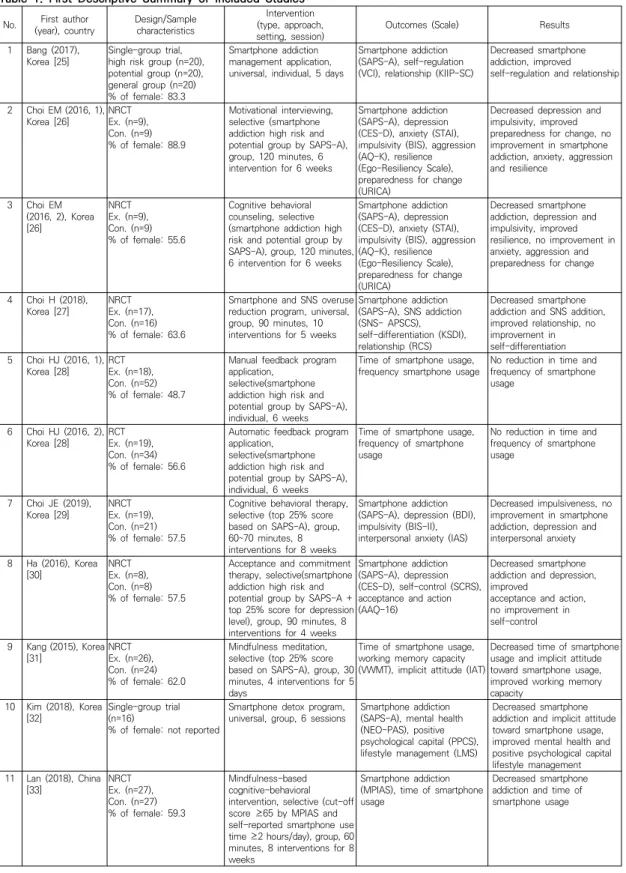
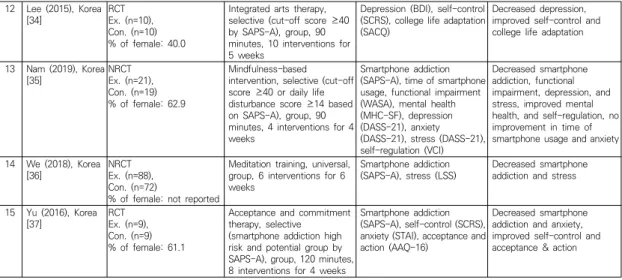
The characteristics of the 15 studies (13 articles) selected for the systematic review are shown in Table 1 and 2[21-33]. Twelve of the interventions were group therapies, and three were individual therapies. The number of sessions in the intervention ranged from 4 to 10.

Thirteen records had a control group, four of which were RCT and nine of which were NRCT.

The total number of participants across all the

studies was 666, and the sample was

predominantly female (61.3%). Eleven records

measured SA (n=526 participants), six measured

depression (n=155 participants), five measured

time of smartphone usage (n=179 participants),

five measured anxiety (n=137 participants), three

measured impulsivity (n=79 participants), and

three measured self-control (n=54 participants).

(5)

Table 1. First Descriptive Summary of Included Studies No. First author

(year), country Design/Sample characteristics

Intervention (type, approach,

setting, session) Outcomes (Scale) Results

1 Bang (2017),

Korea [25] Single-group trial, high risk group (n=20), potential group (n=20), general group (n=20)

% of female: 83.3

Smartphone addiction management application, universal, individual, 5 days

Smartphone addiction (SAPS-A), self-regulation (VCI), relationship (KIIP-SC)

Decreased smartphone addiction, improved self-regulation and relationship 2 Choi EM (2016, 1),

Korea [26] NRCT Ex. (n=9), Con. (n=9)

% of female: 88.9

Motivational interviewing, selective (smartphone addiction high risk and potential group by SAPS-A), group, 120 minutes, 6 intervention for 6 weeks

Smartphone addiction (SAPS-A), depression (CES-D), anxiety (STAI), impulsivity (BIS), aggression (AQ-K), resilience (Ego-Resiliency Scale), preparedness for change (URICA)

Decreased depression and impulsivity, improved preparedness for change, no improvement in smartphone addiction, anxiety, aggression and resilience

3 Choi EM (2016, 2), Korea [26]

NRCT Ex. (n=9), Con. (n=9)

% of female: 55.6

Cognitive behavioral counseling, selective (smartphone addiction high risk and potential group by SAPS-A), group, 120 minutes, 6 intervention for 6 weeks

Smartphone addiction (SAPS-A), depression (CES-D), anxiety (STAI), impulsivity (BIS), aggression (AQ-K), resilience (Ego-Resiliency Scale), preparedness for change (URICA)

Decreased smartphone addiction, depression and impulsivity, improved resilience, no improvement in anxiety, aggression and preparedness for change 4 Choi H (2018),

Korea [27] NRCT

Ex. (n=17), Con. (n=16)

% of female: 63.6

Smartphone and SNS overuse reduction program, universal, group, 90 minutes, 10 interventions for 5 weeks

Smartphone addiction (SAPS-A), SNS addiction (SNS- APSCS), self-differentiation (KSDI), relationship (RCS)

Decreased smartphone addiction and SNS addition, improved relationship, no improvement in self-differentiation 5 Choi HJ (2016, 1),

Korea [28] RCT

Ex. (n=18), Con. (n=52)

% of female: 48.7

Manual feedback program application,

selective(smartphone addiction high risk and potential group by SAPS-A), individual, 6 weeks

Time of smartphone usage,

frequency smartphone usage No reduction in time and frequency of smartphone usage

6 Choi HJ (2016, 2),

Korea [28] RCT

Ex. (n=19), Con. (n=34)

% of female: 56.6

Automatic feedback program application,

selective(smartphone addiction high risk and potential group by SAPS-A), individual, 6 weeks

Time of smartphone usage, frequency of smartphone usage

No reduction in time and frequency of smartphone usage

7 Choi JE (2019),

Korea [29] NRCT

Ex. (n=19), Con. (n=21)

% of female: 57.5

Cognitive behavioral therapy, selective (top 25% score based on SAPS-A), group, 60~70 minutes, 8 interventions for 8 weeks

Smartphone addiction (SAPS-A), depression (BDI), impulsivity (BIS-II), interpersonal anxiety (IAS)

Decreased impulsiveness, no improvement in smartphone addiction, depression and interpersonal anxiety 8 Ha (2016), Korea

[30] NRCT

Ex. (n=8), Con. (n=8)

% of female: 57.5

Acceptance and commitment therapy, selective(smartphone addiction high risk and potential group by SAPS-A + top 25% score for depression level), group, 90 minutes, 8 interventions for 4 weeks

Smartphone addiction (SAPS-A), depression (CES-D), self-control (SCRS), acceptance and action (AAQ-16)

Decreased smartphone addiction and depression, improved

acceptance and action, no improvement in self-control 9 Kang (2015), Korea

[31] NRCT

Ex. (n=26), Con. (n=24)

% of female: 62.0

Mindfulness meditation, selective (top 25% score based on SAPS-A), group, 30 minutes, 4 interventions for 5 days

Time of smartphone usage, working memory capacity (VWMT), implicit attitude (IAT)

Decreased time of smartphone usage and implicit attitude toward smartphone usage, improved working memory capacity

10 Kim (2018), Korea

[32] Single-group trial (n=16)

% of female: not reported

Smartphone detox program,

universal, group, 6 sessions Smartphone addiction (SAPS-A), mental health (NEO-PAS), positive psychological capital (PPCS), lifestyle management (LMS)

Decreased smartphone addiction and implicit attitude toward smartphone usage, improved mental health and positive psychological capital lifestyle management 11 Lan (2018), China

[33] NRCT

Ex. (n=27), Con. (n=27)

% of female: 59.3

Mindfulness-based cognitive-behavioral intervention, selective (cut-off score ≥65 by MPIAS and self-reported smartphone use time ≥2 hours/day), group, 60 minutes, 8 interventions for 8 weeks

Smartphone addiction (MPIAS), time of smartphone usage

Decreased smartphone

addiction and time of

smartphone usage

(6)

Table 2. Second Descriptive Summary of Included Studies

Characteristis Categories N (%) / Mean

General Publication year 2015 2 (13.3)

2016 6 (40.0)

2017 1 (6.7)

2018 4 (26.7)

2019 2 (13.3)

Country China 1 (6.7)

Korea 14 (93.3)

Study design RCT 4 (26.7)

NRCT 9 (60.0)

Single-group trial 2 (13.3)

Participants Sample size

(Range=16~160, mean=44.41, total= 666)

<20 5 (33.3˙)

20-50 5 (33.3˙)

>50 5 (33.3˙)

% of female

(Mean= 61.36) <60 7 (46.7)

≥ 60 6 (40.0)

Not reported 2 (13.3)

Intervention Type ACT 2 (13.3)

Art therapy 1 (6.7)

Application 3 (20.0)

CBT 3 (20.0)

Meditation 3 (20.0)

Motivational interviewing 1 (6.7)

Integrated intervention 2 (13.3)

Approach Selective 11 (73.3)

Universal 4 (26.7)

Setting Individual 3 (20.0)

Group 12 (80.0)

Session

(mean) Duration 87.50 min/session

Frequency 1.36 times/week

Total session 7.00 interventions

12 Lee (2015), Korea

[34] RCT

Ex. (n=10), Con. (n=10)

% of female: 40.0

Integrated arts therapy, selective (cut-off score ≥40 by SAPS-A), group, 90 minutes, 10 interventions for 5 weeks

Depression (BDI), self-control (SCRS), college life adaptation (SACQ)

Decreased depression, improved self-control and college life adaptation 13 Nam (2019), Korea

[35] NRCT

Ex. (n=21), Con. (n=19)

% of female: 62.9

Mindfulness-based intervention, selective (cut-off score ≥40 or daily life disturbance score ≥14 based on SAPS-A), group, 90 minutes, 4 interventions for 4 weeks

Smartphone addiction (SAPS-A), time of smartphone usage, functional impairment (WASA), mental health (MHC-SF), depression (DASS-21), anxiety (DASS-21), stress (DASS-21), self-regulation (VCI)

Decreased smartphone addiction, functional impairment, depression, and stress, improved mental health, and self-regulation, no improvement in time of smartphone usage and anxiety 14 We (2018), Korea

[36] NRCT

Ex. (n=88), Con. (n=72)

% of female: not reported

Meditation training, universal, group, 6 interventions for 6 weeks

Smartphone addiction

(SAPS-A), stress (LSS) Decreased smartphone addiction and stress 15 Yu (2016), Korea

[37] RCT

Ex. (n=9), Con. (n=9)

% of female: 61.1

Acceptance and commitment therapy, selective (smartphone addiction high risk and potential group by SAPS-A), group, 120 minutes, 8 interventions for 4 weeks

Smartphone addiction (SAPS-A), self-control (SCRS), anxiety (STAI), acceptance and action (AAQ-16)

Decreased smartphone addiction and anxiety, improved self-control and acceptance & action AAQ-16=Acceptance & Action Questionnaire-16; AQ-K=Aggression Questionnaire-Korean version; ASR=Adult Self Report; BDI=Beck Depression Inventory; BIS=Barratt Impulsiveness Scale; CES-D=Center for Epidemiologic Studies-Depression Scale; DASS-21=Depression-Anxiety-Stress Scale-21; IAS=Interaction Anxiousness Scales; IAT=Implicit Association Test; KIIP-SC=Short Form of the Korean Inventory of Interpersonal Problems Circumflex Scale; KSDI=Korean Self-Differentiation Inventory; LCC=Life Stress Scale for college students; LMS=Lifestyle management scale;

MHC-SF=Mental Health Continuum Short Form; MPIAS=Mobile Phone Internet Addiction Scale; NEO-PAS=NEO Personality Assessment System; PPCS

= Positive psychological capital Scale; PWI = Psychosocial Well-being Index; RCS = Relationship Change Scale; SACQ=Student Adaptation to College Questionnaire; SAPS-A =Smartphone Addiction Proneness Scale for Adults; SCRE=Self-Control Rating Scale; SCS=Self-Control Scale;

SNS-APSCS=SNS Addiction Proneness Scale for College Students; SRS=Self-regulation Scale; STAI=State-Trait-Anxiety Inventory; URICA=University

of Rhode Island Change Assessment Scale; VCI=Volitional Components Inventory; VWMT=Visual Working Memory Task; WASA=Work and Social

Adjustment Scale

(7)

3.3 SAI effects

Meta-analysis was performed on 12 studies (10 articles) which had control group and mean±SD.

Among them, nine studies were carried out as interventions for SA reduction. The effect size was -1.57(95% CI : -2.84, -0.30). This signified a large effect size and high heterogeneity(I

2

=96%).

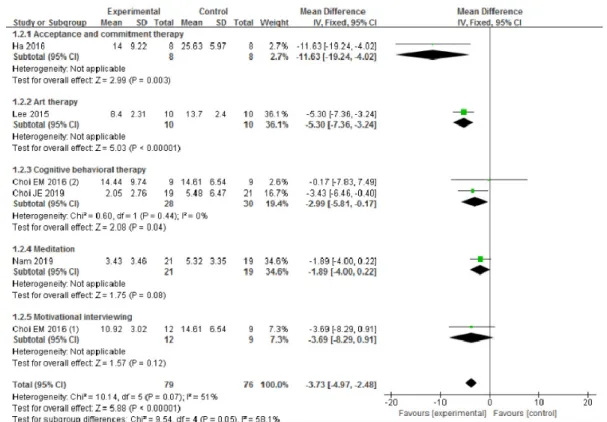
Six studies examined the effect on depression, and the resulting effect size was –3.73(95% CI : -4.97, -2.48). This signified a large effect size and moderate heterogeneity(I

2

=51%). Three studies examined self-control, and the resulting effect size was 7.28(95% CI : 2.76, 11.79). This signified almost no heterogeneity(I

2

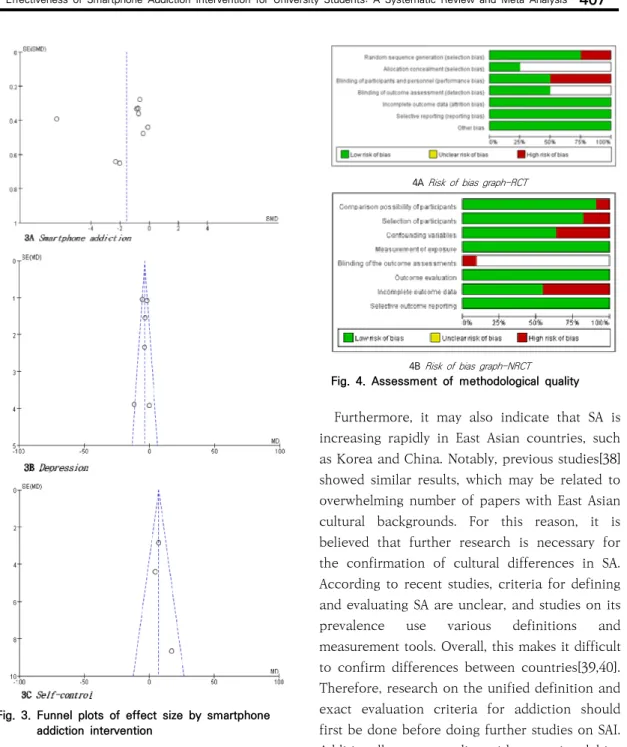
=0%). The effect sizes were not available for outcome variables, such as anxiety (d=-0.64, 95% CI : -2.00, 0.72), impulsivity(d=-2.32, 95% CI : -5.64, 1.00), and time of smartphone usage (d=-0.88, 95% CI : -2.14, 0.39), as shown in Fig. 2. After using the funnel plot for the bias test to check the degree of symmetry, the studies were evenly distributed

in the statistically in significant area. This indicated that there was no publication bias, as shown in Fig. 3.

3.4 Methodological quality

As a result of evaluating 4 RCTs, all studies described incomplete outcome data and selective reporting specifically, whereas two studies showed high bias in blinding of participants(As shown Fig. 4).

In the evaluation of NRCT and single-group

trial, all studies showed low bias in measurement

of expose, outcome evaluation, and selective

outcome reporting, but six studies showed high

bias in incomplete outcome data because of a

high dropout rate. Of those studies, four showed

high bias in confounding variables since the

variables were not statistically corrected(As

shown Fig. 4).

(8)

Fig. 2. Forest plots of effect size by smartphone addiction intervention

4. Discussion

Although SA has become an important health issue, studies that systematically analyze the development and effect of interventions addressing SA on university students remain

scarce. In order to objectively identify the effects

of SAI on university students, this study carried

out a systematic literature review of 15 studies

extracted from 915 articles. A meta-analysis of

12 studies was also done to determine the effect

size of these interventions on SA, depression,

(9)

Fig. 3. Funnel plots of effect size by smartphone addiction intervention

4A Risk of bias graph-RCT

4B Risk of bias graph-NRCT

Fig. 4. Assessment of methodological quality

anxiety, impulsivity, and time of smartphone usage.

Regarding the cultural background of the analyzed articles, 14 studies were conducted in Korea and one was conducted in China. There was no study that examined the effects of an intervention university students situated in the US or Europe.

Furthermore, it may also indicate that SA is increasing rapidly in East Asian countries, such as Korea and China. Notably, previous studies[38]

showed similar results, which may be related to overwhelming number of papers with East Asian cultural backgrounds. For this reason, it is believed that further research is necessary for the confirmation of cultural differences in SA.

According to recent studies, criteria for defining and evaluating SA are unclear, and studies on its prevalence use various definitions and measurement tools. Overall, this makes it difficult to confirm differences between countries[39,40].

Therefore, research on the unified definition and exact evaluation criteria for addiction should first be done before doing further studies on SAI.

Additionally, more studies without regional bias must be conducted. In contrast to active trends in studies focused on the effects of interventions to address Internet addiction[41-43], which has similar symptoms to those of SA, more active research is necessary on studies for SA, as it is increasing exponentially.

The results of this study showed that SAI had

positive effects on psychological problems (e.g.,

(10)

depression and self-control), and the SA status of university students. In particular, the effect size for SA was large at -1.57 (95% CI : -2.84, -0.30).

However, it is difficult to directly compare this result to those of other studies, as no studies calculating the effect size of SAI for university students was found by us. When compared to the study that verified the effect of psychological and pharmacological interventions on Internet addiction from 16 articles[38] or to the study that verified the effect of group counseling programs, cognitive behavioral therapy, and sports interventions on Internet addiction from 58 article[44], the effect size of this present study was considerably robust. Since addiction behaviors affect multiple factors, both quantitative and qualitative studies that identify and/or describe its effects, studies that identify its effects in various aspects, such as emotional, social, and cognitive, including changes in addiction behavior itself, should be actively conducted. Meanwhile, this study showed high heterogeneity in the effect size of intervention.

This might be because the number of RCTs was relatively small, thereby being included in the analysis of NRCT; the results of each study were measured using a variety of different tools; and the types of intervention were diverse.

The intervention method that evenly affected SA, depression, and self-control was the Acceptance and Commitment Therapy (ACT).

After CBT, ACT is currently the intervention most widely researched, as it is a relatively new socio-psychological intervention method[45].

Based on acceptance and awareness, ACT aims to improve psychological flexibility in order to build one’s capacity to cope with problems in life and to move towards values that people want to acquire[46,47]. The effectiveness of ACT on alleviating addiction has been reported by various specialists[48-50]. It improves self-control and psychological well-being, and reduces depression, anger, fear of negative evaluations,

and irrational beliefs[51]. Moreover, it improves quality of life in relation to mental health and self-efficacy, and reduces psychological inflexibility[52].

Previous meta-analysis studies that evaluated the effect of interventions on internet addiction showed that integrated interventions that combine various theoretical backgrounds are more effective than single-background programs[38,42]. Other studies, which collected the opinions of field specialists, argued that program contents that helped in improving self-control, sociality, and self-confidence, and in overcoming depression and anxiety, must be included in SAI[53,54]. In this present study, only two researchers used an integrated intervention.

Given all of this, further research on programs with an integrated approach through various theoretical backgrounds should be conducted.

The assessment of the methodology quality evaluated the risk of bias throughout six areas.

Selection of participants, measurement of exposure, and selective outcome reporting were all considered low in bias. No sufficient explanation was given for the blinding of the outcome assessment. Although subject blinding was excluded for quality assessment in some cases, as it was too difficult to conduct given the nature of psychosocial interventions, evaluator blinding remains possible when designing studies. Therefore, research carried out with evaluator blinding is necessary for the improvement of the quality of intervention studies. However, regarding this issue of incomplete outcome data, bias was deemed low, as the two groups had similar missing values and reasons for omission. Based on the above-mentioned methodological quality assessment, the qualitative aspect of intervention research was at a moderate level.

The significance of this study is that it was the

first to comprehensively examine and analyze the

effects of SAI for university students. This

(11)

provided a basis for SAI development, effective program management, and future research direction. Nonetheless, this study had limitations.

First, while the literature search was conducted using various electronic databases, only articles published in English and Korean were included in the analysis, with 14 of the 15 studies done in Korea, and one study done in China. Second, in order to increase the internal validity of the meta-analysis, the effect size of the intervention may be overestimated, as only a few RCT studies in Korea have been carried out.

5. Conclusion

This study aimed to provide evidence for clinical interventions by determining the effect of SAI on university students’ SA, depression, anxiety, self-control, and time of smartphone usage. The results showed that SAI considerably improved the SA, depression and self-control of university students in Korea and China.

Subsequent interventions for university students with SA should reflect various characteristics, such as the culture and region of the subject.

Additionally, a well-designed RCT, which includes evaluator blinding, should be implemented. This study was significant, as it presented basic data and evidence by identifying the characteristics and effect size of SAI for university students, which can be used for the development of more effective interventions.

REFERENCES

[1] K. Taylor & L. Silver L. (2019, February). S martphone ownership is growing rapidly around the world, but not always equally . Washington, DC: Pew Research Center. https://www.pewresearch.org

[2] Korea National Information Society Agency. (2011).

The survey on internet addiction in 2011 . Daegu:

Korea National Information Society Agency.

[3] H. Y. Kang & C. H. Park. (2012). Development and validation of the smartphone addiction inventory.

Korean Journal of Psycholgy :General, 31(2), 563-580.

[4] K. Demirci, M. Akgönül & A. Akpinar. (2015) Relationship of smartphone use severity with sleep quality, depression, and anxiety in university students.

Journal of Behavioral Addictions, 4(2), 85-92.

DOI : 10.1556/2006.4.2015.010

[5] M. J. Park & G. W. Kim. (2015). A review on the concepts within and individual psychological variables and clinical intervention available for smart phone addiction among Korean children and youth:

focusing on studies published in Korea from 2011 to 2015. Korean Journal of Play Therapy, 18(2), 97-113.

DOI : 10.17641/KAPT.18.2.2

[6] Y. J. Kang & H. S. Ieem. (2015). Effects of Smartphone Usage with Contents and Smartphone Addiction on Accommodative Function. The Korean Journal of Vision Science, 17(3), 289-296.

DOI : 10.17337/JMBI.2015.17.3.289

[7] T. H. Ha & T. G. Beak. (2014). A study on relationships between youth smart phone addiction and mind health, and parameter effect of school life adaptation.

The Journal of Korean association of computer education, 17(6), 147-159.

[8] H. J. Kim & H. S. Ahn. (2015). A study on the effect on flow and smartphone addiction by smartphone user`s self-determination. The Journal of Korean association of computer education, 18(2), 35-45.

[9] Korea National Information Society Agency. (2019).

The survey on internet overdependence in 2018.

Daegu: Korea National Information Society Agency.

[10] Korea National Information Society Agency. (2016).

The survey on internet overdependence in 2016 . Daegu: Korea National Information Society Agency.

[11] H. Choi & K. M. Chung. (2016). Effects of feedback intervention on decrease of smartphone usage of smartphone addiction risk group of college students.

Korean Journal of Clinical Psychology, 35(2), 365-391.

[12] J. E. Marcia, A. S. Waterman, D. R. Matteson, S. L.

Archer & J. L. Orlofsky. (1993). Ego identity: A handbook for psychosocial research . New York:

Springer-Verlag.

[13] E. H. Erikson. (1968). Identity: Youth and crisis. New York: W.W. Norton & Company.

[14] E. J. Oh & S. H. Jang. (2009). The relationship among social support, ego-identity, and cellular phone addiction in adolescents. Journal of Adolescent Welfare, 11(3), 25-44.

[15] J. I. Hwang & J. H. Shin. (2013). Computer education curriculum and instruction: A study on development and application of an educational program to intervene with elementary school students`

smartphone addiction. The Journal of Korean

Association of Computer Education, 16(4), 23-31.

(12)

[16] J. Y. Yum, S. J. Choi, M. H. Chung, I. H. Choi & S. H.

Jeong. (2016). The effects of smartphone addiction intervention for elementary school students. Journal of Cybercommunication Academic Society, 33(2), 125-160.

[17] C. W. Lim & G. C. Jeong. (2016). Development and effectiveness verification of smartphone game addiction prevention program for adolescents. Korean Journal of Addiction Psychology, 1(1), 67-84.

[18] J. h. Baek & T. H. Ha. (2018). A study on the effects of literacy therapy program for the prevention of adolescents' smartphone addiction. Journal of Digital Contents Society, 19(2), 269-276.

DOI : 10.9728/dcs.2018.19.2.269

[19] H. Kim & J. Yang. (2016). A meta-analysis of effects of smart phone addiction prevention program for adolescents. Social Science Research Review, 32(1), 259-281.

DOI : 10.18859/ssrr.2016.02.32.1.259

[20] S. S. Gorin et al. (2012). Meta-analysis of psychosocial interventions to reduce pain in patients with cancer.

Journal of Clinical Oncology, 30(5), 539-547.

DOI : 10.1200/JCO.2011.37.0437

[21] J. P. T. Higgins, S. G. Thompson, J. J. Deeks & D. G.

Altman. (2003). Measuring inconsistency in meta- analyses. BMJ, 327(7414), 557-560.

DOI : 10.1136/bmj.327.7414.557

[22] J. Cohen. (1988). Statistical power analysis for the behavioral science. 2nd ed . New Jersey: Lawrence Erlbaum Associate Inc.

[23] J. P. T. Higgins & S. Green. (2011). Cochrane handbook for systematic reviews of interventions.

New York: John Wiley & Sons.

[24] S. Y. Kim et al. (2013). Testing a tool for assessing the risk of bias for nonrandomized studies showed moderate reliability and promising validity. Journal of Clinical Epidemiology, 66(4), 408-414.

DOI : 10.1016/j.jclinepi.2012.09.016

[25] J. H. Bang. (2016). The effects of smart phone addiction management application on self-regulation and interpersonal relationship ability of university students. Journal of the Korea Entertainment Industry Association, 10(2), 323-337.

DOI : 10.21184/jkeia.2016.04.10.2.323.

[26] E. M. Choi & M. S. Kim. (2016). The effect of motivational interview oriented and cognitive behavioral group counseling for college students with smartphone addiction. Korean Journal of Counseling, 17(3), 169-185.

DOI : 10.15703/kjc.17.3.201606.169

[27] H. Choi. (2018). Development and effect of smart phone and SNS overuse reduction for college students. Doctoral dissertation. Mokpo National University, Mokpo.

[28] H. Choi & K. M. Chung. (2016). Effects of feedback

intervention on decrease of smartphone usage of smartphone addiction risk group of college students.

Korean Journal of Clinical Psychology, 35(2), 365-391.

DOI : 10.15842/kjcp.2016.35.2.003

[29] J. E. Choi & M. S. Hyun. (2019). Effects of cognitive behavioral therapy program on smartphone overuse prevention among healthcare college students. Nusing

& Health Issues, 24(1), 1-10.

DOI : 10.33527/nhi2019.24.1.1

[30] J. M. Ha & J. N. Son. (2016). Effects of acceptance and commitment therapy(ACT) on self-control, depression, and smartphone addiction level in university students with high level of depression and smartphone addiction. Korean Journal of Addiction Psychology, 1(1), 1-16.

[31] K. H. Kang. (2015). The effects of mindfulness meditation on smartphone usage time of users with smartphone addiction tendency: The mediating effects of working memory and implicit attitude.

master’s dissertation. Chungang University, Seoul.

[32] D. B. Buctot, N. Kim & K. E. Park. (2018).

Development and evaluation of smartphone detox program for university students. International Journal of Contents, 14(1), 1-9.

DOI : 10.5392/IJoC.2018.14.4.001

[33] Y. Lan et al. (2018). A pilot study of a group mindfulness-based cognitive-behavioral intervention for smartphone addiction among university students.

Journal of Behavioral Addictions, 7(4), 1171-1176.

DOI : 10.1556/2006.7.2018.103.

[34] S. A. Lee. (2015). The effects of the integrated arts therapy on depression, self-control and college life adaptation of university students smart-phone addiction. master’s dissertation. Kyungsung University, Busan.

[35] S. Nam, Y. Cho & S. Noh. (2019). Efficacy of a mindfulness-based intervention for smartphone overuse, functional impairment, and mental health among undergraduate students at risk for smartphone addiction and the mediating role of self-regulation.

Korean Journal of Clinical Psychology, 38(1), 29-44.

DOI : 10.15842/kjcp.2019.38.1.003

[36] O. G. We, S. G. Ji & J. Han. (2018) The effects of meditation training on stress and smartphone addiction of university students. The Korean Society of Management Consulting, 18(3), 127-134.

[37] H. K. Yu & C. N. Son. (2016). Effects of ACT on smartphone addiction level, self-control, and anxiety of college students with smartphone addiction.

Journal of Digital Convergence, 14(2), 415-426.

DOI : 10.14400/JDC.2016.14.2.415

[38] A. Winkler, B. Dörsing, W. Rief, Y. Shen & J. A.

Glombiewski. (2013). Treatment of internet addiction:

a meta-analysis. Clinical Psychology Review, 33(2), 317-329.

DOI : 10.1016/j.cpr.2012.12.005

(13)

[39] W. Feng, D. Ramo, S. Chan & J. Bourgeois. (2017).

Internet gaming disorder: Trends in prevalence 1998-2016. Addictive Behaviors, 75, 17-24.

DOI : 10.1016/j.addbeh.2017.06.010

[40] K. Kang, S. Hur & J. Jo. (2018). An integrative review of interventions for internet/smartphone addiction among adolescents. Perspectives in Nursing Science, 15(2), 70-80.

DOI : 10.16952/pns.2018.15.2.70

[41] C. Cheng & A. Y. L. Li. (2014). Internet addiction prevalence and quality of (real) life: a meta-analysis of 31 nations across seven world regions.

Cyberpsychology, Behavior, and Social Networking, 17(12), 755-760.

DOI : 10.1089/cyber.2014.0317

[42] Y. R. Yeun & S. J. Han. (2016). Effects of psychosocial interventions for school-aged children's internet addiction, self-control and self-esteem: meta-analysis.

Healthcare Informatics Research. 22(3), 217-230.

DOI : 10.4258/hir.2016.22.3.217

[43] M. W. B. Zhang, R. B. C. Lim, C. Lee & R. C. M. Ho.

(2017). Prevalence of internet addiction in medical students: a meta-analysis. Academic Psychiatry, 42(1), 88-93.

DOI : 10.1007/s40596-017-0794-1

[44] J. Chun, H. Shim & S. Kim. (2017). A meta-analysis of treatment interventions for internet addiction among Korean adolescents. Cyberpsycholgy, Behavior, and Social Networking, 20(4), 225-231.

DOI : 10.1089/cyber.2016.0188

[45] M. G. Craske et al. (2014). Randomized controlled trial of cognitive behavioral therapy and acceptance and commitment therapy for social phobia: outcomes and moderators. Journal of Consulting and Clinical Psychology, 82(6), 1034-1048.

DOI : 10.1037/a0037212

[46] E. M. Forman, J. A. Shaw, E. M. Goetter, J. D. Herbert, J. A. Park & E. K. Yuen. (2012). Long-term follow-up of a randomized controlled trial comparing acceptance and commitment therapy and standard cognitive behavior therapy for anxiety and depression. Behavior Therapy, 43(4), 801-811.

DOI :10.1016/j.beth.2012.04.004

[47] S. C. Hayes, J. B. Luoma, F. W. Bond, A. Masuda & J.

Lilli. (2006). Acceptance and commitment therapy:

model, processes and outcomes. Behaviour Research and Therapy, 44(1), 1-25.

DOI:https://doi.org/10.1016/j.brat.2005.06.006 [48] L. W. Coyne, L. McHugh & E. R. Martinez. (2011).

Acceptance and commitment therapy (ACT): advances and applications with children, adolescents, and families. Child and Adolescent Psychiatric Clinics, 20(2), 379-399.

DOI : 10.1016/j.chc.2011.01.010

[49] F. De Groot, M. Morrens & G. Dom. (2014).

Acceptance and commitment therapy (ACT) and

addiction: a literature review. Tijdschrift Voor Psychiatrie, 56(9), 577-585.

[50] M. B. Powers, M. B. Zum Vörde Sive Vörding & P. M.

G. Emmelkamp. (2009). Acceptance and commitment therapy: a meta-analytic review. Psychotherpy and Psychosomatics, 78(2), 73-80.

DOI : 10.1159/000190790

[51] J. E. Yadavaia, S. C. Hayes & R. Vilardaga. (2014).

Using acceptance and commitment therapy to increase self-compassion: a randomized controlled trial. Journal of Contextual Behavioral Science, 3(4), 248-257.

DOI : 10.1016/j.jcbs.2014.09.002

[52] R. K. Wicksell et al. (2013). Acceptance and commitment therapy for fibromyalgia: a randomized controlled trial. European Journal of Pain, 17(4), 599-611.

DOI:10.1002/j.1532-2149.2012.00224.x

[53] J. A. Ahn. (2016). A study on the smart phone use behavior and addiction of university students: focused on effect of depression, impulsivity and interpersonal relation, campus life. Journal of Communication Science, 16(4), 128-162.

DOI : 10.14696/jcs.2016.12.16.4.128

[54] K. H. Hwang, Y. S. Yoo & O. H. Cho. (2012).

Smartphone overuse and upper extremity pain, anxiety, depression, and interpersonal relationships among college students. Journal of the Korea Contents Association, 12(10), 365-375.

DOI : 10.5392/JKCA.2012.12.10.365

권 명 순(Myung Soon Kwon) [정회원]

․ 1987년 2월 : 연세대학교 간호대학(간 호학사)

․ 1997년 8월 : 연세대학교 간호대학(간 호학석사)

․ 2003년 8월 : 연세대학교 간호대학(간 호학박사)

․ 2004년 9월 ~ 현재 : 한림대학교 간호 대학 교수

․ 관심분야 : 지역사회보건간호, 학교보건, 산업보건

․ E-Mail : [email protected]

한 숙 정(Suk Jung Han) [정회원]

․ 1988년 2월 : 삼육대학교 간호학사

․ 2003년 2월 : 가톨릭대학교대학원 간 호학박사

․ 1999년 9월 ~ 현재 : 삼육대학교 간호 대학 교수

․ 관심분야 : 지역사회간호, 노인보건, 재 난간호

․ E-Mail : [email protected]

(14)

연 영 란(Young Ran Yeun) [정회원]

․ 1993년 2월 : 삼육대학교 간호대학(간 호학사)

․ 2008년 10월 : AIIAS 국제대학원(보 건학석사)

․ 2012년 8월 : 가톨릭대학교 간호대학 (간호학박사)

․ 2014년 3월 ~ 현재 : 강원대학교 간호 학과 교수

․ 관심분야 : 정신건강간호, 건강증진, 정신보건

․ E-Mail : [email protected]

수치

Table  1.  First  Descriptive  Summary  of  Included  Studies No. First  author
Table  2.  Second  Descriptive  Summary  of  Included  Studies
Fig.  2.  Forest  plots  of  effect  size  by  smartphone  addiction  intervention
Fig.  3.  Funnel  plots  of  effect  size  by  smartphone  addiction  intervention

참조

관련 문서

introspective personality and an impulse personality, for a ego problem smoking and drinking, for a internet problem internet addiction, for a sex problem

Since it is found that the self-regulation counseling program has an positive effect on the reduction of addiction in psychological factor, behavior․social

A significant difference was found between children's impulsiveness and aggression by gender in the Internet Game Addiction group.. A low

X-test was conducted to determine if there would be significant differences in students' addiction to Internet according to gender, academic department, the

Forth, as higher Internet addiction degree is, higher Internet-use-con fidence, Internet-learning-efficacy, and Connection-frmation-efficacy of Internet are,

In the university, the university conducted a survey of 400 persons and college students, conducted a questionnaire survey of 400 people through

Second, there was no significant difference in the effect of participants' motivation according to age, final educational attainment, motivation to

An Effect of Group Art Therapy on the Anxiety, Depression and Self-Esteem of single-parented children.. 2009년