Vol. 18, No. 2, 2015, 81-85
http://dx.doi.org/10.5229/JKES.2015.18.2.81
− 81 −
pISSN 1229-1935 eISSN 2288-9000
영가철 나노 입자가 전착된 다공성 탄소전극을 이용한 과염소산 이온의 전기화학적 환원
이인숙1·김은영2·이보경3·팽기정2,*
1서울여자대학교 화학과, 2연세대학교 화학과, 3연세대학교 학부대학 (2015년 3월 2일 접수 : 2015년 5월 18일 채택)
Electrochemical Reduction of Perchlorate Ion on Porous Carbon Electrodes Deposited with Iron Nanoparticles
Insook Rhee1, Eun Yong Kim2, Bokyoung Lee3,and Ki-Jung Paeng2,*
1Department of Chemistry, Seoul Women’s University, Seoul 139-774, Korea
2Department of Chemistry, Yonsei University, Wonju, 220-710, Korea
3University College, Yonsei University, Seoul, 120-749, Korea (Received March 2, 2015 : Accepted May 18, 2015)
Abstract : A method for degradation of the perchlorate anion (ClO4-) has been studied using electrochemically generated zero-valent iron (ZVI) deposited on a porous carbon electrode. The first strategy of this study is to produce the ZVI via the electrochemical reduction of iron (II) on a porous carbon electrode coated with a conducting polymer, instead of employing expen- sive NaBH4. The present method produced well distributed ZVI on conducting polymer (poly- pyrrole thin film) and increased surface area. ZVI surface can be regenerated easily for successive reduction. The second strategy is to apply a mild reducing condition (-0.3 V) to enhance the efficiency of the degradation of perchlorate with ZVI without the evolution of hydrogen. The electrochemically generated ZVI nanoparticles may offer an alternative means for the complete destruction perchlorate without evolution of hydrogen in water with high effi- ciency and at low cost.
Keywords : perchlorate, electrochemical reduction, zero-valent iron, porous carbon electrode
1. Introduction
Perchlorate ion, which is a known toxic compound and is listed as a serious environmental pollutant is generally considered to be very stable in aqueous solutions due to its tetrahedral structure and charge distribution within the polyatomic anion.1-3) As a result, it is very difficult to reduce or remove ions in solution. Currently, there are several methods for the removal of perchlorate
from water, including biological reduction5-6) chemical reduction,7-8) and physical methods based on anion exchange techniques.9-11) Membrane filtration methods have been utilized, too.12) However, the aforementioned methods have drawbacks such as the need for disposal of perchlorate and/or by-products, high cost and low efficiency.
Electrochemical reduction is an attractive a l te r na ti v e b e c a u s e t h e t o xi c ClO4 io n i s converted into the non-toxic Cl ion according to the reaction below:4,15)
*E-mail: [email protected]
(1)
The electrodegradation of the perchlorate ion has been previously investigated using a variety of transition metal electrodes. According to these studies, the rate of reduction depends on the nature of the metal as well as other experimental conditions, including pH. Additionally, these studies showed that hydrogen promotes ClO4 reduction via catalysis by a metal ion,13-17) rendering the rigorous evolution of hydrogen during the application of a high reductive p otentia l una voida ble. T his c au sed seve ra l experimental difficulties, including fast dwindling of sample volume and increasing resistance.
In recent years, zero-valent iron (ZVI) has attracted increasing interest for the reduction of perchlorate. Perchlorate in both fresh water and brine can be rapidly and completely destroyed by low concentrations of stabilized ZVI nanoparticles at moderately elevated temperatures.18) However, chemical generation of ZVI with NaBH4 is expensive and not reusable. In this study, the preparation of ZVI by electrochemical reduction of iron (II) on a porous carbon electrode is investigated as an alternative to the use of expensive NaBH4. ZVI nanoparticles prepared by the present method are well distributed on a polypyrrole conducting polymer film. Therefore, aggregation of ZVI was prevented and surface area was increased, which resulted in better surface reactivity. Additionally, a mild reducing condition was applied to enhance the efficiency of the degradation reaction of perchlorate with ZVI without the evolution of hydrogen.
2. Experimental
Electrochemical experiments were performed using a three electrode system, which consists with a porous carbon (0.5×0.5×0.1 cm: Deuocel C o . ) w o r k i n g e l e c t r o d e , a p l a t i n u m f o i l (0.5×2 cm) counter electrode and an Ag/AgCl reference electrode. The reference electrode was separated from the working solution by a bridge containing a 2 M solution of NaClO4, which prevented contamination of the working solution
with chloride ions. All potentials below are quoted with respect to this reference electrode.
For voltammetry and deposition, an EG&G P r i n c e t o n A p p l i e d R e s e a r c h ( PA R ) 2 6 3 A instrum ent equipped with Model M250/270 electrochemistry software was used. All solutions were purged with nitrogen for 30 min to remove dissolved oxygen.
All chemicals were obtained from commercial sources and used as received: sodium sulfate anhydrous (Duksan, 99.0%), iron(II) sulfate heptahydrate (Sigma-aldrich, 99.0%), and pyrrole (Aldrich, 98%).
F i l m m o r p h o l o g y a n d c o m p o s i t i o n w e r e obtained by scanning electron microscope (SEM, Jeol Model 6700F) equipped with an energy dispersive X-ray analysis (EDX) probe. The perchlorate anion was analyzed using Dionex ion chromatography (DX 300) with a suppressed conductivity detector.
3.
Results and Discussion
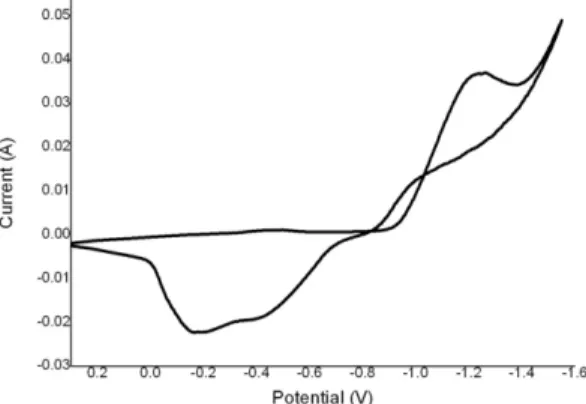
ZVI nanoparticles are electrochemically deposited on the porous carbon electrode modified with a polypyrrole film . For this, the polypyrrole conducting polymer was previously deposited on a porous carbon electrode using cyclic voltammetry (CV). Electrodeposition was performed by 20 cycles of a potential scan between -0.7 ~ -1.1 V at 50 mV/s in a 0.1 M pyrrole solution. Fig. 1 shows a ClO4-+8H++8e-→Cl-+4H2O E0 = 1.388V
Fig. 1. A cyclic voltammogram of polypyrrole modified porous carbon electrode in a 0.1 M sodium sulfate solution containing in 0.1 M iron sulfate. Scan rate : 20 mV/s.
c yc li c v o l ta m m o gr a m ( CV ) of p ol y p y r r o le modified porous carbon electrode in a 0.1 M sodium sulfate solution containing in 0.1 M iron sulfate. The CV clearly demonstrated iron deposition at more negative potential of ~ -1.0 V and oxidation during the reverse anodic scan. ZVI nanoparticles were electrodeposited on the polypyrrole surface at the constant potential of -1.2 V for 300 s using a mixed solution of 0.1 M iron sulfate and 0.1 M sodium sulfate. The total amount of iron deposited during the chronoamperometric experiment can be calculated using the Faraday’s law. According to the total charge, it was calculated that 4.06×10-
6m ol of iron was electrode posited on the e l e c t r o d e s u r f a c e , w h i c h i s e q u i v a l e n t t o 2.265×10⁻³g of iron.
T h e m o r p h o l o g y a n d c o m p o s i t i o n w e r e determined by SEM and EDX analysis. Fig. 2 shows SEM images for the bare porous carbon electrode before deposition of polypyrrole (Fig.
2A) and after modification with polypyrrole (Fig.
2B). Fig. 2B shows that morphology of the p o r o u s c a r b o n w a s m a i n t a i n e d a f t e r electrodeposition of polypyrrole. As seen in the figure, polypyrrole film is very homogeneous and no aggregation is observed. Surface morphology was dramatically changed after electrodeposition of ZVI on the electrode surface. Electrodeposition of ZVI was confirmed by EDX analysis (Fig. 3) and color change of the electrode. The ZVI surface was dark black when freshly deposited on the electrode surface.
It is well known that two overall processes occur simultaneously during the electrochemical reduction of perchlorate by iron:13)
Fe + 2H+→Fe2+ + H2 (2)
4Fe + ClO4- + 8H+→Cl- + 4Fe2+ + 4H2O (3) Electrochemical degradation of perchlorate was performed at -0.3 V using a solution containing 10 ppm of ammmonium perchlorate and change of perchlorate concentration with degradation time was monitored with ion chromatography. Fig. 4 depicts ion chromatograms showing the change in
Fig. 2. SEM images for (A) a porous carbon electrode, a polypyrrole modified porous carbon electrode (B) before and (C) after electrodeposition of ZVI.
Fig. 3. EDX spectrum for a polypyrrole modified porous carbon electrode after electrodeposition of ZVI.
perchlorate concentration, before (Fig. 4A) and after 10 min (Fig. 4B) the degradation of perchlorate with electrochemically generated ZVI.
P e a k c o r r e sp on d in g t o p e r c hl or a te i on ( a t
~9.5 min.) is decreased with electrolysis time and another peak due to chloride (at ~2.4 min.) is i nc r e a s e d a s su g ge s te d in th e de g r a da t io n mechanism (reaction 3). Preliminary results showed that ~12.7% of perchlorate was reduced in just 10 min. and it is expected that efficiency can be increased with area of the carbon e l e c t r o d e , a m o u n t o f Z V I , a n d r e a c t i o n temperature.
I n sum m a r y, w e de ve lop ed a f a cile an d efficient method for the preparation of ZVI on the polypyrrole modified porous carbon electrode and the electrode was successfully used to destroy perchlorate ions. Further studies on the effects of conditions including electrolysis time,
potential, perc hlorate c oncentr ation on the degradation efficiency are under investigation in our laboratory. Additionally, methods to recycle ZVI after experiments will be investigated in the future.
Acknowledgements
This research was supported by fund provided by National Research Foundation of Korea (NRF- 2012R1A1A2041943)
References
1. H. Krienke and G. Schmeer, “Hydration of Molecular Anions with Oxygen Sites - a Monte Carlo Study”, Z.
Phys. Chem., 218, 1 (2004).
2. E. T. Urbansky (Ed.), “Perchlorate in the Environment”, Kluwer Academic Publishers, (2001).
3. E. T. Urbansky, “Perchlorate as an environmental contaminant”, Environ. Pollut., 118, 357 (2002).
4. G. M. Brown, B. Gu, in: B. Gu, and J. D. Coates (Eds.),
“Perchlorate, Environmental Occurrence, Interactions and Treatment”, Springer Publishers, p. 17 (2006)
5. B. E. Logan and D. LaPoint, “Treatment of perchlorate- and nitrate-contaminated groundwater in an autotrophic, gas phase, packed-bed bioreactor”, Water Res., 36, 3647 (2002).
6. B. Min, P. J. Evans, A. K., Chu, and B. E. Logan,
“Perchlorate removal in sand and plastic media bioreactors”, Water Res., 38, 47 (2004).
7. B. Gu, G. P. Bonnesen, F. V. Sloop, and G. M. Brown,
“Perchlorate, Environmental Occurrence, Interactions and Treatment”, B. Gu and J. D. Coats (Eds.), 373-386, Springer Science+Business Media, Inc., New York, NY, (2006).
8. A. M. Moore, C. H. De Leon, and T. M. Young, “Rate and extent of aqueous perchlorate removal by iron surfaces”, Environ. Sci. Technol., 37, 3189 (2003).
9. B. E. Logan, “Peer Reviewed: Assessing the outlook for perchlorate remediation”, Environ Sci. Technol., 35, 482A (2001).
10. B. Gu, G. M. Brown, and C. C. Chiang, “Treatment of Perchlorate-Contaminated Groundwater Using Highly Selective, Regenerable Ion-Exchange Technologies”, Environ. Sci. Technol., 41, 6277 (2007).
11. S. Park, B. H. Jeon, H. Jeong, and K.-J. Paeng,
“Adsorption characteristic of perchlorate anion in aqueous solution by mixed resins”, Anal. Sci. Technol.
23, 429 (2010).
12. J. Yoon, Y. Yoon, G. Amy, J. Cho, D. Foss, and T. H.
Kim, “Use of surfactant modified ultrafiltration for perchlorate (ClO4) removal”, Water Res. 37, 2001 (2003).
13. G. G. Lang and G. Horanyi, “Some interesting aspects of Fig. 4. Ion chromatrograms showing the change of
perchlorate concentration with electrolysis time. (A) before and (B) after applying constant potential for 10 min. using electrochemically generated ZVI electrode.
Initial perchlorate concentration: 10 ppm.
the catalytic and electrocatalytic reduction of perchlorate ions”, J. Electroanal. Chem., 552, 197 (2003).
14. M. Y. Rusanova, P. Polaskova, M. Muzikar, and W. R.
Fawcett, “Electrochemical reduction of perchlorate ions on platinum-activated nickel”, Electrochim. Acta, 51, 3097 (2006).
15. G. G. Lang, N. S. Sas, M. Ujvari, and G. Horanyi, “The kinetics of the electrochemical reduction of perchlorate ions on rhodium”, Electrochim. Acta, 53, 7436 (2008).
16. S. Srinivasan, G. Sorial, and E. Sahle-Demessie,
“Treatment of Microcontaminants in Drinking Water”, Environment Engineering Science, 26, 1661 (2009).
17. M. Ujvari and G. G. Lang, “On the stability of perchlorate ions against reductive attacks in electrochemical systems and in the environment”, J.
Electrochem. Sci. Eng., 1, 1 (2011).
18. S. Y. Oh, P. C., Chiu, B. J., Kim, and D. K., Cha,
“Enhanced reduction of perchlorate by elemental iron at elevated temperatures”, J. Hazard. Mater., 129, 304 (2006).