681
JOURNAL OF KOREAN FOREST SOCIETY
광릉시험림 산림토양의 미생물상 및 중형동물상 분포
어진우1·박병배2*·박기춘1·천정화2
1농촌진흥청 국립원예특작과학원, 2국립산림과학원 산림생태연구과
Distribution of Microflora and Mesofauna in the Forest Soils of Gwangneung Experimental Forest
Jinu Eo1, Byung Bae Park2*, Kee-choon Park1 and Jung Wha Chun2
1Department of Herbal Crop Research, Rural Development Administration, Chungbuk 369-873, Korea
2Division of Forest Ecology, Korea Forest Research Institute, Seoul 130-712, Korea
요 약:본연구목적은 광릉시험림지역의침엽수림과 활엽수림에서토양깊이가미생물상과 중형동물상분포에 미 치는영향을구명하는것이다. 토양미생물상은인지질지방산(PLFA) 지표를이용하여그밀도정도를분석하였고, 중 형동물상은 선충과미소절지동물의밀도를 조사하였다. 미생물 PLFA지표는 B층보다 A층에서 높았고, 산림형에 따
른차이는 적었다. 선충밀도도 A층에서 높았으며, 곰팡이섭식성 선충의밀도는침염수림 토양보다 활엽수림 토양 에서높게나타났다. 미소절지동물 중에서 톡토기와날개응애의평균밀도는 전체미소절지동물 밀도의 44%와 42%
를각각보였다. 세균과곰팡이를 나타내는 PLFA 지표가이들을 섭식하는중형동물과 유의한 양의상관관계가 있
었으며, 이것은 이지역토양에서 세균과곰팡이를 중심으로한먹이망 형성이이들의분포에 영향을준다는 것을
나타낸다. 이러한 결과는광릉시험림의 토양생물분포는 주로토양의깊이에영향을 받으며, 산림형은부분적인 영 향을주고있음을알수있었다.
Abstract: The aim of this study was to investigate the distribution of soil biota across forest types and soil depths in Gwangneung Experimental Forest. We selected 5 sites, which are 3 deciduous- and 2 coniferous forests. The abundance of microflora in these areas was analyzed by the phospholipid fatty acid (PLFA) indicators, and the density of mesofauna was measured by the abundance of nematodes and microarthropods.
The abundance of soil microflora was higher in the A layer than in the B layer based on the PLFA indicators, but there were no differences between deciduous and coniferous forests. Average density of nematodes was higher in the A horizon than in the B horizon. The density of fungivorous nematodes was higher in the deciduous forests. Mean densities of Collembola and Oribatida were 44% and 42% of microarthropods in soil samples, respectively. The results of microbial PLFA indicators were significantly correlated with the density of their consumers, which reflected that the food web in fungi- and bacteria-based soil developed in this forests.
This study suggested that the distribution of soil organisms largely separated by soil depths and was slightly affected by the forest type in the Gwangneung Experimental Forest.
Key words :coniferous, deciduous, microarthropod, nematode, PLFA, soil depth
서 론
광릉의산림은 1911년에시험림으로지정된이래로식
생을중심으로다양한연구가이루어져왔다(이경재 등,
1990). 산림토양연구와관련하여광릉지역의토양환경
인자와식생분석에서수종분포가토양산도, 유기물함량,
전질소함량등의토양성질에영향을받는것으로나타났
다(이경재 등, 1990). 또한, 토양의 입지환경과천연활엽 수림의지상부생체량, 낙엽량, 탄소축적량의관련성에대
한연구도진행되고있다(Lim et al., 2003).
산림토양의 미생물및중형동물은토양생태계에서유 기물의분해및양분의이동과정에서중요한역할을한 다. 유기물의분해속도는유기물의조성에따라달라지 며, 미소절지동물은유기물의화학성을변화시켜분해속
도에영향을미친다(Wickings and Grandy, 2011). 토양미 생물지수와미소절지동물의밀도는지상부식물의종다
*Corresponding author E-mail: [email protected]
양성과밀접한관계가있으며(Eisenhauer et al., 2011), 토 양생물의밀도는식물의생장에영향을미친다(Cole et al.,
2004). 토양동물은산림토양의 화학적, 물리적 성질뿐만
아니라 산림토양의훼손정도를반영하는지표로사용할
수 있기 때문에 이들의 연구가 중요하다(Hanel, 2010;
Heneghan et al., 2004; Neher, 2001).
광릉지역산림의토양생물에대한연구를살펴보면광 릉시험림의고등균류의분포와다양성에대한조사가있 었고(Lee et al., 1987), 중형동물중에서는선충, 톡토기,
응애류의 밀도에 대한 연구가 보고되었다(Park et al., 1996; 박홍현등, 1996; 정철의등, 1998). 유기물의분해 와관련하여낙엽주머니를이용한실험에서응애류및톡
토기목의조사와(배윤환과이준호, 1997), 잣나무림의낙
엽분해에참여하는날개응애류의종류및밀도와토양절
지동물의영향에대한보고가있다(배윤환, 2001; 배윤환
과이준호, 1999).
본연구에서는광릉시험림의식생을침엽수림과 활엽 수림으로나누어각각의지역에서토양의깊이에따른토 양생물의분포를조사하였다. 또한, 미생물중에서세균과 곰팡이를중심으로이들을섭식하는중형동물들과의상 관관계연구를목표로하였다.
재료 및 방법
1. 조사지 개황
본 연구의 실험은 광릉시험림(KEF, Kwangneung Experimental Forest)에서이뤄졌다. 광릉시험림은서울에
서북서쪽방향으로 30 km 떨어져 있고, 시험지면적은
2,240 ha이다. 조사구는소리봉주변의작은유역(127°8'31"
~127°10'14" E, 37°44'30"~37°45'21" N)이며해발고 55~533
m 안에위치하고있다. 지형은경사도 10° 정도의계곡형
으로주로동사면을이루고있다. 해발고가높은지역에 서는천연활엽수림이분포하며, 졸참나무(Quercus serrata),
서어나무(Carpinus laxiflora), 까치박달(Carpinus cordata),
고로쇠나무(Acer pictum)가우점수종이며, 해발고가낮은 지역에는전나무(Abies holophylla), 잣나무(Pinus koraiensis),
구상나무(Abies koreana)가 조림되었다(Chun et al., 2007). 이지역은 여름은 덥고습하며(monsoon climate)
겨울은춥고건조한(continental climate) 기후이다. 연평균 기온은 11.3oC이고연평균강수량은 1,363 mm이다(Lim et al., 2003). 모암은화강편마암(granite gneiss)이며토양 형은갈색산림토양(brown soil)에속하고, 평균토심은 52 cm, 토성은양토와사양토로 pH는 4.2~5.2로약산성이다
(Lim et al., 2003).
2. 토양시료 채취
2005년부터 유역수준의산림생체량및임분구조조사 에이용된 9개의조사구(Chun et al., 2007) 중 5개의조 사구(1, 2, 3, 6, 7)에서토양을채취하였다. 조사구 1, 2, 3
은천연활엽수림이며, 조사구 6과 7은전나무조림지이
다(Table 1). 조사구크기는 20 m×20 m 또는 30 m×30 m
이며토양채취는조사구를 4분위로나눈후, 각분위에서 고사목이나동물에의한훼손이없고수목에서 1 m 이상 떨어진지점을 선정하였다. 유기물층을제거한후그아 래의광물질토양을유기물의함량이나색깔로구분하여
A층(평균깊이 7 cm)과 B층(평균깊이 19 cm)으로나누
었다. 각각의층에서 500 g 토양을채취한후바로실험실
로옮겨토양미생물및중형동물조사에이용하였다.
3. 토양화학성분석
상온에서 72시간동안건조한토양을이용하여 pH, EC,
유기물, 총질소, 유효태인산및치환성양이온을분석하였 다. 토양 pH(1:5)와전기전도도(EC)는초자전극법으로분 석하였고, 총탄소및총질소함량은 CN 분석기(Vario Max CN, Elementar Analysenesysteme, Germany)를이용하여 측정하였으며, 유기물함량은측정한총탄소함량을환산
계수로 계산하였다. 유효인산함량은 Lancaster법으로 측 정하였으며, 치환성양이온함량은 1 N NH4OAc(pH 7.0)
으로 침출한 후 그 여과액을 ICP(Integra XL DUAL,
GBC Scientific Equipment, USA)를이용하여측정하였다.
4. 미생물 PLFA 분석
식생및토심에따른미생물상과환경요인을알아보기 위하여 인지질지방산(PLFA, phospolipid fatty acid)을
Peacock et al.(2001)의방법에따라다음과같이분석하였 다. 동결건조후냉동보관한토양시료 5 g에 chloroform(4 Table 1. Characteristics of experiment sites.
Forest type Sampled
size Basal area
(m2 ha−1) Dominant species
Site 1 Deciduous forest 20 m × 20 m 34.0 Quercus serrata, Carpinus laxiflora, Carpinus cordata Site 2 Deciduous forest 30 m × 30 m 21.5 Quercus serrata, Carpinus laxiflora, Carpinus cordata Site 3 Deciduous forest 20 m × 20 m 36.1 Quercus serrata, Carpinus cordata
Site 6 Coniferous forest 30 m × 30 m 35.5 Abies holophylla Site 7 Coniferous forest 20 m × 20 m 18.0 Abies holophylla
mL), methanol(8 mL), buffer solution(3.2 mL, pH 7.4)을 혼합하여지질을추출한후 silicic acid column으로 neutral-, glyco- 및 phospho-lipid로 분리하여, MIDI Sherlock Microbial Identification System(MIDI Inc., Newark, DE)으 로지방산을정성및정량하였다. 전체 PLFA 중에서주요 지표지방산은 Li et al.(2006)의방법에따른지표들을이 용하여지방산을분류하였다. 각인지질지방산의값은표
준물질로첨가한 19:0를기준으로농도를환산하여계산
하였다. 단불포화 지방산은 16:1 ω5c, 17:1 ω8c, 18:1
ω7c, 포화지방산은 14:00, 15:00, 16:00, 17:00, 18:00, 20:00을지표지방산으로사용하였다. 호기성균은 16:1 ω7t,
혐기성균은 cy19:0을사용하였다. 그램음성균의지표지
방산은 18:1 ω7c, 19:0cy ω8c, 17:1 ω8c, 그램양성균은
i14:0, i15:0, a15:0, i16:0, i17:0, a17:0, 세균은 그램음성 균과양성균을모두이용하였다. 곰팡이는 18:2 ω6, 9c, 방 선균은 10Me16:0, 10Me17:0, TBSA10Me18:0, 균근균은
16:1 ω5c을이용하였다(Li et al., 2006).
5. 토양 중형동물상 조사
선충은베르만깔대기법을이용하여 20 g의토양을 48시 간동안상온에서추출하여 TAF 용액(2% triethanolamine, 2.8% formaldehyde)에보관한 후, 선충의 구두부와내부
기관을관찰하여세균섭식성, 곰팡이섭식성, 식물섭식성,
잡식성, 포식성선충으로분류하였다. 선충의추출에사용 한토양은건조하여토양수분함량을측정하였으며, 선충 의밀도는건조토양 1 g당개체수(N)로표기하였다. 미소 절지동물은툴그렌장치를이용하여 200 mL의토양을 96
시간동안추출후현미경을이용해톡토기와응애류등으 로구분하였다.
6. 통계처리
토양별이화학성, 미생물 PLFA 수치, 중형동물밀도는
분산분석과 Tukey 검정법으로분석하였다. 미생물 PLFA
와중형동물의밀도는상관계수로분석하였다. 통계분석 은 모두 SAS v9.1(SAS Institute Inc., USA)를이용하여 수행하였다.
결과 및 고찰
1. 토양미생물상
지방산분석에서나타난미생물별 PLFA 지표를보면
세균, 곰팡이, 방선균모두 B층보다 A층에서높았으며,
활엽수림과침엽수림과의비교에서는뚜렷한차이가없 었다(Table 2). Gram-/Gram+과 Saturated/unsaturated
비율은 pH, 중금속, 양분결핍등의 스트레스를나타내
는 지표로 이용할 수 있으나(Kaur et al., 2005), 조사 구역간 차이는 없었다. 스트레스 정도를 나타내는 Cyclopropyl/precursor 비율은 A층보다는 B층에서약간
높은 경향이있었다(Table 2). 토양의 EC와유기물함량
은 유의한차이가 있었으며(Table 3), 미생물과의 상관
관계를 분석하였을 때 세균 PLFA 지표는 토양의
EC(r= 0.46, P< 0.05) 및 유기물함량(r= 0.65, P< 0.05)
과유의한상관관계가있었고, 곰팡이 PLFA 지표도토
양의 EC(r= 0.41, P< 0.05) 및 유기물함량(r= 0.50, P< 0.05)과유의한양의상관관계가나타났다. 위의결 과를종합하면이지역의토양미생물은식생에따른변 화는 적으며, A층에서는 B층보다 유기물 함량이 높고 양호한환경이조성되어미생물의밀도가높은것을알 수있다.
Table 2. Microbial characteristics analyzed by the PLFA indicators for microorganisms in soils at different soil depths and sites.
Forest type G-/G+ Aero/
anaero Sat/
unsat Cyclo/
pre Bacteria Fungi Act VAM Total
(PLFA nmol g−1 soil) A horizon
Site 1 Deciduous forest 1.34a 0.98b 1.14a 0.82ab 24.5a 5.7a 5.7ab 1.7ab 57.8ab Site 2 Deciduous forest 1.73a 1.01b 0.83a 0.84ab 23.9abc 4.3abc 4.9ab 1.6ab 50.3abc Site 3 Deciduous forest 1.28a 1.62a 0.91a 0.56b 20.2abc 4.2abc 4.9ab 1.7ab 47.3abc Site 6 Coniferous forest 1.40a 1.14ab 0.98a 0.85ab 19.7abc 3.4abc 4.4ab 1.5ab 43.8abc Site 7 Coniferous forest 1.80a 0.92b 0.92a 0.91a 28.6abc 5.5abc 6.7a 2.0a 64.2a B horizon
Site 1 Deciduous forest 1.65a 0.85b 1.07a 1.00a 14.1abc 3.0abc 2.9b 1.0b 31.0c Site 2 Deciduous forest 1.20a 1.03b 0.96a 0.82ab 15.8d 2.3c 4.0b 0.9ab 33.4bc Site 3 Deciduous forest 1.29a 1.20ab 0.91a 0.72ab 14.4bc 2.8bc 3.5b 0.9b 31.4bc Site 6 Coniferous forest 1.39a 0.79b 0.93a 1.04a 14.4c 1.9c 3.7b 0.8b 29.5c Site 7 Coniferous forest 1.30a 0.88b 0.98a 0.92a 16.8abc 3.2abc 4.4b 1.1ab 37.2bc Values indicated by the same letter are not significantly different within the same column including the A and B horizons according to Tukey's test (P < 0.05). ‘G-’, gram-negative bacteria; ‘G+’, gram-positive bacteria; ‘aero’, aerobic bacteria; ‘anaero’, anaerobic bacteria;
‘sat’, saturated fatty acids; ‘unsat’, unsaturated fatty acids; ‘cycl’, cyclo fatty acids; ‘pre’, the precursors of cyclo fatty acids; ‘act’, actino- mycetes.
2. 선충 개체밀도 및 섭식성별 분포
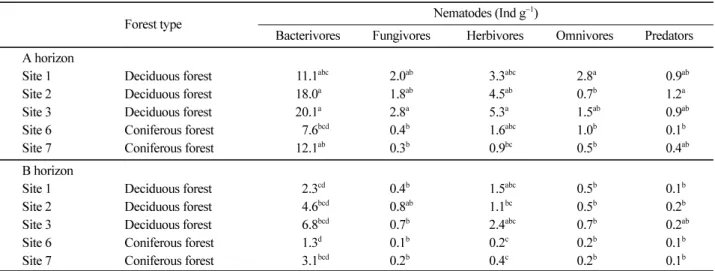
A층과 B층의밀도를비교하면섭식형태에상관없이 A
층에서의밀도가높게나타났다 (Table 4). 선충의섭식형
태별분류에서는세균섭식선충의밀도가전체의 50-80%
를차지하였다. 선충의군집구조에서잡식성과포식성선 충의비율이 침엽수림보다활엽수림에서컸다는보고가
있으며(Hanel, 2008), 본연구에서도활엽수림에서비교적
이들의개체밀도가크게나타났다. 선충의식성분류에서 세균섭식성/곰팡이섭식성선충의비율이활엽수림(약 5-
10)보다 침엽수림(19-40)에서 높은 경향이 있었으나,
Ruess(2003)는활엽수림과침엽수림에서크게다르지않
았다고보고하였다. 본연구에서는특히곰팡이섭식성선 충의밀도가활엽수림에서높게나타났으나, 이들의먹이
가되는곰팡이의밀도를나타내는 PLFA 지표는크게다
르지않았기 때문에먹이의 양에의한직접적인영향은
적은것으로추측된다(Table 4).
3. 미소절지동물 분포
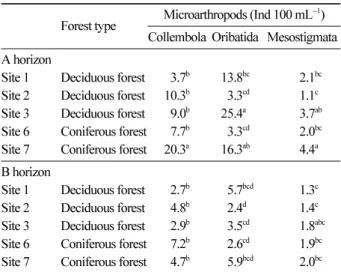
A층과 B층의밀도를비교하면톡토기류와응애류모두
A층에서높았으며, 미소절지동물중에서톡토기가약 44%
를차지하였고, 날개응애는 약 42%를차지하였다(Table 5). 톡토기의밀도는 Site 7에서가장높았으나, 날개응애 의밀도는 Site 3과 7에서높았다. 유기물의 C/N율은유기 물분해에 참여하는 동물들의 밀도에 영향을 주는데
(Marschner et al., 2003; Rosenbrock et al., 1995), Site 3과 7의비교적낮은 C/N율(Table 3)은날개응애의낮은
밀도와 관련성이 높은 것으로 보인다. 배윤환과이준호
(1997)는광릉지역에서낙엽주머니의낙엽분해에관여하
는토양무척추동물의약 60%는응애류이었고, 톡토기목 은약 30%로대다수를차지하였다고하였다. 미소절지동
Table 3. Chemical properties of the soils at different soil depths and sites.
Forest type Moisture pH EC NO3- Av.P2O5 T-N T-C C/N OM
(%) (dS/m) (mg/kg) (mg/kg) (g/kg) (g/kg) (%)
A horizon
Site 1 Deciduous forest 46.4ab 4.8a 0.3abc 16.2bc 3.4ab 0.7g 4.2bc 6.1a 7.2bc Site 2 Deciduous forest 57.1a 4.7a 0.3ab 27.4ab 17.8ab 0.8fg 6.2a 7.7a 10.6a Site 3 Deciduous forest 27.2d 5.1a 0.2bcd 15.2bc 2.6b 1.2d 3.3bcd 2.7b 5.7bcd Site 6 Coniferous forest 37.5bcd 5.3a 0.4a 36.5a 25.1a 1.3d 4.7ab 3.6b 8.1ab Site 7 Coniferous forest 30.6cd 4.7a 0.2bcd 13.5bc 23.2ab 1.7bc 4.5b 2.7b 7.8b B horizon
Site 1 Deciduous forest 38.8bcd 4.8a 0.2bcd 10.3c 2.2b 0.9ef 2.8cd 2.9b 4.8cd Site 2 Deciduous forest 44.5abc 4.8a 0.2bcd 19.0bc 3.0b 1.1de 3.6bcd 3.2b 6.2bcd
Site 3 Deciduous forest 26.5d 5.1a 0.1d 9.7c 2.6b 1.6c 2.1d 1.4b 3.6d
Site 6 Coniferous forest 28.2d 4.8a 0.2bcd 15.9bc 11.6ab 1.9b 2.9cd 1.6b 5.0cd Site 7 Coniferous forest 27.7d 4.8a 0.2cd 9.6c 5.3ab 2.2a 3.2bcd 1.5b 5.5bcd Values indicated by the same letter are not significantly different within the same column including the A and B horizons according to Tukey's test (P < 0.05).
Table 4. Abundance of nematodes including 5 trophic groups in the forest soils of Gwangneung Experimental Forest.
Forest type Nematodes (Ind g−1)
Bacterivores Fungivores Herbivores Omnivores Predators A horizon
Site 1 Deciduous forest 11.1abc 2.0ab 3.3abc 2.8a 0.9ab
Site 2 Deciduous forest 18.0a 1.8ab 4.5ab 0.7b 1.2a
Site 3 Deciduous forest 20.1a 2.8a 5.3a 1.5ab 0.9ab
Site 6 Coniferous forest 7.6bcd 0.4b 1.6abc 1.0b 0.1b
Site 7 Coniferous forest 12.1ab 0.3b 0.9bc 0.5b 0.4ab
B horizon
Site 1 Deciduous forest 2.3cd 0.4b 1.5abc 0.5b 0.1b
Site 2 Deciduous forest 4.6bcd 0.8ab 1.1bc 0.5b 0.2b
Site 3 Deciduous forest 6.8bcd 0.7b 2.4abc 0.7b 0.2ab
Site 6 Coniferous forest 1.3d 0.1b 0.2c 0.2b 0.1b
Site 7 Coniferous forest 3.1bcd 0.2b 0.4c 0.2b 0.1b
Values indicated by the same letter are not significantly different within the same column including the A and B horizons according to Tukey's test (P < 0.05).
물는토양의화학성에영향을받으며, 날개응애는우리나 라산림토양의산성화를나타내는생물지표로서이용한 보고가있다(Jung et al., 2002). 본연구에서 pH는톡토기
(r= -0.10, P= 0.52) 또는날개응애류(r= 0.08, P= 0.63)와 유의한 상관관계가없었으며, 정철의등(1998)이광릉지
역의날개응애류를조사하여이들의밀도는 pH와상관관 계가없다고보고한내용과일치하였다.
지상부의식생에따라낙엽의화학적성질이다르며, 이 것은토양생물의밀도및다양성에영향을미칠수있다
(Loranger-Merciris et al., 2007). 박홍현등(1996)은광릉
지역의침엽수림및활엽수림에서조사된중형동물인응
애류의 밀도는 약 12,000 m−2, 톡토기류의 밀도는 약
3,000 m−2로산림형에따른차이가없다고보고하였다. 본 연구에서도미소절지동물의밀도는침엽수림과활엽수림 에서뚜렷한차이는없었으며, 톡토기류와응애류의밀도
는 각각 약 1,500-10,000 m−2 및 1,000-12,000 m−2로박
홍현등(1996)의보고와유사하였다. 배윤환(2001)은광릉 의잣나무림낙엽분해에관련된날개응애류는 20종미만 이고, 체장이 0.2-0.5 mm인소형종의밀도가높다고보고 하였고, Park et al.(1996)은광릉지역의날개응애류를조
사하여 침엽수림에서 101종과 활엽수림에서는 108종을
보고하였다.
4. 미생물과 중형동물의 관계
조사한 광릉지역토양의 생물들은미생물을중심으로 먹이망구조를형성하는것으로나타났다. 먼저세균중심
의먹이구조를살펴보면세균 PLFA 지표는세균섭식선 충(r= 0.53, P< 0.01) 및톡토기(r= 0.36, P< 0.05)와유 의한상관관계가나타났기때문에, 세균과이들을섭식하
는중형동물간의밀접한상호관계를시사한다. 또한, 곰팡 이중심의먹이구조를살펴보면곰팡이 PLFA 지표는곰
팡이섭식성선충과유의한상관관계가없었으나, 날개응 애와는유의한양의상관관계(r= 0.61, P< 0.01)를보였다.
포식성선충과그이외의선충의밀도관계에서유의한양 의상관관계가나타났다(r= 0.66, P< 0.01). 따라서이지 역토양생물들은세균과곰팡이를중심으로이를섭식하 는중형동물과포식성동물들사이에유기적인먹이연쇄 구조가형성되어있어서, 세균과곰팡이가이들의분포에 영향을주는것으로추측된다.
결 론
본연구에서광릉시험림토양의미생물상및중형동물 상이토양의깊이에따라달라지며, 부분적으로토양의이 화학성에영향을받는것으로나타났다. 또한, 이지역의 토양생물은 미생물을중심으로하는먹이망구조를형성 하고있고산림형에따른토양생물분포는큰차이가없 었다. 일반적으로지상부낙엽과수목뿌리밀도는선충 및응애류의밀도와양의상관관계를보이며, 임분이성 숙될수록 선충의 밀도가 증가하므로(Fisk et al., 2010;
Keith et al., 2009; Reynolds et al., 2003), 향후 낙엽이
나근권분비물에서공급되는유기물과토양생물의반응 에대한추가적인연구가이지역에서필요할것으로사 료된다.
인용문헌
1. 박홍현, 정철의 이준호, 이범영. 1996. 남산과광릉의 토
양미소절지동물에관한 연구. 한국토양동물학회지 1(1):
37-47.
2. 배윤환. 2001. 남산과 광릉지역의 잣나무림에서 낙엽분
해과정에 관련된 날개응애 군집분석. 한국토양동물학회 지 6(1-2): 25-31.
3. 배윤환, 이준호. 1997. 남산과 광릉 활엽수림에서 낙엽 분해에 관여하는 토양무척추동물군집에 관한 연구. 한 국토양동물학회지 2(2): 83-91.
4. 배윤환, 이준호. 1999. 남산과 광릉수목원의 잣나무림에 서낙엽분해과정에 관련된 토양미소절지동물군집. 한국
토양동물학회지 4(2): 75-80.
5. 이경재, 조재창, 이봉주, 이도석. 1990. 광릉 산림의 식 물군집구조(1). 한국임학회지 79(2): 173-186.
6. 정철의, 이준호, 배윤환, 최성식. 1998. 남산과 광릉 활 엽수림지역의날개응애류(Acari: Oribatida) 종구성. 한
국토양동물학회지 3(2): 91-105.
7. Chun, J.H., Lim, J.H. and Lee, D.K. 2007. Biomass esti- mation of Gwangneung catchment area with landsat ETM+
image. Journal of Korean Forest Society 96(5): 591-601.
8. Cole, L., Dromph, K.M., Boaglio, V. and Bardgett, R.D.
Table 5. Abundance of microarthropods in the forest soils of Gwangneung Experimental Forest.
Forest type Microarthropods (Ind 100 mL−1) Collembola Oribatida Mesostigmata A horizon
Site 1 Deciduous forest 3.7b 13.8bc 2.1bc Site 2 Deciduous forest 10.3b 3.3cd 1.1c Site 3 Deciduous forest 9.0b 25.4a 3.7ab Site 6 Coniferous forest 7.7b 3.3cd 2.0bc Site 7 Coniferous forest 20.3a 16.3ab 4.4a B horizon
Site 1 Deciduous forest 2.7b 5.7bcd 1.3c Site 2 Deciduous forest 4.8b 2.4d 1.4c Site 3 Deciduous forest 2.9b 3.5cd 1.8abc Site 6 Coniferous forest 7.2b 2.6cd 1.9bc Site 7 Coniferous forest 4.7b 5.9bcd 2.0bc Values indicated by the same letter are not significantly different within the same column including the A and B horizons according to Tukey's test (P < 0.05).
2004. Effect of density and species richness of soil mesofauna on nutrient mineralization and plant growth.
Biology and Fertility of Soils 39: 337-343.
9. Eisenhauer, N., Yee, K., Johnson, E.A., Maraun, M., Par- kinson, D., Straube, D. and Scheu, S. 2011. Positive relationship between herbaceous layer diversity and the performance of soil biota in a temperate forest. Soil Biology and Biochemistry 43: 462-465.
10. Fisk, M.C., Fahey, T.J. and Groffman, P.M. 2010. Car- bon resources, soil organisms, and nitrogen availability:
Landscape patterns in a northern hardwood forest. For- est Ecology and Management 260: 1175-1183.
11. Hanel, L. 2008. Nematode assemblages indicate soil res- toration on colliery spoils afforested by planting differ- ent tree species and by natural succession. Applied Soil Ecology 40: 86-99.
12. Hanel, L. 2010. An outline of soil nematode succession on abandoned fields in South Bohemia. Applied Soil Ecol- ogy 46: 355-371.
13. Heneghan, L., Salmore, A. and Crossley, D.A. 2004. Recov- ery of decomposition and soil microarthropod communi- ties in an Appalanchian watershed two decades after a clearcut. Forest Ecology and Management 189: 353-362.
14. Jung, C., Lee, J.H. and Choi, S.S. 2002. Potential of using oribatid mites (Acari: Oribatida) as biological indi- cators of forest soil acidification. Korean Journal of Agricultural and Forest Meteorology 4(4): 213-218.
15. Kaur, A., Chaudhary, A., Kaur, A., Choudhary, R. and Kaushik, R. 2005. Phospholipid fatty acid - A bioindicator of environment monitoring and assessment in soil eco- system. Current Science 89: 1103-1112.
16. Keith, A.M., Brooker, R.W., Osler, G.H.R., Chapman, S.J., Burslem, D.F.R.P. and Van der Wal, R. 2009.
Strong impacts of belowground tree inputs on soil nema- tode trophic composition. Soil Biology and Biochemis- try 41: 1060-1065.
17. Lee, K.J., Miller, O.K. and Kim, Y.S. 1987. Distribution and diversity of saprophytic, mycorrhizal and parasitic higher fungi in Kwangnung experiment forest in Korea.
Journal of Korean Forestry Society 76: 376-389.
18. Li, W.H., Zhang, C.B., Jiang, H.B., Xin, G.R. and Yang, Z.Y. 2006. Changes in soil microbial community associ- ated with invasion of the exotic weed, Mikania micran- tha HBK, Plant and Soil 281: 309-324.
19. Lim, J.H., Shin, J.H., Jin, G.Z., Chun, J.H. and Oh, J.S.
2003. Forest stand structure, site characteristics and car- bon budget of the Kwangneung natural forest in Korea.
Korean Journal of Agricultural and Forest Meteorology 5(2): 101-109.
20. Loranger-Merciris, G., Imbert, D., Bernhard-Reversat, F., Ponge, J. and Lavelle, P. 2007. Soil fauna abundance and diversity in a secondary semi-evergreen forest in Guadeloupe (Lesser Antillers): influence of soil type and dominant tree species. Biology and Fertility of Soils 44:
269-276.
21. Marschner, P., Kandeler, E. and Marschner, B. 2003. Struc- ture and function of the soil microbial community in a long-term fertilizer experiment. Soil Biology and Biochemis- try 35: 453-461.
22. Neher, D. 2001. Role of nematodes in soil health and their use as indicators. Journal of Nematology 33: 161-168.
23. Park, H.H., Jung, C.E., Lee, J.H., Choi, S.S. and Lee, B.Y. 1996. Faunal list of oribatid mites (Acari: Oribatida) at the 44th (deciduous) and 45th (coniferous) compartment in Kwangreung. Korea. Korean Journal of Soil Zoology 1: 95-101.
24. Peacock, A.D., Mullen, M.D., Ringelberg, D.B., Tyler, D.D., Hedrick, D.B., Gale, P.M. and White, D.C., 2001.
Soil microbial community responses to dairy manure or ammonium nitrate applications, Soil Biology and Bio- chemistry 33: 1011-1019.
25. Reynolds, B.C., Crossley, D.A. and Hunter, M.D. 2003.
Response of soil invertebrates to forest canopy inputs along a productivity gradient. Pedobiologia 47: 127-139.
26. Rosenbrock, P., Busct, F. and Munch, J.C. 1995. Fungal succession and changes in the fungal degradation poten- tial during the initial stage of litter decomposition in a black alder forest (Alnus glutinosa (L.) Gaertn.). Euro- pean Journal of Soil Biology 31: 1-11.
27. Ruess, L. 2003. Nematode soil faunal analysis of decom- position pathways in different ecosystems. Nematology 5: 179-181.
28. Wickings, K. and Grandy, A.S. 2011. The oribatid mite Scheloribates moestus (Acari: Oribatida) alters litter chemistry and nutrient cycling during decomposition. Soil Biology and Biochemistry 43: 351-358.
(2011년 8월 2일 접수; 2011년 9월 6일 채택)