• 검색 결과가 없습니다.

Systemic Review on Complementary and Alternative Medicine for Breast Cancer

N/A
N/A
Protected

Academic year: 2021

Share "Systemic Review on Complementary and Alternative Medicine for Breast Cancer"

Copied!
18
0
0

로드 중.... (전체 텍스트 보기)

전체 글

(1)

유방암의 보완대체의학적 치료에 관한 연구

대구한의대학교 한의과대학 부인과 교실 박영애, 김동철

ABSTRACT

Systemic Review on Complementary and Alternative Medicine for Breast Cancer Young-Ae Park, Dong-Chul Kim

Dept. of Oriental Obstetric & Gynecology, college of Oriental Medicine, DaeguHaany University

Purpose: The aim of this study was to review systemically journals on the studies for Complementary and Alternative Medicine in the treatment of breast cancer.

Methods: Through medical websites, foreign clinical literatures about complementary and alternative medicines of breast cancer were searched. The cite used was http://www.Pubmed.gov. And then they were divided into three groups. Medication, Non-medication therapies and questionnaire reports.

Results:

1. We researched 23 papers about herb medicines. Most of papers were about single herb and there were rarely about mixed composition. And there were papers about Ocimum gratissimum, elliptilimba, seeds of Livistona chinensis, golden feverfew which were not commonly used in Korea.

2. We researched 16 papers about acupuncture. Acupuncture had a possitive effect on such symptoms like flushing, nausea and vomitting and pain on upper limb caused by anticancer therapy or tamoxifen or surgery.

3. We researched 36 papers about questionnaire study. Most were about research for women who diagnosed as breast cancer or women after breast cancer surgery.

Subjects were about proportion of using CAM, purpose of using it, most popular CAM therapy, satisfaction degree, and relation with age, aducation and social position.

And most conclusion were that patient-doctor communication was needed.

Conclusion: Afterwards we have to focus on realisitic clinical studies about breast cancer patients, especially postsurgery and people who takes anticancer therapy.

And we have to be interest in acupuncture therapy on breast cancer patients.

Key Words: breast cancer, complementary and alternative medicine, herb medicine, acupncture, systemic review

15 )

교신저자

(

김동철

) :

경북 포항시 남구 대잠동

907-8

번지 대구한의대 부속 포항한방병원

전화

: 054-271-8002

이메일

: [email protected]

(2)

Ⅰ. 서 론

유방암은 미국이나 유럽 등 선진 국가 의 여성 암 중에서 가장 흔한 암으로 평 생 8명 중 1명의 여성에서 유방암이 발 병하고 환자 수 역시 매년 15%씩 증가 하는 추세이다 1) . 국내의 경우는 한국중 앙암등록사업 연례보고서에 의하면 유방 암 16.8%, 위암 15% 순으로 유방암 발 생율이 1위를 차지하고 있다 2) .

보완대체의학이란 치료와 예방에 있어 주류의 의료체제를 보완한다는 의미의 보완의학(complementary medicine)과 기 존 의학을 대신한다는 의미의 대체의학 (alternative medicine)의 두 단어가 결합 된 용어이다 3) . 전 세계적으로 보완대체 의학의 수요가 증가하고 있으며 특히 암 환자의 경우 사용빈도가 훨씬 높다 4) .

현재 국내에서 유방암에 대한 한약물 의 최신 연구 경향을 분석한 논문이 있 으며 5) , 중의학 논문에 나타난 유방암의 연구 동향에 관한 논문이 있다 6) . 이에 국외 논문에서 한약과 침구 요법 등 한 의학적 치료법을 포함하는 유방암의 보 완대체의학적 치료 요법을 분석하여 한 의학적 방법과의 통합을 모색하고자 하 였다.

Ⅱ. 연구대상 및 방법

1. 연구대상 논문선정

http://www.Pubmed.gov를 이용하였다. 검 색어는 breast cancer, CAM(complementary and alternative medicine), herb medicine, acupuncture로 지정하였고, 언어는 영어 로 한정하였다.

2. 연구 대상의 출판 기간

검색된 논문의 출판 기간은 2000년 1 월 1일부터 2009년 3월 31일이었다.

3. 연구방법

위의 방법을 통하여 논문을 검색하여 본 연구의 주요 목적인 유방암의 치료를 위해 이용되고 있는 보완대체의학과 관 련된 논문 75편을 선별하였다.

선별한 논문은 다음과 같은 분류방법 에 의해 크게 분류하였다.

1) 유방암에 대한 약물요법 실험연구 논문 (23편)

2) 유방암에 대한 비약물요법 연구 논 문 (16편)

3) 유방암 환자를 대상으로 한 설문 연구 논문 (36편)

Ⅲ. 연구결과 및 고찰

1. 유방암에 대한 약물요법 실험연구 논문

Pubmed에서 보완대체의학과 관련하

여 검색한 유방암에 대한 약물요법 실험

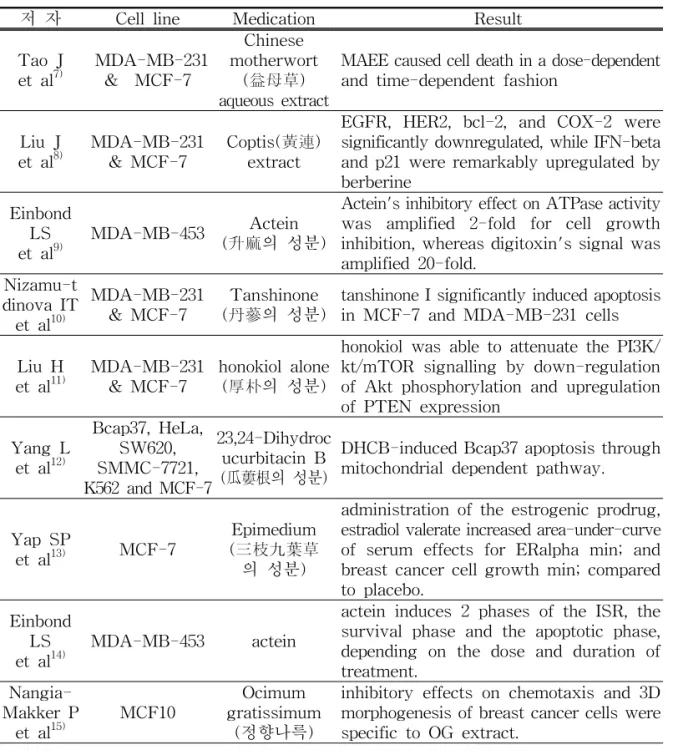
연구 논문은 총 23편이었다. 익모초, 황

련, 승마, 단삼, 후박, 반지련, 과루근, 삼

지구엽초, 갈근, 패장초, 유근피, 박하,

오수유, 자초 등의 물이나 알코올 추출

물이나 주성분을 이용하여 유방암 세포

의 apoptosis 등을 연구하였다. 이는 국

내 유방암 연구에 쓰인 대두 추출물, 귀

전우, 하고초, 황금, 천궁, 유근피, 단삼,

은행잎 추출물 등의 연구와는 좀 다른

경향을 보인다. 물론 유근피, 단삼 등은

겹치는 부분이 있으나, 전통적으로 문헌

상 그리고 실제 임상에서 쓰이는 유방암

(3)

저 자 Cell line Medication Result Tao J

et al 7)

MDA-MB-231

& MCF-7

Chinese motherwort

(益母草) aqueous extract

MAEE caused cell death in a dose-dependent and time-dependent fashion

Liu J et al 8)

MDA-MB-231

& MCF-7

Coptis(黃連) extract

EGFR, HER2, bcl-2, and COX-2 were significantly downregulated, while IFN-beta and p21 were remarkably upregulated by berberine

Einbond LS et al 9)

MDA-MB-453 Actein (升麻의 성분)

Actein's inhibitory effect on ATPase activity was amplified 2-fold for cell growth inhibition, whereas digitoxin's signal was amplified 20-fold.

Nizamu-t dinova IT et al 10)

MDA-MB-231

& MCF-7

Tanshinone (丹蔘의 성분)

tanshinone I significantly induced apoptosis in MCF-7 and MDA-MB-231 cells

Liu H et al 11)

MDA-MB-231

& MCF-7

honokiol alone (厚朴의 성분)

honokiol was able to attenuate the PI3K/

kt/mTOR signalling by down-regulation of Akt phosphorylation and upregulation of PTEN expression

Yang L et al 12)

Bcap37, HeLa, SW620, SMMC-7721, K562 and MCF-7

23,24-Dihydroc ucurbitacin B (瓜蔞根의 성분)

DHCB-induced Bcap37 apoptosis through mitochondrial dependent pathway.

Yap SP

et al 13) MCF-7

Epimedium (三枝九葉草

의 성분)

administration of the estrogenic prodrug, estradiol valerate increased area-under-curve of serum effects for ERalpha min; and breast cancer cell growth min; compared to placebo.

Einbond LS et al 14)

MDA-MB-453 actein

actein induces 2 phases of the ISR, the survival phase and the apoptotic phase, depending on the dose and duration of treatment.

Nangia- Makker P

et al 15)

MCF10

Ocimum gratissimum

(정향나륵)

inhibitory effects on chemotaxis and 3D morphogenesis of breast cancer cells were specific to OG extract.

Table 1. Studies on breast cancer research in herb medicine 치료 약재와의 검토가 필요하다. 특이할

만한 것은 국내에서 한약재로 상용하지 않는 정향나륵, 정공등, 월계수 씨앗, 허 브의 일종인 golden feverfew, 표고버섯 의 성분 등을 연구한 점이다. 또한 국내 에서 이루어진 歸朮破癥湯, 益氣養榮湯,

橘葉散 變方 등 복합처방물 제제의 연구

와는 달리, Pubmed에서는 단미, 추출 성

분 위주의 연구가 대다수였고 복합 처방

물의 연구를 찾아보기 어려웠다. 각 논

문의 주요 내용은 Table 1과 같다.

(4)

Kummalue

T et al 16) MDA-MB435 elliptilimba (丁公藤)

In MDA-MB435 cells, cell cycle analysis showed that the herb extract fraction 3 induced the accumulation of cells in G2/M phase

R. Brown

et al 17) MCF-7

seeds of Livistona chinensis (月桂樹의 씨앗)

the active components with both antitumor and protein kinases inhibitor activities were highly purified from LC, which can inhibit the EGF signaling events mainly through EGFR modification.

Jiang J et al 18)

MDA-MB-231

& MCF-7

Ganoderma lucidum

(葛根)

G. lucidum inhibits proliferation of human breast cancer cells and contain biologically active compounds with specificity against estrogen receptor and NF-kappaB signaling Aung HH

et al 19) MCF-7 American Ginseng

AGBE and the tested ginsenosides do not attenuate cisplatin's tumoricidal activity in MCF-7 cells, but in fact may actually enhance it.

Wu C et al 20)

Hs605T and MCF-7, SiHa

golden feverfew

extract

Feverfew ethanolic extract inhibited the growth of all three types of cancer cells with a half-effective concentration (EC50) of 1.5 mg/mL against Hs605T, 2.1 mg/mL against MCF-7, and 0.6 mg/mL against SiHa

Chiu LC

et al 21) MCF-7

Patrinia scabiosaefolia

(敗將草)

EAE-PS retards MCF-7 cell growth by activating the caspase-independent mitochondrial cell death pathway.

Hsieh TC et al 22)

MCF-7, MCF-10A and MDA-MB-231

ponicidin and oridonin, diterpenoids (薄荷의 성분)

Neither diterpenoid affected growth of MDA -MB-231 cells, at the dose range effective for MCF-7 or MCF-10A cells.

Ponicidin-treated MCF-7 cells expressed reduced levels of cyclin B1, cdc2, transcription factor E2F, and Rb including phosphorylation at S780.

In MCF-10A cells, oridonin was more active than ponicidin

Kang JX et al 23)

MDA-MB-231

& MCF-7

extract of huanglian (黃連)

Treatment of the cancer cells with huanglian extract markedly inhibited their proliferation in a dose- and time-dependent manner.

Zhang YX et al 24)

MDA-MB-468

11,11'-dideoxy- verticillin (표고버섯의 성분)

11,11'-dideoxy-verticillin induced a dose-dependent accumulation of MDA-MB-468 cells in the G2/M phase of the cell cycle.

Rockwell S et al 25)

mouse breast cancer cell line

black cohosh (升麻)

The black cohosh extracts increased the cytotoxicity of doxorubicin and docetaxel and decreased the cytotoxicity of cisplatin.

Lee JC

et al 26) MCF-7 Ulmus davidiana Nakai (楡根皮)

G-120 exerts an important role in the

induction of apoptosis, suppression of NF-kappaB

activation, and induction of c-Jun/Fra-1 or

c-Jun/Fra-2 dimerization in MCF-7 cells.

(5)

Liao CH et al 27)

NCI/ADR-RES cells

evodiamine (吳茱萸의 성분)

Evodiamine inhibited the proliferation of NCI/ADR-RES cells in a concentration -dependent manner with a GI50 of 0.59 +/- 0.11 microM. Evodiamine increased tubulin polymerization as determined by the immunocytochemical and in vivo tubulin polymerization analyses.

Wang W

et al 28) MCF-7 lithospermum (紫草) extract

Lithospermum extract could inhibit the growth of MCF-7 cell. It could also inhibit the expression of ER and increase the expression of PR with large dose.

2. 유방암에 대한 비약물요법 연구 논문 Pubmed에서 보완대체의학과 관련하 여 검색한 유방암에 대한 비약물요법 연 구는 총 16편으로서 침, 이침, 전침 등 침술요법과 지압 등 경혈을 자극하는 요 법을 포함한다.

1) Acupuncture(침술요법)

2002년 Jenner 등은 유방암 절제술 후 여성의 수술 후 통증 조절을 위해 척추 주위 분절의 경혈, TP, 림프부종이 없는 팔의 合谷에 침 치료를 시행하여 반대쪽 정상 유방에서 유즙 분비를 경험하였다 고 보고하였다. 침 치료 이후 유즙의 합 성과 분비에 관여하는 프로락틴과 옥시 토신의 생산이 증가한 것으로 보인다는 내용이다 29) .

2002년 Porzio 등은 유방암으로 타목 시펜 복용하는 환자의 폐경 증상에 침술 이 미치는 효과를 연구했다. 치료 전과 치료 후 1,3,6개월 후의 차이를 Greene 폐경지수 30) 로 평가했다. 불안, 우울, 체 성 및 혈관운동신경 증상은 치료 후 개 선되었으나, 성적 충동은 조절되지 않았 다. 더 많은 수의 환자로 placebo 대조군 과 함께 연구할 필요가 있다 31) .

2005년 Filshie 등은 항암요법 받은 유 방암, 전립선암 환자의 안면홍조 부작용

에 긴 기간의 침 치료가 미치는 영향을 연구하였다. 合谷, 外關, 太衝, 三陰交와 흉골 상부 두 곳에 6주간 침 치료를 했 는데, 림프부종이 있는 곳은 피했다. 그 런 다음 6년 동안 반영구침이나 전통 침 을 三陰交에 자가 시술하도록 하였다.

유방암, 전립선암 환자를 대상으로 하였 으며 치료 후 79%가 50% 이상의 감소 를 보였고, 21%는 50% 미만의 감소를 보였다. 17명(9%)의 환자는 6년간 경미 한 부작용이 있었는데 주로 경미한 반점 이었다; 이 중 한 환자는 다리가 부었다 고 했으나 이것은 침과 직접적 관련이 없는 골절 때문이었다 32) .

2005년 Vickers 등은 폐암이나 유방암 환자에서 침술이 호흡곤란을 감소시킨다 는 연구를 했다. 47명의 환자에게 각각 침과 placebo 침을 시행하였는데 침은 반영구 침 “studs"가 삽입되었다. 하루 2 회 침점을 자극하였는데 47명 중 2명을 제외하고 침 시술 직후와 1주일 간 매일 follow up을 했다. 호흡곤란 점수가 placebo 그룹보다 실제 침을 맞은 그룹 에서 20% 정도 더 높았다 33) .

2007년 Deng 등의 연구에서 침술요법

을 유방암 환자의 안면홍조에 적용하였

다.

(6)

하루 3회 이상의 안면홍조를 느끼는 72명의 환자에게 주 2회 총 4주간 침 치 료를 시행하였다. 침 치료 그룹은 8.7회 에서 6.2회로 감소하였고 대조군인 샴 침 치료 그룹은 10.0회에서 7.6회로 감소 하였다. 그러나 6주 후 다시 측정했을 때 두 그룹간의 차이는 통계적 유의성이 없 었다. 치료 종료 후 안면 홍조의 횟수는 6개월 후까지 지속되었다. 더 오랜 기간, 더 강도 있는 침 치료를 한다면 안면 홍 조 증상을 더 많이 감소시킬 수 있을 거 라고 추측된다 34) .

2007년 Crew 등의 연구에서는 유방암 초기 단계의 폐경 여성으로서 아로마타 제 억제제 치료로 관절염 증상이 있는 환자를 대상으로 6주간 매주 2회 체침 및 이침 치료를 실시했다. 치료 후 가장 심한 통증 지수는 5.3에서 3.3으로, 통증 강도는 3.7에서 2.5로, 통증 관련 기능 장 애는 3.1에서 1.7로 개선되었다. 골관절 염 지수와 암치료 기능평가 지수 역시 개선되었다 35) .

2007년 Walker 등은 유방암 호르몬 치 료의 주된 부작용인 안면홍조와 도한을 이침을 사용하여 관리할 수 있다는 결론 을 도출했다. 홍조 횟수가 감소했을 뿐 아니라 감정적 신체적 안녕도 개선되었 다 36) .

2008년 Alem 등은 유방암 수술 후 침 치료가 재활에 미치는 영향을 연구하였 다. 6개월 후에 어깨의 굴곡과 외전, 림 프 부종의 정도, 무거움, 조이는 증상이 통계적으로 유의성 있게 개선되었다. 그 러나 팔, 전박, 손목의 관절 운동 범위는 통계적으로 유의성 있는 개선이 관찰되 지 않았다. 그러나 이 결과가 자연스러 운 통증의 경과인지 침 치료의 효과인지

분명히 하기 위해서는 대조군을 설정한 연구가 필요하다 37) .

2008년 Hervik 등의 연구에서는 유방 함 수술 후 에스트로겐 길항제(타목시 펜) 치료를 받는 환자에게 10주간 침 치 료와 샴 침 치료를 각각 시행하였다. 치 료 시작 시기와 종결 시기, 치료 12주 후 에 밤낮의 안면 홍조의 횟수와 쿠퍼만 인덱스를 평가하였다. 침 치료 후에 안 면 홍조의 횟수가 50회 즉, 거의 60% 감 소했고 12주 후에 측정하니 30% 더 감 소하였다. 샴 침 치료그룹에서는 치료 후 주간 홍조가 25% 감소하였으나, 12주 후에는 역전되었다. 야간 홍조는 감소가 없었다. 쿠퍼만 인덱스는 침 치료 그룹 에서 치료 후 44% 감소했고, 12주 후까 지 유지되었다. 반면 샴 침 치료 그룹에 서는 쿠퍼만 인덱스의 변화가 없었다 38) .

2) Electroacupuncture(전침 요법) 2000년 Shen 등은 화학요법으로 유발 된 구토에 전침이 효과가 있는지 연구했 다. 유방암 고위험군 여성을 대상으로 3 개의 그룹으로 나누어 전침, 전기 모방 자극, 진토제를 비교했다. 전침 그룹이 구토 5회, 전기 모방 자극 그룹이 구토 10회로, 진토제만 먹은 군(15회)보다 횟 수가 적었다. 전침 그룹이 전기 모방 자 극 그룹보다 구토 횟수가 적고 전기 모 방 자극 그룹이 진토제만 먹은 그룹보다 횟수가 적었다. 9일간의 follow up 기간 에는 통계적으로 유의한 차이가 없었다

39) .

2004년 Gan 등은 유방암 수술 후 오

심에 전침과 진토제 ondansetron의 효과

를 연구하였다. 유방암 수술 후 환자를

전침 자극 그룹(A), ondansetron 4 mg

IV 투여 그룹(O), 샴 대조군(전침 자극

(7)

이 없는 전기, P)으로 나누어 측정하였 다. placebo(샴 대조군)보다 치료 그룹 (전침 자극, ondansetron 투여)에서 완전 반응(오심, 구토, 진토제 미사용)이 더 많이 나왔다. 특히 오심의 정도가 다른 그룹보다 A 그룹에서 현저히 낮았고, P 그 룹보다는 O 그룹이 낮았다 (19/40/79%).

치료 그룹이 수술 후 오심 구토의 처치 에 관해 placebo 그룹보다 만족도가 높 았다. 전침 자극과 ondansetron은 placebo 보다 더 효과적이었으나, 전침 자극이 ondansetron보다는 오심 조절이 더 효과 적이었다 40) .

2006년 Nedstrand 등은 유방암 환자에 게 전침 또는 이완요법을 12주 시행하고 6개월간 follow up하여 그 결과를 관찰 했다. 안면홍조는 50% 이상 감소하였다.

갱년기 증상은 양쪽 그룹 모두 감소하였 고 유지되었다. 정신적 안녕은 양쪽 그 룹에서 모두 개선되었다. 특히 감정은 전침 그룹에서 매우 개선되었다. 결론적 으로 전침 및 이완 요법으로 개선된 정 신적 안녕으로 인해 모두 혈관운동 증상 이 개선되었다 41) .

2008년에 Frisk 등은 유방암 병력 있 는 여성을 전침 그룹과 호르몬 요법 그 룹으로 나누어 24개월 동안 치료를 했 다. 19명의 여성이 12주의 전침 치료를 받았는데 하루 동안 안면 홍조 횟수 평 균이 9.6에서 4.3으로 감소하였다. 12개월 후 14명의 여성만이 4.9였고, 24개월 후 7명이 2.1이었다. 18명의 여성은 12주의 호르몬 요법을 받았는데 안면 홍조 횟수 평균이 6.6에서 0.0으로 감소했다 42) .

3) 그 밖에 경혈을 자극하는 보완대체 요법

2000년 Dibble 등은 경혈 부위의 지압

이 유방암으로 인한 화학요법으로 생기 는 오심에 미치는 영향을 연구했다. 17 명의 환자에게 양측 內關과 足三里를 지 압하였다. 첫 10일 간의 화학요법 동안 지압한 그룹과 대조군 사이에 오심의 빈 도와 강도에 있어 통계적으로 유의한 차 이가 있었다. 지압한 그룹이 오심의 빈 도가 더 적고 강도가 더 약했다 43) .

2005년 Roscoe 등의 연구에서는 첫 번 째 화학요법 후 오심을 경험한 96명의 유방암 환자를 릴리프 밴드 자극, 샴 침 자극, 침 자극 없음의 3개 그룹으로 나누 었다. 릴리프밴드의 효과와 관련하여 5 가지 결과(급성 오심, 지연오심, 구토, 삶의 질, 진토제의 총 사용량)를 분석했 다. 이전의 오심의 정도와 연령별로 분 석했는데, 3개의 그룹에서 통계적 유의 성 있는 차이가 없었다 44) .

2006년 Gardani 등은 화학요법을 받는 암 환자의 오심에 內關 혈 지압이 미치 는 영향을 연구했다. 40명의 화학요법을 받는 직장암, 폐암, 유방암 환자를 대상 으로 하였다. 하루 6시간 內關 혈을 지압 을 시행하였는데 70%의 환자에서 명백 한 개선이 있었다. 암의 타입이나 화학 요법의 약품 종류에 상관없이 효과를 나 타냈다 45) .

3. 유방암 환자를 대상으로 한 설문 연 구 논문

Pubmed에서 보완대체요법과 관련하

여 유방암 환자를 대상으로 한 설문 연

구 논문은 총 36편으로서, 유방암으로

진단받은 여성 또는 유방암 수술 후 여

성 등을 대상으로 보완대체의학 사용 실

태를 설문 조사한 연구가 주로 이루어졌

다. 대부분 단순한 통계 분석적 의미가

(8)

저 자 대 상 내 용

Lee et al 46) 1990-1992년에 유방암 진단 받은 379명의 여성

흑인은 영적 치유, 중국인은 한약, 라틴여성은 식 이요법과 영적 치유, 백인은 식이요법과 마사지 및 침술 이용하는 경향. 높은 교육수준과 수입, 더 젊은 나이, 사설 보험이 있고 운동을 하거나 지지그룹에 참여하는 사람이 보다 CAM을 사용 하는 경향. 50% 이상이 주치의와 CAM 의논.

Boon et al 47)

캐나다 온타리오의 1994-1995년에 유방암

진단 받은 여성

62%가 CAM 식품(흔히 비타민/미네랄, 한약, 녹 차, 특별음식, essiac)을 사용. 응답자의 반수가 주치의에게 그 사용을 알림.

Harris et al 48)

위스콘신의 18-69세의 유방암 진단받은 여성 110명과 대조군 73명

유방암 생존자가 5.3배 더 폐경 증상을 경험하는 경향이 있고, 25배 적게 에스트로젠을 이용하는 경향 있으며, 7.4배 더 CAM 이용하는 경향. 특히 타목시펜 복용자는 비타민 E와 콩 제품, 한약 등 을더 많이 이용함

Targ et al 49)

181명의 유방암 여성 중 CAM 그룹과 대조 군(인식-행동 접근)

CAM 그룹은 명상, 긍정, 상상 및 의식 사용법을 배우고 대조군은 인식-행동 접근법으로 구성원 간에 나눔과 지지를 배움. 대조군은 혼란 및 무 력함, 절망이 감소한 반면, CAM 그룹은 회피 감 소. CAM 그룹은 더 높은 만족과 더 적은 탈락을 보임.

Standish et al 50)

미국과 캐나다의 자격 을 가진 자연요법 의

사 1356명

63%는 지난 12개월간 유방암 여성을 치료함. 주 로 식이상담, 식물 약재, 항산화제, 영양 보충제 (비타민 C, 코엔자임Q10, 허브 복합제) 사용

Ashikaga et al 51)

버몬트 주의 148명의 유방암 진단 여성

72.3%가 수술 후 CAM 사용. 주로 비타민과 비 식품 보충제(72.3%) 이용. 한약, 명상, 전통 마사 지가 각각 1/5 정도 차지함. 연령, 교육, 보조 화 학요법, 사지 부종이 있을수록 CAM을 사용하는 경향. 73.8%의 사용자는 의사에게 사용을 알림.

Lengacher et al 52)

탐파 베이와 시골 중 서부 105명의 유방암

진단 여성

식이 및 영양 보충물을 선택한 사람의 64%가 비타 민, 미네랄을 33%가 항산화제, 한약, 건강식품을 사용함. 스트레스 감소 기술로는 49%가 기도와 영 적 치유, 37%가 유머와 웃음 치료를 사용함. 전통 의학 및 민족의학은 마사지 외에는 거의 사용 안 함. 이전에 화학요법을 받았거나 고졸 이상일수록, 또 기존 치료에 불만을 가질수록 CAM 이 용.

Gray et al 53)

23-36개월 전에 침습적 유방암 진단받

은 1119명의 여성

65%가 설문지 완성, 20%가 CAM 이용. 그 중 39%가 CAM에 접근할 수 없다고 응답. 젊을수 록, 수입이 높을수록, 고용되었거나 학생일수록, 사적 건강 보험이 있을수록, 화학요법 받을수록 CAM 이용하려는 경향 있음.

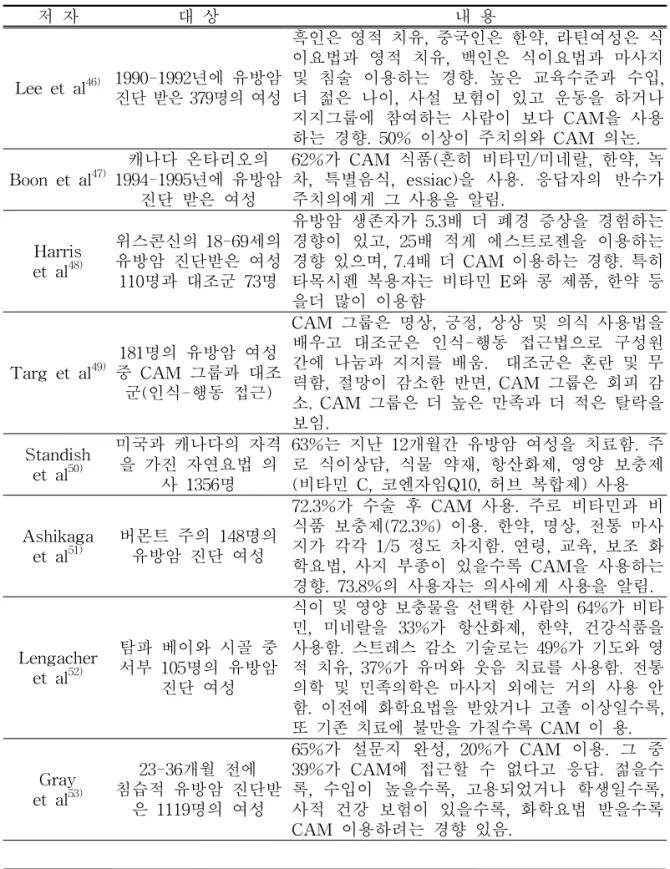
Table 2. Questionnaire studies on breast cancer research 두드러지며, 결론적으로는 환자와 의사

의 의사소통의 필요성을 강조하는 경향 이 있었다.

각 연구의 주요 내용은 Table 2 와 같

다.

(9)

Lengacher et al 54)

유방암 진단 받은 105 명의 백인 여성

총 조사의 알파 계수는 0.86, 식이 및 영양 보충 물이 0.67, 스트레스 감소 기술이 0.79, 전통의학 과 민족의학이 0.80이었음.

Malik et al 55)

파키스탄의 138명의 최근 3개월 이내 유방 암 진단받은 여성

우연히 혹은 정기 자가 검진에서 가족의가 암을 발견하면 평균 8.7주 후 가족에게 말하고 17.2주 후 처음 병원 방문. 29%가 의사에게 가기 전 CAM 이용. 흔한 방법으로 동종요법, 영적 치료, 아 유르베다.

Mills et al 56) 캐나다의 34개의 보완 대체요법 상점

23명의 점원이 환자가 처방된 약을 복용 중인지 묻지 않음. 15명은 전문가 방문을 권유함. 3명은 제품의 부작용 가능성에 대해 알려줌. 2명은 가 능한 치료를 제안했고, 1명은 타목시펜을 끊을 것을 제안함. 4명은 생활양식의 변화를 제안했고 3명은 독서 를 추천함.

Schönekaes et al 57)

203명의 유방암 수술 받은 여성

전이나 재발이 있었던 36명 중 31명은 CAM을 사용함. 비타민, 미슬토, 미네랄이 가장 흔함.

70%가 2개 이상의 CAM 요법을 사용했는데, 이 유는 삶의 질 향상과 면역계 개선을 위해서였음.

정보의 주요 원천은 일반의 혹은 부인과 의사로 부터였다고 함.

Nahleh et al 58)

1975년에서 2002년 Medline Search

미국의 유방암 환자 중 1975년에서 2002년 사용 율은 48%~70%였음. 주로 식이 보충물, 정신-신 체 접근, 침. 사용 이유는 면역 체계 강화, 삶의 질 개선, 암 재발의 예방, 삶에 대한 통제력 제 공, 유방암과 치료 부작용의 치료. 통증 조절, 불 안감 감소, 대처 전략 개선, 오심구토에 유효함.

Henderson et al 59)

포틀랜드, 오레곤, 메 트로폴리탄 지역의 551명의 유방암 여성

66%가 지난 12개월간 CAM 사용. 대다수가 의 사 권유 없이 사용함. 이완/명상, 한약, 정신치유, 메가 비타민이 가장 흔함. 더 젊을수록, 교육 많 이 받을수록, 사설 보험 있을수록 사용하는 경향.

사용 이유는 삶의 질 향상, 암에 대한 통제감을 느끼기 위해, 면역 체계 강화, 스트레스 감소였 음.

Navo et al 60)

텍사스 의과대학의 250명의 유방센터 환 자와 250명의 부인종

양 센터 환자

가장 흔히 사용된 제품은 메가비타민/미네랄.

CAM 사용자는 48%인데 그 중 62%가 대졸, 50%는 학부 졸업, 56%는 대학 중퇴, 33%는 고 졸 혹은 그 이하. 사용자 중 53.5%만이 CAM 전 문가에게 건강관리를 받았음.

Cui et al 61) 상하이의 1065명의 유 방암 환자

98%가 진단 후 CAM 사용. 한약, 보충제, 운동, 지지 그룹 간호 순으로 인기 있음. 한약은 81.5%, 침은 4.9%가 사용. 한약 복용의 이유는 암 치료 가 가장 많고, 그 외 면역 강화, 암 전이 방지와 다른 불편 조절, 폐경 증상을 줄이기 위해서임.

젊고, 기혼일수록, 높은 교육이나 수입, 화학요법

이나 방사선요법을 받을수록, 재발, 전이가 있을

수록 한약을 복용하는 경향이 있음

(10)

Nagel et al 62) 263명의 유방암 환자

젊을수록 CAM 이용하는 경향 있음. 자조 그 룹과 레저활동에 활동적으로 참여하는 것이 보완 대체요법 이용과 관련됨; 이는 환자의 질환에 대 한 대처능력에 따른 차이를 가리킴. 다수는 의사 에게 CAM 정보를 얻음.

Rakovitch

et al 63) 251명의 유방암 환자

젊을수록, 고등 교육을 받을수록, full time job 을 가질수록, 사설 보험을 가질수록 CAM 이용 하는 경향. CAM 사용자는 재발과 죽음에 대한 위험을 미사용자보다 더 크게 지각하는 경향이 있음.

Roberts et al 64)

106명의 유방암 환자 와 82명의 전립선암

환자

84%는 최소 한 가지 이상의 CAM; 운동, 비타 민, 기도, 영양 보충물을 이용함. 최소 반 수의 의사가 마사지, 저널 읽기, 지지 그룹, 침, 바이오 피드백, 예술 치료를 지지함.

Carlsson et al 65)

스웨덴 유방암 환자 중 60명의 인지학 치 료 여성과 60명의 종 양학 외래환자 여성.

49명의 인지학 치료 여성과 51명의 외래환자가 1년 생존; 26명의 인지학 치료 여성과 31명의 외 래환자가 5년 생존함. 인지학 치료는 입원시에 보다 수동적이고 불안하지만 이는 시간이 지나며 감소함. 인지학 치료 여성에서 투지력의 작은 개 선이 있었고 수동적, 불안한 대처는 입원시 보다 감소.

Lengacher et al 66)

탐파 베이와 시골 중 서부에서 유방암 진단 받은 백인 여성 105명

CAM 이용자 중 증상 감소를 위해서 전통의학 및 민족의학, 식이와 영양 보충물 순으로 이용.

치료에 대한 통제감을 얻기 위해서는 주로 식이 와 영양 보충물 이용. 이전에 화학치료를 받거나 고졸 이상의 학력일수록 식이와 영양 보충물, 스 트레스 감소 기술을 이용하는 경향.

Helyer et al 67)

국소 침습 유방암 환 자 36명

보다 젊고, 기혼이며 더 높은 사회경제 계층이 고 아시아 인종일수록 CAM 이용. 비타민이 가 장 인기있음. CAM 이용의 동기는 치유의 보조, 면역체계 강화, 치료에서 통제감을 얻기 위해 순 으로 응답. 기존 의학 치료를 받는 환자의 12%

는 CAM으로 치료를 대체할 수 있다고 느낌.

CAM 이용자는 불안감과 우울감이 덜한 경향.

Buettner et al 68)

1998-2003년에 2022명 의 유방암 진단받은

환자

62%가 CAM 사용. 젊을수록 더 사용하는 경향.

화학요법을 받는 환자는 이완/상상요법. 방사선 요법을 받는 환자는 고용량 비타민. 타목시펜이 나 아나스트로졸 치료를 받는 환자는 동종요법을 사용하는 경향. 삶의 질 지수는 요가에서 높고 기 치료에서 가장 낮음. 낙관주의는 이완/상상요 법 사용자에서 높음.

Susan et al 69) 유방암 환자 8개 그룹 (총 67명)

CAM 사용 비율은 평균 45%. 비타민, 미네랄, 한약이 가장 흔함. 더 젊고 교육 많이 받을수록, 유방암 진단에 앞서 CAM을 경험한 적이 있을수 록 더욱 CAM을 사용하는 경향. 증상 관리, 삶의 질 개선, 면역 기능 강화 등의 이유로 사용.

CAM 공급자와의 의사소통이 반지지적이거나 도

움이 안 되었다고 진술함.

(11)

Fasching et al 70)

1030명의 유방암 및 부인암 여성

유방암 환자 중 50.1%와 부인암 환자 중 44%가 CAM 사용. 미슬토가 77.3%로 가장 널리 사용되 는데 유방암 환자가 더 많이 사용함. 전체적 건 강 상태의 황폐를 CAM 미사용자는 50.1%로, 사 용자는 35.1%로 응답함. 가족 상태의 개선에 대 해서 CAM사용자는 6%, 미사용자는 2%로 응답 함.

Boon et al 71)

캐나다 온타리오 암 등록소의 유방암 환자

1998년 봄(557명)과 2005년 봄(877명)

CAM 제품 및 치료의 사용, CAM 전문가 방문 이 98년보다 05년에 증가. 05년에 CAM 사용 여 성의 41%는 유방암 치료를 위해서라고 응답. 05 년 가장 흔히 쓰인 제품은 녹차, 비타민E, 아마 인, 비타민 C, 가장 흔히 찾은 CAM 전문가는 마 사지사와 영양학자였음.

Matthews et al 72)

115명의 유방암 생존 자

69%는 CAM을 사용. 그 중 73%는 암 진단 때 문에 시작. CAM 사용자는 더 젊고, 더 젊은 나 이에 암 진단 받은 경향이 있음. 전체 불안 지수 는 유의성 있게 상승하지 않음.

Mueller et al 73)

164명의 유방암 돌연 변이 보균자.

78%가 CAM 사용. 기도와 생활양식 식이 가 가 장 흔함. 34%가 3개 이상 요법을 사용. 가장 흔 한 요법은 정신-신체요법(61.6%)과 생물학에 기 초한 운동(51.8%). 나이가 많을수록, 교육 많이 받을수록, 난소암에 대한 걱정이 많을수록, 이전 에 암 진단 받은 적 있을수록 CAM을 사용하려 는 경향.

Myers et al 74)

미네소타 암센터 2198 명의 유방암 여성

49.5%의 여성이 유방암 예방을 위해 1가지 이 상의 CAM을 사용. 위험성이 높고, 일반 건강 행 동이 높고, 유방암 스크리닝 행동이 높고, 긍정주 의가 높을수록, 교육수준이 높을수록 사용하는 경향.

Carpenter et al 75)

LA 캘리포니아의 374 명의 유방암 환자

59%가 CAM 사용. CAM 사용자는 미사용자보 다 의학적 이환율이 높고 정서적 웰빙이 더 낮 게 나왔음. 긴 기간 동안 유방암 생존자 중 CAM 사용자는 미사용자보다 정서적 기능이 더 안 좋 고 의학적 문제가 더 많았음.

Chen et al 76) 상하이의 5036명의 유 방암 여성

97%가 진단 후 CAM을 사용. 건강보조제가 가 장 많았고 한약, 운동이 그 다음. 운동은 걷기가 가장 인기 있음. 거의 모든 한약 복용자가 암 치 료를 위해, 3/4은 면역계 강화를 위해 복용. 2/3 의 여성이 한약이 효과적이라 진술. 한약 복용은 보다 젊고, 수입이 높으며, 갱년기 증상이 있고, 화학요법을 마치고, 과거에 타목시펜 복용한 적 이 있는 경향.

Saxe et al 77)

침습적 유방암의 치료 를 마친 18-70세 여성

3088명

2017명은 CAM 사용에 대한 양식 작성. 이 중

300명이 전문가에게 치료를 받았고, 주치의에게

그 사실을 알림. 자연요법사 85%, 동종요법사

74%, 침술사 71%, 카이로프랙터 47%였음. 학력

이 높을수록 CAM 사용을 의사에게 의뢰하는 경

향이 있음.

(12)

Rao et al 78) 98명의 2,3기 유방암 환자

수술 후 방사선 항암 요법과 6개 사이클의 화학 요법을 받은 사람 중 요가한 사람 18명, 대조군 20명을 분석함. 요가 군은 매일 60분의 요가 세 션을, 대조군은 정기적인 병원 방문 중에 지지 치료를 받음. 요가는 유방암 수술 후 치료 관련 증상과 불안감 관리에 도움이 될 것으로 사료됨.

Gumus et al 79)

터키의 방사선 항암 센터의 30명의

유방암 환자

210시간의 정서적 지지에 초점을 맞춘 간호를 7 개 세션으로 진행함. 건강관리 지남력, 가정 환 경, 성 관계, 확대가족관계, 사회환경 점수가 상 승함. 정신적 스트레스 감소함.

Greenlee H et al 80)

1000명의 1,2기 유방 암 환자

진단 5년 전 96.5%가 CAM 사용. 녹차, 글루코 사민, 오메가-3 지방산, 기도와 종교. 진단 직후 에는 86.1%가 CAM을 사용하였는데 47.5%는 식 물성 보조제, 47.2%는 다른 자연식품, 28.8%는 특별식이, 64.2%는 정신-신체 치료, 26.5%는 신 체/에너지/다른 치료를 이용함.

Field et al 81) 유방암의 가족력이 있 는 여성 892명.

55%는 CAM을 사용하며 그 중 6%는 특히 유 방암 예방을 위해 사용. CAM 사용은 학력, 운 동, 불안과 독립적으로 연관.

Ⅳ. 결 론

유방암에 대한 보완대체의학적 치료에 대한 Pubmed의 논문을 분석하여 아래와 같은 결론을 도출하였다.

1. 유방암에 대한 약물요법 실험연구 논 문은 총 23편이었다. 국내에서 이루어 진 연구와는 달리, Pubmed에서는 단 미, 추출 성분 위주의 연구가 대다수 였고 복합 처방물의 연구를 찾아보기 어려웠다. 특이할 만한 것은 국내에서 한약재로 상용하지 않는 정향나륵, 정 공등, 월계수 씨앗, 허브의 일종인 golden feverfew, 표고버섯의 성분 등 을 연구한 점이다.

2. 유방암에 대한 비약물요법 연구는 총 16편으로서 침, 이침, 전침 등 침술요 법과 지압 등 경혈을 자극하는 요법 을 포함한다. 총 9편의 논문에서 항암

요법이나 타목시펜 복용, 암 절제술에 대한 부작용으로 인한 안면홍조 증상, 도한, 오심구토, 어깨 및 손목의 통증 등의 증상에 있어서 체침과 이침, 전 침 등의 치료가 효과가 있었음을 보 고했다. 그리고 총 5편의 논문에서 전 침, 릴리프밴드, 경혈 지압 등이 유방 암 수술 후의 오심 증상을 호전시켰 다는 결과를 보고했다. 다만 침술 등 비약물요법의 연구에서는 좀더 오랜 기간 및 보다 큰 실험군이 필요하며 대조군의 설정 등을 보완한다면 보다 유의성 있는 효과를 검증받을 수 있 을 것으로 보인다.

3. 유방암 환자를 대상으로 한 설문 연구

논문은 총 36편으로서, 유방암으로 진

단받은 여성 또는 유방암 수술 후 여

성 등을 대상으로 보완대체의학 사용

실태를 설문 조사한 연구가 주로 이루

어졌다. 유방암 환자 중에서 자발적으

로 보완대체의학을 사용한 환자의 비

(13)

율 및 보완대체요법의 종류별 빈도, 이용하는 이유와 만족도 등과 연령, 학력, 사회적 지위 등과의 관계 등을 분석하였고 의사와 환자 간의 의사 소 통이 필요하다는 결론을 내리는 경우 가 많았다.

이러한 Pubmed에서 검색한 유방암의 보완대체의학적 치료의 연구동향의 고찰 을 통해, 향후 국내 연구에서는 보다 보 완적인 실험설계가 필요하며 특히 침술 요법의 연구에 보다 관심을 가져야 할 것이다. 또한 세계적으로 유방암의 보완 대체의학적인 치료에 대한 관심과 이용 률이 높아지므로 한의학적인 치료의 영 역을 더 넓힐 수 있도록 유방암 환자의 한의학적 관리와 치료, 특히 수술 및 항 암 치료 이후의 환자에 보다 초점을 맞 추어 현실적 도움이 되는 연구를 진행하 는 것이 필요하다.

⃞ 투 고 일 : 2009년 7월 27일

⃞ 심 사 일 : 2009년 8월 3일

⃞ 심사완료일 : 2009년 8월 10일

참고문헌

1. 김혜영 등. 유방암 생존자의 삶의 질, 성기능 및 우울: 성생활 집단과 비성 생활 집단 간의 비교. 종양간호학회 지. 2008;8(2):77-85.

2. Korea Central Cancer Registry. 2002 Annual Report of the Korea Central Cancer Registry. Seoul: Ministry of health and Welfare. 2003.

3. 김영구. 비뇨기계 질환의 보완대체 치

료. Urotrend. 2002;7(1):6-10.

4. 송희완. 종합병원에 입원한 암 환자들 의 보완대체의학의 사용. 한국보건복 지학회지. 2007;7:37-60.

5. 이정희, 유동열. 2000년 이후 국내 유 방암에 대한 한약물의 최신 연구 경 향 메타분석. 대전대학교 한의학연구 소 문헌집. 2007;16(2):241-9.

6. 정의민 등. 중의학 논문에 나타난 유 방암의 연구 동향에 대한 고찰 - 중 의학 논문을 중심으로 -. 대한한방부 인과학회지. 2009;22(1):263-78.

7. Tao J. et al. Cytotoxicity of Chinese motherwort (YiMuCao) aqueous ethanol extract is non-apoptotic and estrogen receptor independent on human breast cancer cells. J Ethnopharmacology. 2009;

122(2):234-9.

8. Liu J. et al. Coptis extracts enhance the anticancer effect of estrogen receptor antagonists on human breast cancer cells. Biochemistry Biophysical Research Communication. 2009;378(2):174-8.

9. Einbond LS. et al. Actein inhibits the Na+-K+-ATPase and enhances the growth inhibitory effect of digitoxin on human breast cancer cells. Biochemistry Biophysical Research Communication.

2008;375(4):608-13.

10. Nizamutdinova IT. et al. Tanshinone I effectively induces apoptosis in estrogen receptor-positive (MCF-7) and estrogen receptor-negative (MDA-MB-231) breast cancer cells. Internal J Oncology.

2008;33(3):485-91.

11. Liu H. et al. Anti-tumor effect of

honokiol alone and in combination

(14)

with other anti-cancer agents in breast cancer. Europe J Pharmacology. 2008;

591(1-3):43-51.

12. Yang L. et al. 23,24-Dihydrocucurbitacin B induces G2/M cell-cycle arrest and mitochondria-dependent apoptosis in human breast cancer cells (Bcap37.) Cancer Lett. 2007;256(2):267-78.

13. Yap SP. et al. Molecular and pharmacodynamic properties of estrogenic extracts from the traditional Chinese medicinal herb, Epimedium. J Ethnopharmacology. 2007;

113(2):218-24.

14. Einbond LS, The growth inhibitory effect of actein on human breast cancer cells is associated with activation of stress response pathways. Internal J Cancer. 2007;121(9):2073-83.

15. Nangia-Makker P. et al. Inhibition of breast tumor growth and angiogenesis by a medicinal herb: Ocimum gratissimum.

Internal J Cancer. 2007;121(4):884-94.

16. Kummalue T. et al. Antiproliferative effect of Erycibe elliptilimba on human breast cancer cell lines. J Ethnopharmacol.

2007;110(3):439-43.

17. R. Brown. et al. Selective downregulation of EGF receptor and downstream MAPK pathway in human cancer cell lines by active components partially purified from the seeds of Livistona chinensis. Cancer Lett. 2007;248(1):

137-46.

18. Jiang J, Slivova V, Sliva D. Ganoderma lucidum inhibits proliferation of human breast cancer cells by down-regulation of estrogen receptor and NF-kappaB

signaling. Internal J Oncology. 2006

;29(3):695-703.

19. Aung HH. et al. Cisplatin's tumoricidal effect on human breast carcinoma MCF-7 cells was not attenuated by American ginseng. Cancer Chemotherapy Pharmacology. 2007;59(3):369-374.

20. Wu C. et al. Antiproliferative activities of parthenolide and golden feverfew extract against three human cancer cell lines. J Medicinal Food. 2006;

9(1):55-61.

21. Chiu LC. et al. Ethyl acetate extract of Patrinia scabiosaefolia downregulates anti-apoptotic Bcl-2/Bcl-X(L) expression, and induces apoptosis in human breast carcinoma MCF-7 cells independent of caspase-9 activation. J Ethnopharmacol.

2006;105(1-2):263-268.

22. Hsieh TC. et al. Differential control of growth, cell cycle progression, and expression of NF-kappaB in human breast cancer cells MCF-7, MCF-10A, and MDA-MB-231 by ponicidin and oridonin, diterpenoids from the chinese herb Rabdosia rubescens. Biochemistry Biophysical Research Communication.

2005;337(1):224-31.

23. Kang JX. et al. The extract of huanglian, a medicinal herb, induces cell growth arrest and apoptosis by upregulation of interferon-beta and TNF-alpha in human breast cancer cells. Carcinogenesis.

2005;26(11):1934-9.

24. Zhang YX. et al. 11,11'-dideoxy-verticillin:

a natural compound possessing growth

factor receptor tyrosine kinase-inhibitory

(15)

effect with anti-tumor activity. Anticancer Drugs. 2005;16(5):515-24.

25. Rockwell S. et al. Alteration of the effects of cancer therapy agents on breast cancer cells by the herbal medicine black cohosh. Breast Cancer Rescue Treatment. 2005;90(3):233-9.

26. Lee JC. et al. Plant-originated glycoprotein, G-120, inhibits the growth of MCF-7 cells and induces their apoptosis.

Food Chemistry Toxicology. 2005;

43(6):961-8.

27. Liao CH. et al. Antitumor mechanism of evodiamine, a constituent from Chinese herb Evodiae fructus, in human multiple-drug resistant breast cancer NCI/ADR-RES cells in vitro and in vivo. Carcinogenesis. 2005;26(5):

968-75.

28. Wang W, Li PP. The effects of herb lithospermum extract on MCF-7 cell and estrogen and progestogen levels in mice. Zhongguo Zhong Yao Za Zhi. 2003;28(11):1062-7.

29. Jenner C, Filshie J. Galactorrhoea following acupuncture. Acupuncture Medicine. 2002;20(2-3):107-8.

30. J. G. Greene. A factor analytic study of climacteric symptoms. Journal of Psychosomatic research. 1976;20:425-30.

31. Porzio G. et al. Acupuncture in the treatment of menopause-related symptoms in women taking tamoxifen. Tumori.

2002;88(2):128-30.

32. Filshie J. et al. Acupuncture and self acupuncture for long-term treatment of vasomotor symptoms in cancer

patients-audit and treatment algorithm.

Acupuncture Medicine. 2005;23(4):171-80.

33. Vickers AJ. et al. Acupuncture for dyspnea in advanced cancer: a randomized, placebo-controlled pilot trial. BMC Palliat Care. 2005;18:4-5.

34. Deng G. et al. Randomized, controlled trial of acupuncture for the treatment of hot flashes in breast cancer patients.

J Clinical Oncology. 2007;25(35):5584-90.

35. Crew KD. et al. Pilot study of acupuncture for the treatment of joint symptoms related to adjuvant aromatase inhibitor therapy in postmenopausal breast cancer patients. J Cancer Survivor.

2007 ;1(4):283-91.

36. Walker G. et al. Ear acupuncture for hot flushes--the perceptions of women with breast cancer. Complement Therapy Clinical Practice. 2007;13(4):250-7.

37. Alem M, Gurgel MS. Acupuncture in the rehabilitation of women after breast cancer surgery-a case series.

Acupuncture Medicine. 2008;26(2):

87-93.

38. Hervik J, Mjåland O. Acupuncture for the treatment of hot flashes in breast cancer patients, a randomized, controlled trial. Breast Cancer Rescue Treatment. 2008;10:7.

39. Shen J. et al. Electroacupuncture for control of myeloablative chemotherapy -induced emesis: A randomized controlled trial. JAMA. 2006;284(21):2755-61.

40. Gan TJ. et al. A randomized controlled

comparison of electro-acupoint stimulation

or ondansetron versus placebo for

(16)

the prevention of postoperative nausea and vomiting. Anesthetic Analgesia.

2004 ;99(4):1070-5.

41. Nedstrand E. et al. Psychological well-being improves in women with breast cancer after treatment with applied relaxation or electro-acupuncture for vasomotor symptom. J Psychosomatic Obstetrics and Gynecology. 2006;27(4):

193-9.

42. Frisk J. et al. Long-term follow-up of acupuncture and hormone therapy on hot flushes in women with breast cancer: a prospective, randomized, controlled multicenter trial. Climacteric.

2008 ;11(2):166-74.

43. Dibble SL. et al. Acupressure for nausea:

results of a pilot study. Oncology Nurse Forum. 2000;27(1):41-7.

44. Roscoe JA. et al. Acustimulation wrist bands are not effective for the control of chemotherapy-induced nausea in women with breast cancer. J Pain Symptom Management. 2005;29(4):

376-84.

45. Gardani G. et al. Effect of acupressure on nausea and vomiting induced by chemotherapy in cancer patients.

Minerva Medicine. 2006;97(5):391-4.

46. Lee MM. et al. Alternative therapies used by women with breast cancer in four ethnic populations. J Nationall Cancer Institution. 2000;92(1):42-7.

47. Boon H. et al. Use of complementary/

alternative medicine by breast cancer survivors in Ontario: prevalence and perceptions. J Clinical Oncology. 2000;

18(13):2501-4.

48. Harris PF. et al. Prevalence and treatment of menopausal symptoms among breast cancer survivors. J Pain Symptom Management. 2002;23(6):501-9.

49. Targ EF, Levine EG. The efficacy of a mind-body-spirit group for women with breast cancer: a randomized controlled trial. Gen Hospital Psychiatry.

2002;24(4):238-48.

50. Standish LJ. et al. Complementary and alternative medical treatment of breast cancer: a survey of licensed North American naturopathic physicians.

Alternative Therapuetic Health Medicine.

2002;8(5):68-70.

51. Ashikaga T. et al. Use of complimentary and alternative medicine by breast cancer patients: prevalence, patterns and communication with physicians.

Support Care Cancer. 2002;10(7):

542-8.

52. Lengacher CA. et al. Frequency of use of complementary and alternative medicine in women with breast cancer.

Oncology Nurse Forum. 2002;29(10):

1445-52.

53. Gray RE. et al. Utilization of complementary /alternative services by women with breast cancer. J Health Social Policy.

2003;16(4):75-84.

54. Lengacher CA. et al. Design and testing of the use of a complementary and alternative therapies survey in women with breast cancer. Oncology Nurse Forum. 2003;30(5):811-21.

55. Malik IA, Gopalan S. Use of CAM

(17)

results in delay in seeking medical advice for breast cancer. Europe J Epidemiology. 2003;18(8):817-22.

56. Mills E. et al. Health food store recommendations: implications for breast cancer patients. Breast Cancer Research.

2003;5(6):300-2.

57. Schönekaes K. et al. Use of complementary /alternative therapy methods by patients with breast cancer. Forsch Komplementary medicine Klass Naturheilkd. 2003;

10(6):304-8.

58. Nahleh Z, Tabbara IA. Complementary and alternative medicine in breast cancer patients. Palliat Support Care.

2003;1(3):267-73.

59. Henderson JW, Donatelle RJ. Complementary and alternative medicine use by women after completion of allopathic treatment for breast cancer. Alternative Therapuetic Health Medicine. 2004 ;10(1):52-7.

60. Navo MA. et al. An assessment of the utilization of complementary and alternative medication in women with gynecologic or breast malignancies. J Clinical Oncology. 2004;22(4):671-7.

61. Cui Y. et al. Use of complementary and alternative medicine by chinese women with breast cancer. Breast Cancer Rescue Treatment. 2004;86(1):89.

62. Nagel G, Hoyer H, Katenkamp D.

Use of complementary and alternative medicine by patients with breast cancer:

observations from a health-care survey.

Support Care Cancer. 2004;12(11):

789-96.

63. Rakovitch E. et al. Complementary

and alternative medicine use is associated with an increased perception of breast cancer risk and death. Breast Cancer Rescue Treatment. 2005;90(2):139-48.

64. Roberts CS. et al. Patient-physician communication regarding use of complementary therapies during cancer treatment. J Psychosocial Oncology.

2005;23(4):35-60.

65. Carlsson M. et al. Coping in women with breast cancer in complementary and conventional care over 5 years measured by the mental adjustment to cancer scale. J Alternative Complementary Medicine. 2005;11(3):441-7.

66. Lengacher CA. et al. Relief of symptoms, side effects, and psychological distress through use of complementary and alternative medicine in women with breast cancer. Oncol Nurse Forum.

2006;33(1):97-104.

67. Helyer LK. et al. The use of complementary and alternative medicines among patients with locally advanced breast cancer-a descriptive study. BMC Cancer. 2006;

6:39.

68. Buettner C. et al. Correlates of use of different types of complementary and alternative medicine by breast cancer survivors in the nurses' health study. Breast Cancer Rescue Treatment.

2006 ;100(2):219-27.

69. Susan G et al. Breast cancer patients' perspectives on and use of complementary and alternative medicine: Social Integrated Oncology. 2006;4(4):157-69.

70. Fasching PA. et al. Association of

(18)

complementary methods with quality of life and life satisfaction in patients with gynecologic and breast malignancies.

Support Care Cancer. 2007;15(11):

1277-84.

71. Boon HS, Olatunde F, Zick SM. Trends in complementary/alternative medicine use by breast cancer survivors: comparing survey data from 1998 and 2005. BMC Womens Health. 2007;7:4.

72. Matthews AK. Complementary and alternative medicine use among breast cancer survivors. J Alternative Complementary Medicine. 2007;13(5):

555-62.

73. Mueller CM. et al. Complementary and alternative medicine use among women at increased genetic risk of breast and ovarian cancer. BMC Complementary Alternative Medicine.

2008;8:17.

74. Myers CD. et al. Familial and perceived risk of breast cancer in relation to use of complementary medicine. Myers Cancer Epidemiological Biomarkers Prevalence. 2008;17(6):1527-34.

75. Carpenter CL, Ganz PA, Bernstein L. Complementary and alternative therapies among very long-term breast cancer survivors. Breast Cancer Rescue Treatment. 2008;10:20.

76. Chen Z. et al. The use of complementary and alternative medicine among Chinese women with breast cancer. J Alternative Complementary Medicine. 2008;14(8):

1049-55.

77. Saxe GA. et al. Disclosure to physicians of CAM use by breast cancer patients:

findings from the Women's Healthy Eating and Living Study. Integrated Cancer Therapy. 2008;7(3):122-9.

78. Rao MR. et al. Anxiolytic effects of a yoga program in early breast cancer patients undergoing conventional treatment: a randomized controlled trial. Complementary Theruetic Medicine.

2009;17(1):1-8.

79. Gumus AB, Cam O. Effects of emotional support-focused nursing interventions on the psychosocial adjustment of breast cancer patients. Asian Pacific J Cancer Prevention. 2008;9(4):691-7.

80. Greenlee H. et al. Complementary and alternative therapy use before and after breast cancer diagnosis:

the Pathways Study. Breast Cancer Rescue Treatment. 2009;1:31.

81. Field KM. et al. Predictors of the

use of complementary and alternative

medicine (CAM) by women at high

risk for breast cancer. Europe J

Cancer. 2009;45(4):551-60.

수치

Table  1.  Studies  on  breast  cancer  research  in  herb  medicine치료  약재와의  검토가  필요하다
Table  2.  Questionnaire  studies  on  breast  cancer  research두드러지며,  결론적으로는  환자와  의사

참조

관련 문서

•Targeted therapies are a cornerstone of precision cancer medicine , a form of medicine that uses. information about a person’s tumor genes and proteins to prevent,

• Hormone Therapy With or Without Combination Chemotherapy in Treating Women Who Have Undergone Surgery for Node-Negative Breast Cancer (The TAILORx Trial)..

The clinical outcome and complication for treating proximal femoral shaft fracture were compared and analyzed through the group treated with closed

Results: The human breast cancer cell subline MCF-7/MX5 cells selected in the presence of 5 µg/ml mitoxantrone (MX) were more resistant to MX (15.7... Western blot and

¨ Use alternative project finance and delivery methods across collections of infrastructure projects. ¨ Strategic opportunities to affect the timing, quality, and cost

 mutual exclusion and complementary  application similar to IR.  sensitive to local environment and

The sample for this research are current patients in hospitals or alternative medical centre and were diagnosed to be not in need for special equipments

Solve the problem of Example 6.3.2 using the principle of minimum complementary potential energy as an alternative to using the. principle of minimum potential energy, which